
Rindis.com

All my hobbies, all the time
  • Home
  • My Blog
  • Games
  • History

Categories

  • Books (504)
  • Comics (10)
  • Gaming (919)
    • Boardgaming (675)
      • ASL (155)
      • CC:Ancients (83)
      • F&E (78)
        • BvR – The Wind (26)
        • Four Vassal War (9)
        • Konya wa Hurricane (17)
        • Second Wind (5)
      • SFB (78)
    • Computer games (162)
      • MMO (77)
    • Design and Effect (6)
    • RPGs (66)
      • D&D (25)
        • O2 Blade of Vengeance (3)
      • GURPS (32)
  • History (10)
  • Life (82)
    • Conventions (9)
  • News (29)
  • Technology (6)
  • Video (50)
    • Anime (48)
  • Writing (1)

Patreon

Support Rindis.com on Patreon!
Become a patron at Patreon!

Other blogs:

RSS Inside GMT

  • Defiance AAR: North Jersey, July 2026 — Chili Dogs and Chit Pulls July 20, 2026

RSS Playing at the World

  • Playing at the World 2E V2 Arrives May 5, 2025

RSS Dyson’s Dodecahedron

  • Barin’s Stonehold July 20, 2026

RSS Quest for Fun!

  • The Expense Post May 24, 2026

RSS Bruce Heard and New Stories

  • Pain, Exhaustion, and Morale in D&D BECMI June 7, 2026

RSS Chicago Wargamer

  • The 2 Half-Squads - Episode 310: Cruising Through Crucible of Steel January 27, 2023

RSS CRRPG Addict

  • Al-Qadim: Bottle Shock July 20, 2026
SF&F blogs:

RSS Fantasy Cafe

  • The Leaning Pile of Books July 5, 2026

RSS Lynn’s Book Blog

  • Top Ten Tuesday: I’ve gone with a freebie July 21, 2026
ASL blogs:

RSS Sitrep

  • Cardinal ASL Sins March 18, 2026

RSS Hong Kong Wargamer

  • FT114 Yellow Extract After Action Report (AAR) Advanced Squad Leader scenario April 16, 2025

RSS Hex and Violence

  • This still exists? March 25, 2025

RSS Grumble Jones

  • Grumble Jones AAR for Crucible of Steel Scenarios on the YouTube page. July 20, 2026

RSS Desperation Morale

  • How to Learn ASL March 16, 2025

RSS Banzai!!

  • October North Texas Gameday October 21, 2019

RSS A Room Without a LOS

  • [Crossing the Moro CG] T=0902 -- Rough start July 18, 2015
GURPS blogs:

RSS Dungeon Fantastic

  • Felltower - Monsters Fleeing between Sessions vs. PCs replenishing June 28, 2026

RSS Gaming Ballistic

  • Mission X and Genre Fidelity in Combat July 19, 2026

RSS Ravens N’ Pennies

RSS Let’s GURPS

  • Review: GURPS Realm Management March 29, 2021

RSS No School Grognard

  • It came from the GURPS forums: Low-Tech armor and fire damage January 29, 2018

RSS The Collaborative Gamer

  • Thoughts on a Town Adventures System January 18, 2022

RSS Don’t Forget Your Boots

  • GURPS Supers Newport Academy #7: “Invitation to the future.. of the 1970’s” July 5, 2026

RSS Orbs and Balrogs

  • Bretwalda - Daggers of Oxenaforda pt.4 - Fallen King May 27, 2017

Viking Warrior vs Anglo-Saxon Warrior: England 865-1066

by Rindis on May 30, 2020 at 12:00 pm
Posted In: Books

I’ve been a bit leery of Osprey’s “Combat” series, since it’s impossible not to think ‘pirate vs. ninja’, or ‘Enterprise vs. Death Star’ when looking at their titles. But their recent electronic book giveaway included one of the more interesting books in the series, giving me a chance to try out a PDF version risk-free.

There is a good two-plus page overview of the Viking era in England, and then a chapter that tries to directly compare the two sides, and how they approached recruiting, leadership, and logistics. There’s also plenty of the usual Osprey good photographs of equipment, mostly in color. A good two-page section talks about the changes in strategy over time, including the varying amounts of ability Anglo-Saxon kingdoms had to actually call up armies.

About half the book is descriptions of three major battles of the Viking era (Ashdown, Maldon, and Stamford Bridge), which is the major attraction for me. All three are interesting battles that we know enough to say something intelligent about, though I naturally only knew anything about Stamford Bridge going in. All get good maps showing the campaign that lead up to the battle, though Osprey forgoes the bird’s eye view maps of the battlefield that is the centerpiece of the Campaign series (and I think a good Campaign book could definitely be done on Stamford Bridge, though the other two probably are too uncertain in details for that). A nice bit are some illustrations meant to show what the action looked like from in the middle of it, including a pair showing opposite views of the same scene.

There’s a four-page ‘analysis’, which is part of the entire ‘versus’ nature of the title, which in this case comes down to there not being a lot difference in general equipment and technique. What differences there are get subsumed into the details we don’t have. We know both sides used axes, though the Vikings used them more, we know Anglo-Saxon armies made use of the shield wall as a common formation, we don’t know how much the Vikings did the same, or what cohesive formations they might have commonly used.

There’s about a pages worth of aftermath, which goes into the end of Viking raids in the decades after 1066, and then there is an extensive bibliography, which spends a bit more than a page talking about the seven primary sources for the era, before the usual listing of scholarly works.

Overall, it’s a good Osprey production, and good enough that I will get some of the other more interesting volumes, but it does seem more ‘introductory’ in nature (much like the Essential History series), and remains a lesser interest for me.

└ Tags: books, Combat, history, Osprey, reading, review
 Comment 

Anime Winter 2020

by Rindis on May 26, 2020 at 12:00 pm
Posted In: Anime

Yeah, this is a really late post. Blame COVID-19, as I’m still waiting for My Hero Academia to finish up. As ever, this is in a rough order of how much I liked it.

My Hero Academia — I’m watching the dub, which got delayed on the Funimation end. At any rate, another fairly solid season. Gentle Criminal has been interesting, and I like how he’s been rounded out. But… the fight did have a lot of ‘if you’d just talk‘, which tends to make me grind my teeth.

Pokemon Sun & Moon Ultra Legends — Finally got to see the end, and am now waiting for the English version to pick up with Gen 8. Generally, I was very happy with how all of the ending played out (especially the unmasking of the Masked Marvel), but the ‘moving on’ bit seemed like it all happened a bit fast.

Haikyu — About when I think it’s gone forever, we get another season. It’s been long enough to have forgotten bits (and we flailed around a bit figuring out what was the current series), but it’s still up to the same quality, and still doing a good job of showing with growth comes challenges.

No Game, No Life Zero — Finally managed to squeeze time for this into the schedule. Except for the framing, it’s a fairly independent story (which explains how the world got to the screwed up place it’s in), so I’d think it’d be pretty good to go into cold. I think I like the series more (it’s been way too long), but this is still good, and well worth a watch.

Black Clover — Still catching back up on this. Split between well-done, and too much fight-anime tropes. The padding isn’t… too bad, but the recaps are definitely excessive. I’ve also been having a few problems with the bad guys… but those problems have at least been alluded to. Which is one of the stronger points, the overarching plot so far feels much more cohesive than is often the habit with these.

Meanwhile, we’ve been rewatching a couple things with the guys:

Golden Kamui — We’re about halfway through this, and both Baron and Dave have been enjoying it a lot.

A Place Further Than the Universe — And then we watched this as an antidote. I’ve been very happy that they enjoyed this as well. It an amazingly put together combination of plot and characterization. Probably one of the best put together series of the last few years.

└ Tags: anime
 Comment 

Samurai 1550-1600

by Rindis on May 23, 2020 at 12:00 pm
Posted In: Books

This is Osprey’s third book looking at the most emblematic part of Japan’s military history (starting with the 1979 Men-at-Arms Samurai Armies, to the 1989 Elite The Samurai, to this 1994 Warrior book), and it still manages to miss a few opportunities.

The Warrior series generally concentrates on the details of equipment. Other volumes have some full-color ‘exploded’ diagrams of things like swords, showing just how many parts go into such a simple-looking thing, and really showing how that goes together. A few of those would be very handy Japanese armor which works from very different principles. There is a good examination of the parts that go into a katana hilt, and an illustration of all the tools used by armorers along with how they hung armor pieces to assemble them (and a reproduction of of an original source woodcut).

As usual, this volume is graphically very solid. In fact, much more so than many Osprey books on older subjects, which are reliant on what little archaeology can provide. There’s many photos of surviving armor sets, various styles of helmets, etc. There’s also a few shots of Japanese movie sets to help show the kind of world the samurai lived in (I seem to remember those photos were in one of the earlier books, but I haven’t gone back to check). And of course, the Angus McBride art is first-rate.

The text itself is also very good and informative. It hits all the things you’d want and expect in a clear format, and includes essentials of how samurai were trained, what equipment was expected on the march, and so on. I’d say sieges (which were different than the European model) were somewhat underserved, but I expect that is better handled in the later fortress book, and the important parts would move away from the focus of the Warrior series anyway. The text is also helped by having a fairly tight fifty-year focus, which is pretty much at the climax of a lot of the developments discussed.

I have the PDF version of the book, which is obviously a scan of the physical book, and the scans are in very good shape. There’s some crookedness evident, but not distractingly so. Overall, a very good quick guide to the details of medieval Japanese arms and armor, which sadly misses getting down to some of the fiddly detail I’d like.

└ Tags: books, history, Osprey, reading, review, Warrior
 Comment 

94 Bofors Bashing

by Rindis on May 20, 2020 at 12:00 pm
Posted In: ASL

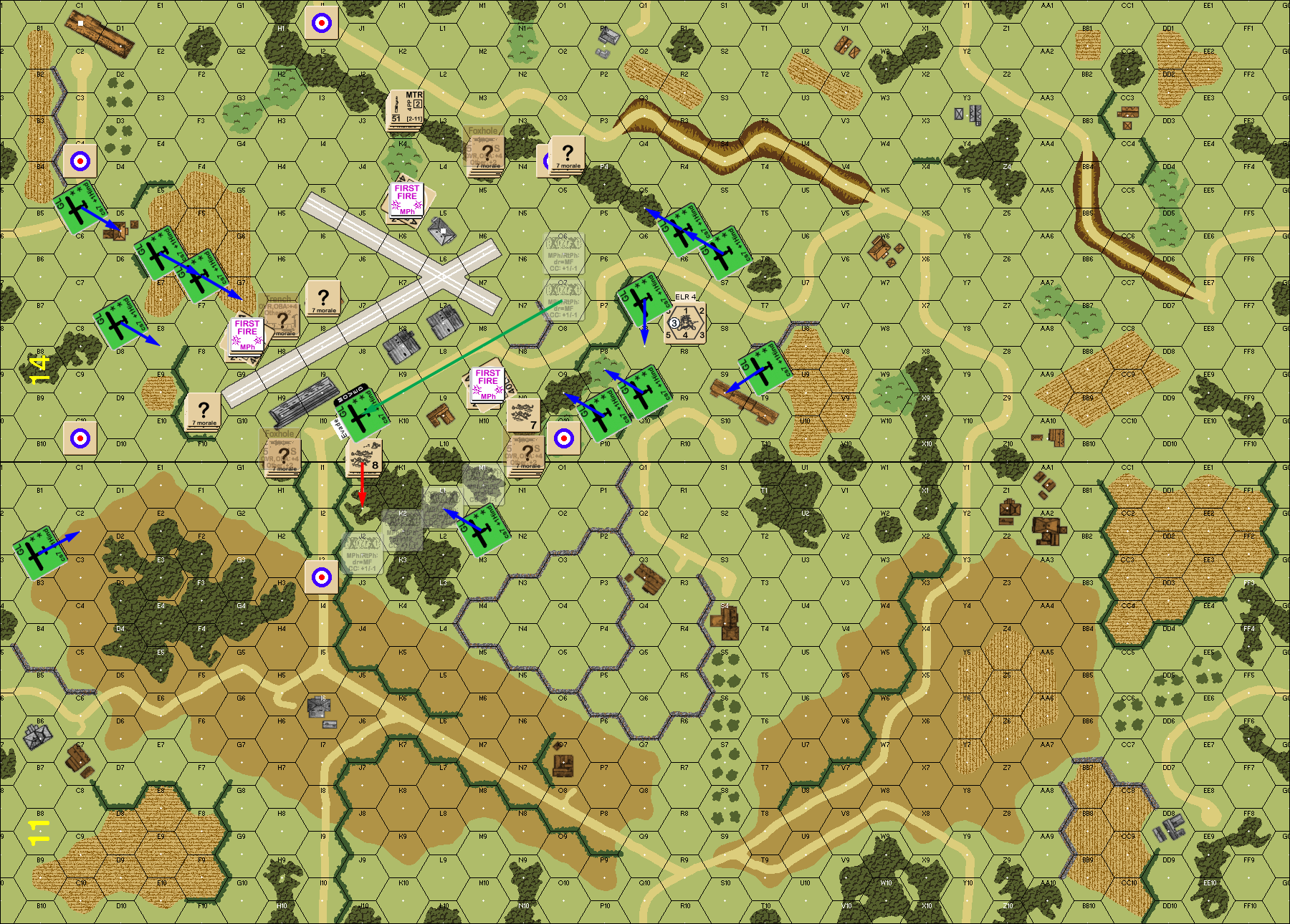
After invading Crete in Tavronitis Bridge, Tracey went and did it all over again with “Bofors Bashing”. This is a companion scenario that originally appeared in Annual ’89, and was reprinted in For King and Country, depicting the main glider landings at the nearby Maleme airfield.

This time the Germans get thirteen elite squads with decent leadership, LMGs, and a couple small MTRs. The British are defending the board 14 airfield with three 20mm AA guns, and the Germans need all three to be eliminated to win (a blown repair roll is good enough, so the Brits can end up eliminating guns for the Germans, especially with IF). Beyond the guns and their crews (which set up in the open unconcealed), the Brits have nine squads, a trench, three foxholes, and six wire (note: none of these can set up on a road), and three light MTR. The wind is blowing down the longer runway of the airfield, and the first two turns have moderate dust, going down to light on turn 3 before going away entirely.

I had the defenders again, and played around with a few ideas. My eventual defense had the AA guns on three sides of the airfield, pointing towards it, and my troops were disposed so that there were some defenders available for each gun. Since even the reprinted version was showing a tendency to British wins, we played with the German balance, which has the British player break three of his MMC before the game begins.

One AA went in 14G8, with the trench in 14H7, with a squad, and another squad in building I7. Also, a MTR team was in F9, and a foxhole+squad in H10. All this should do a good job of protecting the main runway if the Germans felt like landing directly on it, and made a good screen for the north end of the field. the second one was in M9, with the 9-1+LMG squad in a foxhole in N10, with wire stretching from there to 11J2. A broken HS was in N9 and a 8-0 and broken squad in J10. All of this protected the west side, where the Germans have a lot of room for a landing and coordinated charge. The third was in K5, to protect the second runway, with a (broken) MTR HS in K3, a LMG foxhole (w/8-1) in M4 and a MTR squad was in O4. This was generally to protect from the east, with the tree-line keeping anyone else from seeing out there. The south was relatively unprotected, but the last two wire were in O6 & O7.

Tracey didn’t land directly on the airfield, but seven gliders coming in south of the field, with one more coming in near the west tree line at 11M2, and four landing at the north end, and the last one going for the hill in 11B2. With three light AA Guns already in AA mode, things started looking bad for the Germans… until I remembered the dust rolls. My first two rolls killed a glider and damaged a second, but the dust lowered that to no effect and an evade. Despite some good ROF, I was unable to get any other results (lots of +3 dust). All the gliders came down safely, with the evading one going long from O7 to J9.

DFPh wasn’t any better. I managed to put some ACQ down with my MTRs, but couldn’t hit, or get any results against the gliders, despite all the shots available. Of course, Advancing Fire was just as hopeless.


Situation, German turn 1, showing the entire play area. North is to the left, and orchards are olive groves.
↓ Read the rest of this entry…

└ Tags: Annual 89, ASL, For King and Country, gaming
 Comment 

Medieval Polish Armies 966-1500

by Rindis on May 16, 2020 at 12:00 pm
Posted In: Books

First, I must express a certain amount of disappointment. Osprey’s Men-at-Arms series has a number of good books on medieval military history of various countries. These are generally in two volumes, one covering 1000-1300, and the second 1300-1500. That Poland only gets one book for the entire period is a real shame (though it’s not the first time it’s been done this way, either).

As usual with such a short book, the historical background leaves a lot unsaid, especially when the subject is as unfamiliar to me as the history of Poland is. But it’s a decent summary, and of course comes with a good chronology.

The main sections on organization, and arms and armor, are of course the bulk of the book, and fairly well detailed for available space, and probable lack of regular documentary evidence. I kind of wish just a bit more detail was offered on the earlier periods, as it is evident that German and western European military fashions overtook many of the more Polish/eastern fashions as time went on. More meditation on that would also be interesting, but also consume limited space on speculation.

The art is fairly good (Angus McBride is still missed, but Gary Embleton and his son have some good work here), though I’m really unsure about the city walls shown in Plate G. In fact, with a couple exceptions, the backgrounds really seem to suffer here. But the main figures are well done, with good commentary about what’s going on with their equipment (…in fact, this is one of the longer commentary sections Osprey has had, short of books like The Ancient Greeks in the Elite series which was pretty much all commentary). As ever, the black-and-white photographs of period art and artifacts are plentiful and helpful, and include the floor plans of six different fortresses.

In many ways, this all just marks it as typical of the Osprey breed, which it is. Poland is not something that sees a lot of military history coverage here, so I’m very happy to have the book. As ever, it’s well produced, and I hope we see more by Sarnecki.

└ Tags: books, history, MAA, Osprey, reading, review
 Comment 
  • Page 112 of 315
  • « First
  • «
  • 110
  • 111
  • 112
  • 113
  • 114
  • »
  • Last »

©2005-2026 Rindis.com | Powered by WordPress with ComicPress | Hosted on Rindis Hobby Den | Subscribe: RSS | Back to Top ↑