Rindis.com

All my hobbies, all the time
  • Home
  • My Blog
  • Games
  • History

Categories

  • Books (504)
  • Comics (10)
  • Gaming (919)
    • Boardgaming (675)
      • ASL (155)
      • CC:Ancients (83)
      • F&E (78)
        • BvR – The Wind (26)
        • Four Vassal War (9)
        • Konya wa Hurricane (17)
        • Second Wind (5)
      • SFB (78)
    • Computer games (162)
      • MMO (77)
    • Design and Effect (6)
    • RPGs (66)
      • D&D (25)
        • O2 Blade of Vengeance (3)
      • GURPS (32)
  • History (10)
  • Life (82)
    • Conventions (9)
  • News (29)
  • Technology (6)
  • Video (50)
    • Anime (48)
  • Writing (1)

Patreon

Support Rindis.com on Patreon!
Become a patron at Patreon!

Other blogs:

RSS Inside GMT

  • Defiance AAR: North Jersey, July 2026 — Chili Dogs and Chit Pulls July 20, 2026

RSS Playing at the World

  • Playing at the World 2E V2 Arrives May 5, 2025

RSS Dyson’s Dodecahedron

  • Barin’s Stonehold July 20, 2026

RSS Quest for Fun!

  • The Expense Post May 24, 2026

RSS Bruce Heard and New Stories

  • Pain, Exhaustion, and Morale in D&D BECMI June 7, 2026

RSS Chicago Wargamer

  • The 2 Half-Squads - Episode 310: Cruising Through Crucible of Steel January 27, 2023

RSS CRRPG Addict

  • Al-Qadim: Bottle Shock July 20, 2026
SF&F blogs:

RSS Fantasy Cafe

  • The Leaning Pile of Books July 5, 2026

RSS Lynn’s Book Blog

  • Top Ten Tuesday: I’ve gone with a freebie July 21, 2026
ASL blogs:

RSS Sitrep

  • Cardinal ASL Sins March 18, 2026

RSS Hong Kong Wargamer

  • FT114 Yellow Extract After Action Report (AAR) Advanced Squad Leader scenario April 16, 2025

RSS Hex and Violence

  • This still exists? March 25, 2025

RSS Grumble Jones

  • Grumble Jones AAR for Crucible of Steel Scenarios on the YouTube page. July 20, 2026

RSS Desperation Morale

  • How to Learn ASL March 16, 2025

RSS Banzai!!

  • October North Texas Gameday October 21, 2019

RSS A Room Without a LOS

  • [Crossing the Moro CG] T=0902 -- Rough start July 18, 2015
GURPS blogs:

RSS Dungeon Fantastic

  • Felltower - Monsters Fleeing between Sessions vs. PCs replenishing June 28, 2026

RSS Gaming Ballistic

  • Mission X and Genre Fidelity in Combat July 19, 2026

RSS Ravens N’ Pennies

RSS Let’s GURPS

  • Review: GURPS Realm Management March 29, 2021

RSS No School Grognard

  • It came from the GURPS forums: Low-Tech armor and fire damage January 29, 2018

RSS The Collaborative Gamer

  • Thoughts on a Town Adventures System January 18, 2022

RSS Don’t Forget Your Boots

  • GURPS Supers Newport Academy #7: “Invitation to the future.. of the 1970’s” July 5, 2026

RSS Orbs and Balrogs

  • Bretwalda - Daggers of Oxenaforda pt.4 - Fallen King May 27, 2017

Back in Time

by Rindis on May 13, 2020 at 12:00 pm
Posted In: Computer games

This is the fifth in a series of reviews looking at the evolution of Crusader Kings II. See the previous reviews here:
Crusader Kings II:
The Second Crusade
The Old Gods: That Old-Time Religion
Sons of Abraham: A Little of Everything
Rajas of India: My Elephant for a Kingdom

Paradox went even further back in time for Crusader King II’s seventh expansion. Where The Old Gods had pushed the start date nearly 200 years back, Charlemagne’s headline feature was a 769 start date—98 years before TOG’s. Paradox released the expansion on October 14th, 2014, along side patch 2.2.

In the patch, Paradox streamlined the opening interface, so that you are given five general ‘era’ choices (only three of which can be selected without any expansions) instead of the ten bookmarks. Each one has a description of the main features of the era, and a list of possible rulers to play as. There’s a ‘custom game’ button to get at the old interface, and choose rulers other than the given set. It’s a little annoying for an experienced player, but certainly is an improvement for the novice player.

Realm Update

The major work on the patch away from the headline feature and the things it required (new cultures, religions, and the like) focused on more tweaks to how the ream is administered.

Patch 2.1 had added new penalties for having too many holdings in your demesne, and now they added a limit to how many vassals you can have. Like with the demesne limit, going over reduces the taxes and levies you receive from your vassals, and there there is a chance that vassals will just spontaneously become independent upon your death if you’re over the current limit.

This is meant to keep a large realm from just having a bunch counts as direct vassals, so no one has enough power to become a problem. A ruler needs to delegate power to dukes (or even kings in an empire) to keep from having too large a court to manage.

The interesting part was that they let you balance if you wanted a (modestly) larger demesne, or a larger number of vassals. Realm laws were reworked so that centralization gives you more demesne at the cost of your possible pool of vassals, and both that and the other main authority laws have to be unlocked by the Legalism technology.

Regents got a nice tweak, with regents acting more in their own interest, and with their personality, and less as a swap-in replacement for the ruler. Paradox also added the honorary title designated regent, which lets you choose just who will be running things when your incapacitated.

And finally, with the expansion, a powerful ruler can appoint viceroys. These are duke- or king-level governors who administer the title for you (keeping everyone from getting unhappy because you’re keeping all the good titles to yourself) for life. Once the viceroy dies, the title reverts back to you, keeping his family from becoming a permanent power block that may become disloyal. It will make feudal vassals of that rank modestly unhappy, and does require Legalism IV (say, circa 1150) for viceroy kings, and VIII (end game) for duke viceroys.

Tribes

Away from Western Europe and the Middle East, many areas are still not extensively settled, and cities have not grown up. This means the feudal structure of CK II isn’t accurate at all, and the problem got worse as the development team went back in time. So, a fourth basic holding type was added to the game:

Tribes have chiefs, who can become high chiefs and khans, if they hold extensive lands in a tribal government. They provide moderate taxes, and start lightly fortified, but can get good defensive values later in the game, and provide heavy troops. Generally, the tribe is the only holding in the province (some will have a temple as well), and gets an income and levy bonus per empty holding slot in the province. They generally have lots of light infantry, and most improvements (not all) cost prestige instead of money.

Tribes are locked to elective gavelkind inheritance, so that each generation, the titles are split amongst the heirs, with the primary heir being chosen by the nobles of the realm. Instead of the normal crown laws, tribes have tribal organization, which will generally start at ‘minimal’, and acts like the normal crown laws except only unreformed pagans will get unhappy as it progresses to ‘maximum’. A tribe at maximum organization can adopt feudalism or become a merchant republic (through decision).

This converts the ruler’s primary holdings from tribes to castles or cities, and as all the tribal improvements go away, the ruler is left with fairly minimal resources until he can start upgrading. On the other hand, tribal rulers get no vassal levies, but must call their vassals to war as allies (remaining under the vassal’s control). In a stable realm, this generates lots of (light) troops, but they can’t be forced to join, and an unpopular ruler can’t force them to join.

Ibadi

With the patch, Ibadism was moved from a Sunni heresy, to being a separate branch of Islam (following the lead of EU IV: Wealth of Nations, and adding the Kharijites as the Ibadi heresy), and with Sword of Islam it is as playable as the other two branches.

However, while the southeast corner of Arabia maintains an Ibadi population during the entire game, only the 769 start has an available independent ruler (the Emir of Azd Umanid). He has one neighbor of about his power level… and Abbasid Caliph on the other side.

Past the usual tough start of a more minor religion, they aren’t mechanically different from other branches of Islam, beyond their own holy order (with Sons of Abraham) and slightly different holy places.

Zunist

More unexpectedly, Zunism was added to the list of pagan religions. This was a small, not very well documented religion, that may not have been much more than one royal family’s personal beliefs.

It is completely gone in any start after 769 (swallowed up by Shia Islam), so you need both TOG and Charlemagne to play as a Zunist. At that point, three provinces are Zunist, along with the Zunbils and their vassals.

While they share many traits with other pagans, like being able to reform the religion, they are more of a cross between the offensive and defensive subgroups of other pagan religions. They have the same problems with conversion as other pagans, and have the boosted levy size of offensive pagans, but cannot raid, and have the increased defensive attrition of defensive pagans.

The tough-start problems include being adjacent to the Abbassids, though the attrition penalties should help with that, along with mostly being in mountainous terrain. Converting anything to Zunist is very unlikely at the start, but at least you hold one holy site, and a second one is easily available, but the other three range as far away as Cairo.

A Realm of Your Own

Possibly the most immediately interesting feature of the expansion is the ability to create your own kingdoms or empires. This isn’t modding the game, or using the equivalent of the ruler creator, this an in-game function.

Normally, you need to hold a certain amount of land that de jure belongs to a king-level title, and then you can ‘create’ or usurp that title. With the expansion, if you have a large enough realm that is split between several different ‘potential’ kingdoms (leaving you unable to claim any one of them), you can still promote yourself to king, and a new title based on your main duke title is created. Similarly, a powerful king can promote himself to emperor without conforming to any of the defined de jure empires.

It’s handy, and especially at the emperor-level can take a lot of pain out of attempts to get at the next higher rung of titles. The custom ones are more costly to create than the normal game-designated ones, which also makes them just appropriate for those who are stuck with powerful neighbors, or convenient allies, where the pursuit of power would otherwise take them.

Story Missions

Charlemagne’s rise to greatness was not at all inevitable, especially in 769, shortly after becoming effectively a co-equal king with his brother. This is a bit forced with the addition of story missions.

This is potentially a neat idea, that gives a lot of the history involved, and lets certain characters show up when/where needed. However, they’ve never been instituted for any subjects other than Charlemagne’s life, and give something of an ‘acting out history’ feel from EU II. The flexibility of events in CK II has been its strong point, and I think this takes away some of that, and makes playing as Charlemagne less interesting after the first time, even though he’s potentially a very interesting character to play.

Conclusion

Again, as a patch, this is an excellent improvement to the game. The vassal limit strikes me as a bit useless (it’s fairly high normally), though apparently needed for people determined to break the system. But the designated regent is a nice subtle addition, and the new tribal system makes them play very differently, and gives them some nice medium-term goals.

Expansion-wise, not so much. 769 is actually a fairly interesting start date, full of some of the most famous persons of early Medieval Europe. However, the story missions just make things feel a bit artificial, so primary replay interest is away from Charlemagne himself. The custom realms are a big help however, and the primary useful part day-in and day-out, though not really worth an expansion by itself.

└ Tags: Crusader Kings, Paradox, review
2 Comments

Cities In Flight

by Rindis on May 9, 2020 at 12:00 pm
Posted In: Books

This is a four-in-one of a series of James Blish novels. They’re all in the same universe, but only get truly related to each other later.

The first book, They Shall Have Stars, takes place in an early twenty-first century as seen from about 1956. This means there’s all sorts of technical oddities, but the meat of the story is an interesting take. The United States has grown so paranoid about security that everything is split up into little bits that don’t get to talk to each other. Notably, this has happened to science, and since technical progress depends on peer review, and other methods relying on the free flow of information, progress is grinding to a halt. The plot then revolves around a clandestine effort inside the government to squeeze out a couple last breakthroughs, so a young generation can go riding off into the sunset.

The second book, A Life for the Stars, takes place near the year 3000, and a decent chunk of the galaxy has been colonized by humanity in a couple of waves, thanks to the anti-gravity devices developed in the first book. Earth is seriously depleted of its natural resources, and apparently most of the cities have left for the stars, looking for places to work. Which means all these ‘cities’ are really just the major production centers; steel towns and the like, and there’s no reason why a financial, service, or administration center would need to (or rather, be able to) pick up and leave like that. Of course, the main city the remaining three books follow is former financial hub New York…. But, the story itself the best of the bunch, with a well-done coming of age theme.

What’s odd is that the main character of that book gets killed off-screen in between books, even though he could have made it (this looks to be a result of the stories that make up the second book being written later, necessitating writing him out). But the last two are further adventures of New York City (or at least Manhattan), focusing on the Mayor, who is just a secondary character before this. The fourth book (The Triumph of Time) has some of the oddest feel to it, as it’s kind of Blish’s extended farewell to the universe and characters of the first book. It also really runs into modern physics problems as modern cosmology renders the initial seed of the problem nonsense.

Earthman, Come Home is probably the longest, and most extensive plot of the series, and really shows its origins as a series of short stories stitched together. It indulges in lots action-adventure, and saving the day through engineering. Now, for that sort of thing, it is very well done, and overall hangs together well. Its the real core of the series, and works well as such.

I have to say, when I’d heard of antigravity and flying cities… this isn’t at all what I had in mind. My thoughts were far more down to Earth, with the engineering of cities where vertical distance, and the ground below not being a real concern… not space-opera concepts of ‘cities’ as interstellar vessels. However, in its own axioms, the stories do well, and I can see why its one of the classics.

└ Tags: books, reading, review, science fiction
 Comment 

Two Rounds of Ipsus

by Rindis on May 6, 2020 at 12:00 pm
Posted In: CC:Ancients

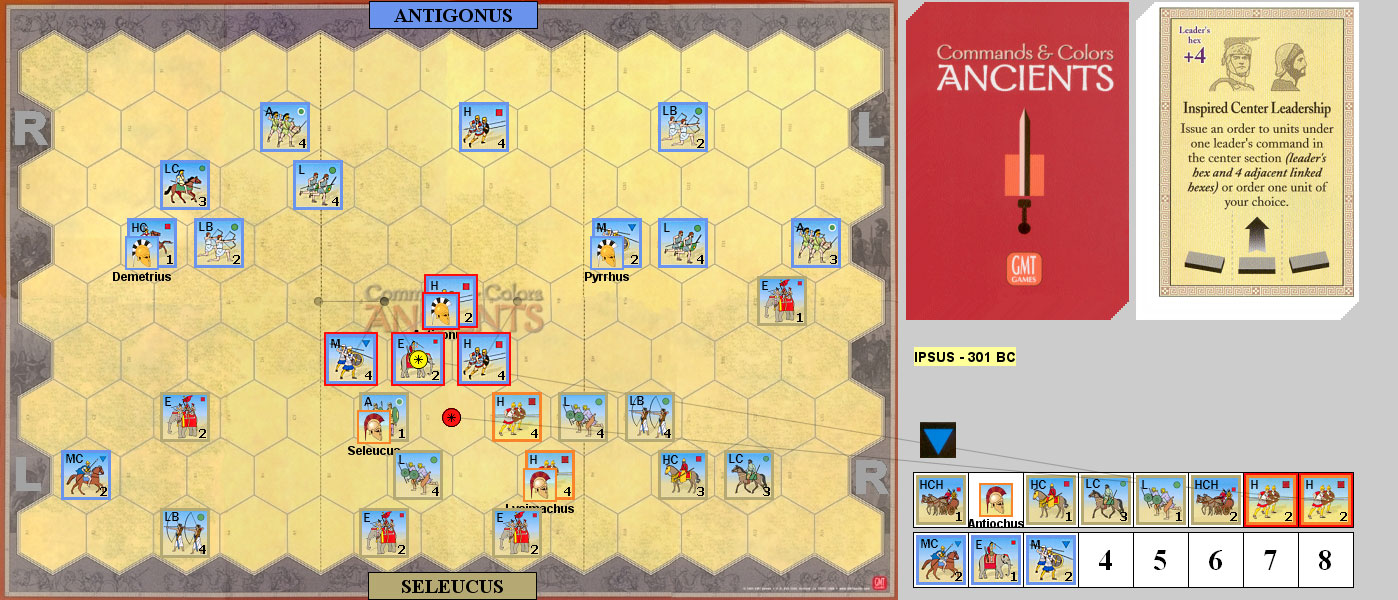
After our short firefight in the snow, Patch and I did our usual between-games set of Commands & Colors: Ancients in the first two weeks of April. This time was Ipsus from Expansion #1. This is basically the end of the Successors, as after this, Antigonus is dead, and so is the dream of reuniting Alexander’s empire. Both sides start far back, and have a mix of unit types, though Seleucus has four units of elephants, two heavy chariots, and a heavy cavalry, leading to a very heavy mounted arm. Seleucus also gets an extra card, though Antigonus goes first.

I had Antigonus the first time, and started with Order Two Right to bring up some lights and did a block to a HCH. Patch ordered his center forward, and I moved forward with Order Mediums, and Patch engaged with Order Three Left, forcing me back. Coordinated Attack allowed me to finish off the HCH, and force a LB back, while bringing up other units. Patch Ordered Two Left, causing a hit on my MC (from a blocked retreat), and two on my LB, in return for one block on his HC. Out Flanked did three hits to a Light, in return for a hit on my HC.

Order Lights let Patch get units into range, but he couldn’t do damage at range. I straightened my line with Left Leadership, and Patch Ordered Three Right to do two hits to a LB as it evaded. I used Mounted Charge, but both of my Elephants did nothing (but at least took nothing in return). On my right, I killed Antiochus, and then finished off the HC he was with, and finished off two LC at a cost of one block on my HC. Patch came back with Order Two Left to finish off my MC, and drive off my HC.

I Double Timed my center into contact, and did three blocks to a Aux and two to a Heavy, at a cost of two hits on a Medium. Patch used Order Heavies to get all his center Heavies into action, and a HCH and Elephant on his right. His Elephant did a block and banner to mine, who hit his on the Rampage; he hit it again on Momentum, didn’t get a hit, the battle back forced him to retreat, and the Rampage finished off my Elephant. He did two blocks to a Med, but lost his HCH in return, while finishing off a different Med and we traded two blocks apiece on Heavies. Inspired Center Leadership kept my center in motion, and my Elephants there finished off two wounded heavies. 8-3

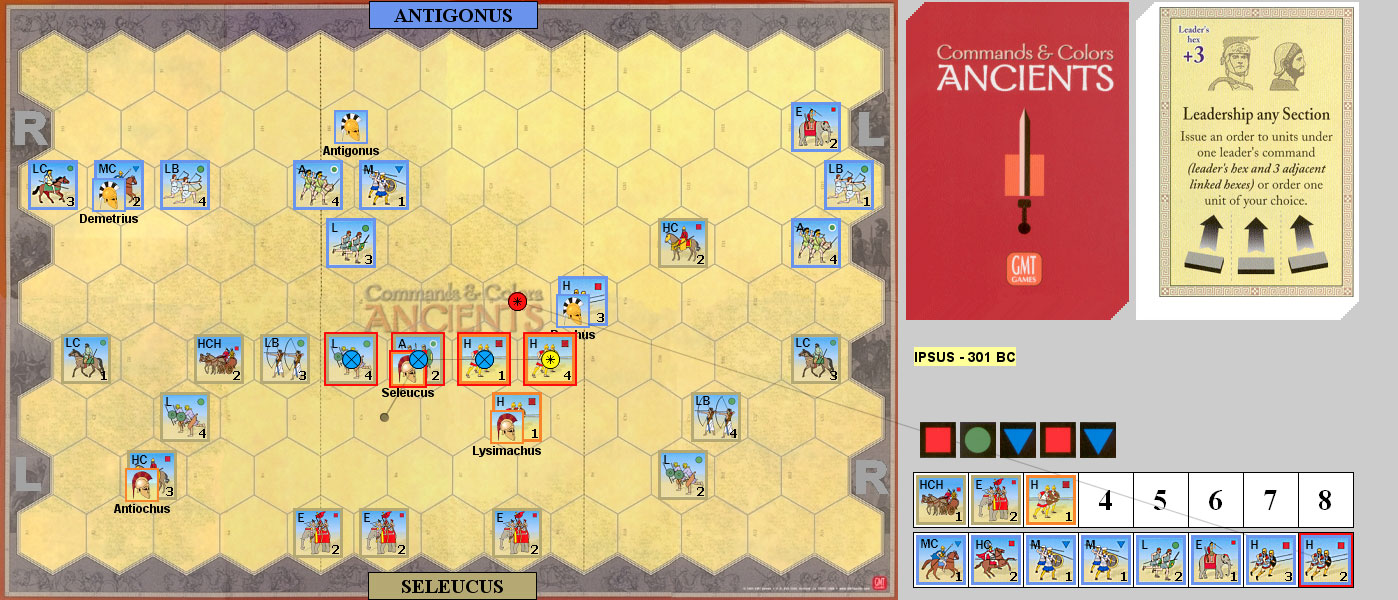
Patch started the second game with Out Flanked to move units up, and I Ordered Two Right to do three blocks to a LB. Patch Ordered Mediums, getting one MC into contact, who did nothing, and took a hit and a banner. I Out Flanked, and did two blocks to a MC forced to retreat from missile fire. Line Command activated most of Patch’s army, but only one flank got into contact, where my HCH traded a block with a Light. I Ordered Four Right, and brought a few units up, while forcing his wounded Lights out of line.

Patch Ordered Mediums, but only did one block to a HC, while I forced a MC back, and finished off another. I used Leadership on my right, and lost a HCH and Elephant for no more than a block each to a pair of Mediums. Patch Ordered Two Right and did two blocks to a LC in return for a block on a HC. I Ordered Four Left and finished off his HC while forcing his MC to retreat. Order Lights only got me a single hit on a Medium; Patch Rallied, and got that block back, but nothing else, but did three blocks to a Heavy, in return for taking two.

I Ordered Three Right, and knocked out two Mediums and a Light. Patch brought up a couple units, but didn’t get any hits, and I used a Line Command to move up much of my army, and picked off an Elephant and did a block to a Heavy with archery. Patch engaged with Inspired Center Leadership, doing two blocks to an Aux, and finishing off my Heavy. I Counterattacked to bring the rest of my Heavies into the fight, destroying a Heavy, and doing three blocks to a Med, who retreated two hexes. Leadership Any Section got Patch’s remaining Heavies into action, which did three blocks to a a Heavy, and two to a Light at no cost. I used my own Leadership Any Section to reassemble the center, and ranged got a block each on a Light and Heavy, and then finished off the Heavy in Melee. 8-3

Afterword

It’s another demolition derby. This time, there’s a lot of heavies around, but with the armies starting away from each other, there’s plenty of opportunities for everything else to do their jobs. The first one ended somewhat suddenly on a Mounted Charge, that left Patch’s army pretty shattered. The second time… I had a bunch of ranged shots that did far more than they should have. That killed off a unit directly, and made killing the last couple a lot easier.

Another important break for me was killing Antiochus early in the first fight. If he hadn’t of died, the battle back would have eliminated my unit on helmet rolls that suddenly did nothing.

└ Tags: C&C Ancients, gaming
 Comment 

Sassanian Elite Cavalry AD 224-642

by Rindis on May 3, 2020 at 12:00 pm
Posted In: Books

Cavalry has nearly always been the prestige arm in the military, so the Osprey Elite book on the Sassanian empire is indeed focused on the ‘elite’ branch of their military. It does also touch on the rest of it, but the noble-based savaran cavalry is the focus.

The book starts with a very good look at pre-Sassanian cavalry, and how that shaped their units. A recurring theme is how much Parthian influence there was early in Sassanian rule, and how that shifted over time to northern Iranian influences. Unfortunately, while there’s a good amount of talk about things like this, and how the cavalry was generally equipped, there is no timeline, and most of this feels kind of nebulous (the lack of a good map doesn’t help).

I imagine the problem is a lack of written records. We’re getting outside of the realm where Roman sources are plentiful, and a fair amount of the photographs in the book are of various stellae… that are highly weathered or damaged. There’s also a couple of excellent metal plates, and a couple statuettes. The late Angus McBride’s art is great as always, and my only problem is actually on the cover. Sources describe something meant to fire five arrows at a time, but there’s no surviving evidence of what it was like, I don’t buy the idea used in that plate.

Six major campaigns are covered in the last chapter, most of which are often covered in other books. Three of them are familiar from the Roman side of things, and the last section is the career of Khosrow II, well known from his defeat of Eastern Rome, being defeated in turn, and the Arab conquest. In between, there’s a short discussion of the Peroz’s defeat of the Hephthalite Huns (which gets talked about with the Huns), and finally the campaigns of Bahram Chobin and Smbat Bagratuni, which are the most interesting part of the chapter.

So, it feel less grounded than most Osprey books, but as ever, the visual reference is good. At the same time, this is a subject without a lot of attention in English, so it is a good primer.

└ Tags: books, Elite, history, Osprey, reading, review
 Comment 

Nobunaga Pokemon

by Rindis on April 29, 2020 at 12:00 pm
Posted In: Computer games

Even though I wasn’t into Pokemon at the time Pokemon Conquest was announced, the idea tickled my fancy to no end. The concept of a Nobunaga’s Ambition game using Pokemon was one of those fun, silly ideas that comes well-developed out of Japan every once in a while.

So, a couple years ago, I finally got around to picking up a used copy, and picked my way through the opening campaign off-and-on, finishing up this February.

First off, as a tactical game, it works. Frankly, regular Pokemon battles are always a bit rough for me, as they’re pure matches of ‘moves’, with some neat complications of statuses and the like, but there’s no actual maneuvering, and I have to wonder just how some of it is working.

Here, all the fights are on a reasonably-sized square grid, and not only are you maneuvering around terrain, but fights are between teams of Pokemon (generally six), and each attack has has its own area that it hits (from the square directly in front of you, to a three-wide area, or a three-long area, or all surrounding squares… you get the idea).

Typing on Pokemon and their attacks is intact, so all the familiar ‘super effective’ mechanics are in the game. On the other hand, every Pokemon has one, unchanging, attack, and one passive ability. This nicely simplifies things down, as the field battle is going to be much more complex than the normal Pokemon game battles.

That said, I’d like to see a version of this that goes the full-featured tactical RPG route. Keep (or adapt) the normal move set, let Pokemon swap out abilities as they grow, and let every one be individual.

There is still some of that as well, as Pokemon do still evolve, which gives them different abilities.

And there’s no complaining about the amount of content. The initial campaign is basically a long tutorial that slowly doles out more of the system as it goes (and there are all sorts of complications, like recruiting more warriors/Pokemon, and training, and…) and ends with taking all 17 regions of the map (there were 17 Pokemon types when this game was done—each type has it’s own province.

The first campaign itself is a bit too long for how much of a tutorial it is. But beating that opens up a bunch of other scenarios, and some of those open up even further ones. In all, there’s about 20 campaigns, and I haven’t gotten around to checking any of the others yet. So, it’s well done, and has a lot to do, I need to revisit Ransei and try one of the other campaigns.

└ Tags: DS, Pokemon
 Comment 
  • Page 113 of 315
  • « First
  • «
  • 111
  • 112
  • 113
  • 114
  • 115
  • »
  • Last »

©2005-2026 Rindis.com | Powered by WordPress with ComicPress | Hosted on Rindis Hobby Den | Subscribe: RSS | Back to Top ↑