Rindis.com

All my hobbies, all the time
  • Home
  • My Blog
  • Games
  • History

Categories

  • Books (491)
  • Comics (10)
  • Gaming (911)
    • Boardgaming (669)
      • ASL (154)
      • CC:Ancients (83)
      • F&E (78)
        • BvR – The Wind (26)
        • Four Vassal War (9)
        • Konya wa Hurricane (17)
        • Second Wind (5)
      • SFB (78)
    • Computer games (161)
      • MMO (76)
    • Design and Effect (6)
    • RPGs (66)
      • D&D (25)
        • O2 Blade of Vengeance (3)
      • GURPS (32)
  • History (10)
  • Life (82)
    • Conventions (9)
  • News (29)
  • Technology (6)
  • Video (48)
    • Anime (46)
  • Writing (1)

Patreon

Support Rindis.com on Patreon!
Become a patron at Patreon!

Other blogs:

RSS Inside GMT

  • Meet The Han: A Civilization of GMT’s Ancient Civilizations of East Asia  March 20, 2026

RSS Playing at the World

  • Playing at the World 2E V2 Arrives May 5, 2025

RSS Dyson’s Dodecahedron

  • Rytassa’s Deep March 23, 2026

RSS Quest for Fun!

  • The Myth of Rational Animals November 23, 2025

RSS Bruce Heard and New Stories

  • Preview: The Iron Queen February 9, 2026

RSS Chicago Wargamer

  • The 2 Half-Squads - Episode 310: Cruising Through Crucible of Steel January 27, 2023

RSS CRRPG Addict

  • Arena: Urban Sprawl March 23, 2026
SF&F blogs:

RSS Fantasy Cafe

  • Michael Swanwick Guest Post and Book Giveaway February 23, 2026

RSS Lynn’s Book Blog

  • Booking Ahead/Weekly Wrap Up March 22, 2026
ASL blogs:

RSS Sitrep

  • Cardinal ASL Sins March 18, 2026

RSS Hong Kong Wargamer

  • FT114 Yellow Extract After Action Report (AAR) Advanced Squad Leader scenario April 16, 2025

RSS Hex and Violence

  • This still exists? March 25, 2025

RSS Grumble Jones

  • 2026 Kansas City ASL Club's March Madness Tournament March 16, 2026

RSS Desperation Morale

  • How to Learn ASL March 16, 2025

RSS Banzai!!

  • October North Texas Gameday October 21, 2019

RSS A Room Without a LOS

  • [Crossing the Moro CG] T=0902 -- Rough start July 18, 2015
GURPS blogs:

RSS Dungeon Fantastic

  • What color is paut? Sigh. March 3, 2026

RSS Gaming Ballistic

  • Pigskin project (by Chris Eisert) February 28, 2026

RSS Ravens N’ Pennies

RSS Let’s GURPS

  • Review: GURPS Realm Management March 29, 2021

RSS No School Grognard

  • It came from the GURPS forums: Low-Tech armor and fire damage January 29, 2018

RSS The Collaborative Gamer

  • Thoughts on a Town Adventures System January 18, 2022

RSS Don’t Forget Your Boots

  • GURPS Supers Newport Academy #3: “Season Of The Witch” February 8, 2026

RSS Orbs and Balrogs

  • Bretwalda - Daggers of Oxenaforda pt.4 - Fallen King May 27, 2017

Two Rounds of Indus

by Rindis on April 14, 2020 at 12:00 pm
Posted In: CC:Ancients

After finishing off yet another epic ASL struggle in Budapest, Patch and I did our usual two rounds in Commands & Colors: Ancients in the first half of March This time is a somewhat speculative battle (more so than normal, as there’s no records of particular battles for this campaign), pitting Seleucus against the Mauryans, from Expansion #1. The Seleucids have a nice solid body of Heavy Infantry in the center, and other forces scattered about, including cavalry and elephants behind a forest. The Mauryans have a more compact army with elephants and Heavy Chariots, and three units of Auxilia that have the three-hex range of Light Bows on their left, behind the Indus.

Patch started with the Indians/Mauryans, who go first, and Ordered Three Right to move up a LC, and drove my left Aux off the hills. I moved up various units (with ranged shots that did nothing), while Patch got his center in motion. Order Lights let me drive his LC off the hills, and did a banner and a block to his elephants, who then did a block to his Heavy as it retreated, and then I did a block to his HCH.

Patch followed with Mounted Charge, which slammed his main line into mine, forcing a Heavy back, doing two blocks to another, three blocks to Seleucus’ Heavy, and three blocks to an Aux. In return, he lost both HCH, the Elephants, and a MC. I brought up my better units, and Patch hit again with Order Three Center, destroying my damaged Aux and both damaged Heavies, but I drove off a LC, and did a block to another. I Ordered Four Center for everything that was left there (including Seleucus, who’d lost his unit), with both of our Heavies taking two losses. Patch Ordered Three Center, forcing a LB to evade, and knocking out my weakened one (they stood on a 2-die attack hoping for battle back… nope), and doing a block to another LB who did a block to his LC in return.

I Ordered Two Left to regain the hills and drive off his MC, then Patch hit with Clash of Shields. His Heavy did three blocks to an evading LB, but a LC missed my other evading LB. Leadership Any Section allowed me to bring in the cavalry, who finished off one of his LC. Patch moved the surviving leader off to his right, and I Ordered Lights for a round of archery that knocked out his Heavy. 6-4

I started the second game with Order Three Left to get my Bow Auxilia into the Indus, and Patch used Move-Fire-Move to bring his LB up, forming a solid line from his left to his center. Order Lights moved the Bow Auxilia up again, and I did two blocks to a Light, and drove off a LB. Line Command got Patch’s center closer, and drove off a LB and damaged a Light. Out Flanked put the LB back, and I knocked out a Light (it had taken all its hits from banners while trapped at the edge of the board), and drove off a LB.

Order Three Center put Patch into contact with my Bow Auxes; both sides retreated an Aux, and I traded an Aux block for a Heavy block. Order Two Left reformed my Aux line, but did nothing, while Patch’s Coordinated Attack brought his Elephants and LB up, while the forward Heavy did two blocks to my weak Bow Aux, who chased him off with a banner. Move-Fire-Move let me get a couple LC up, drive off a LB, and then move my weak Bow Aux back.

Patch then used Mounted Charge; thankfully, the Elephants were the only thing in range, and they traded blocks with a Bow Aux. Order Three Left finished off his Elephants after a Rampage that thankfully did no damage, and I did a block to his MC. Patch Ordered Three Right to bring up the cavalry (and a LB), and did another block to a Bow Aux in return for a block to his MC. I Ordered Four Left (though I only had the three Bow Aux there), and drove off his LC while finishing off the MC. Patch shifted his right flank a little, and Inspired Center Leadership let me finally deploy into a line there. Patch Ordered Two Right, which did a hit to my Heavy, and wiped out a LC when it was forced to retreat. Order Lights drove off three units with missile fire, and did a hit to a LB. Order Two Center moved two of those up again, and did a block to a Bow Aux.

Order Mounted let me get to his line with most of my heavier units; Patch used First Strike on my Elephants, doing one block, before they did two blocks to him, and they retreated a hex. The Elephants used Momentum to get at the next Heavy in line, which took three blocks and retreated. I also knocked out the already-damaged Heavy and forced an Aux back, but lost a HCH in the process. Patch Ordered Three Center to finish off the Elephants and wipe out a MC, but he lost a Heavy in return. I’d lost the MC by not evading because the average was (barely) in my favor, and I wanted them there for Clash of Shields, which only ordered my remaining HCH. I did three hits and a banner to an Aux, and then finished them off with Momentum. 6-4

Afterword

The second round went a lot longer than the first, as I made use of all the left-section cards I was drawing, but both finished in a hurry once the centers got into the fight. Seleucus only has three heavy units to five Indian ones, but other than a single Heavy Infantry, the Mauryan units are a lot more fragile. The Bow Aux were very handy (especially with all the cards I had for them), and helped weaken things just enough that I could use my center with some confidence.

The terrain is a lot more jumbled than you usually get in these battles, and army compositions and deployment are also unusual. Definitely a fun battle even (especially?) if it’s going to turn into a demolition derby right before it ends.

└ Tags: C&C Ancients, gaming
 Comment 

A Tradition of the People

by Rindis on April 10, 2020 at 12:00 pm
Posted In: Computer games

This is the third in a series of reviews looking at the evolution of Europa Universalis IV. See the previous reviews here:
Europa Universalis IV: A Fantastic Point of View
Wealth of Nations: National Trade

During development of Wealth of Nations, PDS had mentioned merchant republics as being too small and vulnerable, even though they tended to be fairly small and long-lived in history. So the next project was considered a ‘mini-expansion’ and focused on republics in general. Res Publica was released on July 16th, 2014, alongside patch 1.7 for a minimal $5 (most expansions are $15, and ‘small’ ones are $10).

Getting Ahead in the World

One important patch change was a reverse in direction. Like in previous games, being behind your neighbors (or just other members of your tech group) in technology grants a bonus to your progress. Whereas before it had been a bonus to budgetary investment per country and tech, in EU IV it is a reduction in power cost from the most advanced neighbor you have.

This was initially a 5% (30 power) decrease in cost per level, but in patch 1.6 this was decreased to 2.5%. In patch 1.7, it was changed back to 5%, the maximum possible bonus was increased (though it’s really hard to get past the old limit), and the worst tech group penalties were removed. Various Far Eastern and African groups actually had penalties to power generation, effectively lowering their base 3 power per group, and these were removed to give everyone the same overall power generation, though non-Western countries still pay more for technology.

The idea had been to discourage lagging behind in technology for the cost bonus by reducing that, but now, they rewarded staying on top of technology. Any time the next Administrative or Diplomatic technology would be ‘ahead of time’ (each level has a target year, and it is more expensive before that point), you get a +20% to production or trade efficiency, giving a nice boost to income for keeping up with your studies.

An extra addition to the patch were three new idea groups (one per category). This also meant adding new policies for all the new combinations, and brought the number of choices up to seven per category.

Focus, Pinkie, Focus

The most useful expansion feature isn’t republic related: With the expansion, you gain the ability to set a national focus. This is done from the main Monarch Power display on the government tab. Activating one gives you two extra power points per month in the chosen field, while you gain one less in the other two.

It’s a nice bit of flexibility, and kind of a shame that it’s not in the base game, as there are times when one area is starved for points (especially Administration), while the others are doing well. The cost is that it can only be done every 20 years, but some countries will start focused, and are ready to change or remove focus from the start.

Factions

The idea of the faction system for Ming China from EU III: Divine Wind had been retained, but the principles changed a bunch. There were still three factions, and now they were tied directly to the three power types of the government. However, factions no longer prevented you from being able to do things. Instead, they each give two bonuses and one penalty.

Unlike before, faction influence isn’t subject to large shifts due to ruler ability and domestic policies (which no longer exist), but the military faction gains influence from army tradition, and the diplomatic faction gains influence from navy tradition, while the administrative faction gains influence from stability. In addition, you can spend monarch power to give influence to a particular faction.

Patch 1.7 reworked this so that factions are associated with particular government types (for modding purposes), and added factions to merchant republics. These are of course different from China’s factions, granting bonuses around goods, and trade instead of extra advisors and diplomatic reputation.

Republics

As briefly mentioned in the main review, republics have republican tradition. This is a measure of confidence in the government, and replaces legitimacy for monarchies. It is a more limited mechanic, with fewer things affecting it (though there are a number of events that directly touch it), and only a couple things that it affects.

The primary effect is that not being at full legitimacy increases stability cost. High tradition also reduces overall revolt risk, with the same maximum of legitimacy (-2%), but at minimum tradition, there is only an elimination of that bonus, instead of it swinging all the way to the +2% penalty that a monarchy has to deal with.

Republics generally elect (player choice) a new president every four years, with the base stats being one point each in two categories, and four in the one that he focuses in. Re-electing the previous president boosts him by +1 in each category (e.g., becomes 5/2/2 depending on his initial focus), but reduces tradition by 10. Tradition generally increases by +1 per year, so constantly increasing the stats of one president leads to an erosion of six points per election.…

There are, of course, events that give a choice between tradition, and losing money and the like, so the path of a stable democracy can be rocky. On the other hand, there can be stability-boosting events at a cost of tradition, and that’s a pretty good deal if you can afford it.

If tradition gets and stays very low, a republic can turn into a Despotic Monarchy. With the Res Publica expansion, this will instead be the unique Republican Dictatorship government, which will last until the current dictator dies. At that point, it’ll either go over to Despotic Monarchy, or if tradition is back up (probably through events, as it doesn’t raise on its own at this point) it goes back to the previous republic form.

Merchant Republics

An extra bonus for Merchant Republics in the expansion is that they can now create trade posts. These generate a bonus to trade power and naval force limits, with a limit of one per trade node, but must be ‘built’ in an owned province that isn’t in the country’s main node. However, despite what it seems, it’s not considered a building, and only costs Administration power (no money) to build, and is buried away in the trade section of the main province interface (though the existence of one does show up in the trade map mode with all the other modifiers).

This gives merchant republics a reason to develop a network of far-flung territories. Better yet, they continue working if the governmental form changes, but of course, there can’t be any new ones at that point.

Dutch Republic

As something of a follow up to the previous expansion, the Netherlands got more customization with this one. They can now choose (through event) to take the unique Dutch republic government form.

This gives them a slider, showing the relative power of the Statists and the Orangists. This shifts with every election (and, of course, events), and with the Orangists in power, the ruler rules for life, but doesn’t cause the republic to fall (though it will cause tradition to stop growing), and there is another election on his death (and events might kick them out of power). Statists act like a normal republic, though the Netherlands can always have royal marriages with other countries no matter who is in charge.

The primary government bonuses are to trade and heavy ships, the Statists will boost naval capacity and trade power, while the Orangists boost army capacity and stability.

As with most of the unique governments, it’s a fairly flexible form, and the bonuses are certainly good compared to early-game governments, and competitive with later ones.

Elective Monarchy

In 1444, Poland is leaderless, with a 0/0/0 interregnum, that can be solved in a few ways. The easy (and historical) one is to form a personal union with Lithuania, becoming the leading partner with Lithuania’s Kasimierez Jagiellon as the head of the monarchy. With the expansion, this will then fire an event to change the government type to the unique elective monarchy.

On the surface, this is a fairly good government, with bonuses to manpower, revolt risk, and vassals (which Poland starts with two of, plus Lithuania). On the other hand, the succession gets… complicated.

As the nobles vote for who succeeds to the throne, they are vulnerable to outside influences. Other countries can use a diplomat to canvas for a successor from their dynasty. Each month the diplomat is kept on the job there is a small chance of picking up a vote for that country’s candidate. You can spend legitimacy to gain votes for the Polish candidate, which should make it fairly easy to guarantee a native king given the scale of the voting, but there are events that seem to fire fairly often that will reduce his votes.

As a country that successfully supports its candidate, you get prestige, very good relations with Poland (a temporary +100 boost, as well as the normal +25 ‘same dynasty’ modifier), and a good amount of monarch power in all three categories. And once this happens to Poland they lose one diplomat (that hurts) and have a higher than normal cost to reduce inflation or war exhaustion until it can find a way out of the elective monarchy.

Finally, there’s a number of historical events that will fire related to this government, that tend to curtail power. Poland is given lots of possibilities with the setup of Poland-Lithuania, but there’s a lot of challenges too.

Conclusion

It’s hard not to recommend anything this cheap (and 50% off sales are fairly frequent), but… there may not be a lot here. National focus is the big ‘useful to everyone’ feature, and generally worth the money by itself… but it is also available through the later Common Sense expansion, so if you go for that big one, there’s no point getting this just for the focus.

On the other hand, if you want to play as any of the merchant republics, the trade posts are handy, and the extra mechanics for the Dutch are nice, and the electoral monarchy is also interesting, so there lots of good small reasons to buy this small expansion.

└ Tags: EU IV, Europa Universalis, Paradox, review
 Comment 

Artillery War

by Rindis on April 6, 2020 at 12:00 pm
Posted In: Boardgaming

Mark was over on March 7th for a round of FtF gaming, now that we’d both recovered from the colds we developed last time. Up this time was The Great War, a Commands & Colors game I’d gotten for Christmas, and finally had prepped.

As my first experience with C&C outside of the GMT games, there were a few things to get used to. First, I’m definitely in favor of the blocks over the minis in this game. They’re not bad, but of course are unpainted, and handling them is a lot more cumbersome than the blocks. The cards were a lot thinner than I’m used to, though it looks like the main deck is just as many cards, and then there’s a secondary ‘attack’ deck. Rules presentation is about comparable, though there was a couple things I wish had made it to the reference card in the same format as in the rules. The board is very well produced, and double-sided (one being a pleasantly verdant field, and the other a churned-up mudscape), though they really really needed to stop that for the half hexes which turn out to be out of play (maybe they plan to have you put two together for epic? but then you only need the half hexes on one side), and the tiles are very thick and solid, and punched out with no trouble.

There’s only a few types of units, so telling the unpainted minis apart generally isn’t an issue. However, Mark missed that he had a German mortar unit, as it didn’t stand out enough from the regular infantry (small problem there: the regular unit is called ‘infantry’ everywhere but the setup instructions, where they’re suddenly ‘rifles’). Really, there’s only three in the base set, plus what’s basically a ‘special unit marker’. The dice are interesting, as there’s ‘burst’, which is the ‘always hit’ result. Two sides of ‘soldier’, which generates one hit no matter how many you get… but terrain protects from them, so it doesn’t do much in a trench. The usual ‘banner’ which causes a unit to retreat (but terrain protects against that as well), a star or ‘HQ’ symbol gives you tokens to be spent (I started calling them ’empty promises from HQ’), and then a ‘skull’, which serves the purpose of the helmet symbol in Ancients: in some cases it’s a hit, but usually it’s a dead side.

The regular deck is about what you’d expect, but you can generally order your OBA as part of one of the section cards, using the HQ tokens to pay for dice. The artillery lands around a designated target hex (chosen by regular d6), but any doubles (or better) also affect the target hex, and the skulls count. Getting three dice ‘on target’ destroys terrain, and negates all protection in the hex. It didn’t happen often for us (twice), but it’s dramatic when it does. And finally, there’s the combat deck, which you spend HQ tokens to use. We didn’t use it much in our game, but I assume we’ll use it more as we get a better idea of what it can do.

We played the non-historical introductory scenario, which took… say three+ hours to do. Now, some of it is relative unfamiliarity, and a desire to keep to the protection of the trenches, but I don’t think it’ll ever match the average 1 hour time of CC:A. That said, it does feel something like western front WWI, which isn’t something I would have said the C&C system can do. I had the Brits, who have more units (and the burden of attack in the second form of the scenario, which we didn’t get to), which I slowly organized for the ‘big push’. Both sides set up nice and comfy in their trench systems, and I moved some reserve up to the front line, while using my mortar and artillery for some effect.

I got the first lucky break of the game, when all four dice on artillery came up ‘4’, and I nearly destroyed a unit along with a hex of trench. I spent some time stockpiling HQ chits and then, two Direct From HQ cards (which allow you to order any unit you care to use a HQ chit on) got me across No Man’s Land, and into the German trench. As expected, the cost of this was a number of wrecked units, but it did finally end with Mark’s left flank wiped out.

…And despite my plan to advance up the trench and start taking on his center with an infantry and machine gun, I had two problems: first, one unit would be in the way of the other, and second, I was completely dry on right flank cards. So, the battle stumbled on for a while longer, without a dramatic conclusion, with more wearing down of our forces (and a triple from me to knock out another trench hex) until I finally won 6-2.

The original plan was to go on to the second version immediately, but that took long enough that there wasn’t really time. We both generally enjoyed it, and we’ll certainly be giving it another try later. We just need to schedule when….

└ Tags: gaming, The Great War
 Comment 

Winter King

by Rindis on April 2, 2020 at 12:00 pm
Posted In: Books

Henry Tudor is a familiar name to students of English history, especially the military side of it. Henry VII is actually a less familiar figure, despite being the same person.

So, a book on Henry VII’s reign seemed like a good way to fill in the ‘hole’ between the Wars of the Roses and the ever-popular Henry VIII. And Penn’s Winter King does a very good job at that.

I would not call this a biography. Henry VII was fairly remote as a king, watching from afar, and generally letting others be the primary face of government. Similarly, you don’t get an up-close and personal view of him here. You do see a lot of him, and his drives. The book starts with a fairly brief overview of the time leading to Bosworth, and gives an idea of how that shaped him. More importantly, it spends a fair amount of time and attention on just how unstable England was after Bosworth. No one yet knew that the trading of the throne from one faction to another had come to an end, and there were still plenty of people that the next rebellion could center around (even if some of them had to be made up for the purpose).

Much of the book therefore focuses on Henry VII’s efforts at control. This turned more and more to economic means, which people fined and held to that debt as a promise of good behavior. The truly disturbing part of this is that it was all extra-judicial, operating outside all the traditional forms of accusations and trials of Common Law. It also shows a deep concern for money matters, and Henry VII was throwing around some vast sums on the continent effectively trying to bribe/finance his way to international deals, particularly ones involving pretenders to the English throne.

One thing I do wish the book had gone into more was the flow of money. It gets touched on a lot, and there’s much that would be hard to say with certainty, but just enough is said to bring up the topic for further interest. One thread in the middle of things deals with the illegal alum trade, which Henry VII made a fair amount of money on, and was part of the shape of international diplomacy.

So, there’s a few dropped threads in what is, after all, a layman’s history. And it does a good job of covering a lot of aspects of the subject, going into the stable transition of power to his son, and perhaps leaving you wanting that little bit more. Definitely a great book to round out understanding of the end of the Fifteenth Century.

└ Tags: books, history, reading, review
 Comment 

FB15 The Taking of Object 59

by Rindis on March 29, 2020 at 12:00 pm
Posted In: ASL

Patch and I finally got back to Budapest recently, starting last December, and finally finishing up at the end of February. Speaking of, the date is 7 February 1945, so the Germans are suffering from food shortage (no double-timing, broken ML is down one), gas shortage (vehicles are immobilized on a 11+ DR when they try to Start), and Ammunition Shortage level 4 (3 for vehicles).

I got the attacking Russians, who are trying to take Object 59—the Southern Rail Station (since re-built). A secondary goal is to instead take three nearby prominent buildings in 6.5 turns. They get eighteen squads (from Assault Engineers, and elites, to 527s), three BVR squads, plenty of leaders, a .50-cal, a MMG, a FT, three DCs (one must go to the BVR), two 122mm ART, three T-34/85s, and one old T-34 M43. They also get 80mm OBA with a HIP observer. The guns come with trucks to haul them around with, and I tried, but as you’ll see, it came to nothing….

The Germans get ten squads (a mix of SS from 658 to 468s), and the Hungarians have six squads (Elite and 1st Line), with a PSK and DC, a 75mm INF, a FlaK 38 (20mm), two each roadblocks and trenches, three wire, and four vehicles: Pz IVH, Hetzer, Zrinyi II, and a Nimrod. They get eighteen mine factors, four fortified building Locations, and one HIP squad.

There’s eight buildings with random rubble checks, and Patch’s rolls knocked down a good part of the city, producing ten rubble counters (at least one of which was falling rubble), and ten debris markers. Patch’s defense largely used this rubble to great effect. There were almost no clear roads through the debris and rubble, and he put his roadblocks on the main two left: narrow streets NN18/OO19 and PP19/QQ20. Way off in the south part of the board were some buildings untouched by the demolitions that could be bypassed for a way for vehicles to get through without Bog (but not for Guns being towed, which I didn’t realize for a bit). He set up almost entirely behind the Kékgolyo utca, giving up a lot of space, but very secure in an extensively built up area. I had to complement him on such a fine cork in the bottle.

With not much visible from my starting line, one ART set up to force him away from PP19. I’d bring up men, tanks, and try to clear the roadblock, getting down the Greguss utca, putting pressure directly on the Rail Station. Five squads would head to the TT19 building to flush him out of there, while the rest would proceed along the south end of the map, though thinly-held territory to BBB15 (one of the secondary objectives) and then continue on to the other two. The primary goal was to take the three secondaries; there was still significant force there, but I could get there with enough time to defeat them. If too much pulled on to defend that section, re-orienting to the Rail Station was still possible.

I failed to contact my OBA on the first turn, and the only Prep was the ART missing ATT on PP19. Patch only had two shots during my MPh, but each one broke a 527; though after one shot, he was disconcerted to see a FT settle in across the street. Most of my advancing fire did little more than put down acquisition markers, but the FT got a result to break a Hungarian squad and the concealed leader with him.


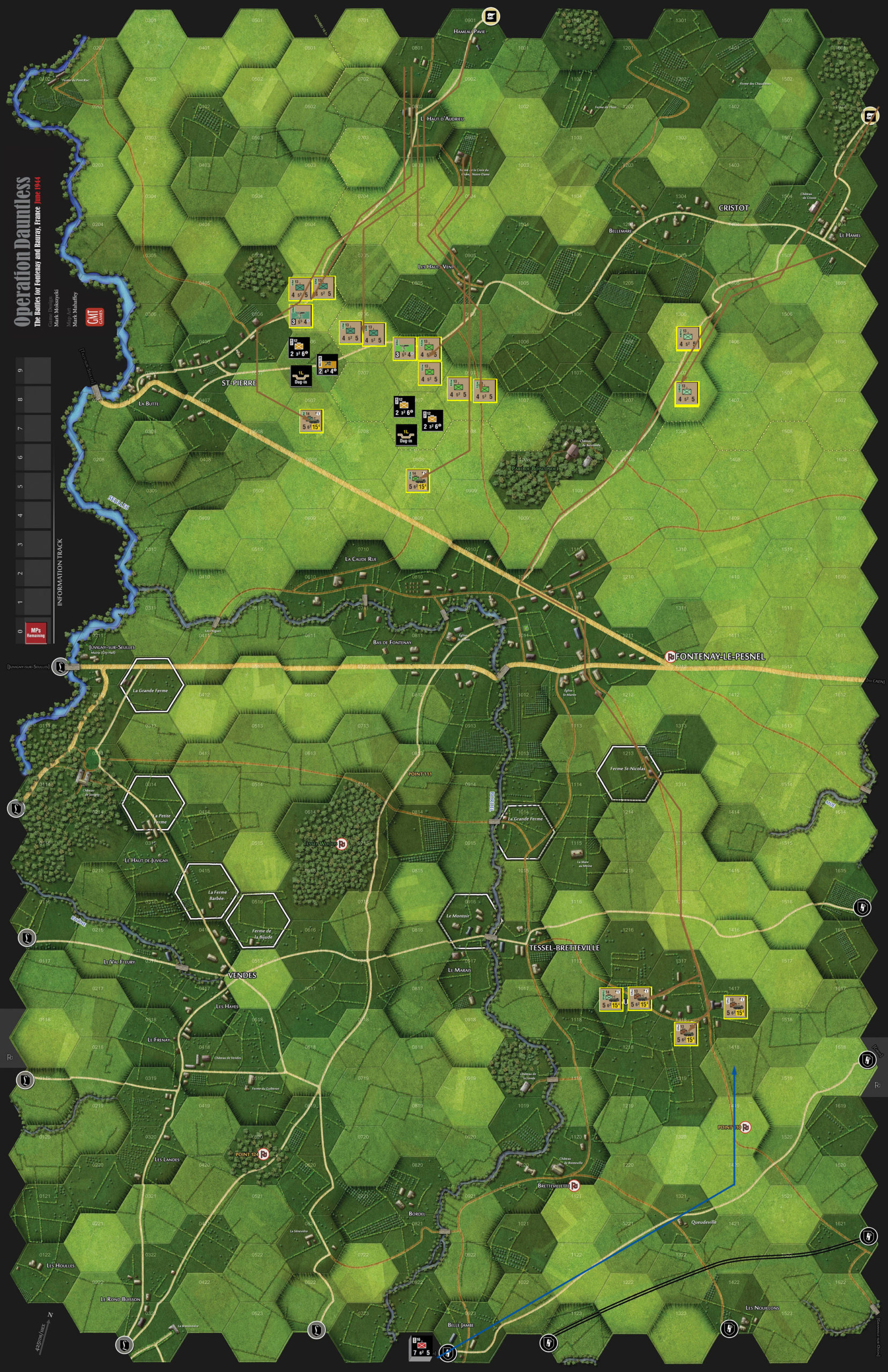
Situation, Russian Turn 1, showing the full board. North is to the left.
↓ Read the rest of this entry…

└ Tags: ASL, Festung Budapest, gaming
 Comment 
  • Page 110 of 310
  • « First
  • «
  • 108
  • 109
  • 110
  • 111
  • 112
  • »
  • Last »

©2005-2026 Rindis.com | Powered by WordPress with ComicPress | Hosted on Rindis Hobby Den | Subscribe: RSS | Back to Top ↑