Rindis.com

All my hobbies, all the time
  • Home
  • My Blog
  • Games
  • History

Categories

  • Books (485)
  • Comics (10)
  • Gaming (906)
    • Boardgaming (665)
      • ASL (153)
      • CC:Ancients (82)
      • F&E (78)
        • BvR – The Wind (26)
        • Four Vassal War (9)
        • Konya wa Hurricane (17)
        • Second Wind (5)
      • SFB (78)
    • Computer games (160)
      • MMO (76)
    • Design and Effect (6)
    • RPGs (66)
      • D&D (25)
        • O2 Blade of Vengeance (3)
      • GURPS (32)
  • History (10)
  • Life (82)
    • Conventions (9)
  • News (29)
  • Technology (6)
  • Video (48)
    • Anime (46)
  • Writing (1)

Patreon

Support Rindis.com on Patreon!
Become a patron at Patreon!

Other blogs:

RSS Inside GMT

  • Meet the Xiongnu: A Civilization of GMT’s Ancient Civilizations of East Asia February 6, 2026

RSS Playing at the World

  • Playing at the World 2E V2 Arrives May 5, 2025

RSS Dyson’s Dodecahedron

  • The Flying Swine – A Fine Drinking Establishment February 6, 2026

RSS Quest for Fun!

  • The Myth of Rational Animals November 23, 2025

RSS Bruce Heard and New Stories

  • WWII Aviation Industry Part 4 August 11, 2025

RSS Chicago Wargamer

  • The 2 Half-Squads - Episode 310: Cruising Through Crucible of Steel January 27, 2023

RSS CRRPG Addict

  • Star Trail: Because It's There February 5, 2026
SF&F blogs:

RSS Fantasy Cafe

  • Strange Horizons Roundtable on Influence January 26, 2026

RSS Lynn’s Book Blog

  • Booking Ahead/Weekly Wrap Up February 8, 2026
ASL blogs:

RSS Sitrep

  • Blockhaus Rock April 1, 2025

RSS Hong Kong Wargamer

  • FT114 Yellow Extract After Action Report (AAR) Advanced Squad Leader scenario April 16, 2025

RSS Hex and Violence

  • This still exists? March 25, 2025

RSS Grumble Jones

  • Grumble Jones February Scenario GJ157 February 2, 2026

RSS Desperation Morale

  • How to Learn ASL March 16, 2025

RSS Banzai!!

  • October North Texas Gameday October 21, 2019

RSS A Room Without a LOS

  • [Crossing the Moro CG] T=0902 -- Rough start July 18, 2015
GURPS blogs:

RSS Dungeon Fantastic

  • Black Company Playtest: Summer of Riots January 27, 2026

RSS Gaming Ballistic

  • Mission X: Obviously Not 2025. Life happened, read on. December 13, 2025

RSS Ravens N’ Pennies

RSS Let’s GURPS

  • Review: GURPS Realm Management March 29, 2021

RSS No School Grognard

  • It came from the GURPS forums: Low-Tech armor and fire damage January 29, 2018

RSS The Collaborative Gamer

  • Thoughts on a Town Adventures System January 18, 2022

RSS Don’t Forget Your Boots

  • GURPS Supers Newport Academy #3: “Season Of The Witch” February 8, 2026

RSS Orbs and Balrogs

  • Bretwalda - Daggers of Oxenaforda pt.4 - Fallen King May 27, 2017

OA24 Buying Time

by Rindis on May 9, 2013 at 12:00 pm
Posted In: ASL

Patch and I have been wanting to do more with the French lately, and still want to see more of the good ol’ American 666, so we decided upon trying OA24 “Buying Time” from Out of the Attic 2, which we’d both gotten relatively recently. Patch took the defending Americans and had a hard time working out a setup.

It’s Morocco in late ’42, and the Americans are trying to keep the French from getting at the beaches where troops are still off-loading with six squads (mix of 666 and 546), two BAZ, a MTR and a MMG. The French enter in the middle of board 19 with ten squads, all in trucks or on motorcycles and three AMD 50 AM armored cars, and have to get 12 EVP off the middle of board 19 (just under one full board length total) in 6.5 turns (and the three ACs could win it themselves). There’s two overlays to get rid of a couple buildings on the already fairly open board 19.

The Americans can set up on three quarters of the available area, but Patch’s line was fairly far back, with only one stack actually on board 17 at all. After fixing a goof where I forgot about the ACs being radioless during setup, they, and a chunk of motorcycle infantry entered on the east edge, where the main continuous road is, and the rest entered near the center, with the plan of possibly deploying in the grain, and/or continuing towards the east, hopping over to the other road.

My second move blundered right into the MMG’s boresighted hex (19I1), which killed a motorcycle squad on a 1MC break and ’12’ Bail Out roll, while setting up a FL. The AC platoon went down the edge-road, towards the outpost in E3, while Patch panicked (You’re usually not this aggressive!), and I hoped the BAZ was not part of the stack. But, I figured it could only kill one of the three before the other two, and approaching infantry support got him where he couldn’t rout. If he was real…. Sadly, there’s no off-board road on the edge by the rules, and with Platoon Movement, it was all I could do to stop in his hex with the lead AC.

The east motorcycle force detoured around the FL by taking a route through a gap in the tree-line and offloaded, in the hopes of getting the MMG up and in action. I also unloaded one squad in the grain, where it would remain concealed and could advance to the hedgeline and try to keep an eye out for American movements. (Note, all the French trucks are Recalled as soon as they’re no longer carrying infantry).

As it turned out, 19I1 was Dummies, which was a relief… and a disappointment. The line ahead of me was just as solid as it looked, and there was a HIP squad out there somewhere.

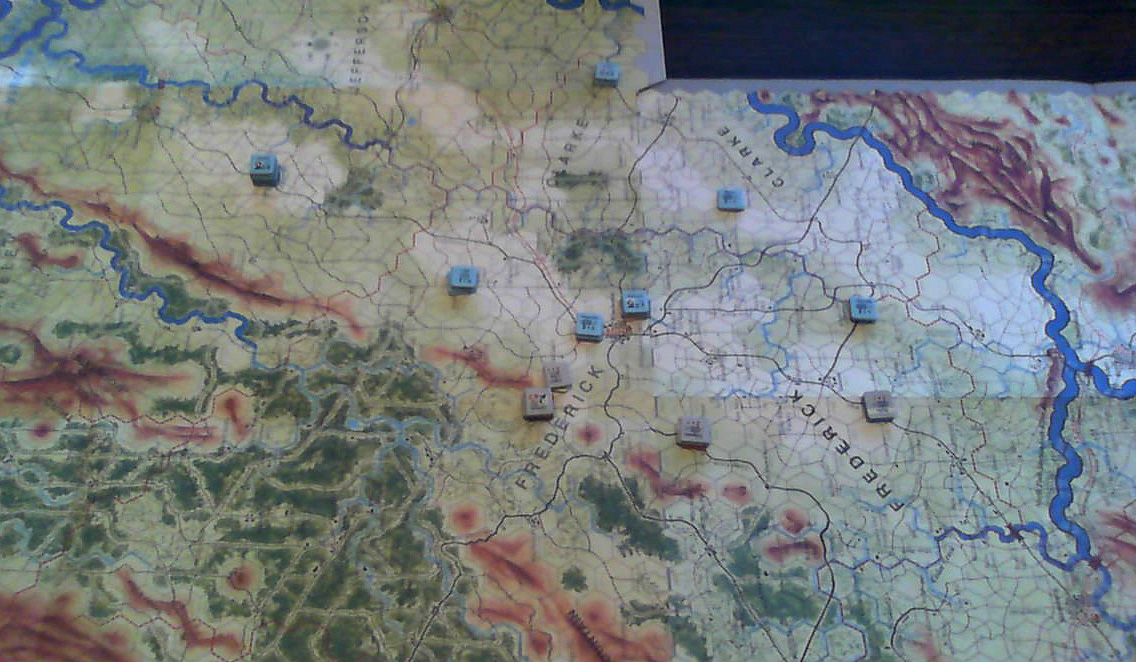
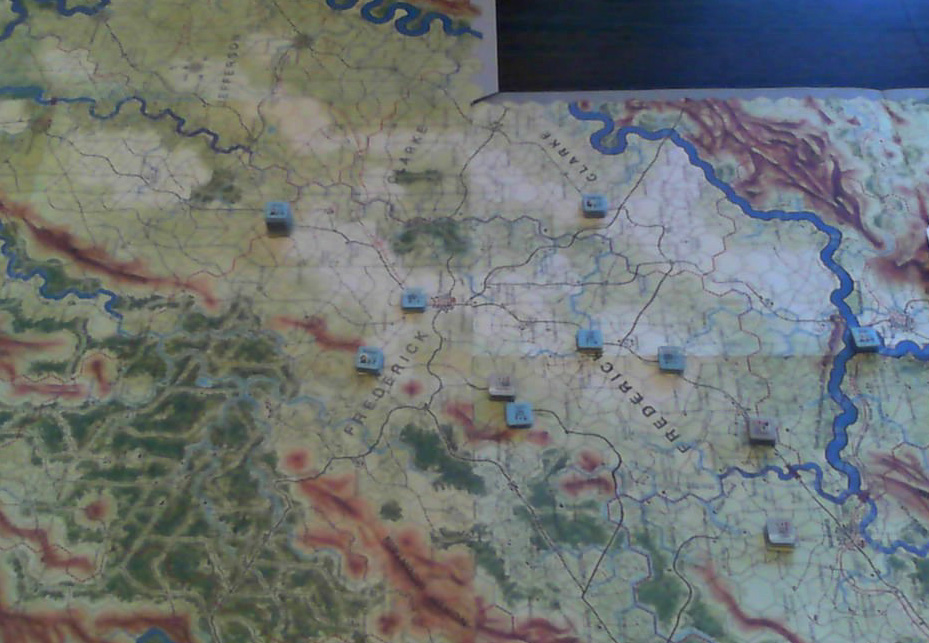
OA24 1F
Situation, French Turn 1. North is to the left, the American setup area started at 19H, and the eventual goal is to exit off of 17R; Orchards are Olive Groves.
↓ Read the rest of this entry…

└ Tags: ASL, gaming, Out of the Attic 2
 Comment 

Space Jutland

by Rindis on May 5, 2013 at 10:52 pm
Posted In: Boardgaming

Had the gang over yesterday for a second go a Space Empires 4X. Jason couldn’t make it, so it was me, Mark, Dave and Patch. The latter two hadn’t played before, so there was some explanations, rules reading, and tiny bits of advice to share from me and Mark.

The four-player game is notably different from the three-player version, because of the reduction in deep space encounters, which leads to a reduction in exploration losses. The game went pretty fast; there wasn’t lots of action, and no truly large fleet actions, but everyone was fairly well developed and trying to feel their way to expand without overreaching.

Dave concentrated on building a large fleet and turtleing early (he figured that was safest while he learned the game), which looked very impressive, and certainly kept me from wanting to mess with him, but it ended up technologically outmoded, and chewing up much of his economy in maintenance. It probably would not have been hard to take him apart, once this was realized.

Mark got adventurous first, and paid the price with constant border squabbles with me and Patch for the rest of the game. This kept him confined to his original ‘safe’ area, and he had troubles keeping that developed.

I ended up pursuing my quality fleet path again, mass producing DDs with Attack and Defense +1 (one of those I got from a Space Wreck), and not having much of a navy until that point. I managed to make do with those until I could get +2/+2 CAs out the door, which served me fairly well, though of course I never had enough. I ended up being the only one to get Movement 2, which helped more than I had thought. I managed to get most of my systems colonized early (and took terraforming early, because my home area barren world was adjacent to my homeworld), and got a couple barrens on my borders colonized and going fairly early. This lead to me having an economic advantage until the end, when Mark got one of my systems and Patch got two others just before we broke up for the day.

Patch had a decent start, but was the main victim of Mark’s first raiding foray. He recovered from that, and actually had quietly colonized three worlds in the center by the end. I only came to that realization late, and did not have anything within one turn’s travel of his worlds (five hexes…). So he ended with the strongest economy as of the ninth economic turn.

Patch had gotten out one BC at the end (used against Dave), while I had built three to try and stop the raiding on my Mark-side border. They caught both Mark and Patch’s forces, and all promptly died to a string of ‘1’s and ‘2’s. (There’s something wrong with our bloody ships today!)

Anyway, everyone enjoyed the game, and had a good time with it. There were some comments on the difficulty of keeping all the hidden information straight, which is a definite problem, but it seems the game is fun enough that everyone is willing to put up with it as the price of entry.

└ Tags: gaming, Space Empires
 Comment 

Nineteenth Century Essay

by Rindis on May 4, 2013 at 12:00 pm
Posted In: Computer games

This is the third in a series of reviews of Paradox’s empire management games. See the earlier reviews here:
Europa Universalis II: A Tale of Two Europas
Hearts of Iron: Europa of Iron

After Hearts of Iron, Paradox turned its attention to the nineteenth century, releasing the empire management game Victoria in 2003. It was not nearly the success that the previous games had been for Paradox, and beyond their usual long-term patch support, there seemed to be little future for the game.

However, in 2006 Paradox announced an expansion that would be primarily available through their new online game store, GamersGate. Victoria: Revolutions took fans by surprise, and revised many parts of the original game, and proved to be a surprise hit for GamersGate, and doubtless helped ensure the future of titles other than Europa Universalis and Hearts of Iron at Paradox. I’ve played both versions, and while the review will mostly talk about the revised version of Revolutions, it will also mention where some changes were made.

As with Hearts of Iron, Victoria is largely the same kind of game as Paradox’s other titles. It is a grand-strategy empire management game with an area-based map of the world, and done in a pausable real-time format. In this case, the focus is largely on internal politics and infrastructure development, with the original game covering from 1836 to 1920, while Revolutions adds 15 years to cover 1920-35, and introduces a number of changes to the basic system.

One important change was an addition to the UI. A number of different notification symbols would appear in the upper left-hand corner of the screen. These alerts warn of budget deficits, production problems, remind you when no research is going on, and so forth. This system was introduced in Revolutions, but became a standard part of the UI in all further Paradox games.

With Great Prestige Comes…

The nations in Victoria are divided into three categories: Great Powers, Independent Nations, and Uncivilized. The former get various benefits, including extra diplomatic ability, while the latter are easily picked on, since their territories are considered ‘colonies’ by civilized powers, and are easier to take by conquest.

Victoria is a little more goal-oriented than previous Paradox games, as there is a score calculated off of a country’s military power, industrial capacity, and prestige. The leading eight countries are the Great Powers, and there is plenty of room for changeover during the game. Prestige is something of a currency in the game, it is gained for events, discoveries, and successful prosecution of a war. Declaring war costs prestige, as well as dishonoring an alliance, and other such activities. Finally, prestige helps the chances of diplomatic deals being accepted.

Uncivilized nations can become civilized by simultaneously hitting benchmarks in military and industrial power, and prestige. Japan can, and often will (aided by events), transition from an uncivilized nation to a Great Power by the end of the game.

Technology

Technological progress is important in Victoria, and is detailed much as it was in HoI. However, this time the entire system is very regularized: There are five basic technological fields (Army, Navy, Commerce, Culture, and Industry), each of which has five sub-fields, and then there are five levels of advances in each of those (with a sixth level added in Revolutions). Only one technology can be researched at a time, and it generally takes a year to get each one.

However, there are three different types of effects that can come from each technology. First, some technologies require other ones be researched first, so research makes those available. Second, there are immediate effects, which can be an increase in army organization, or allowing a new level of province infrastructure to be built. Third, some effects come as events, which will fire at a random time after getting the technology (most events have a time around which they should fire, so if you get a technology late, you may get a bunch of events almost immediately, but if you manage to get it ‘early’, the events will dribble out over a longer period of time).

A little math will show that it is impossible to get all the techs without getting some from other countries (one/year; 5x5x5 = 125 in an 85-year game, or 150 in 100 years for Revolutions…). However, research takes both time and research points to accomplish. If you trade for new technology with a foreign nation, you get it immediately, but still need to spend the research points (to properly integrate it with your infrastructure/culture). If you don’t have the extra research points, your current research halts until the deficit is taken care of.

Research points are generated by your funding, modified by the country’s literacy rate. As funding research also causes the literacy rate to climb, research points slowly go from being insufficient to supply your own needs to generating an excess to use in trading with other nations. In addition, all these points are generated by the population, depending on what type they are. Since one of the primary population types for research is also used in factories (clerks), as your industrialization expands, your research generation will speed up.

Economy

Victoria features a new system of interrelated goods and products as the foundation of the game’s economy. In a sense, this is close to the trade system of EU II, where every province had a product for trade. However, here all such products are raw materials, and then there are factories that turn them into finished (or at least intermediate) products. These products can be traded internationally, like in HoI, though instead of constant offers of trade in kind, countries buy and sell what they want and produce in a singular world market with a cash economy.

In fact, it is much like the trade and production system in Imperialism, and I would like to know if it was inspired by that game, or is just convergent evolution. However, while Imperialism had 18 commodities, Victoria has 47, and they do not all break down into a few separate areas, the way Imperialism‘s did. Moreover, the world market is just a big pool of available items, and there is no option for trade embargoes, preferred trading partners, or the like. On the other hand, the money does not go straight to the treasury (as, after all, the state is not producing or selling the items), but goes to the population, who is then taxed by the government.

Twenty of the 47 goods come straight from the provinces (though oil only becomes available later in the game), and the rest become available by processing suitable materials in factories (one commodity, dye, can come from the provinces, or a factory). Many of these goods are needed for other purposes, like building military units, factories, railroads, and keeping your population satisfied. Unused goods go into a kind of national storehouse, where you can set buy and sell orders (‘buy if I don’t have enough’, ‘sell if I have too much’) at the world market, which acts as a general strategic reserve policy.

Industrialization

A new map concept in Victoria is the state, which is a collection of provinces. There is an easy listing of all the states within your country, and you generally get state information first when clicking on the map (and then province information after clicking again), but the UI for this level is not very good, as it can be hard to perceive the shading of the group of provinces in a state in several map views; also, you cannot easily see which foreign provinces would be part of states that already exist in your country, if the same country owned them.

Factories are of course the primary sign of industrialization in Victoria, and are managed at the state level, instead of the province level. Infrastructure is the other component, and its bonuses for a factory are determined by the average of the level of infrastructure across the state. Also, factories make use of population from all the provinces in the state, unlike the resources, which merely use the population of the local province.

The early sticking point of industrialization is machine parts, which are needed to build all factories, but the only source at the beginning of the game is a single machine part factory in England, so competition for the parts is fierce. However, several industrial technologies give ‘free’ machine parts as well (answering the question of where the first factory came from…). As the middle game starts, more machine parts factories start opening, and industrialization starts taking off.

The other component of industrialization is railroads. Railroads are the primary infrastructure of the province, and improving them will improve the efficiency of resource production and factories, and speed up military movement. Constructing them also (at least in Revolutions) consumes machine parts.

Revolutions takes the unusual step of removing a fair amount of player control from this part of the game. Governments do not generally go about meddling in production and companies directly, so most of the time, you do not get to build factories (state-run economies in socialist or fascist states are an exception). Instead, there is a class of capitalists in each country who save up money (depending on the tax and tariff policies), and when they have enough they build factories and railroads themselves.

The problem with that is you are letting the AI run the supply-side of the economy, and there will be mis-steps along the way. But the AI does judge what is ‘in demand’ (at least partially going off your market orders), and in the long run it ends up doing a pretty good job generating what is needed. Quite possibly, it is no worse than real-life ventures. The other side-effect of this is that the largest money sink in the player’s budget (new factories) is gone, leaving room for the more traditional state-funded province improvements of fortifications and naval bases.

Population

EU II gave the population of each province as part of its taxation model (with wars lowering the population, and peaceful times making it expand faster), while HoI largely ignored population in its production model, other than a manpower pool for recruiting new units. Victoria goes much deeper into the internal demographics of 19th century countries, breaking the populations down by ethnicity, politics, religion and social status, with each block of these called a “POP”. These POPs then have a job (for the working class ones), cash reserves, ‘issues’ (their political agenda), consciousness, and militancy.

At the government level, there is also plurality, which is a measure how much demand there is for democratic and social reforms. There are technologies that cause events that will boost plurality, setting the ball in motion, and a very few that will lower it again. Plurality generally drives up the consciousness rating of POPs, which is a feedback loop, as high consciousness drives up plurality.

Consciousness is a measure of how aware a POP is of politics. A POP with zero consciousness may have a political agenda (issues) at odds with the current power structure, but it doesn’t care. As consciousness rises, it will start wanting the government to address its issues, and will vote (if allowed) in accordance its desires, whereas it will generally vote for the current government at low consciousness.

Depending on the type of government in power, plurality and consciousness have an effect on militancy. Militancy is an expression of ‘unhappiness’ with the POP’s current situation. Militant POPs will either revolt, or emigrate to somewhere better (the game is set up so that POPs will generally want to immigrate from Europe to America).

Politics

Again, Victoria goes into detail not seen in previous games. EU II had policy sliders that made different countries act differently, but the method of government stayed the same. HoI has ideologies that determine what alliance countries end up aligning with. Victoria has a number of governmental forms, and political reforms, along with a political system to determine who is in power.

Government types range from Monarchies and Dictatorships to Democracy. Each country has a number of political parties, with their own agendas on things like citizenship and economic policies (originally, just the historical parties were included, but Revolutions introduced parties for all ideologies in every country). The more autocratic governments can install the party they want, but militancy rises across the country every time it is done. More commonly, an election is held every few years, and during the election season (nine months), there will be a stream of events that will sway opinions of the population of a state towards various political ideals.

There are three main ideologies in Victoria: Conservative, Liberal and Socialist. In the beginning, most countries are deeply conservative, but as consciousness rises, many classes will embrace liberalism. Partway through the game, socialism becomes available, and craftsmen, laborers and soldiers will start converting to it instead. POPs who find their needs are not being met may convert to the extreme version of their ideology: Reactionary, Anarcho-Liberal, and Communist. Revolutions adds a fourth extreme ideology, Fascism, and soldiers who have gone Communist will tend to convert over to it after 1905.

The steady creep of consciousness and plurality can be a ticking time bomb that tears a country apart in a cascade of high-militancy revolts between competing factions. This is a common fate for beginning players, as the beginning symptoms are hard to see (this, too, seems somewhat true to life…).

Military Theory

One of the first things that should happen to most powers in the game is an event caused by the army technology “Post-Napoleonic Thought”. This asks you to choose between following Jomini or Clausewitz for military theory. Many following events will be different depending on the choice made, with Jomini causing advances to emphasize morale and Clausewitz emphasizing organization.

Antoine-Henri Jomini and Carl von Clausewitz were the two most influential writers on military theory in the 19th century, are used here as a somewhat simplified representation of some of the themes of 19th century warfare. Many militaries, including the French, believed that what was needed to win a war was superior élan (ardor or verve), which would hold the army together under the stress of combat until the enemy formation fell apart and broke. Other militaries paid more attention to the details of organization and logistics, though I don’t know if there were any quick summing up of their theory (and equating it to Clausewitzian theory is certainly over-simplifying).

In-game, morale (which stands in for élan) will cause a unit to retreat when it runs out. Organization equates to ‘efficiency’, so that it helps a unit (along with a host of other modifiers) do damage in combat, and it controls the speed at which morale is recovered, and how fast a unit ‘digs in’ while it is standing in a province. In the early going, armies are vulnerable to being forced to retreat from morale loss (especially against cavalry, whose shock attack values can quickly collapse morale), but even Clausewitzian armies will pick up some morale boosts, and as the firepower of infantry increases during the game, defensive bonuses from fortifications and digging in become more and more important, and morale is not enough to win a war. (Personally, while I’ve seen forum complaints about not being constantly forced to retreat as a Clausewitzian army, I’ve never seen it be a problem, even in the very early game.)

On War

Apart from the different tracks that armies can follow, and the separation of morale and organization into two different values, military units work much as they did in HoI. There are three main types of land units, that are recruited as separate divisions: infantry, cavalry, and dragoons (mounted infantry), each of which can have a specialist brigade attached that boosts the statistics and maximum strength.

Most army inventions will improve one or more statistics of a few different types of units, and in all such cases will increase the supply cost for those unit types, so as army units become more capable, they also become more expensive to maintain, and keeping a strong military can become ruinously expensive.

One of the POP types are soldiers, and army units are drawn from these POPs. This also limits how many units can be recruited, as there must be sufficient soldier POPs to support new units. And yes, casualties reduce the size of these POPs, directly impacting the population of the country.

An extra concept to go along with this is mobilization. You can establish a mobilization pool (of four infantry divisions each time it is increased), and when a major war breaks out you can mobilize, which will give you a force of fresh divisions three months later, by converting a number of clerk, craftsmen, laborer and farmer POPs into soldier POPs until you demobilize. This can, of course, severely disrupt an economy as resources and factories go empty to support the war effort (not to mention that these POPs will probably be smaller after the war…).

Like in HoI, these units can be grouped together into armies, and leaders assigned. However, in Victoria there is not one big list of historical leaders, but rather they must be created by using leadership points (which are also needed for some unit recruitment). Leaders will have two different traits, which will determine their actual bonuses for combat. Many leaders will have mostly negative bonuses, but since the ‘default’ leader has penalties in all areas, some leader is almost always better than no leader at all.

Naval units work mostly the same as land units, except that they represent individual capital ships (starting with frigates and men-of-war and working up to cruisers and dreadnoughts and carriers) that can have smaller ships attached to them for stat bonuses. They can be lead by admirals, but do not need to be supported by individual POPs because of the comparatively low manpower requirements.

Finally, occupying a province takes time, instead of being instant as in HoI. It does not use a drawn-out, random siege mechanic, complete with assaults seen in EU II either. Instead, there is just a steady progress of occupying the province which is dependent on the number of occupying troops.

Colonization

The nineteenth century was the last great period of imperial expansionism, and Victoria has a system that ties into the state system, and works very differently from EU IIs. Instead of sending settlers to a colony until the settlement promotes to a city, and turns into a regular province, you stake claims. These are in the form of different colonial buildings that can be built with slightly different effects. Once you have one of each type of building in a state, or all the provinces in a state have one of your buildings, you can claim the colony, and make it an official part of your empire, which grants a high amount of prestige.

It is of course possible to have multiple nations claiming parts of the same state, which can lead to deadlock if no one can claim it through building types. Parts of US territory that were still in dispute are nicely represented by this system at the beginning of the game. However, the diplomatic model allows the buying and selling of territory, so it can be worked out, though the AI is subject to being ‘gamed’ without too much effort.

Revolutions refined the system in several aspects, introducing naval bases to limit where colonies can be founded (as there must be a base in range), and restricting colonization by the habitability index of the province (with various technologies lowering the minimum rating needed to colonize).

History

The event system from previous games is present in Victoria as well, and serves to keep several things on track during the game. It comes across as heavy-handed in a few places where it forces wars that may not agree with the in-game politics.

Worse, while Victoria models much of Europe fairly well, it has many more problems with the United States. Texas is as war with Mexico as the game begins, and almost always loses. The Mexican-American war tends to be out of the scope of the warfare model, so there is an event to enforce the actual treaty borders (in the event that there is such a war and the US wins…). The Civil War is also treated somewhat ham-handedly, with the historical Confederacy generally appearing all at once, and no real treatment of the border states. Similarly, there’s no option for a single war to allow the complete conquest of any but the smallest of nations, so that must be forced as well (and the AI has trouble with this).

The world market is a handy abstraction, but doesn’t account for wars, trade embargoes, or similar things, so much of nineteenth century economic policy is abstracted down to the tariffs in the budget. This makes the trade system much simpler than Imperialism‘s, despite being an otherwise complicated game.

But, many aspects of the game engine seems to do fairly well with the politics of the time, especially in Europe, where the main focus is. The system of event tie-ins to technological progress allow for a number of small essays on the creators of 19th century economic and political thought, helping the usual electronic time-machine feel (though susceptible to the usual ‘click-through-the-flavor-text’ syndrome). More importantly, the map of Europe tends to be fairly stable in Victoria, as in the nineteenth century, though wars are generally more common.

Conclusion

Victoria would be a climax in the development of Paradox’s games, being noticeably more complex than the preceding titles. In turn, it is also a thesis on the forces that drove the 19th century, and has some very interesting things so say. Despite overall poor sales and the release of Victoria II, Victoria still has some die-hard players today, and I think the exceptional ‘historical thesis’ nature of the game is part of what keeps people at it. Sadly, the general fan community has generally died off, leaving the VikiWiki unfinished, and in need of updates for Revolutions, and the main community-developed mod, the Victoria Improvement Project (VIP) was never completely updated for Revolutions either (though I understand it will generally work with it).

I consider it a title I’m very happy that Paradox produced. It has plenty of problems, entire systems that aren’t needed (like the corruption system that I haven’t mentioned because it does so little), and it isn’t necessarily very good at what it tries to model. However, the attempt to show the internal stresses on a government is worthwhile for being so rare, and despite the missteps, and complications, it still makes for a good game that I enjoy.

└ Tags: gaming, Paradox, review, Victoria
4 Comments

Europa Universalis IV Shilling

by Rindis on April 30, 2013 at 9:33 pm
Posted In: Computer games

Okay, I normally don’t do this, but it’s just too tempting:

As you may have noticed, I really like Paradox’s grand strategy titles. I mean, I’ve even started writing a series of reviews of them, that I hope will manage to note just where certain ideas crop up, and trace them through later games. (The Victoria review should be up in just a few days.)

Late last year, Paradox announced the latest game in the series that launched it all: Europa Universalis IV. Right now, they’re launching a ‘spread the word’ campaign, where you get bonuses for getting people to sign up to their newsletter, where they announce upcoming games, and have occasional special deals (I’ve gotten a couple free games through it, though that has dropped off.) Since I’m a sucker for special forum icons, I’ve decided to take part.

So, if you’re one of the 0.375 people who actually read this blog, and have any interest in computer strategy games, go here, and sign up for their monthly newsletter.

└ Tags: Europa Universalis, gaming, Paradox
2 Comments

The Great Sea

by Rindis on April 26, 2013 at 8:21 pm
Posted In: Books

After reading Norwich’s book on Venice, I looked at his other books, and saw one on the Mediterranean that looked interesting. However, most of the reviews for it said it was okay, but Abulafia’s The Great Sea was much better, so I put that on my wishlist instead, and got it for Christmas.

It’s a large, expansive, book, covering from prehistory to the current day (2010). Abulafia purposefully tries to limit the scope of his book by sticking to subjects that impinge directly on the Mediterranean as a whole; the communities on it’s shores, the trade that crosses its surface, the rivalries and the piracy. It is a general history, and doesn’t really have any defining thesis, other than perhaps the one his book is organized around. The book is split into five parts (titled ‘The First Mediterranean’, ‘The Second Mediterranean’, and so on), with each part being about a single economic complex in the Mediterranean.

Many parts are familiar to those familiar with history, but along the way there are plenty of new things to see. I had not known of the ancient ruins on Malta, nor the entire nature of Allied frustrations dealing with French North Africa. The third and second-to-last chapters are depressing, as they cover the destruction of several multicultural communities in the lead up to WWI through the aftermath of WWII. The final chapter takes a quick look at how mid-20th century emigration spread southern Italian cuisine to the rest of the world, and then talks of the impact of tourism on the Mediterranean.

In all, it is a broad book that manages a surprising amount of depth, and an enjoyable read.

└ Tags: books, history, review
1 Comment
  • Page 225 of 308
  • « First
  • «
  • 223
  • 224
  • 225
  • 226
  • 227
  • »
  • Last »

©2005-2026 Rindis.com | Powered by WordPress with ComicPress | Hosted on Rindis Hobby Den | Subscribe: RSS | Back to Top ↑