Rindis.com

All my hobbies, all the time
  • Home
  • My Blog
  • Games
  • History

Categories

  • Books (504)
  • Comics (10)
  • Gaming (918)
    • Boardgaming (674)
      • ASL (155)
      • CC:Ancients (83)
      • F&E (78)
        • BvR – The Wind (26)
        • Four Vassal War (9)
        • Konya wa Hurricane (17)
        • Second Wind (5)
      • SFB (78)
    • Computer games (162)
      • MMO (77)
    • Design and Effect (6)
    • RPGs (66)
      • D&D (25)
        • O2 Blade of Vengeance (3)
      • GURPS (32)
  • History (10)
  • Life (82)
    • Conventions (9)
  • News (29)
  • Technology (6)
  • Video (50)
    • Anime (48)
  • Writing (1)

Patreon

Support Rindis.com on Patreon!
Become a patron at Patreon!

Other blogs:

RSS Inside GMT

RSS Playing at the World

  • Playing at the World 2E V2 Arrives May 5, 2025

RSS Dyson’s Dodecahedron

  • Red Knife Hole July 13, 2026

RSS Quest for Fun!

  • The Expense Post May 24, 2026

RSS Bruce Heard and New Stories

  • Pain, Exhaustion, and Morale in D&D BECMI June 7, 2026

RSS Chicago Wargamer

  • The 2 Half-Squads - Episode 310: Cruising Through Crucible of Steel January 27, 2023

RSS CRRPG Addict

  • Al-Qadim: Over, Sideways, and Under July 13, 2026
SF&F blogs:

RSS Fantasy Cafe

  • The Leaning Pile of Books July 5, 2026

RSS Lynn’s Book Blog

  • Can’t Wait Wednesday: The Thrice Bound Fool (Blacktongue #2) by Christopher Buehlman July 15, 2026
ASL blogs:

RSS Sitrep

  • Cardinal ASL Sins March 18, 2026

RSS Hong Kong Wargamer

  • FT114 Yellow Extract After Action Report (AAR) Advanced Squad Leader scenario April 16, 2025

RSS Hex and Violence

  • This still exists? March 25, 2025

RSS Grumble Jones

  • Grumble Jones July Scenario GJ162 You Will Engage the Enemy July 1, 2026

RSS Desperation Morale

  • How to Learn ASL March 16, 2025

RSS Banzai!!

  • October North Texas Gameday October 21, 2019

RSS A Room Without a LOS

  • [Crossing the Moro CG] T=0902 -- Rough start July 18, 2015
GURPS blogs:

RSS Dungeon Fantastic

  • Felltower - Monsters Fleeing between Sessions vs. PCs replenishing June 28, 2026

RSS Gaming Ballistic

  • B-Scale at the Table July 13, 2026

RSS Ravens N’ Pennies

RSS Let’s GURPS

  • Review: GURPS Realm Management March 29, 2021

RSS No School Grognard

  • It came from the GURPS forums: Low-Tech armor and fire damage January 29, 2018

RSS The Collaborative Gamer

  • Thoughts on a Town Adventures System January 18, 2022

RSS Don’t Forget Your Boots

  • GURPS Supers Newport Academy #7: “Invitation to the future.. of the 1970’s” July 5, 2026

RSS Orbs and Balrogs

  • Bretwalda - Daggers of Oxenaforda pt.4 - Fallen King May 27, 2017

OA25 Side By Side

by Rindis on November 21, 2013 at 12:00 pm
Posted In: ASL

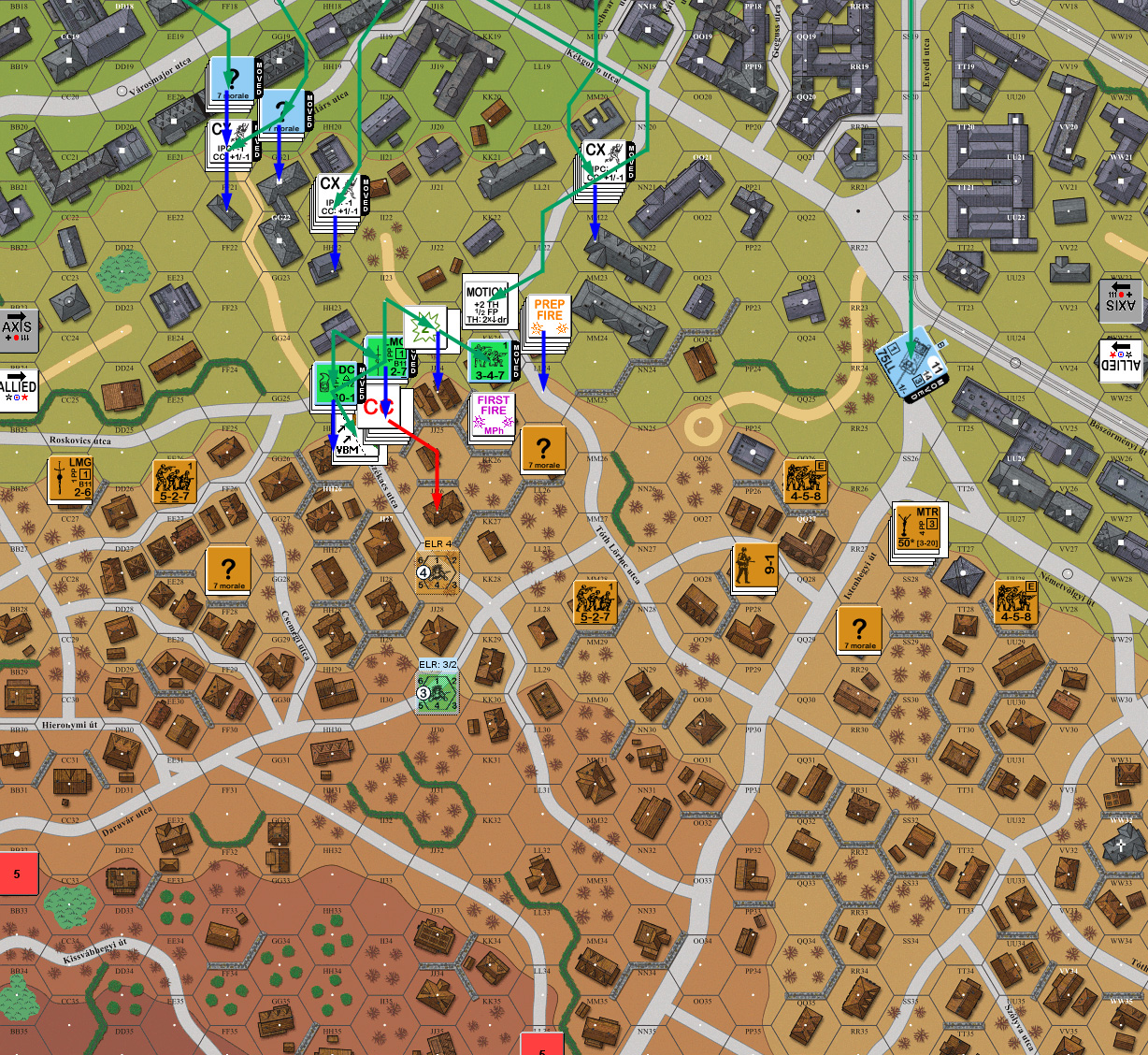
One of the scenarios in Out of the Attic 2 gave me an immediate ‘I’ve got to see this‘ reaction. OA25 features a defense with a combined French-British-American force in 1942 Tunisia. Patch and I initially slotted it for a FtF day, since it looked somewhat short, but then realized we didn’t have all the boards for it.

So, it became our next PBeM game, with Patch taking the defenders with seven French squads and support weapons including a 37mm infantry gun, three and a half British squads, and two American crews manning a .50-cal and a British 25-pounder. They need to protect a bridge for six and a half turns against fifteen elite German squads with the usual toys, a couple 81mm MTR and two flights of Stukas (one of which shows up on turn two, and the other variably, and the both go away after a single turn).

Patch mostly set up in the central board-12 village, with lighter forces holding both flanks. I set up the bulk of my troops to hit the north side, with some cover towards the center, and then a platoon on the south side to make sure he couldn’t afford to pull out of that flank. The terrain is a bit open, but the MTRs are good smoke generators (especially good ones, the Germans are defined as Elite, which gives s9). Sadly, while I didn’t deplete, I didn’t get any ROF, and only one smoke counter went down between the pair.

Movement went fairly well for me, with minimal fire, and while his French 60mm MTR never exhausted ROF, I passed all the morale checks it caused. Patch’s MMG malfunctioned, but his Brits got a 1KIA result which Yahtzeed to kill a squad and 8-0 and destroy a DC.

OA25 1G
Full map, German Turn 1. North is to the left.
↓ Read the rest of this entry…

└ Tags: ASL, gaming, Out of the Attic 2
 Comment 

Two Rounds of Thyreatis

by Rindis on November 19, 2013 at 9:57 pm
Posted In: CC:Ancients

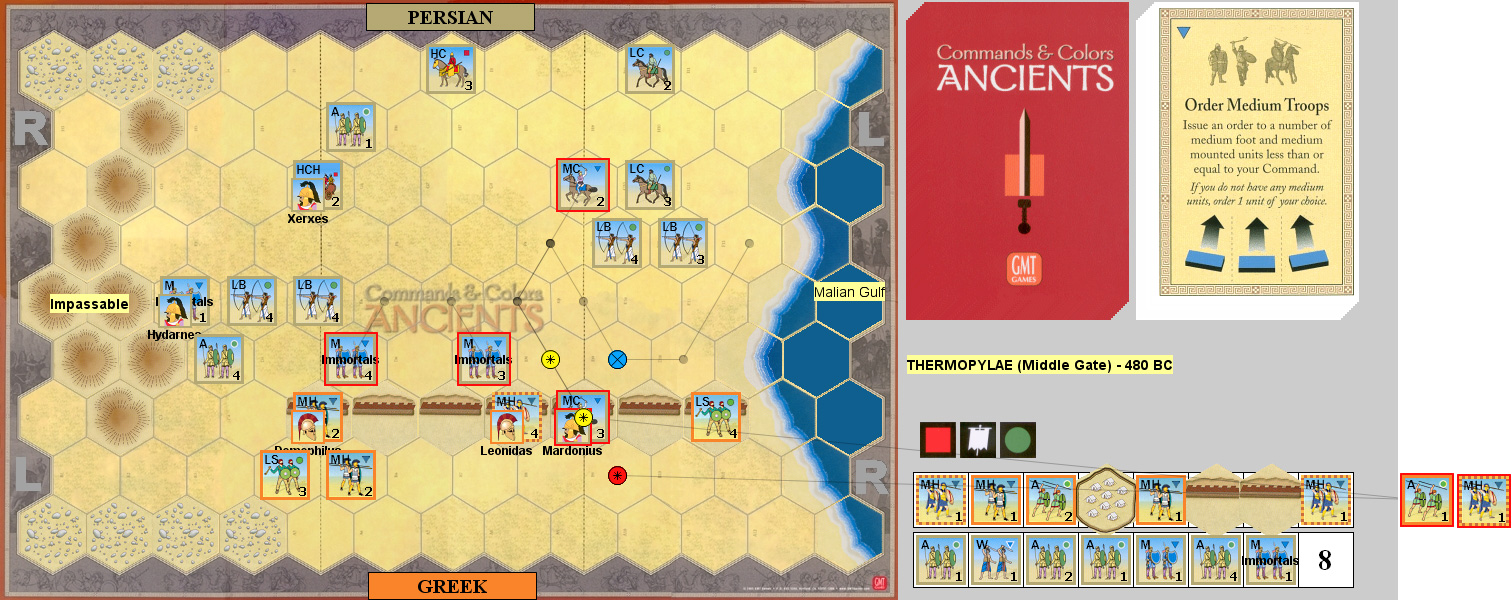
Patch and I had our regular between ASL games bout of Commands & Colors: Ancients tonight. This time was the battle of Thyreatis in 545 BC. It’s a very unusual battle from Expansion 6. First of all, both sides are almost entirely made up of Medium Hoplites, with most of the Spartan side being the special 5-block version. Second of all, the battle kicks off with the ‘battle of champions’. There are eight extra MH blocks from each side, and both players roll two dice to try and cause casualties. This is repeated until one side is down to one or two blocks, and then the survivors are attached to regular units (generating 5-block Argive MH and 6-block Spartan MH). The winner of that battle then goes first in the main one.

I had the Argives the first time around, and eventually won the battle of champions after thirteen rounds. (Patch had a 8-5 lead to start, and I was wondering if it was going to be a complete blowout before his dice went cold for a final 3-2 result.) I had mostly left and right cards, so I boosted both flanks, while Patch piled on his right. Both of us started by cycling cards, and I advanced my flanks into a crescent formation, before detaching my Aux into archery range. With a bit of luck I managed to reduce his right-flank unit from 6 blocks to 4 before the lines made contact.

Patch Double Timed to catch my right Aux and kill it. I Ordered Mounted to bring my right side up and pick on his weaker left flank (where the normal 4-block Spartan allied hoplites are), and Patch countered with a Mounted Charge to nearly kill three of my units (one block left each) and chase off the remaining Aux (three banners!) at a cost of eight blocks. With four units in contact (three of them the one-block survivors), I played Clash of Shields to kill off three units at a cost of one (to a First Strike) and another weakened to one block. Patch Ordered Center and finished off my right flank (and leader), and got the fifth banner in the main line. 3-5

Thyreatis 1

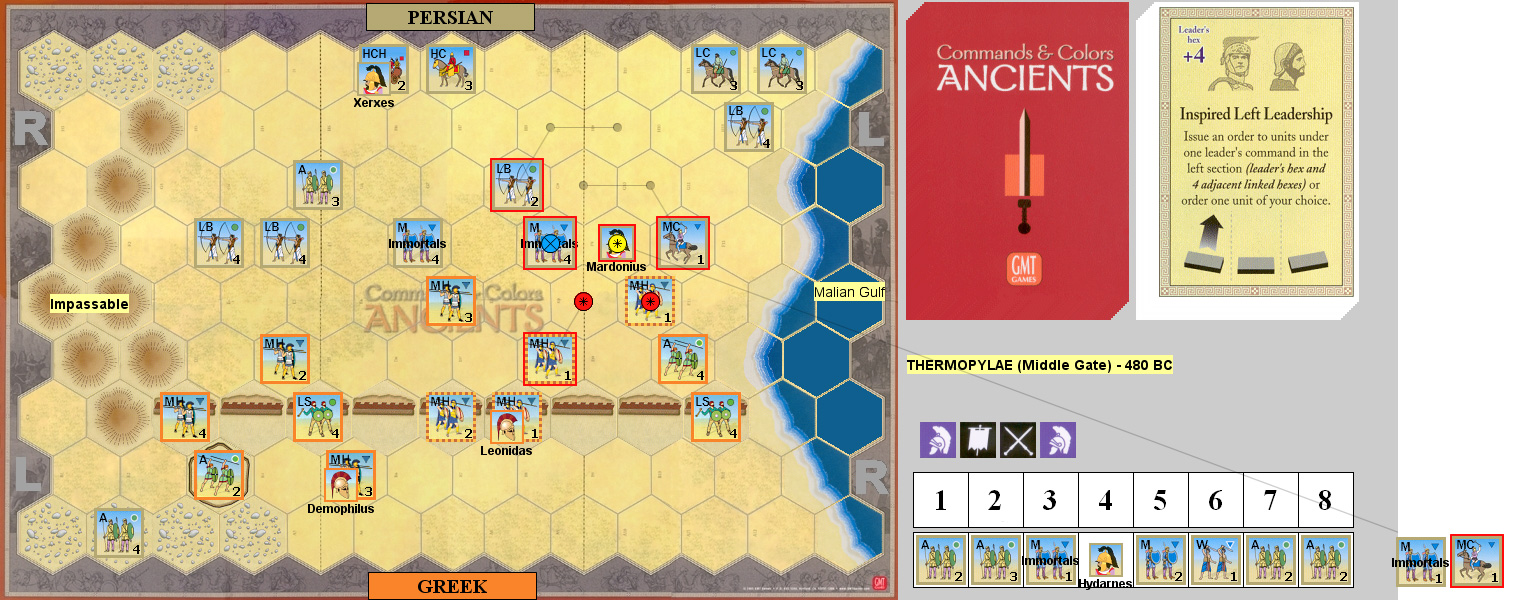
The second round went faster, with the Spartans losing the battle of champions 2-3 in seven rounds. I had a couple center cards this time, so I put the extra blocks in the middle of the line, while Patch spread them out. I started by cycling cards, getting an Order Med (my second) after playing Order Heavy, and a Order Three Center (second of those, too) after playing Order Two Center. Combined with a Leadership Any Section, I was confident in my ability to maneuver my army as I saw fit.

The problem is, there’s not a lot to be done with fancy maneuvers in this battle. The units generally can only go one hex per turn, and both sides have lots of leadership. I cycled a Move-Fire-Move to dress my line, and drew Clash of Shields. If I could live long enough to use all these cards, I could do whatever I wanted. Patch dressed his line too, but had one unit back in reserve. I used Line Command to bring all of my line in contact with most of his (the Argives have two more units than the Spartans), and the demolition derby began. Picking my targets, I got two of his units, and forced his Aux back with one block, while only one of my units was depleted, and one more forced out of line with a pair of banners.

Patch countered with Mounted Charge, and knocked out two units, having reduced two others to two blocks, and a third to one. However, the entire center and left of his line was down to one block apiece, and an Order Mediums took care of that. 5-1

Thyreatis 2

It’s an interesting battle, but there’s a lack of subtlety thanks to the fact that everything is so slow and nearly as effective. It seems like it should be fairly even, though the Spartans do have a one-card advantage, so I’m not sure what to make of the pair of Spartan wins.

└ Tags: C&C Ancients, gaming
 Comment 

More Waterdeep, Less North

by Rindis on November 11, 2013 at 9:08 pm
Posted In: D&D

There have been three main centers of activity in Ed Greenwood’s own Forgotten Realms campaigns. Two of them, Shadowdale and Cormyr, are in the central area well covered by the original boxed set. The third, the great city of Waterdeep, is a bit north of the focus area, and was the primary subject of the first setting supplement from TSR, FR1. It has appeared many times in the years since then, in adventures, such as part of the Avatar trilogy, later supplements (such as City of Splendors: Waterdeep) several novels, and even one of the Catacombs adventure books (Knight of the Living Dead).

It contains the usual 64-page sadle-stiched book, with a three panel separate cover, with a small map of Waterdeep on the third panel, and is backprinted with a schematic map of the wards of the city, the main sewer system, and some typical building interiors; this only takes up the two main panels, and the third is blank. Also included is a keyed poster-sized map of the city.

One of the first chapters in the book grants it it’s ‘and the North’ title, giving a rough guide to trade and important locations in the area. The North is generally defined as the area between the Sword Coast and the great desert of Anauroch from the latitude of Waterdeep on north. The problem is, that the geography talked about is more detailed than is available in the boxed set, and there’s no map in the module to guide you, making the entire chapter very confusing reading. FR5 The Savage Frontier would eventually cover the same ground (and partially quote these entries), with a pair of poster-size maps covering the region in detail.

Dragon #128 includes the article “Welcome to Waterdeep”, which had been cut from the supplement and details the area near the city. The module would have been better off to cut the entire chapter on the North, and include this material instead. It would have better aided the focus of the rest of the text, and the map of the area would have easily gone on the blank interior cover panel. I have a feeling that the decision to cut it was already long made when layout of a map of the North advanced to the point that it was realized that the entire region doesn’t quite fit in one 30 mile/inch poster map. Also, the publication of The Crystal Shard may have caused TSR to decide to do a separate module on the North, that could also include the Icewind Vale area.

The bulk of the supplement focuses squarely on Waterdeep itself, and is very well done, with a few problems. It is obvious that Ed had a bunch of material to present for this, and efforts were made to fit it all in, with the main text being a smaller font than normal (about 9 point), with some parts being an extra-small 7 points. A brief history of the city is given, wrapping up with some current news, before turning to the nature of government. The main government is sixteen lords, whose identities are kept secret behind robes and (anti-magic) masks, except for a high-level paladin who serves as the primary public face of government. This is all too idealized to be really believable, with the lords honestly working for the overall benefit of the city with clarity and foresight, and the protected identities not only protecting them from plots in general, but allowing them to be recruited from all levels of Waterdeep society, keeping the government in touch with the needs of the lower classes. However, there are political maneuverings from the nobles (not detailed) and the guilds (better detailed), so not everything is ideal all the time.

A large section of the book is a key to nearly 300 buildings, giving the name of the establishment, the general type of place, with occasional other details. This accounts for perhaps 5% of all the buildings shown in Waterdeep (probably less), and leaves plenty of latitude for the DM to establish his own residences and businesses (and perhaps borrow a few from the CityBook series…). Along with the standard taverns and inns are guild houses, noble villas and fences.

The main problem with the approach taken is that while a DM can sit down with the book and map, and really study an area, and get to know the neighborhood the party is based in, it is horrible at questions such as ‘where is the nearest inn?’ There’s no easy list of such establishments, so a party randomly asking after something in a random location (which of course they will) has to be met with either a lot of looking up possibilities or just making up a nearby one (which is perfectly fine… but the purpose of a supplement like this one should be not to need to do this).

The biggest problem is the amount of flavor that is buried away, where it can be easy to miss. If you look through the listings, you will note that there’s a bunch of tanneries located in the southeast corner of the Dock Ward. Tanneries generally stank to high heaven, so they were forced to exist in one corner of medieval cities to keep stench away from the rest of the city. But none of this is pointed out in the book, so if you don’t know this bit of trivia (and most people don’t—I certainly didn’t in 1987), nor sit down with the map and key to see the pattern, a bit of the logical flavor of the city will be lost, never to emerge in play. The fact that wooden buildings are restricted to one story by law, and anything taller (as most are now) must be made of stone is buried in the description of the Guild of Stonecutters, Masons, Potters & Tile-Makers.

The best part of Waterdeep is that it physically feels right. The city stops at the city wall, which even with edicts against building against the walls seems unlikely, and the few hints of farms and the like outside the walls seem to include a village with no marked path to the main road. But inside the walls, the streets both run straight and branch off in random directions that feel right for a living, evolving city.

In all, this really is a good springboard for urban adventures, and feels like it’s possible to DM such a large and diverse city without it feeling completely foreign to the original intent. This is a tall challenge, and one not often tackled in fantasy RPG writing. Despite the problems, there’s a lot here, and it fits together well, and I have to think this is one of the better city supplements that has been done.

└ Tags: D&D, Forgotten Realms, gaming, review, rpg
 Comment 

Elminster on Moonshae

by Rindis on October 27, 2013 at 1:57 pm
Posted In: D&D

When TSR adopted the Forgotten Reams as it’s new main setting in 1987, the Moonshae Islands became one of the most prominent locales in the setting, absorbing along the way the Korinn Archipeligo, which had been the setting of module N4 (which had not been tied to the Forgotten Realms at the time). The first Forgotten Realms novel was Darkwalker on Moonshae, which was successful and turned into a trilogy, and the second Forgotten Realms setting supplement (FR2) released shortly afterwards was all about the islands.

Generally speaking, the setting echoes strongly Dark Ages England, with the islands split between the generally Celtic Ffolk, and the obviously Norse Northlanders (I will note that the Ffolk are decidedly Welsh rather than Irish, though the Norse never settled strongly in Wales as they did in Ireland and Germanic-dominated England). A truly interesting wrinkle of the setting was that the Ffolk had a strong druidic tradition worshiping the Earthmother, which was a Gaia-like goddess of the land, rather than the standard Greco-Roman style anthropomorphic deity of D&D mythos.

Sadly, the Goddess was killed off in Darkwell, the third novel of the trilogy (sorry if that’s a spoiler), needlessly reducing the interest of the setting. Since that time, there has been one adventure set there (Halls of the High King), and one further set of novels set there (the Druidhome trilogy), neither of which I am familiar with, and no new supplements focused on the area.

The module itself followed the usual format of the time of a 64-page book printed in the usual Forgotten Realms brown ink with faux-parchment pattern background, with a detached cover. Since there’s no printing on the interior of the cover, and this isn’t an adventure where the cover is separate to act as a DM screen, this is just useless force of habit. There is also a double-sided poster map, with one side depicting the Moonshae islands in the same 30-mile per inch scale as the smaller scale maps of the original boxed set, and is meant continue those maps one panel to the west. Since the isles only take up about half the map at that scale, the reverse is a beautiful map of the Moonshaes at a 20-mile per inch scale. (It should also be noted here that TSR changed color schemes at this point, with much darker colors here and all future FR-series maps than what the boxed set had used).

About half the book is dedicated to an area-by-area description of the islands, broken up by the small kingdoms that exist in the isles. These use the same ‘At a Glance’, ‘Elminster’s Notes’, and ‘Game Information’ format as the original Cyclopedia in the boxed set, but this time Elminster’s notes are the tales of his journey through the islands about a decade previous, and take up the bulk of the section. In fact, the book is dominated by pure fiction, with Elminster’s voluminous tale, and parts of Darkwalker on Moonshae used to introduce all the other sections of the book. This is fairly effective at communicating mood and feel, but is inefficient at getting anything else across, and there there is a dearth of real NPC information, or other detail. In fact, there is but one detail map in the entire volume, a small map of Synnoria, the hidden vale where the Llewyrr (Moonshae’s own offshoot of the elves) live.


Region the FR2 map covers, showing its overlap with the gray box’s detail maps.

That said, the book starts with a decent overview of Moonshae, including availability of races and classes in the region, common conflicts and dangers, a section on trade routes through the area, and what each area produces. There is a section on weather (rainy—almost always), and discussion of the various types of terrain seen in the isles, including random encounter tables for each terrain type (I’m a bit surprised to see Ki-Rin—oriental-style unicorns—showing up in Welsh highlands though). There’s some new magical items at the end of the book, which all make sense for the setting (though the Cauldron of Doom is an obvious, and apropos, shout-out to the Black Cauldron of Chronicles of Prydain fame), and a sparse page of adventure ideas.

Between the fiction and several pages with leftover space, this is the least information-dense setting supplement I can think of. There one real layout disaster, where one section lost some text (it begins in the middle of Elminster’s story after a previous page finished the At a Glance cleanly; there’s some empty room on the previous page that could probably have taken what’s missing), but otherwise no editing problems came to my attention. George Barr does some very nice graphite illustrations for the book, though that too has a problem. A picture of what seems to be Caer Corwell does not follow the description, and is just bad siege engineering to begin with (which is a problem TSR had in general).

In all, the setting is a great idea, the book shows how it is a great idea, but doesn’t do much more than give the barest of starting points for exploring it, though it is good for establishing tone and mood.

└ Tags: D&D, Forgotten Realms, gaming, review, rpg
 Comment 

The Age of Religious Wars

by Rindis on October 24, 2013 at 8:37 pm
Posted In: Books, History

Part of the Norton History of Modern Europe series, this is a good introductory history of a fairly turbulent period written in 1970. I’ll note that the series was apparently reorganized later, as there is a 1979 version of the book that runs to 1715 instead of 1689.

The book starts with the end of international conflict, and runs through the internal crises that beset most of Europe in the later sixteenth century. In so doing, it lays some groundwork that would have helped me with parts of Braudel’s Mediterranean in the Age of Philip II. It spends a fair amount of time showing the evolution of political structure, with the rise of absolutism in France, the failure of absolutism in Spain, the rise of constitutional government in England, to the dissolution of central power in much of Central Europe and Russia.

Despite the title, there’s not a lot of warfare here. Everything from the Hugenots to the Glorious Revolution is discussed, and gives a fairly solid understanding of why things happened for such a small volume. There is a good chapter on the limitations of pre-modern production, and how it limited the economy, and the end of the book gives a whirlwind tour of the trends in art and evolution of the sciences.

In all, if this is a period where you don’t have a lot of background knowledge (and it was never a popular period in my classes), this is an excellent and clear place to start.

└ Tags: books, history, review
 Comment 
  • Page 227 of 315
  • « First
  • «
  • 225
  • 226
  • 227
  • 228
  • 229
  • »
  • Last »

©2005-2026 Rindis.com | Powered by WordPress with ComicPress | Hosted on Rindis Hobby Den | Subscribe: RSS | Back to Top ↑