Rindis.com

All my hobbies, all the time
  • Home
  • My Blog
  • Games
  • History

Categories

  • Books (504)
  • Comics (10)
  • Gaming (918)
    • Boardgaming (674)
      • ASL (155)
      • CC:Ancients (83)
      • F&E (78)
        • BvR – The Wind (26)
        • Four Vassal War (9)
        • Konya wa Hurricane (17)
        • Second Wind (5)
      • SFB (78)
    • Computer games (162)
      • MMO (77)
    • Design and Effect (6)
    • RPGs (66)
      • D&D (25)
        • O2 Blade of Vengeance (3)
      • GURPS (32)
  • History (10)
  • Life (82)
    • Conventions (9)
  • News (29)
  • Technology (6)
  • Video (50)
    • Anime (48)
  • Writing (1)

Patreon

Support Rindis.com on Patreon!
Become a patron at Patreon!

Other blogs:

RSS Inside GMT

RSS Playing at the World

  • Playing at the World 2E V2 Arrives May 5, 2025

RSS Dyson’s Dodecahedron

  • Scavengers’ Deep – Map 33 July 16, 2026

RSS Quest for Fun!

  • The Expense Post May 24, 2026

RSS Bruce Heard and New Stories

  • Pain, Exhaustion, and Morale in D&D BECMI June 7, 2026

RSS Chicago Wargamer

  • The 2 Half-Squads - Episode 310: Cruising Through Crucible of Steel January 27, 2023

RSS CRRPG Addict

  • Game 581: Dragon Quest (1982) July 15, 2026
SF&F blogs:

RSS Fantasy Cafe

  • The Leaning Pile of Books July 5, 2026

RSS Lynn’s Book Blog

  • Friday Face Off: The Raven and the Reindeer by T Kingfisher July 17, 2026
ASL blogs:

RSS Sitrep

  • Cardinal ASL Sins March 18, 2026

RSS Hong Kong Wargamer

  • FT114 Yellow Extract After Action Report (AAR) Advanced Squad Leader scenario April 16, 2025

RSS Hex and Violence

  • This still exists? March 25, 2025

RSS Grumble Jones

  • Grumble Jones July Scenario GJ162 You Will Engage the Enemy July 1, 2026

RSS Desperation Morale

  • How to Learn ASL March 16, 2025

RSS Banzai!!

  • October North Texas Gameday October 21, 2019

RSS A Room Without a LOS

  • [Crossing the Moro CG] T=0902 -- Rough start July 18, 2015
GURPS blogs:

RSS Dungeon Fantastic

  • Felltower - Monsters Fleeing between Sessions vs. PCs replenishing June 28, 2026

RSS Gaming Ballistic

  • B-Scale Detail and Examples July 16, 2026

RSS Ravens N’ Pennies

RSS Let’s GURPS

  • Review: GURPS Realm Management March 29, 2021

RSS No School Grognard

  • It came from the GURPS forums: Low-Tech armor and fire damage January 29, 2018

RSS The Collaborative Gamer

  • Thoughts on a Town Adventures System January 18, 2022

RSS Don’t Forget Your Boots

  • GURPS Supers Newport Academy #7: “Invitation to the future.. of the 1970’s” July 5, 2026

RSS Orbs and Balrogs

  • Bretwalda - Daggers of Oxenaforda pt.4 - Fallen King May 27, 2017

Guns, Germs, and Steel

by Rindis on January 17, 2017 at 12:00 pm
Posted In: Books

To a certain extent, I’ve always wondered why Guns, Germs, and Steel caused such a huge splash. The main premise boils down to ‘differences in geography cause differences in societies and their history’, which belongs to the club of the blindingly obvious.

Of course, the real point of the book is to pin down just which differences are the important ones. This is a cause for much arguement, but Diamond has successfully pulled out the most important ones as applied to history as a whole. This largely turns into a study of what plants and animals were successfully domesticated in early prehistory, and how that turned certain areas into the origin of settled agriculture. That is still fairly basic stuff, but benefits greatly from studying the results from all around the world all at once, and examining just what it takes for something to be capable of being domesticated. (I know there’s been some interesting work done on that since this book came out, but I haven’t seen it escape scholarly journals in more detail than a National Geographic article.)

From there, Diamond points out how plants and animals are generally adapted to a certain climate, and that while it is fairly easy to find different climates going east and west (due to cold mountains, dry deserts, wet coasts, and other accidents of geology), large differences of climate are guaranteed when traveling any real distance north and south. Looking at a map and noting that the Americas and Africa are divided into north-south zones, while Eurasia is oriented east-west, then provides material to show why certain areas needed to work everything out independently, while others were able to borrow everything they needed from elsewhere (before the Age of Exploration, the two situations were probably somewhat even by landmass; the book naturally spends much more time looking at the former).

The main thing that makes this book new is actually the ‘germs’ part of the book. It is only fairly recently that we’ve really become aware of where most of the deadly diseases we have to deal with come from—other animals. So societies that have and live closely with lots of domesticatible animals get to suffer from deadly epidemics when an occasional virus adapts to a new host (us), and then develop some level of immunity to it. When people who don’t have much/anything in the way of domesticated animals run into people who do, they die off as multiple epidemics run through the countryside. This is the other ‘new’ part—the fact that a lot of Native American population was wiped out by disease is well known, but it’s been hard to realize the scale of the disaster. The “Mound Builders” were a disappeared pre-Columbian civilization of the Mississippi valley, and only recently has it been realized it was actually wiped out by European diseases before any Europeans got there to see it.

The ‘guns’ and ‘steel’ parts of the book are essentially non-existent. They just serve as part of the proximate cause of how Europeans came to dominate the world before turning to look for the ultimate causes back in prehistory. This is where his biases as a biologist who’s picked up a fair amount of practical cultural anthropology show. While he does discuss technology, and the fact that the wider the range of where you can get ideas from, the more ideas you will be able to encounter, he doesn’t spend any time looking at the basics of physical technology. A basic study of easily available copper, tin, iron, and clay deposits, compared with the areas that were able to develop settled agriculture could explain much that remains mysterious to him.

It’s decidedly a layman’s book, and has the advantage of being aware of more current research than any pre-college textbook. The fairly breezy, non-technical writing is set off by a good number of informative charts and maps and allow Diamond to make his points without miring himself in the minutia that would lose the non-dedicated reader. Just being able to tackle most of pre-history in a single reasonably-sized volume is an impressive feat of summarization, and the most impressive thing about the book.
└ Tags: books, history, reading, review
 Comment 

A95 The Long Road

by Rindis on January 13, 2017 at 12:00 pm
Posted In: ASL

I got a sudden call from Patch on Saturday, saying that he was in the area, and didn’t have anything to do during the day. So, he came on over, and we started figuring out what to play. Quickly settling on ASL, we started looking through the most recent Journal, but most everything we looked at needed boards I didn’t have. So I pulled out Annual ’96, and we found “The Long Road” dealing with the British campaign in Vichy Madagascar in late ’42.

I randomly picked the Brits, and Patch figured out a setup for the Vichy forces. They defend board 5 with six squads, a pair of MMGs and four hexes of wire; everything in concealment terrain can be HIP, but they suffer from Ammo Shortage. The Brits are looking to exit 16 VP off a three hex area in 7.5 turns, and have 10 squads, some LMGs, and two armored cars with ATR main armament (I never bothered firing them, sticking with the CMG the entire time). Looking online now, I see that looks pretty tough on the defending Vichy, but the balance of trading a MMG for a HMG probably wouldn’t have helped here. It probably needs to be cut down a turn, and then some other adjustments made.


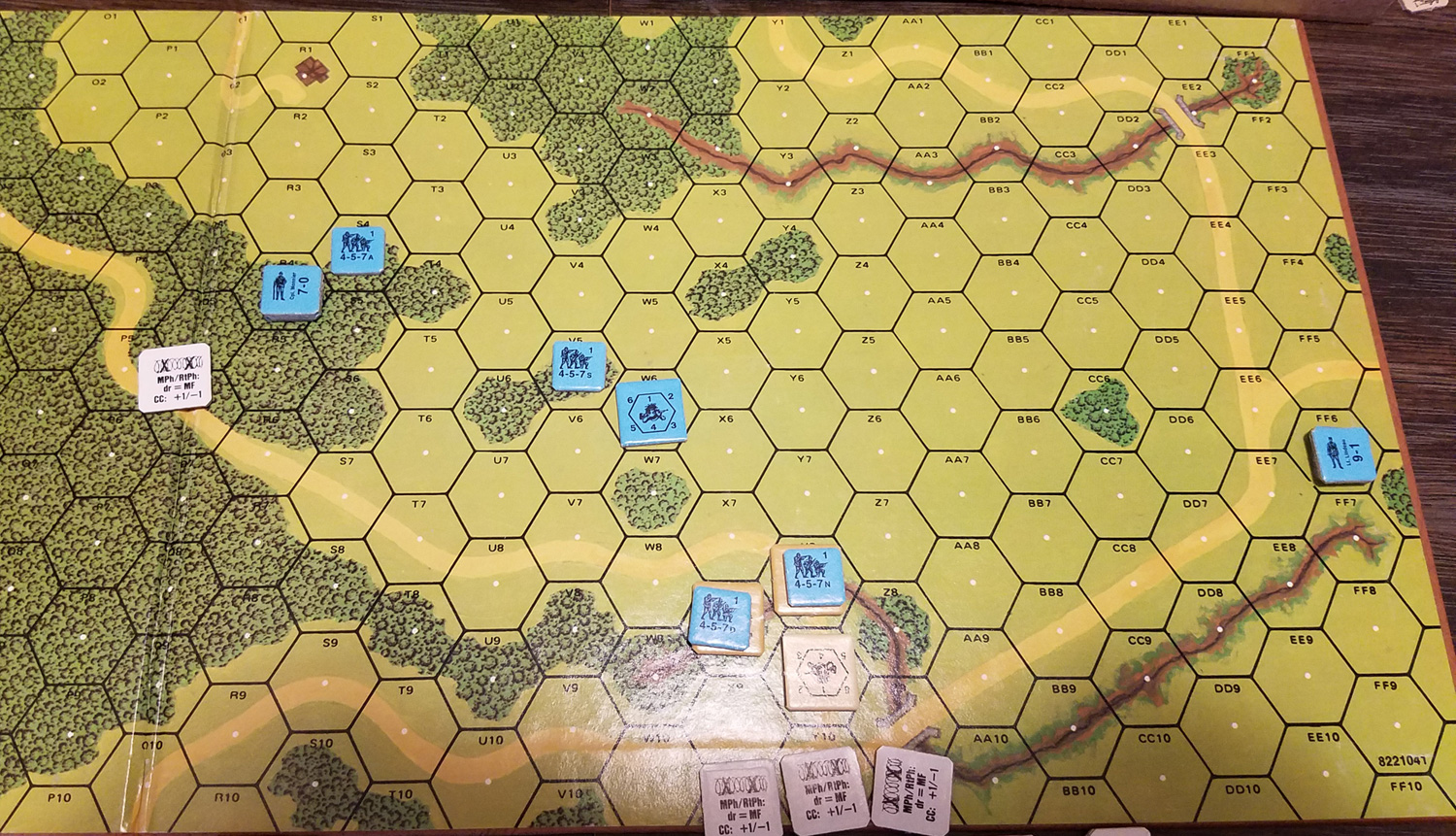
Patch’s reference photo of his setup. Note: there are no bridges in this scenario.

The Brits can come on within two hexes of any one x1 road hex, giving three entry choices. The furthest one (I1), requires going through most of the board 5 woods, and Patch blocked the road with the fourth wire hex (with the other three on the exit hexes; I imagine that just about every game features that setup). The closest one (Y1) features a lot of open ground, with just a gully for cover near the entry. So I went for the middle area (Q1), which is also open, but the woods close in enough to protect it from most of the rest of the board, and there’s good cover nearby. The ACs were to break out of that little area, while at least some of the infantry was to gain the woods on the other side of the clearing and head straight down, hopefully flanking the bulk of the defenses out in the open areas of the board.
↓ Read the rest of this entry…

└ Tags: Annual 96, ASL, gaming
 Comment 

A Free Man of Color

by Rindis on January 9, 2017 at 12:00 pm
Posted In: Books

I know of Barbara Hambly for her various epic fantasy stories, so a historical murder mystery was a bit of a surprise for me.

As a historical story, it’s great. It’s obvious that Hambly spent a lot of time and love getting the feel of 1833 New Orleans. The novel does travel outside the city a bit, and since geography does have some bearing on the plot, I’d actually like a map of where everything is. But mostly, it is about society, or the various different micro-societies existing alongside each other, and the change of eras. The major problem of the book is that the cast of characters is large, including a good number of people observed and talked about, but not really an active character. Include the fact that most of the names are in unfamiliar French… and much of the middle of the book sinks under the weight of names, especially if you’re reading it alongside other things, like I did.

As a mystery…. Well, I don’t read many of those, so it’s harder to say. Certainly, I didn’t guess things ahead of time. But the realization that untangles the knot of plot threads, and sends the book hurtling towards the end is well done, as is the ending itself, though it is a bit too laden with secrets coming out.

At any rate, it is the best writing I’ve seen from Hambly (which is not a surprise, since I’ve mostly read her early books), and confirms that I really need to follow her more closely.

└ Tags: books, historical, mystery, reading, review
 Comment 

SL294 Operation Stabilize

by Rindis on January 5, 2017 at 12:00 pm
Posted In: SFB

Crossposted from the SFU blog on BGG

Just as Patch and I were gearing up for an SFB battle in Y159, I got Captain’s Log #42, which featured a scenario set in Y158. Mark and I found time to give it a try this last Monday, since we were both still off work for New Year’s. We had a lot of catching up and chatting to do, which was great, but did hold us to only getting four turns in.

One particular action early in the operation involved two Hydran frigates: the Brazen and the newly commissioned Catkiller. The Catkiller was one of the first of the new hellbore-equipped ships. The two frigates were returning after not having found anything worth attacking when they picked up a small Lyran convoy nearing a base station. The frigate commanders diverted to attempt to destroy the convoy before it could reach the station. The convoy’s escort, a Leopard destroyer, had been called away to another location during the earlier stages of the Hydran raids. Those Hydrans had been driven off before it arrived. It returned to its original mission just in time to attempt to protect the freighters from the Brazen and Catkiller long enough for the convoy to get under the umbrella of the base station’s weapons.

It’s yet another battle that features early use of the new hellbore torpedo, though it doesn’t headline the scenario the way it does for “Where Wisdom Fails” or “Catching Hell”. We had to review the hellbore/ESG interaction rules, since they just haven’t come up for our group before. The setup is on two maps, with the freighters about 50 hexes from the base station, and the DD actually a few hexes in front of them, while the Hydrans come on the board 26 hexes away from the freighters and slightly in advance of them. While the BS’s ph-4s can reach that far, they don’t do much (or possibly any) damage at that range, and lending EW only works out to 15 hexes, so it’s mostly an appropriate ‘end goal’ for much of the game. Victory is with a unique schedule of points that mostly revolve around destroying cargo boxes on the freighters.

Mark had the Hydrans went fast the first turn, 21, while the DD went 15 with one overloaded disruptor, and the freighters kept together at speed 10 (which is the best the F-S can do without turning off fire control completely). The initial pass weakened shields, and I did a few internals to the CU, knocking out a phaser and a little power, but no more than that.


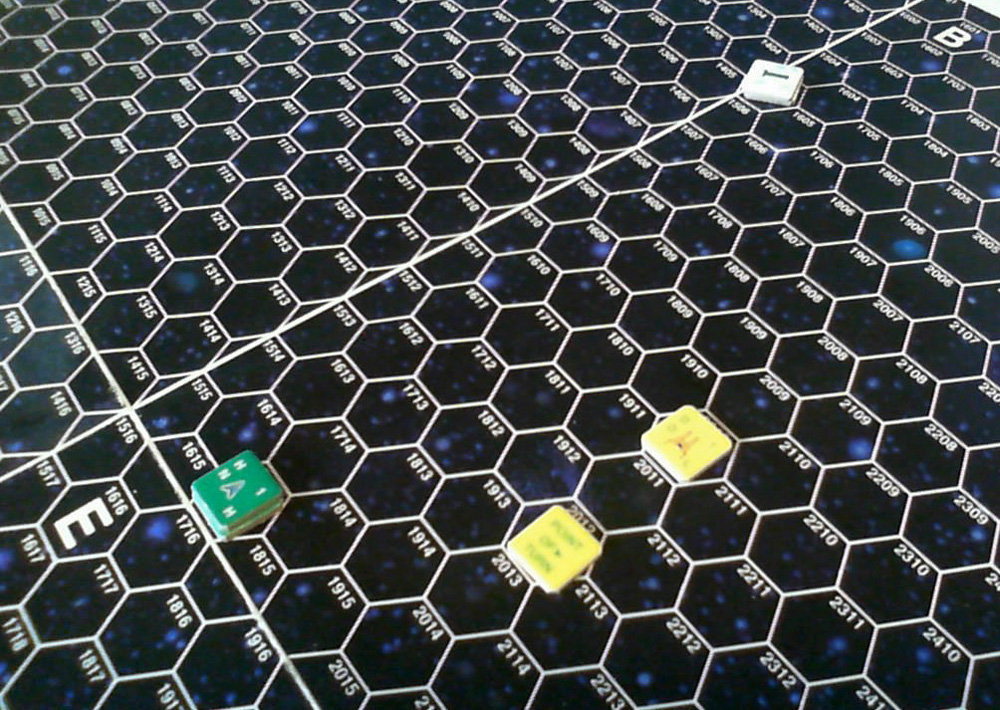
The main action after Turn 1.

The second turn featured some slowing down to charge everything up. I interposed the DD between the Hydrans and freighters, and was about to announce the ESG to force him to turn off (since the hellbore had fired last turn) when Mark did so anyway. In the maneuvering that followed, he got a few internals on the DD and took out a disruptor and the ESG, which gave him greater freedom to maneuver.


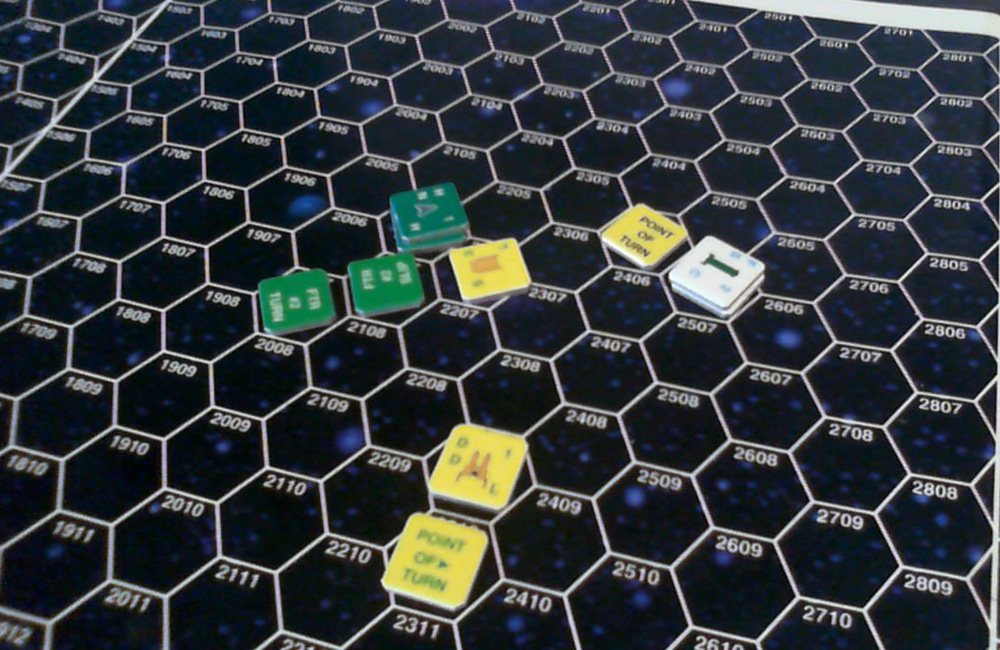
End of Turn 2.

Mark pounded the small freighter during turn 3, and completely depowered it. The main action over the next turn was grabbing the large freighter in a tractor and trying to haul it back away from the BS, since it was nearly to range 15, where it could loan ECM, and the ph-4s on the base would get even more dangerous. However, this was a slow process, as the F-L was larger, and still going at a good speed. Given a little time, he could depower it some more to help, but the DD would eventually come back to help. Meanwhile, the DD had tractored the F-S, and was hauling it closer to the base.

It’s hard to say just where the scenario was going at the point where we had to leave it. Certainly, if Mark managed to completely destroy the F-L, he’d have 93 points (including destroyed cargo on the F-S), but both of his ships had been damaged, for a final total of 83, and a Tactical Victory. However, since the DD was in generally good shape (though with two down shields), it would not be that easy. Quite likely, at least one of the frigates would be crippled, which would drop him down to 68 points and a Marginal Victory. If I drove him off with the F-L, say, half-destroyed, that’d be… (call it 28 cargo vs. two crippled frigates) -8 for a Tactical Defeat. I’d say we were headed for a draw or Marginal Victory for him.

It’s hard to properly protect the freighters, but Mark was rightly worried about the fact that they were getting closer to the BS (which is why he tractored the F-L). Sacrificing the DD will actually work if it can buy enough time to save the freighters. Mark got lucky that the ESG was hit early, before I had a chance to use it, but the HN had taken 14 internals, and the CU had taken 21, including the hellbore, and the Scanner was down to ‘5’. The DD had taken 11, but its shields were in better shape, and it was about to repair the second disruptor as a range-10 version. It’s easy to ignore the BS in the early game, but it should be taking some potshots with the ph-4s and the disruptor, while keeping self-generated ECCM up.

└ Tags: bgg blog, gaming, SFB, Y158
 Comment 

2016 in Review

by Rindis on January 1, 2017 at 12:00 pm
Posted In: Life

This year’s main goal for the blog was to have a new post up every 3-4 days, and to spread out any ‘clumps’ to maintain an even posting schedule. I mostly stuck to that, though there were a couple times in January where the gap stretched out to six days, and a two-week period in July with no posts, largely because I was ill, and not doing much. The idea is to build up a small (probably rotating) reserve of posts that I can schedule into the dead spots, and that hasn’t really happened. Most of the time, I’m posting right on top of deadline. So this year, the goal is to get the schedule a little more stable. A count of the posts says I did 91 this year, which is down from 2015.

Taking a quick look at the categories involved, I had 29 in Books, 12 GURPS, 11 Boardgaming, 6 D&D, 5 each Four Vassal War, BvR – The Wind, ASL, 4 each MMO, CC:Ancients, Anime, 2 each F&E, SFB, and 1 each in Life, Computer Games, and Comics. Folding those up the subcategories gives 12 in F&E, and 29 in Boardgaming, 18 in RPGs, and 5 in Computer Games. I may need to split up the Books category some (fiction and non-fiction, most likely).

One of the things hurting the posting schedule is a lack of gaming. Communication has been breaking down in the FtF group, and Bel’s been busy, so the near-monthly feed of F&E updates has gone dry. I’m doing some PBeM ASL, but that takes a while, and is a lot of effort to write up. I’m thinking that I need to find something new to slot into the dance card. I’d prefer either something a little smaller, or something that’s worth reporting on in 1 (or 2-3) turn chunks like F&E is. So, I’m thinking of trying for some EFS or OCS games, or maybe GCACW. I’d also like to try out the Der Weltkrieg series. We’ll see what happens.

As I just implied, not a lot of gaming happened this last year. Similarly, board game purchasing has been down this year, and all I got was the new ASL Journal, an impulse on-sale buy of Osmanli Harbi, a gift of Hakkaa Päälle!, and the issues of Captain’s Log that made it to PDF. I haven’t done a lot of computer gaming either (though I’ve just about finished up a full game of Europa Universalis IV; no small feat!), and the major purchase there is a 2DS and Pokemon (and that’s about the only thing bringing spending into line with other years). You can see the full details here.

The major purchasing attention has been GURPS, even though I’m not really getting any closer to doing anything with that than at the beginning of the year. I can blame the robust GURPS blogging community for the attention, which has helped keep it in my scattershot brain through much of the year. Further, doing some worked-out spells and creatures has helped fill out a lagging schedule some, giving me a practical incentive. Lately, the fact that I’ve done some work has put me in mind to actually see it in motion, but I keep being wishy-washy on what I want to do.

I hit my Goodreads goal of 52 books read this year (one a week; and I actually hit 53), though that includes a number of modules and graphic novels that I generally don’t count as they’re so short. My “Reading Through History” project is mostly bogged down with new books on earlier eras, but I’m up to the 1730s now. As usual, the annual visit to my parents and Christmas have left me over-full on to-read physical books again, which I’ll spend the next few months trimming back down. I’d say the main reading highlights of the year were Peter the Great (Massie is always very good), The Name of the Rose (which actually has some problems, but is still a very interesting read), and Zita the Spacegirl, which is a very fun graphic novel.

So the year’s goals are to do over 100 posts again, get more wargaming done, and read more books. …Fairly typical actually.

└ Tags: life
 Comment 
  • Page 177 of 315
  • « First
  • «
  • 175
  • 176
  • 177
  • 178
  • 179
  • »
  • Last »

©2005-2026 Rindis.com | Powered by WordPress with ComicPress | Hosted on Rindis Hobby Den | Subscribe: RSS | Back to Top ↑