
Rindis.com

All my hobbies, all the time
  • Home
  • My Blog
  • Games
  • History

Categories

  • Books (504)
  • Comics (10)
  • Gaming (918)
    • Boardgaming (674)
      • ASL (155)
      • CC:Ancients (83)
      • F&E (78)
        • BvR – The Wind (26)
        • Four Vassal War (9)
        • Konya wa Hurricane (17)
        • Second Wind (5)
      • SFB (78)
    • Computer games (162)
      • MMO (77)
    • Design and Effect (6)
    • RPGs (66)
      • D&D (25)
        • O2 Blade of Vengeance (3)
      • GURPS (32)
  • History (10)
  • Life (82)
    • Conventions (9)
  • News (29)
  • Technology (6)
  • Video (50)
    • Anime (48)
  • Writing (1)

Patreon

Support Rindis.com on Patreon!
Become a patron at Patreon!

Other blogs:

RSS Inside GMT

RSS Playing at the World

  • Playing at the World 2E V2 Arrives May 5, 2025

RSS Dyson’s Dodecahedron

  • Scavengers’ Deep – Map 33 July 16, 2026

RSS Quest for Fun!

  • The Expense Post May 24, 2026

RSS Bruce Heard and New Stories

  • Pain, Exhaustion, and Morale in D&D BECMI June 7, 2026

RSS Chicago Wargamer

  • The 2 Half-Squads - Episode 310: Cruising Through Crucible of Steel January 27, 2023

RSS CRRPG Addict

  • Game 581: Dragon Quest (1982) July 15, 2026
SF&F blogs:

RSS Fantasy Cafe

  • The Leaning Pile of Books July 5, 2026

RSS Lynn’s Book Blog

  • Friday Face Off: The Raven and the Reindeer by T Kingfisher July 17, 2026
ASL blogs:

RSS Sitrep

  • Cardinal ASL Sins March 18, 2026

RSS Hong Kong Wargamer

  • FT114 Yellow Extract After Action Report (AAR) Advanced Squad Leader scenario April 16, 2025

RSS Hex and Violence

  • This still exists? March 25, 2025

RSS Grumble Jones

  • Grumble Jones July Scenario GJ162 You Will Engage the Enemy July 1, 2026

RSS Desperation Morale

  • How to Learn ASL March 16, 2025

RSS Banzai!!

  • October North Texas Gameday October 21, 2019

RSS A Room Without a LOS

  • [Crossing the Moro CG] T=0902 -- Rough start July 18, 2015
GURPS blogs:

RSS Dungeon Fantastic

  • Felltower - Monsters Fleeing between Sessions vs. PCs replenishing June 28, 2026

RSS Gaming Ballistic

  • B-Scale Detail and Examples July 16, 2026

RSS Ravens N’ Pennies

RSS Let’s GURPS

  • Review: GURPS Realm Management March 29, 2021

RSS No School Grognard

  • It came from the GURPS forums: Low-Tech armor and fire damage January 29, 2018

RSS The Collaborative Gamer

  • Thoughts on a Town Adventures System January 18, 2022

RSS Don’t Forget Your Boots

  • GURPS Supers Newport Academy #7: “Invitation to the future.. of the 1970’s” July 5, 2026

RSS Orbs and Balrogs

  • Bretwalda - Daggers of Oxenaforda pt.4 - Fallen King May 27, 2017

Destroyer Demolition Derby

by Rindis on February 6, 2017 at 12:00 pm
Posted In: SFB

Crossposted from the SFU blog on BGG

Somewhat to my surprise, after Patch and I finished up “Arctic Crossroads” he suggested an SFB game. He wanted smaller ships, and something other than Klingons, so I looked to a Kzinti-Lyran fight (appropriate as they’re also involved in the Four Powers War right now) with squadrons using ships smaller than CAs.

The Kzinti produce their first Destroyer in Y159 (our current playing date), and I certainly wanted to show it off, as I don’t think it appears in many scenarios. It’s mostly known as an ‘also ran’ ship, as production is halted in favor of the later Medium Cruiser, and it is relegated to second-line duty during the General War. But right now, it is brand new, and effectively the one of the most advanced designs around, and certainly the best ship the Kzinti have for the tonnage. At a Move Cost of 1/2, it has 24 power, 2xdisruptors, 4xph-1, 2xph-3, and 4xdrone racks. This is more power and firepower than the larger Light Cruiser class, which it is effectively replacing (the CL will be refitted to have more power, more disruptors, and bring its drone racks up to 4, but that’s a few years away still). It shows a shift from ph-3 to ph-1s, and an increase in drone throw weight (eventually, just about all Kzinti ships have at least four drone racks, but until now, that’s only been true on the much larger CS/CA/CC hull as well as the seven racks on the much larger DNE).

Then I chose a Lyran Light Cruiser to lead the opposite squadron. It has the exact same BPV as the DD (after adjusting for the lack of ESG capacitors), and while larger with more internals, and it has slightly better phasers (4xph-1, 4xph-3), coverage isn’t quite as good, and its shields are slightly weaker than the DD’s.

Both sides’ squadrons were rounded out by a pair of frigates, which also happen to have the exact same BPV, and fairly similar characteristics. Patch, as it turned out, went for a full load of Type-II (speed 12) drones, with no larger Type-Vs, for a total cost of 16 BPV. I vaguely contemplated taking some transporter bombs, and I should have, but neither of us took any.

We set up, and rolled randomly for Weapon Status (with a +1 for a war zone), and ended up with WS III. That was to my advantage, as the Kzinti don’t have any multi-turn weapons, and it meant my ESGs were already fully charged. I also had a suicide shuttle pre-charged on the CL. The Kzinti squadron went speed 15 for the first turn, as did my CL, while my FFs went 16. We simply closed the range for the first half of the turn, but the DD turned off at about range 25. During impulses 28-30, we fired as ships hit range 15. I stuck to disruptors, which all missed with six straight 5s. Patch launched half his drones on each ship, and volleyed all his disruptors, which all missed with three 6s and a 4, while four phasers he fired also missed on “better” rolls (two 3s and two 4s). On impulse 32, I turned towards the Kzinti FFs to see if could engage them separately from the DD.

With ranges coming down fast, I decided to put power into overloads on CL, and EW on the FFs, and went speed 9 for the CL and speed 13 on the FFs. Meanwhile, Patch sped up to 19 on his FFs while the DD stayed 15. Patch was surprised I hadn’t boosted speed as well, which I had considered, but I wanted to be prepared for a close-range pass (and the FFs stayed on regular disruptors in case something like this happened). Sadly, I only had slightly better EW than Patch, but it meant I would have even shots at his FFs while everyone else was at a +1 to fire at each other.

Patch’s FFs turned off on Impulse 4, confirming my fears that he would just dance around my slower-moving squadron this turn. On Impulse 10, I turned towards the gap between Patch’s forces and starting warming up an ESG to tackle the wave of drones that was in there. To my surprise, Patch turned his DD in shortly after, allowing me to get closer to it. Things started coming to a head on Impulse 15, when my FF-1 started sweeping the drones with its ESG, and my FF-2 and the DD traded shots. Both ships hit with one disruptor, and missed with the other, and had similar phaser rolls, though the ph-2s on my FF led to less damage being done.

On Impulse 18, I turned towards the DD, as it turned back away, launching its last two drones for the turn (the other racks had staggered fire over the previous few impulses). The DD scored another 4 points on the front shield of FF-2 with the 360-phasers, while the CL did 15 points to shield #3 of the DD, hitting with both disruptors and one good phaser roll (a second phaser missed entirely…). The next impulse, FF-2 announced its ESG, and I fired another three phasers at the DD. FF-1’s phaser missed, but the remaining ph-1s on the CL both rolled 1s to knock down the shield and do 5 internals, including a ph-3 and two power. That was pretty much it for the turn, though on Impulse 28, the two Kzinti FFs fired disruptors at my FF-1, with one hitting, and on the next couple impulses, they launched drones.
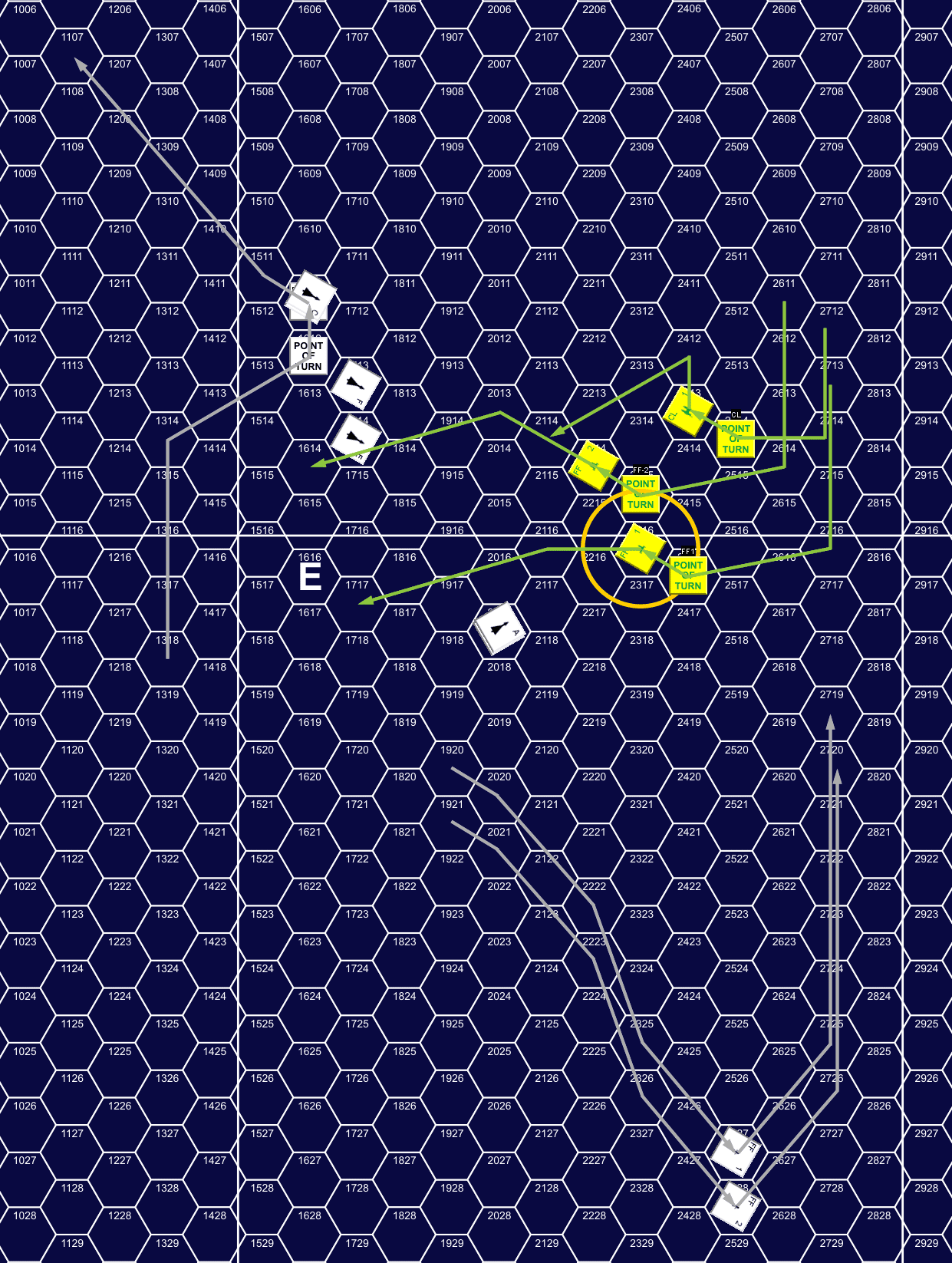

Turn 2, Impulse 18, showing movement throughout the turn.
↓ Read the rest of this entry…

└ Tags: bgg blog, gaming, SFB, Y159
 Comment 

The Tyrants of Syracuse: Part 2

by Rindis on February 2, 2017 at 12:00 pm
Posted In: Books

The second half of Jeff Champion’s history of Syracuse picks up right where the the first left off: The death of Dionysius the Elder and the ascension of his son, Dionysius the Younger as Tyrant of Syracuse. He uses this split as a convenient excuse to avoid using ‘the Elder’ and ‘the Younger’ while each is actually in office, since the change in ‘default’ occurs across the books. And it actually works.

From there, the book details the next two decades in Syracuse dealing trying to get rid of Dionysius the Younger. The careers of Timoleon and Agathocles are also well covered, as well as Pyrrhus’ campaigns in Sicily, Hiero II, and the fighting in Sicily during the first two Punic Wars. Champion points out the shift in Syracuse’s fortunes when the expansion of Rome into southern Italy and Sicily puts the city between two much larger powers. Until that point, Syracuse consistently held sway over most of Sicily, and could successfully fight off Carthage, even though neither side could ever truly conquer the other. Once Rome was on the scene, Syracuse became distant third to the two major powers in Sicily. The book’s epilogue wraps up with a quick overview of Syracuse’s history since being conquered by Rome, including the shift of power in Sicily from Syracuse to Palermo.

For some reason, the editing in this volume broke up for a few chapters in the final third of the book, with some missing words, and sentences that had been incompletely rewritten. But then the problems went away again at the end, and I didn’t see any problems for the bulk of the book. Other than those hiccups, it’s a good book on an interesting subject that doesn’t get a lot of attention, just like the first volume of the series.

└ Tags: books, history, reading, review
 Comment 

MA Style: Hanosa

by Rindis on January 29, 2017 at 12:00 pm
Posted In: GURPS

Having recently gotten and read through GURPS Martial Arts, I thought I’d try writing up a new style.

The Terukai set out to colonize new worlds with giant slowboat colony ships. One particular ship eventually made landfall on a lushly inhabitable planet, but for some reason, the industrial base never set up correctly, leaving the colonists to build an agricultural society largely on their own, and tales of their origin have faded into the dimmest of legends.

One of the few high-tech resources left from the original ship are a set of fabricators of miniature forcefield generators. They aren’t horribly rare (they have no moving parts and last a long time), but maximum coverage tends to be a couple square feet, so protecting anything large is difficult (and there’s usually not much point), but working them into a suit of armor is easy, setting up a few to mutually reinforce for a ‘force-shield’ is common, and they can also be configured to form the edge of a weapon. Such comparatively lightweight protection has made ranged weapons (bows and guns) less popular, and most fighting is dominated by melee weapons.

In addition, various forms of weapon arts are very popular, and there are regular tournaments between popular champions. These tournaments use ornate and fancy (and often fairly skimpy) protective armor, that are well laced with forcefield generators providing complete coverage. Weapons are kept on ‘blunt’ settings, which keeps them from easily penetrating the fields, and minimizes damage when they do—all while still providing an exciting light show for the audience.

The most popular of these sports is Hanosa, which uses a long, narrow, straight sword with a crosspiece (a Thrusting Bastard Sword; B271, 274, LT54, 66, 70), and a reinforced Force Buckler.

Hanosa 4 points

This is actually a family of related styles, only some of which concentrate exclusively on formal tournament dueling, and this entry tries to cover the main points of the spectrum of different schools. Thanks to the forcefield-based equipment, serious injury is difficult, and tournaments put fewer restrictions on non-Sport skill-users than normal.

Perhaps surprisingly, the style is largely defense-oriented, with users usually sticking with Defensive Attacks and Evaluate until an opportunity can be found or made for a Committed Attack, or something flashier. Tournaments are all about sword-play, so various dirty tricks and unarmed strikes are disallowed; strikes are allowed anywhere but the head, but as a pragmatic consideration, attention is focused on the upper body. Non-tournament oriented schools do teach various dirty tricks, and head strikes, but the usual emphasis is on bringing the lower body into play, and training in various kicks.

Serious practitioners are expected to dedicate their life to the art (in tournaments, deadly combat, and in study), which includes learning how to make their own equipment. Any true ‘master’ is supposed to be able to make a sword and armor as good as can be found from a dedicated armorer/weaponsmith—this mostly just gives those very few who can master all three arts bragging rights over the rest! (Note that most ‘armors’ created this way are generally harnesses to put force field generators on (which does still require the Armory (Body Armor) skill), plus protection for important/vulnerable areas such as the vitals and hands. Swords are generally crafted by dedicated weaponsmiths, though many students do learn the basics and could assist in crafting one.)

Naturally, legendary masters not only possess superior fighting skills, but hand-craft the legendary weapons that they’re known for. Combat-wise, tales talk of parrying missile weapons of all types, acrobatic mastery of battlefields, fending off hordes of opponents, and most of the other usual feats. One prominent legendary master was blinded halfway through his career, and still bested all his foes!

Skills: Broadsword or Broadsword Sport; Shield (Buckler); Two-Handed Sword or Two-Handed Sword Sport.

Techniques: Armed Grapple (Any weapon skill in style); Bind Weapon (Any weapon skill in style); Choke Hold (Two-Handed Sword); Close Combat (Any weapon skill in style); Counterattack (Any weapon skill in style); Disarming (Any weapon skill in style); Feint (Any weapon skill in style); Retain Weapon (Any weapon skill in style); Spinning Strike (Longsword); Sweep (Two-Handed Sword); Targeted Attack (Two-Handed Sword Thrust/Arm); Targeted Attack (Two-Handed Sword Thrust/Torso-Chinks in Armor).

Combinations: Broadsword Deceptive Attack/Torso + Two-Handed Sword Swing/Arm; Shield Beat/Weapon + Broadsword Thrust/Torso.

Perks: Acrobatic Feints; Form Mastery (Bastard Sword); Grip Mastery (Longsword); Skill Adaptation (Bind Weapon defaults to Two-Handed Sword).

Cinematic Skills: Blind Fighting; Precognitive Parry.

Cinematic Techniques: Roll With Blow; Timed Defense.

Optional Traits

Secondary Characteristics: Improved Will.

Advantages: Combat Reflexes; Enhanced Block; Enhanced Dodge; Enhanced Parry (Any weapon skill in style); Fit.

Disadvantages: Code of Honor (Duelist), Overconfidence.

Skills: Acrobatics; Armorer (Body Armor)/4^; Armory (Melee Weapons)/4^; Jumping, Karate (plus the Kicking technique); Short Sword.

Perks: Weapon Bond.

Notes: Why, yes… this is all derived from an attempt to figure out a setting where ‘bikini armor’ made sense. (Thank you, Johji Manabe….) Terukai aren’t human, but they’re close enough to it for government work (and roles in Star Trek). I don’t have an entirely clear picture of how the style works, so it’s a bit fuzzy around the edges, though this has already helped focus some thoughts. The swords in use here should use regular Thrusting Broadsword stats with an Armor Divisor of (2) when on, but regular damage and crushing damage when off, and crushing with -1 damage in ‘tournament mode’ (and if it isn’t obvious, this isn’t a lightsaber; this is a regular sword, but the blade is generated by forcefield emitters lining where the regular blade would be). One forcefield generator configured for defense probably provides one square foot of coverage with DR 3 and reduces Armor Divisors by one stage. They’re generally either linked up for larger coverage or greater DR.

I’ll also note that this probably isn’t too far off of what Sword Dancing from Jennifer Roberson’s Tiger and Del books looks like. You’d need to strip it down to just Broadsword/Broadsword Sport, and use COH (Alimat), and past that… I’d have to read the books again. I’d expect a heavier emphasis on the acrobatic parts.

└ Tags: gaming, GURPS, Martial Arts, rpg, theorycrafting
1 Comment

Digger

by Rindis on January 25, 2017 at 12:00 pm
Posted In: Books

The problem with reviewing this is that I don’t know where to start….

Digger is one of those rare things from the world of webcomics: A small project that bloomed into a larger story, and then came in for a successful ending. (Projects that don’t successfully do this aren’t rare in any medium, but only webcomics let you see the process of wandering around trying to find the plot. In other mediums, failures don’t get published very often.) This process took a mere eight years and ~760 pages, collected into six volumes.

I jumped in the deep end with the full collected omnibus. It is now the largest graphic novel I own (yes, beating those legendary Cerebus ‘phone books’—those are only ~500 pages).

Digger echoes Bone in its use of a variation of the Visitation Fantasy where the start of the story is the main character wandering into a new and strange locale, and you never see the character’s original home. Unlike Fone Bone, Digger-of-Unnecessarily-Convoluted-Tunnels talks about her home quite often, and it helps provide defining contrast to what the setting of the story is like.

The central plot structure is The Big Quest, but it takes some doing to get there. In the meantime, the small little area Digger is in provides for more than enough conflicts, and Newhart-style comedy to be going on with.

I’d certainly like to see more of this world. We get an idea of what wombat burrows are like, we see a hyena tribe, we meet a god or two, we see… almost nothing of a human village that’s in the middle of the geographical area the story is in, though we do meet a few humans (including one that currently has a deer head). We hear of dwarves, but don’t see any. There’s a lot of very dangerous territory between Digger and her home, and it takes a lot of arcane knowledge to travel much of the distance safely. It’s a world filled with potential stories.

And a good amount of anthropology (furry-pology? zoopology? eh, heck with it), with the origin myth of hyenas explaining why females are bigger and the first child often dies. Fumbling attempts at ethics. Fortune-telling slugs.

It’s big, and it rambles, and the end is slightly disjointed, and it’s still an excellent story.

└ Tags: books, fantasy, furry, graphic novel, reading, review
 Comment 

Dungeons & Sorcery Spells 5

by Rindis on January 21, 2017 at 12:00 pm
Posted In: GURPS

It’s been a bit since the last set, but here’s ten more spells for GURPS Dungeons & Sorcery. They’re a mixed bag of low-level spells, but there is something of an emphasis on invisibility.

Acid Arrow (SC)
Conjuration, Somatic, Verbal
22 points
Casting Time: 2 seconds
Casting Roll: Innate Attack (Gaze) to aim.
Range: 200 yards
Duration: Instantaneous

This spell launches an acidic projectile at its target, doing 1d+1 corrosion damage if it hits. The acid will continue to work after hitting, doing another 1d+1 damage after 10 seconds unless it can be washed off or diluted in the meantime. There are normally no distance modifiers for this attack.

Innate Attack: 1d+1 (cor; Cyclic, 2 cycles, 10 seconds, +50%; Increased Range, x2, +10%; Long Range, (LDM) +50; Requires Gestures, -10%; Requires Magic Words, -10%; Sorcery, -15%; Takes Extra Time, x2, -10%) [1.65×13]
↓ Read the rest of this entry…

└ Tags: Dungeon Sorcery, gaming, GURPS, rpg, Sorcery, Thaumatology
1 Comment
  • Page 176 of 315
  • « First
  • «
  • 174
  • 175
  • 176
  • 177
  • 178
  • »
  • Last »

©2005-2026 Rindis.com | Powered by WordPress with ComicPress | Hosted on Rindis Hobby Den | Subscribe: RSS | Back to Top ↑