Rindis.com

All my hobbies, all the time
  • Home
  • My Blog
  • Games
  • History

Categories

  • Books (491)
  • Comics (10)
  • Gaming (911)
    • Boardgaming (669)
      • ASL (154)
      • CC:Ancients (83)
      • F&E (78)
        • BvR – The Wind (26)
        • Four Vassal War (9)
        • Konya wa Hurricane (17)
        • Second Wind (5)
      • SFB (78)
    • Computer games (161)
      • MMO (76)
    • Design and Effect (6)
    • RPGs (66)
      • D&D (25)
        • O2 Blade of Vengeance (3)
      • GURPS (32)
  • History (10)
  • Life (82)
    • Conventions (9)
  • News (29)
  • Technology (6)
  • Video (48)
    • Anime (46)
  • Writing (1)

Patreon

Support Rindis.com on Patreon!
Become a patron at Patreon!

Other blogs:

RSS Inside GMT

  • Meet The Han: A Civilization of GMT’s Ancient Civilizations of East Asia  March 20, 2026

RSS Playing at the World

  • Playing at the World 2E V2 Arrives May 5, 2025

RSS Dyson’s Dodecahedron

  • Rytassa’s Deep March 23, 2026

RSS Quest for Fun!

  • The Myth of Rational Animals November 23, 2025

RSS Bruce Heard and New Stories

  • Preview: The Iron Queen February 9, 2026

RSS Chicago Wargamer

  • The 2 Half-Squads - Episode 310: Cruising Through Crucible of Steel January 27, 2023

RSS CRRPG Addict

  • Arena: Urban Sprawl March 23, 2026
SF&F blogs:

RSS Fantasy Cafe

  • Michael Swanwick Guest Post and Book Giveaway February 23, 2026

RSS Lynn’s Book Blog

  • Booking Ahead/Weekly Wrap Up March 22, 2026
ASL blogs:

RSS Sitrep

  • Cardinal ASL Sins March 18, 2026

RSS Hong Kong Wargamer

  • FT114 Yellow Extract After Action Report (AAR) Advanced Squad Leader scenario April 16, 2025

RSS Hex and Violence

  • This still exists? March 25, 2025

RSS Grumble Jones

  • 2026 Kansas City ASL Club's March Madness Tournament March 16, 2026

RSS Desperation Morale

  • How to Learn ASL March 16, 2025

RSS Banzai!!

  • October North Texas Gameday October 21, 2019

RSS A Room Without a LOS

  • [Crossing the Moro CG] T=0902 -- Rough start July 18, 2015
GURPS blogs:

RSS Dungeon Fantastic

  • What color is paut? Sigh. March 3, 2026

RSS Gaming Ballistic

  • Pigskin project (by Chris Eisert) February 28, 2026

RSS Ravens N’ Pennies

RSS Let’s GURPS

  • Review: GURPS Realm Management March 29, 2021

RSS No School Grognard

  • It came from the GURPS forums: Low-Tech armor and fire damage January 29, 2018

RSS The Collaborative Gamer

  • Thoughts on a Town Adventures System January 18, 2022

RSS Don’t Forget Your Boots

  • GURPS Supers Newport Academy #3: “Season Of The Witch” February 8, 2026

RSS Orbs and Balrogs

  • Bretwalda - Daggers of Oxenaforda pt.4 - Fallen King May 27, 2017

MA Style: Hanosa

by Rindis on January 29, 2017 at 12:00 pm
Posted In: GURPS

Having recently gotten and read through GURPS Martial Arts, I thought I’d try writing up a new style.

The Terukai set out to colonize new worlds with giant slowboat colony ships. One particular ship eventually made landfall on a lushly inhabitable planet, but for some reason, the industrial base never set up correctly, leaving the colonists to build an agricultural society largely on their own, and tales of their origin have faded into the dimmest of legends.

One of the few high-tech resources left from the original ship are a set of fabricators of miniature forcefield generators. They aren’t horribly rare (they have no moving parts and last a long time), but maximum coverage tends to be a couple square feet, so protecting anything large is difficult (and there’s usually not much point), but working them into a suit of armor is easy, setting up a few to mutually reinforce for a ‘force-shield’ is common, and they can also be configured to form the edge of a weapon. Such comparatively lightweight protection has made ranged weapons (bows and guns) less popular, and most fighting is dominated by melee weapons.

In addition, various forms of weapon arts are very popular, and there are regular tournaments between popular champions. These tournaments use ornate and fancy (and often fairly skimpy) protective armor, that are well laced with forcefield generators providing complete coverage. Weapons are kept on ‘blunt’ settings, which keeps them from easily penetrating the fields, and minimizes damage when they do—all while still providing an exciting light show for the audience.

The most popular of these sports is Hanosa, which uses a long, narrow, straight sword with a crosspiece (a Thrusting Bastard Sword; B271, 274, LT54, 66, 70), and a reinforced Force Buckler.

Hanosa 4 points

This is actually a family of related styles, only some of which concentrate exclusively on formal tournament dueling, and this entry tries to cover the main points of the spectrum of different schools. Thanks to the forcefield-based equipment, serious injury is difficult, and tournaments put fewer restrictions on non-Sport skill-users than normal.

Perhaps surprisingly, the style is largely defense-oriented, with users usually sticking with Defensive Attacks and Evaluate until an opportunity can be found or made for a Committed Attack, or something flashier. Tournaments are all about sword-play, so various dirty tricks and unarmed strikes are disallowed; strikes are allowed anywhere but the head, but as a pragmatic consideration, attention is focused on the upper body. Non-tournament oriented schools do teach various dirty tricks, and head strikes, but the usual emphasis is on bringing the lower body into play, and training in various kicks.

Serious practitioners are expected to dedicate their life to the art (in tournaments, deadly combat, and in study), which includes learning how to make their own equipment. Any true ‘master’ is supposed to be able to make a sword and armor as good as can be found from a dedicated armorer/weaponsmith—this mostly just gives those very few who can master all three arts bragging rights over the rest! (Note that most ‘armors’ created this way are generally harnesses to put force field generators on (which does still require the Armory (Body Armor) skill), plus protection for important/vulnerable areas such as the vitals and hands. Swords are generally crafted by dedicated weaponsmiths, though many students do learn the basics and could assist in crafting one.)

Naturally, legendary masters not only possess superior fighting skills, but hand-craft the legendary weapons that they’re known for. Combat-wise, tales talk of parrying missile weapons of all types, acrobatic mastery of battlefields, fending off hordes of opponents, and most of the other usual feats. One prominent legendary master was blinded halfway through his career, and still bested all his foes!

Skills: Broadsword or Broadsword Sport; Shield (Buckler); Two-Handed Sword or Two-Handed Sword Sport.

Techniques: Armed Grapple (Any weapon skill in style); Bind Weapon (Any weapon skill in style); Choke Hold (Two-Handed Sword); Close Combat (Any weapon skill in style); Counterattack (Any weapon skill in style); Disarming (Any weapon skill in style); Feint (Any weapon skill in style); Retain Weapon (Any weapon skill in style); Spinning Strike (Longsword); Sweep (Two-Handed Sword); Targeted Attack (Two-Handed Sword Thrust/Arm); Targeted Attack (Two-Handed Sword Thrust/Torso-Chinks in Armor).

Combinations: Broadsword Deceptive Attack/Torso + Two-Handed Sword Swing/Arm; Shield Beat/Weapon + Broadsword Thrust/Torso.

Perks: Acrobatic Feints; Form Mastery (Bastard Sword); Grip Mastery (Longsword); Skill Adaptation (Bind Weapon defaults to Two-Handed Sword).

Cinematic Skills: Blind Fighting; Precognitive Parry.

Cinematic Techniques: Roll With Blow; Timed Defense.

Optional Traits

Secondary Characteristics: Improved Will.

Advantages: Combat Reflexes; Enhanced Block; Enhanced Dodge; Enhanced Parry (Any weapon skill in style); Fit.

Disadvantages: Code of Honor (Duelist), Overconfidence.

Skills: Acrobatics; Armorer (Body Armor)/4^; Armory (Melee Weapons)/4^; Jumping, Karate (plus the Kicking technique); Short Sword.

Perks: Weapon Bond.

Notes: Why, yes… this is all derived from an attempt to figure out a setting where ‘bikini armor’ made sense. (Thank you, Johji Manabe….) Terukai aren’t human, but they’re close enough to it for government work (and roles in Star Trek). I don’t have an entirely clear picture of how the style works, so it’s a bit fuzzy around the edges, though this has already helped focus some thoughts. The swords in use here should use regular Thrusting Broadsword stats with an Armor Divisor of (2) when on, but regular damage and crushing damage when off, and crushing with -1 damage in ‘tournament mode’ (and if it isn’t obvious, this isn’t a lightsaber; this is a regular sword, but the blade is generated by forcefield emitters lining where the regular blade would be). One forcefield generator configured for defense probably provides one square foot of coverage with DR 3 and reduces Armor Divisors by one stage. They’re generally either linked up for larger coverage or greater DR.

I’ll also note that this probably isn’t too far off of what Sword Dancing from Jennifer Roberson’s Tiger and Del books looks like. You’d need to strip it down to just Broadsword/Broadsword Sport, and use COH (Alimat), and past that… I’d have to read the books again. I’d expect a heavier emphasis on the acrobatic parts.

└ Tags: gaming, GURPS, Martial Arts, rpg, theorycrafting
1 Comment

Digger

by Rindis on January 25, 2017 at 12:00 pm
Posted In: Books

The problem with reviewing this is that I don’t know where to start….

Digger is one of those rare things from the world of webcomics: A small project that bloomed into a larger story, and then came in for a successful ending. (Projects that don’t successfully do this aren’t rare in any medium, but only webcomics let you see the process of wandering around trying to find the plot. In other mediums, failures don’t get published very often.) This process took a mere eight years and ~760 pages, collected into six volumes.

I jumped in the deep end with the full collected omnibus. It is now the largest graphic novel I own (yes, beating those legendary Cerebus ‘phone books’—those are only ~500 pages).

Digger echoes Bone in its use of a variation of the Visitation Fantasy where the start of the story is the main character wandering into a new and strange locale, and you never see the character’s original home. Unlike Fone Bone, Digger-of-Unnecessarily-Convoluted-Tunnels talks about her home quite often, and it helps provide defining contrast to what the setting of the story is like.

The central plot structure is The Big Quest, but it takes some doing to get there. In the meantime, the small little area Digger is in provides for more than enough conflicts, and Newhart-style comedy to be going on with.

I’d certainly like to see more of this world. We get an idea of what wombat burrows are like, we see a hyena tribe, we meet a god or two, we see… almost nothing of a human village that’s in the middle of the geographical area the story is in, though we do meet a few humans (including one that currently has a deer head). We hear of dwarves, but don’t see any. There’s a lot of very dangerous territory between Digger and her home, and it takes a lot of arcane knowledge to travel much of the distance safely. It’s a world filled with potential stories.

And a good amount of anthropology (furry-pology? zoopology? eh, heck with it), with the origin myth of hyenas explaining why females are bigger and the first child often dies. Fumbling attempts at ethics. Fortune-telling slugs.

It’s big, and it rambles, and the end is slightly disjointed, and it’s still an excellent story.

└ Tags: books, fantasy, furry, graphic novel, reading, review
 Comment 

Dungeons & Sorcery Spells 5

by Rindis on January 21, 2017 at 12:00 pm
Posted In: GURPS

It’s been a bit since the last set, but here’s ten more spells for GURPS Dungeons & Sorcery. They’re a mixed bag of low-level spells, but there is something of an emphasis on invisibility.

Acid Arrow (SC)
Conjuration, Somatic, Verbal
22 points
Casting Time: 2 seconds
Casting Roll: Innate Attack (Gaze) to aim.
Range: 200 yards
Duration: Instantaneous

This spell launches an acidic projectile at its target, doing 1d+1 corrosion damage if it hits. The acid will continue to work after hitting, doing another 1d+1 damage after 10 seconds unless it can be washed off or diluted in the meantime. There are normally no distance modifiers for this attack.

Innate Attack: 1d+1 (cor; Cyclic, 2 cycles, 10 seconds, +50%; Increased Range, x2, +10%; Long Range, (LDM) +50; Requires Gestures, -10%; Requires Magic Words, -10%; Sorcery, -15%; Takes Extra Time, x2, -10%) [1.65×13]
↓ Read the rest of this entry…

└ Tags: Dungeon Sorcery, gaming, GURPS, rpg, Sorcery, Thaumatology
1 Comment

Guns, Germs, and Steel

by Rindis on January 17, 2017 at 12:00 pm
Posted In: Books

To a certain extent, I’ve always wondered why Guns, Germs, and Steel caused such a huge splash. The main premise boils down to ‘differences in geography cause differences in societies and their history’, which belongs to the club of the blindingly obvious.

Of course, the real point of the book is to pin down just which differences are the important ones. This is a cause for much arguement, but Diamond has successfully pulled out the most important ones as applied to history as a whole. This largely turns into a study of what plants and animals were successfully domesticated in early prehistory, and how that turned certain areas into the origin of settled agriculture. That is still fairly basic stuff, but benefits greatly from studying the results from all around the world all at once, and examining just what it takes for something to be capable of being domesticated. (I know there’s been some interesting work done on that since this book came out, but I haven’t seen it escape scholarly journals in more detail than a National Geographic article.)

From there, Diamond points out how plants and animals are generally adapted to a certain climate, and that while it is fairly easy to find different climates going east and west (due to cold mountains, dry deserts, wet coasts, and other accidents of geology), large differences of climate are guaranteed when traveling any real distance north and south. Looking at a map and noting that the Americas and Africa are divided into north-south zones, while Eurasia is oriented east-west, then provides material to show why certain areas needed to work everything out independently, while others were able to borrow everything they needed from elsewhere (before the Age of Exploration, the two situations were probably somewhat even by landmass; the book naturally spends much more time looking at the former).

The main thing that makes this book new is actually the ‘germs’ part of the book. It is only fairly recently that we’ve really become aware of where most of the deadly diseases we have to deal with come from—other animals. So societies that have and live closely with lots of domesticatible animals get to suffer from deadly epidemics when an occasional virus adapts to a new host (us), and then develop some level of immunity to it. When people who don’t have much/anything in the way of domesticated animals run into people who do, they die off as multiple epidemics run through the countryside. This is the other ‘new’ part—the fact that a lot of Native American population was wiped out by disease is well known, but it’s been hard to realize the scale of the disaster. The “Mound Builders” were a disappeared pre-Columbian civilization of the Mississippi valley, and only recently has it been realized it was actually wiped out by European diseases before any Europeans got there to see it.

The ‘guns’ and ‘steel’ parts of the book are essentially non-existent. They just serve as part of the proximate cause of how Europeans came to dominate the world before turning to look for the ultimate causes back in prehistory. This is where his biases as a biologist who’s picked up a fair amount of practical cultural anthropology show. While he does discuss technology, and the fact that the wider the range of where you can get ideas from, the more ideas you will be able to encounter, he doesn’t spend any time looking at the basics of physical technology. A basic study of easily available copper, tin, iron, and clay deposits, compared with the areas that were able to develop settled agriculture could explain much that remains mysterious to him.

It’s decidedly a layman’s book, and has the advantage of being aware of more current research than any pre-college textbook. The fairly breezy, non-technical writing is set off by a good number of informative charts and maps and allow Diamond to make his points without miring himself in the minutia that would lose the non-dedicated reader. Just being able to tackle most of pre-history in a single reasonably-sized volume is an impressive feat of summarization, and the most impressive thing about the book.

└ Tags: books, history, reading, review
 Comment 

A95 The Long Road

by Rindis on January 13, 2017 at 12:00 pm
Posted In: ASL

I got a sudden call from Patch on Saturday, saying that he was in the area, and didn’t have anything to do during the day. So, he came on over, and we started figuring out what to play. Quickly settling on ASL, we started looking through the most recent Journal, but most everything we looked at needed boards I didn’t have. So I pulled out Annual ’96, and we found “The Long Road” dealing with the British campaign in Vichy Madagascar in late ’42.

I randomly picked the Brits, and Patch figured out a setup for the Vichy forces. They defend board 5 with six squads, a pair of MMGs and four hexes of wire; everything in concealment terrain can be HIP, but they suffer from Ammo Shortage. The Brits are looking to exit 16 VP off a three hex area in 7.5 turns, and have 10 squads, some LMGs, and two armored cars with ATR main armament (I never bothered firing them, sticking with the CMG the entire time). Looking online now, I see that looks pretty tough on the defending Vichy, but the balance of trading a MMG for a HMG probably wouldn’t have helped here. It probably needs to be cut down a turn, and then some other adjustments made.


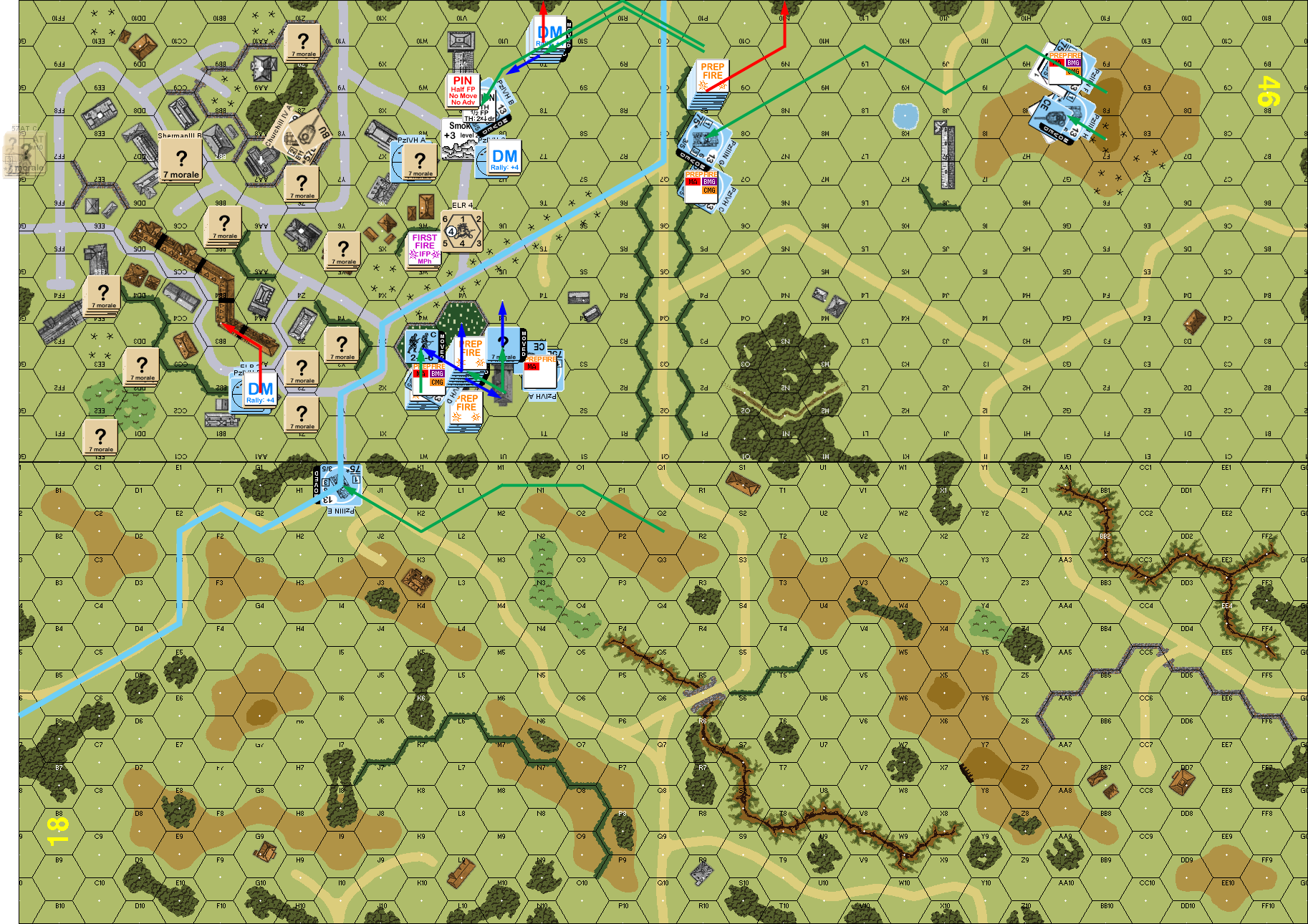
Patch’s reference photo of his setup. Note: there are no bridges in this scenario.

The Brits can come on within two hexes of any one x1 road hex, giving three entry choices. The furthest one (I1), requires going through most of the board 5 woods, and Patch blocked the road with the fourth wire hex (with the other three on the exit hexes; I imagine that just about every game features that setup). The closest one (Y1) features a lot of open ground, with just a gully for cover near the entry. So I went for the middle area (Q1), which is also open, but the woods close in enough to protect it from most of the rest of the board, and there’s good cover nearby. The ACs were to break out of that little area, while at least some of the infantry was to gain the woods on the other side of the clearing and head straight down, hopefully flanking the bulk of the defenses out in the open areas of the board.
↓ Read the rest of this entry…

└ Tags: Annual 96, ASL, gaming
 Comment 
  • Page 172 of 310
  • « First
  • «
  • 170
  • 171
  • 172
  • 173
  • 174
  • »
  • Last »

©2005-2026 Rindis.com | Powered by WordPress with ComicPress | Hosted on Rindis Hobby Den | Subscribe: RSS | Back to Top ↑