Rindis.com

All my hobbies, all the time
  • Home
  • My Blog
  • Games
  • History

Categories

  • Books (491)
  • Comics (10)
  • Gaming (911)
    • Boardgaming (669)
      • ASL (154)
      • CC:Ancients (83)
      • F&E (78)
        • BvR – The Wind (26)
        • Four Vassal War (9)
        • Konya wa Hurricane (17)
        • Second Wind (5)
      • SFB (78)
    • Computer games (161)
      • MMO (76)
    • Design and Effect (6)
    • RPGs (66)
      • D&D (25)
        • O2 Blade of Vengeance (3)
      • GURPS (32)
  • History (10)
  • Life (82)
    • Conventions (9)
  • News (29)
  • Technology (6)
  • Video (49)
    • Anime (47)
  • Writing (1)

Patreon

Support Rindis.com on Patreon!
Become a patron at Patreon!

Other blogs:

RSS Inside GMT

  • It’s all about the Cards: Exploring the Card deck of Ancient Civilizations of East Asia Part III: Six for Sieges and “Sudden Strike” Competition Cards March 27, 2026

RSS Playing at the World

  • Playing at the World 2E V2 Arrives May 5, 2025

RSS Dyson’s Dodecahedron

  • Cyberstyle 8.1 March 27, 2026

RSS Quest for Fun!

  • The Myth of Rational Animals November 23, 2025

RSS Bruce Heard and New Stories

  • Preview: The Iron Queen February 9, 2026

RSS Chicago Wargamer

  • The 2 Half-Squads - Episode 310: Cruising Through Crucible of Steel January 27, 2023

RSS CRRPG Addict

  • Star Trail: Not Starting Over, Just Going On March 26, 2026
SF&F blogs:

RSS Fantasy Cafe

  • Michael Swanwick Guest Post and Book Giveaway February 23, 2026

RSS Lynn’s Book Blog

  • Friday Face Off: The Tapestry of Fate (Amina al-Sirafi, #2) by Shannon Chakraborty March 27, 2026
ASL blogs:

RSS Sitrep

  • Cardinal ASL Sins March 18, 2026

RSS Hong Kong Wargamer

  • FT114 Yellow Extract After Action Report (AAR) Advanced Squad Leader scenario April 16, 2025

RSS Hex and Violence

  • This still exists? March 25, 2025

RSS Grumble Jones

  • 2026 Kansas City ASL Club's March Madness Tournament March 16, 2026

RSS Desperation Morale

  • How to Learn ASL March 16, 2025

RSS Banzai!!

  • October North Texas Gameday October 21, 2019

RSS A Room Without a LOS

  • [Crossing the Moro CG] T=0902 -- Rough start July 18, 2015
GURPS blogs:

RSS Dungeon Fantastic

  • What color is paut? Sigh. March 3, 2026

RSS Gaming Ballistic

  • Pigskin project (by Chris Eisert) February 28, 2026

RSS Ravens N’ Pennies

RSS Let’s GURPS

  • Review: GURPS Realm Management March 29, 2021

RSS No School Grognard

  • It came from the GURPS forums: Low-Tech armor and fire damage January 29, 2018

RSS The Collaborative Gamer

  • Thoughts on a Town Adventures System January 18, 2022

RSS Don’t Forget Your Boots

  • GURPS Supers Newport Academy #3: “Season Of The Witch” February 8, 2026

RSS Orbs and Balrogs

  • Bretwalda - Daggers of Oxenaforda pt.4 - Fallen King May 27, 2017

J32 Panzer Graveyard

by Rindis on April 21, 2017 at 12:00 pm
Posted In: ASL

After finishing up Lagus Assault Guns, Tom suggested trying out J32 “Panzer Graveyard” from Journal 2, and we got going at the beginning of March. A January ’44 scenario in Italy, it has a worn-out German force with a lot of tanks assaulting a stiff British defense in the board 46 town. The Germans attack with twelve squads (ranging from first line to conscripts), a few MGs and four Pz IV Hs with a 9-1 AL and four Pz III Ns. The British are defending with ten first-line squads, a HMG and a MMG, two PIATs (who are assigned to 1-2-7 crews), a 6 pdr AT gun, a Churchill IV and a Sherman III, and some concealment markers. There’s a small cluster of buildings added across the street from the main town that serves as a possible jumping-off point for the Germans.

This ordinarily should be a 1/2 map scenario. But instead, it uses all of board 46 and 18 (including an overlay with another level 2 hill). This is for the use of the Pz IIIs, which set up on the various hills, ready to shell the defenders, or smoke them in. The Germans have six turns and need to control 20 buildings (out of 30) in the British setup area at the end of the game. While they have lots of armor support, they have problems; all German MMC are Lax, and their ELR is only 2. Finally, there is a +1 LV on the final turn.

I took the British defense, and spent some time trying to figure out what I wanted to do. There’s three main ways for the Germans to approach this, the main obvious one is the center area, jumping off from the built up area. I figured an approach from the east had a lot of open ground to go through before reaching the first buildings, and then tended to hit the least-dense parts of the town, with the graveyard, woods, and orchards, though all of that was harder to defend. Meanwhile, the west side had some open ground as well, including an extra small hill, but with some cover just on the other side of the road that forms the setup areas. I put some light forces (including a Dummy in 46W7) to slow down an east-side assault slightly, while defending the west more heavily with the HMG in EE4 and a PIAT in the brush in DD2. Another HS was in the brush in EE1, which was as far forward as I dared to go there (and there was no concealment terrain forward of there anyway). LMGs were in Y5 and W5 to provide Fire Lanes against advances in the center area, with the HMG centrally located in BB5. I had a hard time figuring out where to put the tanks and ATG, since anywhere exposed could lead to them getting easily swarmed, with eight German tanks out there (though the Pz IIIs would struggle to kill either of mine even with a rear shot with a Final TK of 3; 5 with HEAT on a 9 or less), and a good number of PFs available. The Churchill anchored the main line of defense in the northeast in Z7, with help from a PIAT in Z9 (with a crucial error that I’ll get to later), and a 7-0 Z6 to act as a preliminary rally point. The Sherman was in CC7 to cover the central street, and possibly anchor the defense once the first line of buildings had fallen. The ATG went in GG7 facing SE, in case armor tried to go around the west flank and cut off my defenders (and I had problems finding anyplace that could see terrain I wanted to cover).

Tom’s setup surprised me, with the bulk of his forces in the center, but largely a hex back, and out of sight from my line, and three squads (and two HS, with his HMG & MMG) on the eastern flank backed up by two of his Pz IVs. He had figured my ATG was around EE2 (exactly the type of forward position I avoided) and stayed away from the brush. Most of his Pz IIIs were behind them on the board 46 hill, but one was backing up the main force in 18Q2. One Pz III fired, placing Smoke in V5, while the eastern Pz IV first pinned my HS in U7, which then ELRed to fire from his MGs. Most of his center forces fired on my other visible unit in AA2, forcing a 1MC which they passed. The last Pz IV fired on W7, but missed.

Tom then started showing off aggressive armor tactics my moving the second eastern Pz IV into Motion VBM of V8. I attempted CCRF, but pinned instead. Having locked up my primary defense, he advanced two squads and a 9-1 towards the building, but a good roll from W5 managed a 1MC that pinned the leader and broke a squad. This activated his Sniper, who broke the squad that had been the target of all his fire earlier. Past that, there was little left to move, other than some of the Pz IIIs advancing up to the rest of his troops.

My LMG squad Final Fired on his MG stack, and with another low roll, broke both HSes with MGs. Not only that, but my Sniper activated, and hit the same hex, with a three-way tie (out of four units), to fatally wound the 8-1 and then break the squad in the hex. The only CC was with the VBM Pz IV in V8, and my squad only missed because of being pinned.


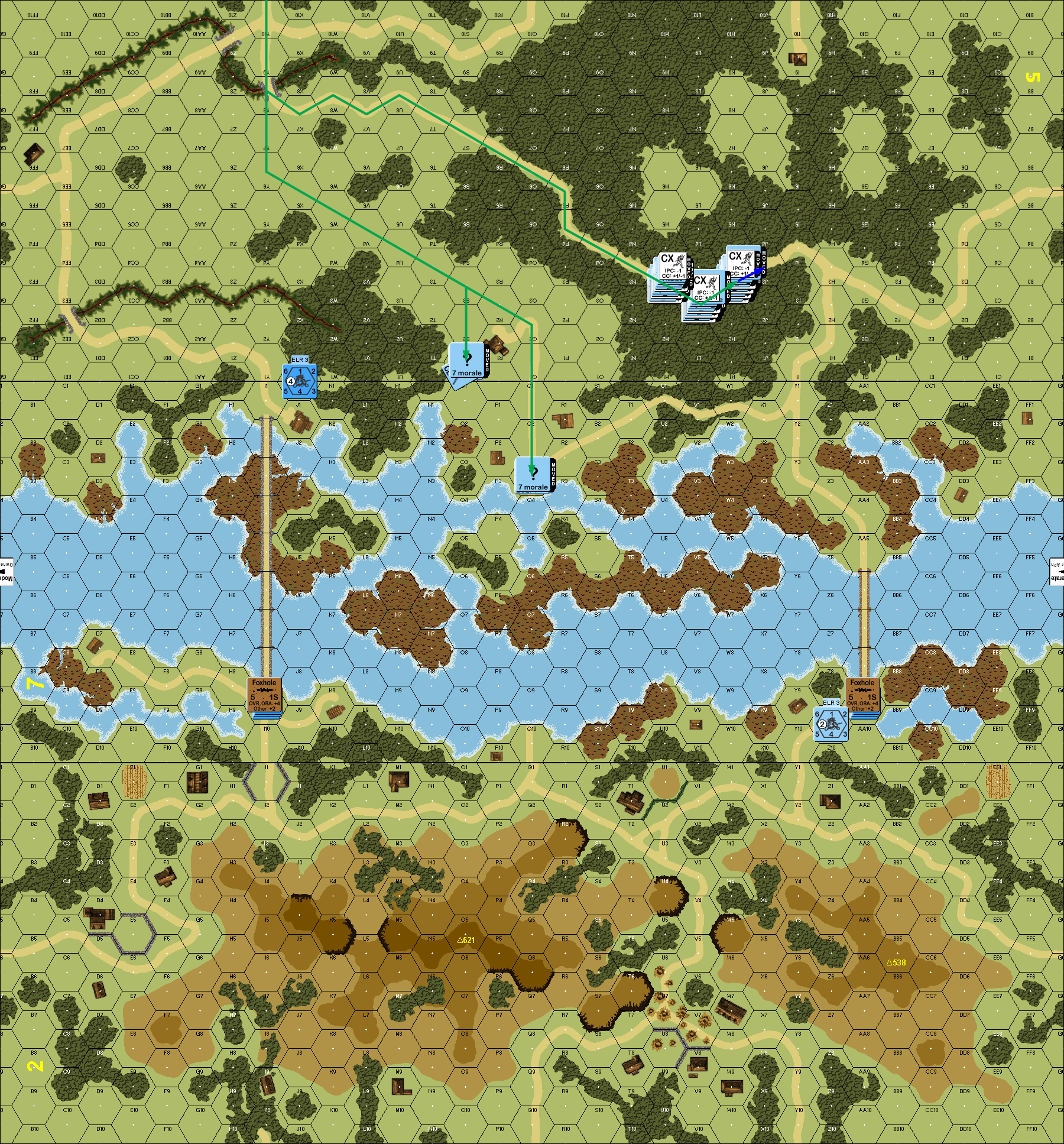
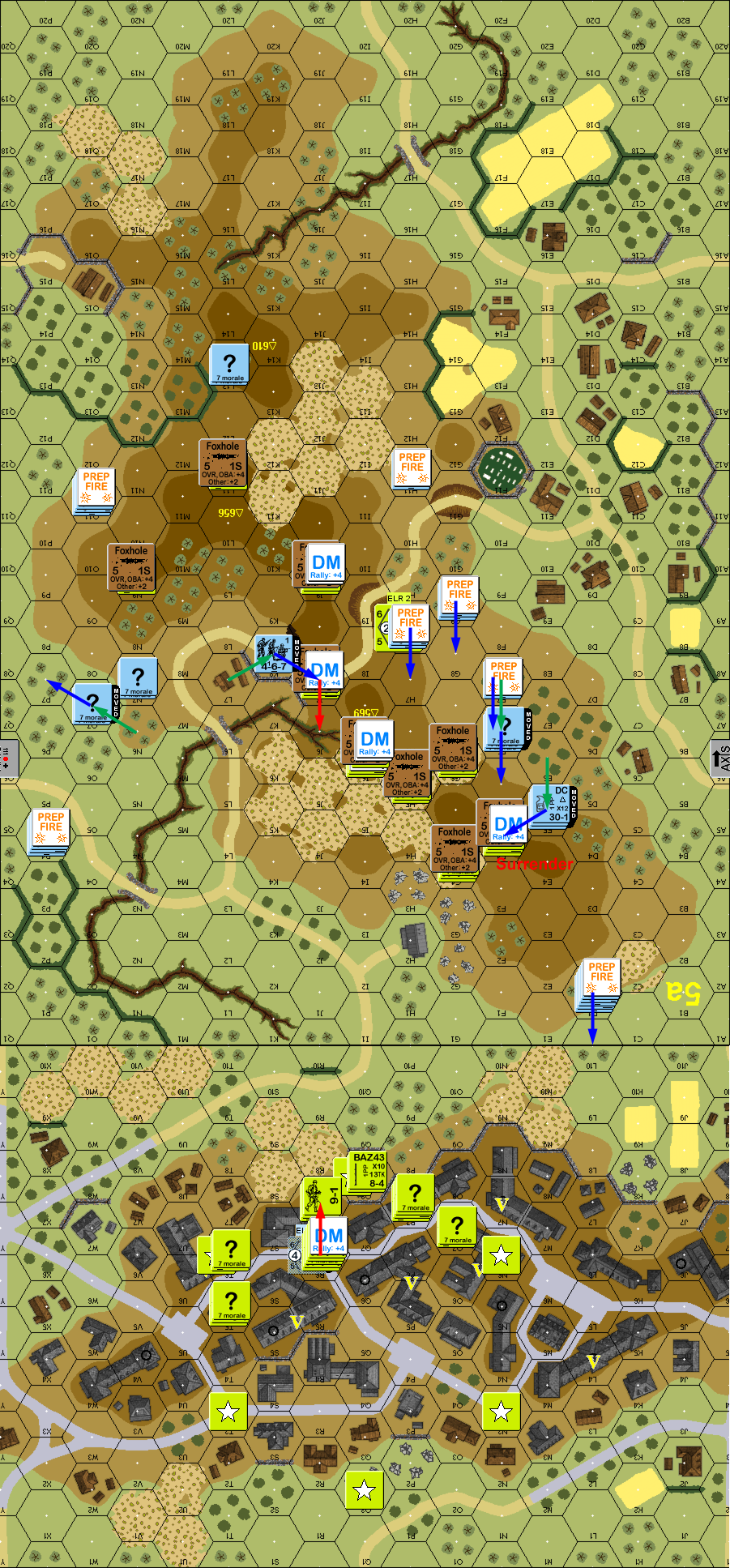
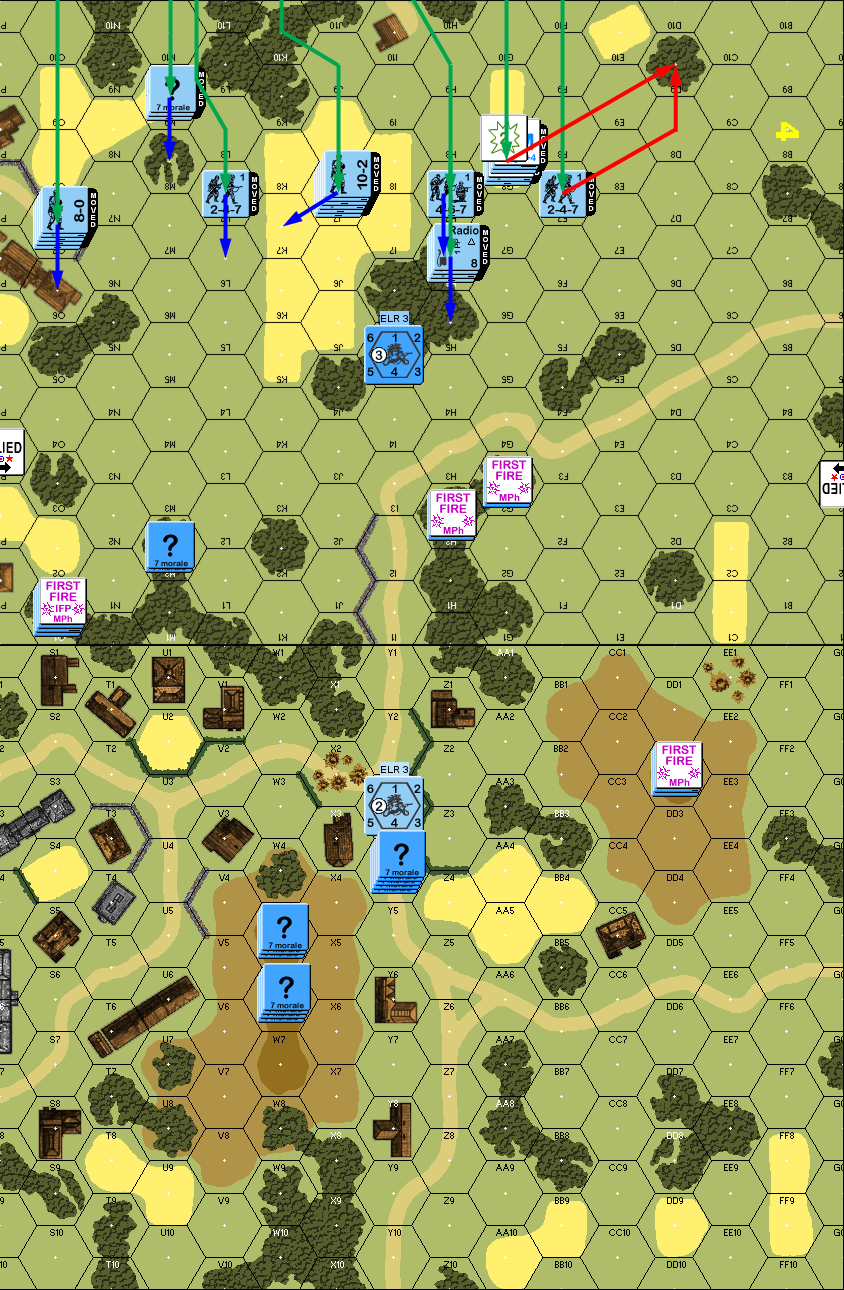
Situation, German Turn 1, showing the full scenario area, and my HIP Gun. The blue ribbon is the dividing line between the British and German setup areas.
↓ Read the rest of this entry…

└ Tags: ASL, gaming, Journal 2
1 Comment

Trading in Danger

by Rindis on April 17, 2017 at 12:00 pm
Posted In: Books

Elizabeth Moon’s Trading in Danger seems at first that it should be an action-adventure tale like the Vorkosigan series or maybe Honor Harrington. The opening of the book is the main character getting tossed out of the military academy for accidentally causing a scandal. Since she’s part of a successful merchant family, this leads to a quick shuffle off-planet, as captain of a cargo ship on its last run; at the end it will be sold for scrap, and the crew will need to pay for passage home. The ship has a few more problems than anticipated, and a diversion for more cargo ends up with the ship being in the middle of a war zone.

This is all very well handled, and the plot is well put together, but there’s no real daring heroics, there’s no rushing in to save the day. The order of business is survival. And it’s at this point that it becomes obvious that this book is more like some of C. J. Cherryh’s merchanter books, and some other older novels.

The main problem with is that the larger situation has one large dangling end that is not tied off. This is acceptable, as it’s not really part of the main focus, but it seems to get set up… and then evaporate. I assume that this will return in the next book, but its the one thing that keeps this one from being truly self contained. Other than that one problem, it’s well written, and recommended.

└ Tags: books, reading, review, science fiction
 Comment 

Manzikert 1071

by Rindis on April 13, 2017 at 12:00 pm
Posted In: Books

Osprey’s Campaign book on the Battle of Manzikert continues their proud tradition of featuring just about every military disaster Rome had. (Well, yes, we are just a bit ‘post-Rome’ here, though it’s still the Roman Empire.) As usual, it’s a well-produced book with plenty of maps and pictures (including of a fair number of buildings that survive from the period, though some may not have made it through the four years since it was published).

The maps are the main weak point in this one. They are very well done, and informative, but three of them in particular try to convey too much information at once. They’re maps of the region, showing movements of armies over a few years, keyed to entries describing what’s going on. However, when there’s 30-50 entries per map, it gets difficult to pull out what’s going on. Worse, the maps are rotated sideways (the area that needs covering fits much better that way), leaving the keying on the opposite page hard to look at at the same time as the map.

The main description of the campaign is interesting. With help from the maps, it gives the general background, including just where the Seljuks had come from, and what other groups they were dealing with at the time. Very interesting is the idea that neither side was in any way anticipating a climatic battle in the region around Lake Van. The Byzantines were busy in the region trying to strengthen their border and stop Türkmen raids (which were often blamed on the Seljuks, but were generally independent), while Alp Arslan was concentrating on fighting the Fatimid Caliphate.

With everything else, the course of the battle itself doesn’t take too long to tell, and the Byzantine defeat mostly comes from poor coordination in the army after a hard day of advancing without being able to force a setpiece battle. More of the problems come from disastrously bad intelligence leading up to the confrontation. The maps are not a great help here, being done in something of a muddy ‘natural’ style that doesn’t point up any features of the terrain.

The defeat of Byzantium still shouldn’t have been nearly the history-changing even it was, but Emperor Romanos IV was captured, and before he was released eight days later, a new emperor had been crowned in Constantinople, leading to a civil war that, combined to concessions to the Seljuks, allowed the border region to collapse and Türkmen tribes to gain control of most of central Anatolia. Sadly, these afterproducts of Manzikert aren’t treated in any detail, even though they’re usually blamed on the battle itself.

With all of that, this Osprey book feels a bit more limited than some others, and seems like it was struggling with the demands of format and the fixed page count. That said, it’s still a good look at the battle itself, and provides (often contrary) details from several first-hand accounts.

└ Tags: books, Byzantium, history, reading, review
 Comment 

Anime Winter 2017

by Rindis on April 9, 2017 at 12:00 pm
Posted In: Anime

The latest anime season wrapped up a little bit ago, but I’ve been slow in getting to the new one, as ‘simul-dubs’ are actually a couple weeks behind.

Konosuba — This series is all the wrongs. And it’s hilarious. I think it helps that I’m watching it with Smudge, and she’s got Phalloide to add comments, but each episode has generally had screamingly funny moments. We weren’t really expecting a second season of this, but the first half especially was really on the mark.

Tales of Zestiria the X — And we get a second season of this. The story has really picked up, and I’ve been enjoying it this season, whereas parts of first season felt more like a chore to get through. I was expecting this to go on for quite a bit longer, but the last few episodes suddenly fell into a final boss climax.

Smudge hasn’t really gotten to trying out anything new from this season, so that’s been largely it. Though recently she introduced me to a few things from previous seasons:

Rage of Bahamut: Genesis — Smudge wasn’t entirely sure I’d like this, but there’s a new/sequel series coming up, so she tried it on me. And I liked it quite a lot. I think I would have gotten thoroughly annoyed with the main character in pretty quick order, but the main plot kicked in in the second half of the first episode, and it drove everything in the rest of the series. Definite recommendation.

Selector: Wixoss — Just recently finished the first storyline, which went two seasons. Take… Madoka Magica and add a CCG as the maguffin. I kind of have to wonder if the creator has ever really played a CCG, as it seems a bit odd. On the other hand, the series stays as far away from the game as a game as it possibly can; it just exists to support the existence of the maguffin. Instead it concentrates on a few characters and the slow reveal of just how messed up the situation is.

Blood Battlefront Blockade — Three Word Title Lotto! The title makes some sense if you stare at it a while, but not really. While does all build to a climatic finale, the first half of the series is more about introducing the cast a bit, and showing just how strange this place is.

And there’s been more Pokemon, but we’ve largely caught up with the collected DVD sets, and the rest is still of fairly scattered availability.

Pokemon XYZ — Well, I’ve seen through the end of the story on this now, and they did a really good job with the wrap up and ending. I’ve also seen the “Legend of XYZ” episode, which was also a really well-done one-off. The final episode still has yet to hit Pokemon TV (grrr), so I’ve seen a horrible fan sub, and it was also good.

Pokemon: Adventures on the Orange Islands — The ‘we need to fill in until there’s more source material to work with’ season. In line with the first part, when it’s on, its good. I definitely appreciate the idea of Ash getting a non-league award to show his progress.

Pokemon: Johto Journeys & Johto League Champions — That last title was way too ironic, considering the bulk of that season is consumed with the trip to one gym. The stories are good, and I definitely appreciate the fact that the three ‘starter’ Pokemon that Ash gets all have their own quirks and problems to work out.

└ Tags: anime
 Comment 

In the Name of Rome

by Rindis on April 5, 2017 at 12:00 pm
Posted In: Books

Adrian Goldworthy’s In the Name of Rome is something of a mixed bag. It purports itself as being an examination of the Roman style of command by looking at several of its most prominent generals. The selection is constrained to those where there’s enough known to be able to say something intelligent, which warps the coverage somewhat. Goldsworthy covers fifteen generals, with Caesar coming in for extra attention (of course!) and two (Fabius and Marcellus) combined into one chapter, and thus feeling a bit more summarized.

Despite the fact that this is centered around individual people, Goldsworthy actually spends a fair amount of time providing extra background and bridging, and the volume can serve as a decent history of Rome from the Second Punic War through the early Empire. After his chapter on Titus and the siege of Jerusalem, the gaps become too big (mostly because of a lack of sources on individual commanders) and the overall narrative of events breaks down for the final two chapters on Julian and Belisarius, making them feel more like the separate essays you would expect from the general format of the book.

The part that surprised me, is that while the book is supposed to be about Roman command, it seemed like it had more to say about the Roman military itself. He points out early on that the Roman Republic army was set up to be a very non-professional force, with it’s constant cycle of recruiting a legion, training it, and then disbanding it once the immediate goal/campaign is done. This leads to Roman armies having trouble at the start of the Second Punic War when there’s been little training, and doing better as experience is gained. In the years afterward, there’s a good number of veterans that cycle into the new legions, and help power Rome’s growth in the 2nd Century BC. Then the Marian reforms put the legions on a more permanent basis, with long-term training, making it a professional service, and creating the armies that both conquer large portions of the future Empire, and tear the Republic apart as they fight each other.

On the other hand, the last two chapters show just how completely this had all come apart. While the Empire was still a major state, even after the fall of the Western half by the time of Belisarius, and the total number of men under arms could still be fairly large, the actual armies in use were very small in comparison to previous centuries. Goldworthy’s main analysis of Julian is that his successful campaigns against various Germanic tribes would have been handled locally by a provincial governor instead of needing attention from near the very top. His failure against Persia is given as being at least partly due to having to manage a larger army and distances than he had yet had to deal with. Finally, Belisarius’ armies are generally puny, and he has to put up with a lack of discipline and mutiny that would never have been allowed in an early legion.

The stated idea of how Roman generals functioned is discussed throughout the book as well, but it felt less prominent than the arc I just summarized. But the book is large enough to support both threads, while talking about the actual people involved, and threading much of the history together. At the large scale, all the history in here can be found in any number of other places, but this particular presentation is a good one, and does develop its own themes well.

└ Tags: books, history, reading, review, Rome
 Comment 
  • Page 168 of 310
  • « First
  • «
  • 166
  • 167
  • 168
  • 169
  • 170
  • »
  • Last »

©2005-2026 Rindis.com | Powered by WordPress with ComicPress | Hosted on Rindis Hobby Den | Subscribe: RSS | Back to Top ↑