Rindis.com

All my hobbies, all the time
  • Home
  • My Blog
  • Games
  • History

Categories

  • Books (491)
  • Comics (10)
  • Gaming (911)
    • Boardgaming (669)
      • ASL (154)
      • CC:Ancients (83)
      • F&E (78)
        • BvR – The Wind (26)
        • Four Vassal War (9)
        • Konya wa Hurricane (17)
        • Second Wind (5)
      • SFB (78)
    • Computer games (161)
      • MMO (76)
    • Design and Effect (6)
    • RPGs (66)
      • D&D (25)
        • O2 Blade of Vengeance (3)
      • GURPS (32)
  • History (10)
  • Life (82)
    • Conventions (9)
  • News (29)
  • Technology (6)
  • Video (48)
    • Anime (46)
  • Writing (1)

Patreon

Support Rindis.com on Patreon!
Become a patron at Patreon!

Other blogs:

RSS Inside GMT

  • Meet The Han: A Civilization of GMT’s Ancient Civilizations of East Asia  March 20, 2026

RSS Playing at the World

  • Playing at the World 2E V2 Arrives May 5, 2025

RSS Dyson’s Dodecahedron

  • Corporate Brief: Cyberus Security March 22, 2026

RSS Quest for Fun!

  • The Myth of Rational Animals November 23, 2025

RSS Bruce Heard and New Stories

  • Preview: The Iron Queen February 9, 2026

RSS Chicago Wargamer

  • The 2 Half-Squads - Episode 310: Cruising Through Crucible of Steel January 27, 2023

RSS CRRPG Addict

  • Star Trail: Sweet Is the Swamp with Its Secrets March 20, 2026
SF&F blogs:

RSS Fantasy Cafe

  • Michael Swanwick Guest Post and Book Giveaway February 23, 2026

RSS Lynn’s Book Blog

  • Booking Ahead/Weekly Wrap Up March 22, 2026
ASL blogs:

RSS Sitrep

  • Cardinal ASL Sins March 18, 2026

RSS Hong Kong Wargamer

  • FT114 Yellow Extract After Action Report (AAR) Advanced Squad Leader scenario April 16, 2025

RSS Hex and Violence

  • This still exists? March 25, 2025

RSS Grumble Jones

  • 2026 Kansas City ASL Club's March Madness Tournament March 16, 2026

RSS Desperation Morale

  • How to Learn ASL March 16, 2025

RSS Banzai!!

  • October North Texas Gameday October 21, 2019

RSS A Room Without a LOS

  • [Crossing the Moro CG] T=0902 -- Rough start July 18, 2015
GURPS blogs:

RSS Dungeon Fantastic

  • What color is paut? Sigh. March 3, 2026

RSS Gaming Ballistic

  • Pigskin project (by Chris Eisert) February 28, 2026

RSS Ravens N’ Pennies

RSS Let’s GURPS

  • Review: GURPS Realm Management March 29, 2021

RSS No School Grognard

  • It came from the GURPS forums: Low-Tech armor and fire damage January 29, 2018

RSS The Collaborative Gamer

  • Thoughts on a Town Adventures System January 18, 2022

RSS Don’t Forget Your Boots

  • GURPS Supers Newport Academy #3: “Season Of The Witch” February 8, 2026

RSS Orbs and Balrogs

  • Bretwalda - Daggers of Oxenaforda pt.4 - Fallen King May 27, 2017

Hexwood

by Rindis on September 13, 2018 at 12:00 pm
Posted In: Books

Hexwood starts off conventionally enough. Earth is an unwitting backwater in the galaxy when an ancient device activates, and the ruling junta’s efforts to stop the problem fail.

Life on Earth continues normally, except for our main character. She observes strange goings on right outside Hexwood Farm (the secret storage facility where this is going on), and gets drawn into the situation, and a rebellion against the cruel leadership of the House of Balance.

And already we’ve gone off the track, because despite appearances, that isn’t entirely true. The rest of the novel slowly goes down a rabbit-hole of increasing awareness of just how much everyone’s perceptions are being played with. It would be interesting to try and map out some of what’s actually going on, but a lot of it is deliberately obscure, and probably impossible to pinpoint exactly.

Despite the confusing mess that the novel tries to descend into, it’s very well written and engaging. I’m kind of disappointed in some revelations near the middle, and while there’s a definite case of characters popping out of the woodwork at the end, much of that is actually mentioned earlier. Worth a read, but be prepared for the plot not to be what it seems!

└ Tags: books, reading, review, science fiction
 Comment 

Shogun: Only War

by Rindis on September 9, 2018 at 12:00 pm
Posted In: Computer games

This is the tenth in a series of reviews of Paradox’s empire management games. See the earlier reviews here:
Europa Universalis II: A Tale of Two Europas
Hearts of Iron: Europa of Iron
Victoria: Nineteenth Century Essay
Crusader Kings: A Dynastic Adventure
Hearts of Iron II: Return Engagement
Europa Universalis III: A Whole New World
Europa Universalis: Rome: Make a Desert and Call it a Game
Hearts of Iron III: One Plus Two Equals Three
Victoria II: Same But Different

After more work on the Far East in the Europa Universalis series, Paradox next developed a new real time pausable empire management game focused on Japan itself. It was announced shortly after Total War: Shogun 2 was announced (but had already been under development at that point), and came out for PC in September 2011, several months after that popular similarly-themed title. A Japanese-language version was released by CyberFront in Febrary 2012, but was not supported by Paradox itself.

The game got a small number of die-hard fans, but apparently was not much of a success. There were four notable patches after release to clean up the interface and work out bugs, but no development past that, leaving it one of Paradox’s only games without a sequel or expansion.

The Time and Place

Sengoku covers the entire Warring States period of Japan from the start of the Onin War in 1467 to 1620, safely past the Battle of Sekigahara (1600) that effectively founded the actual Tokugawa Shogunate and the Siege of Osaka in 1615, which ended the last opposition to Tokugawa.

Unusually for a Clausewitz game, Sengoku does not feature the ability to start at any point in the time period. (One imagines that researching a detailed timeline description for everyone involved is not possible outside of Japanese-language sources.) At first, only 1467 was available, but the second major patch added the ability to start in 1551, when all the late players are established, and most of the familiar names are active.

Interestingly, this makes it one of the wider-ranging of the many games on this period, since most concentrate on just the later Azuchi-Momoyama period/Nobunaga’s career while Paradox elected to start with the initial breakdown of authority.

The game features a fairly detailed map of Honshu, Shikoku and Kyushu (normal for games on this subject). As well, some of the smaller islands, which are usually ignored, are separate provinces, and Awaji and Sado are three provinces each.

The base provinces are considered kori, small districts, which are grouped into kuni, which are all named for the actual historical regions held by the daimyos.

The colors used in the various map modes are a bit muted, and actually help quite a bit with establishing the mood, as does the very good Japanese-styled soundtrack provided by the Knights of Soundtrack, which was only the second time that Paradox has gone outside of their main composer for an original soundtrack.

Clan Warfare

Like in Crusader Kings, there is a large cast of characters, from which individual rulers of kori and leaders of armies are drawn. Everything is organized around clans, with ultimate authority residing in the clan heads.

These clan heads will generally personally control from one to five kori, with all further lands under control of the clan going to other kokujin (ruler of one or more koris). When a clan controls all of the territory in a kuni, it automatically gets access to the title of daimyo for that kuni, which will go to the clan head, but can be granted (like the kori themselves) to a kokujin to make them an extra daimyo within the clan. As in CK, going over the demense size (the number of kori directly held by you) causes an escalating chance of revolts, and unhappiness among everyone else in your court. Here, however, the maximum size is always five kori, and is not modified by rank or the current year.

Like in EU:Rome, characters have three primary attributes; in this game they are, Diplomacy, Martial, and Intrigue. There are two character-based currencies: Money and Honor. Naturally, everyone has a clan they belong to, but may be in service to a clan other than their own. There is a system of traits that can modify the primary attributes, like in the previous character-oriented games, but it’s not as extensive.

They can also have ambitions, like in EU:Rome, but the scope of them is extremely limited. A character may wish to take one of the three main court positions (one that works with each primary attribute)… and that’s about it. There are other things characters will desire, but they are not technically ambitions.

A character can start a plot; this is akin to gaining an ambition, but he can then try to get other people in on the scheme. A clan leader can plot to attack another clan, and invite other leaders in on the plot, and everyone ends up attacking at once. A vassal can decide to go independent and found his own clan, and plot with other vassals to have them go along with him. Or a lesser member of a clan may decide he should be in charge, and plot with others for them to go over to his side when he starts a civil war. The plot screen will show everyone who’s involved, and dis play a plot power, that rates the relative power of everyone in the plot and the target of the plot; when it is high enough, the plot can be enacted.

A character may also ask to get the next kokujin or daimyo title that becomes available (this seems to only happen with people who are already vassals of yours; unlanded courtiers do not seem to ask), and this can affect relations depending on the answer.

This last brings up an important new idea: instead of what two people think of each other being represented by one number, there are two, to show what each person’s opinion of the other is. If one refuses a favor to the other, the snubbed character may be bitter and have a lowered opinion score, but the other may not have seen anything important in it and be unaffected. This really allows for some meaningful flexibility in how relations are handled, and is a great improvement over previous games.

Honor

The major weak point of Sengoku is the relative dearth of diplomatic options. You can’t create alliances (plots, above, stand in for that), or negotiate treaties of who gets what in a peace deal. Because Sengoku depicts a period where authority has broken down, peace generally means that everyone keeps what they currently hold.

There are other options, including one side becoming a vassal of the other, or sending a hostage to secure good behavior. (Hostages can also be exchanged during peace to try and keep a war from breaking out.)

But most actions have a cost in personal honor. Declaring war on someone costs honor (with extra charges for attacking some one less powerful, attacking someone you have a high opinion of…), as do most other actions, like inviting someone into your clan. While at peace, honor slowly accumulates, and characters must prevent their honor from slipping too low: if someone’s honor goes below 0, they must commit seppuku (and if this happens to you, it is Game Over, even if you have an heir).

At very low values for honor (10 or less), a character may voluntarily commit seppuku, and his lord may command him to commit seppuku, which can be refused, but will drive his honor even lower….

Overall, play is like Crusader Kings as you play as a particular character, instead of a government with a cast of characters like in EU:Rome. It doesn’t have quite the same emphasis on a dynasty, as you can adopt a child to be your heir if all else fails. Your heir will take over, and you continue the game as him as long as you do not lose all honor and are forced into involuntary seppuku. Along with most actions having a cost in honor, it’s a fairly effective method of bringing through a good feel for the period.

Warfare

Sengoku uses the same general battle system that was introduced in EU III, and has been in every Clausewitz game. Units line up in a main and reserve row, and attack their counterparts across the way, with units that don’t have anyone directly facing them attacking nearby units in the flank. This time the display is a bit larger and brightly colored, making it a bit easier to follow, if you understand what’s going on.

This time, the basic unit is a 250-man ‘regiment’ which can be of three types: ashigaru (peasant infantry), samarai (cavalry), and arqubusiers. The latter are not available without being subject to Western (Portuguese) influences, which starts by an event around 1547.

It seems like combat is a bit more fluid in this game, with troops redeploying around the lines a lot more, but it’s hard to be sure. As usual, combat relies on a 0-9 die roll, modified by the army leader’s Martial skill, and for attacking across bad terrain. There are alternating fire and shock phases, like in standard EU-series combat, but the general’s skill applies equally to both of them. With only 250 men in each unit (compared to the 1000 of an EU III unit), regiments can disappear quite quickly, which may cause the fluid combat.

Provinces must be taken by siege, or by assaulting the castle. Again, this is pretty much the same system as in other Paradox games, but the ratio of sieging to defending troops seems to have more of an impact, and ‘basic’ castles can fall fairly quickly.

Indeed, while there is no real change in ‘technology’ during the game, everything gets more developed, with larger armies becoming possible, and common. Castles become much harder to take (especially in rough terrain, where bonuses can help them hold out for a long time). Most notably, the sizes of personal retinues, or standing armies, gets much larger, and as wars continue, units of ronin (effetively extra retinues) become available for hire. All of these require pay even in peacetime, which makes overspending a possibility.

An odd point is that musters will replenish in their province even while it has been raised and in the field. So it is possible to lose an army, and then immediately replace it by mustering troops from the provinces all over again. Of course, this takes a long time to happen, so your army would have had to been in the field for a long time, and you can only raise complete brigades of 250 men.

Construction

Kori have a—limited—number of ways they can be improved. At the beginning of the 1467 game, no improvements are built (and very few in the 1551 start), and everyone must start building up their lands from scratch. The two primary things to build up are the castle, and the village. Each has eight upgrades that are built up in a specified order.

In addition, there are four guild slots in each kori. These are a two-step process where each one has to be opened up before a guild can be started there, and they are the primary way to specialize a kori, as there are eight different guilds for the four slots.

Like in the feudal world of Crusader Kings, each kori has a muster that can be called up. While active in the field, they cost money, but are of course ‘free’ when not in use. Low-level improvements of the castle increase the size of this muster (in even steps of one samurai regiment and two ashigaru regiments), while later improvements increase the rate at which this replenishes losses. Meanwhile, the village increases tax revenues and the maximum size of the personal retinue.

Doing all of this construction does not, for a change, cost money. Instead, while construction is underway, revenue from the kori is reduced by 70%. And there are plenty of events where something happens to the construction, and you have to decide between spending money to fix it, or accepting a delay (with more time spent at 30% revenue).

On the other hand, installing a guild in an opened slot, and building a religious building, does cost a flat amount of money. They still take time to build, but do not draw from your continuing income. Guilds are particularly expensive to start, while opening the slot up is short and ‘cheap’.

The first four guild types offer bonuses to personal retinues and ronin, allowing the ‘standing’ troops to be noticeably better than the musters. The fifth builds arquebuses, which then produces 30 guns a month, which is tracked for purposes of equipping regiments and reinforcements.

Religion

At the start of the game, there are two religious factions that a kokujin can court to gain advantages. Building Buddhist temples will help your muster recover strength faster, and building Shinto shrines will give a bonus to your honor.

Actively siding with a religious faction will give a stronger bonus of the same type, and being the leader of that faction a stronger one still.

In the early 16th Century, Portuguese traders will arrive, and a province or two will gain the ‘Western Influences’ modifier. Thereafter, it will slowly spread through the rest of Japan in a haphazard fashion.

Provinces where this is true can build Christian churches, and gunsmith guilds. As with the other two religions, building a church allows a kokujin to join the Christian faction and gain bonuses, with them all being increases in taxes.

Victory

Generally speaking, Paradox’s games are something of a sandbox affair for grand strategy titles. Usually, there’s some form of in-game ranking of countries, and you can certainly try to keep yourself on top, but that doesn’t bring about any sort of victory screen, or in-game reward. Furthermore, it’s quite common for experienced players to take a small country and just try to survive the game, or turn a backwards part of the world around. But there’s still no in-game ‘victories’ there.

Here, however, there is a clear goal: become shogun. This is done by taking control of 50% of the provinces in the game, and then holding off any challenges to you taking the title. There is a bar underneath the upper left interface that fills up depending on how close the largest clan is to this goal. Green if that’s you, or red for the largest clan, with your current percentage in yellow.

Conclusion

I try to avoid ‘looking ahead’ much in these reviews, but it’s nearly impossible here, and for once not doing so is possibly detrimental. Sengoku is often called Crusader Kings II light, or a trial run for Paradox’s next (and break-out) title. Both were actually in development during the same time, and so ideas were likely shared between the development teams. (One suspects that ideas mostly flowed from CKII’s bigger development team to Sengoku, but I haven’t seen anything to say one way or the other.)

The main interface of the portrait in the upper left corner with the line of buttons for other functions is basically identical in the two games, events have largely the same appearance, and many of the sound effects are the same, including a small musical sting that plays when an event fires. The terrain-mode map is gorgeous and detailed, but still not quite in the same style as later games. Plots and the ‘character opinions’ detailed above would be central parts of CK II.

However, Sengoku retains its own identity by being a game that Paradox determinedly stripped as much out of as they could. It is overall one of their simpler games, and one can assume it was meant as more of an ‘entry-point’ to their catalog, but instead, the much bigger and more complex Crusader Kings II ended up doing well in that capacity.

Computer strategy games have been moving away from being just about warfare for some decades, with Civilization being an early marker in the change of direction. One of the hallmarks of all of Paradox’s entries is a fairly robust diplomatic system, which allows for all sorts of interactions. It’s not entirely absent here, but the much-reduced options are at the center of what makes this game feel small, and limited, and probably did much to limit its appeal.

└ Tags: gaming, Paradox, review, Sengoku
 Comment 

Dungeons & Sorcery Spells 9

by Rindis on September 5, 2018 at 12:00 pm
Posted In: GURPS

After some time away, here’s another set of ten spells for GURPS Dungeons & Sorcery. This time, many of them deal with misdirection and effects meant to fool others.

Baneful Deflector (SC)
Evocation, Somatic, Verbal, Buff
32 points + 30 points/level
Casting Time: 2 seconds
Casting Roll: None
Range: Touch
Duration: 30 seconds

The subject of the spell gains a shimmering field of force that attempts to deflect all normal missiles that strike him from a particular direction (front, back, right, left, above, below), as specified by the caster. As long as the base damage of the missile is less than or equal to 2d per level of the spell, it is deflected towards the nearest person other than himself, and a new attack roll is made against this person. If the damage is greater than that amount, the deflector has no effect.

The distance between the subject and the new target is treated as additional flight distance, and may cause the attack to take a greater range penalty, have reduced damage and accuracy for being past 1/2D distance, or do nothing if it goes past its max range. If it misses, the usual chances of Hitting the Wrong Target (B389) must be assessed, but only as if it was going from the subject to the new target. If the new target is hit and also has an active baneful deflector in the way, this will happen again, ignoring all previous targets.

Affliction 1 (HT; Advantage: 7 DR (All-or-Nothing, -10%, Deflection, +20%; Directional: Choose, -15%; Force Field, +20%; Limited: Missile Attacks Only, -20%; Magical, -10%), +300%; Fixed Duration, +0%; Melee Attack, C, 1, -20%; Reduced Duration, 1/6, -15%; Requires Gestures, -10%; Requires Magic Words, -10%; Sorcery, -15%; Takes Extra Time, x2, -10%) [3.2×10] Each level adds 7 DR (2 dice) to the affliction. Notes: ‘Deflection’ is an alternate version of Reflection.
↓ Read the rest of this entry…

└ Tags: Dungeon Sorcery, gaming, GURPS, rpg, Sorcery, Thaumatology
1 Comment

Dealing With Dragons

by Rindis on September 1, 2018 at 12:00 pm
Posted In: Books

Patricia Wrede’s novel is basically a farce of fairy tales; this is something that’s been popular to do over the last few decades. There’s kingdoms in a land with magic, and fairy godmothers and curses and the like are part of daily life.

Jessica Day George mentions that this series was an inspiration for her, and I was thinking while reading that it reminded me much of Dragon Slippers, which was a book I enjoyed a lot. So, it was a great inspiration, and is indeed a lot of fun and very witty.

When she couldn’t stand [etiquette lessons] any longer, she would go down to the castle armory and bully the armsmaster into giving her a fencing lesson.

Wrede effortlessly makes sure you know just what the main character is like on the second page of the book. Cimorene is a great main character, and the rest of the cast are just as delightful. I have a few overall problems with the book, but they come of not being able to just take it for the simple farce it is, and trying to look around the corners. Taken on its own terms, it’s great all the way through.

└ Tags: books, fantasy, reading, review
 Comment 

Konya wa Hurricane Coalition Turn 17

by Rindis on August 28, 2018 at 12:00 pm
Posted In: Konya wa Hurricane

The overall Coalition economy continues to contract, with the Lyrans picking up a little bit of ground, which didn’t make up for either Klingon or Romulan losses, which happened in spite of both of them surveying a new province. Adjusted income was 309.75 EP.

Builds:
Klingon: D7C, D7, D6J, D5W, 7xD5, AD5, F6, 6xF5, D6V->D6U
Romulan: CON, FHF, 3xSP, SPC, SPM, 2xSK, SKE, SEH, WE, SNB, WE->KE, SP->SPM
Lyran: BC, STT, NCA, CW, CWE, CWS, 2xDW, DWE, 2xFF, FCR

The Romulans worked through most of their cripples from last turn’s SB assault, but the Klingons are still dealing with a large number of cripples, and are currently cancelling some of the smaller ships to deal with it. They did convert the last D6V to a D6U, as I had planned, which eliminates that class of odd 5-point carriers. B10-2 rolled well, and is all but guaranteed to come out next turn. B10-3 only rolled a ‘2’; by average rolls, it should come out on 21, but there’s an outside chance that both could show up on 19, which might be a problem.

The Klingons put a repaired D5 back in the Raid Pool, and added an existing FD7 to start filling out the expanded pool. The Lyrans raided a Kzinti province, and killed a Federation FF that was holding a Klingon province, and preventing supply to BG Harbinger. The Klingons raided three Federation provinces, and the C5 was sent to try and crack the wall of ships built around the Orion Enclave, but all the raids were run off, with one D5 being crippled. The Romulans raided two Federation provinces, and one Gorn, and made another attempt to kill the supply LTT in 4007 (partially to draw out a ship from 4006, which was a likely target during the turn). Both Federation provinces were disrupted, but the LTT was merely forced to retreat, and a Gorn POL ran off a FFH to keep that province from being disrupted.

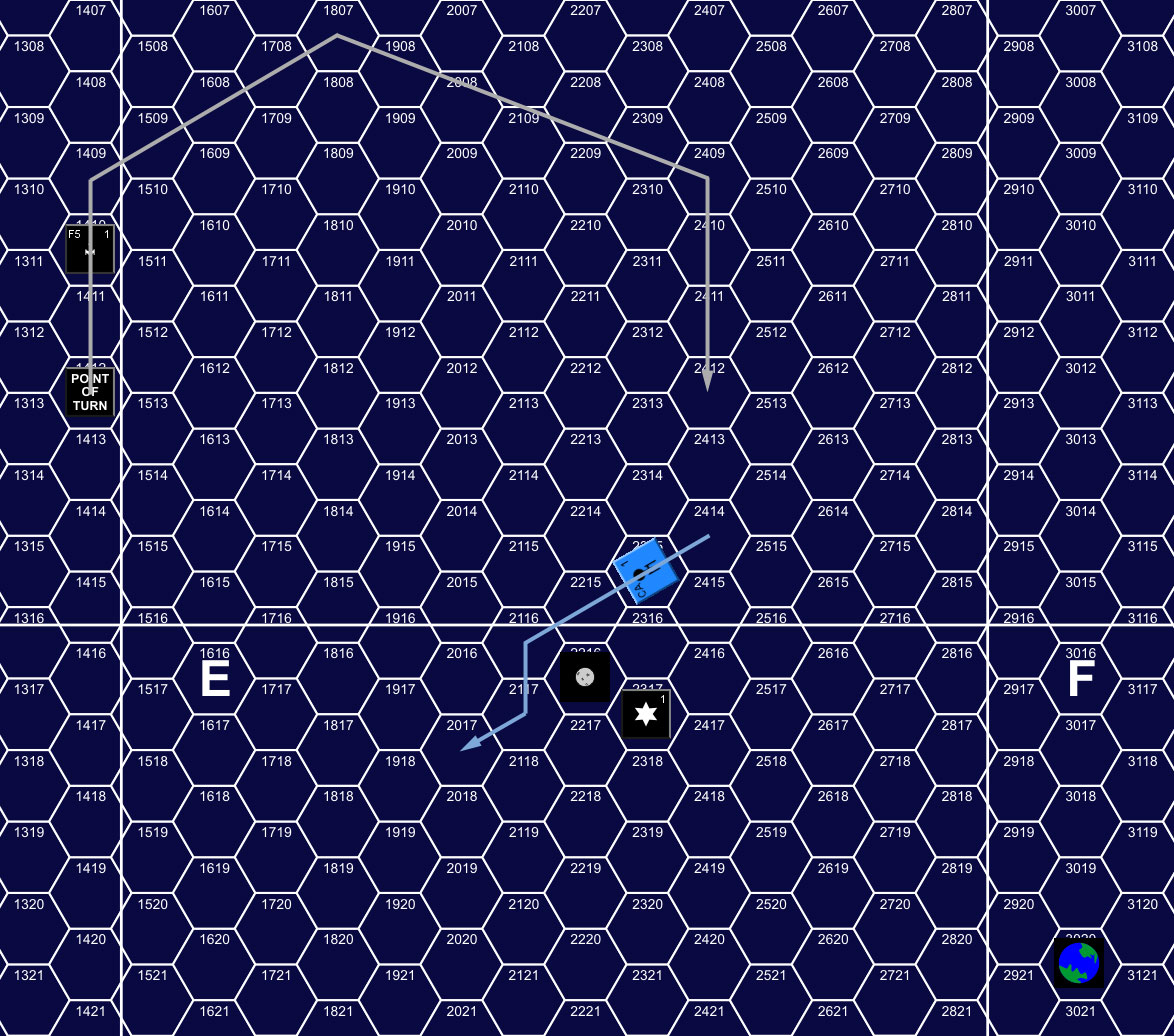
A primary problem was dealing with the solid wall of ships Byron had erected around the Orion Enclave to keep me from keeping supply to it, which would enable me to keep it neutral. There were a number of strong fleets nearby to complicate matters. The biggest problem was the fact that the Third Fleet had shifted forward to 1910 and stayed there, putting it in range of way too many important targets in Klingon space

But that meant the garrison on the 3rd Fleet SB was much reduced (consisting of the 4th Fleet, no longer needed near Kzinti space). So I started concentrating on tying down the reserves as best I could, and making one last try at it before the Federation started destroying everything I had left near it over the next few turns.

The Romulans had a heck of a time working their way out of the knot of Federation fleets near their border, but managed a good force to reclaim the NZ planet. To the north, they struck at the last Gorn border BATS, and had a decent fleet to take one of the Gorn-Fed border BATS while pinning a reserve there.

The Lyrans kept their activity light, going for 1504 in Kzinti space while backing up the Klingons elsewhere and keeping ships available.


Limited goals.


Limited goals.


The big push (again).


Trying to pull back more than a stump.


More BATS destruction.

The small Hydran reserves split between reinforcing 0416, and the small fight in 0916, while both Kzinti reserves went to 1504 (the only fight in range). The Federation 1st R (the only one completely unpinned) went to 3210, and two of the 4th R ships freed up there went to 3111, and the end of the wall around the Orions. The 3rd R in 2610 still had five ships free, and they went to 2509, which allowed the 2nd R there to send five ships to SB 2211. One Gorn reserve was stuck in 2610 with the bulk of the Federation reserve, and the other was stuck in 4006.

Battles:
3511: SSC: Federation: crip FF
3111: SSC: Romulan: dest WE
3412: SSC: Federation retreat
3413: Federation: crip FF; Romulan: crip SN
0416: Hydran: dest TR; Lyran: dest CWG, 2xDW, crip CW, DW
0916: Hydran: crip CU; Lyran: DW
0717: Hydran: dest LNH; Klingon: dest E4
1504: Kzinti: dest FKE; Lyran: dest DWE
2012: SSC: Federation: dest POL
2211: Federation: dest SB, CA, 2xDE, crip BT, CA, 9xNCL, DE, 5xFF, FCR; Klingon: dest 2xD6, D6D, D6S, AD5, D5S, F5L, crip D7, 3xD6, AD5, D5G, MD5, D5S, 2xF5, F5E, wound PT; Lyran: dest DW, crip DW
2509: Retreat after declined approach
2610: Federation: crip CA, NCL; Gorn: dest BDE, crip LTB; Klingon: dest F5W, crip 3xD5, 3xF5
3210: Federation: crip NCA, NCL; Romulan: crip SP, SK
3415: Federation: crip 2xNCL; Romulan: crip 2xSP, 2xSK
3315: Romulan: dest SNB
4408: Gorn: dest BATS
4006: Gorn: dest BATS, crip COM, DD; Romulan: dest SKF, K4, crip SPF, WE

Given an initial 53-point difference in ComPot, I wasn’t sure that I actually could take the 3rd Fleet SB, but it was the best shot I had to limit Byron’s ability to strike into Klingon space. One weakness he had was a limited number of CR10 ships, so I destroyed escorts to drive the CVA off-line, and Byron did some of my work by self-crippling a battle tug. Sure, it’s really efficient to repair, but my first goal was to get his line density down. By round 3, the difference was 17 ComPot, and I had the ships and fighters to take that, and some good rolls was helping. If he’d been willing to self-kill ships (and the Feds build enough), he might have squeezed another round out of it, but it probably wouldn’t have been worth it.

Byron naturally accepted approach in front of 2610, where the Gorns are setting up a MB. Two ‘6’s from the Alliance in a row kept me from getting at the base, and I didn’t have what it took to go four rounds and have any sort of fleet left, so that job was left undone. Maybe I can get there again, but it’s getting more and more unlikely….

The Federation rolled much better than the Romulans over 3415, but ran out all their fighters in the first round, and then gave up the NZ planet. But they gave better than they got, and overran a two-ship garrison next door on the way out.


I had just about given up all hope of killing the 3rd Fleet SB, and as the Federation offensive starts reaching into Klingon space, its presence was something I really couldn’t afford. So killing it is a big win for me, and I got it for relatively cheap. It did leave me a bit out of position, and the cost of taking it out may still turn out to be excessive. But in the long run putting much of the south-center out of reach will pay off. I just have to survive the short term while reorganizing.

Meanwhile, the Romulans have finished off the Gorn border BATS, and hampered their reach that way. Federation pressure is mounting, but the Romulans can… mostly put up a stubborn defense. The Federation has a lot of strength near the rim of the galaxy now, and I expect a fair amount of havoc near Tholian space. This means I’m probably not reestablishing contact between the Klingons and Romulans, and the KR spare parts are winding down….

└ Tags: bgg blog, F&E, gaming, KwH
 Comment 
  • Page 142 of 310
  • « First
  • «
  • 140
  • 141
  • 142
  • 143
  • 144
  • »
  • Last »

©2005-2026 Rindis.com | Powered by WordPress with ComicPress | Hosted on Rindis Hobby Den | Subscribe: RSS | Back to Top ↑