Rindis.com

All my hobbies, all the time
  • Home
  • My Blog
  • Games
  • History

Categories

  • Books (491)
  • Comics (10)
  • Gaming (911)
    • Boardgaming (669)
      • ASL (154)
      • CC:Ancients (83)
      • F&E (78)
        • BvR – The Wind (26)
        • Four Vassal War (9)
        • Konya wa Hurricane (17)
        • Second Wind (5)
      • SFB (78)
    • Computer games (161)
      • MMO (76)
    • Design and Effect (6)
    • RPGs (66)
      • D&D (25)
        • O2 Blade of Vengeance (3)
      • GURPS (32)
  • History (10)
  • Life (82)
    • Conventions (9)
  • News (29)
  • Technology (6)
  • Video (48)
    • Anime (46)
  • Writing (1)

Patreon

Support Rindis.com on Patreon!
Become a patron at Patreon!

Other blogs:

RSS Inside GMT

  • Meet The Han: A Civilization of GMT’s Ancient Civilizations of East Asia  March 20, 2026

RSS Playing at the World

  • Playing at the World 2E V2 Arrives May 5, 2025

RSS Dyson’s Dodecahedron

  • Corporate Brief: Cyberus Security March 22, 2026

RSS Quest for Fun!

  • The Myth of Rational Animals November 23, 2025

RSS Bruce Heard and New Stories

  • Preview: The Iron Queen February 9, 2026

RSS Chicago Wargamer

  • The 2 Half-Squads - Episode 310: Cruising Through Crucible of Steel January 27, 2023

RSS CRRPG Addict

  • Star Trail: Sweet Is the Swamp with Its Secrets March 20, 2026
SF&F blogs:

RSS Fantasy Cafe

  • Michael Swanwick Guest Post and Book Giveaway February 23, 2026

RSS Lynn’s Book Blog

  • Booking Ahead/Weekly Wrap Up March 22, 2026
ASL blogs:

RSS Sitrep

  • Cardinal ASL Sins March 18, 2026

RSS Hong Kong Wargamer

  • FT114 Yellow Extract After Action Report (AAR) Advanced Squad Leader scenario April 16, 2025

RSS Hex and Violence

  • This still exists? March 25, 2025

RSS Grumble Jones

  • 2026 Kansas City ASL Club's March Madness Tournament March 16, 2026

RSS Desperation Morale

  • How to Learn ASL March 16, 2025

RSS Banzai!!

  • October North Texas Gameday October 21, 2019

RSS A Room Without a LOS

  • [Crossing the Moro CG] T=0902 -- Rough start July 18, 2015
GURPS blogs:

RSS Dungeon Fantastic

  • What color is paut? Sigh. March 3, 2026

RSS Gaming Ballistic

  • Pigskin project (by Chris Eisert) February 28, 2026

RSS Ravens N’ Pennies

RSS Let’s GURPS

  • Review: GURPS Realm Management March 29, 2021

RSS No School Grognard

  • It came from the GURPS forums: Low-Tech armor and fire damage January 29, 2018

RSS The Collaborative Gamer

  • Thoughts on a Town Adventures System January 18, 2022

RSS Don’t Forget Your Boots

  • GURPS Supers Newport Academy #3: “Season Of The Witch” February 8, 2026

RSS Orbs and Balrogs

  • Bretwalda - Daggers of Oxenaforda pt.4 - Fallen King May 27, 2017

Anime Summer 2018

by Rindis on October 23, 2018 at 12:00 pm
Posted In: Anime

I’m a bit behind the times again, partly because of watching a dubbed series, which runs behind by a couple weeks, and then being almost done with an older series. Overall, it was a fairly quiet season, though I’m still busy trying to keep up with it all.

My Hero Academia — Well, it’s hardly any surprise by now that this continues to be good. The current storylines have been good, and haven’t been overstaying their welcome.

My Hero Academia: Two Heroes — And for the second time this year, I end up seeing anime in the theater. It was well worth it, though the production quality was lower than I expected. I really think it needed to trim out more of the secondary characters and focus the plot better. Despite their efforts, I think a person coming in cold would have trouble following parts of the movie.

Free!: Dive to the Future — And… the boy-candy series still manages to be well-written. There are two problems this time however. One, they keep adding to the cast without letting anyone else drift out, so it’s getting harder to follow everything. They did manage to tie everything back into other plotlines in the second half, which helped a lot, but they’re going to have to trim back. Two, they ended on a cliffhanger. Wait for the conclusion next year.

Pokemon Sun & Moon Ultra Adventures — Well we’re continuing to get more ultra-beasts, and now the main cast gets to be a sentai team to deal with them. Thankfully, half the time things do not devolve into sentai antics, and maintain the feel of the pokemon world; but the writers are still having a lot of fun with it.

Now for older things I’ve been catching up on:

Golden Kamui — It sounded somewhat interesting when Smudge originally talked about it, and she talked me into trying it, and it rapidly rose to the top ranks of what I’m watching. Now I’m approaching the end just in time to catch the second season.

March Comes in Like a Lion — Just finished this up a couple weeks back. It’s hard to pin this one down too much, as it’s a slice-of-life series, if an excellently done one. But the characters are all good, and the series manages to find a real good place to wrap things up overall and come to an end.

Dofus: Kerub’s Bazaar — It’s not as good as the original Dofus series, but it’s still a series, and all the tales of Kerub’s adventures allow them to do a very different series from before. Definitely recommended.

Black Clover — This is still the bottom of the ‘watch list’, so I’m a ways behind on it. The writing varies a bit, the Asta is still annoying… but it growing up just enough to be interesting. However, while the writing could use some tightening up, it is not padded. So that makes a shonen fight anime I’m willing to watch.

Angolmois: Record of Mongol Invasion — I’ve only tried the first episode of this, but it also looks pretty good. I hope to get back and watch the rest of it, once I can free up some time for it.

└ Tags: anime
 Comment 

Adventurism and Empire

by Rindis on October 19, 2018 at 12:00 pm
Posted In: Books

Narrett’s book takes a look at the intrigues that surrounded a portion of the Gulf coast in a period of unsettled transition. It’s far enough off the track of the usual topics of the colonial period to be nearly completely unfamiliar to me. But it’s surrounded by things a bit more familiar.

At the end of the Seven Years War, England acquired Florida from Spain, and broke it into two administrative parts: East and West Florida (with West Florida including the modern panhandle, southern Alabama and Mississippi, and a bit of modern Louisiana), while France secretly handed Louisiana over to Spain as something of an apology for getting them into this mess. This starts the 41-year period of the book, which examines the unsettled nature of power in the area, which comes to a close when the United States purchases Louisiana from revolutionary France, who’d effectively taken it off Spain again.

The main focus is West Florida, which became the main focus of British efforts in the area until they handed the Floridas back to Spain after the Revolutionary War, and the lower Mississippi river, which was already the focus, in one way or another, of all European settlement in the interior of the continent. There’s a few different tracks followed through the book, but the main one is of various individuals who try to make their fortunes in the area, generally by trying to influence the decision-making of one or more governments with promises, bribes, threats of invasion (and one or two actual invasions/raids), or tales of someone else preparing one.

The Indian tribes living in the interior of the region are discussed from the beginning, but don’t get a lot of focus, though they gain some at the end, as efforts to manipulate some of these groups joins the list above. More time is spent on groups of settlers (but at a remove that they don’t gain much more character than the Indians), and various government policies (most especially Spain’s attempts to keep its currency supply internal vs everyone else’s attempts to force open trade).

I’d like to have a bit more detail on the sizes of populations involved. There’s a little at the beginning, but an idea of the population shifts in the area as a whole, and a rundown of just what Indian tribes were there would have been informative. But, this isn’t a book about populations, it is about the individual efforts mentioned above (‘adventurism’) and how the situation let people make these attempts.

└ Tags: books, history, reading, review
 Comment 

Limited Expansion

by Rindis on October 15, 2018 at 12:00 pm
Posted In: Computer games

This is the second in a series of reviews looking at the evolution of Victoria II. See the previous review here:
Victoria II: Same But Different

Victoria II was part of a string of successes for Paradox Interactive around 2010, and its first expansion was announced a year after the release of the game. A House Divided was released for download only for PC on February 2nd 2012, with a Mac version following at the end of March. As the title suggests, much of the attention, and hype, was around enhancing the American Civil War inside of the game, though there were also a number of other features.

As part of this primary focus, a new start date of 1861 was included, with the South already separated and organized in the Confederate States and at war with the USA. The initial country selection map even moves to focus on the United States instead of Europe, though the rest of the world is playable as always, and some players find it handy for playing Italy and Germany, who are much closer to forming than in 1836, but have not yet done so.

Note that this review is just on the expansion, and you may which to go back over my review of the main game, listed above.

Interface

Overall, the interface was cleaned up a bit and added to, with some new buttons in various screens to make things easier. Additionally, new information was added. When you click on a particular commodity, it brings up an info screen that shows the price history for it, how much you’re producing (and how), and what your consumption is. There’s also a section showing what things may consume it, but currently aren’t in your nation.

And similar to Divine Wind, the number of map modes was doubled, with new informational modes for population density, spheres of influence, supply limits, and the like.

American Civil War

Victoria’s Euro-centric model of politics has always been a problem for one of the bigger events of the mid-19th Century: the ACW. AHD spends a fair amount of effort trying to come to grips with the problem, and is partly successful.

The Second Great Awakening will happen at the beginning of the game, which will make Moralism a dominant issue (a stance all the existing parties agree with), and start triggering Moral Crusaders events that increase consciousness, and start shifting opinions to Secularized. In addition, The Slavery Debate event adds a country modifier for a small increase consciousness over time. A number of other events also increase consciousness, and others (like granting statehood) shift it around.

The net result is the US will have a high level of political consciousness relatively early in the game, forcing appropriate POPs into supporting liberalism (and the eventual liberal Republican Party), and pushing for issues, with slavery allowed/not allowed being likely choices. There are a number of decisions that lower consciousness again, but they are also lead-ins to the Civil War, with the main A House Divided event set to fire while the Upper House is at least 40% liberal (actually electing a liberal president is not necessary). At that point the split between the CSA and USA is judged by slave state status, and possibly whether a secessionist event has fired for that state (which starts happening early), with no events or decisions around border states, or initial attempts contain succession without war.

Despite being more fleshed out, there are still major problems with this model. The pre-war era saw bitter fighting inside the US government, and this still isn’t represented inside V II: AHD. Territories can be made states at the will of the player, and can be made slave or free at the player’s whim (the decision does have consequences), while antebellum politics would be better served by forcing statehood to go through decisions that force effects, slave/non-slave statehood etc. (For example, the Kansas-Nebraska Act is a decision in-game, but just shifts POP consciousness ratings around.)

Moving to Rebellion

Rebellions in Victoria II have the problem of often being based on popular movements, and there’s no consequences for shooting down what essentially seems to be civilian protesters.

AHD improves on this situation in its final big feature, movements. These are non-violent groups established to pressure for a particular reform. They get their own section in the Politics screens, and only exist there. However, if ignored too long they can ‘radicalize’ and convert into an incipient rebellion of the same nature as nationalists and more violent agitators for a change of government.

POPs join movements just as they would a rebellion, and as their numbers swell, moderate factions in the government will bow to the pressure and start voting for the particular reform. This should be different than in the base game, where the system wasn’t refined enough for the upper house voters to start voting for a particular reform, but for some reason (bug?) the upper house will still start voting for any reform of the proper type, instead of just the particular one.
Movements can radicalize if they start feeling like they can’t get their reform passed, at which point they have a chance to turn into a normal rebellion. They can also be suppressed, which will disband the movement for a time, and lower pressure for that reform, but when the movement starts again, it will have a higher chance to radicalize, so it can only be put off for so long.

Westernization

In regular Victoria II, Westernization worked the same as it had in the first game: an ‘uncivilized’ nation needed to research some basic technologies and hit certain prestige and military goals to escape being considered little more than potential colonies by 19th Century Europe.

A House Divided changes this by barring uncivilized nations from researching technology at all. Instead, they have a different reform screen from normal nations, and research goes into military and economic reforms that overcome a number of starting deficiencies, and can grant some of the basic technologies. Each reform contributes to Westernization, and once it reaches 100%, the country becomes a Civilized Nation, the normal reform panel shows up, and normal technologies can be researched.

As usual, Japan gets some bonuses in this system. They start with the basic land reform already active, which increases mining and farming efficiency, and gives 10% Westernization. The Meiji Restoration gives a bonus to research (which is already good for an uncivilized nation thanks to a good literacy rate, and that literacy rate makes the reforms cheaper), and actual research points. As well as the historical option, Japan can choose an ‘early’ Restoration, at a cost in militancy, which should be easy to deal with.

Less easy to deal with is the events that start up once a country is well on the road to Westernization. Each reform will raise militancy in the population, and partway through, there will be an event to embrace or resist Western influences (pretty much just like the events for Westernizing a country in EU III), which will either anger the population, or delay reform progress.
Railroads

Paradox stated that overall, money should be a bit tighter in this version of the game, partially through re-working some of the technology bonuses. With an economic model this complex, it’s really hard to say how much effect there has or hasn’t been….

However, the most interesting part of this re-work is that infrastructure/railroads are now limited by terrain. Hills, mountains, swamps, and the like now impose a penalty on the maximum level of railroads allowed in a province, so that only clear terrain can build railroads after the discovery of Experimental Railroad, and then hills can get level one after discovery of Early Railroad, and so on. This is one of those ideas that’s obvious once you see it, and keeps the rougher terrain areas as something of an economic backwater, since they lack the bonuses of higher infrastructure.

China

The last major new feature of the expansion is the sub-state. This basically an unbreakable loyal alliance between two countries that are supposed to represent one decentralized country. While available for anything in mods, Paradox only uses it for China.
The primary function is to keep the single Chinese economy from wrecking the world economy with its millions of Artisan POPs. Now, the Chinese Empire is China and six substates, each one of which can dealt with, and put into a sphere of influence, separately, breaking up the economic unity of the region. If China manages to fully Westernize, it can then inherit all the sub-states to make itself a unified nation.

This seems like a purely practical solution to a bad problem with V II’s model without really getting at what happened to China in the 19th Century any better. However, the various sub-state’s best relations at the beginning of the game are with China, so they still form their own economic pool of resources and production. When the various sub-states start falling into European spheres of influence, much of that gets diverted to the appropriate great power, weakening the overall Chinese economy, which actually does get closer to the situation.

Conclusion

As a package of improvements to Victoria II, this is definitely a good expansion. The new features do help with the Victoria model of the 19th Century. However, they aren’t quite as sweeping as some of Paradox’s other expansions.

That would have been okay if there had been big sweeping changes centered around the ACW as suggested by the title. Instead, there was just a large number of additions to the existing system of decisions and events. They don’t do a bad job bringing the USA to a boil of tensions before starting a war, but considering that a lot of the forces at work played out inside the national government, which is one of the things that the Victoria series tries to focus on, it still feels lacking.

For someone who already likes Victoria II, this will improve the game, and for someone just getting into it, it will not complicate things any more, and should not be avoided. It doesn’t deserve a strong recommendation as a ‘large’ expansion, but it is still recommended.

└ Tags: gaming, Paradox, review, Victoria
 Comment 

Bloodhound

by Rindis on October 11, 2018 at 12:00 pm
Posted In: Books

The second book of the Beka Cooper series features an almost complete changeover in cast. It’s year after the first book, and Beka is having trouble with finding a permanent patrol partner. After an introductory section, most of the previous cast is shuffled off-screen, with Beka going to Port Caynn with Goodwin, but Tunstall is out of action with broken legs, and Pounce is called away on other business.

The novel starts to touch on, but sadly doesn’t explore the difference between being dependent on someone, and just being used to their presence. That might get too deep for this, and isn’t really where the book goes, but like I said, it does momentarily touch the idea, and I think it’d be a good theme for a YA novel.

Overall, the plot is much more focused and direct than the first book. The bulk of it is one investigation into one problem, and the main uncertainties quickly boil down into motive. This helps the novel keep a fast pace, and all the new cast of characters is as good as the old. Even better, the repetitive elements of the first book seem largely absent here, which helps the flow a lot.

Of course, afterward there’s a return to… most of the status quo of the beginning, so all these new characters are just guest stars, which makes some of the ending feel a bit forced.

└ Tags: books, fantasy, reading, review
 Comment 

Konya wa Hurricane Alliance Turn 17

by Rindis on October 7, 2018 at 12:00 pm
Posted In: Konya wa Hurricane

The Alliance economy climbed by forty points this turn, showing just how out of control the situation is. Even the Hydrans went up 14 EP before exhaustion (for an actual increase of 10.5 EP), with the Gorns showing the smallest improvement. After exhaustion, total income was 378.1, and repairs hit a new record, with the Gorns providing most of the increase. This was also helped by getting Orion back, which I just had had no chance to deal with last turn.

Builds:
Federation: DNG, CA, CF, NCA, 10xNCL, NCD, NSC, 3xDW, 2xDWA, FFB, 9xFF, BP+, 2xFF->FFB
Kzinti: NCA, 3xCM, 3xDW, 2xFFK, 2xFKE, FF, CVL->CVD
Gorn: CCH, BC, CM, 2xHD, LTT, BD, 2xBDE, BDS, DD, BD->BDS
Hydran: MKE, HR, DWE, 4xCU, MB->BATS

The good news is that Kzinti shipbuilding is curtailed, skipping both their CV and BC. The Hydrans are mostly treading water, but are installing a BATS on their capital, which I probably won’t be able to dislodge. And of course, the Federation and Gorns are building ships much faster than I can.

Raids concentrated on the Klingons, with all four Kzinti raids hitting Klingon provinces near the capital, and three Federation raids just south of it. Five of these resulted in disruptions, and I lost a JGP and D5 and had a D5 crippled in the reaction fights. The Hydrans hit two Klingon garrisons in Hydran space, and part of the captured neutral zone. I didn’t bother responding to the last, but the increased garrison groups paid off by destroying the single existing THR. Another Federation raid hit a D5 near the Kzinti border, but good rolls and a reacting F5L killed the DNL for no loss to the Klingons. The last two were in Federation space, one which killed a D5 while a WE cloaked away from the last one. The Gorns sent one raid into west Federation space to kill a garrisoning F5, and Romulans escaped from two attempts to kill garrisons just inside Gorn space, and a last raid disrupted a Romulan province.

The Hydrans naturally attacked toward the Lyran-Klingon corner again, and I intercepted a good amount of it, but he was still able to put a good fleet of about 20 ships on 1013.

The Kzinti started driving south immediately, scattering fleet elements on anything in their way, including sending a bunch of Auxes after the garrison on 1504. The North Fleet started a fight at the NZ planet in 1506 by reaction, but further reinforcements freed up the Kzinti garrison already there. Federation forces moved into to pick off various small forces, and partially pinned the Lyran and Klingon fleets at 1810 before the Kzinti sent another wave at the Northern Reserve SB and BG Harbinger at 1611.

Then the 3rd Fleet moved to the Klingon capital. Or tried to, as NE Fleet moved to intercept… which caused consternation. Byron had entirely missed that it was there underneath the Lyran Fire Squadron marker. Since it was a heck of a thing to miss, I let him go back and rework his moves some, but no matter what, he wasn’t going to have nearly as much in the capital as he’d originally thought. Part of the original planned move was to pin the Klingon 1st Reserve on 1312 (assuming it didn’t react), which he gave up on, but I reacted it into the capital at one point anyway, as he still had good opportunities to do so with the Kzinti, and it was to his advantage to keep the capital as lightly defended as possible (I’m not sure why he didn’t spend some more effort on it, as well as the 3rd Reserve on 1209).

Over on the Romulan side of things, two major thrusts developed: one near Tholian space aimed at picking off the BATS in 3319 and retaking 3415 as well as threatening the SB, while Gorn and Federation forces also concentrated on the corner area near all three. One major thrust also went to 3612, which I stopped part of, but not enough to save the planet, since that would just make 3711 vulnerable.


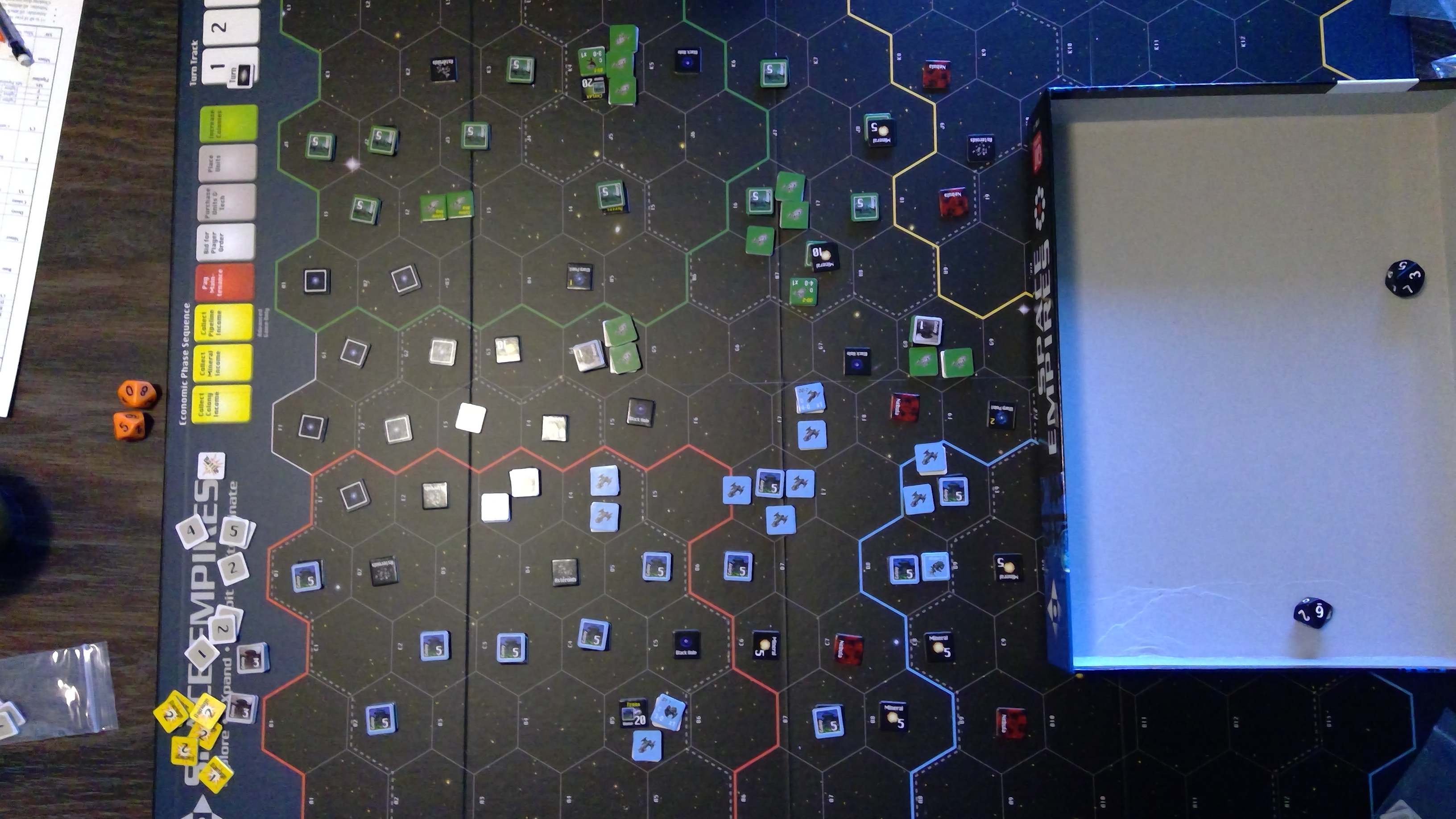
Second strike at 1013.


The Kzinti flood.


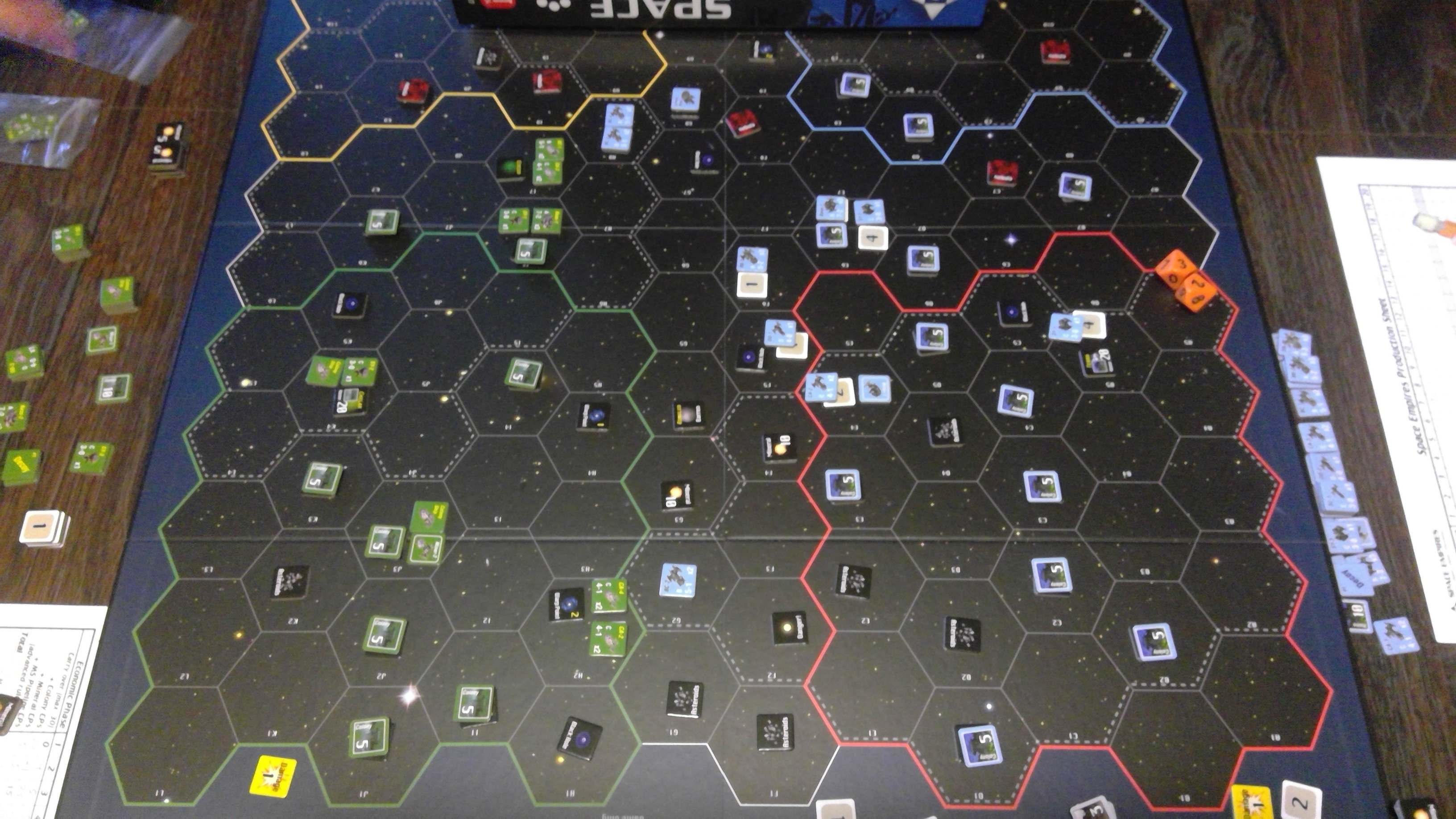
Federation tidal wave.


Losing the rest of the are near the Tholians.


Gorn border offensives.

Naturally, all available reserves (three: Klingon 2nd and 3rd, Lyran 3rd) went to the Klingon capital. The Lyran reserve in Hydran space went to help near the Hydran capital, and one in 0707 had nowhere to go. I had to think long and hard about how serious 3518 was, but sent both Romulan reserves in range to make sure of the SB. Meanwhile, the 2nd Reserve went to save BATS 4010.

Battles:
0916: SSC: Hydran: dest 2xCU
2008: SSC: Klingon: dest cripD5
2313: SSC: Klingon: crip F5; Federation: crip FF
2411: SSC: Klingon: dest 2xF5
2612: SSC: Klingon: crip F5
2514: SSC: mutual retreat
2613: SSC: Klingon: dest cripF5, F5S
3115: SSC: Romulan: crip WE
3412: SSC: mutual retreat
3609: SSC: cloaked evasion
4108: SSC: cloaked evasion
3319: Romulan: dest BATS; Federation; crip 2xFF
2308: Klingon: dest E4A
2309: Klingon retreat
2815: Klingon: crip D7C, F5; Gorn: crip HD
2012: Klingon: dest F5; Federation: crip FF
2215: Klingon: dest BATS, cripD5
2214: Klingon: dest FRD, SAV, cripD6, cripD5, crip F5E, E4A; Federation: dest DE, capture planet; Gorn: crip 2xCM
1507: Klingon: dest F5L
1809: Klingon: crip D6, F5; Federation: crip CA; Kzinti: crip CM
1810: Klingon: crip F5; Lyran: crip CW; Federation: dest CA
1611: Kzinti: dest FKE
1411: Klinshai: dest MB; Kangor: dest SB, 4xPDU, devastated; Kangorax: dest 2xPDU, devastated; Kangor-Ultra: dest 2xPDU, devastated; Kadrak: dest 4xPDU, crip SB, devastated; Drakis: dest 2xPDU, devastated; Shadrak: dest 2xPDU, devastated; Klardon: dest 4xPDU, devastated; Vordon: dest 2xPDU, devastated; Aradon: dest 2xPDU, devastated; Klingon: dest D5W, 2xD5, F5E, crip 3xD7C, 2xD6M, 6xD5, D5V, AD5, 3xF5, F5S, capture MEC; Lyran: dest CWE, DW, FF, crip STT, CW, CWE, DW, FCR; Federation: dest BT, NCA, CA, NCL, 3xCL, 7xFF, crip CA, 14xNCL, 5xDE, 2xDW, 8xFF; Kzinti: dest 2xMSC, CLD, 2xDW, FKE, SDF, crip CC, 5xCM, 5xMEC, CLE, DW, 3xFKE, 2xEFF, 3xSDF
1511: Kzinti: dest FF
1509: Retreat after declined approach
1504: Lyran: crip 2xCL; Kzinti: crip FF, capture planet
1506: Klingon: crip F5, F5E; Kzinti: dest 2xFFK, crip FFK
1013: Klingon: dest BATS, F5W, F5, F5J, crip D7, 2xD5; Lyran: dest MB, 2xDW, crip CW; Hydran: dest 3xRN, LN, crip RN
1815: Klingon: crip D5, 2xF5
0717: Klingon: dest F5L, E4, crip D7C, F5; Hydran: dest CU, crip HR
0816: Hydran: dest POL
2211: Lyran: dest DW; Gorn: dest BD
3518: Romulan: dest SKE; Federation: dest FFE
3612: Romulan: dest WE, SN, K5S; Federation: crip 2xNCL, capture planet
3415: Romulan: dest SP, SK, K5, crip KE; Federation: dest FFE, crip 3xNCL, capture K5, capture planet
3611: Romulan: crip SK, SKE; dest CL, crip FF
3413: Romulan: dest SNB; Federation: crip FFB
4110: Romulan: dest BATS; Federation: crip FF
4109: Romulan: dest SNB
4310: Retreat after refused approach
4411: Retreat after refused approach
4010: Retreat after refused approach

Some of the smaller combats went fairly well, including great rolls in 0916 to wipe out two CUs (who had little business taking on a DW and LTS to begin with…), but Byron managed to arrange for one retreating group to overrun the survivors of an earlier battle in 2613, and that wiped them out.

Byron put the entire pile of cripples from the destruction of the 3rd Fleet SB onto a patrolling F5V group in 2308, which sacrificed the escort to get away. This trick of finding battles for cripples so they can retrograde further has been getting common lately. The F5V was forced to retreat onto a waiting Gorn CM, but poor rolls allowed it to get away from that.

Overshadowed by other events, there was no real backup for my repair center on 2214. The Federation/Gorn force was bigger and better than what I had available, leaving me to pull some cripples out and a LAV.

I had the clever idea of using a fighting retreat to pour BG Harbinger into the capital from 1611, but of course Byron sensibly didn’t resolve that fight until later. At the capital itself, I started fighting at one system per round, determined to extract the highest bill I could over my own defenses. The outer systems quickly got stripped, and then it turned into the real brawl as he started taking on the two non-capital SBs, with me putting a line in front of both. Byron directed the PDUs over a couple of rounds, (when he didn’t drop damage on ‘6’s to force auto-kills…) while leftover damage reduced my mobile fleet to less than two lines worth. (Later on, I realized that cripples could go to the static forces of any system; handy if I wanted to sacrifice a few ships for more rounds against him… but it took a while to wake up to that.)

Midway through, I used the capital SB’s fighters to refill empty bays elsewhere on the same round that Byron captured a Lyran FF, and he took a round at Klinshai itself to blast the Lyran MB set up there, the FF aiding in a deception operation. I had command difficulties elsewhere, but but at the capital, I could bring out Insatiable, the almost-complete B10 that’s worth 19 on the line (no crippled side, so it still needed protecting in form). Another ‘6’ allowed him to kill the MB with 26 left over…. The Klingons mauled a MSC and dropped 61 with a mere ‘3’ roll. A ground attack to kill a PDU while he was there failed, and I ended up capturing the MSC. (With that damage, other ships died, but the random roll came up with the best of all of them.)

To my surprise, Byron left after only crippling the second SB. He’s correct that it’ll be a problem to repair, and isn’t worth a lot crippled, but I figured he’d want finish it off now rather than later. I picked off a couple things in pursuit, but both sides are pretty shattered. Of course, he has a lot more scattered around than I do, and the Klingon economy isn’t worth a lot at the moment…. Even after going through the logs in detail, I don’t know how many rounds this actually was, but it was probably in the mid-teens.

The fight in 1504 was interesting in that the Kzintis had 2xLAV, 3xSAV and no escorts. They ad-hoced a bunch of FFs so they couldn’t just be directed on, but it meant there was very little capable of pursuing me when I retreated (especially since I directed on one of the few FFs not busy escorting a slow unit), and Byron only realized the problem at that point.

I had the advantage at planet 1506 (where the North Fleet had reacted to) but I wasn’t entirely sure I wanted to tangle with a pair of CVDs with 24 fighters to punch through. But I went in, and picked off a couple FFKs in pursuit, though crippling the F5E is going to give me trouble, since the only spare light escorts there are E4As.

The Klingons rolled three better than the Hydran on approach to 1013, doing two less damage to a decidedly superior line. (If the Lyran STL hadn’t shocked last turn in the same place, I probably would have won the approach; that round at any rate.) I forced him to go through the co-located Klingon BATS to kill the Lyran MB, and kept rolling well enough to kill ships, which is something I’ve been needing to do to the Hydrans. But now the Lyrans have almost no supply into Hydran space.

Planet 3612 was something of a disaster. The Federation force was slightly small, so I decided to damage it and retreat, but but I was a good group, and I ended up sacrificing half my group to keep the carrier group intact rather than slowly cycle it through the repair process. I should have just sacrificed one ship and left, which I had almost done.


Coalition: 413 EP (x2) + 530 (bases) + 793 ships (/5) = 1673.2
Alliance: 409.4 EP (x2) + 435 (bases) + 815 ships (/5) = 1579.8

Losing the Klingon capital was a near thing. I had set up last turn to try and hold as many Alliance ships out of that vulnerable location as I could, which is why it didn’t happen. If I hadn’t had the NE Fleet in the way (which hadn’t moved on my turn because of its position in the way of the 3rd Fleet on 1910), the capital would have fallen, and I would have surrendered the game. There’s no real recovery from losing the Klingon shipyard at the best of times, and there’s certainly no SB that the Klingons can guarantee will be out of reach of a powerful Alliance force for six turns right now.

The last several turns has been me going from one disaster to the next, but this was the first one I was… partially ready for. I had hoped to hold the outer systems better than I did, and the economy is going to be a mess. The current plan is to go on a bit longer, but this game is on a short countdown to an end. There’s not a lot I can do to push back on the large number of places that are falling apart, and those are staging points for ever-larger numbers of Federation ships to pound what’s left. Worse, important Lyran bases have been taken out, so they will be largely useless next turn (and after unless I can re-establish some).

└ Tags: bgg blog, F&E, gaming, KwH
 Comment 
  • Page 140 of 310
  • « First
  • «
  • 138
  • 139
  • 140
  • 141
  • 142
  • »
  • Last »

©2005-2026 Rindis.com | Powered by WordPress with ComicPress | Hosted on Rindis Hobby Den | Subscribe: RSS | Back to Top ↑