Rindis.com

All my hobbies, all the time
  • Home
  • My Blog
  • Games
  • History

Categories

  • Books (491)
  • Comics (10)
  • Gaming (911)
    • Boardgaming (669)
      • ASL (154)
      • CC:Ancients (83)
      • F&E (78)
        • BvR – The Wind (26)
        • Four Vassal War (9)
        • Konya wa Hurricane (17)
        • Second Wind (5)
      • SFB (78)
    • Computer games (161)
      • MMO (76)
    • Design and Effect (6)
    • RPGs (66)
      • D&D (25)
        • O2 Blade of Vengeance (3)
      • GURPS (32)
  • History (10)
  • Life (82)
    • Conventions (9)
  • News (29)
  • Technology (6)
  • Video (48)
    • Anime (46)
  • Writing (1)

Patreon

Support Rindis.com on Patreon!
Become a patron at Patreon!

Other blogs:

RSS Inside GMT

  • Meet The Han: A Civilization of GMT’s Ancient Civilizations of East Asia  March 20, 2026

RSS Playing at the World

  • Playing at the World 2E V2 Arrives May 5, 2025

RSS Dyson’s Dodecahedron

  • Corporate Brief: Cyberus Security March 22, 2026

RSS Quest for Fun!

  • The Myth of Rational Animals November 23, 2025

RSS Bruce Heard and New Stories

  • Preview: The Iron Queen February 9, 2026

RSS Chicago Wargamer

  • The 2 Half-Squads - Episode 310: Cruising Through Crucible of Steel January 27, 2023

RSS CRRPG Addict

  • Star Trail: Sweet Is the Swamp with Its Secrets March 20, 2026
SF&F blogs:

RSS Fantasy Cafe

  • Michael Swanwick Guest Post and Book Giveaway February 23, 2026

RSS Lynn’s Book Blog

  • Booking Ahead/Weekly Wrap Up March 22, 2026
ASL blogs:

RSS Sitrep

  • Cardinal ASL Sins March 18, 2026

RSS Hong Kong Wargamer

  • FT114 Yellow Extract After Action Report (AAR) Advanced Squad Leader scenario April 16, 2025

RSS Hex and Violence

  • This still exists? March 25, 2025

RSS Grumble Jones

  • 2026 Kansas City ASL Club's March Madness Tournament March 16, 2026

RSS Desperation Morale

  • How to Learn ASL March 16, 2025

RSS Banzai!!

  • October North Texas Gameday October 21, 2019

RSS A Room Without a LOS

  • [Crossing the Moro CG] T=0902 -- Rough start July 18, 2015
GURPS blogs:

RSS Dungeon Fantastic

  • What color is paut? Sigh. March 3, 2026

RSS Gaming Ballistic

  • Pigskin project (by Chris Eisert) February 28, 2026

RSS Ravens N’ Pennies

RSS Let’s GURPS

  • Review: GURPS Realm Management March 29, 2021

RSS No School Grognard

  • It came from the GURPS forums: Low-Tech armor and fire damage January 29, 2018

RSS The Collaborative Gamer

  • Thoughts on a Town Adventures System January 18, 2022

RSS Don’t Forget Your Boots

  • GURPS Supers Newport Academy #3: “Season Of The Witch” February 8, 2026

RSS Orbs and Balrogs

  • Bretwalda - Daggers of Oxenaforda pt.4 - Fallen King May 27, 2017

City of Fortune

by Rindis on August 24, 2018 at 12:00 pm
Posted In: Books

Crowley’s book on Venice is about the Stato da Mar, and as such, is exactly one of the things I’ve been on the lookout for.

The first section starts with Venice’s mercantile rise, and then goes into the story of the Fourth Crusade. He’s fairly neutral on everyone’s participation later on, but it’s interesting to see a version that’s sympathetic to Venice for the beginning of it all. He doesn’t quite out-and-out blame Villehardouin for it either, but his over-inflated request for transport to the Middle East is the beginning of it all. Crowley points out that Venice effectively stopped all trade for a year to gather and build sufficient transport for the promised crusading army, which put them in a profit-or-perish position when the bill came due.

The second part talks about the small empire Venice picked up from this… and the long series of wars with Genoa, including a fairly lengthy description of the War of Chioggia. This is even more the centerpiece of the book than the Fourth Crusade’s taking of Constantinople, and almost felt like it got a little drawn out, though I’m sure that’s nothing compared to how the Venetians felt. At any rate, the entire subject is one I wish I could find more on in English.

The last part of the book is on Venice’s thankless war against the Ottomans, and is every bit as interesting as the rest of the book. As ever, there are interesting missed opportunities, but here the entire conflict is one I don’t know much of. Certainly, the loss of Negroponte and the Battle of Zonchio aren’t anything I recall hearing of before. At any rate, Crowley concentrates on this part, and finishes in 1503, before things like the loss of Crete, and finishes with some prescient quotes from a couple of Venetians on what the Portuguese discovery of a route to India was going to do to trade.

As ever, this is a very engaging narrative history, and is full of anecdotes and quotes to help it all come alive. This time his subject is one that gets less attention in English, which makes even better.

└ Tags: books, history, reading, review
 Comment 

Winds of Change

by Rindis on August 20, 2018 at 12:00 pm
Posted In: Computer games

This is the eleventh in a series of reviews of Paradox’s empire management games. See the earlier reviews here:
Europa Universalis II: A Tale of Two Europas
Hearts of Iron: Europa of Iron
Victoria: Nineteenth Century Essay
Crusader Kings: A Dynastic Adventure
Hearts of Iron II: Return Engagement
Europa Universalis III: A Whole New World
Europa Universalis: Rome: Make a Desert and Call it a Game
Hearts of Iron III: One Plus Two Equals Three
EU III: Heir to the Throne: Not Done Yet
Victoria II: Same But Different

A year after Heir to the Throne, another poll from Paradox returned more EU III as still the leading desire among fans. This time the proposal was to concentrate on ‘the rest of the world’ (than Europe) though all the attention went into the Orient.

What would become the last expansion (and the second past what Paradox had originally expected to do) for EU III came out for PC in December 2010, and a new bundle, EU III: Chronicles, with all the expansions was released the following March, along with the Mac version of the expansion. This review is just of Divine Wind, so you may want to read/review my EU III and HttT reviews listed above for basic details before reading this.

The World

The most readily apparent thing about the new expansion was that the graphics had gotten a major overhaul. This caught EU III up with the other Clausewitz games graphically, and did away with the overly-muted colors it had been using. The jagged-looking province borders are still there, but they’re better smoothed in some of the larger zoom levels.

The result was still a bit flat, especially compared to how their games would look very soon, but comparatively, it was quite good. There are some other important improvements, including the ability to zoom out much further than before.

Additionally, the number of different map modes generally available about doubled, with views of relative tech levels, number of buildings in a province, and so on being added. In addition, there was a new map mode linked to the peace process. As you go through the list, selecting provinces to change hands, they light up; the area of new nation to be released as a vassal changes color etc. In addition, there’s shading to show what’s currently possible to take in a peace, and the map will shift areas when a selected province is far away, also making it handy for wide-ranging wars.

Japan

In EU III, Japan is a minor power, stuck, like the rest of the east, with a poor technology group and troop types. But, it has the population and riches to be able to do quite a bit in its arena. Left to itself, the AI usually muddles around, winning and losing wars. But given a lucky break or two, it is not uncommon for a Europe-based player to get to the east, and find that Japan is carving up a mighty empire for itself.

In Divine Wind, a lot of detail was added to Japan. First, the map of Japan itself was expanded from 18 provinces to about 40. Second, it was split up into four factions (daimyos) all under one emperor. The rest of the world deals with Japan as a whole through the emperor, for alliances, wars, and the like.

Internally, the daimyos treat with each other as normal, but have no diplomatic options to deal with nations outside of Japan. Typically, one daimyo will be shogun (at the start of any game, the Minamoto will be shogun), and the strength of his rule is shown in a panel that gives the shogun’s influence. This represents his ability to keep control of what the other nominally independent daimyos are up to. At lower levels of influence, the other daimyos can declare war or ally with each other; at moderately high levels, the shogun can declare wars on the other daimyos; and at very high levels, he can declare wars on other countries on behalf of all Japan.

Influence changes on a monthly basis according to the shogun’s current prestige and his relations with the other daimyos. He has a couple of decisions that can be made as shogun, but there’s no series of reforms like in the HRE, so the actions he can take are all limited. At low influence, the daimyos may declare war, and if one can gain enough power, may be made shogun instead. Additionally, if the other daimyos can be eliminated, then the shogun can take full power and become the full Japanese nation, instead of just a clan under the emperor.

Underneath it all, the daimyos are still normal feudal monarchy governments, and can change forms at will. It is instead some hard-coded relationships that make up the differences. It is also possible for an external country to conquer ‘Japan’ (take the one-province nation of the emperor), and cut the daimyos loose that way.

This is still obviously fairly abstracted from the actual situation, which Paradox felt does not fit into EU III’s large-scale model with dozens of clans and fairly rapid shifts of power, but it certainly is closer than just a single unified nation.

China

China (or more properly at the start of the game, the Ming Dynasty) is a large nation that did not do a whole lot during the period of Europa Universalis. As such, it always presents a problem for the developers, as it’s hard to keep such a large and populous country chained to an inward-looking set of goals. (In fact, there was an early AAR on the forums that came to the conclusion that Ming was the easiest country to do a world conquest game with.)

Typically, EUIII hands Ming a number of large problems, such as being in one of the slowest-developing tech groups (Chinese, 40% of the normal rate, with a further limitation on anything past level 7), and a lot of rebellion events to keep attention off of the outside. This often works with the AI (but not always…), but a determined player can still do quite a bit.

Divine Wind gives Ming China a new government form, Celestial Empire, which comes with three factions. The abilities of the current monarch, and the current domestic policy sliders determine the month-to-month support of each faction. There are also events and cultural decisions that can directly influence the current support (which will then slowly slide back into balance according to the monthly support). The factions truly are about a third of a government apiece, as at any time you can only do the third of the functions allowed by that faction.

The Eunuch Faction is supported by Diplomatic ability, Free Trade and Naval policy, and allows the placing of merchants, exploration, the placing of colonies, and building new naval units.

The Temple Faction is supported by Military ability, narrow minded and large army policies, and allows the declaration of wars and the placement of missionaries.

The Bureaucrat Faction is supported by Administrative ability, aristocracy and serfdom, and allows the construction of buildings and army units past the current support limit (which, being China, is already quite large).

It would seem the faction influences were not written into the timeline, as a game will always begin with the Eunuch Faction at 100%, but the policy sliders will make sure it is soon overtaken by the Bureaucrats (with the Temple getting second place). The Celestial Empire is otherwise a fairly simple government with no special bonuses, and a time to domestic policy changes that is fairly good for the beginning government types. But it does come with an extra bonus: the Mandate of Heaven national modifier that reduces revolt risk, stability cost, and gives a monthly bonus contribution to stability progress. (However, going below 0 stability or 60 legitimacy gives the Mandate of Heaven Lost modifier that makes stability much harder to get, along with other nasty effects and events.)

All of this makes the Ming Dynasty ship of state one that is hard to steer, and certainly does its job of keeping it constrained. But while there is some interest in the idea of working the factions against each other, it is more an exercise in frustration for anyone not prepared to be very patient.

However, the factions only exist (and limit the Ming) if there’s no major changes. Westernizing the Ming at all will get rid of the factions (and the Mandate of Heaven, which only applies while you have factions), while fully Westernizing the country allows the government form to be changed. Also, in 1644 or later, the Ming can possibly take the decision Form Chinese Nation (meant to represent the Qing Dynasty) if the Manchu are no longer around, and this changes the formal nation tag, and shifts the government to a Despotic Monarchy (which also gets rid of the factions and Mandate of Heaven).

The Steppe

Lastly, the fluid tribal governments of central Asia got a very interesting rework in Divine Wind. They’re considered to automatically be at war with all their non-steppe horde neighbors all the time. They can be defeated, and a peace imposed, but as soon as the 10-year truce is over, the war starts again.

Not only that, but there is no way to trade territory in a treaty. If a horde occupies a province long enough it automatically goes over to it. Conversely, a ‘settled’ country can colonize any province that they hold from a horde. Like with a normal colony, if it gets to 1000 people, it becomes a regular province of the country. However, these ‘colonies’ develop much faster than normal, taking about 4 years to settle the province if nothing further is done instead of the roughly 18 years of a fast-developing normal colony.

The only ways for the horde to escape from this is to reform the government away from a tribal structure (which is difficult), or to form the Mugal Empire, either of which will turn it into a despotic monarchy.

The good news is that this really does lend central Asia an appropriately fluid feel, and the nearby settled countries must always be wary of what’s going on beyond their border. But since a war with a horde country doesn’t count as a ‘normal’ war for war exhaustion, degrading cultural tradition, etc, the first time they have a problem (such as the usual succession crisis of all tribal governments), it isn’t hard to just occupy everything, put down any rebellions, keep them from ever generating a new army, and just colonize the entire country. An occupied province will have an ever-mounting revolt risk, but as long as there’s troops to keep a lid on while colonization proceeds, not a huge problem. This isn’t too far off of the sudden collapse of these societies in history, but it can happen much earlier than it should by being a bit gamey.

Building Out

One of the interesting ideas introduced in HttT was that of an extended set of provincial decisions, which in conjunction with national focus and magistrates turned into a separate way to improve provinces.

DW did away with much of that system and the province improvement buildings that had been around since the original game. Instead, there are now six categories of buildings (Government, Army, Navy, Production, Trade, Fort), each with six levels. Naturally, at the beginning of the game, very little of this is available, and the levels of buildings unlock as technology progresses through the game. The magistrates from HttT were retained, and now each building costs money and a magistrate, which at least keeps a large country from just saving money and spamming every province with a new building as soon as it becomes available.

An extra wrinkle is that in the late game you must choose to specialize your provinces. No province may have more than one building of level five or higher. (Note that this also means powerful fortifications now come at the cost of other things.) Short of this, it’s still a lot like the older system, but with a lot more steps along the way (6×4+2 = 26 buildings, compared to the 17—including 6 fort levels—of the old system).

Manufactories still exist as a one-off expensive buildings that improve local resource production, and give a bonus to technology investment as before. But there is now also a set of eight ‘Unique Buildings’, which each can be built once in the country. These aren’t as expensive as Manufactories, but overall tend to have higher tech level requirements, making many of them late-game improvements.

Conclusion

Every expansion for EU III saw new features introduced to the main feature set originally presented. Most would find their way into EU IV, but the main exceptions are in Divine Wind. They’re generally all good ideas, but the hard-coded relationships in Japan, the separate government type and factions of China, and the more fluid tribal nations did not work well in practice, and were dropped.

But the interface improvements were a big help, and was something that Paradox continued to work on through further games. The overall look of EU III was still slightly behind the times with DW, but it was a big step forward for the game, and doubtlessly helped it continue to do well as Paradox’s attention was occupied elsewhere for the next couple of years.

For a new player of EU III, going straight to the Chronicles version is fairly easy to recommend. Unlike HttT, which was a mixed recommendation due to all the extra complexity it introduced, most of the new features are in places where a new player probably won’t see them until they are well acquainted with the main parts of the game. The rest of the new features are definite improvements, and will help, rather than hurt, a new player.

└ Tags: Europa Universalis, gaming, Paradox, review
5 Comments

All Quiet on the Western Front

by Rindis on August 16, 2018 at 12:00 pm
Posted In: Books

This is less a novel, and more a fictional memoir. There’s no real plot, and a barebones structure. The entire story is told first person by a young German soldier in WWI who describes the horrors of the Western Front in detail.

It picks up with Paul, the viewpoint character, having already spent time at the front, and feeling alienated from his previous life. The novel then goes through a number of different things to present the full experience of a typical lower-rank soldier. Bombardments, attacks, rotations between the trenches and the reserve, leave, being wounded and spending time in a hospital. Remarque only spent a limited time at the front, but obviously absorbed much from his fellow soldiers as years of experience are recounted in here with a great sense being all too real.

The writing is direct, and extremely effective even in translation at conveying the tone and mood intended. It’s not (and is not meant to be) glowing prose, but to beats at you in the combat beats at Paul. Any sort of more elaborate writing would only dilute the message.

└ Tags: books, historical, reading, review
 Comment 

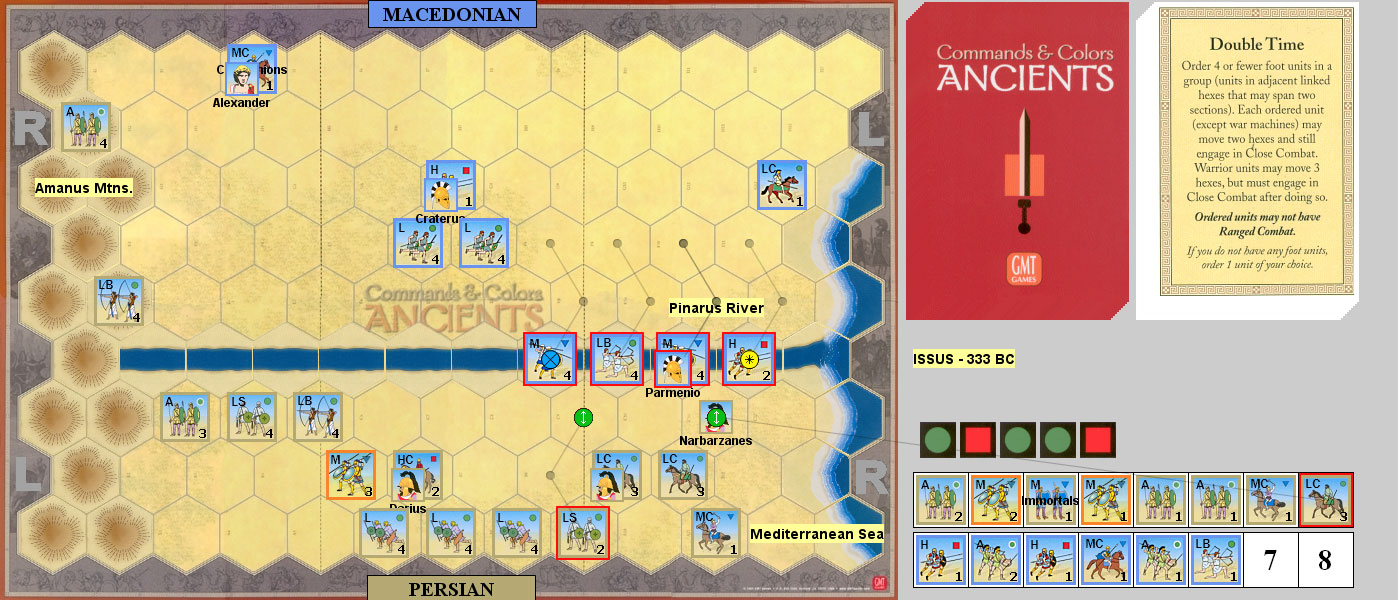
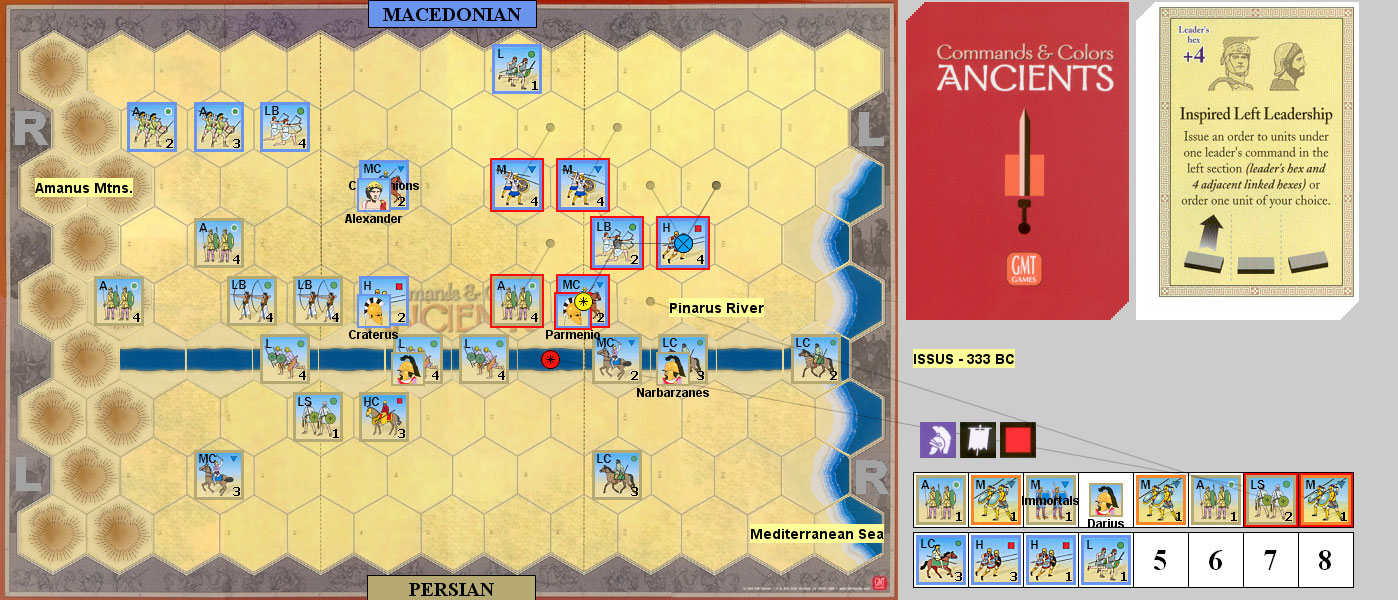
Two Rounds of Granicus

by Rindis on August 12, 2018 at 12:00 pm
Posted In: CC:Ancients

Patch and I recently had our between-games set of Commands & Colors: Ancients, and this time we’ve hit Alexander the Great’s career with the Battle of Granicus from Expansion #1. Alexander has a river to cross to get at a fairly decent Persian army, but has a number of advantages. The Companions ignore one sword hit in combat, and can ignore a banner, while Alexander causes a unit to battle with one extra die. Meanwhile, the Persian leaders only allow helmet hits for the unit they’re attached to, instead of all adjacent units, and Leadership cards only order the unit they’re attached to. And, the Persians have four cards to Alexander’s six.

I had Alexander first, and opened with Order Light, to line up at the river a bit more, and caused two blocks of losses with archery, and drove two units of cavalry back. Patch used Order Mounted to pull the rest of his forward line back out of range, not contesting the river. I started crossing the river, and Patch Ordered Lights into archery range. I Ordered Three Right to charge into the lights before Patch could start getting hits, and did one block to a bow unit.

Patch counterattacked with Order Three Center, putting Spithridates and Rhoesaces into my strung-out units, doing three hits to an Auxilia, and taking one in return. Inspired Center Leadership got my left flank into the river, and an Order Three Right cost me a MC as Patch got a double-banner on it, and drove it off the board. We both inched or centers up, and then Order Lights from me did two hits on a LC from archery, and knocked out a MC while taking one block in return.

Patch then used Mounted Charge (“I failed to do this last turn, and lost a unit as a result”), and got behind Alexander. I used First Strike as he went for my 1-block Aux in the river, but only got one of two blocks, while he got the Aux and Ptolemy. Then he knocked out the Companions, and Alexander had to evade through the enemy line (I’ve known the rule, but never had to do that before), Momentum then took out two LC blocks in the river, but I finished off his LC when they joined in.

I used Line Command to get intact units across the river, as well as getting more into it. Patch then used a second Mounted Charge, which finished off my LC and killed Alexander. World history is in ruins. 2-6

Patch spent the first three turns lining everyone up along his bank of the river, while I moved units up from the base line. Then Patch used Line Command to get most of his line into the river, driving off two of my cavalry units, doing two blocks of damage, and taking one in return. I used Clash of Shields for the two MC still at the river, and drove back his Med and did damage to a Heavy, but took two hits on a MC in return. Patch used I Am Spartacus to order a Light, two Medium and two wild (Med and Heavy), and put his flank cavalry into the river as well as getting his Med back in, and knocked out both of my center MC, while taking two blocks himself.

I used my own Line Command to fill in my center, and Patch used Mounted Charge, and did two blocks to an Aux, who then drove the attacking MC back past the river, and Alexander wiped out a MC, and I decided to keep Mithridates on-board, but momentum caught up to him and killed him (did not think that through…). I used Move-Fire-Move to rework my line and drove Alexander back. Patch used Inspired Right Leadership to move his center across the river, and I used Darken the Sky, which got six hits on various units, and finished off a Heavy, while damaging the other one.

Patch Out Flanked, and drove off my LC (they stayed since it was a river and a one-block MC, but a banner kept me from battling back), and on the other flank his LC was driven off by a banner from my LC. We both spent a turn rearranging a bit, and then I Ordered Three Center to knock out an Aux and drive off another. Patch Ordered Four Right, but only took one hit for his trouble. I Coordinated Attack for no damage and Patch Ordered Two Left to knock out an Aux, and do a block to a LC on momentum.

Desperate, and out of better options, I Double Timed but failed to get a 1-block Aux and lost a full Med on battle back after two attempts on his Medium. 2-6

Afterword

I knew my initial charge over the river in the first game was chancy, but Patch had some really good luck in that one. The second game bogged down near the end as we both had problems. Patch had a bunch of reduced units scattered around and didn’t feel safe taking on my more intact army. But I was out of cards to maneuver with, and couldn’t find any good ways to finish them off.

The scenario is certainly interesting, with the split setup for the Persians, and the Granicus River really influences the battle. The hills never quite came into play, though both Patch and I used them as an anchor at some point.

└ Tags: C&C Ancients, gaming
 Comment 

The Gods Themselves

by Rindis on August 8, 2018 at 12:00 pm
Posted In: Books

Effectively, the full title of this is “Against Stupidity, the Gods Themselves Contend in Vain”, a quote that is spread out across the three sections of the novel. I was a bit worried at first, as the book starts with (a fragment of) chapter 6), and given the occasional screwups of ebook translations, I was initially worried that something truly horrible had happened, but after the first page Asimov inserts a note that he has his own reasons for the numbering, which is part of a narrative device that works out fairly well (including the chapter numbers helping by informing you what is flashback and what isn’t).

Each of the three sections is pretty much its own novella, and were apparently initially published as such, all tied into one overall problem. The first section ultimately deals with academia and the politics that can surround it. The second is unusual for Asimov as it’s purely from the viewpoint of aliens in a different universe (Asimov generally avoided writing about aliens as he was poor at it). And the third is back in our universe, an uncertain but short time after the first section, with a completely new cast on the Moon.

All three are tied together by the interaction between two universes, our own, and one where the strong nuclear force is about one hundred times as strong as it is here. This is explained quite well in the opening parts of the book, and transferring matter between the two allows what seems to be free unlimited energy; the process of adjusting to the laws of the other universe liberates a lot of energy, with no apparent downsides. Much of the premise and action of the book revolves around what it would take to give up nearly free energy if there is an unapparent (and fatal) downside.

As ever, Asimov is a bit of a ‘flat’ writer, but he actually does fairly well on his characters here, though there’s still some ‘telling’ instead of ‘showing’ to establish the scene, and overall I zipped through the book enjoying it the entire way, though both the physics and ‘liberated’ attitudes are a bit out of date now. Certainly, his character drama of the middle section is worth the price of admission.

└ Tags: books, reading, review, science fiction
 Comment 
  • Page 143 of 310
  • « First
  • «
  • 141
  • 142
  • 143
  • 144
  • 145
  • »
  • Last »

©2005-2026 Rindis.com | Powered by WordPress with ComicPress | Hosted on Rindis Hobby Den | Subscribe: RSS | Back to Top ↑