
Rindis.com

All my hobbies, all the time
  • Home
  • My Blog
  • Games
  • History

Categories

  • Books (504)
  • Comics (10)
  • Gaming (919)
    • Boardgaming (675)
      • ASL (155)
      • CC:Ancients (83)
      • F&E (78)
        • BvR – The Wind (26)
        • Four Vassal War (9)
        • Konya wa Hurricane (17)
        • Second Wind (5)
      • SFB (78)
    • Computer games (162)
      • MMO (77)
    • Design and Effect (6)
    • RPGs (66)
      • D&D (25)
        • O2 Blade of Vengeance (3)
      • GURPS (32)
  • History (10)
  • Life (82)
    • Conventions (9)
  • News (29)
  • Technology (6)
  • Video (50)
    • Anime (48)
  • Writing (1)

Patreon

Support Rindis.com on Patreon!
Become a patron at Patreon!

Other blogs:

RSS Inside GMT

RSS Playing at the World

  • Playing at the World 2E V2 Arrives May 5, 2025

RSS Dyson’s Dodecahedron

  • Shrine of the Diseased One July 17, 2026

RSS Quest for Fun!

  • The Expense Post May 24, 2026

RSS Bruce Heard and New Stories

  • Pain, Exhaustion, and Morale in D&D BECMI June 7, 2026

RSS Chicago Wargamer

  • The 2 Half-Squads - Episode 310: Cruising Through Crucible of Steel January 27, 2023

RSS CRRPG Addict

  • The Search for Freedom: Won! July 18, 2026
SF&F blogs:

RSS Fantasy Cafe

  • The Leaning Pile of Books July 5, 2026

RSS Lynn’s Book Blog

  • Friday Face Off: The Raven and the Reindeer by T Kingfisher July 17, 2026
ASL blogs:

RSS Sitrep

  • Cardinal ASL Sins March 18, 2026

RSS Hong Kong Wargamer

  • FT114 Yellow Extract After Action Report (AAR) Advanced Squad Leader scenario April 16, 2025

RSS Hex and Violence

  • This still exists? March 25, 2025

RSS Grumble Jones

  • Grumble Jones July Scenario GJ162 You Will Engage the Enemy July 1, 2026

RSS Desperation Morale

  • How to Learn ASL March 16, 2025

RSS Banzai!!

  • October North Texas Gameday October 21, 2019

RSS A Room Without a LOS

  • [Crossing the Moro CG] T=0902 -- Rough start July 18, 2015
GURPS blogs:

RSS Dungeon Fantastic

  • Felltower - Monsters Fleeing between Sessions vs. PCs replenishing June 28, 2026

RSS Gaming Ballistic

  • Mission X and Genre Fidelity in Combat July 19, 2026

RSS Ravens N’ Pennies

RSS Let’s GURPS

  • Review: GURPS Realm Management March 29, 2021

RSS No School Grognard

  • It came from the GURPS forums: Low-Tech armor and fire damage January 29, 2018

RSS The Collaborative Gamer

  • Thoughts on a Town Adventures System January 18, 2022

RSS Don’t Forget Your Boots

  • GURPS Supers Newport Academy #7: “Invitation to the future.. of the 1970’s” July 5, 2026

RSS Orbs and Balrogs

  • Bretwalda - Daggers of Oxenaforda pt.4 - Fallen King May 27, 2017

How to Plan a Crusade

by Rindis on March 2, 2019 at 12:00 pm
Posted In: Books

Despite the title, this is not a how-to book on how to get your own Crusade going. It’s actually a scholarly look at how the planning of the actual Crusades worked. Tyerman identifies broad subjects in planning and looks at each one in turn, discussing what it would have taken to get a crusade to happen at all, and pointing out where we can see those in action in the actual records.

As such, this is not a book for someone unfamiliar with the crusades as a whole. Tyerman discusses all the major Crusades, including the Baltic Crusades and the Albegensian Crusade simultaneously, and without some background in the subject you will be lost.

However, for someone who is familiar with this period, at least in outline, this book is a great supplement to that knowledge. He starts at the basic foundations, ‘reason’, and how the common popular notion of the Middle Ages as an age of unreason simply doesn’t work, and points up that just because the premises and priorities may be different from what we’re used to doesn’t mean that people did not still reason things out.

He builds from here, looking at how the case for war in the Middle East was worked out, how it was promoted and recruited for. How it was all paid for, how plans were laid and coordinated. Supplies were gathered, and successful or not, plans were reviewed to see how it could go better next time.

There were some very interesting points around shipping during the book. Naturally, technology and technique did improve over this period, and one of the major advantages the Crusades for the Middle East had was that Europe was largely back to dominating the Mediterranean at this point. However, Crusades largely went by land until the development of ships that could carry horses, at which point we see Richard I (and others) proceeding to the Levant by ship.

He ends with a look at strategic planning, which ends up circling around to near the beginning of the book. With the end of the Kingdom of Jerusalem after the Third Crusade, some serious reexaminations were made, in which Egypt, and its wealth, are clearly recognized as the key to the entire enterprise (to be fair, this had been noticed even during the First Crusade), and you start seeing the goal for further crusades shift over there. But that brings into question the initial motives for going in the first place. The idea was to hold and control what was seen as the religious center of the world, but if that’s so unimportant as to let Egypt take center stage in planning… it’s part of why the Crusades become less and less popular after that time.

And that effectively wraps up a very interesting look at the process Europe went through, and the innovations that were brought by the stresses of attempting the enterprise. Recommended for anyone who’s willing to give some thought to processes involved, but it does not present ‘history’ as you’d normally think of it.
└ Tags: books, history, middle ages, reading, review
 Comment 

Gears of the Horde

by Rindis on February 26, 2019 at 12:00 pm
Posted In: MMO

Smudge and I are still going strong on FF XIV, and the last three months has been spent with various tasks, but we’re spending more and more time on the storyline, and are about ready to transition into Stormblood. Overall, there’s been a couple of distinct phases of the story, with the first one covering patches 3.1-3.3. That was a pretty nice end point for business left unfinished at the end of Heavensward.

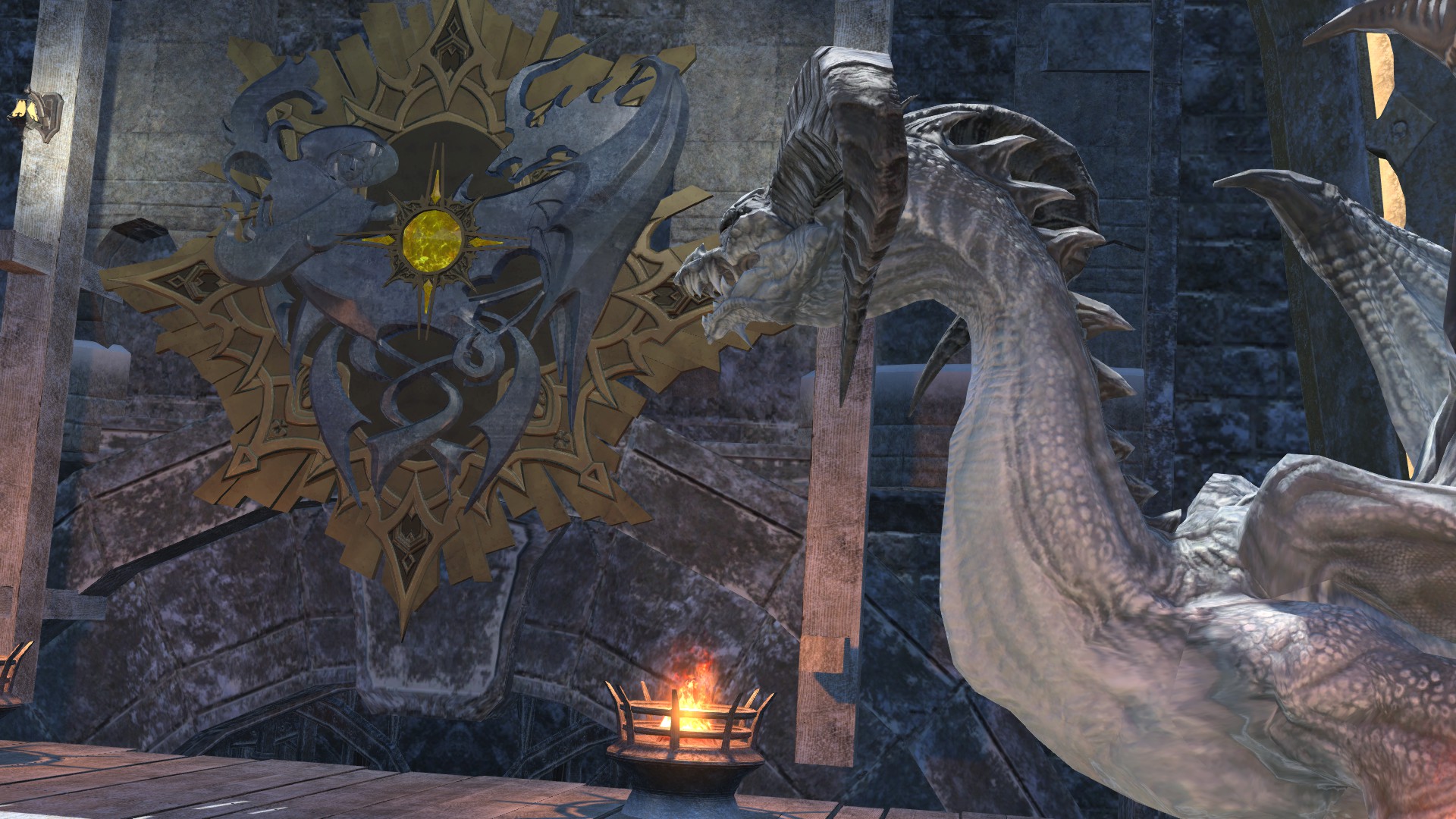
As usual, there’s a number of different threads going on at once, but the dominant one was actually managing a stable peace (or even cease-fire) between Ishgard and the dragons. Nidhogg is still thirsting for revenge for a thousand-year-old betrayal… and trust does not come easy to a people who’ve been lied to for all that time. Despite the complications, this part remains reasonably straightforward, which works a lot better for SquareEnix than the more complex story they tried leading into Heavensward. It eventually centers around two things: a ceremony to celebrate the peace, and a final confrontation with Nidhogg, which also finishes off Estinien’s story (which started back in the level 30 Dragoon quest). The former involved a new iteration of a piece of art we’ve been seeing around to commemorate Shiva and Hraesvelgr.


↓ Read the rest of this entry…

└ Tags: FFXIV, gaming, Heavensward, MMO
1 Comment

Defense of the Fiddler

by Rindis on February 22, 2019 at 12:00 pm
Posted In: Books

Well, this is different… and yet familiar. The broad action and wider themes of Defense of the Fiddler are fairly familiar Military SF. However, this is done in a script format.

Beyond the oddness of that choice in general, there’s odd things inside of this book in how it’s handled. The prologue and and one transition section are in comic format, so I assume that Hogarth was originally thinking of doing a graphic novel, but realized it’d take too much time out of her other writing projects. So we have a script that looks a bit like a Shakespearian play: scene setting and descriptions are fairly minimal. There’s some notable ones at the beginning, which quickly drops to nonexistent, and then as the book goes on, the descriptions slowly fill out a bit again, and for the climax there’s lots of descriptions of camera angles and pans, and… yeah, this is more cinematic than comics can easily do. So you get an initial few pages of visual reference, and then you’re left on your own to fill in the conversations with appropriate visuals. Once you’ve gotten through the beginning and have established the scene for yourself, then more details slowly start filtering in keep you on track.

It’s an interesting technique, but there are some important details not expressed until well into the book. The action is largely in claustrophobic tunnels, with the enemy ‘crabs’ breaking through the walls as well as using the existing tunnels. What isn’t said is that this is all on a planet with a toxic atmosphere, so everyone’s down below for their own safety. It’s obvious that something like this must be true, but the exact reason isn’t mentioned until late, making it hard to figure out what these tunnels are part of.

The story itself is multilayered, and very effective. It takes its time to get going, but the cast of characters is surprisingly large, partly because they’re introduced to you at a very deliberate pace, and you get to know everyone currently involved before expanding the scope slightly to introduce a couple more. It’s a difficult trick, one that all too many books flub at one point or another, and it’s masterfully handled here. The script format take a bit of getting used to, but you are well rewarded for going with it.

└ Tags: books, reading, review, science fiction
 Comment 

Anime Fall 2018

by Rindis on February 18, 2019 at 12:00 pm
Posted In: Anime

Yeah, I know we’re practically halfway through the Winter 2019 season by now, but I have a two week viewing gap in November, and I’ve been trying to catch up on some things ever since, and I’m not convinced that I’ve gotten through everything from the previous season, though I know I’m also well into the current season on a few things.

Sword Art Online: Alicization — This has been one of the stronger stories, and is now the longest, with it going straight into the second season with no signs of stopping. A few troubling problems from before have been addressed, notably Kirito and Azuna have flat out stated they’re a couple, which starts cutting the knot of all the harem-stuff that was wanting to build up. On the other hand, there’s still not a lot of Azuna here, as Kirito is effectively in a coma having an adventure in a VR world, while she takes action on the outside with a time differential that means Kirito is doing lots more. That said, the actual plot has been good, the action has been good, and we’ll see where we end up.

Golden Kamuy — Continuing to be a very good, if (more than) occasionally gorey. I think there’s one sane person in the cast.

Pokemon Sun & Moon Ultra Adventures —This is one that I keep trailing slightly behind on. Still very good and fun. At this point, it’s mostly more of the same, with some very good episodes.

Fairy Tail — I have no idea how caught up I am to this one. It’s been good to see the series back, and I think the writing has improved. The gear-up for the final story line seems to have added some much needed focus, and it’s not feeling padded.

A Certain Magical Index III — … sigh … The ideas in these series have been good all along, but usually let down by various annoying problems. Here, they’ve gone beyond annoying. The villains talk way too much, and me and Smudge have the distinct feeling that they’re rushing through all the plot lines. My guess is that they’re trying to get through everything that’s been written since the last series aired.

And a couple older things I watched last year (and into this one):

Children of the Whale — I think this came out early in the year; anyway Smudge introduced me to it around November. Generally good, it spent all its points on the world building, though the plot certainly works too. To my surprise, it’s not really complete, and kind of ends just as a second plotline is picking up. I do hope we see a second season.

Kerub’s Bazaar — We finally finished off watching this and it was fun all the way through. Most episodes being stories Kerub is telling Joris allow for them to do lots of different types of episodes, and (usually) tie it together with the framing. I hope we get another series (or at least Dofus Book II) soon.

Konosuba — Been re-watching this with Baron, and got through the first season. It really is a fun series. The first episode has the usual, ‘we need to get this going’ problem. But it really is hilarious once it does start going.

└ Tags: anime
 Comment 

Maria Theresa

by Rindis on February 14, 2019 at 12:00 pm
Posted In: Books

Kudos to Bloomsbury for making worthwhile older books available in e-format with good editing. No kudos for spending zero effort on the cover, but… the text’s the thing anyway.

Crankshaw’s biography of Empress Maria Theresa is certainly well done, within certain limits. He’s not afraid to be quite opinionated, which I generally find a good thing for a non-technical biography, as long as you get a good idea of what the opinions are. It’s obvious that he admires Maria Theresa, and there is certainly a lot to admire about anyone who can survive the attempted dismemberment of her inheritance as she took the throne. More surprising was his low opinion of Catherine the Great.

At any rate, this is not a ‘technical’ history by any means, and there’s only general descriptions of what happened, that tend to go through one subject at a time. Without prior knowledge of the War of Austrian Succession and the Seven Years War, those sections may be difficult to follow. But of course, he’s only concerned about their effects on Maria Theresa and Austria as a whole, and his discussion of the diplomacy that ended up touching off the Seven Years War is interesting.

There is discussion of her inner circle, which is the most developed and most interesting part of the book. There’s also a couple chapters on what was going on in the arts (this is, after all, when Vienna starts becoming a cultural center), which was rough going since my Art History knowledge is severely lacking. The two main themes are politics and personal life. There’s talk of the government and reforms that were made, but no real detail. Sadly, while her two prominent children (Joseph II and Marie Antoinette) are discussed at length, but the other eleven children who survived infancy remain near non-entities.

So it’s a decent general book on the period, and a decent biography. I got some things out of it, but I did feel like there wasn’t enough detail to really get an understanding of much of what was going on. There’s generally not enough on Central Europe in English, so I’m still happy I read it.

└ Tags: books, history, reading, review
 Comment 
  • Page 138 of 315
  • « First
  • «
  • 136
  • 137
  • 138
  • 139
  • 140
  • »
  • Last »

©2005-2026 Rindis.com | Powered by WordPress with ComicPress | Hosted on Rindis Hobby Den | Subscribe: RSS | Back to Top ↑