Rindis.com

All my hobbies, all the time
  • Home
  • My Blog
  • Games
  • History

Categories

  • Books (490)
  • Comics (10)
  • Gaming (910)
    • Boardgaming (668)
      • ASL (154)
      • CC:Ancients (82)
      • F&E (78)
        • BvR – The Wind (26)
        • Four Vassal War (9)
        • Konya wa Hurricane (17)
        • Second Wind (5)
      • SFB (78)
    • Computer games (161)
      • MMO (76)
    • Design and Effect (6)
    • RPGs (66)
      • D&D (25)
        • O2 Blade of Vengeance (3)
      • GURPS (32)
  • History (10)
  • Life (82)
    • Conventions (9)
  • News (29)
  • Technology (6)
  • Video (48)
    • Anime (46)
  • Writing (1)

Patreon

Support Rindis.com on Patreon!
Become a patron at Patreon!

Other blogs:

RSS Inside GMT

  • How Balanced is the Congress of Vienna Game? March 17, 2026

RSS Playing at the World

  • Playing at the World 2E V2 Arrives May 5, 2025

RSS Dyson’s Dodecahedron

  • Return to An-Nayyir’s Pyramid – Part 1 of 3 March 16, 2026

RSS Quest for Fun!

  • The Myth of Rational Animals November 23, 2025

RSS Bruce Heard and New Stories

  • Preview: The Iron Queen February 9, 2026

RSS Chicago Wargamer

  • The 2 Half-Squads - Episode 310: Cruising Through Crucible of Steel January 27, 2023

RSS CRRPG Addict

  • Game 572: The Elder Scrolls: Arena (1994) March 14, 2026
SF&F blogs:

RSS Fantasy Cafe

  • Michael Swanwick Guest Post and Book Giveaway February 23, 2026

RSS Lynn’s Book Blog

  • Top Ten Tuesday: Green Book Covers March 17, 2026
ASL blogs:

RSS Sitrep

  • Blockhaus Rock April 1, 2025

RSS Hong Kong Wargamer

  • FT114 Yellow Extract After Action Report (AAR) Advanced Squad Leader scenario April 16, 2025

RSS Hex and Violence

  • This still exists? March 25, 2025

RSS Grumble Jones

  • 2026 Kansas City ASL Club's March Madness Tournament March 16, 2026

RSS Desperation Morale

  • How to Learn ASL March 16, 2025

RSS Banzai!!

  • October North Texas Gameday October 21, 2019

RSS A Room Without a LOS

  • [Crossing the Moro CG] T=0902 -- Rough start July 18, 2015
GURPS blogs:

RSS Dungeon Fantastic

  • What color is paut? Sigh. March 3, 2026

RSS Gaming Ballistic

  • Pigskin project (by Chris Eisert) February 28, 2026

RSS Ravens N’ Pennies

RSS Let’s GURPS

  • Review: GURPS Realm Management March 29, 2021

RSS No School Grognard

  • It came from the GURPS forums: Low-Tech armor and fire damage January 29, 2018

RSS The Collaborative Gamer

  • Thoughts on a Town Adventures System January 18, 2022

RSS Don’t Forget Your Boots

  • GURPS Supers Newport Academy #3: “Season Of The Witch” February 8, 2026

RSS Orbs and Balrogs

  • Bretwalda - Daggers of Oxenaforda pt.4 - Fallen King May 27, 2017

The Campaigns of Napoleon

by Rindis on May 15, 2022 at 12:00 pm
Posted In: Books

Chandler’s massive tome on every campaign Napoleon conducted makes a great one-stop shop for a basic military history of any action you may want to look up. This is aided by lucid accounts all the way through, good maps (which are present in the Kindle version too—if a trifle small on my screen), and thoughtful brief analysis of each one.

All of this means it’s still the primary reference for the period nearly sixty years after it was first published; a feat very few other books can claim. It is highly likely no other book will ever combine the relatively introductory nature and comprehensiveness of this one and do it better. This does come at a price—the individual campaigns are covered at something approaching the level of an Osprey Campaign book, and this weighs in at ~1100 pages, with a smaller proportion than normal given over to appendixes, references, bibliography, etc.

There are some limits. As this is the Campaigns of Napoleon, as opposed to ‘the Napoleonic period’, there’s extremely little discussion of the Peninsular War, naval actions, or any campaign not directly involving the star of the show (I would like to see something on the French Revolutionary campaigns in Germany, that Napoleon’s campaigns in Italy were supposed to be a sideshow to). And it’s still 1100+ pages, so not losing focus in this volume is for the best.

And it’s not just the campaigns either. He goes into Napoleon’s background and early training at École Militaire, and spends a nice little bit of time on where his ideas on warfare came and were developed from; that is certainly a nicely informative chapter.

I’ll note the Kindle version has certainly been gone over, and there’s a minimum of errors, though a lot slipped through in the confusion of if a number should be a Roman numeral ‘I’ or an Arabic ‘1’ (there is one rendering of “IIth”), and Blücher gets rendered as “Blöcher” twice. Outside of that, the text is in very good shape.

└ Tags: books, history, reading, review
 Comment 

WO1 French Toast and Bacon

by Rindis on May 11, 2022 at 12:00 pm
Posted In: ASL

Patch and I got back to ASL at the end of January, and went for the first Winter Offensive scenario, “French Toast and Bacon”. Early in the Battle of the Bulge, a small German force tries to seize a river bridge from a small American force.

I had the defending Americans, who have eight half-squads, a single M18 TD, and a pair of 76mm AT, as well as the ability to keep their three BAZ hidden. An interesting SSR gives them an off-board 105mm ART (akin to “Regalbuto Ridge“, but self-spotting this time), which can declare its using what’s normally a long-range charge to get a CH on a 2 or 3, even if it would normally be a miss. That last is low-odds enough I never got around to declaring it. Anyway, they’re defending half of boards 44 and 59, and a stream overlay on 44 hooks up with 59, with everything past the stream effectively out of play. The Germans get four squads and three each Panthers and Pz IVs. Some GameSquad Q&A points out a vehicle can’t control a hex with a bridge as it can’t control the Location under it (even though that Location is inaccessible here), so the infantry must get to the bridge, as the goal is to Control the bridge hex as well as the hexes adjacent to it.

I had a heck of a time coming up with a defense, as there’s not a lot to work with, and the Germans have two possible entry hexes. With 5.5 turns, part of the goal must be to slow down the Germans, and that means a hopefully cautious entry as a first step. But there’s a lot of open ground near the entries. The two ATs were set up in the back where they could support each other, and cover the main gaps that the tanks had to go through as they got into board 55. The TD takes a TC at the start of every turn (with a penalty equal to the turn number), and recalls when it fails, so it set up forward where it could see both entry areas. The MMG set up nearby, where there was a decent rout path.

Patch used the south-edge entry (as opposed to the west-edge one), and started with a squad and his only leader, who shrugged off a 1MC from my MMG. He nearly searched to reveal the HS in 44Y3, but realized taking search casualties could be really bad. The next squad armor assaulted with a Panther. I fired to put down residual, and bounding first fire… malfunctioned his CMG. The Panther stopped in LOS of the TD, which turned out to have no APCR. He kept his Pz IVs out of sight, while the Panthers started covering the rest of the board.

The TD bounced a couple shots off the front of a Panther (-1 Final TK). The AAMG pinned a squad, and the ART put an Acq on his leader (including the extra six hexes range from SSR, a range 27 shot, for a 4TH +1). Patch’s advancing fire mostly went wild with high rolls, including a MA malf, but he managed a 1 MC on the TD to stun it. He also got an improbable hit on CC4 to reveal the HS, but it passed the resulting NMC. He piled two squads and the 9-1 into Y3, and got ambushed. Sadly, I didn’t see the HS living long after ducking out either, so he stayed for a 1:2 and missed, while the Germans got him.


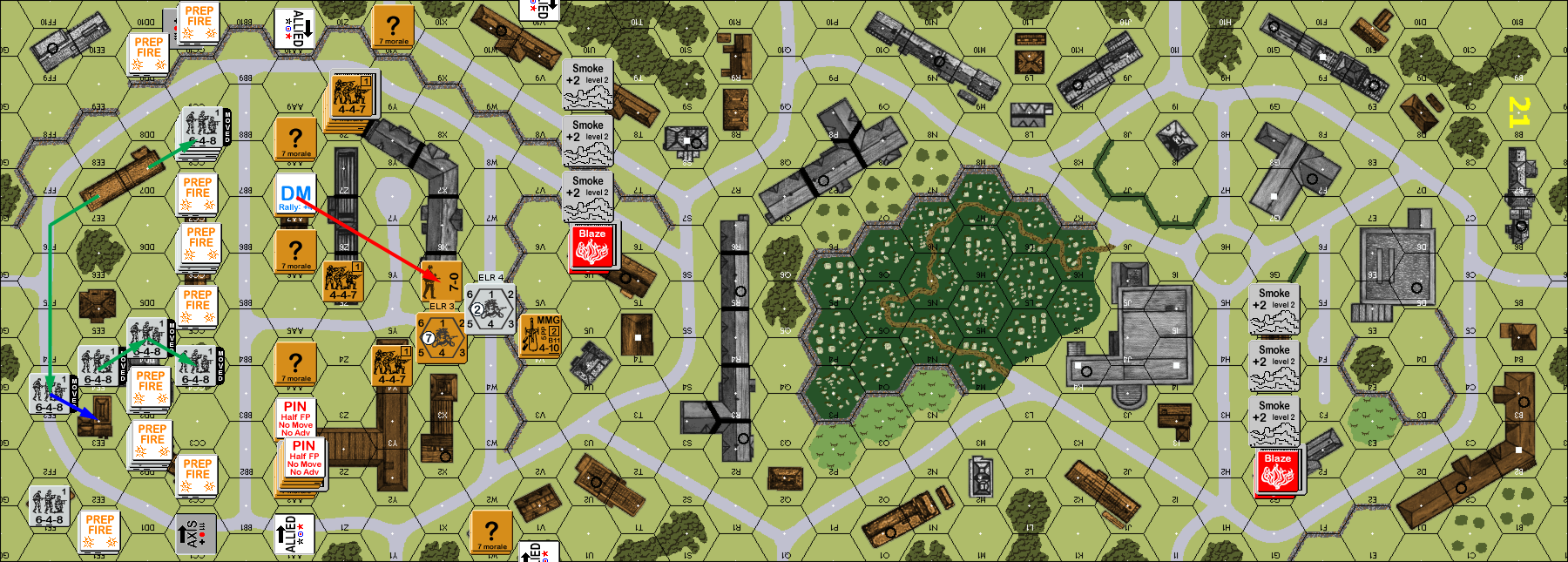
Situation, German Turn 1, showing the entire board and my guns.
↓ Read the rest of this entry…

└ Tags: ASL, gaming, WO1
1 Comment

Operation Brevity

by Rindis on May 7, 2022 at 12:00 pm
Posted In: Boardgaming

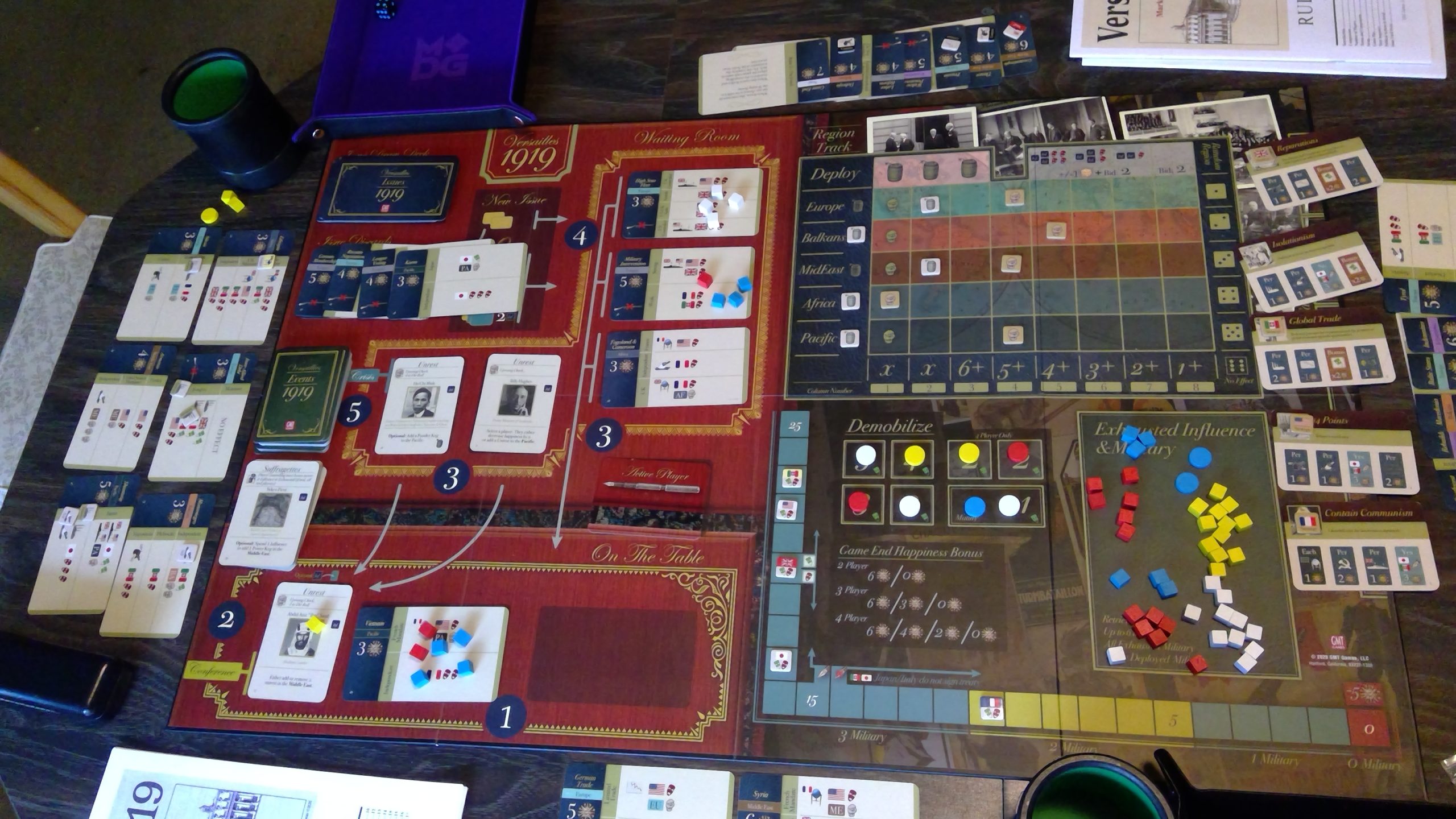
One of the things on Mark and I’s to-do list for a while now is to try out the Battalion Combat Series from MMP/The Gamers. The scale is an interesting choice, and more importantly for me, the fact that North Africa is well-represented in the current titles. I find the desert war interesting, and a bit under-served these days. Mark got a couple titles in the series in 2019, and in January we finally tried out the “Operation Brevity” scenario from Brazen Chariots. It’s a nicely limited two-day scenario, that was about the right size for our initial trial of the system.

I had the Axis forces, the bulk of which are an Italian Frontier… “Command” defending Halfaya Pass, and areas south, and the rest in two small German Kampfgruppes near Bardia. The British have an armored and a motorized battalion to the south, and at the start of the game a support group comes on as reinforcements along the coast (…I don’t quite get the point of coming on as reinforcements at the start of the game). There’s a number of odd/ad-hoc unit designations here, including HQs of ‘groups’, and the Support Group consisting of three ‘columns’, (which seem to be the Jock Columns; I wish these had been mentioned in a supplemental unit symbol key, instead only talked of in the Order of Battle notes without explicitly stating that’s how the counters are organized). The British win by taking Halfaya Pass and one of Sollum, the barracks on the outskirts of the town, or Ft Capuzzo.

Brazen Chariots demands use of the optional Orders segment (which I don’t think I’d mind using all the time), which mostly controls the movement of the HQs, but also limits switching in/out of prepared defense (which the Italians start the game in, and it is wise to keep them that way) and fatigue recovery, making things go a bit slower, as you have to be prepared to change options instead of a more ‘on-the-fly’ sequence.

The British automatically go first, and Mark started with 22nd Guards Brigade, the force that starts just south of Halfaya Pass, and moved two motorized battalions up to the southern entrance of the pass and attacked with an assist and suppression barrage for an overall +2 combat, which cost us both a step. Combats are interesting, since it’s just a single result table with a bunch of modifiers. It seems to work well, and in this case, I took a loss instead of retreating because of the prepared defense. The trouble was the defending unit was only a German company, and therefore had two steps, compared to the six from each British battalion. The good news was Mark rolled low for fatigue, and the formation was no longer “fresh” (which is a level below “0”).

He also failed a second activation attempt, and play passed to me with Kampfgruppe Herff. (This was probably a mistake in timing.) My general plan was for Herff to take over defense of Ft Capuzzo, allowing the Frontier command to concentrate to the east. So the HQ and a battalion ended up there, while Holmann’s battalion continued down to the wire at Bir Wair, applying coordination penalties to both formations.

The 7th Armored Brigade moved north, and pretty much surrounded a MG company at Point 207, but did not attack. I attempted to move up the Frontier command, but the modifiers from being Italian, and being mixed with Herff meant it failed the SNAFU roll completely, and failed an attempt for a “second” activation. Every formation actually has to pass a SNAFU roll to actually do anything, but with everyone being ‘fresh’, that was generally impossible to fail until that roll. There’s such a thing as a ‘partial’ success while limits movement and to a smaller extent combat, but we hadn’t seen one yet.

The Support group went next, and it moved up into position between the two units guarding the pass, and then got a partial SNAFU for its second activation, and attacked the company blocking the coastal route (interestingly, it’s nearly impossible to get at the southern location from that direction, thanks to the combination of ZOC and indirect road path). A destruction barrage knocked out a step, and then a good roll on a -1 attack took out the second, while the British also took a loss, and advanced into the hex. KG Wechmar finished off the turn by racing forward to take up positions along the wire.

For the second (and final) day of the scenario, an armored battalion and company of 88s arrives for the Germans, and there’s a one third chance of the 4th Light Panzer Division shows up, which they did not. The 88s were attached to the Frontier command, and went into support mode, instantly giving them limited support. Mark took his Matildas out of support mode, letting them show up on map a bit ahead of the rest of the 22nd Guards.

I got the initial activation, but the Frontier group failed SNAFU again (final roll = -1), and I lost the garrison in the pass to isolation, and then failed the second activation. The 22nd Guards took the pass, and headed north along the ridgeline to attack the barracks, losing two steps of a battalion and the Matildas in the process, though a destruction barrage reduced the defenders.

KG Herff went next, and in a double activation moved south of the wire, taking up positions to keep the forward MG company at Point 207 from being completely surrounded. The Support group went next, reducing the defenders of Sollum with a destruction barrage, but then losing one of their columns entirely in a botched attack. The remaining columns played it safer, with one stopping adjacent to provide support to the third when it attacked. That knocked out the defenders with a situational retreat, and the British took Sollum for a win.

We continued anyway, with KG Wechmar moving south on a Partial SNAFU, and forcing the 11 Hussars (in screen mode) to retreat, and then causing losses to both sides with an engagement with the 6 Cavalry Battalion. The second activation was another Partial, with engagements that finished off 6th Cav, and forced the Hussars to retreat twice (once with a loss). Sadly, all of that still came up short of the goal, which was to jump the 7th Armored HQ, but the engagements chewed up too much time.

The 7th went next, and the 11th Hussars dropped out of screen mode to engage my forward unit (3rd), for losses to both sides. 2nd RTR moved over to engage, but took a loss on a poor roll, but then knocked out my unit with a destruction barrage followed by a successful engagement. An assisted attack on the MG company caused losses to both sides, while while a final attack rolled poorly for an A2 to lose a column. And the 2nd activation failed, ending things there.

Afterword

There’s a lot to like in the system. The combat system is kept very simple, and seems to work very well considering. The formation activations do a good job forcing you to think about the separate higher-level units and the twin challenge of keeping them separate and coordinating an overall thrust. In a way, its reaching for something like the orders system of Rifle and Spade (at least with the optional orders system, and realizing that a WWI system needs to be a lot more inflexible). The idea of “support” (and units that can either be together on the map, or split up to provide support) is great, and really brings the purpose of many brigade and divisional assets to light in this system.

SNAFU makes sense, but does leave me a little cold. Some of that is just getting burned twice by the Italians refusing to budge at all, but it does seem like some form of letting a new unit move into a position before the previous one marches out without screwing everything up would be nice. Doing it as I did causes the double penalty of coordination and mixed units for wanting to trade out in one hex. Moving one out, and then the other invites the enemy to come in for free. Admittedly, if the enemy is that close…. Combined with the forced back-and-forth and sequential double-move… I just miss GCACW’s initiative, though that’s built around units going 1-4 times during a turn, instead of 1-2.

The rules, however, need work. There needs to be a lot more crossreferencing in there than there is. A lot of time was wasted trying to find things in the rules, often far from where the rule actually was. And I have some questions/comments:

3.2d Mixed formations: Imagine a line of six hexes (A-F); one formation has units in A and F, the other has units in C and D (square in the middle of the first formation’s blob). By the wording of the rule, the second formation, being the the middle of the other’s blob, is judged mixed since they’re in the middle of an inactive blob. The first one isn’t, since they have no units inside an inactive blob. Isn’t this reversed? (They would both get coordination markers. Coordination should come after mixed formations in the rules, since the latter is how you get the former.)

One of the defense combat modifiers is a bonus for being certain types in a “terrain hex”. Well… any hex has terrain. “Desert” is a terrain. I eventually figured out that it was trying to reference the “Combat/Barrage Terrain” column in the terrain chart, but since the terminology wasn’t the same, this took some looking and an assumption. Terminology needs to be more consistent. Also, talking about some of the modifiers in the rules would be helpful.

Is there any particular order to exiting and entering support in the assignment phase? If a formation gains support, and an enemy unit goes from support to real such that it could cut support to a unit in the formation that just gained support, which happens first? Also, the rules should mention that a unit exiting support must be on move-side instead just having it on the Assignment Procedure Chart.

The Vassal module helpfully has the Brazen Chariots version of the SNAFU table, with the modifiers applicable to the game. However, looking them up to verify in the playbook was derailed by skipping past the relevant section buried in the supply section several times. I’m willing to bet that the negative modifiers to SNAFU for the Axis are for supply reasons, but, in the game context, this is a SNAFU issue, not a supply issue, which is a separate section of rules.

└ Tags: BCS, Brazen Chariots, gaming
 Comment 

By Schism Rent Asunder

by Rindis on May 3, 2022 at 12:00 pm
Posted In: Books

The second book of the Safehold series continues to play to Webber’s strong points. And his weak points.

The book starts very well by giving a number of different incidents across the world to reintroduce where things left off, and show where they’re going. And these are followed up, and are important points to the wider story. So far, so solid structure, and nicely immersive writing. And, things progress naturally from there. Webber does a great job getting all the balls in the air again, and the action moves along briskly, with some very important plot points, and turning points in the history of this invented planet.

And then the book ends, with some of the most important bits not addressed at all. The main thing that is expected ‘next’ is dealt with peripherally all throughout the novel, with various preparations going on, and when everything is done, and the fleet sets sail, the book ends with a JoJo’s-style “to be continued”.

And you know, I enjoyed the book, I will continue on to book three, but I am gravely concerned. Despite how much I liked certain things, I dropped Wheel of Time hard after the first few books, because each one did well on its own, but while new plot elements and complications would be introduced, none of the old ones would get resolved, and the overall plot get bigger without moving forward. Jordan, at least, had written the ending scene when he started. He knew exactly where he was going, and the story merely grew in the telling. I don’t know if Webber has any solid idea of what his overall plot here is. Certainly, the series pacing needs some work, and that at least implies a need for a tighter outline of the structure.

└ Tags: books, reading, review, science fiction
 Comment 

Planets of Tripoli Y77 Region 1

by Rindis on April 30, 2022 at 12:00 pm
Posted In: SFB

Last December, Mark and I got going on a large project that is going to take us a while: Playing a modified version of the SFB Admiral’s Game campaign from Advanced Missions. Once sorting out the basics was done, we decided to try the first region… first. It features his largest base defense force, and my smallest base assault force, “merely” being lead by a CC (it was also the only force where it was not theoretically possible for me to add another ship). It would also serve as a test of just how tough these early bases were going to be for me. We had the following available:

This was about the only fleet where I tried to stick with one particular member navy. The Andorians (xNx ships) use drones instead of photon torpedoes as heavy weapons, so I figured massing them against a static object for a bombardment would be one of my better options for them. (In this era, speed-8 drones are relatively faster, but still slower than what ships can actually do, so base bombardment is still a good option.) It also features my only ‘pair’ of ships, as the only classes I have more than one of are the four that I built new ones of this turn, and the other three all ended up split up from their sisters.

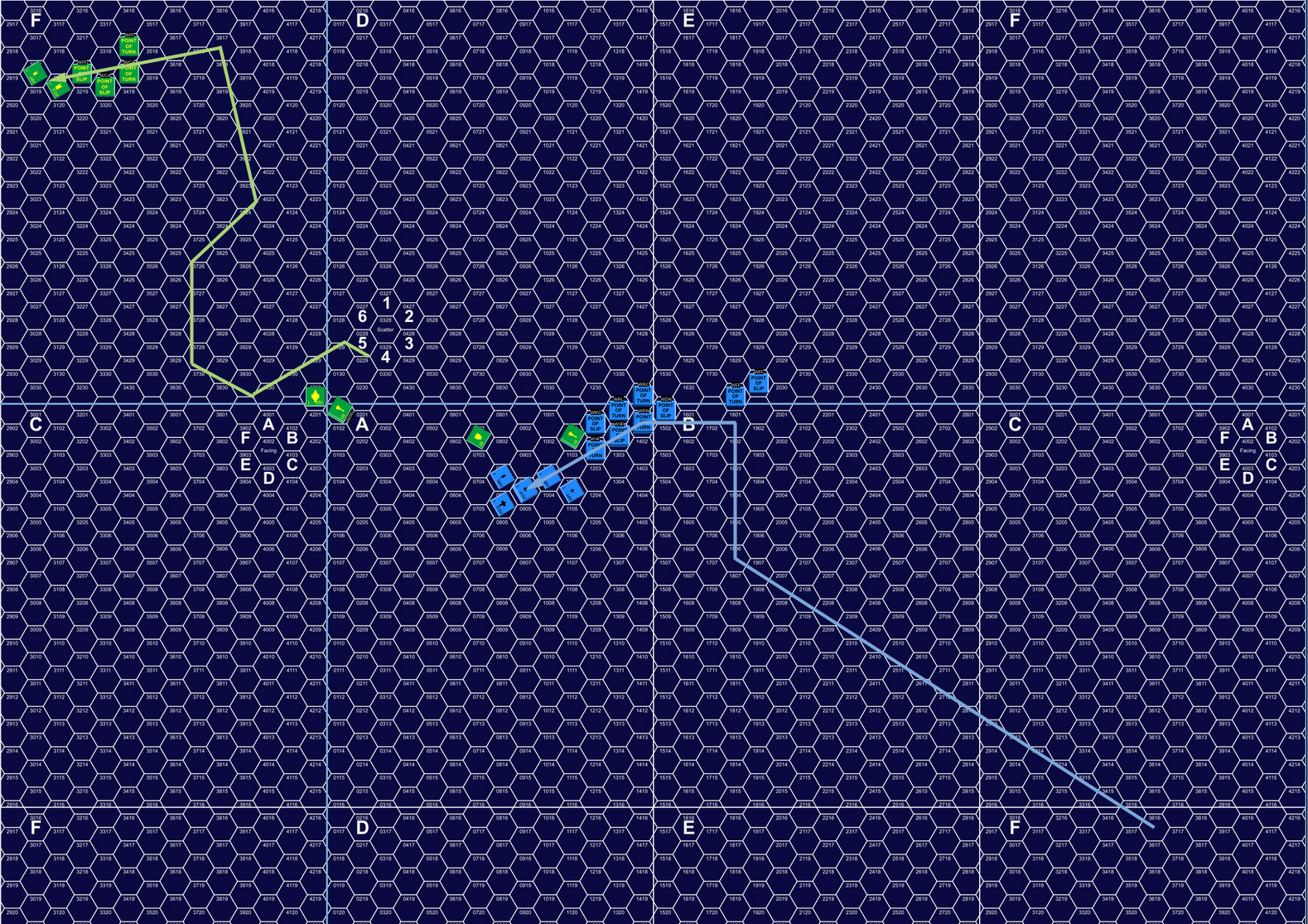
Mark set up with his two ships a few hexes away from the base, but pointed towards it, and a poor roll left him at Weapon Status-I (with his bonuses, the lowest possible). The rules give the attacker an automatic WS-III, but I have to set up at least 35 hexes from the base, which with these ships is over two turns travel at best speed. With my mix of designs, I ended up with my fleet speed scattered from 11 to 14 even at the beginning, while Mark went 12 (WDN) and 9 (WDD). EW was minimal, with only the base and Mark’s WDN opting for any at all. I set up opposite of the Carnivon fleet and headed in, while they passed through the base’s hex and turned right. On impulse 32, the base fired its two bearing phaser-1s at WND USS Battler (SF-75) at range 25, doing one point to its #1 shield.

For turn 2, I kept to the same speed range, though Battler reduced speed to 11 to repair the shield damage, while the WDN dropped to 8, and the WDD boosted to 13; the WDN boosted ECM to 4 (the maximum in this era), and the WNC and WNL started generating 1 point of ECM. On impulse 12, the base fired on Battler again (range 21) and missed. By impulse 24, the WDN was ten hexes away from the base, and turned towards my oncoming fleet, followed by the WDD on the next impulse. I started slipping that way, and then turned to intercept over the next few impulses.


Turn 3, Impulse 1, showing movement from impulse 24 of turn 2, to impulse 8 of turn 3.
↓ Read the rest of this entry…

└ Tags: gaming, Planets of Tripoli, SFB, Y77
1 Comment
  • Page 71 of 310
  • « First
  • «
  • 69
  • 70
  • 71
  • 72
  • 73
  • »
  • Last »

©2005-2026 Rindis.com | Powered by WordPress with ComicPress | Hosted on Rindis Hobby Den | Subscribe: RSS | Back to Top ↑