Rindis.com

All my hobbies, all the time
  • Home
  • My Blog
  • Games
  • History

Categories

  • Books (490)
  • Comics (10)
  • Gaming (910)
    • Boardgaming (668)
      • ASL (154)
      • CC:Ancients (82)
      • F&E (78)
        • BvR – The Wind (26)
        • Four Vassal War (9)
        • Konya wa Hurricane (17)
        • Second Wind (5)
      • SFB (78)
    • Computer games (161)
      • MMO (76)
    • Design and Effect (6)
    • RPGs (66)
      • D&D (25)
        • O2 Blade of Vengeance (3)
      • GURPS (32)
  • History (10)
  • Life (82)
    • Conventions (9)
  • News (29)
  • Technology (6)
  • Video (48)
    • Anime (46)
  • Writing (1)

Patreon

Support Rindis.com on Patreon!
Become a patron at Patreon!

Other blogs:

RSS Inside GMT

  • How Balanced is the Congress of Vienna Game? March 17, 2026

RSS Playing at the World

  • Playing at the World 2E V2 Arrives May 5, 2025

RSS Dyson’s Dodecahedron

  • Return to An-Nayyir’s Pyramid – Part 1 of 3 March 16, 2026

RSS Quest for Fun!

  • The Myth of Rational Animals November 23, 2025

RSS Bruce Heard and New Stories

  • Preview: The Iron Queen February 9, 2026

RSS Chicago Wargamer

  • The 2 Half-Squads - Episode 310: Cruising Through Crucible of Steel January 27, 2023

RSS CRRPG Addict

  • Game 572: The Elder Scrolls: Arena (1994) March 14, 2026
SF&F blogs:

RSS Fantasy Cafe

  • Michael Swanwick Guest Post and Book Giveaway February 23, 2026

RSS Lynn’s Book Blog

  • Top Ten Tuesday: Green Book Covers March 17, 2026
ASL blogs:

RSS Sitrep

  • Blockhaus Rock April 1, 2025

RSS Hong Kong Wargamer

  • FT114 Yellow Extract After Action Report (AAR) Advanced Squad Leader scenario April 16, 2025

RSS Hex and Violence

  • This still exists? March 25, 2025

RSS Grumble Jones

  • 2026 Kansas City ASL Club's March Madness Tournament March 16, 2026

RSS Desperation Morale

  • How to Learn ASL March 16, 2025

RSS Banzai!!

  • October North Texas Gameday October 21, 2019

RSS A Room Without a LOS

  • [Crossing the Moro CG] T=0902 -- Rough start July 18, 2015
GURPS blogs:

RSS Dungeon Fantastic

  • What color is paut? Sigh. March 3, 2026

RSS Gaming Ballistic

  • Pigskin project (by Chris Eisert) February 28, 2026

RSS Ravens N’ Pennies

RSS Let’s GURPS

  • Review: GURPS Realm Management March 29, 2021

RSS No School Grognard

  • It came from the GURPS forums: Low-Tech armor and fire damage January 29, 2018

RSS The Collaborative Gamer

  • Thoughts on a Town Adventures System January 18, 2022

RSS Don’t Forget Your Boots

  • GURPS Supers Newport Academy #3: “Season Of The Witch” February 8, 2026

RSS Orbs and Balrogs

  • Bretwalda - Daggers of Oxenaforda pt.4 - Fallen King May 27, 2017

Two Rounds of Arausio

by Rindis on June 4, 2022 at 12:00 pm
Posted In: CC:Ancients

The latest between-other-games round of Commands & Colors: Ancients with Patch was the Battle of Arausio from Expansion #2. Historically, this was a major defeat for Rome, and the scenario gives them one less card, less cavalry, and the barbarians can get an extra banner by occupying the Roman camp.

Patch had the Romans first, and he initiated battle as a LC took on a Warrior to do a hit for no loss. I countered by Ordering Lights, but got no hits in ranged combat. Patch moved up with a Line Command, and knocked out a LC when it was unable to retreat. So, I used Line Command to dive off a Light and LC with a hit each (if I’d been smart, I’d have reversed that order to trap the LC). Patch Double Timed to bring his Mediums into contact, knocking out a Medium and doing two hits to an Aux in return for two hits each on two Mediums.

I Ordered Four Center to wrap around the Mediums, and knock two out, with Caepio fleeing to one of the Heavies in reserve, while I took three hits on two units. Inspired Center Leadership, and took out two Warriors with Caepio’s Heavies, only losing a block to a First Strike. Three Units Left let me finish off a Medium, but I took two blocks in return. Patch rearranged a couple units, and Order Two Center let me trade two blocks with him. Patch Counter Attacked,  destroying a Medium and MC with Caepio. I Ordered Mediums to drive off an Aux with a loss and destroy a LC. Patch used Line Command on… Caepio (no one was adjacent) to destroy another Warrior. 4-7

In the second game, I led off with Line Command, which let me deploy a bit better, and Patch Counter Attacked, getting us nearly in contact after the first turn. Move-Fire-Move let me adjust the flanks, and do a block each to two Lights. Inspired Light Leadership brought Patch onto my flank, killing a Light and doing a block to another, while I did two blocks to a Warrior and another to an Aux.

Order Three Left let me finish off the weak Warrior, while taking a block on a Medium. A Coordinated Attack did nothing, and I Ordered Lights to do one block to a Warrior, while taking two blocks on an Aux. Patch Double Timed his Warriors into my center, destroying a Medium and Aux, and taking two blocks each on two Warriors. Inspired Center Leadership let me do three blocks across two units for no losses, while Patch Ordered Mediums to reengage the Warriors with Boiorix’s MC backing them up. He did four blocks across two Mediums, but lost three Warriors and two blocks on another in return.

I Ordered Three Center to finish off another Warrior, and Patch Ordered Two Center to finish off a Medium, but lost two blocks on a MC in return. Order Three Center let me move the Heavies up, and let Caepio join one of them, doing hits to an Aux and Warrior while forcing them to retreat. Patch Counter Attacked to force a Heavy to retreat, and I declared a Mounted Charge to do one block to a Light. Darken the Sky drove off my MC and did two hits to a Heavy. Coordinated Attack let me knock out an Aux, and do a hit to a MC while I took one hit on a Medium. Patch Ordered Three Center to pick off the weak Heavy, but instead First Strike finished off a Warrior. 7-4

Afterword

This scenario doesn’t want to follow the historical action other than the Romans are likely to aggressively move forward to attack. But there’s nothing to really punish that, and in neither game did the action ever get close to the camp.

Still, it’s a nice scenario, that plays fast for a seven-banner limit. Patch had pretty hot dice the first time, while both of our dice were pretty cold until the end in the second game.

└ Tags: C&C Ancients, gaming
 Comment 

An Italian at Versailles

by Rindis on May 31, 2022 at 12:00 pm
Posted In: Boardgaming

Had Mark and Jason over over for a game of Versailles, 1919 back on the 22nd. Dave was available, so we had four, and Mark and I were eager to try it with a full player count. We had concerns that Italy might have a slightly weaker position than the other powers (mostly from a relative lack of options to have ‘flag tokens’ from my perspective). And as I won the two previous games, I took them, and somewhat random drawing gave Dave Britain, Mark the US, and Jason France (in that order of play, with me going last).

Dave, as the new person got stuck going first by die roll, and struggled to figure out what to do, but actually did well at first, picking up the majority of the first few issues. I was struggling through the early part of the game, partially from Mark particularly targeting me (with some justification, given my record), but by the time the first uprising happened, I had turned things around some and was in second place by issues, giving me third choice.

I believe Dave had first choice and took Global Trade, while Mark took Isolationism, I went for Reparations (not my first choice, I would have preferred to avoid happiness scoring bonuses), Jason took Outlawing War, and I think Mobilization was the extra. We all started with fairly good happiness; I demobilized first, claiming the 5 spot, and hitting 25 early on. However, Mark’s campaign against me was much more successful with the population at home than in the meeting room, and Italy’s happiness fell sharply before the first revolt.

As usual, events conspired to help with demobilization during the game, with only me and Jason retaining one army each at the end of the game. I had deployed mine to Europe, and gained Tyrol from Dave (it had been one of the first settled issues, and the target of the first revolt, though League Voting had become unsettled twice through events first), which put me in the European hot-seat (three versus two issues), and I retained it through use of the two-army bid, recovered it, redeployed to Europe… I think I lost 4-5 happiness that way. Even so, I ended the game a couple points above Jason’s France, whose happiness took a beating in the decisions on issues.

By the time Game End came up, I had a pretty good selection of settled issues, but I knew some of the objective scoring was going to be pretty good. I maneuvered for control of Game End, and eventually got it to the table and settled it. I had no idea if I would really win, but I certainly had a lead in issues, those 7 points would help, and my position wasn’t going to get any better.

Dave was in last with 42 VPs (31 issues, 1 British token, 2nd happiness for 4, and 6 for his strategy after deducting 3 for reparations); Jason was in third at 48 VPs (28 issues, no tokens, last-place happiness, but 20 on his strategy thanks to 11 self-determination and 6 containment); Mark made second with 52 VPs (24 issues, no tokens, best happiness for 6, and 22 for strategy including doubled happiness and 11 self-determination); while I managed first, again, with 58 VPs (42 issues, 1 token, 3rd happiness, and 13 for strategy, including doubled happiness and 6 containment).

Afterword

Dave warmed up to the game a bunch as the day went on and things started falling in place. No surprise, the biggest problem with the game is the number of mechanisms that are not familiar from elsewhere, but once it gets going, it’s good.

Controlled issues are the largest chunk of VPs in the game, so that’s generally what I play to. I ended up with a good lead there (11 ahead of Britain, with the second-best set), but a lot of that happened late, and partially because of my ability to maintain control over Tyrol with the army. I knew that self-determination was going to be a high-scoring goal, and that had me worried for a win, but my issues lead was larger than I had supposed. (I’ll also note that if I didn’t get Game End, I would have been at 51 VP, and if it had gone to either Mark or Jason, they would have won.

└ Tags: gaming, Versailles 1919
 Comment 

17 Lost Opportunities

by Rindis on May 27, 2022 at 12:00 pm
Posted In: ASL

After finishing up in Tulle, Mark and I went back to Paratrooper, and scenario 17, “Lost Opportunities”. It’s D-Day, and the Germans are trying to retake Ste.-Mère-Église from 505th Parachute Regiment. They have six turns to take five buildings on board 1.

I had the defending Americans, who get eight paratrooper squads, a 60mm MTR, a couple MMGs, five BAZ, and an AT gun. The defense is along the narrow edge of the board, where it abuts board 2. The ATG went in J4, where there’s actually pretty good LOS up the entire center street, and if the Germans went too far on either flank, it’d still have a shot. My one HIP squad took a MMG and was in D2, where it could do a surprise shot if he advanced on that flank. The MTR was in E6 with a foxhole, as it’s one of the few hexes with open ground in front of the buildings, and has a few places it can see in the MTR’s range. The other MMG was up in 1F6h2, where it could largely out-range the Germans.

The Germans have a mix of nineteen second line and conscript squads with the usual machine guns, a couple 50mm MTRs, a Marder I, and a couple of captured French Renault tanks. Most of them in a line at the limit of the setup area, but the two MTRs set up on the hill, with the Marder right in front. As a last note, the Germans lose if they ever go below nine unbroken squad equivalents. Given the quality of troops, its a heck of a restriction.

Mark led off with a bombardment of forward positions from all his ordnance, including a nice rate-tear from one of the MTRs. However, the only result was to reveal my squad in 1B6 and battle harden him. Movement was fairly calm until a 8-0 came into view, and the high-up MMG pinned him and ELRed the conscripts with him (for the first turn or so, I was stuck on the underscored morale method of breaking into HS for anyone who couldn’t be Replaced, before finally remembering they should be disrupting instead). Then an 8-1 came in next to that, and the MMG broke him and the MMG squad with him. In DFPh, the MMG claimed another victim, breaking his 9-1 and LMG squad, and the ATG took what I supposed to be a ranging shot at the hull down Marder, which hit and burned it.


Situation, German Turn 1, showing the full board. North is to the left.
↓ Read the rest of this entry…

└ Tags: ASL, gaming, Paratrooper, Yanks
 Comment 

Cossack Estate

by Rindis on May 23, 2022 at 12:00 pm
Posted In: Computer games

This is the seventh in a series of reviews looking at the evolution of Europa Universalis IV. See the previous reviews here:
Europa Universalis IV: A Fantastic Point of View
Wealth of Nations: National Trade
Res Publica: A Tradition of the People
Art of War: Reform-Minded Patch
El Dorado: Expansion of Gold
Common Sense: Uncommon Changes

The seventh expansion for EU IV largely concentrated on the internal politics of countries, adding a whole new internal mechanic for players to balance along with everything else. At the same time, there was a focus on central Asia and the horsemen of the steppes (following the lead of CK II: Horse Lords released five months earlier), who also got their own mechanics.

Patch 1.14 also featured a slightly revised launcher, which allows you to sign into to your Paradox (not Steam) account to participate in leaderboards and the like. The patch was was released on December 1, 2015 alongside The Cossacks, with revision patch 1.15 following on January 27, 2016.

It’s a New New World

Part of the patch was actually revising a previous expansion. The ‘random New World’ feature from Conquest of Paradise had been disappointing. Not only for the ‘names in a blender’ problem I mentioned in the original review, but the geography generally came out fairly poor (especially when looking at the details; the overall forms could come out strategically interesting, though it was far from guaranteed).

Instead of trying to render a completely random New World every time, Paradox came up with a series of pre-rendered template land masses which could then be fit together into fresh patterns every time. The pre-rendering allowed for more detail, and making sure they looked natural, while not chewing up lots of end-user processor time on the effort. Better, the new system was open for them to add more ‘tiles’ as they had time later, and others could be introduced through mods. In addition, ‘scenarios’ would be applied to the random New World, generating new countries of various types, with new (generally appropriate-sounding) names, instead of just trying to completely re-use the non-random version.

I found the old system acceptable (other than the names), but it was, at best, a bit bland. The new system definitely helps.

The Estates

The main feature of the expansion looked at detailing the internal administration of your country. So, with the expansion, there are now (usually) three estates in the country, which can provide bonuses, but can also cause major problems.

At base, each estate has a loyalty of 50%, and it will naturally go back towards that level after anything which raises or lowers it. At this base, neutral, level it will provide a single bonus to the country; if it is pushed up to 60% loyalty or higher, there’s a second bonus, and if it falls below 40%, the first bonus is instead reversed.

In addition, estates are rated for influence, and generally, more influential estates provide a stronger version of the bonuses generated by their loyalty. However, an estate that reaches 100% influence starts a timer on a disaster where that estate effectively tries to take total control of the country in a coup.

Each estate expects to be given control over a certain number of provinces, which means that autonomy cannot go below 25% in that province (though the autonomy is also negated for a particular category, like a noble estate always contributes the full amount of manpower). Refusing to give enough provinces to an estate cripples its influence, but also sucks away their loyalty.

The nobles generally help with manpower and army maintenance. They can be used to create army leaders, and gain military monarch points. When playing with Common Sense, parliamentary governments don’t have this estate at all (generally leaving them with two), with the separate parliament interaction taking its place.

The clergy help with taxes, stability, and any religious power the country has (e.g., theocratic devotion, protestant church power, etc.) when loyal. They can help with administrative power, gaining particular minister types, or even colonization efforts.

The burghers help with trade efficiency and development cost (which at the time required Common Sense to use…). They can help some with direct income, or gaining admirals, or even getting some new heavy ships.

As implied above, there’s a bunch of interactions with each estate, which can shuffle around the influence and loyalty stats, and can also be used to gain bonuses from them. Smart play can involve a fair amount of interaction, as you use them to gain monarch power, or get extra income or other goodies. You can also generally keep interactions to a minimum, but occasional events, and the need to grant new provinces to estates in a growing country mean that you can’t completely ignore it.

There are also a few other estates with limited availability. Cossacks are only available to eastern tech group countries, and provide bonuses to cavalry. Dhimmi are available to Muslim nations, and provide bonuses to tolerance and technology.

National Revenge

After losing a large war, a country can easily be in dire straights that it can’t recover from. The army is decimated, manpower has been drained dry, the treasury is empty, and 10% of income is going to the victor….

The patch included a new mechanic to help out such shattered countries. Revanchism is gained in proportion of the war score cost of any peace deal against them. This goes down at 10% per year, so even a maximum 100% revanchism is gone by the time a standard 10-year truce is over, but it will help with the rebuilding in between, and during any other wars that happen.

As it helps with tax income, manpower, and unrest (along with several other less prominent things), it really does help a country recover and rebuild, though of course it doesn’t actually replace what was lost.

For the Horde

The expansion introduced a third legitimacy replacement: horde unity. This is used solely by the Steppe Nomad government, which will use legitimacy without the expansion. Unlike the other governmental mechanics, it will always decrease over time, though the rate can be slowed. On the other hand, the larger (/more developed) the country is, the faster it’ll fall.

There are of course, ways of raising it again. Like anyone else, nomad armies will loot enemy provinces they are occupying, and the money earned from that will raise unity again. You can also raze your own (non-core) provinces, reducing development (…which does make it cheaper to turn into a core), but generating money, monarch power, and unity.

Unity itself affects unrest and discipline. The +5% discipline from 100 unity isn’t too bad (there are plenty of other effects that grant a similar bonus), but is available from the start, and one of the government bonuses is to shock damage in clear terrain, and it is easy to get lots of cavalry with a horde. Early in the game, this makes a potent military combination.

In fact, hordes get their own tribe estate (the only one they get), which aids manpower recovery and cavalry costs when loyal. One of the primary interactions with the estate is to raise a host, providing several cavalry units for free, just leaving problems of paying the monthly maintenance.

In all, they don’t feel quite as dangerous as in EU III: Divine Wind, where the automatic war with everyone and territory seizing made them a major short-term problem. However, with all cavalry, and all the shock bonuses, their military can feel nearly unbeatable in the early going, making them a major problem for their neighbors.

I Need a Favor

The expansion also added several features to diplomacy. Countries can now declare ‘places of interest’; this is basically something the AI always did, as it determined what areas it wanted to expand into, but now this is surfaced to other countries (and a human player), and the player can now do the same, warning other countries away from interfering.

In addition, the player can now choose diplomatic stances like the ones the AI uses. It can limit what you can do, but it also signals your vassals on what to do (they will generate claims on bordering provinces of countries you are hostile to, for instance). Also, setting your attitude to ‘threatened’ makes rivals of that country more likely to ally with you.

The annoying part of this is that alliances get a hit from the nerf-bat. Ordinarily, as soon as you have an alliance, you can declare war on a country, and your allies may come along, if they have enough reason to. With the new diplomacy system, you have to use favors for anyone to come along in your war. Now, you can promise them territorial gains in the war, but this only works if there’s something they can gain of course. Failing to carry through will also cause massive relations problems, assuming that you won (the AI will be understanding about a losing war). Otherwise, you gain one favor per year of alliance, and it takes ten favors to drag someone into an offensive war, so alliances are… more unwieldy than they used to be, which really is annoying, though possibly truer to life. Defensively at least , alliances are unchanged.

Tengri

Tengri had been separated out from the general Animist religion a few patches ago, occupying much of of Central Asia. With the expansion, it now gains its own mechanic, like several other religions from the previous few expansions.

By default Tengi countries always gain a discount to raising new land units, and can use a higher proportion of cavalry. Now, they can gain additional bonuses as a syncretic faith.

This means that a second religion can be chosen to be a part of the Tengri faith, and countries and provinces of that religion will be counted as the same as the nation’s (this second religion can be changed later, but it costs prestige to do so). In addition, new national bonuses will be granted, based on that religion’s bonuses.

Conclusion

Estates would turn into another feature too big for an expansion. Like development, this feature moved to being part of the base game with patch 1.26 (before development, actually), but just for the basic three; the variant ones still need this expansion. Personally, I generally feel like you gain far more annoyance from estates than you gain interesting decisions.

In principle, dealing more with the internal stresses of a country is a good idea (and was a much-requested one). The general thrust of the estates is not bad (handing partial control of parts of your country over in return for bonuses), but the entire thing feels way to impersonal. The diplomacy and AI system of other countries gives a certain feeling of ‘personality’ to various countries, but the estates purely react to your interactions, leaving them flat and impersonal. Moreover, their goals (for they don’t really have any) do not grow and change with your country.

On the other hand, the other mechanics work out, and the new horde governments are nicely effective. Similarly, the rework of the random New World was needed, and great to see. With estates in the main game now, this expansion is really just worth getting to round out the collection of religious mechanics and government types, and so is just for the completist.

└ Tags: EU IV, Paradox, review
1 Comment

21 Gurkhas at the Chapelle

by Rindis on May 19, 2022 at 12:00 pm
Posted In: Boardgaming

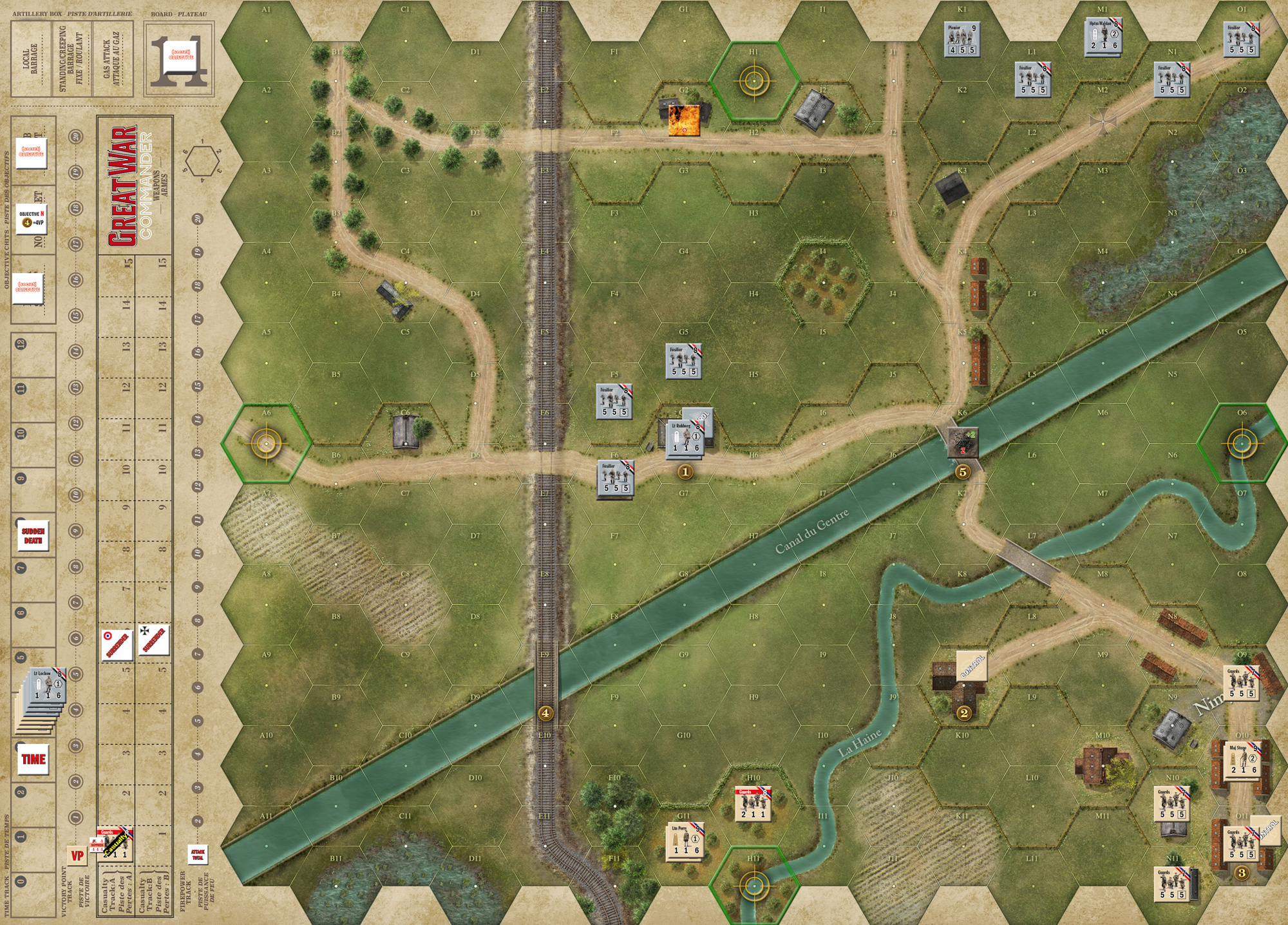
Mark and I cycled around to Great War Commander again in February, with scenario 21, “Gurkhas at the Chapelle”, from the BEF expansion. This is in March 1915, so we got to see the standing barrage rules in action. The board has an extensive trench system, which was also a first for us. Both sides get 9 FP artillery (the Germans as a reinforcement), which is heavier than seen in the 1914 scenarios.

I had the defending Germans, with eight platoons, ten hexes of wire, and two MGs with teams to man them. This isn’t quite enough wire for the entire board, and I left gaps at either end. One of the MGs went on objective 4, which is a forward spur of the trench line. The better leader, and bulk of the troops were clustered around objective 3, while the remainder backed up the MG. The British have a mix of fifteen platoons, including three engineers, two MG (with teams), and four leaders. They also automatically have objective chit “Y”, which gives an extra VP per unit exited off the enemy side, and an Offensive card already in hand. The open objective made objective 3 worth 3 VPs, and my secret objective gave 4 VPs for objective 4.

The scenario starts with two local barrages from the British, the first of which scattered off map, and the second “hit”, but scattered into no man’s land for no effect. Mark’s first actual card play was an Artillery Request, which also scattered into no man’s land. After trying, and failing, to soften me up, he Moved his left flank up, getting a platoon into the trench. I redeployed a bit to have better line of sight on my own backfield, and used an Artillery Denied to break his phone. He Moved more of the flank up, and then went on the Offensive on his right, getting into the trench behind my forward MG. With use of a +1 from a strategy card, I was able to keep my MG crew down to being suppressed by his fire. He then Moved the first group off-board for nine VPs.

The next turn, he Fired on the forward MG again without result other than promoting my best leader (Waldau) to Veteran, and moved more of the left towards exiting. I used an Offensive to move closer to his string of units, and his Op Fire caused a time trigger to return his exited units, and give me artillery access. His fire broke Waldau and suppressed the MG team, while mine broke one of his platoons. Recover put everything to rights again.

Mark Fired on his right, breaking my forward MG, but Probe recovered him, and on my turn an Artillery Request put a standing barrage down in front of my trench, to break two platoons (and my sniper eliminated one on the other side of the board. Then a second one shifted it one hex up to break a leader and suppress a couple platoons as well as chew up the landscape. (And there was an error, I forgot I needed the overall commander for artillery, and had used Lt Lochow for the first request and then the FAO for the second. Of course, we also hadn’t yet realized  standing/creeping barrage markers hung around from turn to turn either, and thought you had to do all of this inside one turn to make the adjustment work. We figured that out a little later. Not that it mattered for me, as you’ll see.)

Mark led off his turn with two Artillery Denied, breaking my brand new phone and eliminating it, and then Advanced on his right, getting into melee with the forward MG with Griffith and a guards platoon, and narrowly losing them to a good roll and my use of another +1 bonus. Right afterward, I Fired the MG to eliminate a broken platoon, and got a hero with the MG thanks to an event. Mark Moved up on his right, and conducted an Offensive on the left, but ran into Op Fire, breaking Maj Stone, and a platoon, and suppressing another, and setting off two time triggers. Then Mark’s attack at the end caused another time trigger (taking us to 7/10).

Mark Recovered, rallying all his broken units (which had really piled up), repaired his phone, and then put a standing barrage down in the middle of the trench, reducing three hexes to “foxhole” status (a scenario rule makes that slightly easier than normal) and suppressing the one platoon it hit. I Advanced along the trench on the left, and killed a British platoon, while an Offensive tried to shore up the right, with the only real result being my Lt Lochow breaking on an event. Mark went on the Offensive to exit two platoons and Maj Stone, taking control of objective 2 on the way.

I Recovered to rally Lochow, and Advanced to redeploy my flank a bit. Two creeping barrages moved his artillery across my units on his right, creating more shellholes, but not breaking anyone, though an event allowed me to eliminate a guards platoon. With Lt Priestly and his platoon suppressed, I decided to Advance in and try to deal them before Mark finally took out my forward MG, but lost the melee despite a 7 to 5 advantage. I Moved to start centering my defense with Waldau moving towards the center, and suffered a suppression on the MG team with him, but Mark’s MG jammed.

Mark Advanced in turn to take out another platoon in melee, which also advanced time to bring his exited units back. I finally continued my Move towards the center, and came under Op Fire, which caused two more time triggers to end the game.

Afterword

After adjusting for my hidden objective, Mark won by 5 VPs. Both of us were about halfway to a surrender (I was at 3/8 casualties, Mark was at 6/11), and things were getting thin on the ground by the end.

Overall, the scenario gave the fun back-and-forth experience that GWC does well at. However, the start of the game was the deeply frustrating experience that this kind of game can also provide, as I went a few turns with a pretty much dead hand. Move (when I’m where I want to be), Recover (with no one broken—yet), and Artillery Request (and no artillery). This let Mark get going, once he started to realize what was up, and set up the early exits which did a lot to give him the points he needed to win. The main problem of course was just being stuck twiddling my thumbs when discarding didn’t help.

Still, seeing the standing/creeping barrages in play was very educational. I think there’s too much control in there, as you get to adjust it how you want on the fly each time, but it’s not a bad match for the level of complexity, and certainly gets a lot of the right feel for the long artillery bombardments that would happen.

└ Tags: gaming, Great War Commander
 Comment 
  • Page 70 of 310
  • « First
  • «
  • 68
  • 69
  • 70
  • 71
  • 72
  • »
  • Last »

©2005-2026 Rindis.com | Powered by WordPress with ComicPress | Hosted on Rindis Hobby Den | Subscribe: RSS | Back to Top ↑