Rindis.com

All my hobbies, all the time
  • Home
  • My Blog
  • Games
  • History

Categories

  • Books (504)
  • Comics (10)
  • Gaming (919)
    • Boardgaming (675)
      • ASL (155)
      • CC:Ancients (83)
      • F&E (78)
        • BvR – The Wind (26)
        • Four Vassal War (9)
        • Konya wa Hurricane (17)
        • Second Wind (5)
      • SFB (78)
    • Computer games (162)
      • MMO (77)
    • Design and Effect (6)
    • RPGs (66)
      • D&D (25)
        • O2 Blade of Vengeance (3)
      • GURPS (32)
  • History (10)
  • Life (82)
    • Conventions (9)
  • News (29)
  • Technology (6)
  • Video (50)
    • Anime (48)
  • Writing (1)

Patreon

Support Rindis.com on Patreon!
Become a patron at Patreon!

Other blogs:

RSS Inside GMT

  • Defiance AAR: North Jersey, July 2026 — Chili Dogs and Chit Pulls July 20, 2026

RSS Playing at the World

  • Playing at the World 2E V2 Arrives May 5, 2025

RSS Dyson’s Dodecahedron

  • Barin’s Stonehold July 20, 2026

RSS Quest for Fun!

  • The Expense Post May 24, 2026

RSS Bruce Heard and New Stories

  • Pain, Exhaustion, and Morale in D&D BECMI June 7, 2026

RSS Chicago Wargamer

  • The 2 Half-Squads - Episode 310: Cruising Through Crucible of Steel January 27, 2023

RSS CRRPG Addict

  • Al-Qadim: Bottle Shock July 20, 2026
SF&F blogs:

RSS Fantasy Cafe

  • The Leaning Pile of Books July 5, 2026

RSS Lynn’s Book Blog

  • Top Ten Tuesday: I’ve gone with a freebie July 21, 2026
ASL blogs:

RSS Sitrep

  • Cardinal ASL Sins March 18, 2026

RSS Hong Kong Wargamer

  • FT114 Yellow Extract After Action Report (AAR) Advanced Squad Leader scenario April 16, 2025

RSS Hex and Violence

  • This still exists? March 25, 2025

RSS Grumble Jones

  • Grumble Jones AAR for Crucible of Steel Scenarios on the YouTube page. July 20, 2026

RSS Desperation Morale

  • How to Learn ASL March 16, 2025

RSS Banzai!!

  • October North Texas Gameday October 21, 2019

RSS A Room Without a LOS

  • [Crossing the Moro CG] T=0902 -- Rough start July 18, 2015
GURPS blogs:

RSS Dungeon Fantastic

  • Felltower - Monsters Fleeing between Sessions vs. PCs replenishing June 28, 2026

RSS Gaming Ballistic

  • Mission X and Genre Fidelity in Combat July 19, 2026

RSS Ravens N’ Pennies

RSS Let’s GURPS

  • Review: GURPS Realm Management March 29, 2021

RSS No School Grognard

  • It came from the GURPS forums: Low-Tech armor and fire damage January 29, 2018

RSS The Collaborative Gamer

  • Thoughts on a Town Adventures System January 18, 2022

RSS Don’t Forget Your Boots

  • GURPS Supers Newport Academy #7: “Invitation to the future.. of the 1970’s” July 5, 2026

RSS Orbs and Balrogs

  • Bretwalda - Daggers of Oxenaforda pt.4 - Fallen King May 27, 2017

The Chronicles of Chrestomanci II

by Rindis on May 17, 2019 at 12:00 pm
Posted In: Books

The third and fourth books featured in this collection are better than the first two. Interestingly, they also don’t focus on Chrestomanci, and seem to happen around the same time as the first book (as opposed to decades before as in the second book).

Book three, The Magicians of Caprona, takes place in an alternate Italy that is still a collection of regional city-states (DWJ states that Chrestomanci’s world is a bit more ‘old fashioned’ than ours, so things are roughly like they were in the first half of the Nineteenth Century). So, you have a city-state, Caprona, with founding myth of being protected by an angel, and two feuding families that specialize in crafting magic. Things have apparently been going downhill in Caprona for a while, but the viewpoint young characters aren’t overly aware of that. Overall, the story is a lot of fun, though it gets more serious for much of the climax. Chrestomanci is basically the ‘special guest star’, as he shows up for parts of the second half as the plot gets moving. I saw some of the twists coming, but they weren’t really the important parts. Definitely my favorite of the series so far.

Book four, Witch Week, is even odder. Chrestomanci doesn’t show up until very late, and is fairly mystified as to what’s going for much of his time there. Though he has a fair amount of fun with the situation in usual DWJ style. This time, we have a boarding school farce. A dreary, depressing, institutional English boarding school, absolutely ordinary from our contemporary point of view. Oh, but witches are a thing in this world, and witchcraft is against the law, and punishable by burning at the stake. Which is an instant signal that this isn’t the normal world of magic we’ve been seeing in the series. A world that sounds a lot like ours, but burnings at the stake happen might seem like something of a stretch, but that turns out to be the point of all the action. Like most of her books, this one has a lot of flailing around until the ending just suddenly collapses into place, but it doesn’t feature characters just popping out of the woodwork like some of her’s do.

Overall, the Chrestomanci series is a lot of fun, and while these books feel more… peripheral thanks to Chrestomanci not being a major part, they’re also very much their own thing. I felt the first book suffered to much from characters just showing up for the ending, and the second mirrored the first too strongly, so I definitely like the change of pace here, even if seeing more directly with Chrestomanci and/or Cat would be good.

└ Tags: books, fantasy, reading, review
 Comment 

High Score Mammals

by Rindis on May 13, 2019 at 12:00 pm
Posted In: Boardgaming

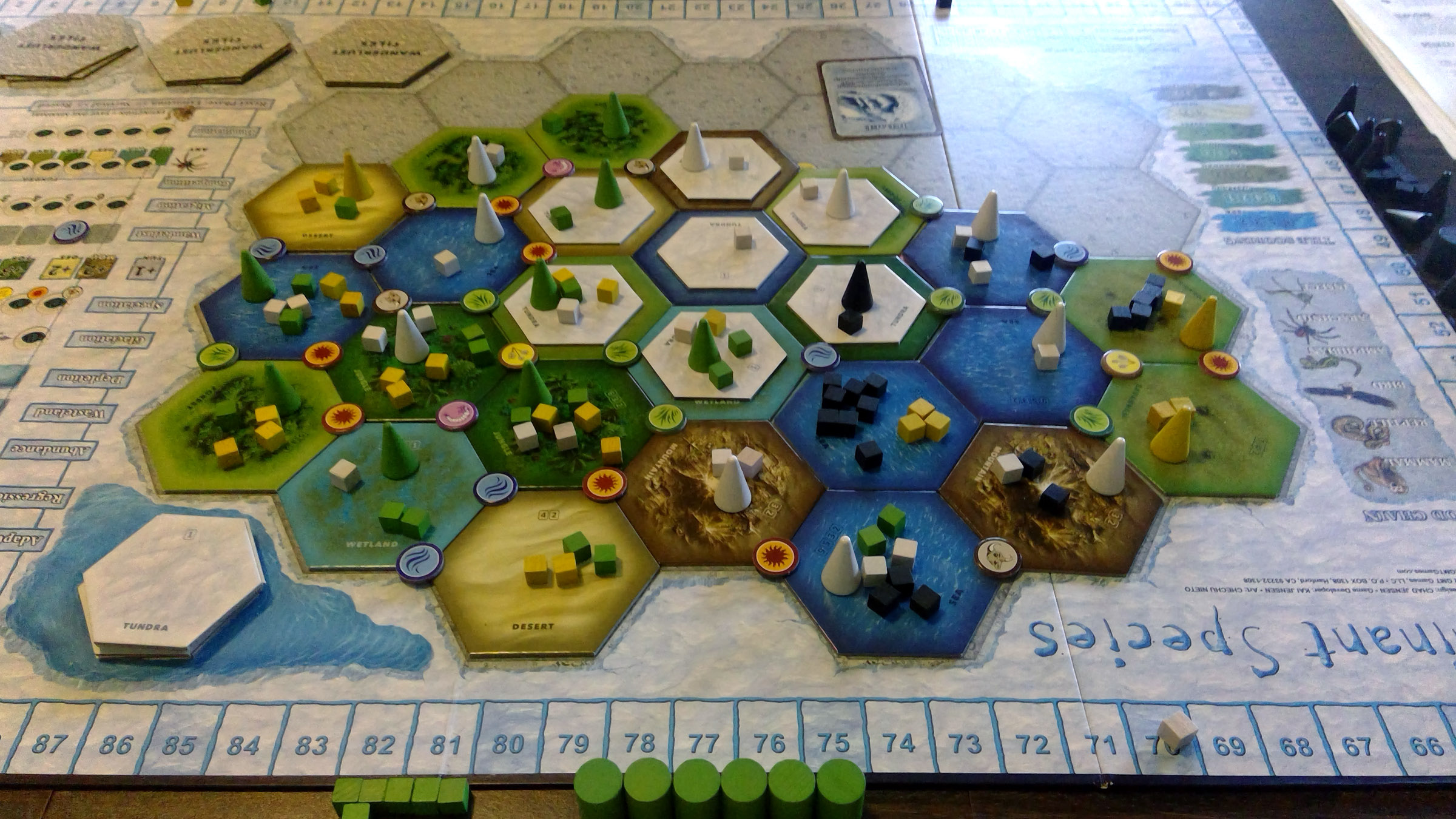
Got… almost everyone together for another multiplayer day a couple weeks ago (car trouble kept us down to four out of a planned five). Me, Dave, Jason and Patch went for Dominant Species, another favorite of the group that we haven’t gotten to in a while. Random selection gave me the Insects, Dave the Birds, Jason the Reptiles, and Patch the Mammals.

Dave got off to a strong start, managing a fairly substantial lead in the first round, which somewhat surprisingly he maintained for the next couple of turns. I skipped Speciation the first round (other than my one freebie), which was a mistake that helped put me at the back of the pack, as I had one cube left on the board by the end of the round. I managed to recover from that naturally, but I was feeling a bit behind in more than just score. This wasn’t helped that I fouled up an early move by getting a new element with Adaptation, and then losing it the next turn on Regression.

After that, things went better for me, partially because of my high initiative, as I got the first scoring in the second round when Parasitism came up, and Patch had the second scoring that round, and Intelligence was available, so the two us took them to get new action tokens for ourselves but no one else. My initiative also let me score first the next round, and get Omnivore, so I had one more action than Patch, who had one more than Jason and Dave. But I was getting more and more worried about Jason, as he was doing fairly decent, and was keeping a large pool of species available.

Patch was also being trouble. He ended up being the main inhabitant of the tundra, and started racking up Survival points to start pulling away from the rest of us. Adaptation turned into something of a race for all of us, and he and I ended the game with full element slots, and Jason and Dave were one short of that (this has been unusual in my experience). In some ways I was being fairly successful, as grass was widely available, and the elements I’d adapted to were widely available as well. However, after doing well in Dominance at the start (thanks to all the grass), I ran into problems in the mid-game, mostly losing out to Patch. I recovered ground on that front for the last couple rounds (including final scoring), but still had a bunch of trouble, both with dominance, and just managing to be in good locations in general. I never felt like I was on top of things for the entire game, and largely trailed in VPs.


End of game. Me = Insects/green; Jason = Reptiles/black; Dave = Birds/yellow; Patch = Mammals/white.

The biggest surprise to me was people started getting past 100 VPs a couple turns from the end. I’m used to that happening as the game is ending, but we had some very high scoring this day. Patch maintained a lot of dominances at the end of the day for a grand total of 215 VPs. My large number of dominances got me out of the cellar for a total of 145, while Jason got up to 130 (mostly from strong regular VP plays), and Dave languished at 113 purely from being stuck at three dominances; he had been competitive most of the time before finally just coasting for the last turn.

This left us with a bit of spare time, so we broke out a quick game of Settlers of Catan to finish the day. Again, the first time it’s been out for a couple of years, and its only the second time Jason has played. Random placement caused the usual odd scattering of things, and none of the hills had good numbers. Being last, I made sure to grab access to two hills with my second placement. This worked early on, as I did get a number of bricks out of them, but my resources dried up in the late game. The big problem was ‘6’ came up a bunch in the late game, which got everyone lots of grain and/or lumber, except me. Conversely, ‘8’, where I was, hardly ever came up, and the robber was often on the one I was at when it did. So I ground to a halt as everyone else continued building up, and Patch eventually won that game as well by grabbing Largest Army to get to 10 VP.

Two wins for Patch, and a successful day of gaming. We were already putting together the next game day at the end of the day, but still need to figure out what we’re doing.

└ Tags: Dominant Species, gaming
 Comment 

The Lions of Al-Rassan

by Rindis on May 9, 2019 at 12:00 pm
Posted In: Books

Guy Gavriel Kay is an author who I really, really need to read more of. My first experience with him (Tigana) was very good, and I’ve been meaning to read more for a couple decades now. Thankfully, I was reminded of him a while back, and picked this up just recently.

His general formula is to do a rich story in an invented, fantasy world that borrows heavily from a particular period of history. Here, the invention is fairly limited, as the geography is quite recognizable, if juggled around a little. Of course, geography had, in many ways, so much to do with the Reconquista, that that’s probably necessary. And… past that its fantasy side is stunted. One secondary character has a foreseeing ability. And that’s it. There’s no other magic here.

But, the religions are also shifted around, with the three-way tension of the Abrahamic faiths being instead different peoples who worship the sun, the moons (two), or the stars. Which allows Kay a few devices that add to the poetry of the book, but… grates on my sensibilities a bit. How did any of these get started? Why, when there’s already worship of one, does another get started? I mean, factionalism inside any of these would be easier to understand than just what exact problems these three religions have with each other. What would the fantasy-Romans or Greeks have worshiped? The can of worms can only stay closed when you refuse to look outside the confines of the story.

But the story itself is well done, and powerfully presented. This is Kay’s real strength. He brings ~14th Century Spain to life, and makes some interesting choices on how to do it. The Caliphate is gone, and the major characters are a little too aware of where history is going, and that not only will it not return, but the brilliant culture it produced is doomed to fade away. The major characters are all too well aware of where history is going (really, anyone this prescient would make a killing on Wall Street), which is more a vehicle to simply explain to the reader and add to the tone of loss. He also goes for a lot of poetic imagery, deliberately concealing information in one scene until it can be revealed later, and other literary slight of hands to raise tension and bring more of a ‘mythic’ feel to a story that is solidly grounded in real characters. They’re a bit larger-than-life, with some action-adventure tropes, but those impulses are restrained.

Kay juggles action and world-watching throughout the book. The types of action vary a bit, which is nice, though one portion felt more like it was lifted from a Clancy novel. On the other hand, part of the magic is being able to incorporate so many different things. It’s not perfect, but it is well-balanced and enjoyable throughout.

└ Tags: books, fantasy, reading, review
 Comment 

SH176 Kobol’s Rock

by Rindis on May 5, 2019 at 12:00 pm
Posted In: SFB

Crossposted from the SFU blog on BGG

A couple weeks ago, Mark came over for a day of SFB. I was originally hoping to squeeze in two small scenarios, but the first one turned out to be slightly bigger than we thought, and we needed to do a fairly thorough rules review first. We had a fairly long talk about all sorts of things afterward; there’s lot for us to catch up on.

Module M expands the boarding party combat system in a number of ways, including a proper abstract system for combat on a planetary surface. To my surprise, a couple years back, Mark expressed interest in the scenario provided to showcase those rules. The Kzinti are besieging a Klingon-held planet, and are making one final push to take it. Normally, they could just slowly grind their way in, but previous assaults have failed, and a Klingon fleet is approaching to retake the system at large. As such, there is only ground combat. As that (and regular boarding party combat) only happens at the end of the turn, the entire impulse procedure is skipped, and instead there’s an abbreviated sequence where the Kzinti move around their troops, then the Klingons can move theirs, and then it’s time for the combat.

The general structure of ground combat is that each hexside of the planet (which ordinarily fills one SFB hex) is a separate ‘combat location’ (this ties into the normal ground base rules, where they are set up on particular hexsides). Each of those has three ‘control stations’, and, if it’s a defended planet (as opposed to the ‘defender’ having beamed down just before you did), each of those has two defense systems. The control stations act a bit like the control systems on a ship; you can give them up instead of casualties (two casualties instead for a single station), and the other side can force the issue by expending four casualties they generated. Having at least two of the control stations generates a bonus in combat, and the defense systems have to be knocked out first, and they act as a pair of extra boarding parties (each).

It should be noted that despite the details, it all abstracts down to strength points. Ground combat uses the exact same boarding party combat results table, which is purely a ‘fire’ table, no odds, or anything like that are looked at. Shuttles can transport troops, and support the fighting directly, where they provide two extra strength points, and take two hits to kill (this translates to three of the normal combat hit points per ground combat hit; the Ground Attack Shuttle counts as four boarding parties, and its better armor only takes two hit points per ground combat hit, causing it to need to take four hits…). There’s a whole bunch of other types of troops and shuttles that boil down the same way; in fact the other types of ‘boarding parties’ generally act the same as regular ones here, as the bonuses are just better results tables on specialized actions.

The Klingons are defending with 25 boarding parties per side of the planet, while the Kzinti have 200 boarding parties, and good mobility. Even with the single admin shuttle and GAS the Klingons have per side of the planet (which can move one hexside per turn while staying immune to fire from the ships up in orbit) adding another six effective BPs, it looks pretty grim. However, those six defense stations add another 12, which means the base setup is 25+6+12 = 43 equivalent BPs, and the scenario defines that only up to 50 strength can be used in any one location per turn. The Klingons also have a set of two tanks and four ground combat vehicles in one location.

I ended up taking the Kzinti, who can move 20 BPs per turn by transporters (more at the non-combat rate, which means they’re nothing more than targets on the turn of arrival, but with the ‘remote area’ rules, it could have been worthwhile, as Mark would have to go hunting for them first), and have 12 admin shuttles and 16 GAS for ‘airlift’ and fire support. We pencil and papered everything with notes except the shuttles (and I found that a helpful planetary combat diagram had been printed in Captain’s Log #17 a week later…), which we used counters for, and its been long enough that I don’t have the best recollection of the sequence of events.

I started by organizing some of my shuttles into flights of one Admin and two GAS (which is 12 strength with the shuttles loaded with boarding parties), and put a set above each of three areas (with the hexsides labeled by the usual directional nomenclature of SFB, so that A-F are the six sides going clockwise around the planet; I put shuttles over B, C, and D, while the main Klingon defense was a A), and transported 20 boarding parties directly to C.

It was while we were working things out that we remembered the extra 12 strength from the defenses, and we realized this was indeed not going to a walkover. …And I lost most of the initial party, for doing minimal damage. Though I did kill an Admin shuttle. In fact, that was a part of my early strategy. I spent 4 points to kill Admin shuttles, mostly to limit his mobility, so I had a better chance to isolate areas and pound them later. I’m not sure if it was worth it as opposed to just trying to burn out his defenses, but I don’t think it hurt too much in the long run either.

Mark had adjusted some of his defenses too, so on turn 2 I aborted my landing at B, but kept the shuttles there, while sending out a second wave there and elsewhere, and of course sent more troops in. With a lot more on the ground, things started going better, and I really started straining Mark’s defense of C. (I think I killed another shuttle or two.) After that, my pressure on him steadily mounted, with Mark taking a lot of damage on his various shuttles as combat raged across half the planet with my forces landing with more troops beaming down directly every turn. Mark just took partial damage on the shuttles, leaving them fragile, but still worth the same amount offensively.

I got lucky with two turns of relatively bad die rolls from Mark. However, the casualties in my troops were mounting quickly. In B, where there was some heavy fighting, I eventually pulled out (even beaming ten boarding parties back to orbit while the shuttles took off with the rest) and transferred over to C while grimly hanging on in D. I’d damaged some of my shuttles in this process, but mostly took it on my boarding parties so as to preserve my ability to move. In the end, Mark lost most of his assets, while I kept my shuttles, but the cost was high.

Once the defense finally cracked, I shifted back to B and mopped up in D while leaving a garrison in C. Eventually it went to a minimal 3 boarding parties (needed to hold the three control stations), but as the Klingons move last, I needed to avoid him moving in behind me. D, and then B fell, and I massed to take out E. With a better idea of what I was doing, and a lot of Klingon shuttles dead, I took it… and then declared the scenario over as a draw. I could defend against the limited Klingon ability to make counterattacks, but I’d taken 172 casualties, leaving me with 28 boarding parties to do that and then press on to F (avoiding all the nice tanks and armored cars in A). With all the shuttle cover, I probably could have taken F and held everything. By the victory conditions, the Klingons holding 5-10 control stations (with three per location) is a draw. If I took F, that’d get the Klingons down to three, and a Kzinti victory, but nearly 75% losses, and the prospect of losing most of my shuttles (which were all damaged) in the assault took the heart out of me.

Obviously, I could have planned and executed the invasion better. Probably transporting to a remote area at the non-combat rate on the first turn would have been better, even with some losses from patrols. Then a few shuttles could join them, and I’d hit the max of 50 in an area easy. I also parcelled the shuttles out over several turn instead of just putting everything out at the beginning. It did leave some much-needed flexibility, but threatening to swamp another area or two with a massive shuttle landing would keep him pinned down.

Looking at the tactics section now, there’s some interesting notes. Mark basically fought to the last man, keeping the defenses intact until there was no other choice. Preserving a few boarding parties by running for the remote areas has possibilities (that we didn’t even think of). I’ll loose a few less men, as the combat breaks off a round early, but then I have to send out teams to hunt them down before I can strip the place to a minimal garrison, which keeps me distracted while working on the other locations.

At any rate, neither of us expected much from the scenario, but it definitely made us think, and got us very familiar with the ground combat section procedures. I wish there was another scenario or two like this (maybe not entirely focused on the surface) that used a greater variety of equipment. There’s several shuttle types presented in Module M, but all you have here are normal Administrative shuttle and the GAS.

└ Tags: gaming, SFB
 Comment 

The Nisibis War

by Rindis on May 1, 2019 at 12:00 pm
Posted In: Books

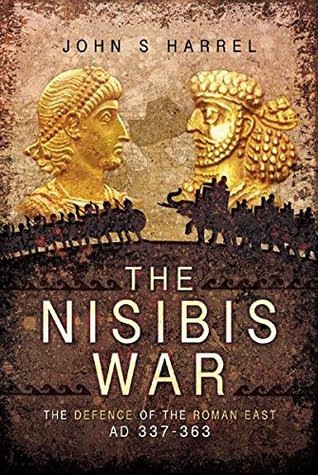
You’ve probably never heard of this war. There’s a good reason: John Harrel is the only one calling it that. This book covers what is usually considered two wars, neither of which seems to have any sort ‘official’ name. “Nisibis” was the name of a city that Rome had gotten in the previous peace deal with Persia (known as the Peace of Nisibis), and was the focus of much of the campaigning in this period, though not where the most decisive actions happened.

Considering that there is basically nine quiet years on the frontier between the two wars, I’m not sure considering them one war is justified. However, they are of a piece, with Shapur II campaigning to drive the Roman Empire out of Mesopotamia, so no matter how you look at it, studying them together is well justified.

This is a fairly in-depth study of the campaigning and the armies of the period, and definitely recommended for anyone interested in 4th Century military history. Given the state of knowledge of the period, I think he’s a bit too certain on some of his statements, but he does a good job of laying out his thinking for the state of the Roman army, it’s composition, and sources of replenishment. There’s a good number of maps, I found the symbology a little crude, but effective.

My main problem is the use of terminology, which kind of goes all over the place. For most Roman offices, he sticks with the Roman names, in italics as foreign words, which is fine. However, he then insists on translating comes and dux as ‘count’ and ‘duke’. That is where the English words come from, but those forms come with a lot feudal baggage that has nothing to do with the Roman offices, and they shouldn’t be translated like that. Also, oddly, he insists on giving place and unit names italics as foreign words, even though as proper nouns, that not the general practice. It makes for some highly distracted reading in places.

There is also some good discussion of Shapur II’s activities (including during the ‘lull’), and discussion of his strategic skill. Sadly, while he gives a good look at Emperor Julian (and a very good account of the entire retreat from Ctesiphon), he touches on Julian’s experience (and gives an account of his campaigns in Gaul), but doesn’t consider anything analogous to  Goldworthy’s assertion from In the Name of Rome that Julian’s being unused to the scale of operations (in men and distance) was the major Roman failing in 363, though he does touch on a similar idea.

└ Tags: books, history, reading, review, Rome
 Comment 
  • Page 134 of 315
  • « First
  • «
  • 132
  • 133
  • 134
  • 135
  • 136
  • »
  • Last »

©2005-2026 Rindis.com | Powered by WordPress with ComicPress | Hosted on Rindis Hobby Den | Subscribe: RSS | Back to Top ↑