

After my quick defeat in “Armored Car Savikurki“, we went for another round of Commands & Colors: Ancients. This time, it’s Alexander the Great’s final battle, Hydaspes from Expansion #1. The river is at one edge of the board, squeezing in that flank slightly, and the Macedonians have the usual rules: Alexander provides one extra die in combat, and the Companions (of which there’s two units), can ignore a sword and a flag on their own. The Indians have no infantry heavier than Auxilia, but do have three Elephants and two Heavy Chariots.
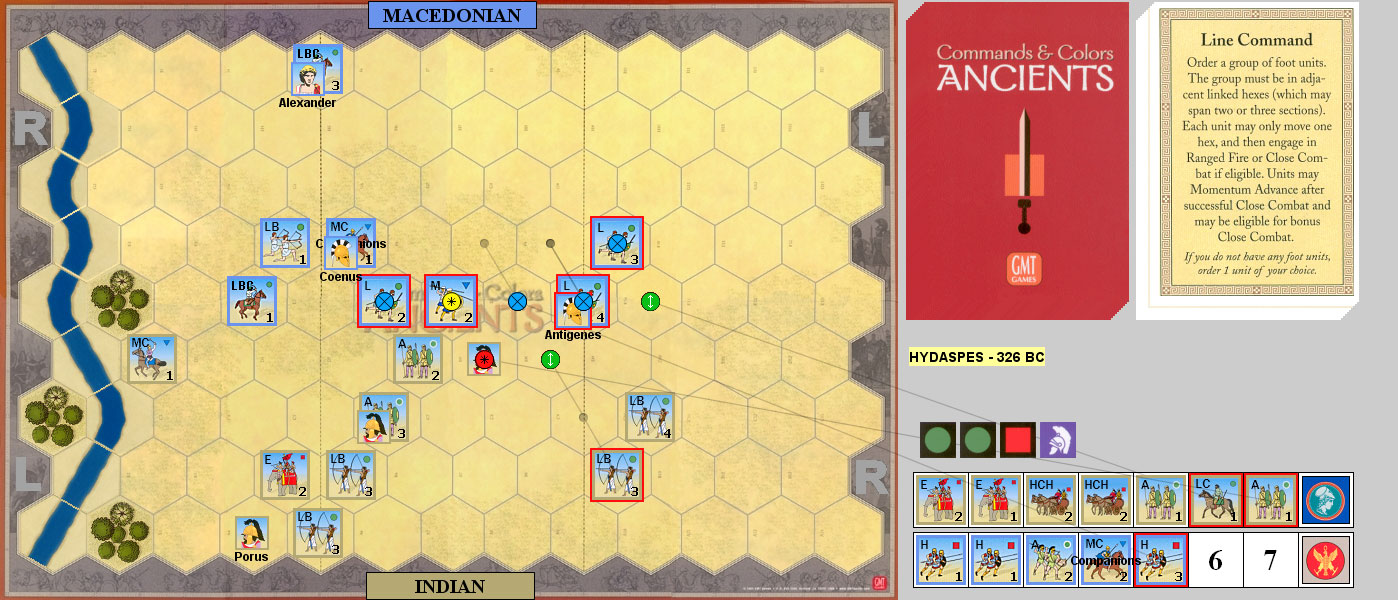
I had the Macedonians first, and Ordered Lights to bring up the flanks. The Bow Cavalry forced an Elephant to retreat, but the rampage did no damage. Patch Ordered Three Left, with his LB doing a block, and his Med Cav doing another to an evading LBC. I Ordered Three Right to drive off the Chariots, and do a block to his MC. Patch Ordered Four Center, and did a second block to a LB with archery, while moving forward a LB and Aux. I Double Timed my center forward, but which thoughtlessly put my heavies in range of his elephants.
Patch used Leadership any Section to slam his Elephants into my heavy unit center. The first one did three hits to a heavy, and then died to battle back, while the second Elephant finished them off, forcing Antigenes to retreat, and used momentum to do three hits to another heavy and force it to retreat. I Out Flanked to drive off a MC on my right, and bring Antigenes up to an Aux, who got First Striked by the Elephant for a block, and then did a hit and a banner, with the rampage doing another block to the Aux.
Patch Coordinated an Attack between his Chariots and Elephant, finishing off the weak heavy, but losing his Elephant to battle back on a failed momentum attack, but the Aux was finished off by a Chariot, forcing Antigenes to flee again. The other Chariot did one block to Companions (who ignored a second hit), and was eliminated by battle back. I Ordered Lights to sort out the flanks a little, and use the Indian army for archery practice, doing a block to a LB, and wiping out the second Chariot unit. Patch Ordered Three Right to move forward, while I Ordered Two Left to attach Antigenes to a Light and drive off his LC. Patch Ordered Two Right, and forced the other Light left on that flank to retreat, while I Darkened the Sky to do a block to his LC and to a MC.
Patch Coordinated another Attack to bring his MC behind his lines and do a block to my remaining Heavy. I used Move-Fire-Move to drive off his LC, but otherwise couldn’t do more than single banners to supported units. Patch Rallied his MC and an Aux to full strength, and then used them to get his left flank forward. I Ordered Lights, and drove off his MC again (losing a block at the baseline), and did a block to the rallied Aux and a LB. Patch Ordered Three LB Center to do a block to my LB. I Ordered Mediums, and brought two left-behind units up, while Alexander did two hits to the rallied Aux, and forced it to retreat; he used momentum to hit them again and finished it off.
Patch did a Mounted Charge, which killed Alexander’s Companions, with momentum doing a block to a LB while they evaded; the other Companions successfully evaded the last unit of Elephants; and a LC and Light traded blocks. I followed up with… the Mounted Charge I had just drawn. The Companions drove off a LB, Alexander (attached to the intact LBC) did a block to MC but retreated to the baseline on a two-banner battle back, and my one-block LBC did… two banners to the Elephants (there would have been a hit if Alex hadn’t been driven off), and thankfully the rampage did nothing. Patch had Inspired Center Leadership to do two hits to each of a Med and the Companions, while taking a block on each of two Auxes. I used Line Command to engage the center, and wiped out his LC, and finally got an Aux after losing a Heavy. 7-5
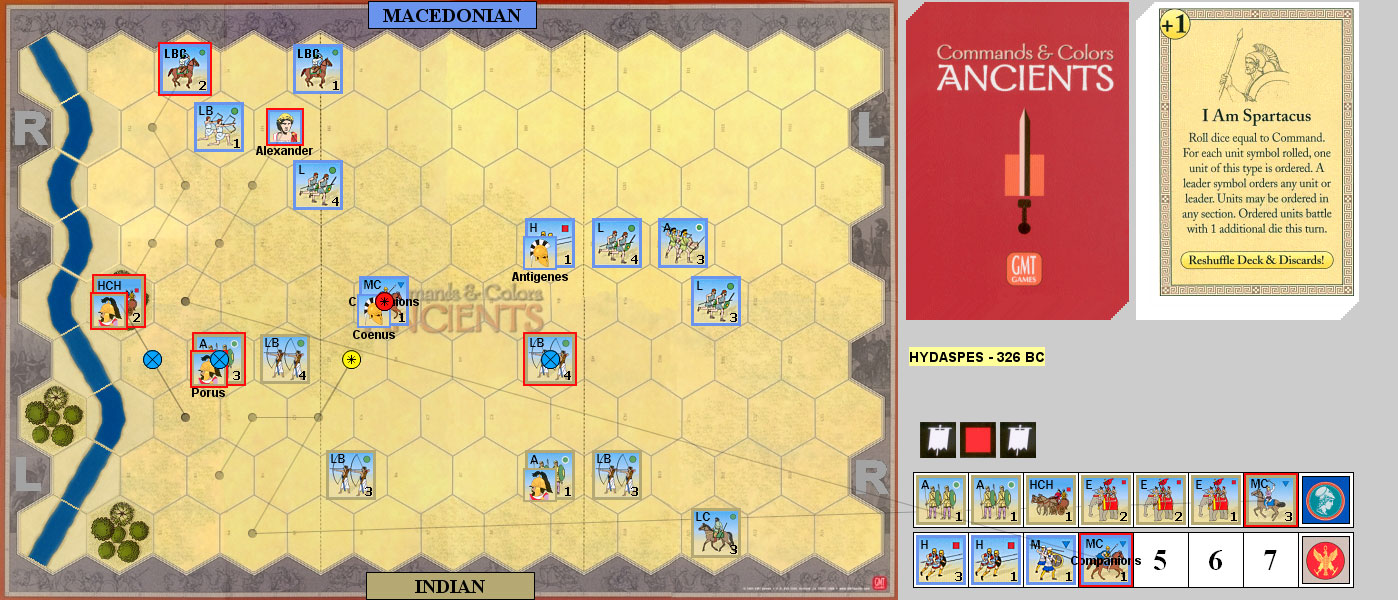
Patch opened the second game by Ordering Lights, with the LBC going toe-to-toe with the Chariots on my left flank (“Boy, my head is not in this. What the hell was I thinking?”), but they did not attack. I Ordered Lights in turn, and did a block to a LBC as it evaded. Patch Ordered Three Right, drew back the other LBC, and drove off the Chariot with archery. I used Inspired Right Leadership to move forward a bit, and drove off a Light with archery. Move-Fire-Move let Patch re-work his right flank some, but did no damage. I used Move-Fire-Move to solidify my center, and do a block to a Light. Patch used Line Command to move up his center and right, and drove off my LC with a banner. I countered with my own Line Command, but only moved up a single Aux, while everyone else fired into Patch’s line, doing a block to an Aux, two to a LB, and forcing a LBC back with a banner (where it lost a block at the baseline).
Patch Double Timed his center into my line, reducing two Auxes to one block each, and a third to two blocks (one hit caused by a blocked retreat…), while having his Med reduced to a block, two Heavies took two hits each, and a third also took a hit. I used Order Two Right to pull one Aux out of the line, and sent in the Chariot, which finished off the three-block Heavy; momentum did no damage to another Heavy, and the Chariot took a block and retreated. Patch used Order Three Center to have his damaged units finish off two my my damaged Auxes, but took another hit on a Heavy in the process. I used Order Heavies to send in the Chariots and Elephants to mop up, and eliminated a Heavy on the first attack… and then did no other damage, losing a Chariot and a block on an elephant, and on a LB on rampage in the process. Patch Ordered Two Center, and killed one Elephant, but lost his Medium attacking another one.
I Ordered Three Center, sending two Elephants forward, and a spare leader over to command the remaining Chariots. I drove off a LB with a loss, but did no damage to a Heavy and lost the Elephants in return. Patch used Coordinated Attack to get the remaining Elephant, and drove off my LBs, while Alex’s Companions attacked an Aux for one hit, and took two in return. I cried “I Am Spartacus!” to order a LB, Aux, MC, and Chariot. I did a block to a Heavy (ranged), finished off the Companions, drove off a LBC with a loss, did two blocks to the other Companions… and lost my MC to a two-banner battle back. 4-7
Afterword
The first battle really dragged out longer than you’d expect. After forgetting that I probably wanted to hold back my heavier units until the Elephants could be dealt with, there wasn’t a lot of offensive power left in either army. The second game, I tried to screen the Elephants until the time was right. Patch obliged with the Double Time and thankfully rolled relatively poorly. Unfortunately, it was a situation I couldn’t sort out in a hurry, and my dice with my heavy units were absolutely horrible, blowing the chance that I’d had there with Elephants going down after completely missing attacks on depleted Heavies.
Overall, its an interesting scenario, and probably the biggest concentration of the ‘unusual’ units there’s been. Like with most Alexander scenarios, it’s really unlikely he’ll lose (as show by these two games), but there are some possibilities here.


/pic4321436.jpg)
/pic4583364.jpg)
/pic4684441.jpg)