This is the fifth in a series of reviews looking at the evolution of Europa Universalis IV. See the previous reviews here:
Europa Universalis IV: A Fantastic Point of View
Wealth of Nations: National Trade
Res Publica: A Tradition of the People
Art of War: Reform-Minded Patch
/pic3013015.png) Paradox went back to the New World for the fifth expansion to EU IV. Instead of the North American focus of Conquest of Paradise, the new one, El Dorado, would focus on Mesoamerica and South America, and it would re-work exploration instead of settlement.
Paradox went back to the New World for the fifth expansion to EU IV. Instead of the North American focus of Conquest of Paradise, the new one, El Dorado, would focus on Mesoamerica and South America, and it would re-work exploration instead of settlement.
It was released on February 26th, 2015, alongside patch 1.10, and patch 1.11 followed on March 8, along with the free “Women in History” DLC.
Exploration
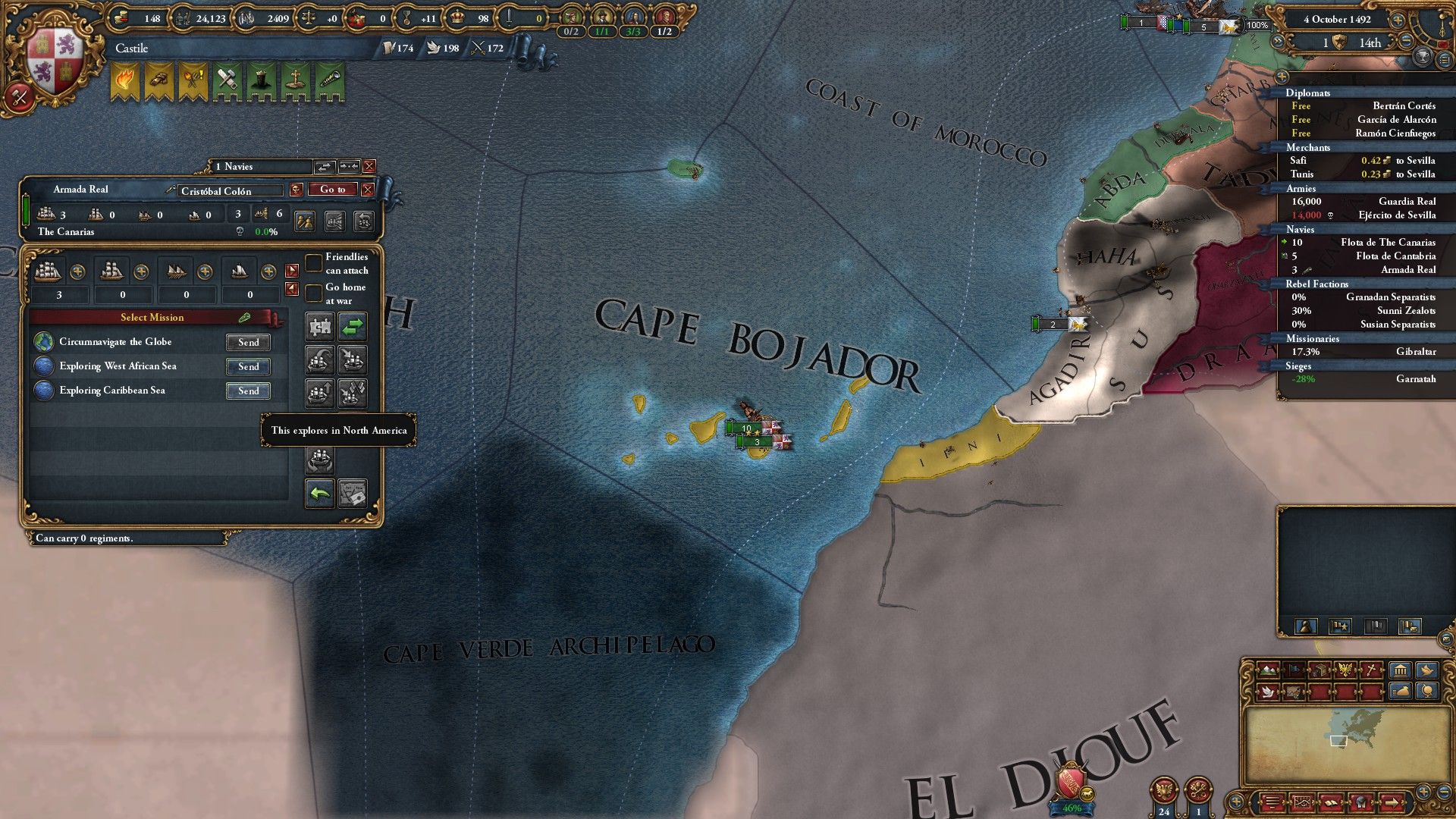 With a focus on the New World, exploration mechanics were re-worked for the expansion. Without El Dorado, it still works the same; get Quest for the New World, hire explorers and conquistadors (instead of admirals and generals), and have them command forces that can slowly uncover new areas.
With the expansion, you never ‘explore’ just by walking into terra incognita (outside of ways that everyone can always do it; notably marching around the interior of a country you’re at war with). Instead, you assign explorers and conquistadors to exploration missions.
An explorer will get options to explore the ‘waters of x’, which will send out his fleet to uncover all the sea zones of a region. Once at least some of these are known, he can ‘chart the coast’ of that region, which will uncover all the coastal provinces there.
These require a fleet of at least three light or heavy warships to do, and once one of these missions is started, it cannot be recalled (you do get a notice when it comes back home). So a lot of control is taken away, and as these only work within your colonial range, it might be difficult to target the area you want. But it takes a lot of micromanagement out, and the ships do not suffer attrition while on these missions (unless the explorer dies, at which point there might be very high attrition on a fleet a long way from home).
Conquistadors can go exploring on their own, which works pretty much like the usual auto-explore command in any game, though the army will halt to rest and replenish troops if too many are lost to combat against native populations.
And finally, explorers can attempt to circumnavigate the world. This takes a slightly higher tech level, and the fleet will take normal attrition. However, the first nation to complete the mission gets 100 prestige, with other nations getting 10 if they do it later.
All of these missions have extra events attached to them, especially the conquistadors. Their auto-explore is actually hunting for the seven cities of gold, and in addition to to the normal dealing with the natives, getting lost, and other exploration events, they may find clues and actually try to find one of the legends of the New World, with a (small) chance of succeeding.
A final note is that a country that builds up a colonial nation first gets a ‘claim’ on all the provinces of that region. Well, assuming you’re Catholic, and only other Catholic nations will care. It’s meant to represent the effects of the Treaty of Tordesillas. Generally, the AI will abide by these claims, and violating them causes relations penalties; though conquering territory from native nations is still fair game.
Religion
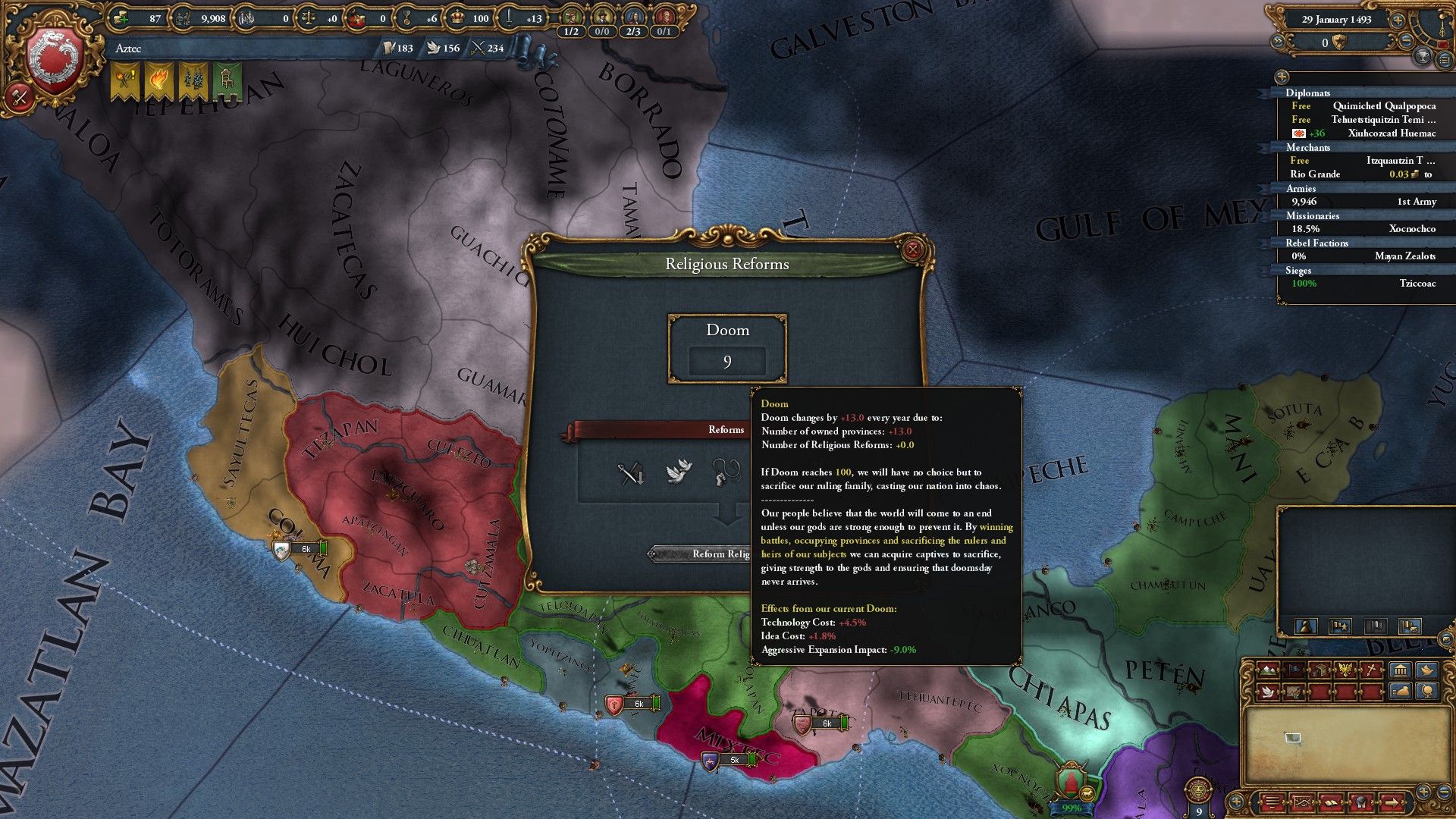
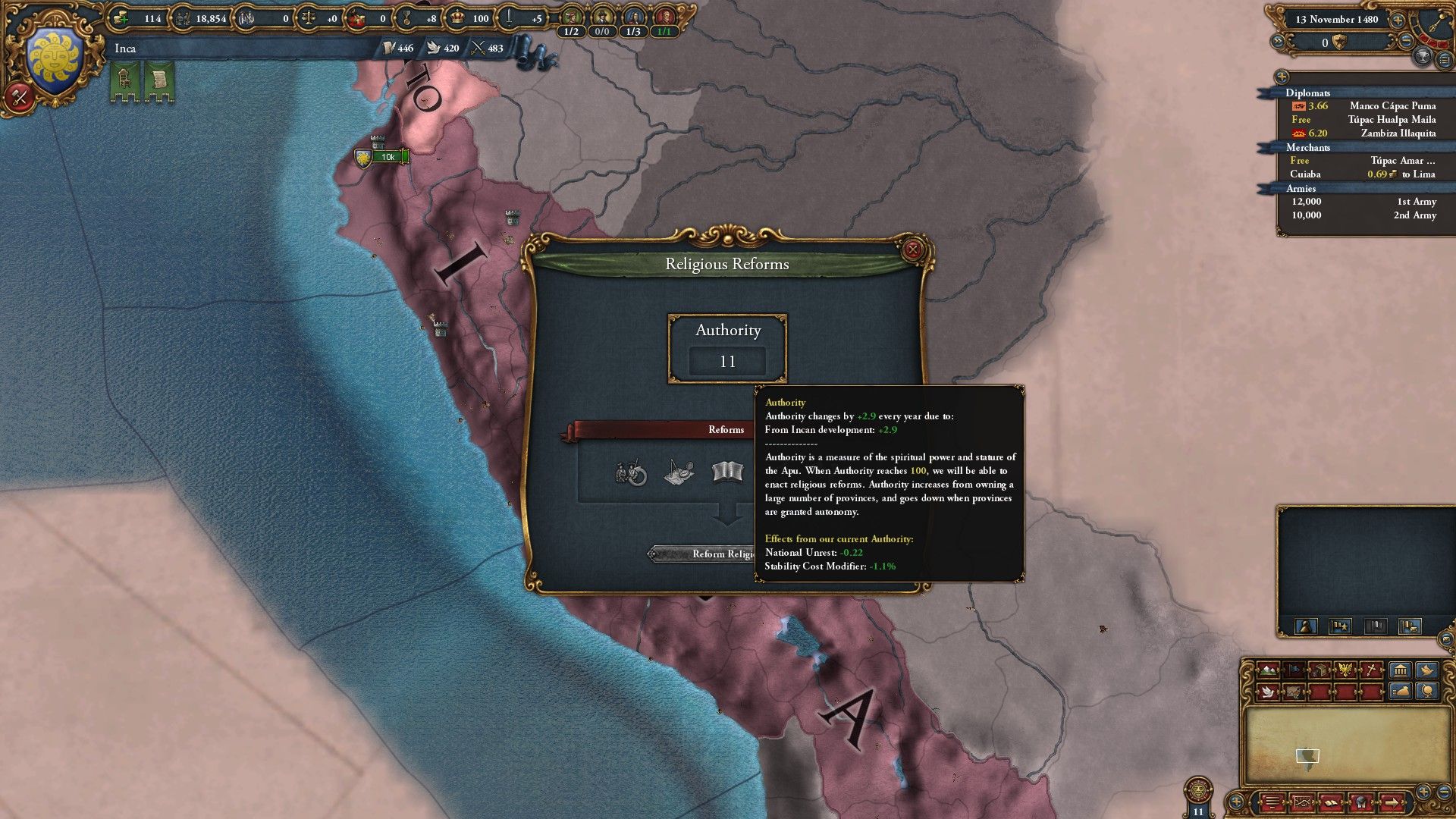 With more attention on the New World, three new religions were added: Nahuatl, Mayan, and Inti, displacing some of the generic Animist religion that had been used. They have bonuses roughly similar to Animism, and that’s it.
Unless you have El Dorado, in which case they all have similar enhanced mechanics. Notably, they all have five reforms they can pass for fairly good bonuses. Passing one is difficult, and resets everything that was needed to pass it. For instance, a Nahuatl country needs five vassals, and positive stability to pass a reform, but doing so lowers stability and releases all the vassals. Once all five are passed, the religion as a whole can be reformed (if there’s a Western nation on its border), which will basically ‘Westernize’ the country, bringing its tech level up as is done for other methods. Each one also has a unique extra mechanic:
Nahuatl has Doom, representing the Aztec belief in a series of sacrifices to empower the gods to keep the world from ending. Doom is a counter that slowly goes up, technologies and ideas become more expensive, and at 100, the royal family is sacrificed, eliminating the current ruler and heir in favor of a new 0/0/0 monarch. Large battles and sacrificing monarchs can reduce Doom.
Mayans don’t have an overt mechanic, but have to (directly) control 20 provinces to pass a reform. Doing so splits up the country, releasing nations, or transferring provinces to other bordering nations.
Inti has Authority, representing the current power of the Sapa Inca worshiped as a god. Authority is gained from having a large, prosperous nation, and decreases stability cost and unrest. Once it hits 100, a reform can be passed… which lowers Authority to 0, and starts a civil war with pretender rebels.
All three are neat ideas, and are guaranteed to cause instability in the region, especially in Mesoamerica, where the competing states won’t just conquer each other as they specifically need vassals. And naturally, someone has to lose, and since each Nahuatl nation has its own Doom counter (a universal one might be a little more reasonable), sacrifices of reigning monarchs are common.
Liberty Desire
The colonial nations introduced with Conquest of Paradise had a new stat, liberty desire. As of patch 1.10, all vassal nations now use this. Originally, it was just to allow for colonial revolutions, but now any sufficiently unhappy vassal state can rebel. Since one of of the modifiers for this score is just how powerful all the subjects of a nation are (taken together), it’s also a serious brake on just establishing a handful of powerful vassals, who will then act as a buffer against all the other powers, while you concentrate on one or two things.
Below 50% liberty desire, a vassal is loyal, and will act as vassal states always have in the series; always joining wars with the leading nation, and being a good little servant. Over 50%, and they are disloyal, which causes them to stop paying taxes, and only defend themselves in wars. Also, other countries can promise to support their independence. At 100%, the nation is rebellious, and will actively seek opportunities to successfully rebel.
Trade & Treasure Fleets
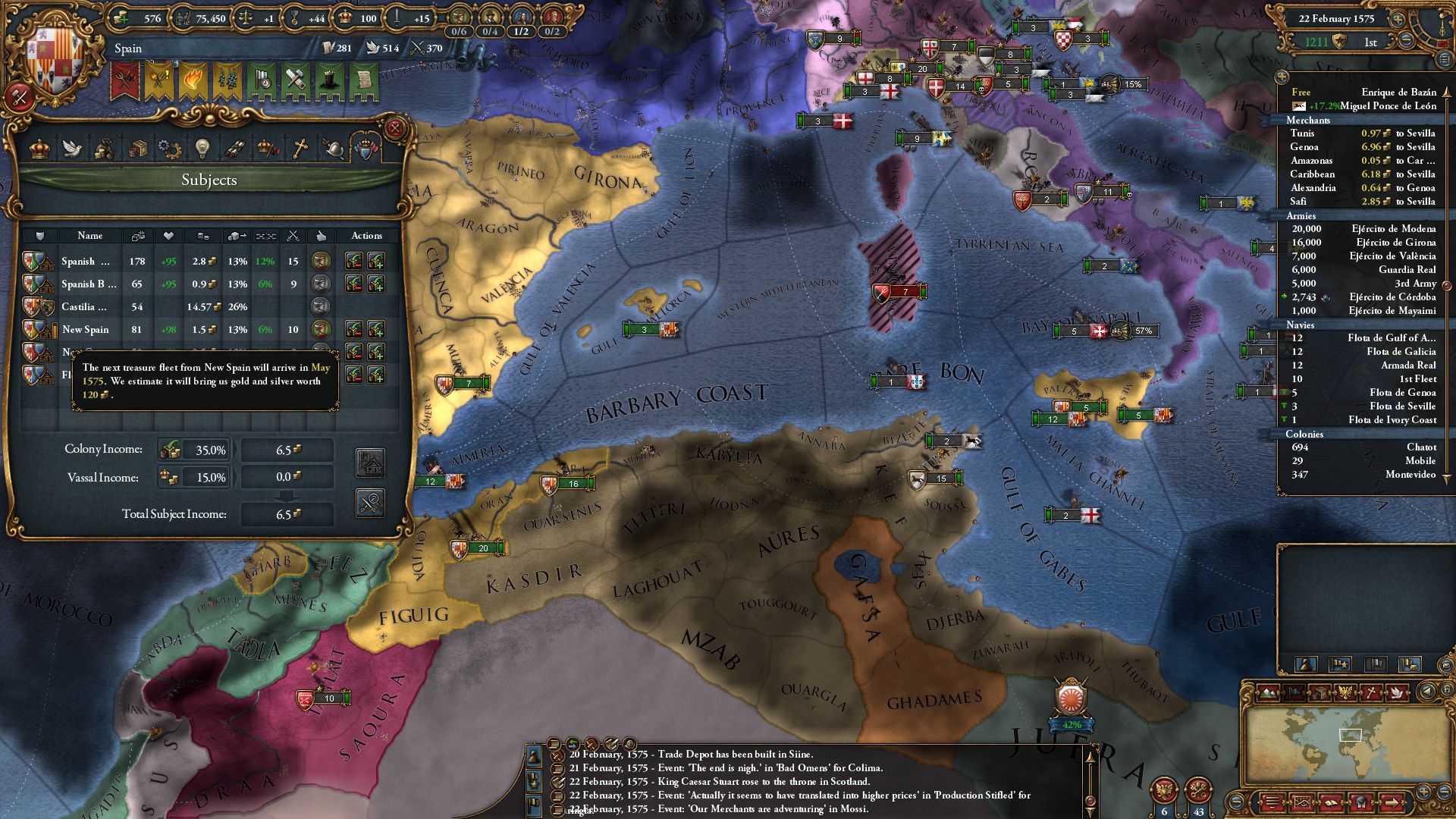 Trade came in for another round of tweaks, with some general rework of inland trade power. Also, colonial nations now generate an extra merchant for their parent country if they’re large enough (10 provinces). These can be used anywhere, but the obvious intent is to put them into New World trade centers to steer the trade to your own European trade centers for collection.
With the expansion, treasure fleets were added to the game. Sort of. Colonial nations with gold-producing provinces now store up gold and send it home as one big lump sum. It technically travels down the trade routes to the overlord’s trade capital, and it can be intercepted by privateers, who will whittle away at the amount of gold depending on their trade power in the nodes it goes through.
Once it arrives, the receiving nation gets the money, and inflation, as if they’d gotten it in a peace deal. With them coming in regularly, it can really start causing real inflation problems, instead of the more usual modest problems from gold provinces. Overall, it’s a neat idea, and the use of privateers is good, but it’s not obvious to anyone but the receiving nation that anything’s happening. And of course, since it’s not really on the map, they can’t be directly captured or disrupted by an enemy nation in a war.
Nation Designer
Another addition of the expansion is a custom nation designer. You choose a capital province, and then build out a nation from there, including the territory, culture, religion, traditions, etc. This all uses up a budget of points, which can be set to nearly any level. There’s achievements connected with it that all have a set budget to use, but more usefully, everyone in a multiplayer game can be set to get the same number of points, and then create ‘equivalent’ nations to play with.
I haven’t really used it, but the interface for it is pretty good.
Women in History
This was a free DLC that automatically gets downloaded as part of the Steam copy of EU IV, though it could be disabled in the launcher. Mostly, it adds events for countries to get historically prominent women as possible advisors. This also means that female portraits for all advisor types were also added, and they can, very occasionally, show up without the specific events.
It’s a nice bit of adding a bit of awareness of how much women have added to history, and not even so much in the background. I’m not quite sure why Paradox did it as a DLC instead of adding it straight to the game files; presumably so it would be easier to talk about the fact that they did do it. At any rate, I will say it feels a little odd, because its mostly fixed people at a fixed time, which gets back to the acting out history style of the first two games of the series.
Conclusion
For some, the Nation Designer is the headline feature, and reason enough to get the expansion. I don’t care for things like that (if I had a particular alternate-history to explore, maybe, but then I’d need to adjust more than one nation), so I pretty much ignore it.
As far as filling out the New World, I like it a lot better than CoP. The new religion mechanics are interesting (well, Maya not so much), and make the dynamics of the Aztecs in particular much more in line with history. Exploration is a mixed bag, seemingly taking some of the wonder out as explorers do things on their own, but taking micromanagement out with it, with all the attrition-watching that was needed, is overall worth it. If you get lots of colonial nations the number of extra merchants gets out of hand, but a few extras are a great boon for steering trade from your colonies to your home port.
The main patch is mostly notable for the rework of vassal relations, which gives that system a lot more character, and I think it was really needed. On the other hand, it saw the second rework of inland trade nodes, and this one was way too heavy handed with a flat extra 50 trade power or not.
Overall, the game improved again, and the free Women in History DLC is a nice addition. Assuming you’re not interested in the Nation Designer, I give El Dorado a limited recommendation: it won’t do much if you’re not exploring, and it’s a good, but not essential, addition if you are.


 Once again, we get a change in format with the third book of the “Queen’s Thief” series. This time, we get an all-new main character, and… almost all the story is told from the viewpoint of Costis. Costis is a much simpler and straightforward person than Eugenides… but spends the entire novel dealing with him, and the disruption the new King of Attolia has caused in the royal court.