Rindis.com

All my hobbies, all the time
  • Home
  • My Blog
  • Games
  • History

Categories

  • Books (504)
  • Comics (10)
  • Gaming (918)
    • Boardgaming (674)
      • ASL (155)
      • CC:Ancients (83)
      • F&E (78)
        • BvR – The Wind (26)
        • Four Vassal War (9)
        • Konya wa Hurricane (17)
        • Second Wind (5)
      • SFB (78)
    • Computer games (162)
      • MMO (77)
    • Design and Effect (6)
    • RPGs (66)
      • D&D (25)
        • O2 Blade of Vengeance (3)
      • GURPS (32)
  • History (10)
  • Life (82)
    • Conventions (9)
  • News (29)
  • Technology (6)
  • Video (50)
    • Anime (48)
  • Writing (1)

Patreon

Support Rindis.com on Patreon!
Become a patron at Patreon!

Other blogs:

RSS Inside GMT

RSS Playing at the World

  • Playing at the World 2E V2 Arrives May 5, 2025

RSS Dyson’s Dodecahedron

  • Red Knife Hole July 13, 2026

RSS Quest for Fun!

  • The Expense Post May 24, 2026

RSS Bruce Heard and New Stories

  • Pain, Exhaustion, and Morale in D&D BECMI June 7, 2026

RSS Chicago Wargamer

  • The 2 Half-Squads - Episode 310: Cruising Through Crucible of Steel January 27, 2023

RSS CRRPG Addict

  • Al-Qadim: Over, Sideways, and Under July 13, 2026
SF&F blogs:

RSS Fantasy Cafe

  • The Leaning Pile of Books July 5, 2026

RSS Lynn’s Book Blog

  • Can’t Wait Wednesday: The Thrice Bound Fool (Blacktongue #2) by Christopher Buehlman July 15, 2026
ASL blogs:

RSS Sitrep

  • Cardinal ASL Sins March 18, 2026

RSS Hong Kong Wargamer

  • FT114 Yellow Extract After Action Report (AAR) Advanced Squad Leader scenario April 16, 2025

RSS Hex and Violence

  • This still exists? March 25, 2025

RSS Grumble Jones

  • Grumble Jones July Scenario GJ162 You Will Engage the Enemy July 1, 2026

RSS Desperation Morale

  • How to Learn ASL March 16, 2025

RSS Banzai!!

  • October North Texas Gameday October 21, 2019

RSS A Room Without a LOS

  • [Crossing the Moro CG] T=0902 -- Rough start July 18, 2015
GURPS blogs:

RSS Dungeon Fantastic

  • Felltower - Monsters Fleeing between Sessions vs. PCs replenishing June 28, 2026

RSS Gaming Ballistic

  • B-Scale at the Table July 13, 2026

RSS Ravens N’ Pennies

RSS Let’s GURPS

  • Review: GURPS Realm Management March 29, 2021

RSS No School Grognard

  • It came from the GURPS forums: Low-Tech armor and fire damage January 29, 2018

RSS The Collaborative Gamer

  • Thoughts on a Town Adventures System January 18, 2022

RSS Don’t Forget Your Boots

  • GURPS Supers Newport Academy #7: “Invitation to the future.. of the 1970’s” July 5, 2026

RSS Orbs and Balrogs

  • Bretwalda - Daggers of Oxenaforda pt.4 - Fallen King May 27, 2017

The Mediterranean World in the Age of Philip II (part two)

by Rindis on August 22, 2013 at 10:41 pm
Posted In: Books

Braudel’s massive scholarly treatment of the Mediterranean from 1550 to 1600 is in three parts split between two volumes. However, even with part two being split between volumes, there is a change in direction at the volume break.

Part two deals with long term trends, and stuck to fairly abstruse subjects such as the economy in volume one. The first chapter in volume two is ‘Empires’. This is an examination of the two poles of the Mediterranean: Spain and the Ottomans. From there he looks at society, civilization and warfare before moving on to a more regular history of the period in part three. Being of the annales school of history, he is almost apologetic for including it, but argues that it has its place too.

In many ways, the centerpiece of part 3 is the battle of Lepanto. While the description of the battle itself only takes a couple of pages, an entire chapter is devoted to event around the battle. History has often recorded the battle as a great spectacle—which lead nowhere. Braudel argues that while it did not lead to further successes, it did bring the erosion of the Christian world to a halt, and break a defeatist sentiment that had taken root.

Like the first half, it is a truly massive undertaking, and well deserving of its status of one of the landmarks of 20th century historiography. It is by far the more readable and interesting half for the non-academic historian, but at the same time revealed less of the sixteenth century from its archives.

└ Tags: books, history, review
1 Comment

Return Engagement

by Rindis on August 22, 2013 at 12:00 pm
Posted In: Computer games

This is the fifth in a series of reviews of Paradox’s empire management games. See the earlier reviews here:
Europa Universalis II: A Tale of Two Europas
Hearts of Iron: Europa of Iron
Victoria: Nineteenth Century Essay
Crusader Kings: A Dynastic Adventure

Having explored four different eras in their games, Paradox Interactive returned to WWII with their first sequel game, Hearts of Iron II in 2005 for PC and Mac. (I’m considering EU II to be more of a ‘second edition’ then a ‘sequel’ here because of how similar those two games were.)

The World War II era of 1936-1947 proved itself a popular subject once again, and sales of HoI II were very strong, prompting a stand-alone expansion, Hearts of Iron II: Doomsday (which expanded the timeframe to 1953) in 2006. Hearts of Iron II: Armageddon was released as an expansion to Doomsday in 2007, which extended the timeframe to 1963, and provided a couple of odd alternate history scenarios.

In general, HoI II is the same warfare/empire-management game as the original, but with a reworked interface, and some new concepts. I have mostly played the original and Doomsday, so this review will generally be about them.

Interface

Much of HoI II is familiar to someone who has played the first game, but there are numerous areas that are obviously different as well. The first obvious one is the interface; instead of trying to rely entirely on Paradox’s usual map-and-sidebar scheme, a couple of new full-screen ‘folders’ were introduced to manage production and technology in, with yet another folder being added in Doomsday for espionage and intelligence.

Production works largely the same as in the original, but giving it the entire screen makes it much easier to work with the queue and select new things to build. When going through a ‘quiet’ part of the game (before war breaks out), it is quite possible to go for quite some time without looking at the map at all, just managing the details of research and production.

The first game had issues with trying to organize all the units, because the vital statistics of those units were not visible in the dialogs to split units into a second organization, or trade between two of them. This is solved here, with a much more informative display. However, there are still issues with selecting the right two organizations to trade between, and a few other related situations.

An interesting touch is that all nations have their own background image that kind of serves as a ‘wallpaper’ while playing that country. It’s generally nicely understated, and lends a good amount of color, compared to the unrelieved grays of the original.

Scenarios

While almost all play of any Paradox game is the Grand Campaign, which starts at the earliest date possible, and then goes through the end date of the game, there are always a few scenarios that start later. WWII is always good for this, as there’s a number of obvious start dates to cover well-known parts of the war.

However, HoI II also has a good number of very small scenarios that just use part of the map, and have fairly tight win-lose conditions. There’s sixteen of these, ranging from classic subjects like the Battle of the Bulge, and Barbarossa, to lesser known situations, such as the Winter War. Also, there’s a few ‘alternate history’ scenarios like the conquest of Czechoslovakia, the invasion of Japan, and the Planitean War—an Axis-aligned Argentina vs Allied Brazil.

I haven’t gone through most of these, but many, like Fall Grün (Czechoslovakia), don’t seem have much for one side to do, since the defense mostly needs to sit tight, and often can’t counterattack effectively.

The first expansion, as well as extending the time frame into the early Cold War, added an alternate history regular scenario: “Doomsday”. The Soviet Union attacks the western Allies on October 2, 1945, while the Soviet Army is at its greatest strength, and before the United States can build too many atomic bombs.

A fairly odd wrinkle is that while all saved games have a flag displayed next to them showing what country you were playing as, not only can you pick another country to play as when you load the game, but the country you were playing is not even selected by default.

Revised Resources & Production

Mostly, HoI II uses the same resource model as the original, but there are some significant differences. It is both simplified and expanded, with rubber being traded out for ‘rare materials’, and money is added as a sixth resource. Coal was generalized into energy, while oil, steel, and supplies remained the same, including the ability to turn some energy into oil.

Overall, there is no way to increase the total production of raw materials, since unlike the first game, improving infrastructure has no effect on the amount of raw materials produced in a province. Supplies and consumer goods must be produced with some of the nation’s industrial capacity (IC) as before, but now, consumer goods not only are used to keep the population content, but they generate money, which is needed for research and diplomacy.

An annoying part of the original was having to send units back into the production queue to be upgraded. Instead, there is now a production slider for upgrades, and when there are units capable of being upgraded, it will tell you how much IC is needed for maximum effort, and when units receive their needed IC investment they get upgraded in the field. Also, there is now a similar production slider for the reinforcements needed across all units, instead of having to select individual ones and spend supplies to reinforce. This spreads things out across all your armed forces, but you can mark particular units to be first in line.

Movement is Combat

Usually, in any area-based game, units move from one area to another, and when they arrive, they engage in combat with any defenders present. Paradox’s games have followed this same pattern.

But in HoI II, this was reversed. Moving into a province with enemy defenders starts a combat immediately (you can still set a particular time, as in the first game), and if the attack succeeds the units start moving in, and the enemy starts retreating out of the province.

This makes coordination of forces easier to accomplish than in the original game, and introduces a number of other wrinkles, most of which are good. For instance, if you have a second province that borders one where an enemy attack is coming from you can attack it from there, causing the enemy forces to take losses from two battles at once, nicely emulating a counter-attack into the flank of the advancing forces.

Also, one of the listings the side bars can be switched to is a list of current battles. This makes it easy to see what’s going on, and how well battles are going at a glance. Any air support against troops you’re attacking is a separate entry, so the list can get cluttered. However, there’s a separate icon for each type of battle that makes that easy to sort out.

However, when an attack succeeds it takes time to move in and take it. Often, there are a few enemy units that were already moving towards the province, and they will end up arriving in the province piecemeal before your troops arrive, who then have to be defeated. It’s not a major problem, but you end up with a bunch of extra battle notices as things get ‘cleaned up’.

Zones

In HoI II, units can be issued any number of orders. These may be ‘move’ or ‘attack’, or even ‘support attack’, but there’s a number of different specialized options as well. Naval units can patrol an area, bombers can be sent on strategic or tactical bombing missions, transports set to transport units (which automatically returns them to their home base after dropping off the transported units).

Many of these missions (like strategic bombing) are not targeted at a specific province, but rather a zone, which is a group of 4-5 provinces. This allows things like air cover and naval patrols to be set up in a general sense, without having to constantly retarget strategic bombing, or try to react to enemy air strikes individually, or go through the process of hand-creating a patrol pattern every time. Generally, you can also set how long the mission will last, and how much damage can be sustained before breaking it off and going home for R&R.

In general, the idea is sound, and it handles naval patrols, air superiority and strategic bombing fairly well. But managing air power in the close attack role can still be quite a chore, and the ‘zoning’ of those missions may mean they never hit the particular target you had in mind.

Government

Instead of a tri-polar space representing government ideology, HoI II borrows the political sliders from EU II. This is more flexible than the system in the first game, but how they interact with the three main alliances (Axis, Allies, Commintern) of the game is not always as obvious. There’s seven sliders, each of which moves between two opposing ideologies, with it being possible to move one slider one step every six month. Like in the first game, it is possible to try and influence another nation’s policies diplomatically, and that takes the form (with a lot of effort) of moving policy sliders for that country.

Two of the sliders determine the main ideology of the government: democratic/authoritarian and political left/right. The minister system from the first game is pretty much entirely intact here, but certain ministers can only be used with appropriate government types, which is again determined by those two sliders.

The next four mostly generate bonus or penalties in production, and things like partisan movements (which are mostly handled abstractly), and unit effectiveness. The last slider is interventionism/isolationism, and determines how hard it is to go to war. In the first game, democratic countries start out unwilling to go to war, and effectively had a timer on them that counted down to war, which could be influenced by how nice or badly the Axis and Commintern powers were behaving. In this game, countries gain beligerency for going to war, or annexing another country. Countries that are isolationist can only declare war on countries that have built up a certain amount of beligerency, and will have a certain amount of internal dissent when they do. The more extreme positions have increased costs for diplomacy, and even the inability to do some diplomatic functions, in exchange for generally improved relations with everyone.

Technology

The technology system is both very similar, and yet completely redone from the original game. There are a large number of advancements, in the same eight fields (plus ‘secret projects’) as before. However, these are almost all concrete things in and of themselves, and do not have the complex interrelationships of HoI.

Instead, each technology is split into five components, which each have a difficulty rating and field of study. You choose a research team, or company, to develop the technology, and they all have specialties in various fields of study (each team will have one to five specialties, and there is a large number of different specialties in the game), and then you pay them to develop it; running short of cash will halt progress.

Originally, technology was researched purely by IC investment, and you could undertake as many projects as you wished to devote capacity to. Now, there is a hard limit of how many teams can be assigned at once, and that limit can be from one to five, depending on the current IC of the country.

Even aside from the rework of research, there’s some further differences of note. Tank development was poorly handled in the first game, moving from light tanks, to mediums, to heavies in a logical, and completely ahistorical, progression. Now, early heavies come first, accompanied by light tanks, and they move on to medium tanks, along with more advanced versions of all three. Better yet, heavy tanks are actually brigades, sub-units that can be attached to the normal divisions. This represents early-war infantry tanks attached to infantry divisions well (something the first game completely failed at), and the fact that late-war heavy tanks also almost never appeared in divisional strength as well.

In fact, the brigade system is taken advantage of to good effect in HoI II. Later light tanks move from being divisions to being brigades, making them replacements for armored cars, and representing their use as recon units. Instead of trying to manage air units being loaded onto an aircraft carrier, there are Carrier Air Group ‘brigades’ that are attached to the carrier directly, and each new carrier technology allows the construction/upgrade of newer CAGs as well as a new class of carrier. In Doomsday, escort fighters go from being separate units to being brigades for attaching to bombers.

Overall, the system is a bit better, and the units that result are a better thought out, however, not seeing the interrelationships between fields is a bit disappointing.

Espionage

HoI II: Doomsday added the all-new mechanic of intelligence gathering and espionage. Generally speaking, you can attempt to place spies in other countries (or defensively in your own), who will then start informing you of the ‘highlights’ of that country’s actions. Most notably, you’ll start getting an idea of what that country is researching, and (with enough spies) how their progress is going. You can also get an assessment of what the country is concentrating on (paying attention to naval power, developing an air force, etc.), which I assume only works right with AI nations (though it might be peeking at the production queue).

With a number of spies available in a country, you can try more active tasks, such as trying to steal the blueprints of a technology you don’t have, assassinating a particular minister (and his bonus), raising dissent, and a number of others.

The typical problems of espionage in strategy games are present here: The odds of success for the simpler tasks are low enough to be frustrating to try and perform, and have a decent chance of alerting the target. Building up to the point where it’s possible to try the more active tasks takes time, and generally has an even lower chance of success. Also, while this is the period where espionage came into its own (with the creation of the OSS, and similar organizations, and of course the Cold War), none of this in is shown in the game. In the end, between the low odds, and the need to manage it all in detail, it ends up feeling easier to ignore than try to gain much real benefit out of.

Conclusion

Hearts of Iron was in many ways the most problematic and most successful of Paradox’s early games, so the desire to revisit it made a lot of sense. HoI II still has the problems of being a game on a period I know well, and a game that can demand attention in a horde of places at once in a real-time format, but many of the problems of the original are improved on here, if not always solved.

Certainly, the changes in interface and production were needed and very welcome. I consider the changes to how technology works to be a mixed bag. Assigning teams to work on a technology project should lead to some interesting tradeoffs, but generally doesn’t. The little sub-projects feel like there should be some in common, so finishing one of them would grant a bonus elsewhere, but don’t.

However, the revised unit line up, with the ‘brigades’ handling more functions (especially in Doomsday) is a big improvement. Armor development and deployment acts more like it should, carriers are much easier to work with, and the integrated escort fighters start simplifying the over-fiddly air system.

For me, this game still isn’t as good as Europa Universalis II, or Victoria, or Crusader Kings, but it is nearly as good as they are, instead of being too clunky to truly enjoy, which was true of the original.

└ Tags: gaming, Hearts of Iron, Paradox, review
9 Comments

A Dynastic Adventure

by Rindis on August 9, 2013 at 8:53 pm
Posted In: Computer games

This is the fourth in a series of reviews of Paradox’s empire management games. See the earlier reviews here:
Europa Universalis II: A Tale of Two Europas
Hearts of Iron: Europa of Iron
Victoria: Nineteenth Century Essay

After two successes, and one failure in the market, Paradox Interactive continued to look at doing further empire management games. They got a request from their publisher to produce one on the medieval era, and after some consultation, they came up with a general plan for a new game, which became Crusader Kings in 2004. While not in the league of Europa Universalis II or Hearts of Iron, it apparently sold reasonably well for PC and Mac.

After the success of the Victoria: Revolutions expansion, a final patch that had never left beta was picked up, polished off, and some all-new features added. This was released as the download-only expansion Deus Vult in 2007. This added the alerts that had been introduced in Revolutions, a windowed mode and advanced resolution support was added, so the game could be run on modern LCD screens in their native resolution (1280×1024 had always been the maximum available resolution before). I’ve only played Crusader Kings with the expansion, so this review will be about the final version.

The new game was both very similar, and very different from Paradox’s previous games. While keeping with the normal pauseable real-time format, you do not control a country, but rather a person. This person may be a count, duke or king, he may or may not have a liege-lord, but he will have experiences, age, and eventually die. And then the game will pass you on to his heir. If you have a landed heir of your dynasty, that is. If you do not, it’s Game Over.

So, the goal in the game is to enhance the power and prestige of your dynasty. The exact country you play can change over time as titles are lost or gained. This isn’t a role-playing game, it is still an empire management game, but the emphasis on people does give it more of a role-playing flair, and a very different feel than Paradox’s earlier efforts.

Music

Paradox’s games had typically featured soundtracks full of music from the time period of the game. In fact, EU II would switch track lists in different centuries. This, of course, mostly equated to classical music for the soundtrack. However, medieval music is not generally familiar to modern ears, and Paradox decided to commission an original soundtrack for this game, composed by Inon Zur, and this has now become their usual practice (though with a different composer, Andreas Waldetoft, for most if not all later titles).

Considering it is a long game, it would be nearly impossible for the soundtrack to not eventually get repetitive, but it is a good soundtrack with some nice pieces.

Kings & Things

As mentioned, people are the main focus of CK, and they all have nine primary features: Four prime attributes: Martial, Intrigue, Diplomacy, and Stewardship; two hidden attributes, fertility and health; and then three ‘currencies’: money, prestige, and piety. All characters also have a portrait, a culture, and a religion.

Each character also has a rank. Since this is still an empire management game, the major players are the landed nobility in charge of the actual provinces on the map. CK uses a simplified and rationalized version of feudal structure with kings, dukes and counts, along with a number of variant terms (culturally defined) for those same ranks. There will also be a number of un-landed persons in the courts of these nobles, who are all termed courtiers (even if they are the heir-apparent to a throne). There are five posts to hand out to these courtiers, along with possibly granting landed titles to them. The first four offices each correspond to the the four primary attributes of a character, so that the sum of the courtier’s appropriate ability and the lord’s ability are what determine the realm’s effectiveness in that field.

And there is a trait system. Traits come in about four different types, and can affect all the attributes of a character (including the hidden ones), and give an idea of what the person is like. The most general traits show on the character screen as a green dot with a symbol on it, and may be gained and lost freely through events. Most of them have an ‘antithesis’ trait, that will remove an existing trait if the antithesis is gained. There are a small number of negative statuses with red symbols such as ‘stressed’ and ‘wounded’ that can evolve into worse statuses. For instance ‘stressed’ can go away on it’s own, or it could descend into ‘depressed’, which not only has even worse attribute modifiers, but can cause an event to fire where the character kills himself. There are traits on blue shield symbols that largely represent life choices and the like, such as celibate, and the extremely dangerous realm duress, which represents a contested succession, with a high likelihood of all vassals trying to declare independence.

Most events (using the same engine as earlier Paradox games) affect characters. An unused courtier may decide to move to another court. You may be tempted by a pretty face (a bastard son will have trouble inheriting, but it beats no son at all). You may gain a new rival, or friend, or fall in love with your wife, or gain her as a bitter enemy.

Feudalism

Kings can hold dukes and counts as vassals to himself, and dukes can have counts as vassals. Each province on the map is really a county, with an associated count title and coat of arms. The duchies and kingdoms also have their own coats of arms. There is a map mode that shows the relationships between a lord and his vassals and liege, but isn’t as informative as it could be, since there is (for instance) no one view of all the separate duchies (with their vassal counts) in a kingdom, leaving you to remember who is who’s vassal.

There is a fair amount of possible skulduggery related to titles. You can fabricate a claim to a county (at a cost in Prestige), and then demand control of the county—usually by war. In fact, to go to war with someone, you generally need such a claim. Peace negotiations revolve around acknowledging claims, giving up claims, money, and possibly forcing the other power to become a vassal.

Duke and king titles are associated with certain areas, and if they are not currently in use, you can create the title if you hold the associated area and spend money for the privilege (and a gain in prestige). If someone else holds the title, but you hold the associated area, you can create a claim by virtue of your holdings, and then go to war to force the holder to give up the title.

Finally, a lord can keep direct control of his counties (his demense), but there is a maximum size before the game starts penalizing the lord with reduced taxes and troops (and any vassals the lord does have will become unhappy), encouraging proper division of lands. The amount a lord can directly control depends on his intrigue skill (without counting his spymaster), modified by the time period (later parts of the game allow larger demenses), and the lord’s title (kings can control more than dukes who can control more than counts).

Counties

The county is the basic territorial unit (/province), and has a few things to manage in its own right. Unlike other Paradox games, you do not recruit military units at all. Instead, each county has its own muster. Normally, this stays at home in the county and costs you nothing. However, when you muster the fighting men of the county, they appear on the map as a unit, and you start paying them money.

You can always do what you want with the musters of any county you directly control, but those of your vassals can be another question. If the muster isn’t already serving the lord, you can directly muster it for yourself, if the vassal is loyal enough, and doing so will tend to decrease his loyalty. You can also ask that vassal to muster his troops for you, which will still place them under your control, but it will take a few days to get a response, and he may refuse.

Each county will have a maximum unit size (which will vary), and when the muster isn’t called out, it will gradually replenish to its maximum size. However, this does not happen while it is in the field, so the muster can start out large, but will slowly be reduced by attrition, and can be very quickly reduced by a losing battle, leaving large field armies mere shadows of themselves.

There are four classes that make up the population of a county: peasants, burgers, clergy and nobility. Each one has a certain amount of power in the county, and as the power of the lower two classes increase, more taxes will be collected, and the size of the county’s muster will increase. Increasing the power of the nobility will grant prestige bonuses, and the power of the clergy piety bonuses; increasing them will yield fewer, more effective troops.

Technology

Counties can also have a number of improvements built in them. What can be built will depend on the technology in the county. As the game progresses, and technology builds up, the number of available improvements gets quite large. Some of these will generate extra gold, some will expand the size of the muster, some help the spread of technology; the number of different effects (not all visible to the user) is quite large.

Technology is not so much researched in this game, as it spreads. You can decide to concentrate on certain subjects, which gives a continuing chance at improvement in that field, but that only affects your capital. The normal mechanism is that when a county possesses a technology, it will eventually spread to adjacent counties on its own. There are three main fields of advancements (military, economic, culture) with a number of different fields in each, and then five levels in each field.

Combat and Sieges

The muster of a county consists of seven different types of soldiers: heavy and light infantry and cavalry (well, knights instead of heavy cavalry), pikemen, archers, and horse archers. That last category does not actually appear in normal armies. Only Mongol and Arab armies have the capability of fielding horse archers, leaving the Christian armies to suffer under their mobile firepower. Combat itself loops through four different phases where first the archers attack, then the light units join in, and then all troops get to attack with archery at half effectiveness (for two phases, front and flank).

Beyond the number of troop types, and increase in the number of phases, combat works much like usual in Paradox games. Once the battle is joined, events are out of the player’s hands, and the battle is decided by the troops, the leaders, and the terrain. There is morale that will force an army to retreat, and will take time to recover after a battle, but this is only visible during a battle, so it can be hard to tell if an army is actually effective at this moment, or will just run away shortly after the battle in joined.

Military technologies generally represent the adoption of later equipment and grant bonuses for various troop types. Though, while the bonuses are spelled out in the game, the base figures are not, so it is hard to get a handle on just how much meaning these bonuses have.

Taking control of a county follows much the same model as in Victoria; once a county is invested with enemy troops, there is a constant progress bar of how the siege of the local castle is proceeding. Castle types improve with technology, and start with a cheap and simple hill fort (really a motte-and-bailey castle), expensive and time consuming huge castles. Each level of fortification of course takes more time (and men) to besiege, but they also ‘push back’ the progress on a random basis. A force might get halfway through a siege, but lose so many men to attrition, that the push back starts dominating, and the progress will reverse until reinforcements can be brought to bear.

Finally, it is worth noting that seapower is absent from the game. Instead of building fleets and transports, troops automatically embark ships and set sail any time you tell them to cross water. This costs money, and the travel is quite slow. Unfortunately, the pathing tends to be too eager to send musters on expensive sea voyages, so it can take some management to avoid.

The Crusades

One common complaint against Crusader Kings is that you can only play Christian powers. However, this was an intelligent design decision, since, with one exception (the Kingdom of Nubia), this keeps players away from ‘edge of the world’ problems, as limits of the map are either ocean, or occupied by non-Christian powers.

The game does split between Catholic and Orthodox countries, though Catholicism gets most of the attention. The fifth councilor is the head of your local church, and he determines your relations with the Papacy. When the current pope dies, a new one is selected, and the court closest to the new Pope becomes the ‘Papal controller’, who can try to have enemies excommunicated and the like. Having good relations with the Papacy helps you get this position.

A major preoccupation of the Christian powers in this period were, of course, the Crusades. In-game, the Pope will occasionally call a Crusade (which is a random event, and not controlled by anyone, even the Papal controller), with a particular goal (Jerusalem, Cairo, etc.). As long as the Crusade is active, there is a monthly hit to your piety (which often just counters your normal gain), but any piety rewards for fighting infidels are increased; taking the target of the Crusade can be very lucrative in terms of your piety rating.

There’s some problems with the system, though it apparently was re-worked for the expansion to cut down on the randomness of Crusade targets. However, it still feels arbitrary. And that, of course, is because it is. It a pure AI/random decision, only constrained by what places are currently ruled by Moslems. There’s no sense of the politics or strategic considerations that drove many decisions with the later Crusades, and it it actually feels foreign to the rest of the game because of that.

The Mongols

The Mongols of course, conquered much of the eastern portions of Europe and parts of the Middle East during the 13th century, and in the game they show up about on time, via events that populate the fringes of the map with large armies that have several advantages.

Their military technology is fairly high, giving them most of the combat bonuses. They take over a province as soon as they finish besieging the castle. They have no domain limit to reduce the effectiveness of a large realm.

This means that once established, the two Mongol states (Golden Horde for the eastern Europe armies, and Il-khanate for the Middle Eastern armies) can easily become a potent force, and a big problem for everyone else. However, they are religious enemies for everyone, making declarations of war easy, and eventually they will be forced to adopt gavelkind succession, which splits the realm up between heirs, and the successor states will not have the demense bonus.

History

I’ve long thought about doing a game on warfare in the Middle Ages. You’d spend a lot of time trying to gather money so that you could afford to pay your troops for one season. One of the high points of CK for me is the fact that you do not have standing armies. And indeed, money goes up in peacetime (you hope) and down in wartime.

While the game does shift the focus from countries to dynasties, it’s still a bit empty. There are friends and rivals, but no real feel of factions, and dynastic infighting. The simplified version of feudalism does not allow for the entanglements of a vassal having more than one lord (or the classic case of William the Conquerer being King of England in his own right, but also owing fealty to the King of France for his Norman possessions.

But even if Crusader Kings is not the most historical game possible on the subject, it still gets things right that a lot of other games (especially the technically medieval-based fantasy conquest games) get absolutely wrong about the period. It isn’t the in-depth examination of period society that Victoria is, and it isn’t the close technical examination that Hearts of Iron is, but I think it gets the job done very effectively.

Conclusion

Strategy games journalist Troy Goodfellow once said that Crusader Kings wasn’t Paradox’s best game, but it was his favorite from them (this was in 2011, before CK II came out), and while I’m not sure what my favorite Paradox game would be, I can well understand his sentiment.

Once again, Paradox showed that they could take the same basic game structure, and deliver a very different feel. From the grand sweep of empires across the globe in Europa Universalis, to the very detailed study of society and internal politics of Victoria, this time the game has a very personal feel. It isn’t a role-playing game, and cannot be mistaken for one, as there are no real characters here, and no dialog, no spark of life behind the actors on the stage. But the actors are there, and they are people, and not countries.

The common failure of most grand strategy games is to ignore the centrifugal forces that act against larger structures, while preserving most of their advantages. In CK, keeping a large kingdom together for any length of time can a harder accomplishment than conquering the world in a game like EU. It isn’t a detail-oriented simulation like Victoria, but it is much more successful at delivering the feel of the era.

└ Tags: Crusader Kings, gaming, Paradox, review
2 Comments

Two Rounds of Hysiae

by Rindis on July 23, 2013 at 10:46 pm
Posted In: CC:Ancients

With the latest ASL game done, Patch and I went for another round of Commands & Colors: Ancients. Since we polished off the last of the Truceless War scenarios last time, and several of the Expansion #1 scenarios were modified in Expansion #6, I thought it’d be good to just start doing the scenarios in historical order. First up: the Battle of Hysiae, 669 BC, from Expansion #6.

This one introduces the hoplite rules, which are just regular medium infantry that can be ordered as if they were mounted units. The bulk of the Argive army is MH, while the Spartans just have regular mediums and one heavy unit. I had the Argives for the first round and never saw an order mounted card all game. In fact my hand was fairly poor all game.

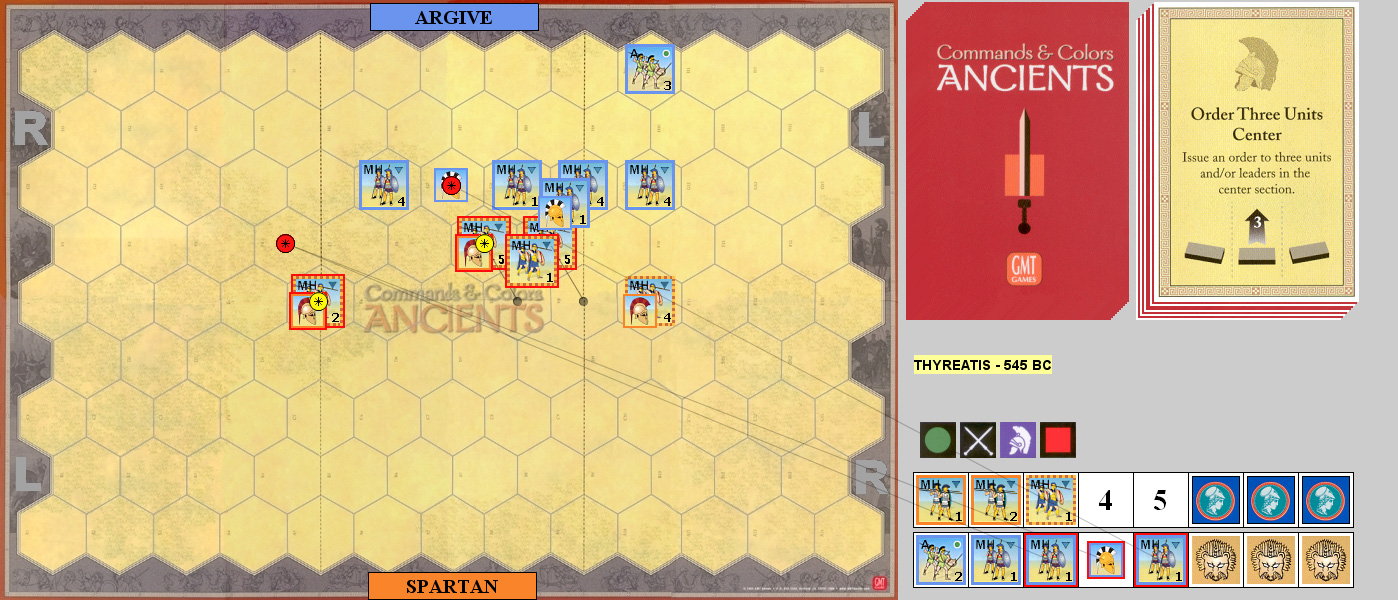
Things started off slow, with the centers stubbornly immobile while the flanks engaged. Patch moved up with two Line Commands, but there was still a two-hex gap between the bulk of the lines. I hit his right flank, and managed to take out a Med for no loss. Patch then Double Timed to engage the rest of the line, and knocked out a Light and a a MH for two Med and two Heavy blocks. I had Inspired Right Leadership to continue the melee, and knocked out his weakened units at the cost of a weakened unit of MH, then the MC chased down the leader who’d been with his heavy and picked him off.

Patch used the Mounted Charge card that I’d really been hoping to have for my hoplites. I cost him three blocks across his two MC, but nearly lost my MC in the process. I used Leadership on Patch’s left, and only caused light damage, but it broke up his line. Patch countered with Order Mounted, and eliminated my weakened MC.

I reformed my center, and Patch used a third Line Command to move his right flank up and picked of another MH. Then followed up with Order Four Right, and nearly took out another. The best I could do was Order Two Left, which picked off a unit, before following up with Order Three Center to pick off a Med for the win. 6-5

Hysiae 1

That one had gone a bit slow and long, so the second round waited for next week. I had a better hand this time, but it turned out that Patch still had the really good cards.

It took a while to get into contact again, but the first skirmishing was over on the left flank, where I drove his Lights off with some damage. Patch got lucky on an Order Three Right to knock out my MC on that side while it was in the hills.

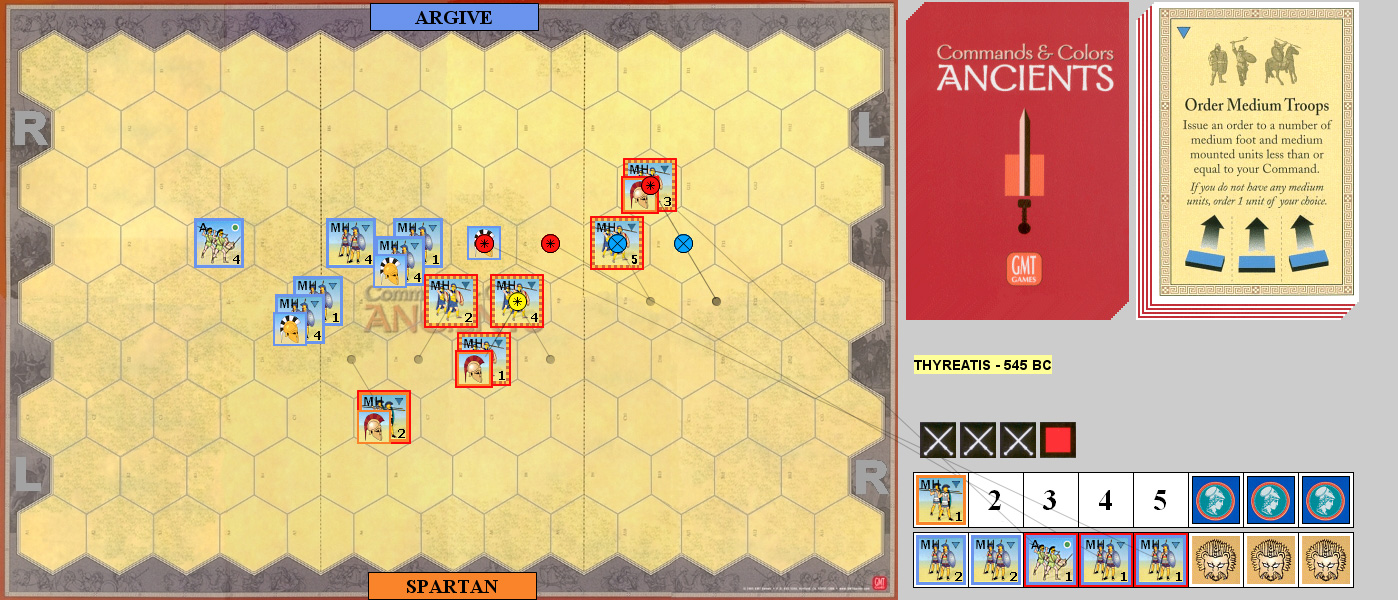
I used a Line Command to get the opposing lines to one hex away, and drove off his MC. Patch answered with a Mounted Charge that activated the bulk of his hoplites that killed a Med and my Heavies and reduced another Med to one block at a cost of three blocks across two units. I Double Timed to tighten up the line, and took two hits to zero. Patch then used Clash of Shields to activate three units, and knocked out another two units of Med.

A second Double Time closed that gap and picked off his MC and leader, and got a MH, though the leader there survived to evade back to an intact group of three MH. Patch answered with a Order Medium (with command of six…) to finish the game when he picked off a one-block Medium. 3-6

Hysiae 2

The first game was very even all the way down, and we both didn’t have much of an army left at the end. The second game really went over to Patch fast with two very successful bonus die cards. Both times I tended have have substandard hands, and Patch really got some good cards.

└ Tags: C&C Ancients, gaming
 Comment 

FB18 Red Banner Days

by Rindis on July 18, 2013 at 12:00 pm
Posted In: ASL

Having spent a little time away, Patch and I went back to working our way through all the Festung Budapest scenarios. This time we went with “Red Banner Days” from Journal 10, which actually happens slightly before “Siesta Time” (and the day after “Waffenbrüderschaft”).

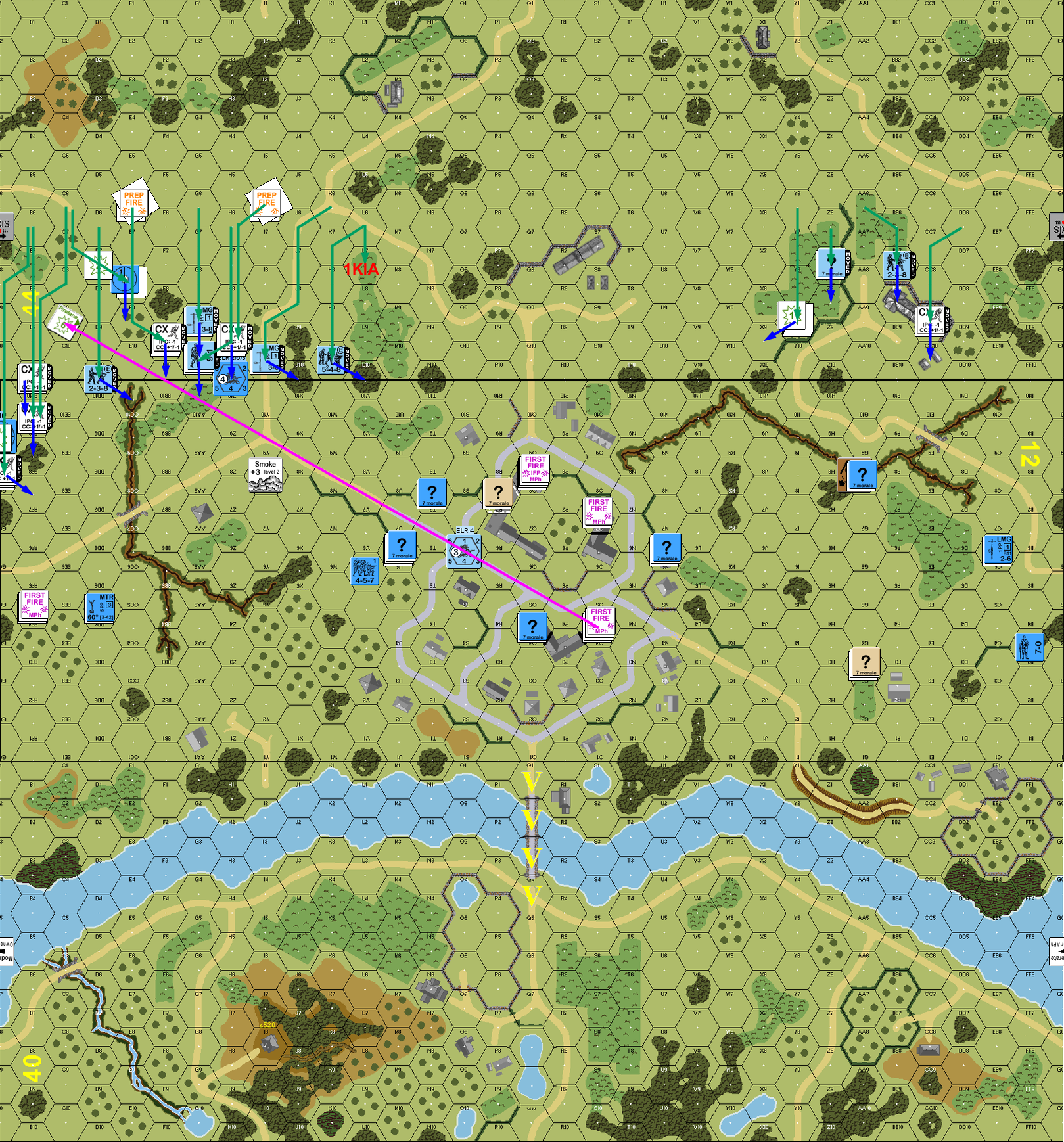
The Germans are preparing to counterattack Russian gains in the NW of the city, when the next Russian attack goes in immediately beforehand. So the Soviets go first, attacking into a tiny Hungarian force, while a large German force is stuck under “No Move” markers for two turns (or until attacked by the Russians). The Russians win by getting 12 VPs, counted by building control, GO squads and T-34s in the area past the Hungarian defenders, with both sides having a 26 CVP cap. Patch took the Russians, and I tried to parse what the heck I was doing as I set up.

The map is between the sizes of the previous two FB scenarios we’ve played, but with the amount of forces available, a 13-hex wide playing area feels cramped. The west edge features the familiar terrain of the cogwheel RR, but the real action is well to the east, where a dense urban zone slopes down into a factory area. Oddly enough, this scenario features random rubble generation, even though the other scenarios we’ve just played did not. I had some interesting luck with the rubble, knocking down most of the D14-H14 block as well as a couple hexes of the Hungarian area, and three on the front line of the Russian set up area. There wasn’t any falling rubble, but there was some falling debris.

If I’d payed more attention to the sheer amount of firepower the Russians have (15 squads, FT, DC, 4xT-34, 4xGuns, including a 152mm ART!) I would have set the Hungarians (4 squads, LMG, leader, 9x’?’) up on the back side of the block, and tried for hide-and-seek. As it was, I tried to keep him cautious about crossing the street, and lost nearly everything in the first turn. Patch led off with a couple hexes of Smoke on the south, and then pounded the center of the line, managing to ELR and reduce a squad on a couple of MCs. The 152 broke my squad on the north corner on a CH, also placing a flame on Level 1.

In movement, the bulk of the line took one big step forward into the street. I only had one effective squad left (not counting the HS and Dummy under Smoke) in G20, and the cowered on their first shot and then broke and ELRed on a second FPF shot.

Then the FT squad ran in, and was unaffected by the Resid.

Advancing fire eliminated G20 including the Dummy there. He advanced into I21 and J21, finding only a Dummy in the latter, but blew his roll in I21 on a 4:1 attack while I stayed concealed, and out of Melee.

FB18 1R
Full scenario area, Russian Turn 1. Yellow hexes are the VP line the Russians need to pass.
↓ Read the rest of this entry…

└ Tags: ASL, Festung Budapest, gaming
3 Comments
  • Page 229 of 315
  • « First
  • «
  • 227
  • 228
  • 229
  • 230
  • 231
  • »
  • Last »

©2005-2026 Rindis.com | Powered by WordPress with ComicPress | Hosted on Rindis Hobby Den | Subscribe: RSS | Back to Top ↑