
Rindis.com

All my hobbies, all the time
  • Home
  • My Blog
  • Games
  • History

Categories

  • Books (504)
  • Comics (10)
  • Gaming (918)
    • Boardgaming (674)
      • ASL (155)
      • CC:Ancients (83)
      • F&E (78)
        • BvR – The Wind (26)
        • Four Vassal War (9)
        • Konya wa Hurricane (17)
        • Second Wind (5)
      • SFB (78)
    • Computer games (162)
      • MMO (77)
    • Design and Effect (6)
    • RPGs (66)
      • D&D (25)
        • O2 Blade of Vengeance (3)
      • GURPS (32)
  • History (10)
  • Life (82)
    • Conventions (9)
  • News (29)
  • Technology (6)
  • Video (50)
    • Anime (48)
  • Writing (1)

Patreon

Support Rindis.com on Patreon!
Become a patron at Patreon!

Other blogs:

RSS Inside GMT

RSS Playing at the World

  • Playing at the World 2E V2 Arrives May 5, 2025

RSS Dyson’s Dodecahedron

  • Shrine of the Diseased One July 17, 2026

RSS Quest for Fun!

  • The Expense Post May 24, 2026

RSS Bruce Heard and New Stories

  • Pain, Exhaustion, and Morale in D&D BECMI June 7, 2026

RSS Chicago Wargamer

  • The 2 Half-Squads - Episode 310: Cruising Through Crucible of Steel January 27, 2023

RSS CRRPG Addict

  • The Search for Freedom: Won! July 18, 2026
SF&F blogs:

RSS Fantasy Cafe

  • The Leaning Pile of Books July 5, 2026

RSS Lynn’s Book Blog

  • Friday Face Off: The Raven and the Reindeer by T Kingfisher July 17, 2026
ASL blogs:

RSS Sitrep

  • Cardinal ASL Sins March 18, 2026

RSS Hong Kong Wargamer

  • FT114 Yellow Extract After Action Report (AAR) Advanced Squad Leader scenario April 16, 2025

RSS Hex and Violence

  • This still exists? March 25, 2025

RSS Grumble Jones

  • Grumble Jones July Scenario GJ162 You Will Engage the Enemy July 1, 2026

RSS Desperation Morale

  • How to Learn ASL March 16, 2025

RSS Banzai!!

  • October North Texas Gameday October 21, 2019

RSS A Room Without a LOS

  • [Crossing the Moro CG] T=0902 -- Rough start July 18, 2015
GURPS blogs:

RSS Dungeon Fantastic

  • Felltower - Monsters Fleeing between Sessions vs. PCs replenishing June 28, 2026

RSS Gaming Ballistic

  • B-Scale Detail and Examples July 16, 2026

RSS Ravens N’ Pennies

RSS Let’s GURPS

  • Review: GURPS Realm Management March 29, 2021

RSS No School Grognard

  • It came from the GURPS forums: Low-Tech armor and fire damage January 29, 2018

RSS The Collaborative Gamer

  • Thoughts on a Town Adventures System January 18, 2022

RSS Don’t Forget Your Boots

  • GURPS Supers Newport Academy #7: “Invitation to the future.. of the 1970’s” July 5, 2026

RSS Orbs and Balrogs

  • Bretwalda - Daggers of Oxenaforda pt.4 - Fallen King May 27, 2017

Designers & Dragons: Part 2

by Rindis on April 14, 2018 at 12:00 pm
Posted In: Books

The second volume of Shannon Appelcline’s history of the RPG industry is every bit as large as the first. It’s a much bigger subject though, since the 1980s saw a lot of activity up and down. But TSR and GDW were very prominent parts of this decade, and were already covered in the first volume. This is also the decade of most of my role-playing activity, so there’s a lot of familiar names here, and many more I remember from ads, but never knew someone who actually got the products.

There’s another 23 major histories here, plus six ‘mini-histories’, and two magazine histories (these really need to be in the table of contents). This is about twice as many entries as the previous volume, which shows that most of them aren’t as long, though there’s still some very substantial chapters.

The biggest omission I noted in this volume was Car Wars. Appelcline passes over it quickly as a board game that Steve Jackson Games did very well with. However, it really exists in that halfway realm of the ‘proto-RPG’ or ‘hybrid game’ that he explores a little in the first volume. While the people in Car Wars are largely not the focus, there is a skill system, and there is character advancement through those skills. Moreover, the expected mode of play was for characters to persist from session to session. Sunday Drivers (expanded and reprinted from The Space Gamer, and later retitled Crash City) was labeled as ‘a role-playing supplement for Car Wars‘ and Convoy (reprinted from the first issue of Autoduel Quarterly) is a solo adventure (though not for one character) not unlike the ones produced for Tunnels & Trolls. Perhaps a large history of the RPG industry isn’t the place to meditate on just what constitutes an RPG, but I think looking at the edge cases, especially where play styles and fan groups start bleeding over into each other, is instructive.

While there’s several companies I’m very familiar with in here, they’re concentrated in the early parts of the book. In the last two (of six) parts, the company I’m most familiar with (DGP) I only really knew of after the fact, and I never got anything by New Infinities and only one from R. Talsorian (Dream Park, though I certainly enjoyed playing Teenagers From Outer Space). Again, it’s an extremely informative book that covers a lot of ground well.

└ Tags: books, gaming, history, reading, review, rpg
 Comment 

Decline and Fall of the Ottoman Empire

by Rindis on April 10, 2018 at 12:00 pm
Posted In: Books

The title of Palmer’s book is generally familiar, and he acknowledges directly that he’s writing a similar book to Decline and Fall of the Roman Empire in the introduction. However, this is a ’90s book for a more casual audience, and so isn’t anywhere near as long or as moralizing as Gibbon’s classic.

And… maybe a little moralizing would help. He does a good job describing a lot of the events of the Ottoman Empire’s slow breakup, but never really tries to posit any real reason why such a strong state should come apart, and why it took so much longer to do so than many outside observers assumed. A large part of this, is that you never get a good picture of the Empire as a whole, with the bulk of the attention being tied up with the person of the Sultan, and innermost circle of advisers and diplomats.

Palmer picks the failure of the second siege of Vienna (1683) as the starting point of his book, which seems to be a good one. I had not realized just how battered the Empire was in the next few years, with revolts in Greece, and various European powers picking up what they could. But like the Byzantine Empire before them, the Ottomans recover, and retake almost everything that was lost.

After a decent amount of detail in this section, coverage becomes light, but slowly picks up detail again, with the 19th Century (understandably) taking up a fair amount of the book. The various diplomatic maneuverings of Europe around the ‘sick man’ are covered in more and more detail as time passes. WWI itself isn’t as detailed, but the actual fighting of the war is not the primary focus. Instead, we get good broad accounts of the activity on the fronts, increasing Arab restlessness, and the maneuverings of the men at the top. The ‘post WWI’ struggles of Kemal, and the final fall of the Sultanate and Caliphate are handled in some detail.

It’s a very good introductory account of all these events, and probably at its strongest at the beginning and the end, which deal with subjects that don’t get enough coverage in histories. The real shortcoming is the lack of any kind of look at how it all came to be. There’s a good amount on the efforts to ‘Westernize’ (and to resist Westernizing) the Empire late in its life, but Palmer does little to show just how the Ottomans ended up with with a dysfunctional system that left them unable (or likely, unwilling) to adapt, and unable to impose its will within its own borders.

└ Tags: books, history, reading, review
 Comment 

WO2 Failure to Communicate

by Rindis on April 6, 2018 at 12:00 pm
Posted In: ASL

After Patch and I’s last SFB game, we returned to ASL, and decided to try “Failure to Communicate” from the first Winter Offensive pack, which I’d picked up during MMP’s Fall sale. It’s May ’40, and a miscommunication leads to an overwhelming force to take out a French garrison. The French have a mix of nine elite and 1st line squads with good leadership, a MMG, MTR, 25mm ATG, two AMR 33 ‘tanks’ (with 4FP MG MA), one AMD 35 armored car with a 25mm gun, all radioless, and 10 “?”. They get to choose between also getting either another AMD AC, another ATG, or a ATR (with HS) and some mines), and get another elite squad, 8-0, and DC on turn 5. The Germans have 6.5 turns to take five out of seven multi-hex buildings with fourteen squads, with a typical mix of leaders and support weapons. On turn three they get two Pz IIs and three Pz 38(t)s. The French can also win by getting 25 CVP.

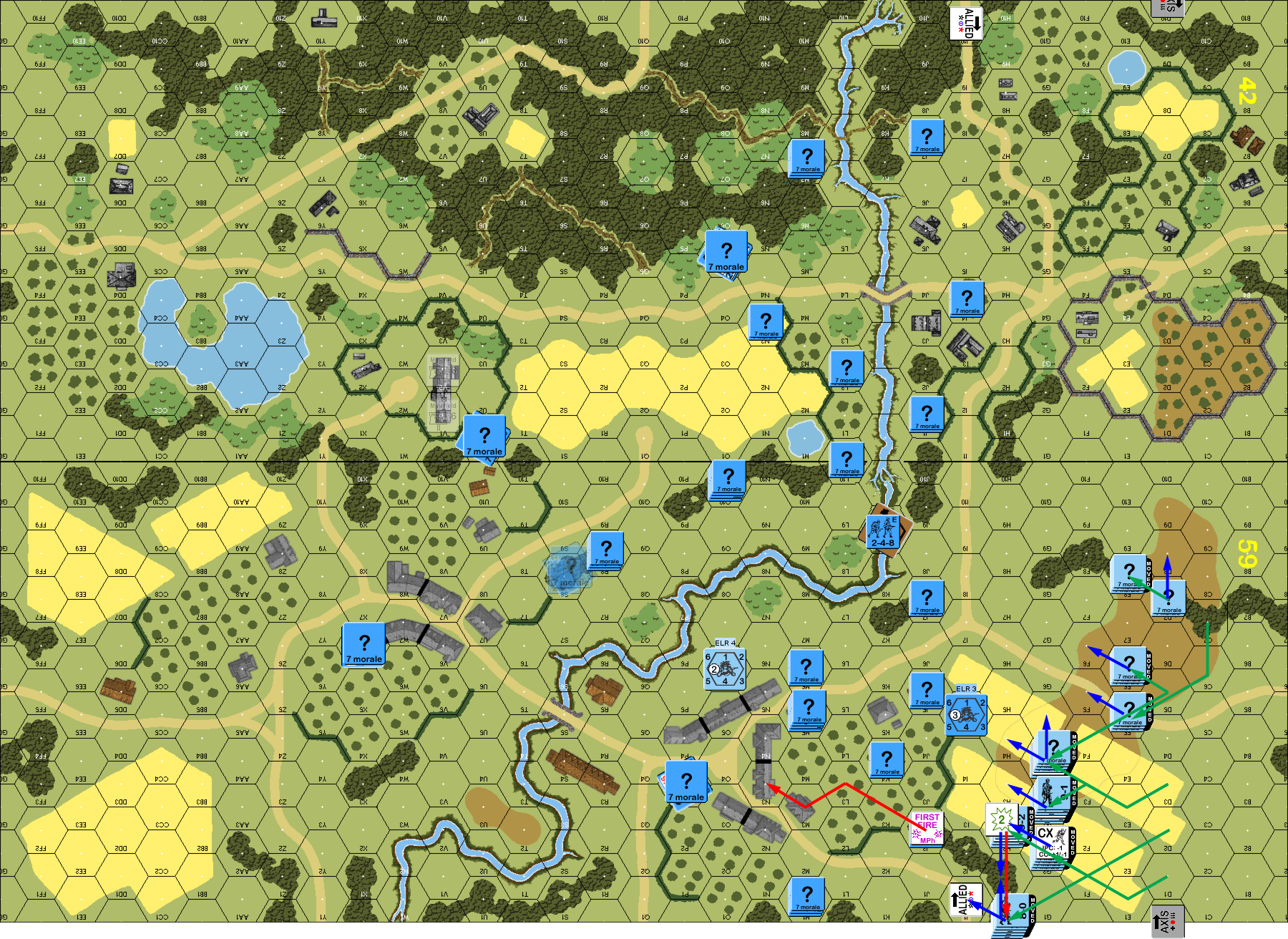
The new board from WO1, 59, has a stream crossing it, and board 42 has a stream overlay, so the stream goes across the entire board, and only four multi-hex buildings are on the near side of the stream to the Germans. I took the French defenders and concentrated on two things in my defense: the main village (with four victory buildings), and defending the stream. Especially with my limited anti-tank ability and the fact that he’d need at least one building across the stream, I wanted to make that painful. The main weight of the defense went in and around the main village, with the MMG and MTR behind the stream, and 3.5 squads (with a lot of Dummies) around the board 42 crossing to keep him from just trying to seize that bridge early, drive on the two victory buildings across the stream on board 59 and then try and take the village from both sides. I took the ATR… and then stuck it in a corner that was less likely to see armor (42J1 might have been much better), with the mines going on the one board 42 building in case he went there. I used two “?” to look like a fourth vehicle in 42U1, so he’d think I took the extra AC instead. Sadly, I had forgotten that French tanks tend to have radio trouble, and didn’t consider setting up any platoons. The ATG was set up so it could cover the board 59 bridge, but facing down the road coming from board 42.

Patch setup entirely concentrated on the village. With a hill, and a bit of woods in the way, I couldn’t see anything, and many moves still didn’t give me a chance to see anything, but his 9-2 and a HMG squad moved through the grain to a clear shot of 59J2, which Patch had figured as a Dummy. However, he was part of my outer defensive line (with the Orchard to provide cover for his withdrawal later), and a K/2 wounded the leader while breaking the squad. (It would have been soo nice to get a fatal wound, ah well.) He did get two positions that could fire on J2, and broke the squad on his second attempt with a NMC in AFPh.


Situation, German Turn 1, showing the full board and my HIP setup.
↓ Read the rest of this entry…

└ Tags: ASL, gaming, WO1
 Comment 

Page

by Rindis on April 2, 2018 at 12:00 pm
Posted In: Books

The second book of Protector of the Small picks up directly, and predictably, from the first. Kel is now a page, and no longer on any sort of probation. It also moves more into the usual tropes growing up, and dealing with the world. Hazing an bullying aren’t absent by any means, but is not the major running theme.

There is some action early on, as well as for the conclusion, and we find that Keladry has a good head for basic tactics, and maintaining awareness under stress. Outside of these sections, about three years pass, told in a few significant parts. The training continues to be tough, but she has an established network of friends now, and takes on a servant at the beginning of the book. Lalasa is interesting as she seems determined to stay as inoffensive as possible, but later shows that Kel has had a real effect on her.

Compared to the Alanna quartet, this book comes off very well, as it feels like a complete book, instead of a mere ‘part two’ that In the Hand of the Goddess did. Both Alanna and Kel are good characters that I enjoy reading about, but so far this series is a bit better structured.

└ Tags: books, fantasy, reading, review
 Comment 

Designers & Dragons: Part 1

by Rindis on March 29, 2018 at 12:00 pm
Posted In: Books

Shannon Appelcline’s Designer’s & Dragons is a truly massive undertaking: A history of the entire roleplaying game industry from its beginnings to about 2010. Just the first volume, covering six years (1974–79), is 400 pages.

However, the structure is such that he is covering a lot more than those six years. Each chapter is a complete history of a single company, running to when they closed down, and many of the companies here are still running in one form or another today (and certainly, none of them ended in the ’70s). This volume covers thirteen companies who had an impact on the RPG industry during the ’70s, plus three ‘mini-histories’ of more peripheral companies, and one ‘magazine history’ (annoyingly, these last do not show up in the table of contents).

This does fracture a lot of subjects, notably how the industry and market was evolving, and how one company’s releases were affecting the others. This is present, but because it bridges chapters, is not well served. And the the history of RPGs outside the companies is under-served. There is a nice bit of background on the Bay Area gaming scene (as the background of Arduin), but no similar coverage of the Los Angeles area, which was an important early center of RPG fandom (most surprising is that Alarums & Excursions doesn’t even rate a mini-history box, even if it is a completely amateur production). Appelcline keeps solidly focused on his general subject, only touching on non-RPG products from a company where they impinge on the company and its RPG side as a whole, making several of those chapters noticeably incomplete on their subject.

And… the book is still 400 pages with all those omissions, and only covers the first corner of the industry. I want more, but I have to admit my interests are further reaching than most, and I would really like to see a good history that tackles wargaming, and frankly also ‘adventure gaming’ in general. It breaks these six years into four parts, with TSR and the genesis of the form being part one (which is available as a very generous free trial here), part two covering the first four major companies to leap onto RPGs, part three consisting of wargame publishers who moved into RPGs in the early days (though GDW is rightfully part of part two), and the fourth talking about the rise of ‘universal’ (as in ‘for any game system’, even when you which which game they really mean…) publishers.

Several of these companies I kind of consider ‘childhood friends’ of mine, having grown up around products by GDW, Flying Buffalo, and of course, TSR. Others, like GW, are less familiar. It is a little depressing seeing just how many ways a company can run into financial trouble, but it is nice to find out just what happened to a fair number of people who, from my fairly limited viewpoint, just disappeared along the way. Finding out more about games I saw ads for, but never knew anyone who had a copy was also a plus. The book was entertaining and informative, with just a few small editing issues. And I’m already most of the way through devouring the second book.

└ Tags: books, gaming, history, reading, review, rpg
1 Comment
  • Page 154 of 315
  • « First
  • «
  • 152
  • 153
  • 154
  • 155
  • 156
  • »
  • Last »

©2005-2026 Rindis.com | Powered by WordPress with ComicPress | Hosted on Rindis Hobby Den | Subscribe: RSS | Back to Top ↑