Rindis.com

All my hobbies, all the time
  • Home
  • My Blog
  • Games
  • History

Categories

  • Books (504)
  • Comics (10)
  • Gaming (919)
    • Boardgaming (675)
      • ASL (155)
      • CC:Ancients (83)
      • F&E (78)
        • BvR – The Wind (26)
        • Four Vassal War (9)
        • Konya wa Hurricane (17)
        • Second Wind (5)
      • SFB (78)
    • Computer games (162)
      • MMO (77)
    • Design and Effect (6)
    • RPGs (66)
      • D&D (25)
        • O2 Blade of Vengeance (3)
      • GURPS (32)
  • History (10)
  • Life (82)
    • Conventions (9)
  • News (29)
  • Technology (6)
  • Video (50)
    • Anime (48)
  • Writing (1)

Patreon

Support Rindis.com on Patreon!
Become a patron at Patreon!

Other blogs:

RSS Inside GMT

  • Defiance AAR: North Jersey, July 2026 — Chili Dogs and Chit Pulls July 20, 2026

RSS Playing at the World

  • Playing at the World 2E V2 Arrives May 5, 2025

RSS Dyson’s Dodecahedron

  • Barin’s Stonehold July 20, 2026

RSS Quest for Fun!

  • The Expense Post May 24, 2026

RSS Bruce Heard and New Stories

  • Pain, Exhaustion, and Morale in D&D BECMI June 7, 2026

RSS Chicago Wargamer

  • The 2 Half-Squads - Episode 310: Cruising Through Crucible of Steel January 27, 2023

RSS CRRPG Addict

  • Al-Qadim: Bottle Shock July 20, 2026
SF&F blogs:

RSS Fantasy Cafe

  • The Leaning Pile of Books July 5, 2026

RSS Lynn’s Book Blog

  • Top Ten Tuesday: I’ve gone with a freebie July 21, 2026
ASL blogs:

RSS Sitrep

  • Cardinal ASL Sins March 18, 2026

RSS Hong Kong Wargamer

  • FT114 Yellow Extract After Action Report (AAR) Advanced Squad Leader scenario April 16, 2025

RSS Hex and Violence

  • This still exists? March 25, 2025

RSS Grumble Jones

  • Grumble Jones AAR for Crucible of Steel Scenarios on the YouTube page. July 20, 2026

RSS Desperation Morale

  • How to Learn ASL March 16, 2025

RSS Banzai!!

  • October North Texas Gameday October 21, 2019

RSS A Room Without a LOS

  • [Crossing the Moro CG] T=0902 -- Rough start July 18, 2015
GURPS blogs:

RSS Dungeon Fantastic

  • Felltower - Monsters Fleeing between Sessions vs. PCs replenishing June 28, 2026

RSS Gaming Ballistic

  • Mission X and Genre Fidelity in Combat July 19, 2026

RSS Ravens N’ Pennies

RSS Let’s GURPS

  • Review: GURPS Realm Management March 29, 2021

RSS No School Grognard

  • It came from the GURPS forums: Low-Tech armor and fire damage January 29, 2018

RSS The Collaborative Gamer

  • Thoughts on a Town Adventures System January 18, 2022

RSS Don’t Forget Your Boots

  • GURPS Supers Newport Academy #7: “Invitation to the future.. of the 1970’s” July 5, 2026

RSS Orbs and Balrogs

  • Bretwalda - Daggers of Oxenaforda pt.4 - Fallen King May 27, 2017

The Romulan Way

by Rindis on August 30, 2019 at 12:00 pm
Posted In: Books

Duane’s second Romulan (excuse me: Rihannsu) novel is also, or maybe more of, a follow up to Spock’s World.

Like that book, which dived into the history of the most prominent member of the Federation after Earth, every other chapter of this book gives the history of the Romulans, starting with their original split from Vulcan society, and self-imposed exile among the stars.

This alternates with a far better, but very unusual plot centered around the head servant of a Rihannsu household that has seen better days. Other things intrude on this setting, including Ael from the first book near the end, but the only regular cast member who has a presence is McCoy. Rihannsu and Federation covert plots get involved, and what starts as a fairly sedate focus gets shaken to pieces. I don’t buy some of how the Federation op is put together, but once that’s accepted, everything els falls into place very well.

As such, much of the book is fairly actionless, and is a decidedly slow burn. Thankfully, the characters are well-done, and keep a creaky opening going. Things heat up over the course of the book, for a fairly epic conclusion, featuring, among other things, ‘a good ol’ southern fillibuster’. Duane doesn’t do as much violence to the setting as some other novels, but this is an event that would go down in the history books.

└ Tags: books, reading, review, science fiction, Star Trek
 Comment 

Mixed Callinicum

by Rindis on August 27, 2019 at 12:00 pm
Posted In: Boardgaming

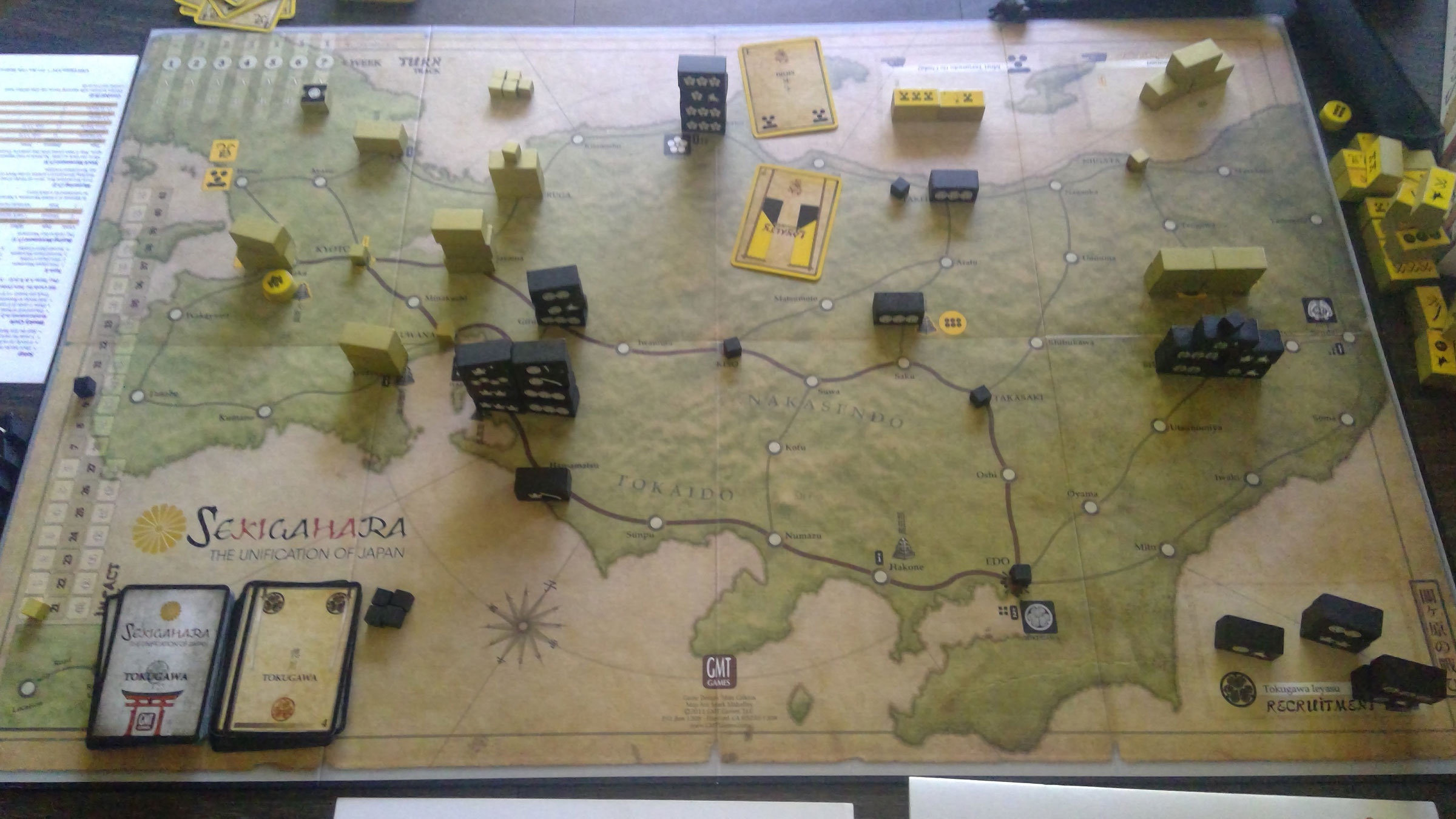
Patch came over on July 28 for a little FtF gaming. First up was a game of Sekigahara, which we don’t do too often, but Patch always enjoys.

By circumstance of how Patch set up the board, he had Ishida, which might not be the best idea when I’ve played it more recently than he had, but he certainly did a creditable job of it. I kept having problems with armies that wouldn’t fight, and had to stay a bit cautious, but despite that, I mostly stayed on the overall offense.

This was aided by early battles where Patch besieged Miyazu, and I rescued the garrison the next turn. Mid-game, he came back and took it, but by that point I was besieging Ueda castle. Our first real major battle was near Gifu, and victory there allowed him to take Okazaki, but the main Tokugawa army advanced to take Gifu, and then re-took Okazaki at the end. Patch had a good position, which he improved throughout the game, but the constant drain of blocks from combat and the occasional siege certainly kept him feeling desperate.

I’d had plans for my end game, planning on taking three different resource points, but Patch blocked access to all of them. Well, I could have have tried one block vs one block at Niigata, but figured the defense advantage on ties would kill me if nothing else. Patch tried the opposite on his last move, attacking Takeda, and lost 2:3 impact (he was surprised I had a 3-mon block, but there just hadn’t been anything else to split from the force that took Ueda).

I mostly avoided spending any cards I didn’t need to, which along with the castle advantage had me build up a pretty large hand at the end of the game. Final score was 15-12 for me.

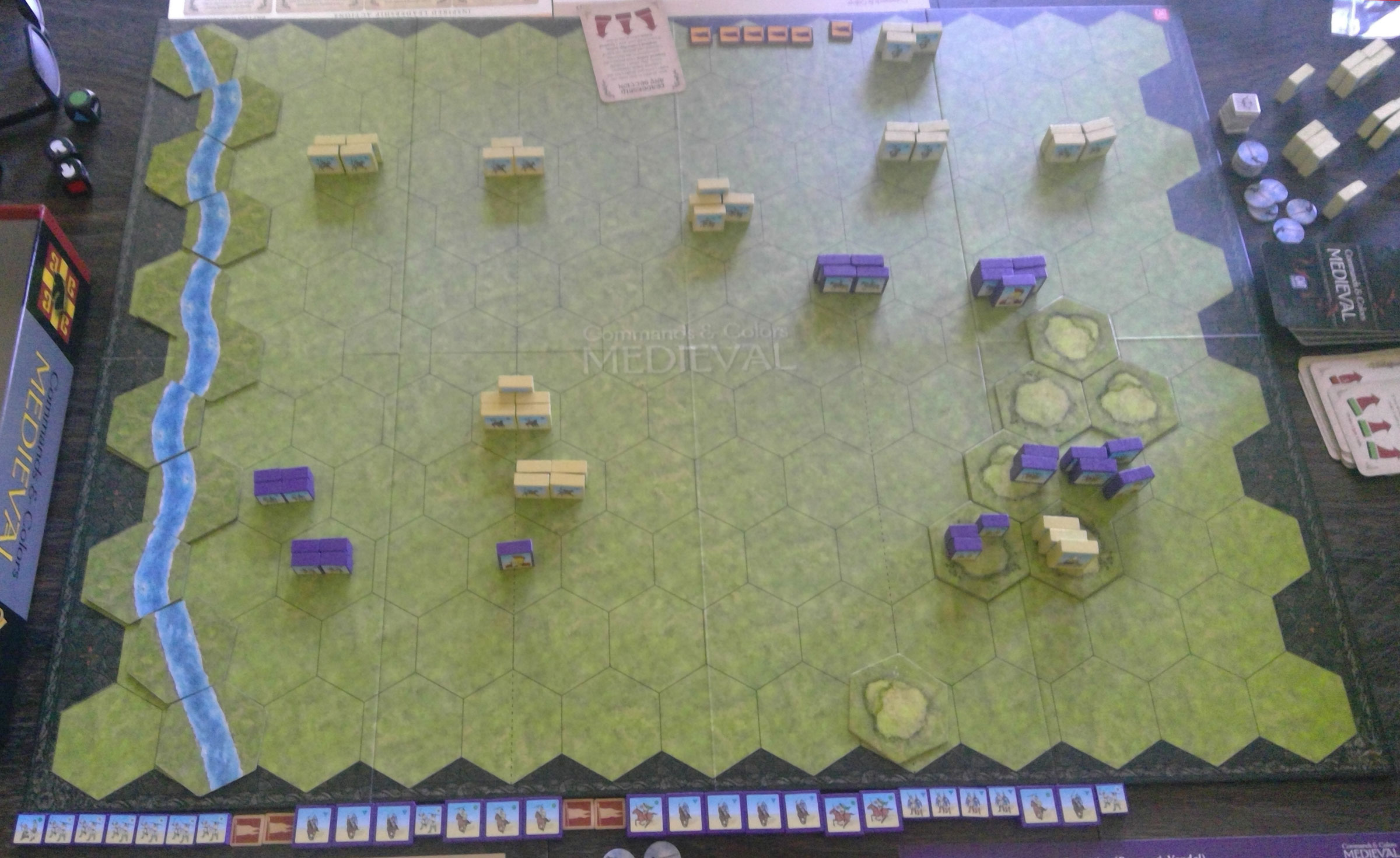
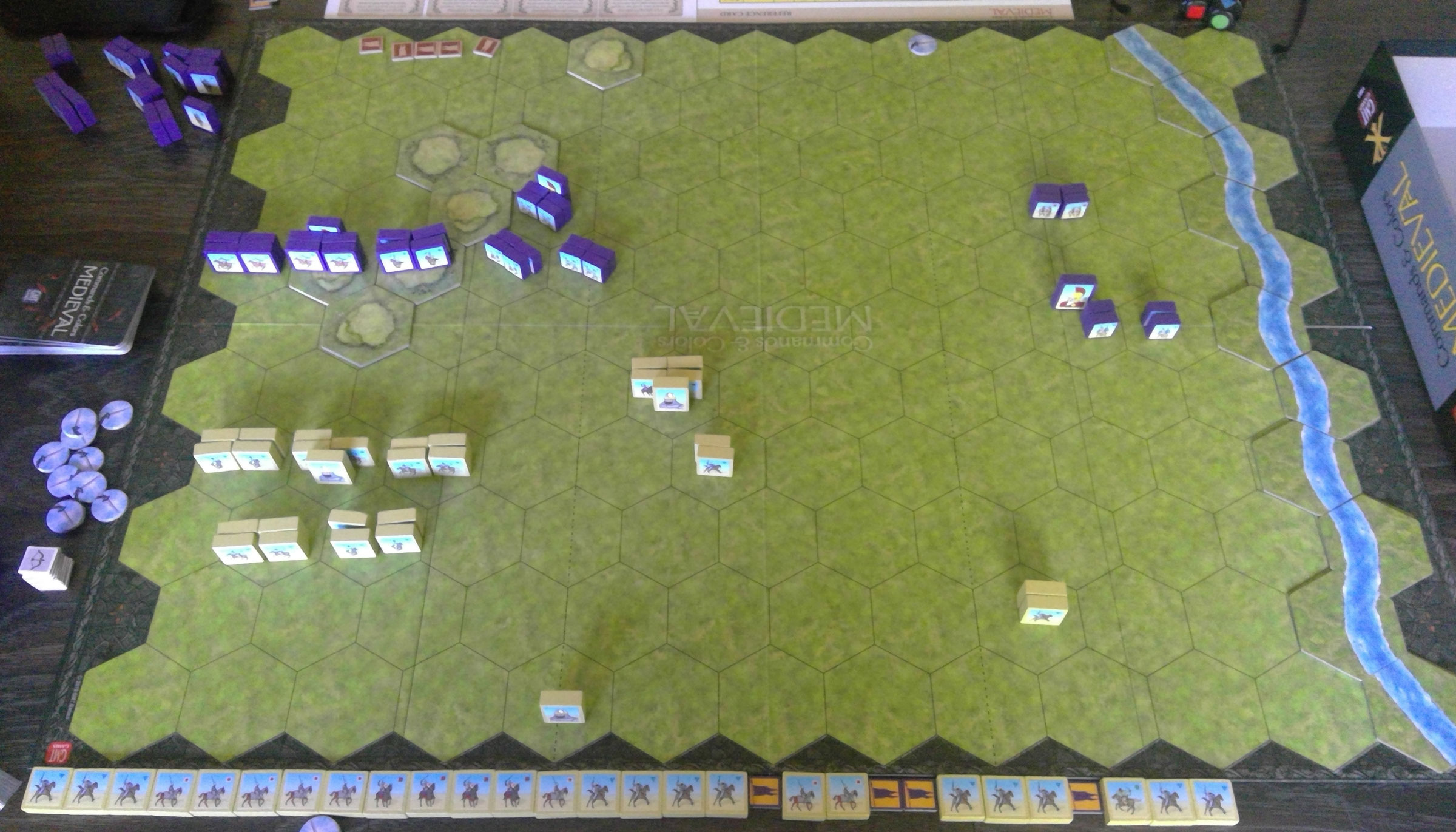
After that, we tried out Commands & Colors: Medieval. Patch is my regular opponent for CC:A on Vassal, so it was odd (especially for him, as I’ve tried this with Mark) to be playing a physical C&C game with him again. Flipping through the rulebook, we ended up on the Battle of Callinicum (phase 1), where the Byzantines have a line of infantry on their left, mixed light units on a on the right, and cavalry in the middle, and the Sassanids are all cavalry. It’s six banners with both sides having 5 Command, but the Sassanids have more Inspired Action, and anyone on the hill while the other side isn’t on it, is counted as having one extra banner.

Patch took the Sassanids for the first go, and hit my right with his cataphracts. I then charged in with mine from the center, and did very well, knocking out the cataphracts and threatening his left. However, he smashed my medium cavalry, and also got up on the hill, scattering my light units. I chased his main unit down, but just couldn’t eliminate it before finishing off the remnants of my center for the win. 4-6

We finished the day by switching for round two. I tried getting my cataphracts in range for a Mounted Charge, but Patch beat me to the punch, and slaughtered them. I lost my mediums as well, but did have success in counterattacks, and both of our centers just disappeared. I technically was getting an edge with our remaining units, but Patch managed to pick off another medium, and was still on the hill (my left had had no opportunity to do anything). 4-6

It’s a good scenario, and Patch was definitely liking the more powerful cavalry. Jason’s the other regular CC:A player in the group, so I’m going to have to make sure to try CC:M with him as well. I find it definitely feels different, but I don’t find it dramatically so.

└ Tags: C&C Medieval, gaming, Sekigahara
 Comment 

The Templars

by Rindis on August 24, 2019 at 12:00 pm
Posted In: Books

All right, I was disappointed by this.

It is a good book, and well written. If you don’t really know much about the Crusades, and specifically the part the Knights of the Temple played in it, it is an informative book.

On the other hand, if you do already know the history of the Crusades, there’s nothing new here. I’m no specialist scholar; my knowledge primarily comes from two general overviews of the Crusades as a whole (Ashbridge’s and Runciman’s), and there was nothing new in this more specialized work.

Non-Crusade history is pretty much limited to the prosecution and dissolution of the Templars by King Phillip IV of France. This is well-covered, and while I’ve seen it covered about as well elsewhere (I’m not sure where though…), he does a particularly good job here. By Jones’ lights, it’s pretty much all Phillip IV’s show. Pope Clement V comes in for a bit more sympathy than normal, noting a French army just outside Avignon as the trials finally reached their conclusion in front of the Pope.

However, the Templars were more than fighting men in Outremer, and victims in France. They had an entire network of holdings in Europe that generated money for their needs (and loaned large sums to several kings; including largely underwriting the entirety of a Crusade), and helped recruit new people into the organization. This all gets mentioned in any work that deals with the Crusades. And here, it is mentioned, without any additional detail being gone into. This is decidedly a popular history, and this is certainly the less ‘exciting’ part of this history, but actually digging into how they worked outside of the Kingdom of Jerusalem would have been greatly appreciated.

There’s also an afterword talking about the history of the order in fiction. I’m sure this is really the prime motivator for writing this book, but the early parts of it are interesting on their own. They had become a trope at a fairly early date, and their afterlife in fiction is interesting.

└ Tags: books, history, reading, review
 Comment 

Successive Exhaustion

by Rindis on August 21, 2019 at 12:00 pm
Posted In: Boardgaming

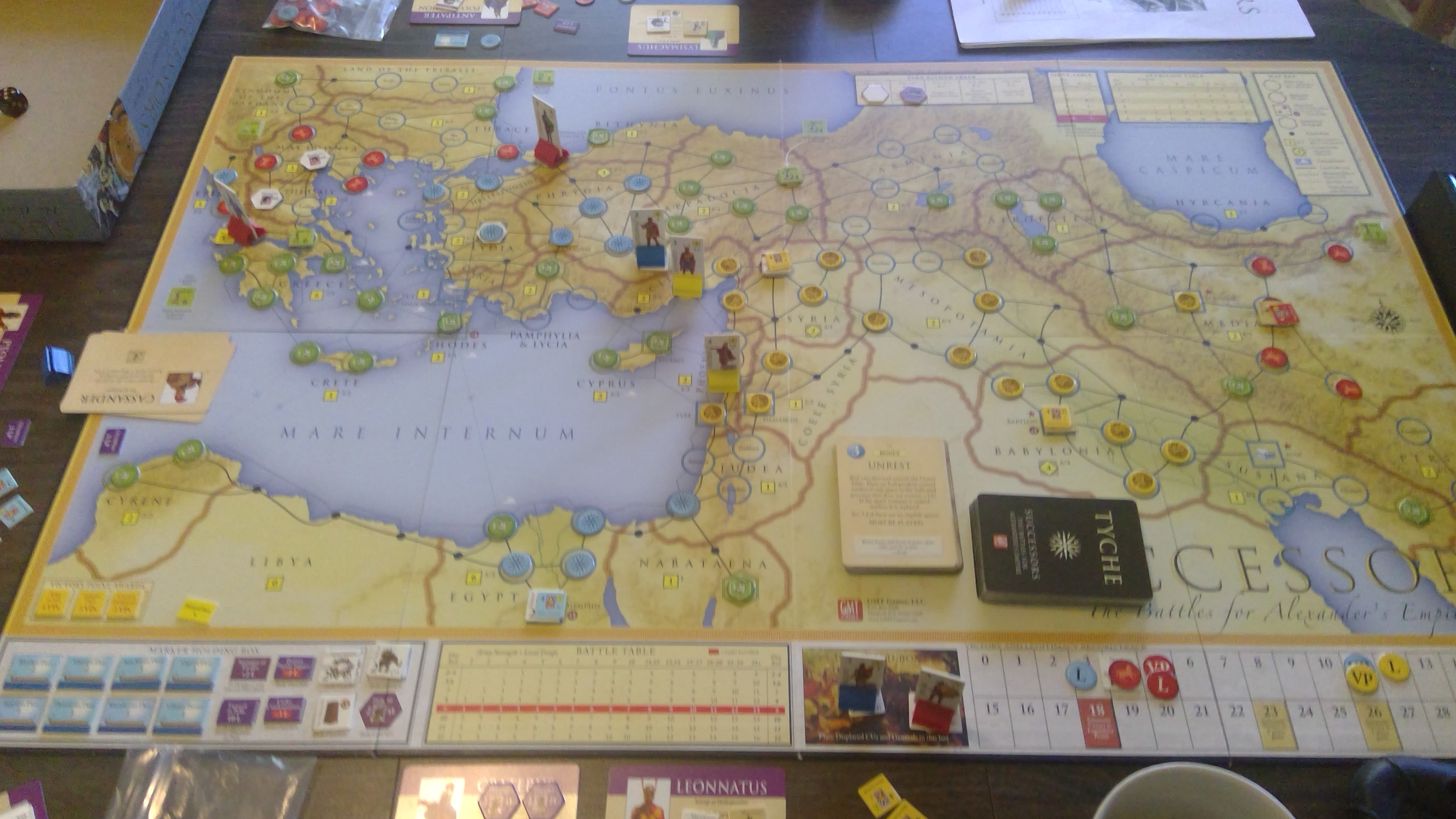
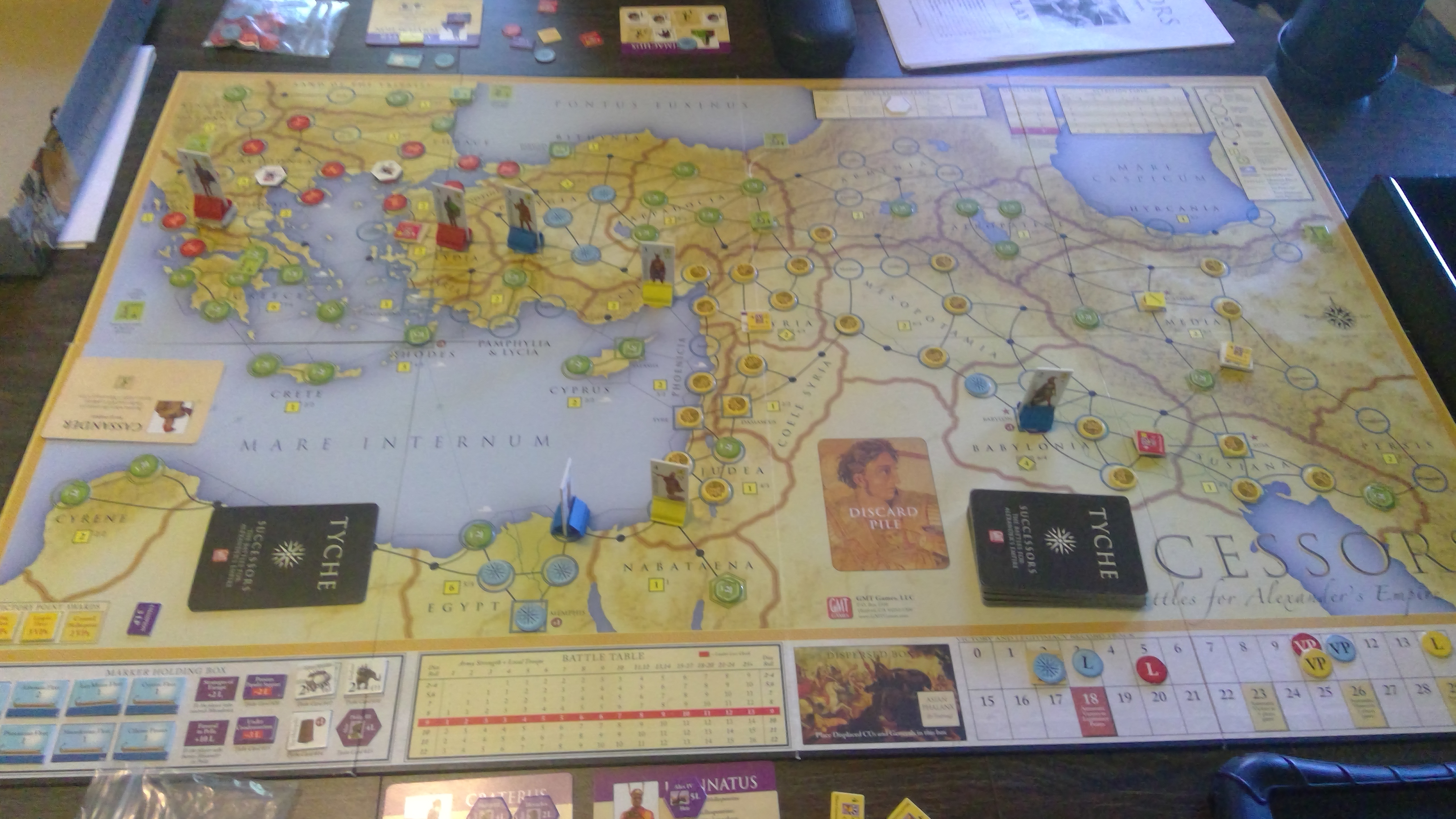
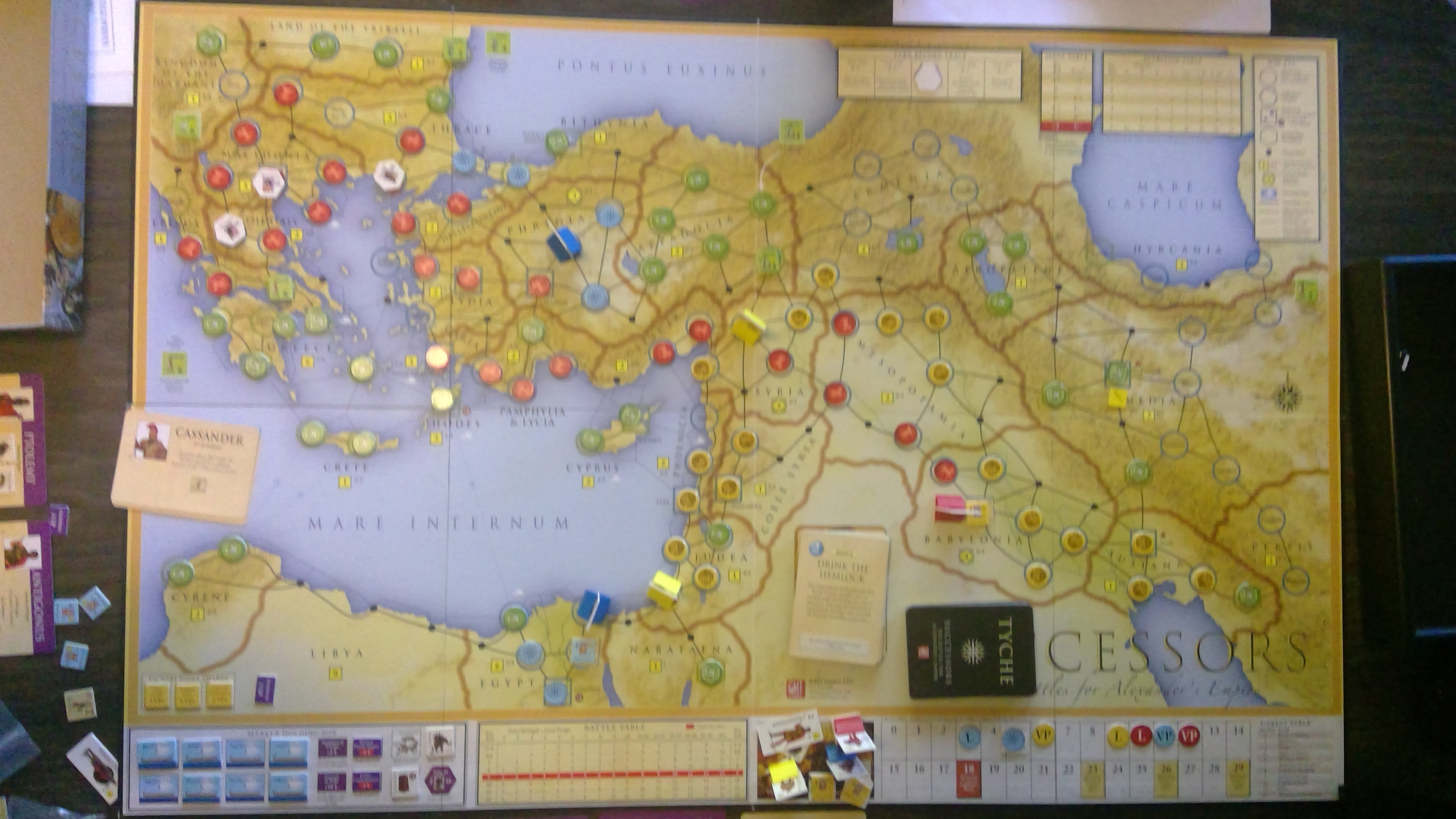
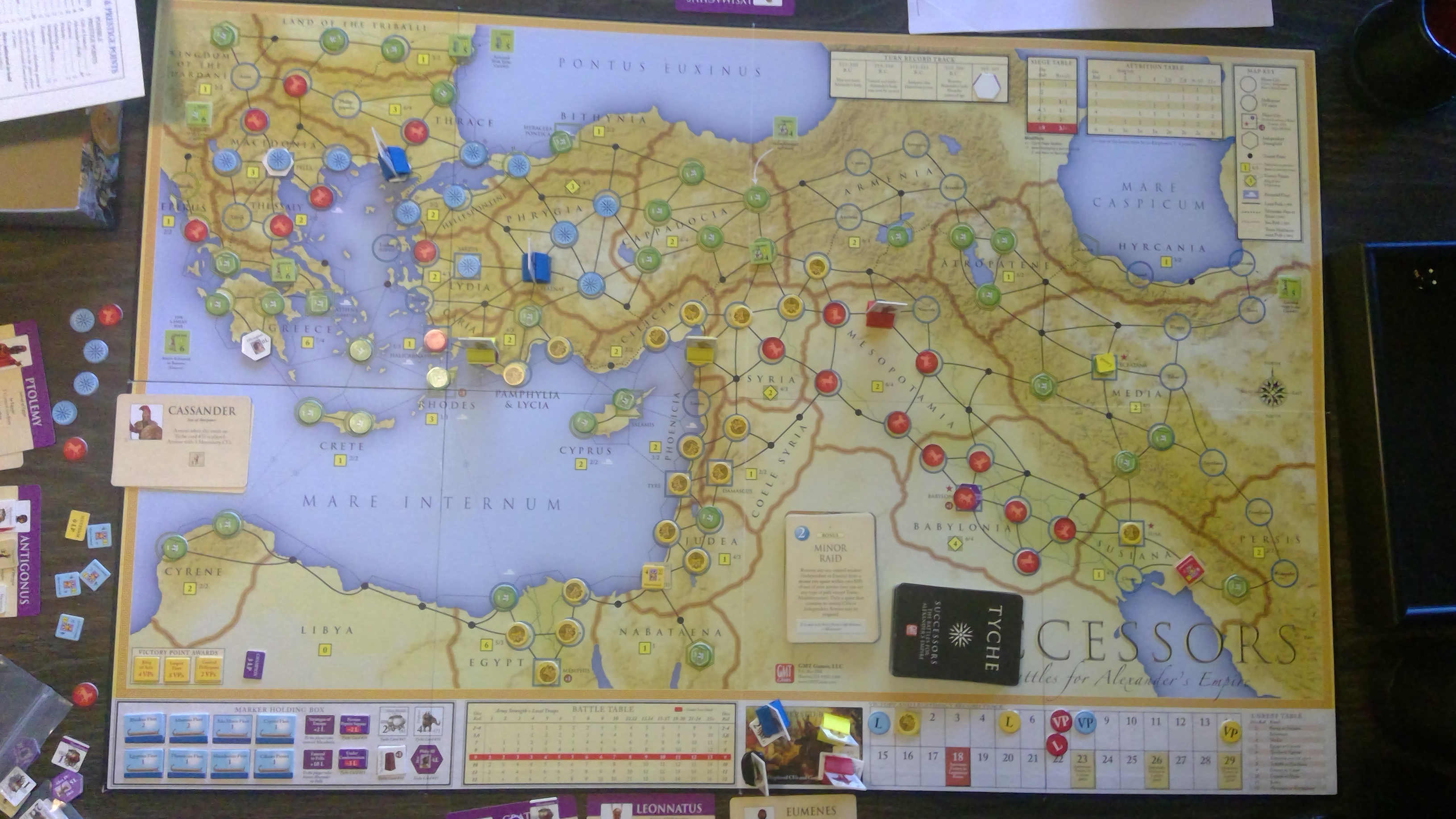
Had the gang over for a game of Successors on July 15th. Or tried to; Mark was in no shape for driving, so it was down to me, Jason, and Dave. This is one of the four-player games I’m always eager to get to, but less so for most everyone else, and with the problems the group has had, it was our first play since 2015, and the play before that was 2011. Despite some problems, things went well, and I hope we can get back to this in a few months.

At any rate, I got Ptolemy and Antigonus; I like having Egypt, but it comes with the price of being the Usurper, which I would rather have done without. Jason had Antipater and Peithon, giving him the unenviable position of being on the two opposite ends of the world. And Dave had Craterus and Perdiccas, giving him a relatively central position, and control of Alexander’s body. (I had thought to use option 2, and deal out three generals per person, but we got this set up, and the extra three shuffled into the deck before I remembered to pull them out again.)

Turn 1 went poorly for me. Dave concentrated on the west, with Craterus and Perdiccas staring at each other (and not wanting to attack into the other’s province bonus) while Perdiccas secured Syria, and trounced Ptolemy as he went to do the same. I re-built a small army in Memphis, but Dave didn’t go that far, though Unrest developed in Egypt to weaken my hold there. Worse, both Dave and Jason drew new generals. Dave needed his, as he nearly lost Craterus in his battle against me (‘9’ followed by a ‘5’ leader casualty check), and then did lose his new general defeating Peithon out in Media. I had spent early efforts on getting Helespontine, and the Greek shore of Thrace, but had to go stare down Perdiccas, and then Jason used Leonnatus to break that up. Finally, I had also played Olympias to get a small army in Epirus, and started trying to build a base in there, but Jason took exception, and knocked the army out just before I could use Greek Mercenaries to strengthen the army.


I’m Star, Dave is Lion, and Jason is Horse.

Turn 2 was more frustration for me. I had two generals, and was effectively bottled up by Dave’s generals. In one case I could move around and do things, but I’d lose Phrygia trying. In the other case, Dave was camped outside of Egypt with an army just about as good as the returned Ptolemy’s. I was slowly building up a secondary army that I could possibly move into the main army, pick it up, and attack, but it was a very slow process, and I never got far enough along.

The biggest problem is that Dave had both heirs, and the body of Alexander (which he promptly buried in Babylon), and a strong position. In fact, he knocked out the minor army Jason had left in Media and took it over. I had some cards that didn’t seem to do me a lot of good, when I finally realized. I used Diplomacy to take over Sippara, and then started building an army there, with skipped movement, and another minor card. Jason followed suit in Nippur, but only built a mercenary or two. Still, Dave’s hold on Babylonia was slipping, and no one was minding the store. I stripped control of Opis, and the turn ended with no one in control of Babylonia, and my army was besieging Babylon.

The start of Turn 3 granted me Demetrius, who showed up to lead the army in Babylon. Dave got to go before I did, and he had poured reinforcements into the army in Media which immediately hurried home, and defeated me before I could take the city. Worse, Jason had poured reinforcements into Macedonia, marched east, and easily defeated Antigonus, and then continued on to Perdiccas, still guarding the route east. Dave had separated out two Royal Macedonians to hurry back to Babylon. Now he didn’t need them there, and the lack helped make sure Jason had the advantage, and Perdiccas went to the dispersed pool as well. Jason was well over the attrition limit, which is part of why he did this lightning campaign: use the army (and eventually split it up) before it could melt away.

Jason captured Philip IV from Dave, and continued on to Babylonia. I got a new general (I forget which one), for a total of four, and he set about repairing things in Phyrigia. Unrest happened in Media, and Ecbatana went independent. Since there were no armies in Media, and none of the passes had been cleared (there were a number of tribal attrition rolls during the game), all of Media and Persis went neutral at the end of the turn, robbing Dave of more VPs, after Jason had already broken his hold in several territories.

Things got a bit worse for Dave, as Heracles came of age, and he was no longer in a position to win, so he gave up his Legitimacy lead killing him. Dave poured all his reinforcements into the Judean army, and quickly defeated Ptolemy and took Egypt. Meanwhile, I had concentrated on causing problems with Jason. I was tired of watching him get a phalangite each turn, so I took control of Macedonia. With all the losses, I barely had enough for two okay armies with four leaders, so I couldn’t get much more done. Jason and Dave sparred some more, but nothing too earth-shattering.

We called it at the start of turn 5. It was getting a bit late, and Jason and Dave especially were feeling a bit beat up from the events of the last couple turns (frankly, I’d been in despair for most of the game). Jason had Phillip IV, but the combined VP and legitimacy totals were a tie with Dave’s. Jason no longer had Macedonia, and Dave had the highest number of Macedonian CUs. So, Phillip was killed, and the world was set for another round of the soap opera.

I figure most of the action would have been in the first two rounds as armies annihilated each other again. Dave was back on top of VPs, and he had the good units. A number of these were Royal Army units, which he’d had to keep away from Jason; now that Phillip was dead, prestige bonuses made them usable again. So, we voted Dave “Most Likely to Succeed”. Jason definitely had a good shot, depending on how the fighting went. I technically had an outside chance. If Jason and Dave focused enough on each other, I might conceivably put together enough province control to get to the top of the VPs, but it was very unlikely.

└ Tags: gaming, Successors
 Comment 

That Old-Time Religion

by Rindis on August 18, 2019 at 12:00 pm
Posted In: Computer games

This is the second in a series of reviews looking at the evolution of Crusader Kings II. See the original review here:
Crusader Kings II: The Second Crusade

With the release of The Republic, Paradox’s CK team mentioned that they had finally exhausted all the ideas they’d had for the game during development. So it isn’t so surprising that the fifth expansion for Crusader Kings II started a new round of expansions by expanding the scope of the game.

The Old Gods was released on May 28th, 2013, along with patch 1.10. My main review of CK II covered the state of the game as of the last free patch before the expansion after this (1.111; more properly ‘1.11.1’), so this review will concentrate on the features of the expansion itself.

A New Start

The major feature of the expansion was a new starting date of AD 867, 199 years before the previous starting date of the game. Pretty much everything else about the expansion is related to this feature. Sadly, it does not conform to the usual ‘timeline’ practice of Paradox’s games, so there is no way to start in between 867 and 1066.

This is a very different environment than the comparatively settled 11th Century, with Charlemagne’s empire broken up into five parts, and not yet in anything resembling their modern forms, while England is fractured between different minor or ‘petty’ kings, and in the middle of dealing with Viking invasions.

Raiding

The map was re-worked so some major rivers became akin to sea areas: They were now navigable for ships, so sea-borne forces can work inland before coming ashore again, potentially going around or through all sorts of defenses.

Pagan rulers can raise an army, set it to ‘raiding’ mode, and attack neighboring and overseas provinces for loot… without being at war (though much the same mechanics apply to any army that is at war). Anyone raided becomes hostile and can attack the raiders and the origin country for a short while, and can start an actual war. But especially with raiders made mobile with ships, it can be very difficult for a ruler to protect his own lands.

The point of this activity is that each province has a pool of money that in turn produces taxes. Fortification values of the holdings protect some of this value (until the holding is taken in a siege; for looters this won’t ‘take’ the holding, but they will get a massive cash bonus), and the rest is vulnerable to looting. When the pool is drained, taxes are reduced or eliminated until it can replenish. But the money doesn’t disappear; when raiding a neighboring province, the looted money goes straight to the raider’s treasury, along with a prestige boost. Overseas raids send money to the fleet, and the money is transferred to the owner’s treasury when it comes back home.

I generally like the idea (actually, I rather like any time Paradox plays around with war/peace mechanics), and it’s amazingly thematic, but there is a problem. A raiding army generates a bit of loot every four days out of a limited pool. Keeping an eye on when a province is exhausted, and it is time to move on becomes micro-management. If you’re raiding by sea, then you need to move back to the fleet, which halts movement, and then give the order to land in the next province. If you have a small realm with not much to do, this might not be too bad, but if you have a large realm, it’s a problem, as there’s no automation for, ‘loot this, move on’, or ‘warn me if a hostile army shows up.’

Religion

Along with the earlier start, the expansion makes Zoroastrians and the pagan religions playable (this includes the Aztecs if playing with Sunset Invasion). By the time of the normal start, all of these are fairly limited in utility, with small areas and few rulers still following those faiths (though a large chunk of Eastern Europe is still Tengri), but it would not end the game if you converted to one of them (to make your new Aztec overlords happy, for instance), but the 867 start has wide possibilities for the standard set of them.

And finally, the patch featured an enhancement for all religions. Each one has five holy sites, and control of them is the main basis for current authority for that religion (see the original review). This helped out that system immensely, and helps with the demise of the pagan religions mid-game as their holy sites get taken over by encroaching Christians and Muslims.

Pagans

All of the pagans together are considered one religion group, but there are two different styles of mechanics for them, offensive and defensive. All of them have access to various casus belli that make expansion easy, but are locked to gavelkind inheritance, which splits the realm amongst all the heirs, leading to a great deal of instability. Also, there is a steep penalty to non-pagan supply in pagan territories, so that large armies cannot easily go in and suppress the pagans.

That penalty goes away at organization technology 4 (all of a sudden, instead of graduated), while gavelkind keeps large pagan empires from lasting long, and they have a hard time converting provinces to their religion, while pagan leaders tend to be vulnerable to converting to Christianity or Islam from outside influence. This means the various brands of pagans are very powerful early on, especially as they’re hard to invade, but will fade as the game goes on.

Offensive pagans (Germanic, Tengri, and Aztec) have a bonus to their muster sizes, and pay no money or opinion penalty for mustering troops, so they can easily field large armies, especially considering their lower technology levels which inhibit holding development.

Defensive pagans (Romuva, Slavic, Suomenusko, and West African) have a bonus to garrison sizes, and have a +80% to defense when fighting on territory (any territory, including someone else’s) of their religion. This combines to make offensive operations against tribes of these faiths exceptionally punishing.

Additionally, Germanic leaders may take an ambition to gain a particular king-level title (say, of Scotland or of England). This allows them to declare a prepared invasion, where a large number of warriors will gather in special event-created armies in the expectation of loot and plunder. The actual war must happen within two years, or the character will lose a lot of prestige, but it grants him an even bigger and more powerful army to conquer large realms with.

Finally, there is the option to reform a pagan religion. The idea is to organize the religion with formal scripture and hierarchy, so that it can try to compete with the world religions of Christianity and Islam. I’m not exactly sold on this idea, as ‘competing’ with a religion like this isn’t part of the mind set of the era. But, it is at least as likely as any other method for those religions to survive. At any rate, it requires control of that religion’s holy sites to accomplish, which certainly makes it a challenge for any of them, as some of these tend to be in the area of powerful Christian or Muslim states.

Reforming the religion disables the standard advantages it provides, but reduces the main problems as well (conversion rate, and increased ‘short reign’ penalties). When it happens, everyone else of that religion gets a decision of whether to reform along with the person who did it, or keep to the old ways, which then becomes a heresy of the new reformed faith.

Zoroastrians

The other enabled religion is a much smaller deal. Zoroastrianism is an older religion, and is considered an organized one in game, though there is no high priesthood (it having been eliminated by the Muslims…).

There’s only one duke-level Zoroastrian ruler as of 867, out by the Caspian Sea, and the holy sites are scattered across the ex-Persian Empire, making play of the Zoroastrians very challenging, as there’s no friends, and religious authority is low, making conversion difficult, and the three heresies likely to pop up often. As of 1066 there are no playable Zoroastrians, though there are still courtiers and provinces of that religion. Even better, doing well as a Zoroastrian puts you right in the path of the Seljuks.

Paradox still gave the religion the full suite of mechanics: A Zoroastrian ruler of the Persian Empire (one of the ‘de jure’ empires not normally in existence) can restore the high priesthood, giving the religion a head that can operate like the head of the Orthodox church, and be declared Saoshyant, a messiah-figure.

Conclusion

At first glance, a single bookmark doesn’t seem like much of an expansion, but Paradox really went all-out to expand CK II to the new era. My initial worry was that the game just couldn’t handle the feel of the period. But in the main it works very well. There are events to help a few ‘transitions’ between the periods such as the split up of Norse culture into various sub-cultures, and the Magyar transition from a tribe to the settled nation of Hungary, though I’m not yet convinced that it really does post-Charlemangian western Europe very well (I haven’t played enough to really tell).

If you don’t feel like playing as pagan, it’s not as valuable, but still a good expansion if you want to deal with the challenges of a Christian Europe that is much less secure than in 1066. The cross-over with Sunset Invasion is a nice touch, though not a reason in itself to get it.

└ Tags: Crusader Kings, gaming, Paradox
1 Comment
  • Page 128 of 315
  • « First
  • «
  • 126
  • 127
  • 128
  • 129
  • 130
  • »
  • Last »

©2005-2026 Rindis.com | Powered by WordPress with ComicPress | Hosted on Rindis Hobby Den | Subscribe: RSS | Back to Top ↑