Rindis.com

All my hobbies, all the time
  • Home
  • My Blog
  • Games
  • History

Categories

  • Books (490)
  • Comics (10)
  • Gaming (911)
    • Boardgaming (669)
      • ASL (154)
      • CC:Ancients (83)
      • F&E (78)
        • BvR – The Wind (26)
        • Four Vassal War (9)
        • Konya wa Hurricane (17)
        • Second Wind (5)
      • SFB (78)
    • Computer games (161)
      • MMO (76)
    • Design and Effect (6)
    • RPGs (66)
      • D&D (25)
        • O2 Blade of Vengeance (3)
      • GURPS (32)
  • History (10)
  • Life (82)
    • Conventions (9)
  • News (29)
  • Technology (6)
  • Video (48)
    • Anime (46)
  • Writing (1)

Patreon

Support Rindis.com on Patreon!
Become a patron at Patreon!

Other blogs:

RSS Inside GMT

  • Meet The Han: A Civilization of GMT’s Ancient Civilizations of East Asia  March 20, 2026

RSS Playing at the World

  • Playing at the World 2E V2 Arrives May 5, 2025

RSS Dyson’s Dodecahedron

  • Return to An-Nayyir’s Pyramid – Part 3 of 3 March 20, 2026

RSS Quest for Fun!

  • The Myth of Rational Animals November 23, 2025

RSS Bruce Heard and New Stories

  • Preview: The Iron Queen February 9, 2026

RSS Chicago Wargamer

  • The 2 Half-Squads - Episode 310: Cruising Through Crucible of Steel January 27, 2023

RSS CRRPG Addict

  • Star Trail: Sweet Is the Swamp with Its Secrets March 20, 2026
SF&F blogs:

RSS Fantasy Cafe

  • Michael Swanwick Guest Post and Book Giveaway February 23, 2026

RSS Lynn’s Book Blog

  • Friday Face Off: The Geomagician by Jennifer Mandula March 20, 2026
ASL blogs:

RSS Sitrep

  • Cardinal ASL Sins March 18, 2026

RSS Hong Kong Wargamer

  • FT114 Yellow Extract After Action Report (AAR) Advanced Squad Leader scenario April 16, 2025

RSS Hex and Violence

  • This still exists? March 25, 2025

RSS Grumble Jones

  • 2026 Kansas City ASL Club's March Madness Tournament March 16, 2026

RSS Desperation Morale

  • How to Learn ASL March 16, 2025

RSS Banzai!!

  • October North Texas Gameday October 21, 2019

RSS A Room Without a LOS

  • [Crossing the Moro CG] T=0902 -- Rough start July 18, 2015
GURPS blogs:

RSS Dungeon Fantastic

  • What color is paut? Sigh. March 3, 2026

RSS Gaming Ballistic

  • Pigskin project (by Chris Eisert) February 28, 2026

RSS Ravens N’ Pennies

RSS Let’s GURPS

  • Review: GURPS Realm Management March 29, 2021

RSS No School Grognard

  • It came from the GURPS forums: Low-Tech armor and fire damage January 29, 2018

RSS The Collaborative Gamer

  • Thoughts on a Town Adventures System January 18, 2022

RSS Don’t Forget Your Boots

  • GURPS Supers Newport Academy #3: “Season Of The Witch” February 8, 2026

RSS Orbs and Balrogs

  • Bretwalda - Daggers of Oxenaforda pt.4 - Fallen King May 27, 2017

For the Horde

by Rindis on November 10, 2020 at 12:00 pm
Posted In: Computer games

This is the seventh in a series of reviews looking at the evolution of Crusader Kings II. See the previous reviews here:
Crusader Kings II:
The Second Crusade
The Old Gods: That Old-Time Religion
Sons of Abraham: A Little of Everything
Rajas of India: My Elephant for a Kingdom
Charlemagne: Back in Time
Way of Life: The Short Way

After the focused expansion of Way of Life, the Crusader Kings II team went back to expanding the scope of the game. In this case, exploring the eastern edges of the map (which was re-worked a bit), and the lives of the nomads of the steppes. Horse Lords was released on July 14, 2015, alongside patch 2.4.

The map was also expanded slightly again for this. The geographical scope didn’t change, but some previous wasteland north of the Tibetan Plateau was made into new counties, and new cultures were introduced for them.

Cleanup

Even before announcing the actual expansion, it was announced that CK II was in for another round of clean up and bug fixing. One of the programmers had found in his own game with a successful (and very large) Byzantine Empire, that the vast majority of AI time was spent with all the characters checking ‘can I blind/castrate him’ on all the other characters. So, obviously there were optimizations that could be done.

Along with this, the interface was cleaned up, and got some nice upgrades. Upon starting a game, there is now a large page that comes up giving all the main ideas you are operating under. That is, the type of culture you are, the main government form, and your religion. Moreover, this page can be accessed at any time through a button next to your portrait, so you can see all the characteristics and bonuses.

The idea of honorary titles was also regularized a bit, and a very important one added: commander. Instead of appointing commanders of your troops directly from your vassals and Marshal, commander is now a minor title with some income and prestige, and your army leaders now come out of this pool. The old system occasionally let the same character be in multiple places at once, which naturally caused problems. The new system is handy, since the position also improves opinion, and allows you to vet potential army leaders before you’re desperately hunting through all your vassals as you raise armies for a war.

Nomad Hordes

The main focus of the expansion itself are the nomad tribes of the eastern regions of the map. Without the expansion, the area continues working under tribal government rules (see the Charlemagne review), but having the expansion changes the government and holding types for the region, and allows you to play as a nomad horde, no matter what their religion (though that might become a problem, and cause a Game Over, if you ‘settle down’ as a tribe or feudal/iqta government).

Generally speaking, nomads are looking for empty holding slots, which are used as pasturage, and contribute to their maximum population and manpower. Unlike tribes, this is not one holding per county, and getting bonuses for empty slots, this is one holding in the realm, and getting bonuses for all the counties’ slots. Additionally, their capital is a new type of holding:

Nomad capitals have khans or khagans in a clan. These do not directly generate levies or taxes, and always have a minimal fortification value. However, they have an extensive list of fairly cheap upgrades to the capital, that provide bonuses to population, taxes, morale, combat bonuses, and even movement speed. Moving a capital is fairly easy, and all buildings will go to the new location.

Like tribal governments, they are stuck with one inheritance rule, which is for the male relative with the highest prestige to take over the primary title. Vassals also get a choice as to whether to stay with the new ruler, or declare independence, creating the usual breakup and scramble whenever the current ruler dies. A new feature is to send sons away to become mercenaries, where they will hopefully become rich and famous.

Nomads can hold other holding types (and even build temples) as vassals, but of course don’t see them as directly useful (though holding, say, a castle, can allow a horde to settle down as a new feudal kingdom… who will lose most of his old bonuses, and all the unsettled land, and will need to get more regular holdings in a hurry). So, regular holdings can be pillaged, which causes all sorts of problems (revolts, lower taxes…), but also destroys two building improvements in the holding, and if the last building is destroyed, so is the holding, returning it to an empty state to become pasturage.

Clans

Each independent nomad ruler has an emperor-level title, while his direct vassals (well, the nomad ones), have king-level titles. Each of these denote rule over a clan, as opposed to any territory. So, every nomad realm will have one or more clans in it.

Clans are fairly independent, and for instance, will never provide troops to their liege. On the other hand, there’s no musters in the first place. As intimated above, clans have population and manpower in addition to other attributes, and population is is the prime determiner of income. Meanwhile, manpower is used to raise 250-man contingents for the horde (this acts like retinues from Legacy of Rome, and replaces them for nomads; they’re generally a lot easier and less expensive to raise, but they’re also nearly the entire sum of the available military).

Inside of a horde, the clans have relations with each other, which are spelled out on a new status screen. The primary things you get to see are all the current clans, and their leader, and whether any have a current blood oath or blood feud going on. The former is basically an alliance between the two current heads of clans, while the feud can keep going for generations. It also shows each clan’s sentiment with the others. That is effectively a relations score like the normal ones between characters, but it is turned into a modifier to actual relations between members of the different clans.

In addition, clans can be absorbed into another (if it is small, and probably, unpopular), a large clan can be spit up (which it’s likely to resist), and new clans can be created (really, just a minor clan being ‘promoted’ to being big enough to show in game). All of this helps add a fair amount of… Brownian motion to the structure of a horde, and seems like a pretty good job of getting the fluid nature of nomads into a static game format.

Tributary

Nomadic nations generally have lots of ability to go to war with their neighbors, but can’t have a lot of vassals, and pillaging a rich area down to pastures may be time consuming, and lead to lots of rebellions to put down (but can make you quite rich!), and absorbing lots of new land may unbalance the clans, and lead to internal chaos.

So there’s a new type of ‘vassalage’ available with the expansion: tributary. This leaves the country technically independent, but subordinate to its master, paying taxes to it, and liable to be called up in wars.

Tributaries are fragile relationships, and can dissolve upon the death of the current suzerain. The tributaries aren’t part of the court, so they can’t be part of a faction there (like ‘independence’), though they can declare war on their suzerain to gain it on their own.

Silk Forts

Another slight change to the interface was the ‘tab’ for trade posts was redesigned and regularized a bit. There’s now two special holdings that can be constructed for cheap in most provinces.

The Silk Road was added to the map (for everyone), as a series of routes stretching from the east edge of the map to traditional end points in the Sea of Azov, Constantinople, and the Middle East. Any province it goes through gets bonus income… until war (sieges, raids…) blocks that branch. That stops income on that route, but others will get more money in compensation.

Trade posts can be built by anyone who controls part of the Silk Road, to get even more income out of it. This is subject to limitations by technology, and Merchant Republics can still build them in any coastal province.

Along with those, forts can be built as temporary fortifications in any county you occupy (except that nomads can’t build them). This is a new slot in the same ‘tab’ introduced for trade posts, and are cheap to build, and have no upgrades.

They can (slightly) delay enemies who will have to besiege it before they can get to the regular holdings when invading a country, but the main uses are offensive. The main trouble with attacking nomads is that their counties have no holdings, so as soon as your army moves on, you give up control of the county, and lose the war score taking it gets you. Typically, the only ways to get war score is by winning battles (which can be difficult), and taking their capital (which still doesn’t give much).

But you can occupy a province, build a fort, and then move on. The fort keeps control, and you extend your supply line, avoiding the attrition that being far beyond your borders can bring. Similarly, building a fort on Pagan territory negates the supply and attrition penalties attacking them gives.

Conclusion

I have some problems with this one, caused by the problems of ‘layering on’ new mechanics after the fact. Introducing nomads is a good idea, and they’re handled very well here. But they only exist if you have the expansion, whereas tribes always exist. Similarly, if HL is the only expansion you have, you’re a bit trapped, as settling down can put you out of the game.

What is outside of the expansion is also quite good, with plenty of little touches that round off more sharp corners. Not mentioned yet is the fact that government type is no longer strictly holding dependent. This was mostly to keep from suddenly changing governments accidentally (and maybe ending the game) by changing your capital. But it opens the door to introducing some extra nuanced types, which would happen.

If one wants to play as Genghis, or some other horde leader, this is obviously the expansion to get, and I don’t think anyone desiring that will be disappointed. But the ability to… paint yourself in corner means that it is unwise as a first expansion. Getting one or more of the ‘religious unlock’ expansions (SoI, TOG, SoA, RoI) would be recommended.

└ Tags: Crusader Kings, Paradox, review
2 Comments

Gold Brick II

by Rindis on November 6, 2020 at 12:00 pm
Posted In: Comics

This is a straight reprint of the second half of the Gold Digger B/W series, so its another ~600-page volume reprinting issues 26-50. Unfortunately, it does suffer from there being two cross-overs and one spin-off during this period that aren’t in here. Those should be fixed with volumes 2 and 3 of the color remaster, which is the primary thing making me think about getting them (along with the slowly ageing newsprint).

Again, there’s a lot of single-issue stories in here, but there’s some bigger ones too. Most notably, the Dynasty storyline takes a fair chunk of the volume, as things kick off in issue 30, and it runs through 38. However, the first half or so of that is the main characters getting distracted by other problems that crop up at the same time as El Dorado suddenly disappearing. And, it turns out that events in Asrial vs Cheetah (a two-issue Ninja High School crossover) kicked off this storyline before issue 30 (it’s not actually directly plot related, but it will be in the remaster).

While Stripe goes to save his people’s homeworld, Gina and the rest end up having to save themselves from the return of Dr Peachbody from the first volume. Time Warp is the place where the Brick really falls down, as it was an interleaved story of four issues of GD and four of NHS, so there’s gaps here (this is the second-biggest reason I’m looking at the remaster), so there’s holes in the story here. Thankfully, the original issues actually have decent recaps of the previous NHS issue’s action, so it can still be followed, except that part 8 was in NHS…. After that wraps up it still takes a couple issues to focus on the Dynasty, and then that fight actually wraps up in a couple issues.

The other big story is Beta, which starts in Gold Digger Beta #1, which was going to be a color spin-off series running concurrently with the main one. However, after one issue the new story was folded into the main series while plans were made to transition to color full-time (and getting Beta #1 in there is the biggest reason I’m looking at the remaster). At the same time, Brianna and a couple others set out to Jade, and that actually turns into a bigger story that’s just as important.

In fact, a lot of this volume relies on Perry handling multiple on-going stories, and he generally succeeds. I feel that the Dynasty got too stretched out by all the things allowed to interrupt it as it gets going, but it does work as a story. During the later part, Perry experiments a bit more with layouts (which have always had a very dynamic manga-influced style), with a page with a single small panel in the center, and one two-page spread that goes sideways (he needed all the height he could get for it, and it works very well).

Things largely devolve back to single-issue adventures at the end of the volume/series, but Perry continues juggling old villains (Dark Bird), and introducing new ones, such as the wererats and Gothwrain, who becomes one of the main problems in the future.

└ Tags: comics, Gold Digger, graphic novel, reading, review
 Comment 

Two Rounds of Beneventum

by Rindis on November 2, 2020 at 12:00 pm
Posted In: CC:Ancients

Last Wednesday, Patch and I had our latest between-games session of Commands & Colors: Ancients (I still need to write up our latest ASL adventure). This a third Pyrrhus vs Rome scenario, this time a few years later, and one that Pyrrhus actually lost. The setup for the Battle of Beneventum is unusual, with the Romans on their base line behind ramparts and in a couple of camps. They also have two Heavy War Machines, which is a first for both of us. Their fire is largely blocked by the rest of the army, which is mostly Mediums with some Heavies in the rear and lights in front. Pyrrhus, main force is also on/near his baseline, but there’s some MC forward on one wing, and a couple units of Warriors out in front.

I had Pyrrhus of Epirus for the first game, and the first couple turns were spent trying to get things in motion. Patch eventually Ordered Three Center to use the HWM and a light for ranged combat, but got no results. I Ordered Mounted to bring my MC into contact, and start moving up the one unit of elephants, while keeping them screened from the HWM. Good die rolls killed Patch’s MC outright, and did then killed a Light for no losses. Patch Ordered Three Right, but got no hits as I evaded away. I then Mounted Charge, and killed a Medium with the Elephants, who then did one block to a Medium in a camp, taking a hit and a banner in return, with the rampage knocking a block off a Roman Aux. I then finished off the Aux, and killed a MC when it was forced to retreat while surrounded at the edge of the board.

Patch Ordered Three Center again, but didn’t do more than a couple of banners. I Ordered Three Left, concentrating on the Roman flank, and knocked out the Medium in camp with a really good roll, while his leader evaded off-board. I then did a hit to a HWM and a Medium, and took nothing in return. Patch did a Coordinated Attack, and the HWM did no more than an ignored banner against the adjacent MC in camp, and took a block in return. 7-0

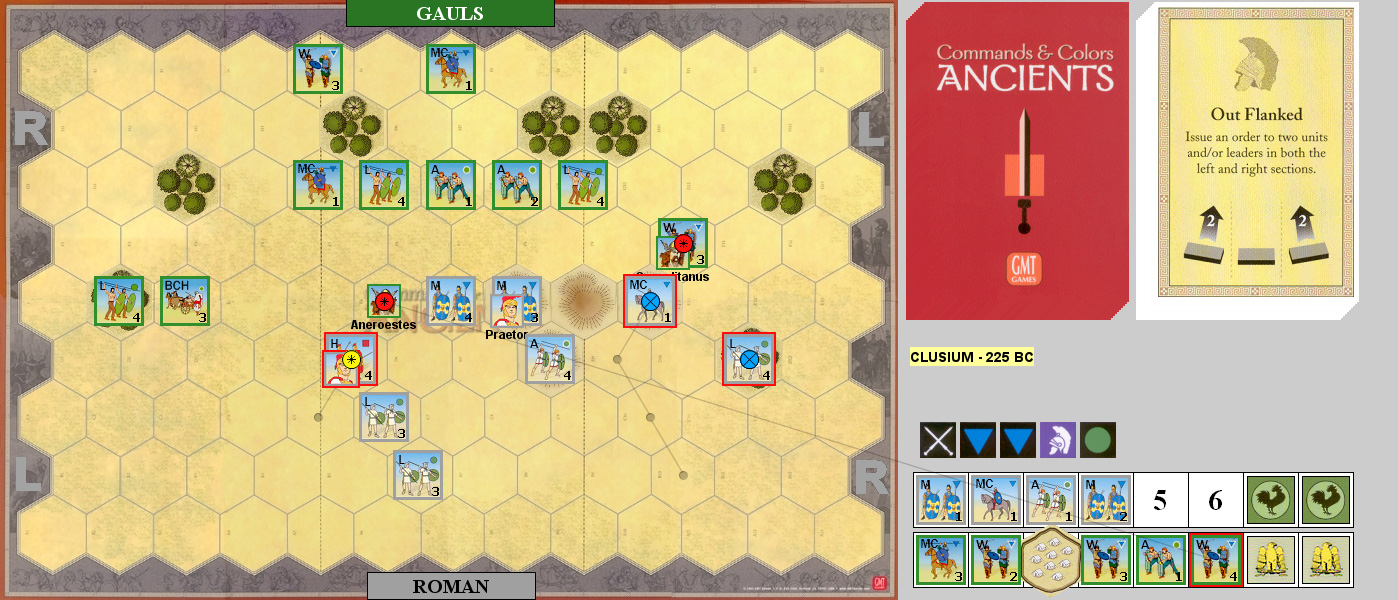
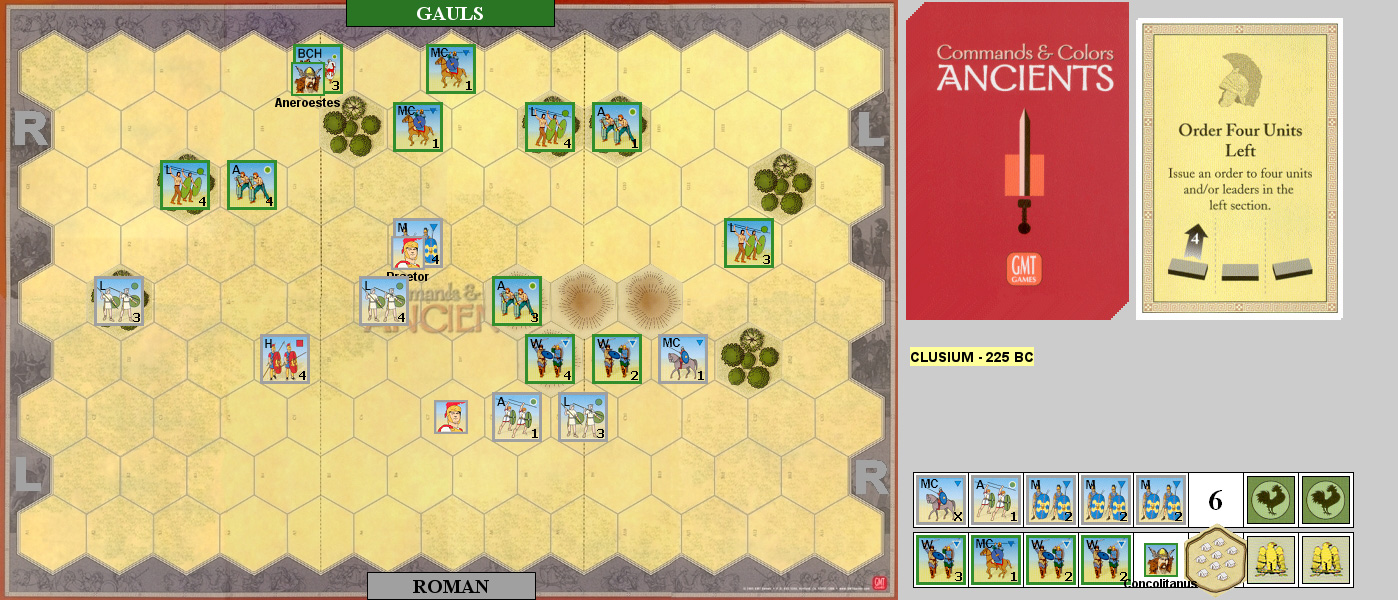
For the second round, Patch started by moving up the heavier units in the center like I did, but I started with Order Two Center for early ranged combat, and did a block to a Light. Line Command got a lot of mass moving, and got a hit on one of my Lights. I deployed a bit with Move-Fire-Move, and forced a Light back with two banners. Line Command got his Warriors into contact, picked off another Light block, and eliminated an Aux (two hits & two banners into my line; momentum to do the final block).

I Double Timed to get units around his forward Warrior, and it retreated for no losses, while the other Warrior took three hits and retreated. Momentum took me to the first Warrior, who took three blocks and retreated. Patch Counter Attacked, getting his Heavies up to my exposed Heavy, and wiped it out in two attacks, taking one block in return, with Dentatus evading back to a Medium. He also got a block on an evading Light. I Ordered Four Right to re-engage, and did two blocks to a Medium on poor rolls (overdue, frankly), and a block to a Light, while taking three blocks in return.

Patch announced that He Was Spartacus, to order three mediums and a Heavy, and finished off a Medium to send Dentatus evading back to a HWM, and forced two losses on a Medium with a hit and two banners. I Ordered Mediums, and sent a depleted Medium reeling with two banners, while doing two blocks to a Heavy in return for losing a MC. Patch Ordered Three Center, wiping out a Medium, and sending another leader evading back to a Light. I said, No I’m Spartacus, to order two Mediums. I dove into the junction of his line to finish off both Warriors, and did a block to an evading Light.

Patch Out Flanked for ineffective ranged attacks on his right, and did two blocks to my MC on the other side. I Ordered Three Right to do a block to a Heavy with a HWM, and Patch used First Strike to do two blocks and a banner to my Medium before it could try to take out a MC. Leadership Any Section got Patch’s center in motion to finish off a Medium and MC. 2-7

Afterword

So both games were pretty convincing losses for the Romans, though my dice were somewhat past ‘hot’ in the first game. It was nice to finally use HWMs, but I think they did all of one block between the two games. And frankly, the Romans have a pretty tough row to hoe here. There’s just enough good units at the front of the Epirote army that they can get in some early good strikes and get some momentum. The Romans should have the advantage of some fortifications, but by the time they’re back to that, too many units will have been wiped out (as they don’t fit).

It didn’t help that Epirus got good cards both time. I’ve noticed that Mounted Charge is generally decisive, and my use of it in the first game got me three banners. Patch got a Line Command that I would have been very happy to have, a good roll on I Am Spartacus, and that Counterattack on my Double Time blew apart my offensive.

└ Tags: C&C Ancients, gaming
 Comment 

Gold Brick I

by Rindis on October 29, 2020 at 12:00 pm
Posted In: Comics

The Gold Bricks started as a project to get the original 50-issue black-and-white Gold Digger series into a convenient, but impressive format, with 25 issues per volume. They’ve continued since then with 25-issue collections of the color series. On one hand, the production’s a little cheap, with ~600 pages on thin newsprint paper that that has yellowed over the years, but the binding is amazingly solid.

The regular series sees a refining of Perry’s art and character design, though it remains very loose in feel. As a regular series, and 25 issues, there’s a number of story arcs in the first volume. One of the more impressive things, reading it all now, is just how little ‘throw away’ pieces there are: a lot of things in here continue being central parts of the series for a long time to come, or secondary characters show up for a story… and then show up again a dozen issues later at a logical point. The fact that Fred Perry is writing all of this doubtless does wonders to keep things consistent, but it can be amazing just how much he juggles. Some characters do fade away though. Tark and Mesha from the original story slowly get sidelined, and then basically take a job that rotates them out of the recurring cast.

Perry loves making references to popular culture as part of his light-hearted tone (the computer-book from Inspector Gadget showed up in the limited series), and he spends a couple moments explaining one, establishing the A-Wing as one of that world’s next generation fighters. Which is a fun way of underscoring that superscience is a part of that world. A lot of the stories in here are short, and as the series went on, story titles got dropped; here’s the bigger stories:

Issues 1-4 — The Curse: The first story of the continuing series, and the second big story for GD (I kind of wonder if Perry had originally planned it out as a second limited series). We start with another ancient-ruin-exploration-gone-wrong (Gina was beaten to the loot by Croesus no less), a demon, and the creation of Brianna. That last is introduced really well, with the issue starting with the aftermath, and going back to figure out what happened.

Issues 4-6 — Tooth and Claw: The end of The Curse melds straight into the next story, which I always felt didn’t have quite enough groundwork laid, but was still quite logical. Britanny’s relationship with Stripe has disturbed the relationships within El Dorado, and now that comes back to bite Britanny. Not only do we get a rematch with Jetta and Thabian, but we finally get to see more of Gina and Britanny’s dad, Dr. Theodore Diggers, and get an idea just what he can do (that he was a powerful mage had been established in the mini-series, now we get to see what that means).

Issue 6-7 — Night Flight: Dark Bird returns for a rematch with Ace. This story really shows off that Fred Perry loves flying and aircraft, and he does a good job narrating a multi-plane dogfight.

Issue 7-8 — Crime Syndicate X: Early on, we get a mention that Cheetah had spent time ‘super heroing’ in high school with a friend, and that gets picked up with Cheetah running into her old pal the Pink Avenger in New York, and things go into a typically wacky take on superhero adventures, though with something of a nasty twist as the main villain is smart enough to find out heroes’ identities and threaten friends and family.

Issues 13-19 — The Lich King: This story technically starts with #15, but the the issue and a third before lead straight into it. Meeting the werewolves brings in more details on the end of the war between them and the werecheetahs, and leads directly to the next big story dealing with Dr Digger’s father,  and a very epic story with the fate of Gina and the realm of the undead at stake. It’s the biggest story so far, and is very well paced, and introduces Jade, the alternate world of magic, and Gina’s mother (who is every bit as competent as the rest of the family).

Aside from those, there’s eleven issues in here that are single-issue stories, mostly with lots of high-action plots, with more character-focused bits being banter and side-pieces to the rest, though issue #24 takes a break from high-speed action but still has lots of character-based conflict. Issues 11 & 12 establish that GD and Ninja High School are in the same universe, with the Rat Exterminators and Dog Supreme showing up from NHS. The number of characters grows explosively in these stories, and most of them are seen again later. There’s also several bits of circling back to the limited series to continue things introduced there.

One nice continuing thing in the series is that there’s multiple references to time passing. A previous issue’s events are often a week earlier, so between that and multiple-issue stories, it probably isn’t keeping up with publishing time, but it’s a lot better than many series of this type. Overall, this volume is a little over two years of growth in the characters, and the extreme sexiness gets toned down just a bit, which helps. (Not that there isn’t still a lot, but it does tone down a bit. Gina especially tones down a bit, though she is getting into a love triangle by the end of the volume.)

└ Tags: comics, Gold Digger, reading, review
 Comment 

Dungeons & Sorcery Spells 11

by Rindis on October 25, 2020 at 12:00 pm
Posted In: GURPS

After a couple years away, my thoughts have been on RPGs again, and that, combined with a slow period of Vassal-gaming leads me to my eleventh spell compendium for GURPS Dungeons & Sorcery. There’s no coheseive theme, but October has suggested a number of spells dealing with the undead, and some illusions.

Animate Dead (SC)
Necromancy, Somatic, Verbal
13 points
Casting Time: 5 seconds
Casting Roll: None
Range: 10 yards
Duration: Permanent

This spell allows the magic-user to create a skeleton or zombie, who will follow the commands of the caster (which must be kept simple: protect me, guard this door, etc.; conditional and multi-step orders will not work). The created undead are permanent, and neither dispel magic nor remove curse will have any effect. However, the creature can be killed/destroyed normally, and does not heal. As many such undead can be animated as the magic-user desires, subject to available corpses, time, and fatigue. In all cases, the caster must have four times the CP of the animated dead, or the spell will fail.

It should be noted that this isn’t quite “bringing someone back from the dead”, and the animated dead will have no memories, abilities, or mental traits of the person whose corpse is used, nor is their soul involved in any way. In many respects, it is a simpler and formulaic version of a “create golem” spell, using the Laws of Similarity and Contagion as shortcuts to describe how the golem can move and act; however, as this spell uses the body’s previous status as a living being for this shortcut, it is necromancy, and usually considered the first step down a dangerous path.

Keep in mind that nearly any complete deceased living creature can be used (and it must be a complete single creature), and will have its racial default ST & HP, but DX 10 and HT 10, with one or two appropriate weapon skills at DX, decided by the nearest functional weapon(s) (which could be a length of wood—or bone—used as club, or nothing at all, if there’s nothing the undead can hold handy, limiting them to default punch). If the body has decomposed (or had the flesh stripped off), it will be animated as a skeleton, while a more recently deceased body will become a zombie.

Ally (25% Power, Constantly Available; Accessibility, Must Have Appropriate Remains Handy, -20%; Extended Duration, Permanent, +300%; Minion, +0%; Requires Gestures, -10%; Requires Magic Words, -10%; Sorcery, -15%; Takes Extra Time, x4, ‑20%) [3.25×4] The Ally will have the racial (not individual) ST, HP, and SM of the original creature (with modification for physical traits such as Gigantism and Dwarfism), Unhealing (Total) [-30], Automaton (B263) [-85] and apply either the Skeletal Undead meta-trait (F133) without the Basic Speed increase [48] or the Rotting Undead meta-trait [59]. [-67 or -56]
↓ Read the rest of this entry…

└ Tags: Dungeon Sorcery, gaming, GURPS, rpg, Sorcery, Thaumatology
 Comment 
  • Page 99 of 310
  • « First
  • «
  • 97
  • 98
  • 99
  • 100
  • 101
  • »
  • Last »

©2005-2026 Rindis.com | Powered by WordPress with ComicPress | Hosted on Rindis Hobby Den | Subscribe: RSS | Back to Top ↑