Rindis.com

All my hobbies, all the time
  • Home
  • My Blog
  • Games
  • History

Categories

  • Books (503)
  • Comics (10)
  • Gaming (917)
    • Boardgaming (673)
      • ASL (154)
      • CC:Ancients (83)
      • F&E (78)
        • BvR – The Wind (26)
        • Four Vassal War (9)
        • Konya wa Hurricane (17)
        • Second Wind (5)
      • SFB (78)
    • Computer games (162)
      • MMO (77)
    • Design and Effect (6)
    • RPGs (66)
      • D&D (25)
        • O2 Blade of Vengeance (3)
      • GURPS (32)
  • History (10)
  • Life (82)
    • Conventions (9)
  • News (29)
  • Technology (6)
  • Video (49)
    • Anime (47)
  • Writing (1)

Patreon

Support Rindis.com on Patreon!
Become a patron at Patreon!

Other blogs:

RSS Inside GMT

  • Meet The Northern Wei: A Civilization of GMT’s Ancient Civilizations of East Asia  June 19, 2026

RSS Playing at the World

  • Playing at the World 2E V2 Arrives May 5, 2025

RSS Dyson’s Dodecahedron

  • Blog Updates June 20, 2026

RSS Quest for Fun!

  • The Expense Post May 24, 2026

RSS Bruce Heard and New Stories

  • Pain, Exhaustion, and Morale in D&D BECMI June 7, 2026

RSS Chicago Wargamer

  • The 2 Half-Squads - Episode 310: Cruising Through Crucible of Steel January 27, 2023

RSS CRRPG Addict

  • The Search for Freedom: Our Repeated Petitions June 20, 2026
SF&F blogs:

RSS Fantasy Cafe

  • The Leaning Pile of Books May 24, 2026

RSS Lynn’s Book Blog

  • Summer of Horror: Can’t Wait Wednesday: Sleepers in the Snow by Joanne Harris June 17, 2026
ASL blogs:

RSS Sitrep

  • Cardinal ASL Sins March 18, 2026

RSS Hong Kong Wargamer

  • FT114 Yellow Extract After Action Report (AAR) Advanced Squad Leader scenario April 16, 2025

RSS Hex and Violence

  • This still exists? March 25, 2025

RSS Grumble Jones

  • YouTube AAR for Critical Hit's Gettysburg Turning Point 1863 - ID4 At Will Fire June 16, 2026

RSS Desperation Morale

  • How to Learn ASL March 16, 2025

RSS Banzai!!

  • October North Texas Gameday October 21, 2019

RSS A Room Without a LOS

  • [Crossing the Moro CG] T=0902 -- Rough start July 18, 2015
GURPS blogs:

RSS Dungeon Fantastic

  • GMing Shortcuts in Felltower June 17, 2026

RSS Gaming Ballistic

  • B-Scale: Damage That Scales from Tardigrades to Kaiju June 5, 2026

RSS Ravens N’ Pennies

RSS Let’s GURPS

  • Review: GURPS Realm Management March 29, 2021

RSS No School Grognard

  • It came from the GURPS forums: Low-Tech armor and fire damage January 29, 2018

RSS The Collaborative Gamer

  • Thoughts on a Town Adventures System January 18, 2022

RSS Don’t Forget Your Boots

  • GURPS Supers Newport Academy #6: “Old Friends, New Again” June 7, 2026

RSS Orbs and Balrogs

  • Bretwalda - Daggers of Oxenaforda pt.4 - Fallen King May 27, 2017

T3 The Lone Gray Wolf Y160 S1-S2

by Rindis on September 11, 2020 at 12:00 pm
Posted In: SFB

“The Lone Gray Wolf” is an interesting mini campaign for SFB that I’ve had some desire to play ever since the days of Commander’s Edition. Back in Captain’s Log #41, there was an ‘update’ to it, positing that this situation could have happened before, maybe an early version was even the reason why it was tried at the height of the General War. This provided for alternate versions of the campaign in each Klingo-Kzinti conflict, which works out to a W-era, Y-era, two ‘middle years’, and late-GW variants of it. The fourth one happens to be set in Y160, our group’s current scenario date, so with our expanded Vassal playing time, I talked Mark into playing through it with me.

A Klingon dreadnought goes alone to the Kzinti capital to negotiate a peace. The talks break down, and the dreadnought is forced to make its lonely way back to Klingon lines, with Kzinti forces hunting for it. There are six Kzinti groups hunting for it, and the dreadnought must survive six scenarios to win through. But, this is not ‘face each force in turn’. Instead, each scenario starts with a die roll to determine which force finds the dreadnought this time. Repeated rolls of the same number will bring up the same ships (worse for wear from the previous scenarios, just like the dreadnought, and if the Kzinti ship(s) were destroyed before, this becomes a ‘free pass’ for the Klingons). The Klingons must conserve fuel, and must stay to speed 20 or below most of the time, and can only disengage by acceleration once in the entire campaign.

Mark volunteered to take the Kzinti, and after some pondering over drone choices (especially for me, as they have to last for six battles), and deciding to try MRS shuttles (which added more drones to the mix), we started in mid-August. The first roll was a ‘6’… the weakest Kzinti group, a single FA-L (drone-armed freighter; also about the only ship unchanged from the original version). Against a C6 early dreadnought (this is the second time I’ve piloted one), Mark’s main hope was to force me to at least expend consumables, either launching drones, or using T-bombs.

Setup is always with the Kzinti a half-map behind the C6, and Mark set up about six hexes off to one side. Initial speeds were 17 for me and 18 for the FA-L. I spent on 4 ECM and 1 ECCM while Mark didn’t spend anything on EW. I spent half the turn getting turned around, while the FA-L first turned to parallel my initial turn, and then turned in. As I started setting up for an oblique attack, Mark fired his two bearing ph-2s at range 7 with a +2 shift to do one point of shield damage, and then turned off. Three impulses later, just short of the oblique, I fired all bearing weapons (4xph-1, 2xph-2, 4xdisruptors overloaded off of batteries) to do 11 internals through shield #5 with below average rolls (phasers never rolled under a 3, and two disruptors hit on a 2/3s chance). Internals were all over, taking out two of three control spaces, and reducing the sensor rating to ‘3’ (making drones a really chancy weapon, as he had a 50-50 chance of losing lockons and all drone tracking next turn), but not taking out any weapons.
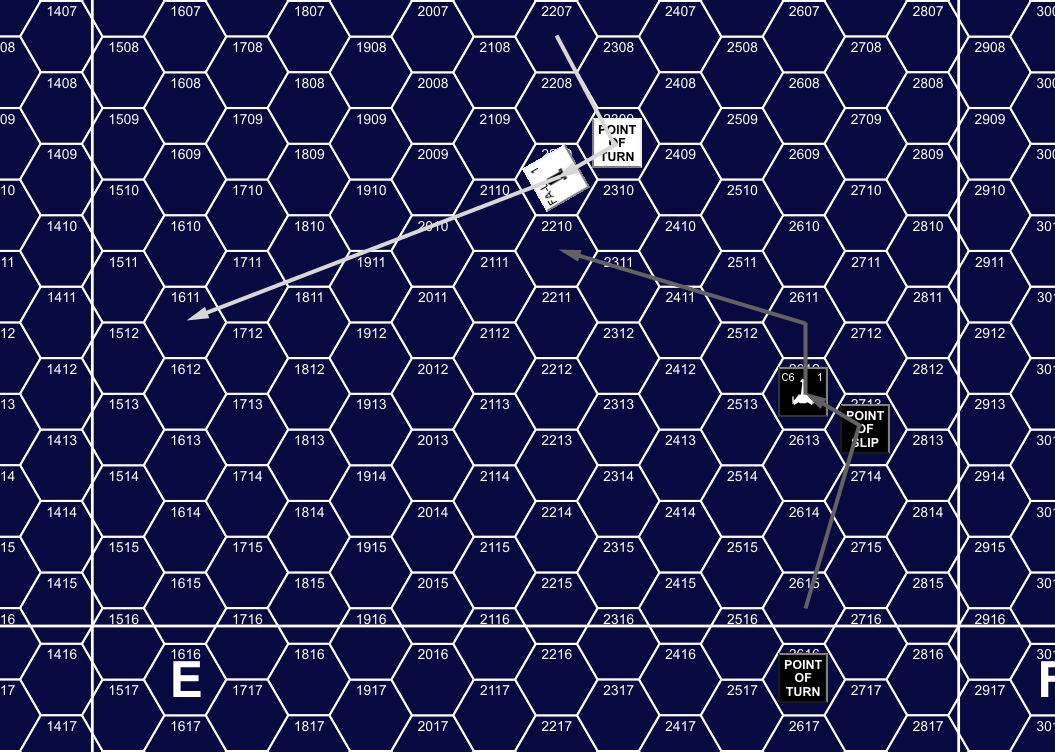

Turn 1, Impulse 23, showing movement from Impulse 17 through 32.

Two impulses later, the left waist phasers were in arc, and better rolls did three points through the down shield, for two hull, and one sensor hit, reducing it to ‘0’. By the end of the turn I was six hexes away in a stern chase, and it was obvious that Mark would be trying to disengage by acceleration. I went down to speed 12, overloading the disruptors and recharging the phasers and batteries, while the FA-L went its maximum of 23 (…okay, 31, we forgot about the freighter’s acceleration limits).

I immediately volleyed everything I had, trying to get it down to less than half its original warp power, and unable to disengage by acceleration. The phasers were a bit more mixed (with a 2 in the mix, but also two 6s), but all the disruptors hit, to do 17 internals through the #3 shield. This took out the last control space, two phasers, both impulse, and left just enough warp to disengage with. On impulse 4, I turned to get the right boom phasers into arc, and did two more points to take out the shuttle and a third phaser. After that, the distance opened up, and Mark got me off the down shields, so that I couldn’t do any internals, even if I got the waist phasers to bear, and he disengaged.

We checked what the next group would be after that. And it was… 6! again!

We set up and did a half turn in a short session, just to see if I could get internals before it fled. Between scenarios, all shields are regenerated, and limited repairs can be made (he repaired the sensors, a couple warp, and I don’t recall what else). However, he set up smartly in a far corner, and I couldn’t manage more than about two greater speed than him, and couldn’t do more than dent a shield.

We’ve started scenario 3, which should be much more of a challenge. (Spoiler: he got his second-best group.)

Mark was just too aggressive given the disparity in power between the ships. Of course, group #6 is probably best to see towards the end of the campaign, hopefully after something has done some real damage, and the Klingons have to be a lot more cautious. Catching me with a scatterpack could have been bad, but even that is unlikely to scare an intact C6 much (partially because of drone speeds, and partially because it doesn’t have to give much credence to the FA-L’s pop-guns).

The real goal would be to drag things out. It’s unlikely to go anywhere near twenty turns (at which point he rolls again for another group to show up), but if he can get me thinking about it, I might make a mistake. And of course, short of hoping for that, the goal should be to get me to use T-bombs or drones, but with a fresh C6, the FA-L just couldn’t force that either.
└ Tags: gaming, SFB, Y160
2 Comments

SH76 Quarantine

by Rindis on March 2, 2020 at 12:00 pm
Posted In: SFB

Mark and I are getting into weekly Vassal sessions to supplement our FtF gaming, and maybe finish off ones we can’t do in a session. We started off with Star Fleet Battles scenario SH76, “Quarantine”, which is part of the Y160 timeline we’re in as a group.

Plague had broken out on a small planet near the Klingon Border. The planet had not been colonized and only had personnel who were surveying it for colonization. The CLH Refuge was sent to the planet to rescue them. The Refuge was accompanied by a single escort vessel because the Klingons were too involved in their current war with the Kzintis and Hydrans to interfere, or so it was thought.

A Klingon Commander serving a penance tour on a penal frigate became aware of the plight, and he arrived to “investigate possible biological warfare experiments” in hopes of earning a quick ticket off the penal ship.

This is something of a scenario to show off the hospital cruiser and the F5J. Mark took the Federation force, which has a POL and the CLH. The CLH is by far the bulkiest thing in the scenario, and has armor to boot, but it only has four ph-3s for armament, so all the fighting is on the POL. The action centers on a planet and a small moon, both of which have a small outpost on side B (they are shut down, and pure accounting exercises for if they get shot up) each with 8 crew units (the standard) who are infected and must be transported directly to the CLH (which has the facilities to contain them), and two crew units from the CLH (who are apparently not infected yet). The Federation needs to get the infected crew units up to the CLH and off-board (with a minimum of 10).

The Klingons have a single F5J, which is better armed than the Federation force put together, but is limited by ph-2s and a poor crew. It comes on board at the start of the game, and wants to get 10 information points on each station before all the infected crew units are removed (I didn’t see anything about it, but I ruled that the EW system impacts the research table—it is a poor crew after all—which meant I generally had a +1 to my rolls), and kill one ship before leaving (which is likely to be the POL).

The Federation ships start in orbit of the planet, and Mark started up the CLH at speed 9, while the POL went 12 (thanks to being Nimble), and the F5J came in at 15, a speed I would largely stick to. The CLH was running 4 ECM (giving me 7 to burn through after my poor crew penalty), while the F5J put up 2. The CLH immediately beamed two crew units up from the planet (it also only has two transporters; I’d think an extra or two would make sense for a hospital ship). I got to range three of the planet at the end of the first turn, and a poor roll get me all of 2 points of info (1×2 labs…), while the Feds headed down, and regrouped.

Turn 2, the CLH went 12, and boosted to 6 ECM (giving a total of 9, or +2 for me if I didn’t spend on ECCM), the POL used 2 ECM and everything else stayed the same. I cruised next to the planet and then headed for the moon, hoping to get decent info on both. Bad rolls continued, getting me 6 points on the planet (total 8) and 8 on the moon after having been adjacent to both.

Unfortunately, I didn’t record full logs for turns 3 and 4, and turn three was where the main battle pass happened. I shifted down to speed 13 and overloaded both disruptors, heading back to the planet to get decent range to both during the turn, and get my information gathering finished off. The Feds had ended turn 2 near the planet again, and the CLH headed off to moon for turn 4 transports, while I went after the POL.

We ended up with a range 1 pass around impulse 10, with main weapons fire happening slightly earlier. Thanks to turn and sideslip restrictions, I was able to hit him with a drone as the pass ended, and if I had looked at the impulse chart earlier, could have gotten him with a suicide shuttle as well (as it was, it got crippled by phaser fire, and spent the rest of the scenario wandering around trying vainly to get to the POL. The F5J took two internals through the #2 shield (Hull & Aux Con), while a disruptor damaged the POL’s #1, and the drone collapsed #2, followed by good close-range ph-2 fire to do a warp hit, take out the #1 phaser, and almost all the cargo and hull. Not still combat effective, but the padding was largely gone.

I spent turn four recharging phasers and starting work on the down shield, and keeping it away from the Feds drove me further out of the way than I intended. I dropped down to speed 11, and stayed there for turn 5, while the POL went up to 15, and the CLH to 14 (increasing to 17 for turn 5). The CLH kept to 6 ECM the entire time, making sure I had no good shots at it as it continued to transport up two crew units a turn. Towards the end of turn four, I got a phaser shot off at the POL to damage the #3 shield, and then missed with an overloaded disruptor on Impulse 1 of turn 5 as it pulled out of range.

At this point, it was time to pull down some extra power, and try to maneuver a bit more, as I wasn’t getting any more solid shots at the POL; but that would cost overloads on the disruptors. However, things got interrupted by a too-hurried re-reading of the victory conditions, and we missed the ‘all surviving’ part of the Federation’s victory condition, leaving us with the ‘at least 10’, which Mark was up to now. A quick look showed that I couldn’t really intercept either ship if it went to disengage.

And yeah, that was wrong. Oops. On the other hand, Mark only had three turns of transports needed left (generally all at the moon, and the POL had picked up the uninfected crew there already too), and I was not going to get another close pass like the first one if Mark had anything to say about it. Overall, I needed to be a lot more aggressive of a Klingon commander. I concentrated on the information-gathering first, so I wouldn’t need to worry about it, but even with the EW shift, I finished that off on turn 3 without trouble.

Of course, killing a CLH with a F5J takes a fair amount of work, and the POL is the one that can hurt you, so it’s the only real viable target. But while it’s not as well armed, being nimble and a regular crew makes up for a lot. Just don’t get caught in a short-range tussle unless you need to save the CLH. I’ll admit I wasn’t as gung-ho going into this one as some of the other scenarios, as I find it only moderately interesting. But once again, I find just having a planet on the map can do a lot to change the nature of maneuvering, and this one gives a better reason to hang around it than most.

A turn 1 dash for the POL and anchor it… nah. Most likely you can’t get there that fast. If the POL doesn’t want to fight, you have have to force it to save the CLH, or force it towards a corner of the fixed map, and while possible, that’s not something I normally think in terms of (I tend to prefer floating).

└ Tags: gaming, SFB, Y160
 Comment 

SH176 Kobol’s Rock

by Rindis on May 5, 2019 at 12:00 pm
Posted In: SFB

Crossposted from the SFU blog on BGG

A couple weeks ago, Mark came over for a day of SFB. I was originally hoping to squeeze in two small scenarios, but the first one turned out to be slightly bigger than we thought, and we needed to do a fairly thorough rules review first. We had a fairly long talk about all sorts of things afterward; there’s lot for us to catch up on.

Module M expands the boarding party combat system in a number of ways, including a proper abstract system for combat on a planetary surface. To my surprise, a couple years back, Mark expressed interest in the scenario provided to showcase those rules. The Kzinti are besieging a Klingon-held planet, and are making one final push to take it. Normally, they could just slowly grind their way in, but previous assaults have failed, and a Klingon fleet is approaching to retake the system at large. As such, there is only ground combat. As that (and regular boarding party combat) only happens at the end of the turn, the entire impulse procedure is skipped, and instead there’s an abbreviated sequence where the Kzinti move around their troops, then the Klingons can move theirs, and then it’s time for the combat.

The general structure of ground combat is that each hexside of the planet (which ordinarily fills one SFB hex) is a separate ‘combat location’ (this ties into the normal ground base rules, where they are set up on particular hexsides). Each of those has three ‘control stations’, and, if it’s a defended planet (as opposed to the ‘defender’ having beamed down just before you did), each of those has two defense systems. The control stations act a bit like the control systems on a ship; you can give them up instead of casualties (two casualties instead for a single station), and the other side can force the issue by expending four casualties they generated. Having at least two of the control stations generates a bonus in combat, and the defense systems have to be knocked out first, and they act as a pair of extra boarding parties (each).

It should be noted that despite the details, it all abstracts down to strength points. Ground combat uses the exact same boarding party combat results table, which is purely a ‘fire’ table, no odds, or anything like that are looked at. Shuttles can transport troops, and support the fighting directly, where they provide two extra strength points, and take two hits to kill (this translates to three of the normal combat hit points per ground combat hit; the Ground Attack Shuttle counts as four boarding parties, and its better armor only takes two hit points per ground combat hit, causing it to need to take four hits…). There’s a whole bunch of other types of troops and shuttles that boil down the same way; in fact the other types of ‘boarding parties’ generally act the same as regular ones here, as the bonuses are just better results tables on specialized actions.

The Klingons are defending with 25 boarding parties per side of the planet, while the Kzinti have 200 boarding parties, and good mobility. Even with the single admin shuttle and GAS the Klingons have per side of the planet (which can move one hexside per turn while staying immune to fire from the ships up in orbit) adding another six effective BPs, it looks pretty grim. However, those six defense stations add another 12, which means the base setup is 25+6+12 = 43 equivalent BPs, and the scenario defines that only up to 50 strength can be used in any one location per turn. The Klingons also have a set of two tanks and four ground combat vehicles in one location.

I ended up taking the Kzinti, who can move 20 BPs per turn by transporters (more at the non-combat rate, which means they’re nothing more than targets on the turn of arrival, but with the ‘remote area’ rules, it could have been worthwhile, as Mark would have to go hunting for them first), and have 12 admin shuttles and 16 GAS for ‘airlift’ and fire support. We pencil and papered everything with notes except the shuttles (and I found that a helpful planetary combat diagram had been printed in Captain’s Log #17 a week later…), which we used counters for, and its been long enough that I don’t have the best recollection of the sequence of events.

I started by organizing some of my shuttles into flights of one Admin and two GAS (which is 12 strength with the shuttles loaded with boarding parties), and put a set above each of three areas (with the hexsides labeled by the usual directional nomenclature of SFB, so that A-F are the six sides going clockwise around the planet; I put shuttles over B, C, and D, while the main Klingon defense was a A), and transported 20 boarding parties directly to C.

It was while we were working things out that we remembered the extra 12 strength from the defenses, and we realized this was indeed not going to a walkover. …And I lost most of the initial party, for doing minimal damage. Though I did kill an Admin shuttle. In fact, that was a part of my early strategy. I spent 4 points to kill Admin shuttles, mostly to limit his mobility, so I had a better chance to isolate areas and pound them later. I’m not sure if it was worth it as opposed to just trying to burn out his defenses, but I don’t think it hurt too much in the long run either.

Mark had adjusted some of his defenses too, so on turn 2 I aborted my landing at B, but kept the shuttles there, while sending out a second wave there and elsewhere, and of course sent more troops in. With a lot more on the ground, things started going better, and I really started straining Mark’s defense of C. (I think I killed another shuttle or two.) After that, my pressure on him steadily mounted, with Mark taking a lot of damage on his various shuttles as combat raged across half the planet with my forces landing with more troops beaming down directly every turn. Mark just took partial damage on the shuttles, leaving them fragile, but still worth the same amount offensively.

I got lucky with two turns of relatively bad die rolls from Mark. However, the casualties in my troops were mounting quickly. In B, where there was some heavy fighting, I eventually pulled out (even beaming ten boarding parties back to orbit while the shuttles took off with the rest) and transferred over to C while grimly hanging on in D. I’d damaged some of my shuttles in this process, but mostly took it on my boarding parties so as to preserve my ability to move. In the end, Mark lost most of his assets, while I kept my shuttles, but the cost was high.

Once the defense finally cracked, I shifted back to B and mopped up in D while leaving a garrison in C. Eventually it went to a minimal 3 boarding parties (needed to hold the three control stations), but as the Klingons move last, I needed to avoid him moving in behind me. D, and then B fell, and I massed to take out E. With a better idea of what I was doing, and a lot of Klingon shuttles dead, I took it… and then declared the scenario over as a draw. I could defend against the limited Klingon ability to make counterattacks, but I’d taken 172 casualties, leaving me with 28 boarding parties to do that and then press on to F (avoiding all the nice tanks and armored cars in A). With all the shuttle cover, I probably could have taken F and held everything. By the victory conditions, the Klingons holding 5-10 control stations (with three per location) is a draw. If I took F, that’d get the Klingons down to three, and a Kzinti victory, but nearly 75% losses, and the prospect of losing most of my shuttles (which were all damaged) in the assault took the heart out of me.

Obviously, I could have planned and executed the invasion better. Probably transporting to a remote area at the non-combat rate on the first turn would have been better, even with some losses from patrols. Then a few shuttles could join them, and I’d hit the max of 50 in an area easy. I also parcelled the shuttles out over several turn instead of just putting everything out at the beginning. It did leave some much-needed flexibility, but threatening to swamp another area or two with a massive shuttle landing would keep him pinned down.

Looking at the tactics section now, there’s some interesting notes. Mark basically fought to the last man, keeping the defenses intact until there was no other choice. Preserving a few boarding parties by running for the remote areas has possibilities (that we didn’t even think of). I’ll loose a few less men, as the combat breaks off a round early, but then I have to send out teams to hunt them down before I can strip the place to a minimal garrison, which keeps me distracted while working on the other locations.

At any rate, neither of us expected much from the scenario, but it definitely made us think, and got us very familiar with the ground combat section procedures. I wish there was another scenario or two like this (maybe not entirely focused on the surface) that used a greater variety of equipment. There’s several shuttle types presented in Module M, but all you have here are normal Administrative shuttle and the GAS.

└ Tags: gaming, SFB
 Comment 

SH3 The Coming of the Meteor

by Rindis on December 2, 2018 at 12:00 pm
Posted In: SFB

Patch and I recently finished off a try at this old scenario (I think it’s from the original pocket edition) in the Basic Set. It has some of the ‘feel’ of the Original Series adventures, and is a neat premise:

In Y160 a massive meteor was spotted headed for the industrial colony on Pollux IX. The Federation heavy cruiser Kongo, under the command of Captain Phillip Kosnett, was dispatched to avert the disaster. When Kongo arrived on the scene, however, Kosnett discovered that a Klingon frigate was shepherding the meteor.

The meteor starts 10 hexes away from the planet (and moves on the first impulse of every turn, so it’s about nine turns away), with the F5 Khedive next to it, and Kongo 22 hexes from them. The asteroid can be towed by a ship facing away from it and tractoring it for 16 impulses (…speed does not matter). Victory is purely by how close to the planet the asteroid gets to the planet, with even two hexes being a danger as small fragments will still hit the colony, killing a tenth of the inhabitants, and causing a draw. The asteroid can be ‘destroyed’ (broken up into pieces by 400 points of damage), which does not affect the ability to tow it, and does make it less dangerous to the planet.

We had to have a bit of discussion about the MacGuffin, as while the scenario quite clearly calls it a ‘large asteroid’, it doesn’t call out that section of the rules (which I hadn’t known of, I remembered the general asteroid field rules, and the small moon rules…), and defines that it will destroy any unit in a hex the asteroid enters. Large asteroids don’t prevent ships from entering its hex (and they can even land on it), or block fire, or anything you might expect of something large enough to crush whatever is in a hex 10,000 kilometers across. We did go with the large asteroid rules, and drop the normal asteroid ‘dodge’ rules as it is supposed to be a singular object instead of a debris field. It’s one place where clearer instructions would help.

Patch volunteered to take the F5, and a few impulses in realized just what he was in for. (I had expected he’d stick me with figuring it out.) He went a reasonable speed of 16, while I went 18 to get near the asteroid on the first turn. The CA is at WS-2, or the second turn of arming of photons, and I fully overloaded one, while keeping the others standard, while the F5 is at WS-1 and had to charge up phasers, and it also put up 2 points of ECM to discourage longer-range shots.

On the first impulse, the asteroid moved, and Patch lowered shield #1 to put a transporter bomb in front of the meteor. This did change my initial approach plan, but we both commented later that while a great opener, a second mine behind the asteroid would have been much better, and forced more maneuvering from me (as it was, I just sideslipped enough to bring me around behind the meteor). As I headed in, the F5 got underway, and did a clockwise loop that ended with the disruptors out of arc until he turned directly in on Impulse 26, with the range 15 and closing. Patch fired at that point, hitting with one disruptor on shield #1, and we finished the turn at range 11.

Only being three hexes from the meteor, I slowed to speed 10, charged up a tractor beam, partially overloaded a second torpedo, set one for proximity fuse, and held a HET in reserve in case Patch got too close. Patch stayed at 16, and dropped all EW while I put up 6 ECM. Patch turned away on Impulse 2, and on Impulse 4, with him about to go out of arc, I hit him with the prox photon on the #3 shield. Patch then increased his ECM to 1, presumably to discourage any more of that….

On Impulse 13, I slipped in ahead of the asteroid, and attached the tractor beam. On 16 Patch started coming back in for a run at my rear, and I launched a shuttle to provide some cover and/or drone defense. On 20, Patch fired his overloaded disruptors at range 8 as he was about to go out of arc again; thanks to my ECM shift, only one hit on shield #3, partially countered by the one point of reinforcement I’d afforded there. On 26, he turned directly in, launched a drone the following impulse, and my towing took effect on 29 to get it out of line of a direct impact with the planet.


Turn 2, Impulse 4, showing movement throughout the turn.

For the third turn, I kept up the tractor while still paying for speed 10 and an HET, and 5 ECM with 1 ECCM which left very little power for everything else. I finished overloading the second photon, and started reloading tube D, and had to pay a half point out of batteries to balance it all. Meanwhile, Patch’s F5 dropped to speed 14 and didn’t bother with EW.

I launched a second covering shuttle on Impulse 4 as Patch continued to come in. The first shuttle fired at the drone, but only did three points on a bad shot. Patch came in with a second drone following, and the second shuttle fired at him on 14, doing 2 points to #4 on another bad roll at range 2. On 16, the F5 passed directly behind the CA on the oblique, and unloaded it’s best shot at range 1: with the +2 shift, one disruptor missed, and the five phasers did 18 damage, I blew the remaining batteries to take five internals, which knocked out two phasers and one power. I had fired back with two of the side phasers to do 11 to his #2, and the other two were used to shoot down the second drone and finish off the first one; which thankfully weren’t Type-Vs. (Patch pointed out that it’s really rough to take two-space drones when you only have one four-space rack.)

I seriously contemplated cutting the tractor as he came out of his pass, and burning the HET to pump three photons (two overloads) and two phaser 1s into a rear shield at point blank range (it was, after all, the general plan of all those expenditures), but I’d already had the second towing move, and the third one would come up before the end of the turn, and the F5 was empty. So, I stuck it out, got the third hex, which pulls the asteroid completely out of range on Impulse 29, and Patch basically conceded at the end of the turn.

Afterword

With the asteroid out of the way, I could basically go slow near it, and keep myself pointed at the F5. It would get pounded if it tried to tow the asteroid back into range. I could have pounded him during turn 3, but sticking with the asteroid meant I didn’t need to go back to it later.

There were a few more options that Patch had: He could have put another TB into where I’d go when I towed, he could have powered up a suicide shuttle (though he was probably a bit thin on power) and launched it during his pass. I wasn’t going anywhere, and it’d absorb even more of my fire. A scatterpack could have been interesting… but Patch still needs to get Advanced Missions.

I knew it was going to be an odd match, and wasn’t sure how it would play out. One thing I finally realized is that it was written back when plotted movement was the norm, and that could give the F5 the edge it needs here. Even with plotting, the F5 knows where the CA is going eventually; the CA has fewer guarantees about the F5.

Suggestions:

There seems to be a habit of not going back and really reexamining older scenarios when republished in later editions. Along with plotting, it looks like this was written before ‘speed is life’ became a real mantra, and it’s expected that things will proceed more slowly. Also, the asteroid really needs more clarifications in the rules. I’ve got a few ideas on how this scenario could be refitted, though I don’t have any idea how balanced any of it might be.

First, I think the variation in SH3.62 might work a lot better. Adding a CL and D6 to the mix could be very interesting. It evens the firepower out a lot, and more importantly, the D6 and F5 can threaten to try and dodge around one Federation ship to get at whichever one’s towing.

Second, it’s too easy for the CA to park next to the asteroid and just put everything into reinforcement for a turn or two. I deliberately didn’t do this, and kept to speed 10, but there was no reason go even that fast on Turn 3. It gets even worse if you use mid-turn speed changes to slow down right as you get to the asteroid, and speed up when it’s time to break the tractor. My thought is instead of spending sixteen impulses towing, you must spend so many movement points (calculated off of Practical Speed) to move the asteroid one hex. This could allow faster towing, though getting a CA to go really fast takes some doing, and possibly means cutting power elsewhere. Eight movement seems like a likely base figure to try, since that means speed 16 for the same rate as the original, though if you’re using mid-turn speed changes, it should definitely be something like 10 movement. (This could also be translated into energy expended if you want to make it harder for the F5 to tow back, or to make the CA and D6 the obvious towing candidates in the four-ship version.)

Lastly, this seems like a perfect situation to give the Federation some firing restrictions. Chasing down the F5, blowing it up, and then towing the asteroid out shouldn’t be too hard (it is a fixed map), but it’s not very Star Fleet. There’s already a rule that the Klingon captain can claim “it was all a horrible mistake”, and all combat halts. A simple solution would just be to use the Non-Violent Combat system (D6.4), which would allow the F5 to feel safer about losing a shield or two. (We’ve had a scenario where it was used once, and small ships can generally not worry about the big CA too much.) A more custom rule could be interesting though: Don’t fire unless the Klingon has. Don’t fire anything that could cause internals (on best rolls) unless the Klingon has done internals.

└ Tags: bgg blog, gaming, SFB, Y160
1 Comment

SM3 The Moray Eel of Space

by Rindis on March 9, 2018 at 12:00 pm
Posted In: SFB

Since I was still in an SFB mood after finishing “Border Incident” with Patch, I soloed my way through the third monster scenario during January as part of my Y160 games. Having just played the Romulans in KRs, and realizing I hadn’t played as the Klingons in a while, I took the D7 for this scenario.

The Moray Eel is the first monster not directly inspired by a TOS episode, though it is definitely a graduate course for the Planet Crusher. While there is an optional variant to use information gathering, the scenario is geared around combat to defeat a monster that is headed for an inhabited planet. It doesn’t do nearly as much damage as the previous monsters (5-10 points per ‘bite’), but is much nastier as it ignores shields, meaning that every attack is doing internals, and suffering too many attacks will destroy the ship in short order. The real twist is that the Eel only attacks after being damaged. After any impulse where it receives damage, it moves to the offender’s hex (instantly, even if that’s several hexes away) and bites that unit. If there’s several ships, and they all do damage at the same time, it moves to each of these hexes, and bites them all, in a random order, in a ‘biting frenzy’.

The eel is 100 hexes from it’s goal, and moves straight towards it at speed 12 (making it the fastest monster so far), which not distracted by a ship. It apparently used to follow close-by ships, akin to the Planet Crusher, but that was removed in Captain’s Edition to keep the time pressure up. Defeating it is also a problem, as the ship has to do 200 points of damage (reduced to 193 here for BPV balance), after which there is a die roll for each separate volley (which will involve a bite) that does 10 points of damage (9 after balancing), and the Eel is killed on a ‘1’. And as usual with these scenarios, the monster can’t be fired on from outside a six-hex range, and it has MCIDS to deal with shuttles and drones.

The D7 started 15 hexes away from the Eel in the direction of the planet, and I overloaded all four disruptors as part of a turn 1 alpha strike overrun to do as much damage as possible. I lined up an oblique shot for maximum firepower, and launched a drone as it entered my hex, which was instantly shot down by MCIDS.

One of the tricks with the Eel is to fire at range, and force it to move away from the planet, which is hard to do with the initial approach, especially as I went for a range-0 shot. But I fired just as we were both scheduled to move, so that it moved a hex further away following me, and it gave up its normal move to do it. The phasers rolled a little under average for a total of 77 damage (with 4 disruptors auto-hitting to do 40 of that), and the eel did a minimal 5 points to destroy one phaser and two warp.

For turn 2, I reduced speed from 12 to 9, so that the Eel could get a little in front of me, and be drawn back by my next volley of fire. I fired on Impulse 21 at range 4, hitting with two disruptors and doing three points with the boom phasers (everything else being out of arc) for a running total of 96 damage. The next Impulse, the Eel moved to the D7 and bit for 9 damage, knocking out one drone rack, a phaser, two warp power, and one battery after finishing off the forward hull. The D7 launched a drone from the remaining rack, and MCIDS missed allowing it to hit for 12 more damage the next impulse to bring the total up to 108.


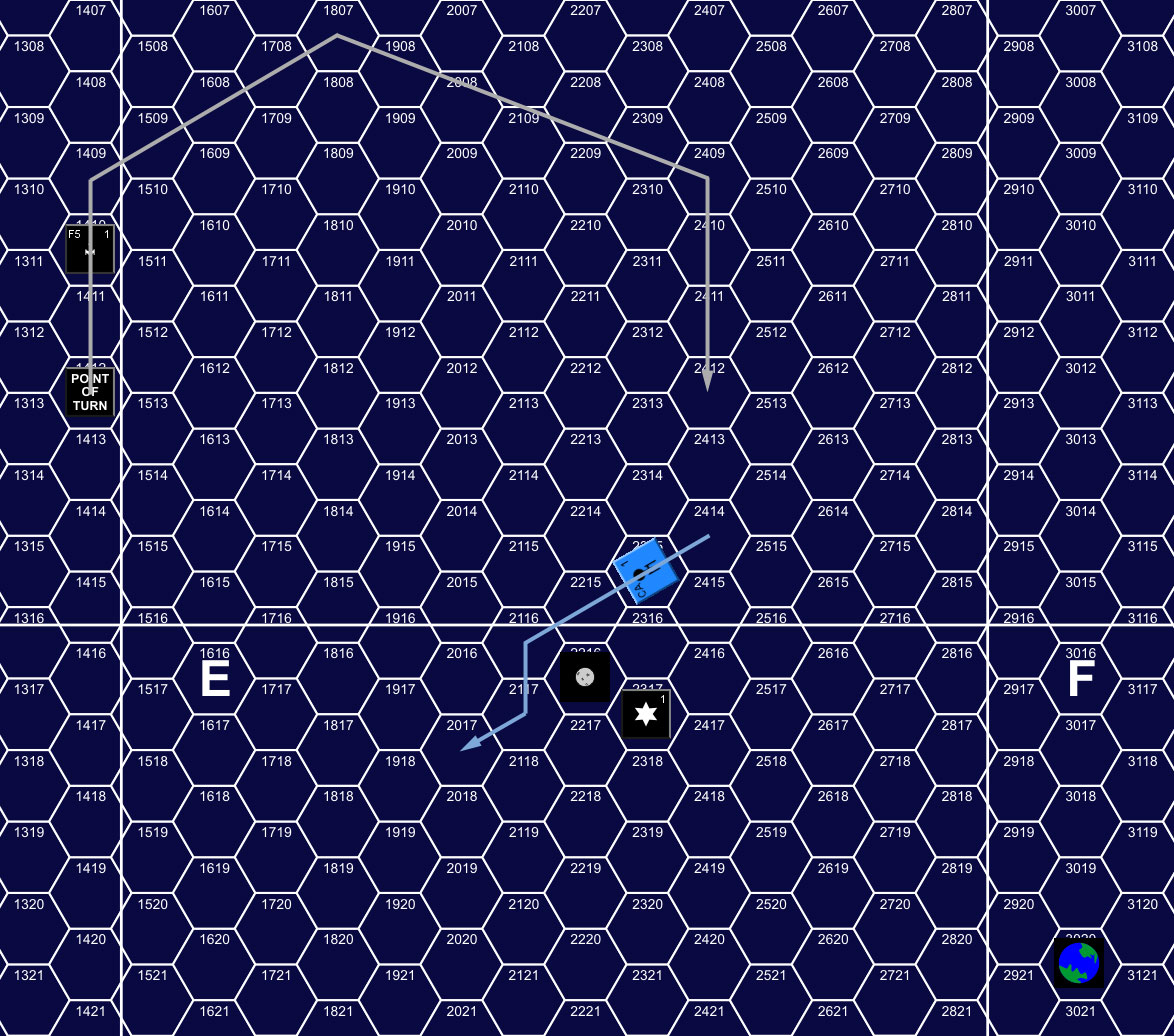
Turn 1, Impulse 24, showing movement from Impulse 23 through Turn 2, Impulse 22. The paler arrows are the Eel’s movement to bite.

The D7 repaired the first destroyed phaser as of the end of Turn 2, and increased speed to 13 to get another close-range oblique shot. The Eel was sideslipping back to its original course (part of the robot rules), which meant the D7 was drawing slightly ‘ahead’ of it to make this maneuver, but the low speed differential meant it took most of the turn to pull off. The D7 launched another drone as they met at range 0 again, but MCIDS shot it down. On Impulse 31, the D7 fired all bearing weapons to do 40 with overloaded disruptor auto-hits, and the maximum 30 points from 5 phaser-2s for a grand total of 178 damage. On 32, the D7 sideslipped away, and the Eel followed to do 8 damage to take out another phaser, the remaining drone rack, two more warp, the remaining two batteries, and a shuttle. At the end of the turn, the second damaged phaser was repaired.


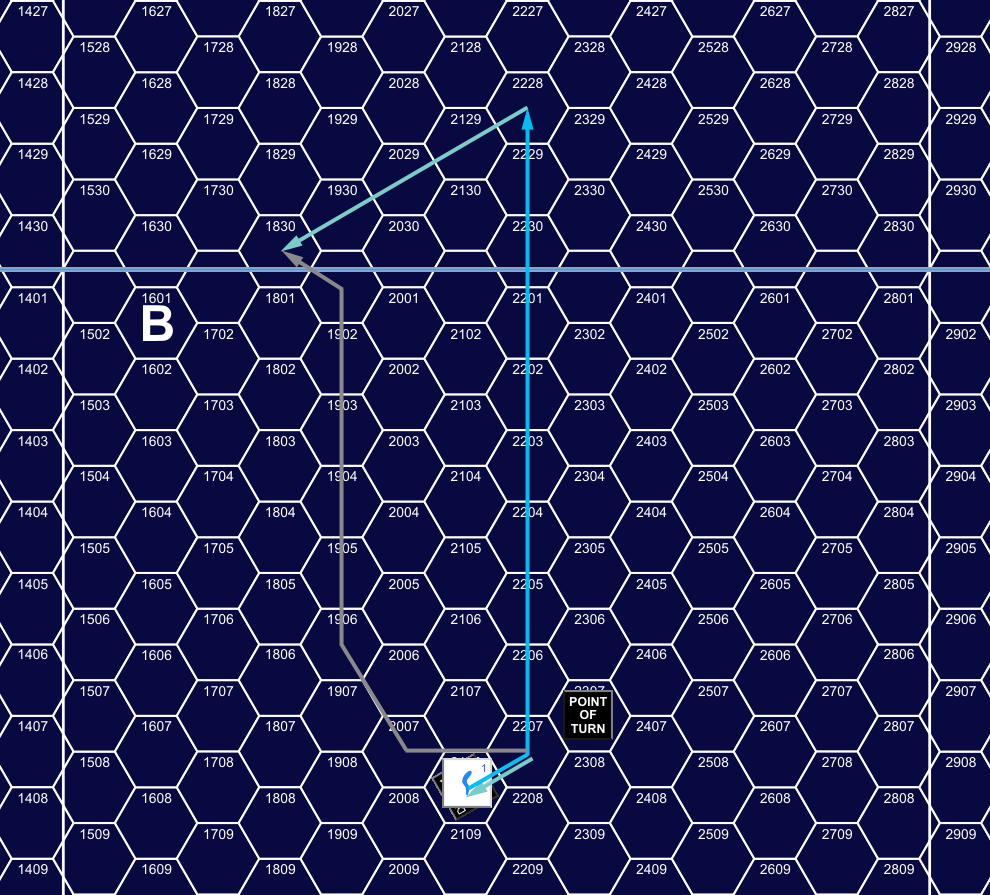
Turn 3, Impulse 31, showing movement from 25 to 32.

With power continuously dropping, the D7 only went speed 8 for Turn 4, while it prepared to do the last 15 points needed before it started rolling for destroying the Eel. On Impulse 7, the phasers cleared, and the D7 fired four of them at range 1 to do 17 points on poor rolls (grand total 195). On Impulse 8 the bite did 10 points to destroy two phasers, two more warp power, the remaining shuttle, an impulse, and an APR. The D7 turned and moved back into the Eel’s hex after it sideslipped out, and fired an overloaded disruptor on 13 to do 10 points and force a roll to kill the Eel, which failed with a 5. The next impulse, the Eel bit instead of moving, doing 10 damage, which destroyed three phasers, 2 warp power, 1 impulse and 1 APR.

The D7 tried another disruptor on Impulse 15, rolling a ‘3’ for destruction. On 16 it slipped away from the planet, drawing the Eel after it, which did 7 points to take out a disruptor, one warp power, and two impulse. On 18 the D7 fired a boom and waist phaser at the Eel to do 10 points, and rolled a ‘1’ to destroy the Eel!

The 1/6 chance of killing the Eel each time probably makes the end of many plays of this a bit exciting. Certainly the D7 was well through a lot of padding, and was down to 23 power at the time the Eel expired, and that was only on the third attempt. I was very lucky that I didn’t take any ‘torpedo’ hits until the very end, and had two more of those left to try once the D7 was facing it again. In addition to the more important systems listed above, the D7 had lost its bridge (but not any other control spaces), most of the lab, one tractor, and one transporter. Damage was getting up to about column F of the DAC, and another couple of strong damage rolls from the Eel would have been big trouble, with 7’s headed for the ‘phaser’ and ‘any warp’ entries.

The purely deterministic movement makes it less of a maneuvering challenge, though the higher speed adds some interest back there. The tactics section in the rules mentions dragging it away from the planet by firing, but doesn’t mention the fact that you can scrub little bits of movement off just by timing shots around when you are about to move (so you can move even further away), or especially when the Moray Eel is about to move (so it doesn’t move closer to the planet). This is a more interesting and challenging scenario than the previous two simply because the ship will take internals every time it fires, and you have to figure out how to survive the consequences long enough to play the odds.

└ Tags: bgg blog, gaming, SFB, Y160
 Comment 
  • Page 6 of 16
  • « First
  • «
  • 4
  • 5
  • 6
  • 7
  • 8
  • »
  • Last »

©2005-2026 Rindis.com | Powered by WordPress with ComicPress | Hosted on Rindis Hobby Den | Subscribe: RSS | Back to Top ↑