Rindis.com

All my hobbies, all the time
  • Home
  • My Blog
  • Games
  • History

Categories

  • Books (490)
  • Comics (10)
  • Gaming (910)
    • Boardgaming (668)
      • ASL (154)
      • CC:Ancients (82)
      • F&E (78)
        • BvR – The Wind (26)
        • Four Vassal War (9)
        • Konya wa Hurricane (17)
        • Second Wind (5)
      • SFB (78)
    • Computer games (161)
      • MMO (76)
    • Design and Effect (6)
    • RPGs (66)
      • D&D (25)
        • O2 Blade of Vengeance (3)
      • GURPS (32)
  • History (10)
  • Life (82)
    • Conventions (9)
  • News (29)
  • Technology (6)
  • Video (48)
    • Anime (46)
  • Writing (1)

Patreon

Support Rindis.com on Patreon!
Become a patron at Patreon!

Other blogs:

RSS Inside GMT

  • It’s all about the Cards: Exploring the Card Deck of Ancient Civilizations of East Asia (Part 2): March 15, 2026

RSS Playing at the World

  • Playing at the World 2E V2 Arrives May 5, 2025

RSS Dyson’s Dodecahedron

  • The Ziggurat of Shadows – top view and upper levels March 13, 2026

RSS Quest for Fun!

  • The Myth of Rational Animals November 23, 2025

RSS Bruce Heard and New Stories

  • Preview: The Iron Queen February 9, 2026

RSS Chicago Wargamer

  • The 2 Half-Squads - Episode 310: Cruising Through Crucible of Steel January 27, 2023

RSS CRRPG Addict

  • Game 572: The Elder Scrolls: Arena (1994) March 14, 2026
SF&F blogs:

RSS Fantasy Cafe

  • Michael Swanwick Guest Post and Book Giveaway February 23, 2026

RSS Lynn’s Book Blog

  • Booking Ahead/Weekly Wrap Up March 15, 2026
ASL blogs:

RSS Sitrep

  • Blockhaus Rock April 1, 2025

RSS Hong Kong Wargamer

  • FT114 Yellow Extract After Action Report (AAR) Advanced Squad Leader scenario April 16, 2025

RSS Hex and Violence

  • This still exists? March 25, 2025

RSS Grumble Jones

  • 2026 Kansas City ASL Club's March Madness Tournament March 16, 2026

RSS Desperation Morale

  • How to Learn ASL March 16, 2025

RSS Banzai!!

  • October North Texas Gameday October 21, 2019

RSS A Room Without a LOS

  • [Crossing the Moro CG] T=0902 -- Rough start July 18, 2015
GURPS blogs:

RSS Dungeon Fantastic

  • What color is paut? Sigh. March 3, 2026

RSS Gaming Ballistic

  • Pigskin project (by Chris Eisert) February 28, 2026

RSS Ravens N’ Pennies

RSS Let’s GURPS

  • Review: GURPS Realm Management March 29, 2021

RSS No School Grognard

  • It came from the GURPS forums: Low-Tech armor and fire damage January 29, 2018

RSS The Collaborative Gamer

  • Thoughts on a Town Adventures System January 18, 2022

RSS Don’t Forget Your Boots

  • GURPS Supers Newport Academy #3: “Season Of The Witch” February 8, 2026

RSS Orbs and Balrogs

  • Bretwalda - Daggers of Oxenaforda pt.4 - Fallen King May 27, 2017

Arguing About Slavery

by Rindis on July 19, 2024 at 12:00 pm
Posted In: Books

There’s a few things Miller’s book is about.

Most centrally, it is about the Gag Rule, or really, the series of Gag Rules about slavery in the US House of Representatives in the 1830s. It is also about the birth of the abolition movement in the North, and is about President John Quincy Adams’ later tenure as a Massachusetts representative.

There’s also a number of more minor themes of course. An interesting one is the fact that the fight centered around the right to petition. It’s not something we really pay attention to these days, but it is actually the right with the longest recognition in English use. Miller also spends time going into the points of view clashing in these fights, and the impossibility of making a subject go away by refusing to talk about it.

There’s also a love for going through the old Congressional records on Miller’s part. There’s a lot of quotes from actual speeches as recorded in the two newspapers that covered the doings of the government. This is accompanied by a lot of commentary; explanations of the wider circumstances, summary of what’s been said leading to the part he quotes, etc. Unfortunately, there is a tendency towards just restating what has been said. Sometimes (often), the other bits involved means this enhances the quote he’s restating, but too often it is just a direct restatement without any purpose.

Other than that last problem, this is a great, well-written book, that is a great study of the US political process relatively early in its life. It deserves to be widely read. However, the Kindle edition deserves to be shunned. It is obvious that someone scanned the book, ran it through OCR, and poured it into ebook format, and never even looked at the result. The table of contents is a disaster, there’s a number of graphics present that are just the spine of the book from the scan, year references such as “I8 3 r” are common, the page header (title and chapter names) are left in (along with page numbers), and the start of each subchapter is a jumbled out-of-order mess.

└ Tags: books, history, reading, review
 Comment 

King of Bloodstone

by Rindis on July 15, 2024 at 12:00 pm
Posted In: D&D

The ninth FR-series supplement returned to the geographic format of the bulk of the series, this time heading northeast and covering the two countries that had been introduced through the four H-series adventures. The usual major editing goof this time occurs in the back cover blurb which states that this is the area featuring Icewind Dale, as well as Bloodstone Pass.

Icewind Dale had already been covered in FR5 The Frozen North. This product was, however, written by R.A. Salvatore, the author of the Icewind Dale books, which is where the confusion came from.

The introduction fixes the H-series position in Realms history; the four modules take place across two years, which are given to be 1357-8 DR (the boxed set was effectively set at the start of 1358, and FR5 and this module are explicitly set in 1359). So, the supplement assumes that the Bloodstone Pass series is over, and that the pregenerated characters for those modules are the ones that did it. This has the very good side effect of not needing to actually run those adventures to use this, and the less-desirable side effect of if you did run them, you may need to adjust quite a few things. But that last is the nature of making the world your own, and the book ends up making a lot of good suggestions about where to take veterans of the series next.

Physically, it is the typical 68-page book printed sepia-tone with a faux-parchment pattern, with detached cover, and a 30-mile/inch poster map of the region. The interior cover has a more detailed map of Damara itself showing its former constituent duchies/counties/baronies (the terms get thrown around a bit interchangeably here; perhaps in Damara they’re more a sign of seniority than rank). The introduction also explains the focus of the book—despite the area of the full map, attention is largely on the (former) countries of Vaasa and Damara, with secondary interest given to Narfell and Impiltur. The rest of the map is nearly ignored in the text. Since these books generally need more focus, this is good for the product, but since Ashanath didn’t even get a mention in FR6 Dreams of the Red Wizards, and Thesk got two-thirds of a page, these countries have been virtually ignored twice now.
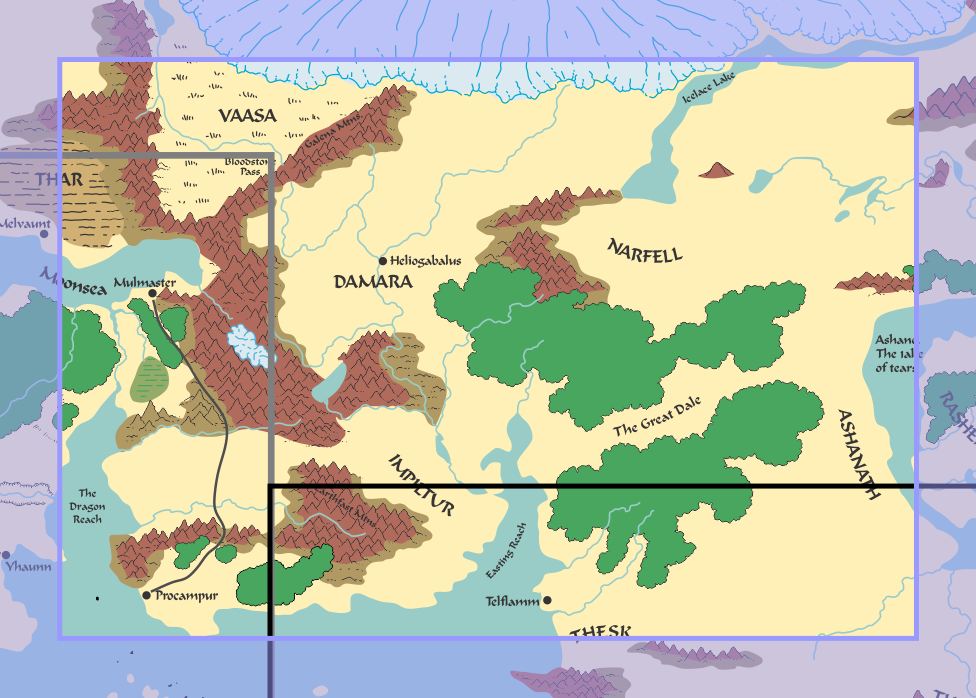

Region the FR9 map covers, showing the overlap with the original boxed set and FR6.

You might also ignore the 2nd Edition logo on the cover. Obviously, a project like this takes time to write, and the big map to be drawn up. The NPCs section (9 pages) has magic-users running around, despite the recent name change to ‘mage’. (You might think it’d be easy to just find-and-replace that, but in the days of manual layout, those parts could have been physically done well before 2e came out….) Also, monks didn’t reappear in 2e until PHBR3 The Complete Priest’s Handbook came out the next year, and the Monastery of the Yellow Rose is an important location, that naturally, is an order of monks running under all the extra-special 1e rules, including limited access to higher levels. An interesting note is the book states that the land is harsh and dangerous, and anticipating Dark Sun a bit, anyone not otherwise classed is a 1st level fighter. (No o-level peasants, or just o-level characters from Unearthed Arcana, in this howling wilderness.)

Of course, as a setting supplement, rules hooks are pretty rare to begin with. There’s no new spells, monsters, or items to muddy the waters with. Characters are given with class/level, alignment, deity, and notable attributes (16+). Given the shifts seen in characters elsewhere, it’s a little surprising that there seem to be no attribute shifts in the Bloodstone Pass cast (presumably because they are adventure characters instead of novel characters…), though they’ve mostly gone up two levels since their appearance in H4 The Throne of Bloodstone.

The main hook used for the supplement as a whole is that while the Witch-King Zhengi is dead, Damara is still an ex-kingdom, having been split apart and factionalized by Zhengi when he defeated its armies a bit over two years ago. The best claim to the vacant throne was basically a willing lackey of Zhengi, and is looking to take over now. However, the head of the victorious adventurers who defeated Zhengi is now the Baron of Bloodstone in his own right, and is looking to put together a Kingdom of Bloodstone that would eventually cover most of Damara and Vaasa. This tension defines most of the book, and helps a lot.

The main geographic entry part of the book is fairly well done. I don’t know why, but it doesn’t feel as interesting as the similar parts of FR5, though it does read better than FR3 Empires of the Sands, even though that had the better idea of providing every place with a ‘hook’. It does suffer somewhat from a presentation split up by subject rather than geography, though not nearly to the extent that FR5 did. The other problem is that not all the entries are actually on the main poster map of the module. No, they only show up on the map of Damara from the inside cover.

Other than the main poster map, there’s the mentioned map of Damara on the inside cover. In the book, there’s a map of Bloodstone Valley (reused from the modules, but with a couple new settlements, and new gatehouses that are being constructed to block the pass added). There’s small maps of Impiltur and Vaasa (handier than the poster, but don’t show anything new), and a half-page map showing the distribution of tribes in Narfell. There’s maps of Ostrav (a walled farming village), and of Hillsafar Hall (a fortified dwarven mine entrance). If you want a map of Bloodstone Village itself, you need any of the first three H-modules (and it is growing rapidly now, meaning those maps are obviously out of date, though the major buildings will be the same). The nearby mines are only covered in H2-3, and the Svirfneblin and Duergar caverns are only given in H2. Now, most campaigns shouldn’t need most of that, but an updated Bloodstone Village (Town?) map would have been an intelligent addition. (Oh, and the interior map of the fortified manor in Bloodstone is only in H1, but it’s so awful you should just start over from scratch.)

Thanks to the Bloodstone/Damara tension, this one feels more like a Gazeteer, which always paid attention to the internal problems of the country under study to great effect. Sadly, unlike one of those, we still don’t see a lot of development on the cultural side, leaving it to feel more like anywhere else in the Realms, just a little colder. In theory, it’s a little emptier too, though the maps don’t really give a sense of where cultivated land and the such is, and the prevalence of city-states in much of the Realms tends to give all of it a somewhat empty feel.

Still, it has a basic “hook” for everything, and confines itself to a decently-sized bit of geography. It also avoids the Dreams of the Red Wizards mistake of wandering between presenting it straight as a campaign area, and trying to figure out how to get adventurers to go there. So this makes for one of the better entries of the FR series. Considering that, it is a shame that it seems the area has not been the focus any products since.

└ Tags: D&D, Forgotten Realms, gaming, reading, review, rpg
 Comment 

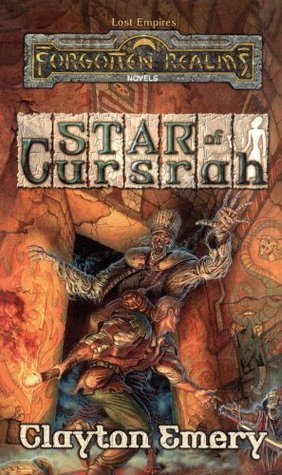
Star of Cursrah

by Rindis on July 11, 2024 at 12:00 pm
Posted In: Books

Doing a story that hops back and forth between two distinct storylines is difficult. It’s done quite well here.

There’s a lot of very deliberate parallels (in fact, this is brought up inside the novel), which help strengthen the structure. We have a privileged female character who goes slumming with her two best lower-class friends.

In the primary arc, this is in current-day Calimshan, where our lead is the daughter of a merchant house, and she is not planning on taking over the family business of dealing in slaves. The trio is very much a set of low-level adventurers, and there is a lot good old-fashioned swords and sorcery feel going on in these parts.

The other part happens thousands of years ago, centering on an extremely spoiled princess of the now-vanished city-state of Cursrah. One of the strong points of the book is that it shows just how spoiled and petty Amenstar is, and yet she is a sympathetic character.

Lore-wise, this is a great dive into the history of Calimshan, which was early established as a region where genies had once ruled, and most of the population still has some of their blood in them. Even by this point, the big ruling genies, including the great Calim himself, are gone, but many of the lesser ones remain, bound to service.

Of course, the two plots intersect because our modern trio stumble across the long-lost ruins of Cursrah, and we end up dealing with the aftermath of its fall….

Its not truly great, but it is well structured, and uses the structure well, and really delivers on mood and feel in important places, so I certainly recommend it.

└ Tags: books, fantasy, Forgotten Realms, reading, review
 Comment 

Dungeons & Sorcery Spells 14

by Rindis on July 7, 2024 at 12:00 pm
Posted In: GURPS

And now for another set of ten spells for Dungeons & Sorcery. The big standby of the bunch is lightning bolt, and the spells are generally third or fourth level. By my rarity system, fourth is when spells start getting harder to find, so we’re seeing a lot more semi-common, and named ones will go to uncommon.

Chill Shield (SC)
Evocation, Somatic, Verbal
47 points
Casting Time: 4 seconds
Casting Roll: none
Range: None
Duration: 10 minutes

The caster is wrapped in a veil of blue or green flames that do no damage, but are cold to the touch. All fire-based attacks are reflected by this shield—the caster takes no damage, and the damage is dealt to the attacker instead—if it can take damage from such an attack. However, all injury from cold-based attacks is doubled.

This is the twin of warm shield, and is usually found in spellbooks together with it.

Static (Fire; Extended Duration, x10, +40%; Reflection, +100%; Requires Gestures, –⁠10%; Requires Magic Words, –10%; Sorcery, –15%; Takes Extra Time, x4, –20%; Temporary Disadvantage: Vulnerability (Cold), x2, –30%) [1.55×30]
↓ Read the rest of this entry…

└ Tags: Dungeon Sorcery, gaming, GURPS, rpg, Sorcery, Thaumatology
 Comment 

The Rites of Peace

by Rindis on July 3, 2024 at 12:00 pm
Posted In: Books

I had thought Zamoyski’s book was just on the Congress of Vienna, but I should have taken a better look at the subtitle, which is accurate.

Zamoyski starts the action in December 1812, with Napoleon racing into the Tuileries just after news of the disaster in Russia. From here, you get, over the course of several chapters, a bare outline of the fighting through Napoleon’s abdication in April 1814.

Instead, Zamoyski looks at the peace process during this time. Both sides would rather not go through the expense and destruction of nearly a year and a half of fighting, but neither side was willing to give everything that the other desired either, so the fighting continued, until Napoleon’s shrinking army could not control the situation any more.

The Peace of Paris stops the fighting, but brings questions of what post-Napoleonic Europe is going to look like. The past quarter-century had seen conquests, annexations, partitions, and whole new political entities galore. The new potentates wanted to keep what they had been given, and the old wanted what had been taken away back.

So, a congress is scheduled in Vienna to sort this out, with the main focus of attention being Germany since the old Holy Roman Empire is gone, and it isn’t coming back. There is a stopover in London, which isn’t nearly as edifying as hoped, and points to the fact that nothing will be easy in Vienna.

From there, we get a real blow-by-blow account of the proceedings. With a host of nobility and their upper-crust representatives present, the full story is an entitled soap opera that could turn into a comedy if the subject wasn’t so serious. Zamoyski dives into the steamier (and seedier) side of the proceedings, giving a fairly well-rounded picture of the social scene, and how the emotions opened up by this affected the congress itself.

The thing that comes up during this, but doesn’t quite get enough immediate emphasis is that this isn’t—and isn’t really supposed to be—a fair-minded body of statesmen trying to get the fairest result out of a host of unfair history. This is the four biggest powers (five, once France gets into the proceedings) largely dictating to everyone else. Of course, it’s not like the major powers could easily agree to much of anything, which causes the entire process to become protracted and generate high feelings in everyone involved. This is the bulk of the book, and feels a bit interminable, but nowhere near as much so as the actual was for those involved.

Eventually outside events that everyone is aware of intervene again, and Vienna watches as Napoleon is found to slipped his exile on Elba, and heads to France rather than the expected Naples. After the Hundred Days, there is a renewed round of wrangling—France is potentially on the chopping block again, and does indeed loose a few bits of territory. But, the major problems had already been worked out, so the main work is merely to keep the more aggressive allies (notably Prussia) from doing too much damage.

All the way through, this is told in an entertaining style, and very clearly. It is as clear a book as you will find that has such a large primary and secondary cast. Zamoyski’s conclusions are a bit surprising. At the time, the congress was considered something of a failure, and certainly pointed up the vanity of people involved to their public detriment. Zamoyski agrees with this assessment, and fights against the later perceptions as having guaranteed European peace for most of a century. And he has some very good points, though I think he doesn’t give enough credit to how stable Europe was in the period compared to the 25 years previous. But, he does say that if the congress did not live up to its promises, there’s also no clear alternative that would have necessarily been better. And, it did pave the way towards better models such as Versailles (which at least, with major exceptions, tried to reference what the actual populations wanted), and the United Nations.

└ Tags: books, history, reading, review
 Comment 
  • Page 31 of 310
  • « First
  • «
  • 29
  • 30
  • 31
  • 32
  • 33
  • »
  • Last »

©2005-2026 Rindis.com | Powered by WordPress with ComicPress | Hosted on Rindis Hobby Den | Subscribe: RSS | Back to Top ↑