Rindis.com

All my hobbies, all the time
  • Home
  • My Blog
  • Games
  • History

Categories

  • Books (485)
  • Comics (10)
  • Gaming (906)
    • Boardgaming (665)
      • ASL (153)
      • CC:Ancients (82)
      • F&E (78)
        • BvR – The Wind (26)
        • Four Vassal War (9)
        • Konya wa Hurricane (17)
        • Second Wind (5)
      • SFB (78)
    • Computer games (160)
      • MMO (76)
    • Design and Effect (6)
    • RPGs (66)
      • D&D (25)
        • O2 Blade of Vengeance (3)
      • GURPS (32)
  • History (10)
  • Life (82)
    • Conventions (9)
  • News (29)
  • Technology (6)
  • Video (48)
    • Anime (46)
  • Writing (1)

Patreon

Support Rindis.com on Patreon!
Become a patron at Patreon!

Other blogs:

RSS Inside GMT

  • Meet the Xiongnu: A Civilization of GMT’s Ancient Civilizations of East Asia February 6, 2026

RSS Playing at the World

  • Playing at the World 2E V2 Arrives May 5, 2025

RSS Dyson’s Dodecahedron

  • The Flying Swine – A Fine Drinking Establishment February 6, 2026

RSS Quest for Fun!

  • The Myth of Rational Animals November 23, 2025

RSS Bruce Heard and New Stories

  • WWII Aviation Industry Part 4 August 11, 2025

RSS Chicago Wargamer

  • The 2 Half-Squads - Episode 310: Cruising Through Crucible of Steel January 27, 2023

RSS CRRPG Addict

  • Star Trail: Because It's There February 5, 2026
SF&F blogs:

RSS Fantasy Cafe

  • Strange Horizons Roundtable on Influence January 26, 2026

RSS Lynn’s Book Blog

  • Booking Ahead/Weekly Wrap Up February 8, 2026
ASL blogs:

RSS Sitrep

  • Blockhaus Rock April 1, 2025

RSS Hong Kong Wargamer

  • FT114 Yellow Extract After Action Report (AAR) Advanced Squad Leader scenario April 16, 2025

RSS Hex and Violence

  • This still exists? March 25, 2025

RSS Grumble Jones

  • Grumble Jones February Scenario GJ157 February 2, 2026

RSS Desperation Morale

  • How to Learn ASL March 16, 2025

RSS Banzai!!

  • October North Texas Gameday October 21, 2019

RSS A Room Without a LOS

  • [Crossing the Moro CG] T=0902 -- Rough start July 18, 2015
GURPS blogs:

RSS Dungeon Fantastic

  • Black Company Playtest: Summer of Riots January 27, 2026

RSS Gaming Ballistic

  • Mission X: Obviously Not 2025. Life happened, read on. December 13, 2025

RSS Ravens N’ Pennies

RSS Let’s GURPS

  • Review: GURPS Realm Management March 29, 2021

RSS No School Grognard

  • It came from the GURPS forums: Low-Tech armor and fire damage January 29, 2018

RSS The Collaborative Gamer

  • Thoughts on a Town Adventures System January 18, 2022

RSS Don’t Forget Your Boots

  • GURPS Supers Newport Academy #3: “Season Of The Witch” February 8, 2026

RSS Orbs and Balrogs

  • Bretwalda - Daggers of Oxenaforda pt.4 - Fallen King May 27, 2017

A History of the Babylonians and Assyrians

by Rindis on February 11, 2014 at 9:48 pm
Posted In: Books

I picked up this book for free in the Kindle edition some time ago. Published in 1902, it is long out of copyright, and offered by Lecturable, who seems to specialize in Kindle editions of older historical works.

It is one of the first overview histories of ancient Mesopotamia written after archaeology efforts started in the region in the 19th century. This makes the scholarship well out of date, but accounting for that problem, it is a well done, and readable introduction to the subject, and certainly well worth the $2 it normally costs if you want to get at the root of scholarship on the subject.

Or, it would be if the text was in better shape. It is, of course, an OCR scan of the book, but it seems to have gotten minimal, if any, editing. Words breaking with a space in the middle (artifact of a word broken between lines, with a space inserted in place of the hyphen?) are an endemic problem, and garbled words (caused by the OCR picking the wrong letter) are not uncommon. In fact, I’d say the book as a whole averaged better than one error per page, except for one section 75% of the way through which was much worse. Any sort of minimal editing with a human pair of eyes would have found the bulk of the problems I saw.

I can’t really complain for free, and the vast majority of the errors were such that the book was quite readable (there was only one case where I was truly uncertain what a word was supposed to be). But, it has made me quite leery of Lecturable’s products, if this is going to be the usual quality.

└ Tags: books, history, review
1 Comment

Two Rounds of Thermopylae (Middle Gate)

by Rindis on February 9, 2014 at 12:00 pm
Posted In: CC:Ancients

With “Came Tumbling After” winding up fast, Patch and I played the ‘Middle Gate‘ scenario from CC:A Expansion #6 over the last couple of Tuesdays. This is the ‘famous part’ of the battle, and features a special rule for three Persian units suddenly coming in behind the Spartan forces (through the pass) with the use of an appropriate Command card. Spartans have a great Hoplite-heavy army (mostly 5-block Spartan hoplites, with some allied hoplites on one wing) lined up on a rampart, against a mixed Persian army with bows, auxiliaries, Immortals (medium infantry with archery like an aux), cavalry, warriors and heavy chariots. The Persians can gain banners by occupying the ramparts and a camp behind the wall. It’s also a long scenario, going to ten banners.

I had the Persians the first time, who go first, but only have four cards to the Spartan’s six. I started with Line Command to start a missile bombardment with the forward line and got lucky enough to reduce one Spartan MH from 5 blocks to 2. After taking one more loss, Patch cycled that unit out of the line as I moved my cavalry up on that flank. Patch then came out in the center to eliminate one of my Auxes. I moved up the warriors and knocked out a Spartan MH at the cost of two blocks on another Aux. The warriors died right after that, but only after taking another three blocks with them.

The lines separated for a little bit after that, until I tried hitting his other flank, and got thrown back with heavy losses. I plugged the Immortals into the center of my line, which had opened up, and Patch rearranged his left flank, putting a 1-block Hoplite into the camp.

I finally had a Leadership any Section card, and sent my troops though the pass to knock out the MH and take the camp. Over the next couple turns, I drove off his left flank, and took down two hexes of rampart before things stabilized. I used another Line Command to re-engage the center and traded units. Patch reorganized and took out a unit of Immortals before I finally used an Order Mediums to re-engage and knock out a couple weakened units. 10-7

Thermopylae Middle 1

For round two, Patch attempted to lead off with archery, but I had Mounted Charge, and used it to try and sweep up his lighter units, planning to retire back to the ramparts as best I could afterwards. For the loss of three blocks, I killed two Auxilia, and drove two more off with losses, leaving a single Aux left on the Persian front line, which I drove off with losses on the next turn.

Patch came through the pass at that point on a Leadership any Section, but couldn’t knock me out of the camp on the first turn, and didn’t have the cards to follow it up quickly. I eventually pulled Demophilus back and took out the Immortals in that force, and got Hydarnes as well. Patch Ordered Mediums to counterattack there and in the center, and nearly killed the MH Leonidas was with, but lost more of his flanking force and nearly his warriors for his trouble.

I moved forward in the center again, and mopped up the warriors and an Aux, and Patch Double Timed the Immortals into the breech. He caused losses, and pushed me back, but lost another Aux in the process. I used Order Mounted to re-work my line a bit, pulling out a 2-block unit while going after the Immortals. I took heavy losses to two units, while almost getting his MC, and finishing off some weakened Immortals. Patch tried attacking that part of the line, and knocked a Spartan Hoplite down to one block, but lost his MC to a battle back after failing to kill a (different) 1-block Hoplite. 10-0

Thermopylae Middle 2

Afterword:
The second game featured really friendly dice. The first game was a long slog (2 hours on Vassal, as opposed to our usual 1 hour/game) that had me down 0-4 before I managed to get any banners at all, and I only won because of the bonus points for the camp and ramparts. The second one was a shorter game where nothing could go wrong for me. I knew I didn’t want to just sit and trade archery with him for the beginning of the game. The walls don’t help with that, and he can trade out wounded Aux for Immortals and then engage me at the wall when I’m down several blocks. So I charged, and never pulled more than a couple wounded units back.

└ Tags: C&C Ancients, gaming
 Comment 

FB6 Came Tumbling After

by Rindis on February 6, 2014 at 10:00 pm
Posted In: ASL

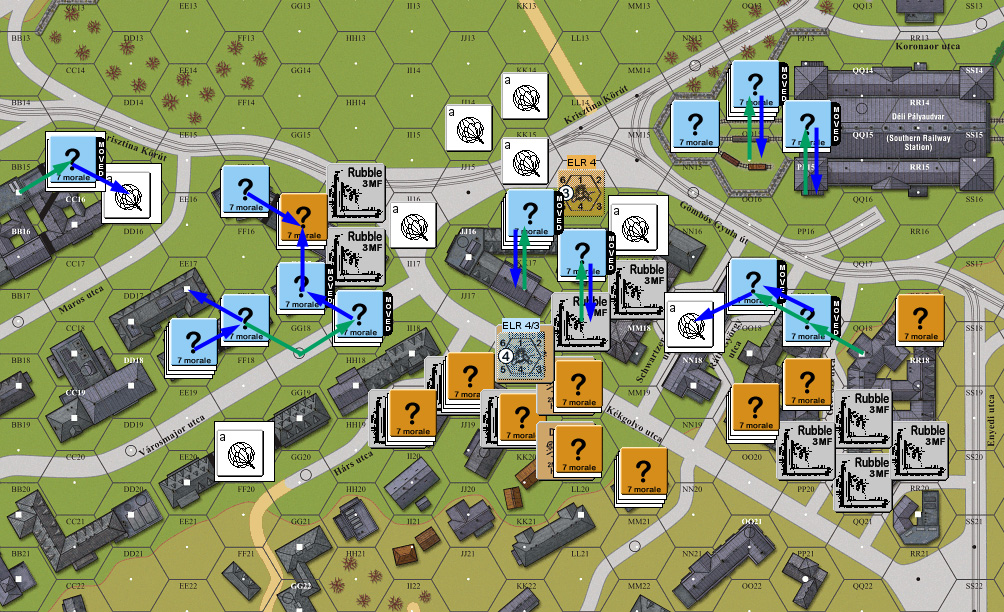
After the desert adventure, Patch and I decided it was time to get back to Festung Budapest. The sixth scenario features a Hungarian countertack up the hill on the SW map. Since I attacked up the hill last time, I took the defending Russians and set up what I called the ‘wet paper bag defense’.

The Russians get 9.5 squads plus a 57mm AT Gun to defend a fairly long front line, with a couple machine guns, a light MTR and a DC thrown in. The Hungarians get 6 first line squads, with another 12 conscript squads entering the first turn with three German JagdPanzer IVs in support, with a goal of getting two GO squads to level 5 hexes in 6.5 turns. Coming up with a Russian defense that had decent coverage was a challenge, but the Axis have bigger problems. Not only do their reinforcements have further to go at a lower speed (thanks to the reduced movement of inexperienced personnel), but the leadership situation is bad (one 7-0 leader for the entire set of twelve squads, and two more for the starting six), and the AFVs are automatically recalled at the start of turn 5. There is ground snow to slow down the advance up the hill, and Axis forces are at Ammunition Shortage level 4 (by far the worst we’ve seen).

Patch noted that the record, while a bit thin, was heavily in the Russian’s favor, so I gave him the Axis balance, which lets one of the AFVs set up with the initial force, instead of entering on turn 1. The main force set up on columns HH and LL, with two squads and the JgPz in between, and the reinforcements scattered from EE to MM with the two remaining AFVs entering on the main roads.

Patch, not liking the options for crossing the street, opened up with a 8 +1 attack from the LL23 stack, and my 458+DC squad barely passed the resulting 1MC. The on-board PzIV moved into II25, locking down my main defensive stack in the area after the squad failed a PAATC to try to Street Fight it (given that it has sN9, that may have been a good thing…).

Rather than stick around for a CC with a couple squads and a leader, or just the sN, my 458 self-broke and routed away, carrying the 8-1 with them.

FB6 1A
Full map, Axis Turn 1. North is to the left.
↓ Read the rest of this entry…

└ Tags: ASL, Festung Budapest, gaming
 Comment 

The Fourth Part of the World

by Rindis on January 22, 2014 at 6:59 pm
Posted In: Books, History

In 1507, new world maps were something of a booming business. The Portuguese had been discovering more about Africa for decades, the Spanish had recently found a number of islands, and a larger landmass across the Atlantic, and the English had found a long shoreline to the west of Greenland.

Since Asia was mostly known to be a northerly continent, that last was still presumed to be part of Asia, but the Spanish mainland, in the tropics, was starting to look like something else again. In 1507 a new map was published, designed to put together all the pieces of the world, as they were becoming known. It was a large map, meant to be mounted and used as huge wall map, and it marked the southern landmass “America”, after Amerigo Vespucci, who was known to have visited the landmass a year before Columbus did on his third voyage by a letter written by him that was being reprinted across Europe.

The map, made to be used, largely disappeared, and it was only in the nineteenth century that its existence as the first use of the word “America” for the New World was discovered. Toby Lester’s book is about this map—and everything else that led to it. This begins with medieval mappaemundi, and works its way through Marco Polo, the Italian and German humanists, and the dawn of the Age of Exploration.

It’s a very entertaining and informative book all the way, and gives a good overview of the careers of Columbus and Vespucchi, and explains the letter that has caused much gnashing of teeth over the centuries, and kept Columbus from being a major cartographical feature, even if it did not keep him out of the history books.

It is most likely not written by Vespucci at all. It takes pieces of two of his letters, some details from one of Columbus’ reports, adds sex and cannibals, and did a brisk business for local printing presses across the continent. It’s kind of a early-sixteenth century equivalent to the DaVinci Code.

└ Tags: history, reading, review
 Comment 

The Advanced Set

by Rindis on January 5, 2014 at 12:32 pm
Posted In: GURPS

One of the first major supplemental releases for GURPS 4th Ed was GURPS Powers. The introduction for the book states that it is a ‘how to’ guide, and can be considered to be Basic Set: Powers. I disagree with this sentiment; it’s really GURPS Advanced Set.

I first came to this conclusion before getting the book. I noticed while cruising around the SJG forums that any ‘how do I do this’ question that didn’t have a fairly straightforward answer invariably ended up referring to Powers, if only in passing. In general, it is meant to be a pure tool kit replacement for Psionics and Supers from the 3rd Ed line, with wider applicability. Since that time, there have been some ‘worked example’ products based on the principles in Powers, most notably Psionic Powers.

GURPS 4th Ed can boil down to a very simple game, but is very much a system where the more effort you put in, the more you get out of it. This is the core of GURPS Powers. The central concept of the book is providing a logical framework to plug ‘powers’ into. In this case, ‘powers’ are abilities (which may be represented by several different advantages) that stem from some special power source (magic, chi, etc).

Instead of just letting a character take a number of different abilities, and tie them together with ‘special effects’ (if that), Powers proposes a structure that explicitly ties them together as a package. This then allows the introduction of concepts like shutting down the entire package with an ‘anti’ power, or defenses that only work against another type of power (like a fire power melting ice attacks), allowing complicated interactions between abilities to be defined ahead of time instead of ignored (because there’s nothing in the mechanics to support it), or done purely on ad hoc basis.

With some time spent working things out (or even revising powers later, and adjusting point totals when good ideas come up), it seems to me that GURPS can now do better genre-emulation of superheroes than Champions in character creation. (At least Champions 4th, I don’t know if the later editions have added anything to help guide the interplay of powers/special effects.) And this is even better for universes with a more limited set of wide-ranging powers (say, The Last Airbender universe).

There is, of course, a cost. To do this properly, the GM needs to spend the time and effort to define the ‘sources’ and ‘foci’ of the powers in the game, and quite likely, the overall structure of the abilities in the powers. This is extra time, effort, and math. But, after putting in the effort, you have much better support for all the interactions.

Some 60+ pages are spent on advanced discussion of existing advantages and modifiers in the context of powers, and a couple of new, potentially very abuseable advantages are introduced. (The existing ones also get some interesting extensions, such as the version of injury tolerance that replicates the type of zombie that keeps going after being dismembered, including outlining the abilities of the various separated body parts.)

Other parts of this book include a wide range of pre-worked-out examples. This ranges from the modifiers that many powers would use (and since these often make them less useful by defining situations where they won’t work, they are usually modest cost breaks), the types of abilities many popular power types should have associated with them, to detailed abilities built out of the base advantages and disadvantages of GURPS to better suit things often seen in fiction. And then there is the usual very well done discussion of how to handle things in a campaign (including a rundown of abilities that can interfere with, or short-circuit, an adventure, and how to prevent it becoming a major problem). And there is a chapter of optional rules for use with powers, such as the possibility of a power being crippled (say, by over-use). And a chapter discussing the nature of genres that typically have powers as a major focus (from mythic fantasy to superheroes).

Overall, this is a ‘crunch’ book, mostly useful for GURPS 4th Ed, and a very well done one at that. But… I can’t help thinking that the power structure ideas here could be taken and adapted to other general point-based systems. It would take even more work, but this may be nearly unique as a crunch book that could actually serve more than one system.

└ Tags: gaming, GURPS, Powers, review, rpg
 Comment 
  • Page 218 of 308
  • « First
  • «
  • 216
  • 217
  • 218
  • 219
  • 220
  • »
  • Last »

©2005-2026 Rindis.com | Powered by WordPress with ComicPress | Hosted on Rindis Hobby Den | Subscribe: RSS | Back to Top ↑