Rindis.com

All my hobbies, all the time
  • Home
  • My Blog
  • Games
  • History

Categories

  • Books (491)
  • Comics (10)
  • Gaming (911)
    • Boardgaming (669)
      • ASL (154)
      • CC:Ancients (83)
      • F&E (78)
        • BvR – The Wind (26)
        • Four Vassal War (9)
        • Konya wa Hurricane (17)
        • Second Wind (5)
      • SFB (78)
    • Computer games (161)
      • MMO (76)
    • Design and Effect (6)
    • RPGs (66)
      • D&D (25)
        • O2 Blade of Vengeance (3)
      • GURPS (32)
  • History (10)
  • Life (82)
    • Conventions (9)
  • News (29)
  • Technology (6)
  • Video (48)
    • Anime (46)
  • Writing (1)

Patreon

Support Rindis.com on Patreon!
Become a patron at Patreon!

Other blogs:

RSS Inside GMT

  • Meet The Han: A Civilization of GMT’s Ancient Civilizations of East Asia  March 20, 2026

RSS Playing at the World

  • Playing at the World 2E V2 Arrives May 5, 2025

RSS Dyson’s Dodecahedron

  • Rytassa’s Deep March 23, 2026

RSS Quest for Fun!

  • The Myth of Rational Animals November 23, 2025

RSS Bruce Heard and New Stories

  • Preview: The Iron Queen February 9, 2026

RSS Chicago Wargamer

  • The 2 Half-Squads - Episode 310: Cruising Through Crucible of Steel January 27, 2023

RSS CRRPG Addict

  • Arena: Urban Sprawl March 23, 2026
SF&F blogs:

RSS Fantasy Cafe

  • Michael Swanwick Guest Post and Book Giveaway February 23, 2026

RSS Lynn’s Book Blog

  • Booking Ahead/Weekly Wrap Up March 22, 2026
ASL blogs:

RSS Sitrep

  • Cardinal ASL Sins March 18, 2026

RSS Hong Kong Wargamer

  • FT114 Yellow Extract After Action Report (AAR) Advanced Squad Leader scenario April 16, 2025

RSS Hex and Violence

  • This still exists? March 25, 2025

RSS Grumble Jones

  • 2026 Kansas City ASL Club's March Madness Tournament March 16, 2026

RSS Desperation Morale

  • How to Learn ASL March 16, 2025

RSS Banzai!!

  • October North Texas Gameday October 21, 2019

RSS A Room Without a LOS

  • [Crossing the Moro CG] T=0902 -- Rough start July 18, 2015
GURPS blogs:

RSS Dungeon Fantastic

  • What color is paut? Sigh. March 3, 2026

RSS Gaming Ballistic

  • Pigskin project (by Chris Eisert) February 28, 2026

RSS Ravens N’ Pennies

RSS Let’s GURPS

  • Review: GURPS Realm Management March 29, 2021

RSS No School Grognard

  • It came from the GURPS forums: Low-Tech armor and fire damage January 29, 2018

RSS The Collaborative Gamer

  • Thoughts on a Town Adventures System January 18, 2022

RSS Don’t Forget Your Boots

  • GURPS Supers Newport Academy #3: “Season Of The Witch” February 8, 2026

RSS Orbs and Balrogs

  • Bretwalda - Daggers of Oxenaforda pt.4 - Fallen King May 27, 2017

The Amazons

by Rindis on March 17, 2016 at 12:00 pm
Posted In: Books

I was expecting something of a detailed look at the Greek myths of Amazons with modern archaeology put in to start telling us just how much of it might have been true.

Instead, this is a bit more wide-ranging, largely conflating ‘amazon’ with ‘woman warrior’, and examining pretty much everything we know, from a variety of mythological traditions from Greece to China, and from archaeology, and from those ancient traditions that still continue today, though the strongest associations are still Greek myth.

Mostly, it’s a good discussion of what we do know of ancient women warriors (through archaeology) in nomadic peoples such as the Scythians, but a little more general than I was hoping for.

└ Tags: books, history, reading, review
 Comment 

Reluctant Offensive

by Rindis on March 13, 2016 at 1:40 pm
Posted In: Boardgaming

Mark came over for some FtF gaming yesterday; he showed me the basics of the Operational Combat System with the first few turns of Reluctant Enemies. Mark and Jason have played some OCS, but apparently haven’t done much with RE, so Mark didn’t know too much more than me about the situation. It had also been a while, so there was some self-refresher going on from the teacher.

I took the Vichy French, and started down the road of figuring out the administration of supplies. They start with a decent-sized dump off at the east edge of the map, where doesn’t seem to do much good, and is easy to cut off. I shifted much of it to a more exposed position that I was trying to protect, as it was a crossroads, and managed to bring a little all the way back to Damascus.

The initial British assault took out some of the border guards (little 2-5 units), but the main push at the coast and just inland stalled for a lack of supplies, and problems getting HQs sorted out. The Free French showed up in Syria on turn two, and spent a little bit of time getting to my main position, but knocked the center out of that easily. I had also maintained a position in a bit of rough terrain in western Syria, that did a much better job of holding of the Commonwealth forces, forcing them to retreat on the first attempt, and then retreating a hex on the second attempt, which left them still in the hills, but low on ammo.

Meanwhile, the inland valley in Lebanon was holding very well. Between the supply situation, the escparpment, and my local collection of troops, Mark wasn’t getting anywhere, and a very lucky bombing run (’12’) eliminated a strong unit while disorganizing another.

We only got through the first three turns, though that was enough to start getting the idea of how the game operates. I still have some confusion over supply distances and the such, though supply consumption I’m getting.

It’s impossible to not make some comparisons to EFS, and I do like how defending units are not just given a free pass for supply. On the other hand, I’m not sure I care for the ‘barrage’ system for artillery and tactical air support, instead of wrapping it into the combat system (though it does allow for more flexibility in proactively affecting units—disorganizing them—without actually attacking or waiting for an attack). I’m also generally happier with the air combat/support system in EFS for much of the same reason, and I really like the ready/flown cycle in EFS (especially the fact that most aircraft will not fly on a rain turn), but I have problems with the generic basing, and that is a welcome extra bit in OCS.

└ Tags: gaming, OCS, Reluctant Enemies
 Comment 

R vs B Alliance Turn 13 in Review

by Rindis on March 8, 2016 at 12:00 pm
Posted In: BvR - The Wind

Crossposted from the SFU blog on BGG.

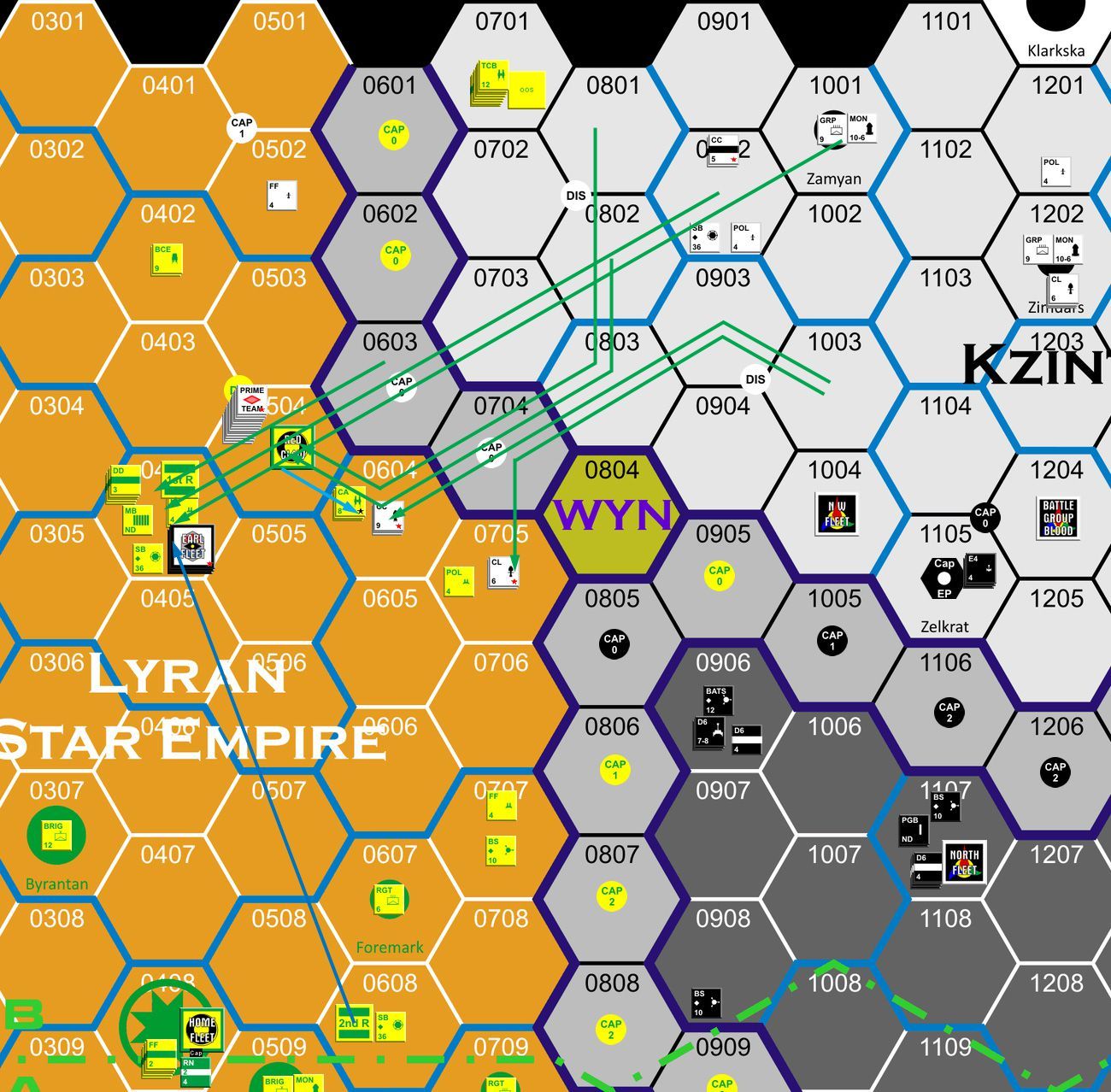
Economically, turn 13 was fairly good. The Kzintis earned 94 EP, greater than their base economy of 93. This is kind of inevitable, as the slow expansion off off-map territories drives up income, but is also a sign that the Kzinti territory is in good shape, with all but one of their planets back in their possession, all but one of those producing income again, and all but one of those producing at the full undevastated rate. This allowed them to repair everything, produce a full schedule, convert a CVL up to a CV (while producing the standard one CV per turn), convert the remaining captured D5 to Kzinti service, install a third PDU on 1502, and produce a PDU that is being set up on 1504.

Meanwhile, while the Federation economy is not unhealthy (211.4 income), they could only afford around half of the waiting repairs, and despite telling myself that I needed to maximize carrier production, only produced one CVS; instead opting to produce the second CVA pod, which immediately went to the TG with the 6th Fleet.

While I wanted to hit some major targets near the rim of the galaxy, including the Klingon Tholian Border SB, there were too many ships in the region (including way too many Romulans still near the 7th Fleet SB) to be able to do much. Elsewhere, my main target was the Klingon Fleet, which had a number of poorly-supported elements scattered around their northern area. This was complicated by the fact that the Lyrans are still capable of reaching the Kzinti capital, so large chunks of the Kzinti fleet need to be able to retrograde back to cover that.

While I’d like to push the Lyrans out of Kzinti space proper, the Klingons are still taking up too much attention, so a decent fleet was sent to 1001 with the idea of trading some fighters for some cripples, and wear the Lyran garrison down over the course of a couple turns.

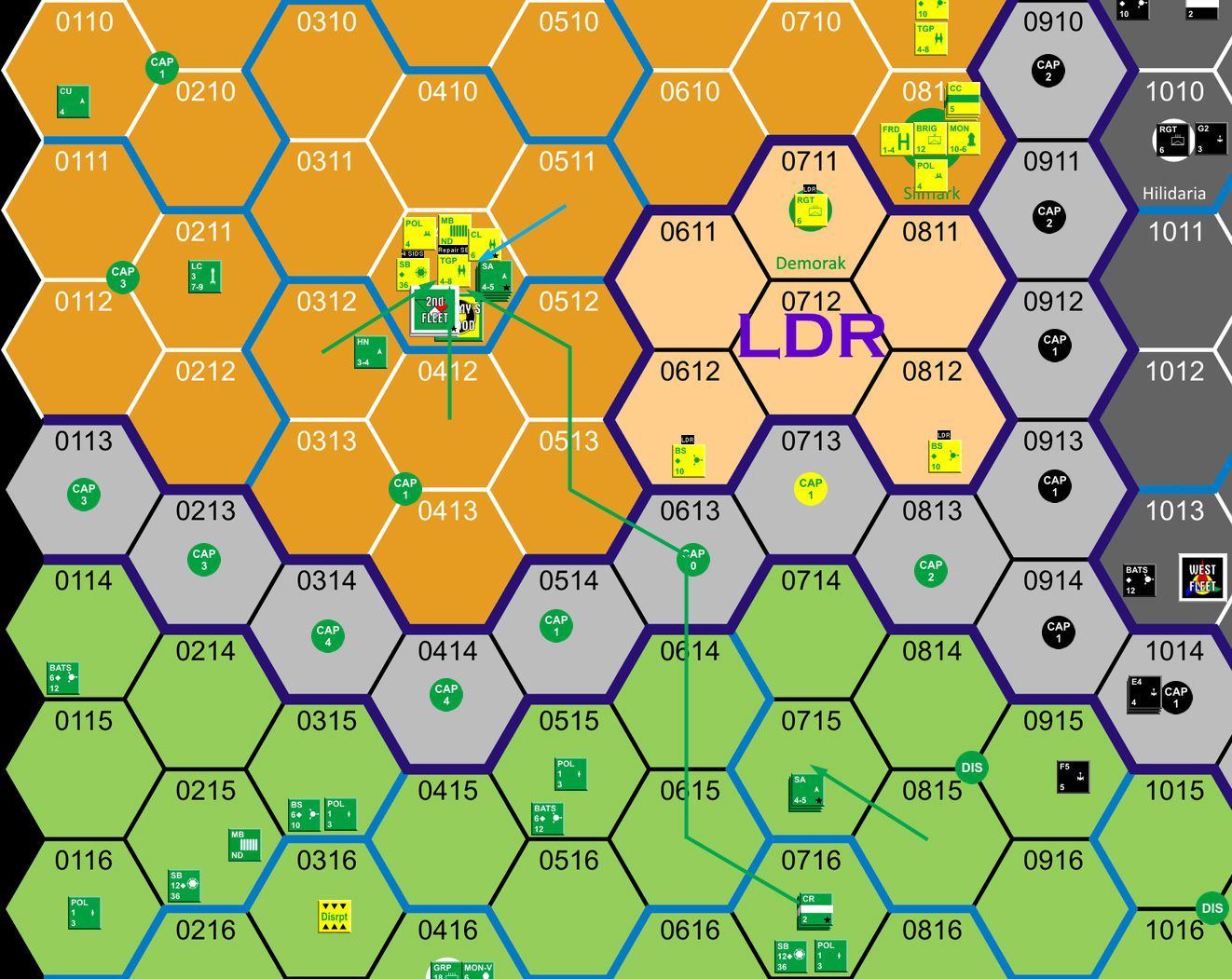
Bel had, to my surprise, left me an opening in Hydran space by not retrograding his forces from last turn’s battle back to their base at 0416. I was able to pin the force in 0119 with the bulk of the forces still in the Old Colonies (I was worried that Battle Group Blood in 0117 would react and spoil the show, but they didn’t), and then the 2nd Fleet swung around the other Klingon/Lyran forces to attack the captured Hydran capital! This is ordinarily important as the hex is providing 9 EPs to the Coalition, but Bel had just started setting up three different MBs in the hex, so he was planning on making it much harder to take in the near future.


Kzinti offensives.


Operation “Clean Sweep”.


Operation “Limited Target”.


Home again…

Battles:
3516: Romulan: BATS destroyed
3415: Romulan: dest SPH, crip SP, WE, FAL, K5L, SNB; Federation: dest 2xCC
3313: Cloaked evasion
3412: Cloaked evasion
2815: Romulan: dest WE; Federation: dest FF
2516: Klingon: dest E4; Federation: crip DD
2315: Klingon: crip E4A; Federation: crip FF
2216: Klingon: dest 2xPDU; planet captured
2014: SSC: Klingon retreat
1916: Klingon: dest 2xPDU; planet captured
1812: SSC: Federation: crip FF, retreat
1611: SSC: Klingon: dest PDU; Federation: crip CL, capture planet
1810: SSC: Klingon: retreat
1612: Klingon: crip D7C; Federation: dest CA
1909: Klingon: dest crippled D5
1709: Klingon: dest D5, crip 2xD5, 2xF5L; Kzinti: dest Z-D5, crip BC, CM, EFF
1605: Klingon: crip F5E
1305: Klingon: dest E4, crippled E4
1408: Klingon: dest D6D; Kzinti: crip FF
1210: Klingon: dest 2xPDU, planet captured
1209: Klingon: dest BATS
1009: Klingon: dest BATS
1001: Unopposed withdrawal
0801: SSC: Lyran: crip SC, retreat
0803: Lyran: dest 2xFF; Kzinti: crip 2xCM, FF
0519: SSC: Lyran: crip 2xFF; Hydran: crip CU, retreat
0119: Unopposed withdrawal
0617: Lyran: dest 2xDW; Klingon: dest E4; capital captured

I was a little surprised that the Romulans didn’t send a reserve to both major battles on their border, and was even more surprised that Bel was initially prepared to retreat out of the fight that he sent the reserves to (I did still have a larger force), and he was surprised when I retreated out. But the mission was to kill the MB being set up in 3415 and the adjacent BATS, and get back to the 6th Fleet SB. Bel obviously tried to block the way home, but thanks to retreating out of both hexes, I could just manage a retrograde path back. On the other hand, he killed two CCs, and that is going to hurt.

There were a few SSC fights on the Klingon border, and I didn’t roll well on any of them. Both sides have a negative modifier in 2014, so that wasn’t so surprising, but I had to go two rounds against a single PDU in 1611, and I couldn’t do more than kill the fighters of a lone FV in 1810 with a +3 roll.

I was surprised that Bel sent both Klingon reserves after BG Napoleon instead of rescuing the major planet in 1611, or interfering in other fights. Having been out of supply, it was low on fighters, but was still a powerful fleet, once back in supply for combat. Unable to get the damage to cripple a carrier, he mauled a CA in formation….

…And then he mauled the D5 in Kzinti service in the next battle. It’s disappointing to see it go, but it’s already been in several battles, and crippled more than once, so I got good service from it. In return, I managed to kill a D5 during a pursuit battle.

I was surprised that the Lyrans were willing to let 1001 go without a fight. He’s still in range of the Kzinti capital, but now there’s no supply there, and no place to retrograde to if he raids it, so there’s significantly less danger to it than before.

The Lyran reserve went to 0803 instead of the planet, so he had a good line versus a half line that was picking on some province garrisons. With some extra reserves, I’m not sure why he self-killed frigates, since the Lyran economy is in great shape.

If I’d been thinking, I’d have left a ship in 0319 so I’d be able to string supply through 0519 to the capital, no matter how temporarily. As it is, the fleet is in a partial grid, and not replacing fighters.

I was hoping to do a bit more damage to the Klingon fleet this turn, but it really is hard to force someone into a fight he doesn’t want, and I wasn’t really expecting to take out another four planets this turn.

Turn 13 scoring:
Coalition: 390.8 EP (x2) + 570 (bases) + 570 ships (/5) = 1471.4
Alliance: 333.4 EP (x2) + 480 (bases) + 547 ships (/5) = 1256.2

Difference = 215.2 Major Coalition Victory

Eliminating the 100-point bonus for the Hydran Capital still doesn’t shift this down from a major victory (barely), partially because of the addition of further Romulan bases as they survey and activate their backfield (I may have forgotten to account for some of that last turn). The Coalition also gained 35 ships this turn, mostly with the Romulans. Meanwhile, the Alliance gained 46 ships, even with the Coalition mauling away cruisers.

└ Tags: BvR Wind, F&E, gaming
 Comment 

Walls of Troy VI

by Rindis on March 4, 2016 at 12:00 pm
Posted In: Books

Osprey’s Fortress book on ancient Troy is not a bad guide to the history of the site as known to archaeology as a whole, but the bulk of the book concentrates (understandably) on Troy VIh, which is one of the contenders to be the Troy of the Illiad (there are arguments for VIIa). It also has the most well-developed defenses.

Beyond a few pages introducing archaeological periods, and the history of excavations of the site, there is a nice color diagram of the major features of each level of the city showing how it grew over time, and a 12-page history of the city from 2900 BC to 550 AD. I should say in the previous sentence, how the central fortress of Troy grew, since it has now been established that there was a walled lower town, at least during the Troy VI period, typical of major fortresses.

After a five-page digression on techniques of mud-brick building (the stone lower walls of Troy had mud-brick upper sections), book gets into its main focus on the walls of Troy IV, with an emphasis on the later portions of the period. Various towers and gates have technical names for archaeologists to identify them by (such as Gate VIT), but no diagram of these elements is provided, and would have made things much clearer. As usual with Osprey, there are some very good photos of various elements, that also show some of the unusual features of Troy’s fortifications. The color illustrations also do a great job with reconstructions of the city, and cut away views, but are curiously washed out with low contrast (the cover has much higher contrast than the full illustration when shown on page 39, and is much easier to read because of it).

The last parts of the book deal with evidence that the Myceneans were indeed involved in plundering the shores of Anatolia (as well as other places), and spends a few pages pondering interpretations of the Trojan Horse, including possibly as an actual siege engine. While the discussion was interesting, there just is too little known for it to be more than speculation.

In general, this is a typical interesting Osprey look at an interesting subject, but I think the color illustrations desperately need another pass through the art department to get the color balance and contrast fixed, and some of the subsidiary material could have been dropped for a detailed layout of Troy VI, both of which leave the book a little lacking.

└ Tags: books, fortress, history, Osprey, reading, review
 Comment 

The Name of the Rose

by Rindis on February 27, 2016 at 12:00 pm
Posted In: Books

It’s hard to figure out where I should start with this book, because there’s a lot of places where I could start.

The Name of the Rose is set in 1327, and the struggles of the Christian church in northern Italy form the real background of the novel. The early 14th century comes through very clearly throughout the pages of the book, and as a historical novel it does extremely well. Various struggles surrounding the idea poverty and the church, heresy, the nature of heresy, the changing nature of towns and power, the emperor and the pope are all there, and come to life as much as the monastery that provides the setting of all the action.

However, all of this is part of the secondary plot, and form long passages that distract from what is technically the main action. The center of the book is a series of murders at a Benedictine monastery, which are investigated by the two main characters. (The main—not viewpoint—character, William of Baskerville, is an obvious homage to the origin of the mystery story, Sherlock Holmes.) The mystery itself is less successful, partially because all the other parts of the book demand too much time to keep it moving consistently, but more because the story is more of a tragedy than the mystery it presents itself as.

The book is well-written, even in translation from Italian, and well worth reading for a good combination of prose, history and mystery, but it tends towards the overwrought and long-winded.

└ Tags: books, history, reading, review
 Comment 
  • Page 188 of 310
  • « First
  • «
  • 186
  • 187
  • 188
  • 189
  • 190
  • »
  • Last »

©2005-2026 Rindis.com | Powered by WordPress with ComicPress | Hosted on Rindis Hobby Den | Subscribe: RSS | Back to Top ↑