
Rindis.com

All my hobbies, all the time
  • Home
  • My Blog
  • Games
  • History

Categories

  • Books (504)
  • Comics (10)
  • Gaming (918)
    • Boardgaming (674)
      • ASL (155)
      • CC:Ancients (83)
      • F&E (78)
        • BvR – The Wind (26)
        • Four Vassal War (9)
        • Konya wa Hurricane (17)
        • Second Wind (5)
      • SFB (78)
    • Computer games (162)
      • MMO (77)
    • Design and Effect (6)
    • RPGs (66)
      • D&D (25)
        • O2 Blade of Vengeance (3)
      • GURPS (32)
  • History (10)
  • Life (82)
    • Conventions (9)
  • News (29)
  • Technology (6)
  • Video (50)
    • Anime (48)
  • Writing (1)

Patreon

Support Rindis.com on Patreon!
Become a patron at Patreon!

Other blogs:

RSS Inside GMT

RSS Playing at the World

  • Playing at the World 2E V2 Arrives May 5, 2025

RSS Dyson’s Dodecahedron

  • Scavengers’ Deep – Map 33 July 16, 2026

RSS Quest for Fun!

  • The Expense Post May 24, 2026

RSS Bruce Heard and New Stories

  • Pain, Exhaustion, and Morale in D&D BECMI June 7, 2026

RSS Chicago Wargamer

  • The 2 Half-Squads - Episode 310: Cruising Through Crucible of Steel January 27, 2023

RSS CRRPG Addict

  • Game 581: Dragon Quest (1982) July 15, 2026
SF&F blogs:

RSS Fantasy Cafe

  • The Leaning Pile of Books July 5, 2026

RSS Lynn’s Book Blog

  • Friday Face Off: The Raven and the Reindeer by T Kingfisher July 17, 2026
ASL blogs:

RSS Sitrep

  • Cardinal ASL Sins March 18, 2026

RSS Hong Kong Wargamer

  • FT114 Yellow Extract After Action Report (AAR) Advanced Squad Leader scenario April 16, 2025

RSS Hex and Violence

  • This still exists? March 25, 2025

RSS Grumble Jones

  • Grumble Jones July Scenario GJ162 You Will Engage the Enemy July 1, 2026

RSS Desperation Morale

  • How to Learn ASL March 16, 2025

RSS Banzai!!

  • October North Texas Gameday October 21, 2019

RSS A Room Without a LOS

  • [Crossing the Moro CG] T=0902 -- Rough start July 18, 2015
GURPS blogs:

RSS Dungeon Fantastic

  • Felltower - Monsters Fleeing between Sessions vs. PCs replenishing June 28, 2026

RSS Gaming Ballistic

  • B-Scale Detail and Examples July 16, 2026

RSS Ravens N’ Pennies

RSS Let’s GURPS

  • Review: GURPS Realm Management March 29, 2021

RSS No School Grognard

  • It came from the GURPS forums: Low-Tech armor and fire damage January 29, 2018

RSS The Collaborative Gamer

  • Thoughts on a Town Adventures System January 18, 2022

RSS Don’t Forget Your Boots

  • GURPS Supers Newport Academy #7: “Invitation to the future.. of the 1970’s” July 5, 2026

RSS Orbs and Balrogs

  • Bretwalda - Daggers of Oxenaforda pt.4 - Fallen King May 27, 2017

Revel Bay

by Rindis on June 26, 2016 at 12:00 pm
Posted In: Boardgaming

Patch came over yesterday to try out GMT’s Flying Colors series through my copy of Blue Cross, White Ensign. I discovered at the last minute that I had missed a sheet while punching and clipping it, so I was a little under-prepared, and picked the Battle of Revel as a relatively short battle with relatively few units. It features a Russian fleet at anchor as a much larger Swedish force sails towards it (with over half the fleet trailing off off-map to enter along the same line as the at-start fleet). After a little back-and-forth, Patch ended up taking the outnumbered Russians.

My initial plan was to continue on course, and then turn to break the Russian line between the first and second ships and then… well, I wasn’t too sure what I’d do once through, since the edge of the bay would be right there, but the continued string of Sweedish ships would keep coming to let me concentrate power at that forward point.
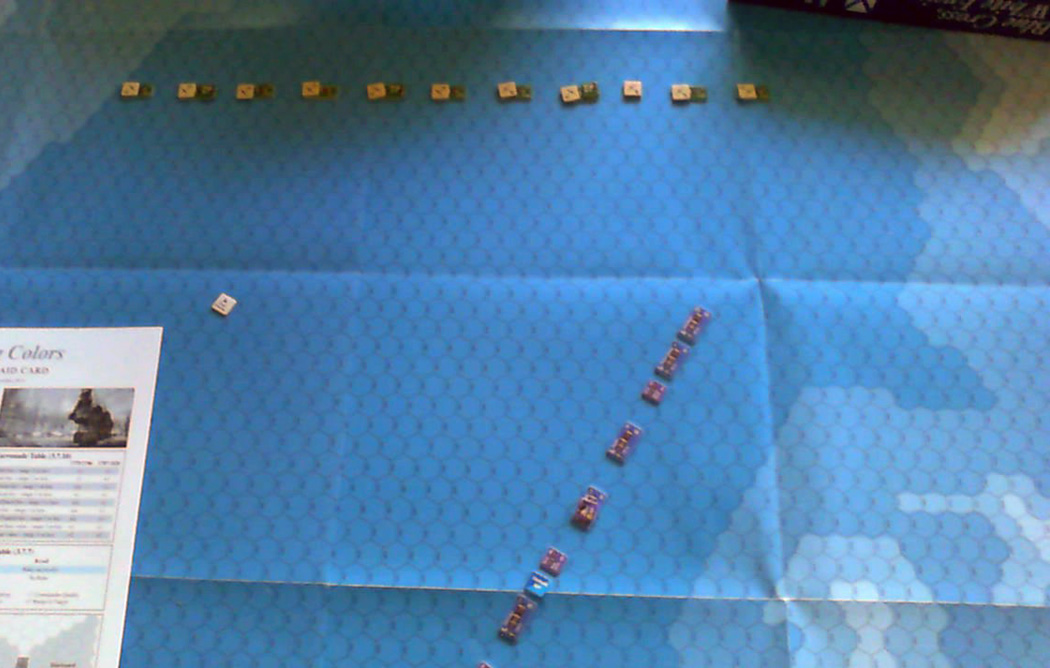
Revel-1
After the end of the first turn. I’ve backed sails a couple times with the lead ships to have a more solid ‘punch’ once I started getting into range. Note that the light blue are shallows, and the even lighter blue areas are automatic grounding (effectively the coast).

That plan started going wrong on the second turn, when the wind turned two point (120°) clockwise, meaning that my line was now beating against the wind (thanks to the breezy conditions, this meant a speed of three for the entire line). Since the wind was now coming from the rear of the Russian fleet, there was no way to turn to make speed, since the only options would carry me away from the Russians. Only one ship got in range on turn two, and the range didn’t start getting close until turn 4. Patch had been content to sit and let things develop, but slipped anchor on his rearmost three ships at this point, and started sailing them towards the emerging melee.

During all of this, most of the marked Russian advantages started showing themselves. In this scenario, Audacity is 2 for the Russians and 0 for the Swedes, so Patch was generally firing two columns higher, and being at anchor gave him a +2 for all the die rolls. Also, the Russians have a special rule that allows them to fire twice out the same side, so long as they don’t do it in the same activation. All this is fairly needed in their situation, but it did mean that each ship was firing twice when mine could only fire once. Finally, as I was firing into the wind, I was generally firing at the rigging against anchored ships just to improve my odds of hitting anything, while Patch was firing at the hull.
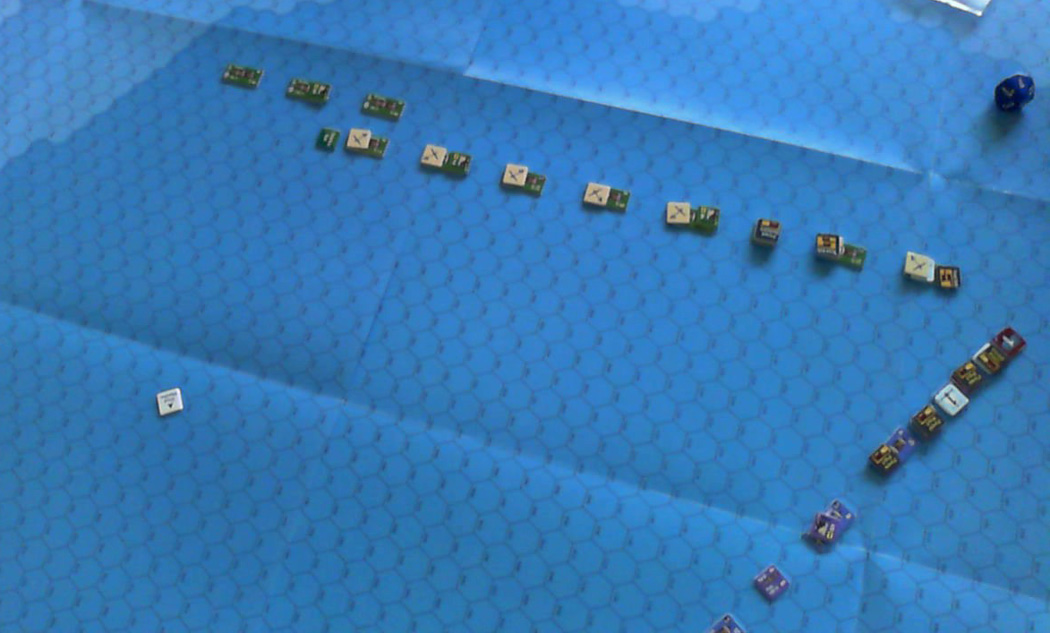
Revel-4
End of Turn 4. My lead ship would anchor on the next turn to deliver broadsides while partially out of the Russian’s arc.

I abandoned formation on turn 5, leaving the forward commander to control by proximity for the rest of the game. I slowly fed in ships, getting them beaten up, as Patch broke off a second squadron to slip anchor and sail towards the fight that I was already losing. On turn eight, the wind finally shifted again, after five turns of staying steady, turning another point clockwise to put the entire Swedish line In Irons! Most ships turned to port to beat against the wind toward the rear of the Russian line, while Patch’s advancing squadrons were slowed by needing to beat against the wind themselves.
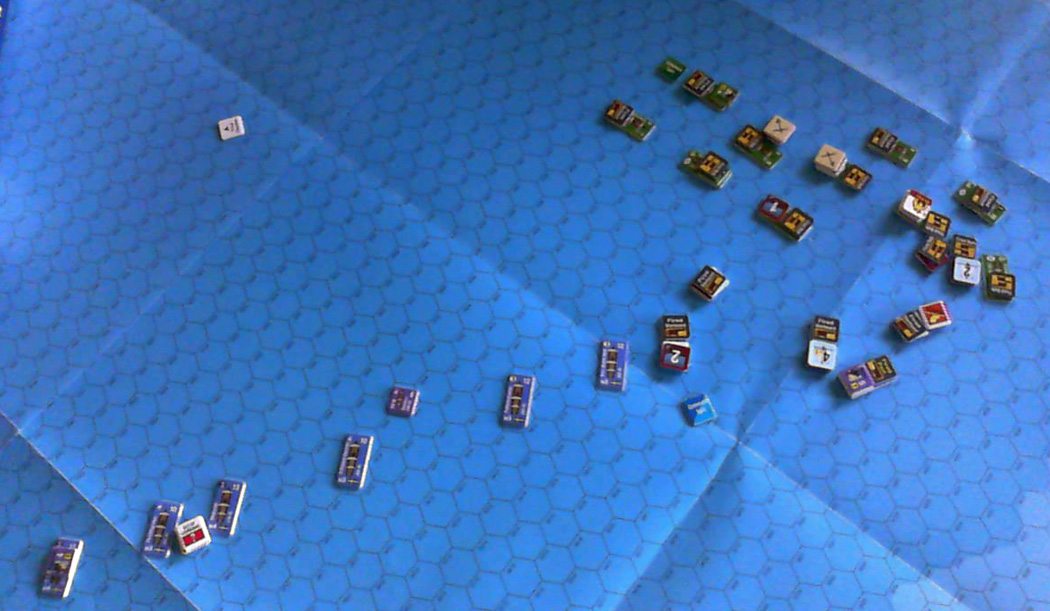
Revel-9
End of Turn 9. One ship has struck it’s colors and another will follow in a couple turns. This one will get captured by Patch.

The last Russian advantage is that they have two 1st Rate ships, while everything else present is 3rd or lower. Neither of them  is near the front of the line, but when Patch’s mobile squadrons came up, I started taking an even higher firepower drubbing (though it was nice to be getting fire that wasn’t constantly at +3). I forgot to check to see if my fleet broke off after my first ship struck it’s colors, but at least it’s low odds (I had plenty of undamaged ships) and it was getting near the end of the scenario anyway.
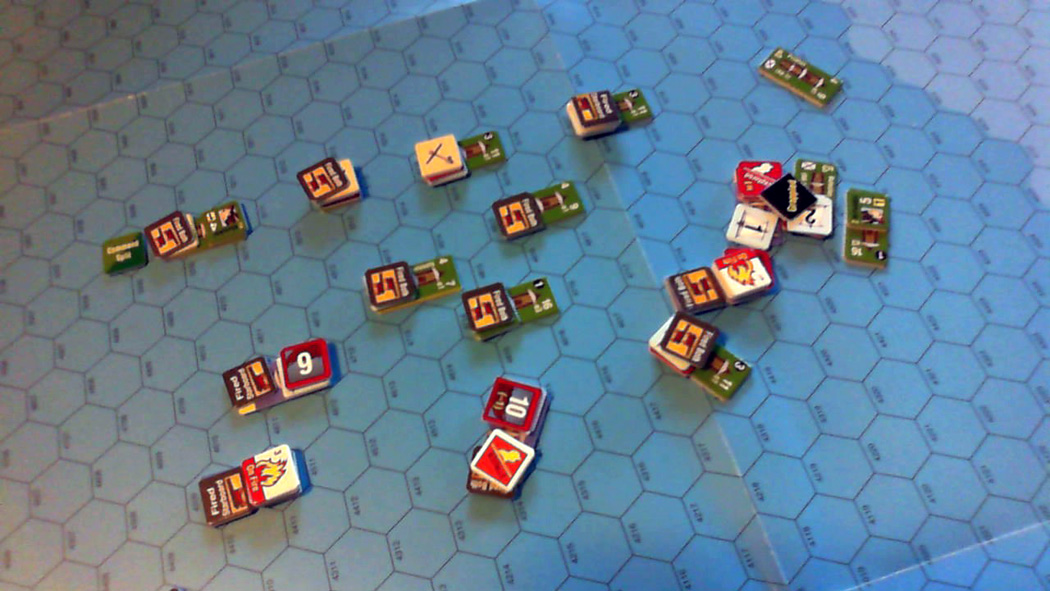
Revel-12
End of Turn 12/Game. Yes, those are my ships on fire, though Kir Ioann was on fire for a couple turns.

I think I did better than the Swedes did historically (a ‘handful’ of Russian casualties), but still did not actually get to the point of dismasting or flipping any Russian ships over as ‘damaged’ (some were getting close). The wind just absolutely killed my ability to do much; I needed mobility and didn’t have any. The Russians got 22 VPs:

Dristigheten – Captured
Dygden – Sunk
Riksens Stander – Sunk
Gota Lejon – Struck
Aran – Damaged
Camila – Damaged
Froja – Damaged

About a third of the Swedish fleet never got to the combat, and another third never even got on the board, as they have to enter in one place, in one direction, and the wind was directly against it for the end.

Patch says he enjoyed the game and would like to play again, which makes me very glad. He’s never really had the naval bug, and this is the first time he’s played a Age of Sail game. I certainly enjoyed it a lot, though it got depressing towards the end as more and more Russian ships got involved, and I just couldn’t do anything. I’ve been wanting to try out my set for the last month or so, and am happy I finally did.

However, there are a surprising number of places where the rules and charts still need some clean up. The sequence of play is never given in the charts (just near the beginning of the rules), and the various parts of the end-of-turn status checks are hidden in other rules rather than put where one can find them for that particular segment. A number of modifiers on the charts could do with an explicit reference to it’s particular rule. The modifier for a black or white background on the rate is looks like it says ‘+1 [to] Rate value’ instead of ‘+1 [if] Rate value…’ at first glance (I’d say “White­ background Rate value if base­ fire­powe­r is shade­d”, or better, “Shaded base firepower with white background Rate value”). Actually, I’d like a cheat sheet of all the various different symbols associated with the relative rate value. Finally, taking 6 hull hits increases the relative rate by one, but the counters say ‘-1’ and only start at 7 hull hits (I suspect it used to be a -1 firepower modifier instead of +1 rate, but the counters need updating).

└ Tags: Blue Cross, Flying Colors, gaming
 Comment 

The Magic of Points

by Rindis on June 23, 2016 at 12:00 pm
Posted In: GURPS

As GURPS initially evolved, a few different subsystems started getting added on to the core attribute-advantage-skill package. One of the very early ones was the magic system in GURPS Fantasy that added spells as a complex series of skills with other spells as prerequisite dependencies, a need for an advantage to be able to use them, and so on. This would grow, and be elaborated on, until Fourth Edition’s version of Magic was a 240-page book with a couple of PDF supplements adding even more spells.

Meanwhile, the concept of advantages grew, and became more nuanced and complex, especially with GURPS Supers 2e, which introduced modifiers to advantages. In Fourth Edition the entire system got overhauled and made as complete and flexible as possible. One of the results has been a number of ideas floating around as to how to do magic using the advantage system instead of as a series of skills. SJG finally released an official product in 2015 that used this approach: GURPS Thaumatology: Sorcery. (I find it interesting that Sorcery gets put in the Thaumatology line, even though it’s a spells-as-powers system, while the related concept of magic-as-patron in Divine Favor was put in the Powers line.)

Sorcery starts off laying out some very clear ground rules: All sorcerers need to have a new Sorcerous Empowerment advantage (…which is actually built off of existing abilities, and a side note talks about how) and should probably take the related talent that boosts all rolls with sorcery. Then, each spell the sorcerer knows must be bought, at one-fifth the normal cost (i.e., if it was a normal ability instead of one of many possible spells), but the Empowerment ability must be able to cover the full cost. All of this is relatively expensive (given spell costs are from 4 to 98 points with many leveled ones capable of going higher), and will keep beginning mages in a ‘normal’ 150-point campaign either relatively low-powered, or fairly specialized into sorcery (which is not exactly against genre expectations…). Costs can increase even further as a sorcerer can only have one spell ‘going’ at a time, but can get around this by paying full cost for his most expensive spell.

Further ground rules are established with eight keywords used to define how particular spells work with consistent mechanisms instead of redefining effects, resistance, etc., every time. Since ‘obvious’ is one of the keywords, this also allows the system to easily mark which spells are easy to identify as being cast by a particular person. All spells are defined as requiring at least one second (plus one second to switch between spells) and 1 Fatigue Point to cast (with a few needing more than that, and many of the underlying advantages needed modification to bring into line), and an option is presented of speaking and gesturing instead of the fatigue cost, with the idea that character would then need to do any two of the three (so, speaking and spending fatigued while bound, etc.). Finally, a sorcerer is actually able to improvise spells (to make up for the limited options at high cost), easily if they’ve spent ten times as many points on Empowerment than what the spell requires, or ‘hardcore improvisation’ involves spending 3 FP and a Will roll to cast any spell once that would be valid to learn with his current Empowerment. This could allow casting effects not covered by any spell, but it’s noted that the GM has final say, and could declare that only existing spells can be improvised (in fact, the author’s intent is more to allow a completely new spell only if the GM decides that it’s one that should already exist in the game world, but just hasn’t been written up yet).

The bulk of the book is taken up with the write-ups of 48 spells under this system (all adaptations of spells from Magic). While that is a good number to start with, it actually works out to about two spells per college in the normal skill-based system (and these are categorized in accordance with that), so no one subject gets very much attention, and building a specialist mage (rules for which are given) would be difficult currently. The surprising part is that the attack spells tend to be the cheapest, while ‘utility’ spells tend to be expensive; if you consider GURPS advantage pricing to be reasonably well balanced, this perfectly fine, but it is surprising when you’re used to systems that keep the nasty magical hurt people abilities under the lock and key of higher spell levels.

Surprisingly, there is also a six-page section on enchanting items, with another page on economics giving the wages of an enchanter at various Tech Levels (which affects the item prices!). There’s already been a couple of different systems for enchanting in GURPS, including an extensive one in Magic. That one I never cared for, as it’s geared around making very weak magic items, or making it so hard to do (so players don’t just make everything themselves) that it seems unlikely anyone would bother. This system is more flexible (Magic gives what kind of item each spell can be enchanted into, while Sorcery lets the enchanter choose his materials), but still tries to put some interesting brakes on PC enchanters by requiring more powerful items be made from more valuable items. It’s still costly, using “Spending of Yourself” in Thaumatology to require a few character points to be spent on creating non-trivial items as well as a decent amount of time. My main problem with the system is that it still assumes that any spell can be enchanted into an item, and anything that isn’t a spell can’t. However, with the points-based costs of everything, it would not be hard to work around this. A smaller problem I have is that it is assumed an existing item is being enchanted, and there’s still no support for enchantment through the act of creation, which is popular in a lot of fiction.

Conclusion

As a drop-in-and-play system, Sorcery is still underdeveloped, as the relatively low number of specific spells quickly becomes a problem. Hopefully, we will see sequels dedicated to rounding out the system some more (it should be noted here that an early version of this system appeared in Pyramid Vol 3, #63, and it has eighteen fire spells that aren’t in the current volume; also, Pyramid Vol 3 #82 included two more spells and a full sorcerer template for use with the Dungeon Fantasy line). Even if/when there are further volumes, an eager GM is going to need to make multiple purchases (of course, Google searches for other GM’s spells will help); I think this could be a great place for an eventual package deal.

That said, it’s a great book for tinkering GURPS GMs on two levels: First, all the mechanics are explained (though often kept out of the way in clearly marked boxes) so it is not hard to start making new spells on your own with just Basic Set (though Powers would help a lot). Second, the solutions for how to build some of the spell effects are very inventive, and there are ideas to be stolen here that can be used in completely different contexts.

As a magic system, it provides a very different feel to the standard GURPS solutions as there are no magic skill rolls. An attack spell still needs a ‘to-hit’ roll, and the target gets a defense roll, but normally a mage has to make a skill roll to cast the spell before even getting to that point. Most of the systems in Thaumatology don’t change this basic fact, but merely reduce the number of skills in use from dozens for the standard magic system (up to hundreds for a ‘know-it-all’ mage) to about a dozen in Path/Book, Syntactic, and related systems. Here, the relatively high expenditure of points declares this to be something the character can reliably do, and the initial point of failure is removed.

Also, since there’s no need for the logical prerequisite chains of the skill-based system, it’s possible for a GM to create a spell set that has deliberate holes in it. The standard skill-based system was built around mages learning small effects and working up to large ones, with enough prerequisites drawing from other areas to cause trouble if a GM wanted to disallow one college. Most of the other systems have enough flexibility that a mage can always do a small spell (light a fire) if he has a large spell. Only Path/Book and Sorcery can say A does not imply B (and Path/Book is built around longer rituals and hidden effects instead of the endless potential for flashiness in Sorcery).

└ Tags: gaming, GURPS, review, rpg, Sorcery, Thaumatology
4 Comments

Prince of Dogs

by Rindis on June 19, 2016 at 12:00 pm
Posted In: Books

The second book of Crown of Stars definitely suffers from a fracturing of the plot, with eight different viewpoint characters, most of which get turns from the get-go. Only one of these is a completely new character, and Anna’s story serves as something of the spine of the book, covering the plight of a pair of orphans after the taking of Gent. Unfortunately, even though her arc moves from a unstable equilibrium to a new, much better one at the end, it still feels partly unresolved, keeping Price of Dogs from having the same ‘tied off’ feeling that King’s Dragon did (that isn’t necessarily bad in book two of seven, but it feels like it was supposed to feel more complete at this point).

Between snippets of continuing threads, and much of the more developed portions centering around politics and the royal court, the book lacks the energy needed to really sweep you along, even though there’s plenty here, and some more of the worldbuilding becomes evident. Then ending suddenly, and surprisingly, picks up in tempo and sends you through the last hundred pages in a rush. Mostly though, Eliott does a great job in juggling all the different pieces of her story, keeping them moving along, and threading elements of each part into the others, so that you never feel that you really should be reading two or three different books.

The worst problem Prince of Dogs has is that the two main characters of the series, Alain and Liath, continue to be among the least dynamic of the cast. Liath’s arc continues with some important steps—as long as she can stay away from Hugh—and it’s shown that her helplessness is being imposed on her. Alain… mostly spends the book trying to grow into his new role, and having the predictable problems, as well as less expected ones. But, it doesn’t really feel like his story does much, except perhaps help weave much of the rest of the book together.

└ Tags: books, fantasy, reading, review
 Comment 

The Eastern Realms

by Rindis on June 15, 2016 at 12:00 pm
Posted In: D&D

In 1985 TSR released Oriental Adventures, a new AD&D hardcover geared towards adventuring outside the normal tropes of Western Medieval Fantasy. Unusually for TSR and AD&D, it also contained the outline of a setting, called Kara-Tur, instead of saying as little as possible about locales outside of specific products.

Some of this reticence about particular settings carried over, as it was still designed to be able to be dropped into any existing campaign, although it was assumed to belong at the far end of the continent featured in the World of Greyhawk. With the discovery of world-building as a new class of product line, a full boxed set was done on Kara-Tur in 1988, setting it in their new hot property, the Forgotten Realms.

In general, the contents resemble the Forgotten Realms boxed set, with two 96-page booklets, and four poster-size maps (with no grid, and the same clear plastic hex-grid sheets as in the former box set). Past the pure physical contents, it gets stranger. The books are purely a two volume guide to the lands of Kara-Tur, instead of being split between a general use guide and DM’s materials (in fact, the page numbering continues straight through both books). The four map sheets are double-sided, and much more scattershot than the systematic presentation the Realms were getting between the main set and the FR-series supplements. One sheet gave two overview maps of Kara-Tur, one political and one topographical, each at a scale of 580 miles per inch. (The two full-sheet 90-mi/in maps of the original set cover about 12 million square miles; the single Kara-Tur map covers roughly 125 million square miles, or more than 10 times the area.) From there, there are three 90-mi/in full sheet maps and one half-sheet one, a 30-mi/in full sheet map, a 30-mi/in 3/4 sheet map (the remaining quarter is used for a city map and some building plans), a half-sheet 30-mi/in map, a 30-mi/in inset map of an island, and a couple small 30-mi/in maps on the same sheet as several city maps and a couple of building plans. These maps generally do not connect to each other or (with a few exceptions) detail an area covered in larger scale, giving a somewhat disjointed sense of presentation.

Despite being in two physical parts, the books break down into three rough sections, with the beginning being Chinese-inspired countries, the end being Japanese-inspired countries, and the stuff in the middle being more of a variety of other Oriental influences. China and Japan have decided top billing here, with the middle chapters being shorter, much less detailed, and not as well written. Each chapter supposedly written by a different in-world personality describing the area to Elminster, and actually written by a different contributing author. As with any anthology, this leads to a variety of styles, presentation, and quality.

The first part of “China” is Shou Lung, a fantasy version of ancient China which gets a pretty good introduction in about forty pages, including a gazetteer of the provinces, a cultural guide, Chinese-style renamings of the largely Japanese-influenced classes from Oriental Adventures, secret societies, religion, history, sample NPCs, and some details on a typical example town, complete with social tensions. These forty pages are packed. Of course, since this is the country that takes up most of the overview map, there’s plenty of room for invention as well.

If Shou Lung is fantasy Lawful Good China, T’u Lung is its Chaotic Evil mirror, where the bureaucracy hinders every action, taxes go uncollected, many towns are ruined by unrestrained bandits, etc. This overstates the case, as neither country is full of people of a particular alignment, but it’s not a bad assessment of the character of the countries. Overall, this section gets a bit more lost in details, such as having even more NPCs than given in the longer Shou Lung chapter, but since this is the Southern Song to Shou Lung’s Imperial China, the cultural notes from both chapters can be of help for both countries.

Kara-Tur transitions from China with Tabot, a little too obvious fantasy Tibet. With only eight pages, if you already knew something of Tibetan history, this might be enough. For me at least, this is where the boxed set starts strongly saying, ‘there’s China, and then the rest of the world is boring’. There’s just not enough here to get a real feel of the place. Sure, there’s some history, and short bits about architecture, language, religion, etc. But it is all breezed through, there’s no touches like Tabotan-culture class names; nothing more than the barest overview.

This too-short treatment dogs the next several chapters, starting with The Plain of Horses, which is obviously the home of the fantasy Mongol/barbarian horde stand-ins before you even read the chapter. And… it’s pretty much a fastball straight down the center of those expectations. Almost everyone is a barbarian (in the class-mechanics sense), everyone rides, etc. That said, while there’s a number of different tribes that fight with each other, many of them have apparently permanent cities that serve as their central meeting spot, up to the largest, Li-Raz, that has a 15,000-man (barbarian) standing army. Still, this feels a little more like a place to flesh out and adventure in, rather than visit, than Tabot, though it probably comes down to relative existing knowledge for me.

The Northern Wastes (out past the Plain of Horses) is another sparsely-populated area with no central nation, and no overriding culture either, leaving the area undeveloped in text as well, a home of lone mysterious places, and a primary place to find non-humans (more on that later). The Jungle Lands to the south of T’u Lung with multiple nations are broadly-Indonesian in flavor, but this ten-page chapter is ill-served with pages of short city descriptions crowding out broader concerns of what the area is like, with the three peoples presented are given the barest outlines. The Island Kingdoms… yes, technically, there are kingdoms (multiple) here. But the chapter spends its time purely on the island of Bawa (too-obvious renaming—Java—strikes again). With such a tight focus, the island is actually fairly well developed, and this is one of the better places to have adventurers visit and interact with, but it’s hard to imagine a campaign starting here. I’d like to complain about ignoring the rest of the region the chapter should be about, but this product needs more focus like this.

Then Kara-Tur transitions to Japan with Koryo, or fantasy-Korea. While Korea has often suffered from being stuck between China and Japan, Koryo is much more influenced by Kozakura than Shou-Lung. The ‘narration’ of this chapter is schizophrenic, supposedly written by the author of the Shou-Lung chapter, but with parts also from a brother/sister pair. They offer nicely contrasting views in one part, and the entire chapter could have been much stronger with more use of the technique.

Kozakura is a chain of islands modeled after waring states Japan, with Wa being an adjacent set of islands modeled after the Tokugawa Shogunate (down to persecuted Chauntea cultists in place of Christian missionaries). Like the pair of ‘Chinas’ earlier, these chapters have a decent amount to offer each other in terms of crossover society and background. Thanks to the increased coverage, and the smaller geographical size, they’re probably the easiest to digest for adventuring in, pointed up by the fact that most of the OA-series adventures happen in these two countries. They also feature a lot of color by way of Japanese terms and titles. I’m happy with it, but I can easily see someone being severely overwhelmed by all the foreign names and terms, and having a lot of trouble with this section.

Conclusion

In many ways, the Kara-Tur boxed set is just crammed full of possibilities, and can serve as a great inspiration to a DM. But it also suffers from overreach. It would be easy to take any one part of this product and turn it into something deeper and more focused, and still be giving the barest outlines of world-building inspiration. However, the worst omission is actually the absence of any sort of timeline. There are history sections, and many parts refer to an event happening in ‘such-and-such a year’, but the current year is never stated, making all those references nearly useless (and they’re obviously not in Dale Reckoning, and probably are in different calendars in different countries).

For me, the boxed set lived entirely on its Forgotten Realms tie-in, and that is a place that it also runs into trouble. While Kara-Tur has plenty of high-power, high-fantasy elements that make it fit into AD&D well, it does not fit with the Realms so well. The Realms are an ancient land that have been dominated by dragons, dwarves, and elves in turn, where the human era is still getting going with the wreckage of former empires scattered about. Meanwhile Kara-Tur is a very human-oriented land. There’s no signs of this backstory here. No elves, and only peripherally dwarves (if you count korobokuru), and no great pre-human empires. It’s possible they just didn’t get out this far, but it clashes with the tone of the main Realms.

The fact that the regions and cultures are all closely modeled after Earth equivalents comes in for some criticism. I’m generally fine with it (I’m a fan of Mystara, which uses that technique for much of the world), but there is the problem that as alluded to before, they the ‘fantasy’ here is largely powered by the actual myths of these cultures, and not by the implications of AD&D style-magic and the like. For instance, Shou Lung has some very nicely Chinese ideas of a Celestial Empire and heavenly bureaucracy that is reflected in the mortal realm by Shou Lung itself… but this has no place in the ‘great wheel’ cosmology of AD&D that has such an influence on the Realms. It’s not even explained how it works in relation to the other countries in the boxed set.

All of this is probably why Kara-Tur remained almost unexplored in further products. There were a few more OA-series adventures released after this, and The Horde would tie the eastern and western parts of the continent together, but there were no KT-series modules to expand on the setting, and when WotC released a new Oriental Adventures for 3rd ed D&D, and included a setting in that book, it was Legend of the Five Rings‘ Rokugan, not D&D‘s Kara-Tur. It remains a good foundation for adventure settings, but is too much to just visit, and needs too much work to base a campaign in.

└ Tags: D&D, Forgotten Realms, gaming, Kara-Tur, review, rpg
 Comment 

Studying Magic

by Rindis on June 11, 2016 at 12:00 pm
Posted In: GURPS

A common problem with generic role-playing systems is that they often have non-generic answers to important questions.

For instance, Traveller was originally meant as a generic SFRPG, before it started generating a setting that pretty well took over the line in later iterations. But even sticking with the early, non-setting specific materials, it still has a number of assumptions built into the basic rules. Most notably, a severely range-limited hyperspace FTL system keeps it from feeling like, say, Star Trek, without going in and completely redoing that section. Similarly, for some time GURPS had a single magic system, that while very good in its own right, had its own flavor. Other systems got introduced in various worldbooks during 3rd Edition, but it would take a 4th Edition book to really look at the problem.

GURPS Thaumatology is a big book about magic systems (plural). It has a number of different systems to use, and some general talk about the ways magic can work in a world, and how this might be reflected in the game, all so a GM can have a system that feels right.

Variations on a Theme

Thaumatology starts out with a chapter on how magic works in general (magic as art vs as engineering, Law of Contagion, etc.), and then goes on to an extensive chapter that just deals with tweaking the normal GURPS skill-based system.

Just doing that provides a lot of food for thought, with a vast array of options. This ranges from different tweaks to the advantage that allows spell-casting, to the possibility of basing spell casting on something other than intelligence (say, willpower). There’s discussion of changing around the spell lists (including one thorough worked example), and prerequisites, and even a look at what types of shapeshifting fit with different background cultures. And there’s a too-brief look at how to enforce the ‘mages wear robes’ trope (the two methods looked at are skill penalties for encumbrance or for the amount of iron worn). In all cases, the options get the usual GURPS thoughtful look over, complete with the likely effects on the game.

The chapter after that presents bigger variations on the standard system; these are sections that deal with an overall rework of the system, instead of a bunch of little options. The first one is the idea of using the skill-based system for clerical magic as was presented in GURPS Religion, with a few more notes added.

After that comes a section on Ritual Magic, which is an expansion of a system suggested in Basic Set. There, it got about half a page, and here it gets four, which goes much more in-depth as to how to make it work. In this case, it simplifies the skill system down to colleges, with all the spells in the college attached directly to that. Then comes Threshold-Limited Magic from an early issue of Pyramid, which replaces the fatigue cost with a tally that limits casting by putting the mage at personal risk when he does too much.

Then “Mandatory and Significant Modifiers”, are more of a tool kit again. It proposes giving skill modifiers for various astrological or symbolic concerns, possibly being used to overcome a flat overall penalty (or they may be needed to be able to cast at all!), and several tables in the appendix give details. Finally, “Assisting Spirits” has the idea of a character getting a large break on spellcasting… by making a contract with another being that provides the bulk of the power—at an appropriately steep price.

Physical Magic

The next chapter takes a look at the use of physical objects for magic, first looking at the inherent properties some things may have, and how they could be used as another system of modifiers for a regular spell-casting system. Then about seven pages are given to alchemy, including thoughts on allowing characters to come up with new concoctions, or even treating it as a gadgeteer advantage.

After that, there is a serous look at enchanting items, starting with the standard systems given in Basic Set and Magic, and how they can be tweaked for the needs of a campaign. Some more serious alternatives are looked at with the idea of age granting power to items (after all, all the most powerful items in fiction are immeasurably old…). Also covered are all of the possibilities of great deeds, regular use and the like causing an item to become magical on its own. Finally, there is a discussion of items with a will of their own, from how they are created under the normal enchantment rules, to how to write them up as a character.

The Path of the Book

After this Thaumatology finally starts going further afield. The next chapter covers what’s called Path/Book Magic, which is based off a Third Edition system that originally appeared in GURPS Voodoo. Meant to act like a lot of real-world magic traditions, all ‘spellcasting’ is in the form of rituals that generally involve gathering energy, and then expending it for the particular effect. This is still effectively a skill-based system, but it concentrates on one skill: Ritual Magic. That skill, and skills for each particular tradition—a ‘path’ or ‘book’—makes up all the skill entries on the character sheet, which is a lot more compact than the normal system.

However, each tradition contains a limited number of particular spells, which are then cast at a specified penalty to the base skills. These are also more general spells than the standard ones, with the area of effect, duration, or number of targets being decided by the caster, which modifies the skill, energy, and time needed. The system is arranged around wider-ranging, and more subtle, effects than the usual ‘mage as artillery’ systems seen in many RPGs, though very high skill levels can allow a character to shortcut many limitations. After a fairly thorough grounding in the system, the chapter concludes with ten sample paths and three books.

How to be Flexible

The next chapter then gets to the idea of cutting loose from pre-defined spells completely, and gives a couple major versions of that idea. The first is the use of symbols, or runes, which give a set of concepts to work with, which are then combined into a spell. This allows for inventiveness from the player, and the use of Symbol Drawing skill and skill in each symbol used (which means a character can easily be better at certain types of effects). Thaumatology then gives a couple of sample traditional systems, and gives ideas for using rune stones or drawing symbols fresh and the like.

Then is Syntactic Magic, which works similarly, with everything split up into categories, which need to be worked out by the GM, though two general schemes are presented: First, ‘Verb-Noun’ magic, where every spell consists of what is being done to whom. It’s mentioned that mages can potentially leave some normal parameters (like duration) undefined, and let his margin of success determine it. To that end, there’s also options as to whether certain effects take more energy or more skill to pull off, and lots of advice and tables for modifiers, depending on which way the GM goes. Second, ‘Realms and Power’ focuses on how much a mage can do with any particular realm as defined by leveled advantages (one side box also discusses the possibility of recasting this entire idea as a power structure from GURPS Powers, which would be mechanically much more complex to work out, but would tighten up the mechanics and definitions—which is great for consistency, and horrible for letting the GM insert plot-appropriate easing and tightening of restrictions). In both cases, the emphasis is on flexibility, with characters/players defining what they’re doing as they go, with the system defining what the limits and costs are, instead of working with a rigid list of spells.

Magical Advantage

The last ‘crunchy’ chapter points out that many of the advantages presented in Basic Set could easily have a magical origin. There’s some good discussion of how some traditional magical powers are represented in advantages, and there’s a couple pages of recapitulation of the basics from Powers (which is good for not requiring that book for this, but is the type of repetition that 4th Ed has tried to avoid). There’s good advice on supernatural servants (bound demons, spirit familiars, etc., done as Allies and Patrons), and spirit vessels (someone possessed by a spirit), effectively the methods where a character gets magic from another character.

My Kingdom For a Mage!

At the end of the book, Thaumatology returns to the discussion of magic instead of magic systems it began with. In this case, the chapter is about the nature of a campaign dealing with magic, and magic’s place in society and the like, instead of general thoughts of how magic works. One of the first sections notes that it probably not worth the GM’s time to work on an elaborate magic system unless magic is going to be a central pillar of the campaign. …It would have been best to present that advice up front, before going through two hundred pages of just that.

The more social discussion is then followed up by thoughts on particular game styles, most clearly when it comes to emulating how magic seems to function in a lot of superhero stories. The chapter then finishes up with four different campaign frameworks, describing settings where the nature of magic has much to offer in terms of adventure.

Conclusion

One of the brilliant moments of GURPS Space was boiling every form of FTL travel down to one of three general types and then showing how to vary them to produce anything ever seen in science fiction. Of course, how FTL drives work doesn’t really have any real influence on game mechanics the way the intensely personal nature of spellcasting does. Still, I consider it a missed opportunity that Thaumatology, for all of its wide-ranging discussion of a number of different systems and their variations, doesn’t even begin to provide a framework of discussion by taking a real comparative look at its own systems, grouping and giving an overview of them.

It is also worth noting that there are four different magic systems that currently get a fair amount of use in GURPS, each with its own distinct mode of operation, and none of them are in Thaumatology. The original magic system (magic as skills) presented in Basic Set and Magic still gets most of the attention. Second is Ritual Path Magic (magic as player/GM mediation) which got its own supplement after being introduced in Monster Hunters, but drew inspiration from several parts of Thaumatology. Divine Favor (magic as Patron) isn’t nearly as popular as the first two, but does see regular use. Finally, Sorcery (magic as Powers) just recently came out, and perhaps won’t see that much use, but so far seems to have a lot of people wanting to use it, and is based off a popular idea.

In the end, Thaumatology is an expansive, wide-ranging book with a lot of ideas for the inventive GM. But, while it has several pre-packaged systems, if that’s what you want, you’re better off skipping this book, and going for one of the ones mentioned in the previous paragraph. If you don’t play GURPS, but want to tinker around with a different magic system, this isn’t as good at cross-system inspiration as some other GURPS supplements, but it does have a lot to say, and there’s very little out there that addresses the the question at all.

└ Tags: gaming, GURPS, review, rpg, Thaumatology
 Comment 
  • Page 187 of 315
  • « First
  • «
  • 185
  • 186
  • 187
  • 188
  • 189
  • »
  • Last »

©2005-2026 Rindis.com | Powered by WordPress with ComicPress | Hosted on Rindis Hobby Den | Subscribe: RSS | Back to Top ↑