Rindis.com

All my hobbies, all the time
  • Home
  • My Blog
  • Games
  • History

Categories

  • Books (504)
  • Comics (10)
  • Gaming (919)
    • Boardgaming (675)
      • ASL (155)
      • CC:Ancients (83)
      • F&E (78)
        • BvR – The Wind (26)
        • Four Vassal War (9)
        • Konya wa Hurricane (17)
        • Second Wind (5)
      • SFB (78)
    • Computer games (162)
      • MMO (77)
    • Design and Effect (6)
    • RPGs (66)
      • D&D (25)
        • O2 Blade of Vengeance (3)
      • GURPS (32)
  • History (10)
  • Life (82)
    • Conventions (9)
  • News (29)
  • Technology (6)
  • Video (50)
    • Anime (48)
  • Writing (1)

Patreon

Support Rindis.com on Patreon!
Become a patron at Patreon!

Other blogs:

RSS Inside GMT

  • Defiance AAR: North Jersey, July 2026 — Chili Dogs and Chit Pulls July 20, 2026

RSS Playing at the World

  • Playing at the World 2E V2 Arrives May 5, 2025

RSS Dyson’s Dodecahedron

  • Barin’s Stonehold July 20, 2026

RSS Quest for Fun!

  • The Expense Post May 24, 2026

RSS Bruce Heard and New Stories

  • Pain, Exhaustion, and Morale in D&D BECMI June 7, 2026

RSS Chicago Wargamer

  • The 2 Half-Squads - Episode 310: Cruising Through Crucible of Steel January 27, 2023

RSS CRRPG Addict

  • Al-Qadim: Bottle Shock July 20, 2026
SF&F blogs:

RSS Fantasy Cafe

  • The Leaning Pile of Books July 5, 2026

RSS Lynn’s Book Blog

  • Top Ten Tuesday: I’ve gone with a freebie July 21, 2026
ASL blogs:

RSS Sitrep

  • Cardinal ASL Sins March 18, 2026

RSS Hong Kong Wargamer

  • FT114 Yellow Extract After Action Report (AAR) Advanced Squad Leader scenario April 16, 2025

RSS Hex and Violence

  • This still exists? March 25, 2025

RSS Grumble Jones

  • Grumble Jones AAR for Crucible of Steel Scenarios on the YouTube page. July 20, 2026

RSS Desperation Morale

  • How to Learn ASL March 16, 2025

RSS Banzai!!

  • October North Texas Gameday October 21, 2019

RSS A Room Without a LOS

  • [Crossing the Moro CG] T=0902 -- Rough start July 18, 2015
GURPS blogs:

RSS Dungeon Fantastic

  • Felltower - Monsters Fleeing between Sessions vs. PCs replenishing June 28, 2026

RSS Gaming Ballistic

  • Mission X and Genre Fidelity in Combat July 19, 2026

RSS Ravens N’ Pennies

RSS Let’s GURPS

  • Review: GURPS Realm Management March 29, 2021

RSS No School Grognard

  • It came from the GURPS forums: Low-Tech armor and fire damage January 29, 2018

RSS The Collaborative Gamer

  • Thoughts on a Town Adventures System January 18, 2022

RSS Don’t Forget Your Boots

  • GURPS Supers Newport Academy #7: “Invitation to the future.. of the 1970’s” July 5, 2026

RSS Orbs and Balrogs

  • Bretwalda - Daggers of Oxenaforda pt.4 - Fallen King May 27, 2017

Artillery War

by Rindis on April 6, 2020 at 12:00 pm
Posted In: Boardgaming

Mark was over on March 7th for a round of FtF gaming, now that we’d both recovered from the colds we developed last time. Up this time was The Great War, a Commands & Colors game I’d gotten for Christmas, and finally had prepped.

As my first experience with C&C outside of the GMT games, there were a few things to get used to. First, I’m definitely in favor of the blocks over the minis in this game. They’re not bad, but of course are unpainted, and handling them is a lot more cumbersome than the blocks. The cards were a lot thinner than I’m used to, though it looks like the main deck is just as many cards, and then there’s a secondary ‘attack’ deck. Rules presentation is about comparable, though there was a couple things I wish had made it to the reference card in the same format as in the rules. The board is very well produced, and double-sided (one being a pleasantly verdant field, and the other a churned-up mudscape), though they really really needed to stop that for the half hexes which turn out to be out of play (maybe they plan to have you put two together for epic? but then you only need the half hexes on one side), and the tiles are very thick and solid, and punched out with no trouble.

There’s only a few types of units, so telling the unpainted minis apart generally isn’t an issue. However, Mark missed that he had a German mortar unit, as it didn’t stand out enough from the regular infantry (small problem there: the regular unit is called ‘infantry’ everywhere but the setup instructions, where they’re suddenly ‘rifles’). Really, there’s only three in the base set, plus what’s basically a ‘special unit marker’. The dice are interesting, as there’s ‘burst’, which is the ‘always hit’ result. Two sides of ‘soldier’, which generates one hit no matter how many you get… but terrain protects from them, so it doesn’t do much in a trench. The usual ‘banner’ which causes a unit to retreat (but terrain protects against that as well), a star or ‘HQ’ symbol gives you tokens to be spent (I started calling them ’empty promises from HQ’), and then a ‘skull’, which serves the purpose of the helmet symbol in Ancients: in some cases it’s a hit, but usually it’s a dead side.

The regular deck is about what you’d expect, but you can generally order your OBA as part of one of the section cards, using the HQ tokens to pay for dice. The artillery lands around a designated target hex (chosen by regular d6), but any doubles (or better) also affect the target hex, and the skulls count. Getting three dice ‘on target’ destroys terrain, and negates all protection in the hex. It didn’t happen often for us (twice), but it’s dramatic when it does. And finally, there’s the combat deck, which you spend HQ tokens to use. We didn’t use it much in our game, but I assume we’ll use it more as we get a better idea of what it can do.

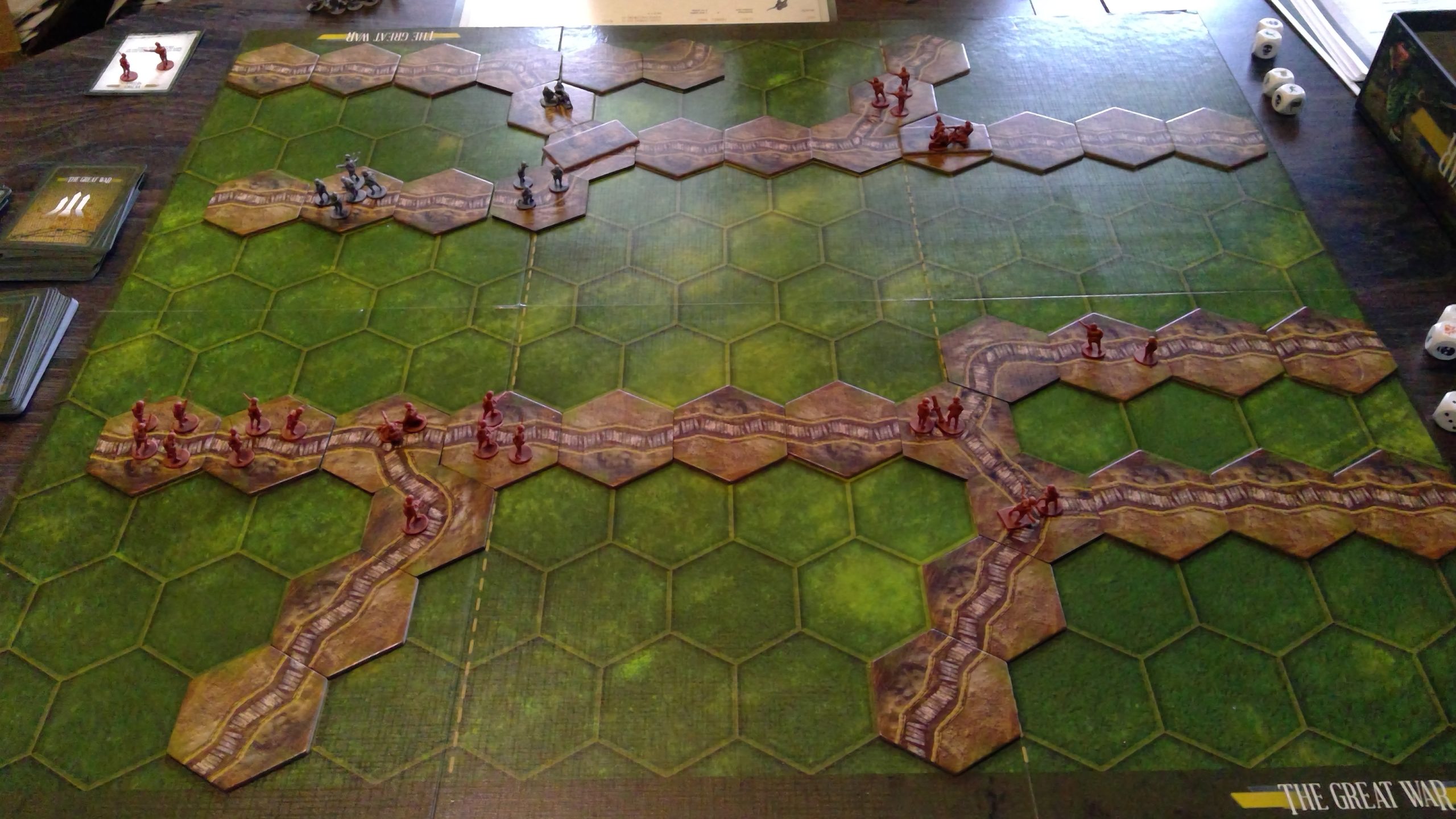
We played the non-historical introductory scenario, which took… say three+ hours to do. Now, some of it is relative unfamiliarity, and a desire to keep to the protection of the trenches, but I don’t think it’ll ever match the average 1 hour time of CC:A. That said, it does feel something like western front WWI, which isn’t something I would have said the C&C system can do. I had the Brits, who have more units (and the burden of attack in the second form of the scenario, which we didn’t get to), which I slowly organized for the ‘big push’. Both sides set up nice and comfy in their trench systems, and I moved some reserve up to the front line, while using my mortar and artillery for some effect.

I got the first lucky break of the game, when all four dice on artillery came up ‘4’, and I nearly destroyed a unit along with a hex of trench. I spent some time stockpiling HQ chits and then, two Direct From HQ cards (which allow you to order any unit you care to use a HQ chit on) got me across No Man’s Land, and into the German trench. As expected, the cost of this was a number of wrecked units, but it did finally end with Mark’s left flank wiped out.

…And despite my plan to advance up the trench and start taking on his center with an infantry and machine gun, I had two problems: first, one unit would be in the way of the other, and second, I was completely dry on right flank cards. So, the battle stumbled on for a while longer, without a dramatic conclusion, with more wearing down of our forces (and a triple from me to knock out another trench hex) until I finally won 6-2.
The original plan was to go on to the second version immediately, but that took long enough that there wasn’t really time. We both generally enjoyed it, and we’ll certainly be giving it another try later. We just need to schedule when….

└ Tags: gaming, The Great War
 Comment 

Winter King

by Rindis on April 2, 2020 at 12:00 pm
Posted In: Books

Henry Tudor is a familiar name to students of English history, especially the military side of it. Henry VII is actually a less familiar figure, despite being the same person.

So, a book on Henry VII’s reign seemed like a good way to fill in the ‘hole’ between the Wars of the Roses and the ever-popular Henry VIII. And Penn’s Winter King does a very good job at that.

I would not call this a biography. Henry VII was fairly remote as a king, watching from afar, and generally letting others be the primary face of government. Similarly, you don’t get an up-close and personal view of him here. You do see a lot of him, and his drives. The book starts with a fairly brief overview of the time leading to Bosworth, and gives an idea of how that shaped him. More importantly, it spends a fair amount of time and attention on just how unstable England was after Bosworth. No one yet knew that the trading of the throne from one faction to another had come to an end, and there were still plenty of people that the next rebellion could center around (even if some of them had to be made up for the purpose).

Much of the book therefore focuses on Henry VII’s efforts at control. This turned more and more to economic means, which people fined and held to that debt as a promise of good behavior. The truly disturbing part of this is that it was all extra-judicial, operating outside all the traditional forms of accusations and trials of Common Law. It also shows a deep concern for money matters, and Henry VII was throwing around some vast sums on the continent effectively trying to bribe/finance his way to international deals, particularly ones involving pretenders to the English throne.

One thing I do wish the book had gone into more was the flow of money. It gets touched on a lot, and there’s much that would be hard to say with certainty, but just enough is said to bring up the topic for further interest. One thread in the middle of things deals with the illegal alum trade, which Henry VII made a fair amount of money on, and was part of the shape of international diplomacy.

So, there’s a few dropped threads in what is, after all, a layman’s history. And it does a good job of covering a lot of aspects of the subject, going into the stable transition of power to his son, and perhaps leaving you wanting that little bit more. Definitely a great book to round out understanding of the end of the Fifteenth Century.

└ Tags: books, history, reading, review
 Comment 

FB15 The Taking of Object 59

by Rindis on March 29, 2020 at 12:00 pm
Posted In: ASL

Patch and I finally got back to Budapest recently, starting last December, and finally finishing up at the end of February. Speaking of, the date is 7 February 1945, so the Germans are suffering from food shortage (no double-timing, broken ML is down one), gas shortage (vehicles are immobilized on a 11+ DR when they try to Start), and Ammunition Shortage level 4 (3 for vehicles).

I got the attacking Russians, who are trying to take Object 59—the Southern Rail Station (since re-built). A secondary goal is to instead take three nearby prominent buildings in 6.5 turns. They get eighteen squads (from Assault Engineers, and elites, to 527s), three BVR squads, plenty of leaders, a .50-cal, a MMG, a FT, three DCs (one must go to the BVR), two 122mm ART, three T-34/85s, and one old T-34 M43. They also get 80mm OBA with a HIP observer. The guns come with trucks to haul them around with, and I tried, but as you’ll see, it came to nothing….

The Germans get ten squads (a mix of SS from 658 to 468s), and the Hungarians have six squads (Elite and 1st Line), with a PSK and DC, a 75mm INF, a FlaK 38 (20mm), two each roadblocks and trenches, three wire, and four vehicles: Pz IVH, Hetzer, Zrinyi II, and a Nimrod. They get eighteen mine factors, four fortified building Locations, and one HIP squad.

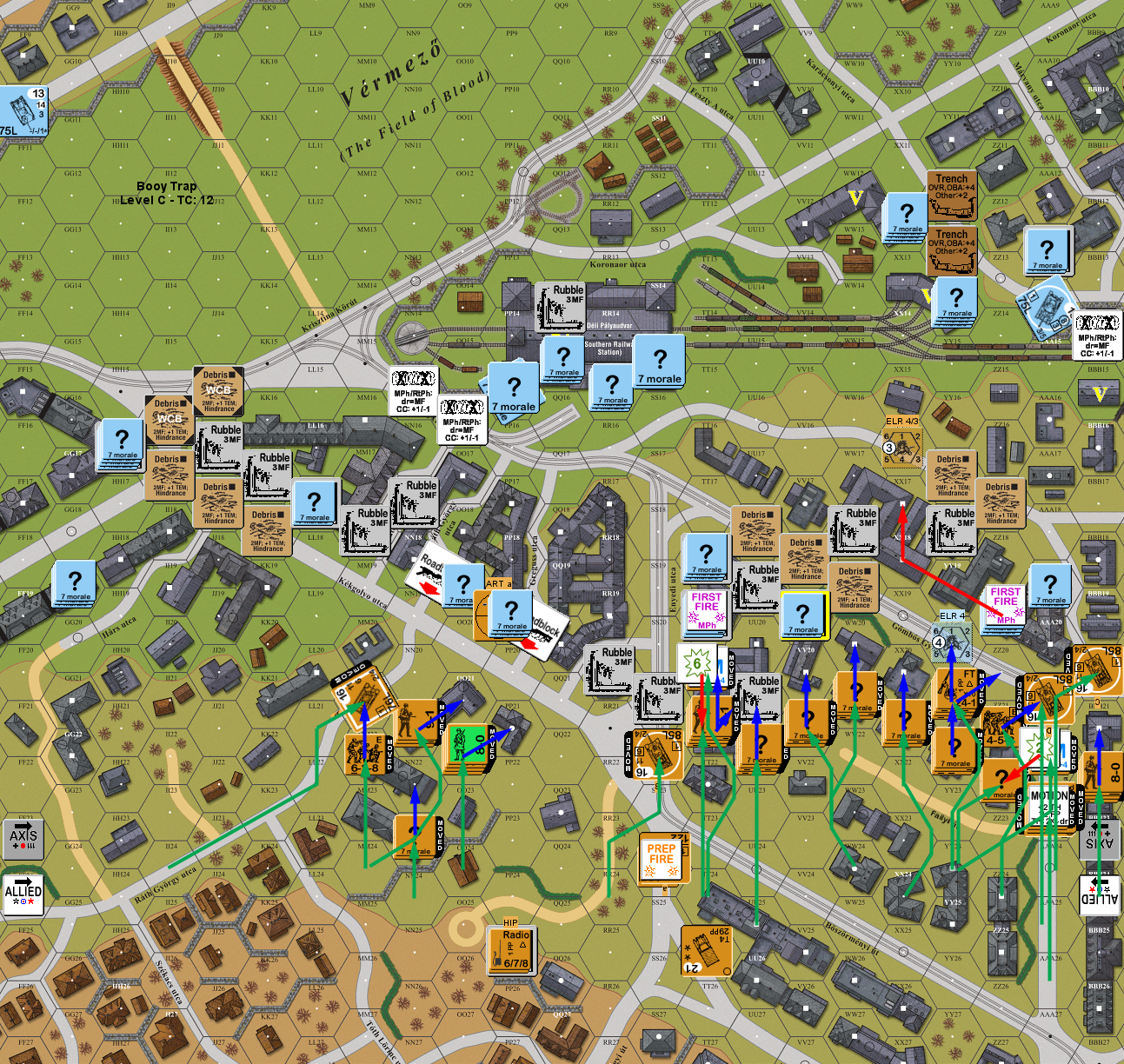
There’s eight buildings with random rubble checks, and Patch’s rolls knocked down a good part of the city, producing ten rubble counters (at least one of which was falling rubble), and ten debris markers. Patch’s defense largely used this rubble to great effect. There were almost no clear roads through the debris and rubble, and he put his roadblocks on the main two left: narrow streets NN18/OO19 and PP19/QQ20. Way off in the south part of the board were some buildings untouched by the demolitions that could be bypassed for a way for vehicles to get through without Bog (but not for Guns being towed, which I didn’t realize for a bit). He set up almost entirely behind the Kékgolyo utca, giving up a lot of space, but very secure in an extensively built up area. I had to complement him on such a fine cork in the bottle.

With not much visible from my starting line, one ART set up to force him away from PP19. I’d bring up men, tanks, and try to clear the roadblock, getting down the Greguss utca, putting pressure directly on the Rail Station. Five squads would head to the TT19 building to flush him out of there, while the rest would proceed along the south end of the map, though thinly-held territory to BBB15 (one of the secondary objectives) and then continue on to the other two. The primary goal was to take the three secondaries; there was still significant force there, but I could get there with enough time to defeat them. If too much pulled on to defend that section, re-orienting to the Rail Station was still possible.

I failed to contact my OBA on the first turn, and the only Prep was the ART missing ATT on PP19. Patch only had two shots during my MPh, but each one broke a 527; though after one shot, he was disconcerted to see a FT settle in across the street. Most of my advancing fire did little more than put down acquisition markers, but the FT got a result to break a Hungarian squad and the concealed leader with him.


Situation, Russian Turn 1, showing the full board. North is to the left.
↓ Read the rest of this entry…

└ Tags: ASL, Festung Budapest, gaming
 Comment 

Marque and Reprisal

by Rindis on March 25, 2020 at 12:00 pm
Posted In: Books

The second book of Vatta’s War finally gets to the ‘war’. Things take a very violent turn at the start, and everything follows on for that.

We get a little bit of the opposing viewpoint near the beginning, but nothing after that, so it’s still too early to know what exactly the plan is. However, there’s a feel that they might be a bit incompetent for how competent they’re acting.

Part of the setup is InterStellar Communications has an enforced monopoly on… communications. You can travel from system to system easily enough, and bring things with you, but if you want to send a direct message FTL, you go though ISC. Thankfully, they seem to be a good ‘neutral carrier’, and trustworthy, even as they’re making money off of you. As the book goes on, it becomes obvious they’ve been stifling progress with FTL communications to maintain their monopoly. Okay, fine, nice bit, and some twist in there… but then it jumps a couple orders of magnitude, which makes you wonder why this hasn’t broken loose before. And then, the final version of that jumps the shark at the end.

Outside of Macguffin concerns, there’s a lot to like. The characters all are well drawn, and Kylara continues to be a great central character. This time, there’s a lot more of the action promised but not delivered by the first book. The space-lanes are suddenly a lot less safe than they have been, and Ky is still in an old, slow, merchant carrier that’s on its way to being sold for scrap. At least, if viable ships of any type weren’t suddenly a rare commodity for Vatta Transport….

The Macguffin problem seems aimed at giving Ky a super-ability for the next book, so much will depend on just how badly that gets abused next time. Short of that, it’s a solidly-written book, with good action, and characters who have to struggle with what the violence means.

└ Tags: books, reading, review, science fiction
 Comment 

Fading Smolensk

by Rindis on March 21, 2020 at 12:00 pm
Posted In: Boardgaming

Back on Feburary 15th, Mark came over for some FtF gaming.

This turned out to be a bad idea as we both came down sick that day. I woke up wondering if I had more than my usual morning sore throat, and progressively figured out that yes, I had come down with something (and Mark mentioned I was looking pretty bad by the time lunch was over). Mark was feeling a headache and some other symptoms that only got worse as the day went on.

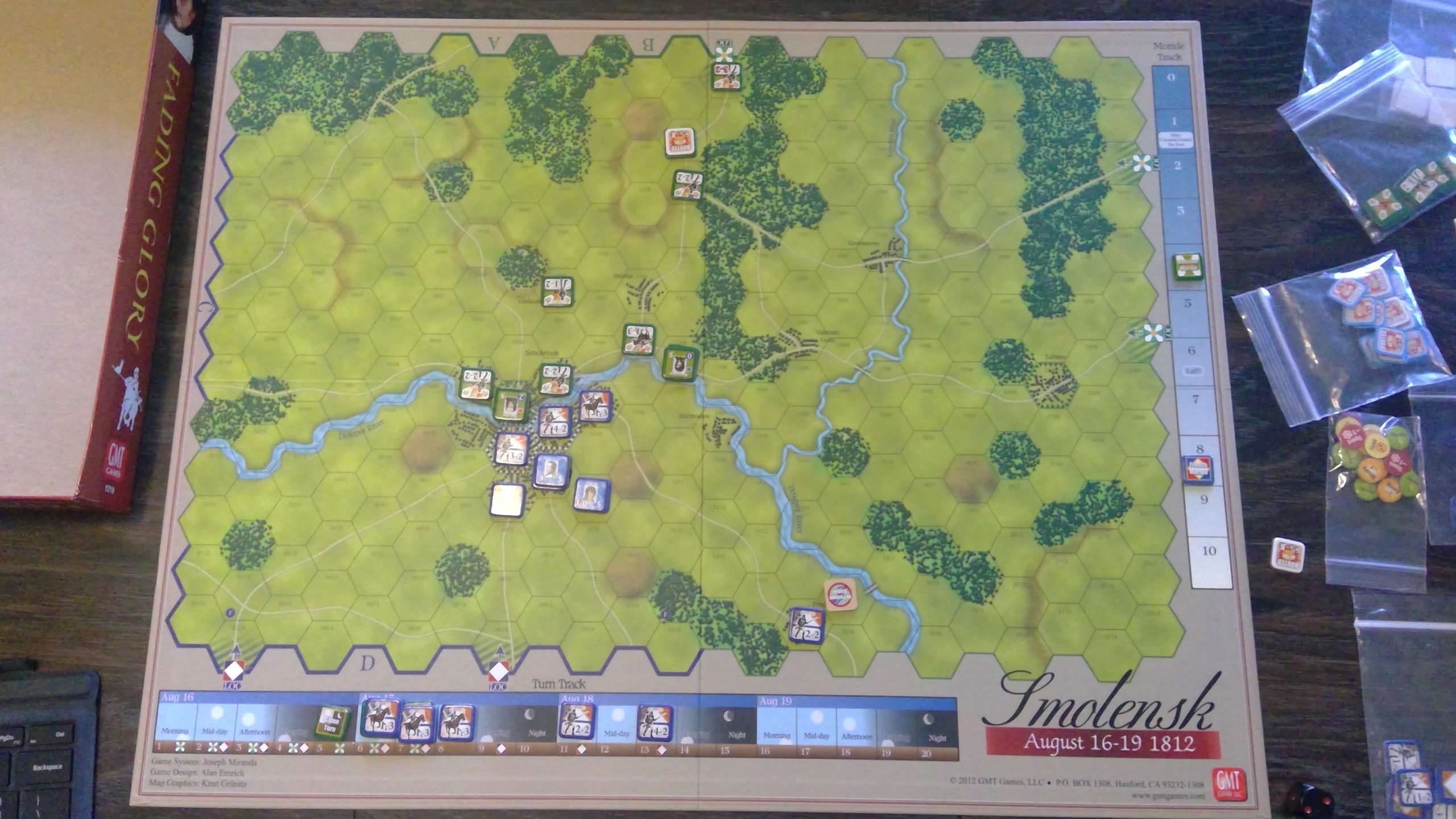
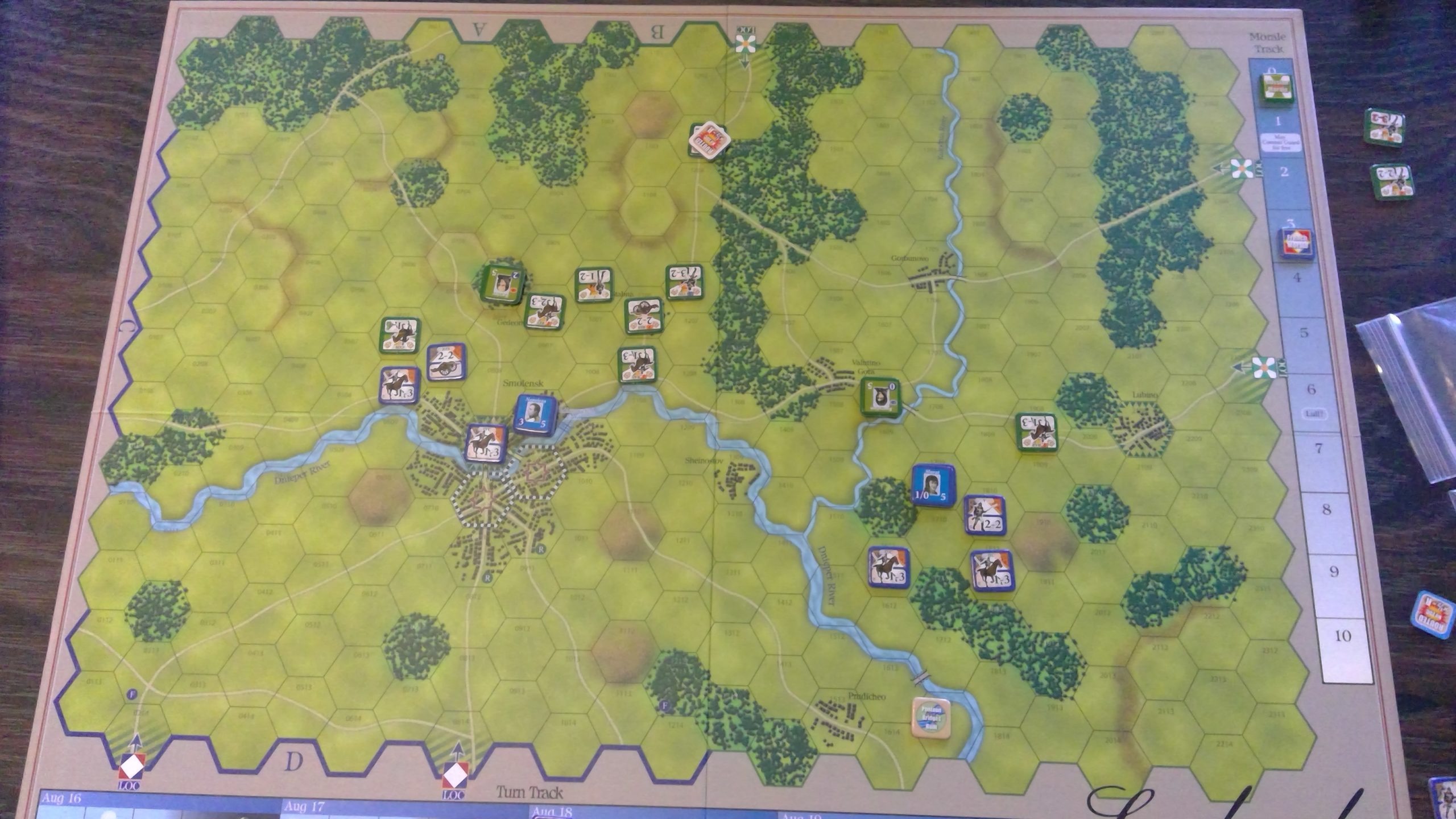
So it was a good thing that we were trying a relatively short game; namely the Smolensk scenario from GMT’s Fading Glory. This has been on Mark’s ‘to try’ list for a little bit, and presumably won’t be the last time we see it.

It’s a collection of four scenarios from Victory Point Game’s Napoleonic 20 series, which is meant to do Napoleonic battles with about 20 counters per side in a very quick playing format. So, its a simple system with no stacking other than leaders, and five turns per day (including the night turn). I had the French, which start with about two units on the board, and while a fair number of other units come on during the first day, just about as many Russian units arrive too.

But, the French are arriving much closer to Smolensk than the Russians, and as the day wore on, I was able to push him out of the near side. One of the neat bits is that both sides are rated for current morale, and you can spend morale to do certain things. There’s also cards for random events during the battle (a different, small, deck per scenario), and an early one cost the Russians some morale (after starting lower), so I could ‘push’ more effectively than Mark.

The scenario ended… I think around the end of the third day? Russian morale collapsed, and forced a general retreat. I had taken one infantry, and most of my cavalry to construct a foot bridge (via special rule), and crossed to the east, threatening Lubina, and effectively forking the Russians. Meanwhile, I got across at Smolensk, and got pushed back again (my best non-Guards unit breaking, and not coming back), before crossing a second time, and knocking around a few Russian units, teetering between keeping the Russians from having a good line to being overextended.

Its a clean system, and the GMT presentation is very nice. We would have done more, but Mark headed back early as he was getting progressively worse, and we both spent the next week to two weeks sick and recovering. -.-;

└ Tags: Fading Glory, gaming, Nap20
1 Comment
  • Page 115 of 315
  • « First
  • «
  • 113
  • 114
  • 115
  • 116
  • 117
  • »
  • Last »

©2005-2026 Rindis.com | Powered by WordPress with ComicPress | Hosted on Rindis Hobby Den | Subscribe: RSS | Back to Top ↑