Rindis.com

All my hobbies, all the time
  • Home
  • My Blog
  • Games
  • History

Categories

  • Books (503)
  • Comics (10)
  • Gaming (917)
    • Boardgaming (673)
      • ASL (154)
      • CC:Ancients (83)
      • F&E (78)
        • BvR – The Wind (26)
        • Four Vassal War (9)
        • Konya wa Hurricane (17)
        • Second Wind (5)
      • SFB (78)
    • Computer games (162)
      • MMO (77)
    • Design and Effect (6)
    • RPGs (66)
      • D&D (25)
        • O2 Blade of Vengeance (3)
      • GURPS (32)
  • History (10)
  • Life (82)
    • Conventions (9)
  • News (29)
  • Technology (6)
  • Video (49)
    • Anime (47)
  • Writing (1)

Patreon

Support Rindis.com on Patreon!
Become a patron at Patreon!

Other blogs:

RSS Inside GMT

  • Coast Watchers – Session Report – “The Airfield” June 5, 2026

RSS Playing at the World

  • Playing at the World 2E V2 Arrives May 5, 2025

RSS Dyson’s Dodecahedron

  • Cyberstyle 8.4 June 6, 2026

RSS Quest for Fun!

  • The Expense Post May 24, 2026

RSS Bruce Heard and New Stories

  • Pain, Exhaustion, and Morale in D&D BECMI June 7, 2026

RSS Chicago Wargamer

  • The 2 Half-Squads - Episode 310: Cruising Through Crucible of Steel January 27, 2023

RSS CRRPG Addict

  • BRIEFs: Black Crystal (1982), Creepers (1982), Chitei Tanken (1982) June 8, 2026
SF&F blogs:

RSS Fantasy Cafe

  • The Leaning Pile of Books May 24, 2026

RSS Lynn’s Book Blog

  • Booking Ahead/Weekly Wrap Up June 7, 2026
ASL blogs:

RSS Sitrep

  • Cardinal ASL Sins March 18, 2026

RSS Hong Kong Wargamer

  • FT114 Yellow Extract After Action Report (AAR) Advanced Squad Leader scenario April 16, 2025

RSS Hex and Violence

  • This still exists? March 25, 2025

RSS Grumble Jones

  • AAR Slides for Schwerpunkt SP96 Husum Hotfoot June 5, 2026

RSS Desperation Morale

  • How to Learn ASL March 16, 2025

RSS Banzai!!

  • October North Texas Gameday October 21, 2019

RSS A Room Without a LOS

  • [Crossing the Moro CG] T=0902 -- Rough start July 18, 2015
GURPS blogs:

RSS Dungeon Fantastic

  • Felltower House Rules Examined June 7, 2026

RSS Gaming Ballistic

  • B-Scale: Damage That Scales from Tardigrades to Kaiju June 5, 2026

RSS Ravens N’ Pennies

RSS Let’s GURPS

  • Review: GURPS Realm Management March 29, 2021

RSS No School Grognard

  • It came from the GURPS forums: Low-Tech armor and fire damage January 29, 2018

RSS The Collaborative Gamer

  • Thoughts on a Town Adventures System January 18, 2022

RSS Don’t Forget Your Boots

  • GURPS Supers Newport Academy #6: “Old Friends, New Again” June 7, 2026

RSS Orbs and Balrogs

  • Bretwalda - Daggers of Oxenaforda pt.4 - Fallen King May 27, 2017

The Last Best Hope

by Rindis on April 3, 2023 at 12:00 pm
Posted In: Books

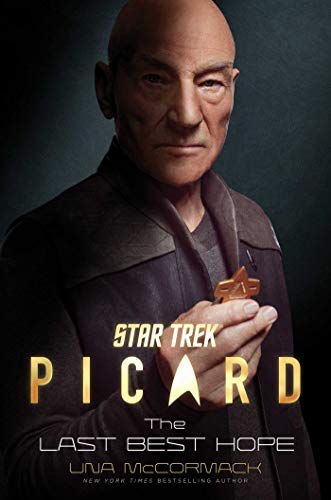
Star Trek: Picard picked up later Star Trek continuity with a fairly tough job. It had been nearly twenty years since the last TNG-era movie came out. Since then we did find out that the Romulan star had gone nova (as the backstory to the reboot movie). So, if you want Patrick Stewart back in his iconic role, anything you do will have to happen later to account for his ageing, and you’re going to have to account for this bit of backstory.

The first season of Picard did well with this, and gave us sometimes confusing tidbits of those missing two decades. New characters that he had gotten to know, Picard in a quiet semi-disgraced retirement. And much more.

This prequel novel fleshes out much, but not all of that background. (There are two other prequels….) The Federation becomes aware that the star for Romulus and Remus is on a path to a supernova detonation, and that is going to require evacuating far more people than anyone is equipped for. The novel then follows, in a very summary fashion, the years of Picard’s efforts at the head of the Federation’s effort to help relocate people out of the way of the blast.

The good news is that this is well-written with a good feel of the characters. You can often hear Patrick Stewart saying Jean-Luc Picard’s lines, because the characterization is spot on. I’m sure that McCormack had access to the writer’s bible for the series, and this looks to mesh perfectly with what has been said on-screen.

Of course, that tells us that this is not going to come to a happy conclusion for much of anyone, and the novel more ends than concludes. As a pure prequel, that’s not bad, but it is the weakest point. The journey is the main thing, and it is well told, and this makes a good guide to some of the confusing backstory of ST:Picard.

└ Tags: books, reading, review, science fiction, Star Trek
 Comment 

Charioteer Fury

by Rindis on March 30, 2023 at 12:00 pm
Posted In: Boardgaming

Had a four-player day this last Sunday. Mark and Jason came over, and with Dave and I we tried out GMT’s Charioteer. Circus Maximus has put in regular appearances at our game days, so I was interested to see what a different game had to say.

And it is different. Charioteer is a very abstracted, fairly Euroish take on the genre. Circus Maximus is more of a traditional look, with the ability of each horse in the team of four tracked, and you can attack the horses, or opposing drivers, and you pick what categories of things to be good at, which seems to be lifted from Speed Circuit. Charioteer abstracts many elements, with ‘damage’ being more of a handling modifier, skills advancing during the course of a single race, and matching of card symbols to determine speed. Even positioning is abstracted as when you catch up to another racer, you are automatically on the outside, and then you pay one movement per racer to go inside of them before finally being allowed to go to the next space on the track.

Overall, it’s a very streamlined design that does get to the heart of the matter very efficiently. On the other hand, its obvious all the game design decisions were made purely from a game-logic perspective. I like it a lot, but it scratches a very different itch for me than Circus Maxiumus does, and I couldn’t tell you at this point which I like more. Charioteer does need a reorg of the rulebook though, as it is very easy to miss sections when searching for them. A few crossreferences would be good, and while the number of illustrations is good, the layout tends to give it a cluttered look, making it easier to miss things.

At any rate, I burned two of the beginning bonus chits to build an early lead. I figured at the least everyone else would have to pay an extra move to get by me. That lasted about half a lap as we all sorted out and started doing better with the moves. We also forgot damage from the first attack move or two. One of the neat game-side ideas is you move by the combination of number of symbols you matched, and the number in that symbol, with sprint moves being the highest numbers, and cornering moves being the lowest, but getting you through the corners twice as fast. Even with a eight card hand, and a “shared” card, it’s harder to get the type of move you want than you’d think.

Jason ended up in the rear, and seemed to struggle through the first lap, but after that, he slowly worked his way forward. In fact, we were nicely bunched back up in a pack again as the first lap finished. Dave was the first one to get past me, and stayed there for a lap or so. Damage piled up a bunch during the mid-game, and attempts to git rid of it were of course time-consuming. Jason was slowed down quite a bit, but managed a full recovery thanks to a recover move with a recovery card. This helped him get into the lead for a nicely long win. I managed to get back into second during the final lap, with Mark and Dave ending up neck-and-neck. I’d had a fairly good sprint move coming that might have helped if there’d been one more turn. As it was, I was stuck with three red whips at the end, because I just hadn’t been able to burn through them (not enough attacks, and too many other red tokens).
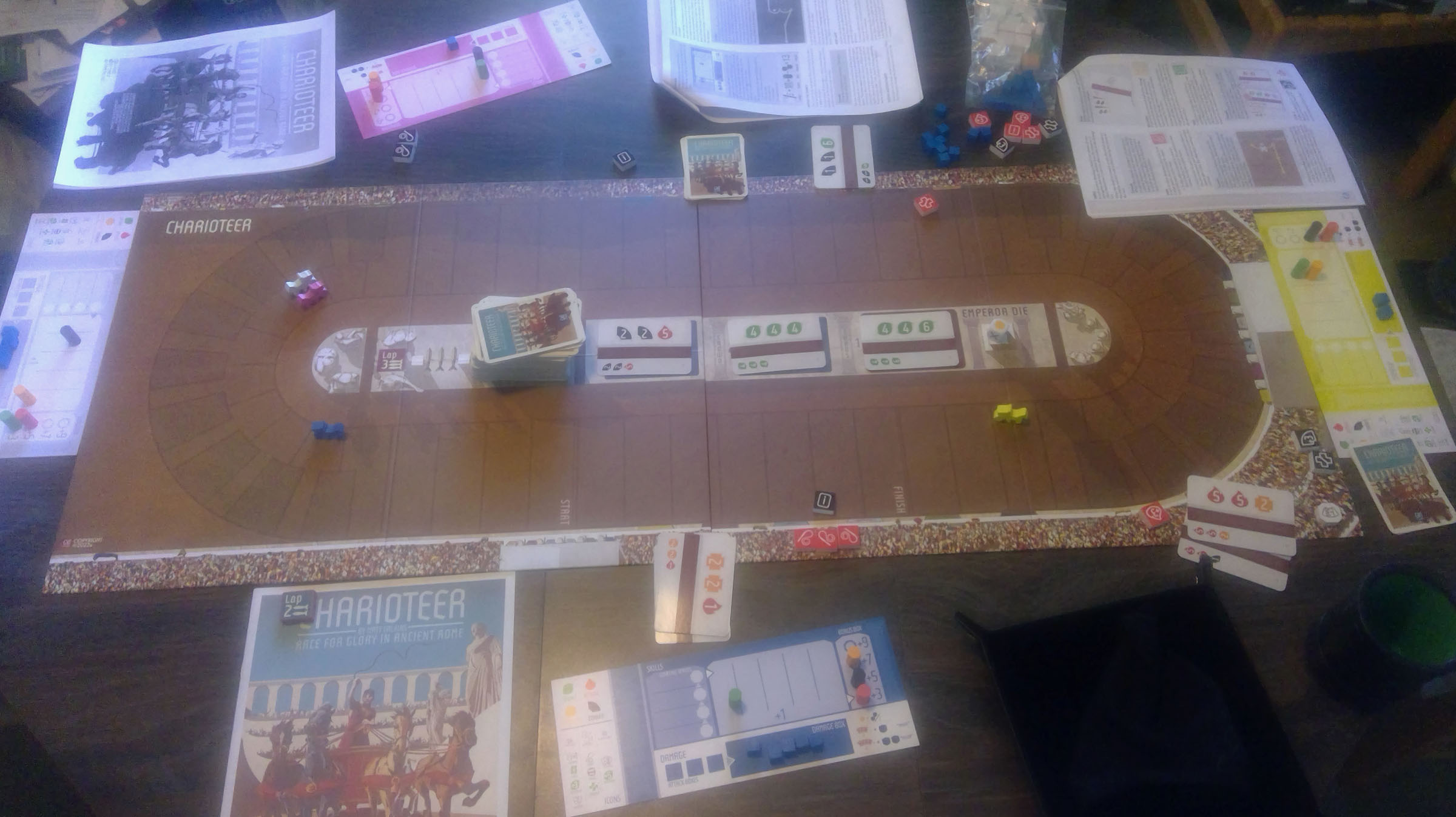

Jason is the winning Yellow team, I was dark blue, Dave was grey, and Mark was pink.

One surprising bit is that the game needed more turns than any of us really expected from the structure.

After that we played a round of Braggart, which has become a favored short game of the group. I managed a couple of good boasts, and snuck in a couple of large single cards as part of hand-clearing two-card boasts when I knew I couldn’t win. However, I mostly struggled for a 43-point third place. Mark started with a good first-round boast, and got more later for second at 53, while Jason had a number of very strong boasts for 56 points and the win, with Dave having a couple of moderate winning boasts to end at 31.

Last, we tried Ramen Fury, which Dave had gotten as a present a while back. I personally find it okay, but everyone else was taken with it, so presumably we’ll see it again. Its a card game where you try to assemble and finish three sets of cards. The game ends when someone finishes (eats) all three, and you only score what is finished. Of course, the more complicated sets score better, and you get a limited amount of ability to mess with other people by putting in unwanted cards or spooning out a choice ingredient. It eventually occurred to me that finishing first can be all you need since you’ll be the only one to score on all three. (Mark actually realized this a bit ahead of me, and nudged my thought process down the path it was already heading towards.) So I won with 8, 10, and 9 point bowls, while Dave only had one eaten for 10, Mark had eaten a 10 and an 8, and Jason had one 14 point bowl eaten.

└ Tags: Braggart, Charioteer, gaming, Ramen Fury
 Comment 

Karavans

by Rindis on March 26, 2023 at 12:00 pm
Posted In: Books

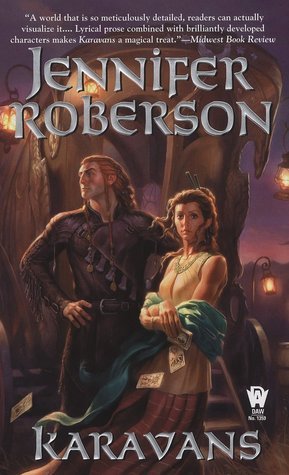
I’m used to Jennifer Roberson’s series containing fairly self-contained novels, so this one took me by surprise. Tiger and Del is a series of nearly independent novels, and while the Cheysuli series very much has an overall arc to it, each novel is also pretty self-contained, which is essential since the books happen years apart, and feature new generations of characters as time goes on.

Karavans is part one of a much more tightly spun story. As such, it takes time to get started. There’s a bunch to unpack, and much of it we don’t get a lot of answers to.

The easy part is that the nation of Sancorra has just been overrun by a warrior people called the Hecari. At this point it’s best to just think of them as Mongol stand-ins, though we may learn more later. This has led to a lot of people fleeing the country to get away from them, including one of the central groups of characters.

To do this, a family packs everything up in a wagon, and prepare to join a regularly scheduled caravan out of the country. These are complicated affairs, with a lot of people moving, and fortune-telling is used to make sure that things will go well. This brings in the rest of the characters.

But not the major MacGuffins. The central one, introduced at the very start, is Alisanos. We’re never given a great idea of what exactly it is, as those few characters who know anything about it aren’t talking. It’s an area deep in the woods that anyone with any sense stays away from, as anyone who goes in, does not come out… if they’re lucky. We slowly start getting a bit more as the half-way point approaches.

After a very slow-burn start, the book does start picking up momentum, and we get into real plot territory. Simultaneously, a couple of tedious days of the caravan preparing finishes, and it starts to move. In fact, a sign of the too-slow start is that we spend nearly half the novel with a lot of detail of two days, and then we skip forward through much of a week before the ending starts powering up.

And there is certainly a powerful action climax to the book, which helps make it a satisfying read, but it’s really all just a lead up to a second book. Some important plot threads are just getting started, and the ending itself puts a main character into new, unknown, danger. The ending also promises we’ll learn a lot more about Alisanos next time.

This is an unfinished series, with current info saying book four is to be self-published. I imagine the series didn’t do all that great, and I certainly don’t recommend it as a place to start with Jennifer Roberson, who I do generally recommend (start with Sword-Dancer). Overall recommendations on the series will have to wait.

└ Tags: books, reading, review
 Comment 

Falkirk of Iron

by Rindis on March 22, 2023 at 12:00 pm
Posted In: Boardgaming

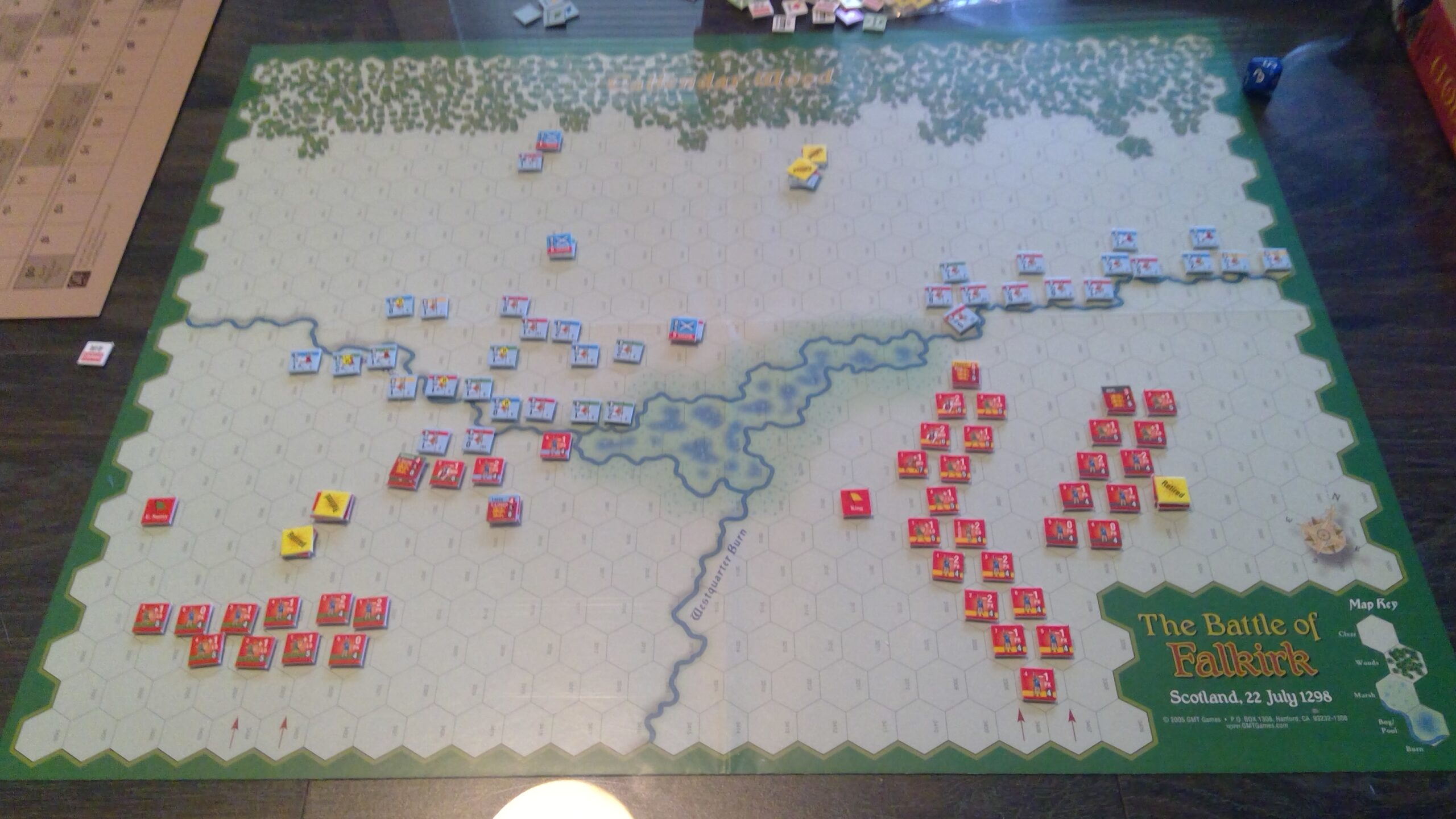
Jason came over on Sunday for a FtF game. He introduced me to the Men of Iron system. Since I had a slightly shorter day than originally planned (went out to see a charity showing of Princess Mononoke that evening), we went with the Battle of Falkirk, with the non-historical options for the Scots (free setup, actual ability to activate, etc).

Jason took the Scots and lined everybody up in two lines, but while a shield wall/schiltron could be useful like that, he never went into it, preferring to keep tactical flexibility, which he used to the utmost. I led off with getting Durham’s Battle on the map while the mounted men-at-arms already near the front crossed the Burn and hit the flank of the first line. That went well, but naturally, they got overwhelmed by numbers with one retiring and the other eliminated.

As that was winding down, I sent in Lincoln to cross the Burn before the Scots could anchor their line on it while the foot came up. This turned into the major part of the fight that took the rest of the day. Naturally, Scottish numbers began to tell, even as good chunks of the line became disordered and needed reforming. My goal was to start my free activations with Lincoln to address my own problems, and then continue with Edward I to get his troops on board and put pressure back on the Scottish left. I blew a lot of continuation rolls, with the last of Edward I’s troops only getting on map after much had already been decided (in a negative fashion) on my left.

I did eventually get the second activation of Edward I, and then got a banner activation for Lincoln and got Surrey’s battle on board. This let me counter-attack and briefly advance again, but it didn’t last long, and I couldn’t get another activation of Surrey to bring him up to the rest of the line, and soon Lincoln was in trouble again.

That’s about as far as things got before we had to pack up. There was a lot of action, and I got to see a lot of useful examples of cavalry in good and bad situations, as well as extended infantry fights.

Afterword

I can definitely see the relationship between this and GBoH. While I like chit-pull mechanics in general, I thought it didn’t quite do what it seemed meant to in GBoH, and the continuation rules here work much better. I’d like to see an experiment with something more akin to BCS’s Second Activation rule instead. The Continued Attack rule sort of gets into this, and does a nice job with the local momentum of breaking through a line. Overall, it seems to show a bit more polish than the original GBoH, and the differences (in my limited experience with both systems) seem positive. I’d prefer a system where low or high is always better instead of the split we get here though.

We both had plenty of good and bad die luck in battle, but my dice tended to be pretty cold for continuations, while Jason had one round with about four activations (getting to really low numbers towards the end). With the (understandably) slightly friendly command rules that let him stay in charge of a flank that kept threatening to break up under pressure. This unity of command, compared to the English army is the root of a lot of my trouble.

Another trouble is I probably should have ordered the other battles more and then fixed up Lincoln if I got the continuation, but I figured if I got it half the time, they’d still come up in plenty of time, and Lincoln would last longer if I shifted the most endangered units. Now, if I’d just been anywhere near those odds….

└ Tags: Falkirk, gaming, Men of Iron
 Comment 

Virginia: The New Dominion

by Rindis on March 18, 2023 at 12:00 pm
Posted In: Books

I picked up this history of the state of Virginia mostly because of curiosity about the Colonial era. There’s lots of political cross-currents going on as the Colonies move towards rebellion and independence, and providing true scope to these just isn’t something histories of the Revolution can have space for. (I would really like to see this on Pennsylvania, the politics there are extra-special.)

It was written in 1970 and shows. There is no sympathy for slavery and direct racism as such, but often feels apologetic for some of the further offshoots in Virginia politics. This is largely just trying to keep some distance and evenhandedness, ‘these are the people, and this is what they did’, leaving moralizing for in extremis. But it’s really more the author’s love for his state, and wanting to show how it did better/different than the rest of the south, and it’s obvious enough to cast doubt on what he’s saying on occasion.

Its a large book, covering a bit over three-and-a-half centuries, and while it spends a lot of time on politics, it also covers everything else you’d expect in an overview. The establishment and growth of the major cities, overall economic and population trends (that last might have stood some more attention). However, this all purely from a modern and Western view. Which is to say, even when talking about the original charters, establishing Virginia as having authority over a wide swath of land, all the talk is pretty much limited to Virginia’s current, or at least pre-Civil War borders. There is some nice attention paid to the increasingly separated politics of the future West Virginia, which helps explain that split.

The big missing part is not a lot is said about Native Americans. They’re there, various conflicts, and problems on both sides are there. But you don’t really see them outside of direct dealings with the colony. No discussion of the original tribes, how broad a cultural spectrum there was, how they dealt with each other, and so on. If it’s not dealing directly with a political entity called “Virginia”, it doesn’t exist in this book.

Overall, it’s decently written, a little dated, and covers the subject about as well as anything so broad can. It’s been printed three times, with the last in the early ’90s. It’s not going to be a common find on used shelves, and I wouldn’t recommend specifically hunting it down, but if a cheap copy crosses your path, consider picking it up.

└ Tags: books, history, reading, review
 Comment 
  • Page 59 of 314
  • « First
  • «
  • 57
  • 58
  • 59
  • 60
  • 61
  • »
  • Last »

©2005-2026 Rindis.com | Powered by WordPress with ComicPress | Hosted on Rindis Hobby Den | Subscribe: RSS | Back to Top ↑