Rindis.com

All my hobbies, all the time
  • Home
  • My Blog
  • Games
  • History

Categories

  • Books (485)
  • Comics (10)
  • Gaming (906)
    • Boardgaming (665)
      • ASL (153)
      • CC:Ancients (82)
      • F&E (78)
        • BvR – The Wind (26)
        • Four Vassal War (9)
        • Konya wa Hurricane (17)
        • Second Wind (5)
      • SFB (78)
    • Computer games (160)
      • MMO (76)
    • Design and Effect (6)
    • RPGs (66)
      • D&D (25)
        • O2 Blade of Vengeance (3)
      • GURPS (32)
  • History (10)
  • Life (82)
    • Conventions (9)
  • News (29)
  • Technology (6)
  • Video (48)
    • Anime (46)
  • Writing (1)

Patreon

Support Rindis.com on Patreon!
Become a patron at Patreon!

Other blogs:

RSS Inside GMT

  • Meet the Xiongnu: A Civilization of GMT’s Ancient Civilizations of East Asia February 6, 2026

RSS Playing at the World

  • Playing at the World 2E V2 Arrives May 5, 2025

RSS Dyson’s Dodecahedron

  • The Flying Swine – A Fine Drinking Establishment February 6, 2026

RSS Quest for Fun!

  • The Myth of Rational Animals November 23, 2025

RSS Bruce Heard and New Stories

  • Preview: The Iron Queen February 9, 2026

RSS Chicago Wargamer

  • The 2 Half-Squads - Episode 310: Cruising Through Crucible of Steel January 27, 2023

RSS CRRPG Addict

  • Dark Designs IV: The Land of Beginning Again February 9, 2026
SF&F blogs:

RSS Fantasy Cafe

  • Strange Horizons Roundtable on Influence January 26, 2026

RSS Lynn’s Book Blog

  • Review: Agnes Aubert’s Mystical Cat Shelter by Heather Fawcett February 9, 2026
ASL blogs:

RSS Sitrep

  • Blockhaus Rock April 1, 2025

RSS Hong Kong Wargamer

  • FT114 Yellow Extract After Action Report (AAR) Advanced Squad Leader scenario April 16, 2025

RSS Hex and Violence

  • This still exists? March 25, 2025

RSS Grumble Jones

  • Grumble Jones February Scenario GJ157 February 2, 2026

RSS Desperation Morale

  • How to Learn ASL March 16, 2025

RSS Banzai!!

  • October North Texas Gameday October 21, 2019

RSS A Room Without a LOS

  • [Crossing the Moro CG] T=0902 -- Rough start July 18, 2015
GURPS blogs:

RSS Dungeon Fantastic

  • Black Company Playtest: Summer of Riots January 27, 2026

RSS Gaming Ballistic

  • Mission X: Obviously Not 2025. Life happened, read on. December 13, 2025

RSS Ravens N’ Pennies

RSS Let’s GURPS

  • Review: GURPS Realm Management March 29, 2021

RSS No School Grognard

  • It came from the GURPS forums: Low-Tech armor and fire damage January 29, 2018

RSS The Collaborative Gamer

  • Thoughts on a Town Adventures System January 18, 2022

RSS Don’t Forget Your Boots

  • GURPS Supers Newport Academy #3: “Season Of The Witch” February 8, 2026

RSS Orbs and Balrogs

  • Bretwalda - Daggers of Oxenaforda pt.4 - Fallen King May 27, 2017

Death of a Death Mage

by Rindis on October 15, 2014 at 12:00 pm
Posted In: Computer games

Note: This post largely cribbed from posts on videogamegeek….

I’ve been a fan of Master of Magic since I discovered it maybe a decade ago (long after it was originally published). It’s great game, with some nice options.

It does, however, have it’s share of problems. Mostly, the AI just isn’t as competent as it needs to be, but there’s also a number of things that don’t work the way they’re supposed to. Anyway, I have it on my portable computer, Azuna, though I have to have a mouse plugged in to play it (touch does not work). A little while ago, I discovered the ‘unofficial’ 1.4 patch (currently at 1.4n), and have been playing it some more after seeing a much more active AI.

I usually end up creating a custom wizard, with some sort of odd combination of spellbooks. This last time, I went against type and took standard Rjak. He’s the all death-magic wizard, which I also have generally stayed away from.

I had trouble from the start; I managed to conquer some smaller cities, but just couldn’t get very far with anything bigger, and kept losing units trying. My mana production usually, lags, but was worse than normal this time. Very worrisome was the fact that I finally got my first hero very, very late, even though I had lots money.

I had neighbors to the east (and I just can’t seem to remember who, though Raven showed up somewhere past him), and north (Tlaloc) who never wanted to warm up to me (surely they could see my winning personality under the death-mage exterior…). South and west were all wilderness with encounters I couldn’t beat out to the seacoast, with a large neutral city full of defenders in between. I bumped into East again while trying to fill in the blanks of my frontier, and he declared war.

At this point I finally tried out the Lycanthropy spell (turns a normal unit into werewolves with a lot of immunities, but a high magic upkeep), and took the major city out in the wilderness, losing my one first level hero in the process. I then turned my burgeoning military East, and took over two frontier settlements, and then two cities directly north of his capital.

And that was my high water mark. I managed to fritter away the initiative and army trying to keep the lid on, and lost the biggest city I’d taken to Raven. Then Tlaloc got antsy and started sending units into my territory without formally declaring war. I might have handled that too, but I let a stack slip through and take my capital. I’ve been kind of ironmaning these games, so I took the loss instead of taking the long resummoning time. 35 score (0%), actually my ‘best’ loss.

I really could have done much better all along. I was starting to really pump up my magic buildings to play into Rjak’s strength, and needed to do so much earlier than I did. I’m too used to having better initial relations with the AI, and getting heroes early, and didn’t know what to do without that.

└ Tags: gaming, Master of Magic
 Comment 

Anime Summer 2014

by Rindis on September 28, 2014 at 5:48 pm
Posted In: Anime, Video

It often seems like Smudge watches all the anime there is. She certainly catches a good portion of it, and then I watch the things she recommends. Well, mostly. Anyway, the Summer 2014 season for anime is just wrapping up, and I thought I’d talk about what I watched over the last three months.

Sword Art Online II — As many of you may know, I really enjoyed the original series, though I didn’t get into until it was about halfway through. Kirito is back, but the rest of the cast, including Azuna, isn’t. They’re there, but not even as a supporting role. Obviously, the author considers this to be a series about Kirito, and not Kirito and Azuna, even though those two together is what made the original story. It’s good, and better than the second part of the original series, and Sinon is a nicely developed character. I have some problems with how the mystery around Death Gun is handled, but in general it works, and is very much a personal issue for Kirito even while being a bigger problem.

And it’s hit episode 13 without hitting the end of the story. I suppose this means it’s going for another season, and will do a 14-12 episode story split like the first series did….

Nobunaga Concerto — It seems like we just can’t go very long without some sort of historical Warring States drama. This one is an interesting mix of the goofy and the serious. Saburo, a modern high school student gets inexplicably sent back in time to the Warring States era, where it turns out that he looks just like the young Oda Nobunaga. Nobunaga, a sickly youth, and overcome with his responsibilities, has Saburo take his place. Saburo isn’t much of a student (“Quiet. This is the first time I’ve legitimately read a textbook.”), and while he knows some of the more famous names, he doesn’t know what they did, nor Nobunaga’s eventual fate.

The interesting thing is that it looks like they’re playing the history straight. There’s been four time-travel characters so far, and it looks like they’re all being used to explain the inexplicable in history. I don’t quite know enough to really be able to catch all of it, so I really wish I had the time to study the period some more just to aid my enjoyment of the series.

Monthly Girls’ Nozaki-kun — This was the surprise of the season. I’m not sure what inspired me to see the first episode with Smudge, but if I hadn’t I probably wouldn’t have seen it, since I liked it more than Smudge did. Most of the series was nicely humorous, but there were a good number of laugh out loud moments, which is why I watched it.

It’s primarily about the relationship between Sakura, and her crush Nozaki. It turns out he’s a successful manga creator. Girl’s manga creator. Much of the series is wrapped around his creative endeavors (trying to figure out the next romantic plot line, research for new ideas…), but also devolves upon an extended cast of wacky characters. It scratches the same kind of nerdy humor itch as Genshiken and Comic Party, but more episodic and also with a gender role-reversal theme.

Free! — I missed this one-season series last year, but caught up on it early in the season before watching the sequel Free! Eternal Summer, which just finished. The high concept is definitely to show a bunch of exceedingly fit boys not wearing much as part of a swim club, a nice reversal of the usual, which Smudge appreciated. ~_^ However, it also has good writing, and an actual story to tell.

In fact, the original told such a complete story that the sequel was something of a surprise. And you know, it was just as good a story, and not a rehash of the original. They really put together a good team to do this series.

Sailor Moon Crystal — Okay, Sailor Moon, being relaunched from scratch. Instead of ‘reinterpreting’ (dark! edgy! …bleh), or trying to polish up the original, they’re playing it fairly straight to the original manga, including hewing closer to the original character designs.

Somehow, I figured the relaunch of such a storied property would get more love. This is very much a ‘B’ (or even ‘C’!) team effort. The writing has been tightened up some, but could use a lot more polish, and hasn’t really aged well. Characters are wandering off-model all over the place, and the animation is fairly limited (okay, I’ve been spoiled by the likes of Haruhi). And it’s coming out every other week for some reason. The transformation sequences were lovingly done by someone in 3D… and I’ve certainly seen better. But it’s just getting to the point where the story starts coming together, so we shall see….

The Devil is a Part-Timer — This came out some time ago, but it was on Funimation, while the smart TV only has an app for Crunchyroll (Funimation promised one…). But thanks to the magic of AirPlay and Apple TV, we can now see Funimation on the TV.

Anyway, this was a favorite of Smudge’s, and with good reason. It’s a very fun series that kept avoiding my expectations even when being predictable.

A Certain Magical Index/Scientific Railgun — Again, being able to see Funimation shows on the TV have led me to this one. The two series cover different people in the same universe (/city), so occasionally the plotlines overlap a bit. Smudge is attempting to fit them together, so I’ve seen about a season of both so far.

I have to agree with Smudge that the stories are stronger in Railgun, but it suffers… other problems. Index leans towards harem anime, but not to a point where I really notice yet. Railgun has a bad side of humor-through-sexual-harassment that seems to have gotten a little better over time. Here’s hoping the plot continues to crowd it out.

As far as this next season goes, well, I’ll find out what I’m watching over the next few weeks. However, I know that Log Horizon is back, so I’ll certainly be catching that.

└ Tags: anime
1 Comment

A New World

by Rindis on September 24, 2014 at 12:00 pm
Posted In: Computer games

An approximate pattern for 4X games in general is to start out with a single base/settlement, move out, find valuable terrain and claim it with further bases, solidify borders to keep others away from the valuable bits you’ve found, and then go take their stuff.

Thus, these games generally start out as ones of colonization. Whether it’s sending ships out into the galaxy, or settling the barbarian-infested wilderness, it’s much the same. Colonizing the New World is a natural fit for the common strategy game desire of building up. But, other than a fad in the late-’80s to mid-’90s it has not been a popular subject. More interesting, they’re a fairly disparate bunch.

Gold of the Americas (1989) from SSG is a favorite of mine, in part because it is so small. It covers three centuries at a rate of a decade per turn, and is playable in an afternoon. You play as the king’s viceroy in the New World, in charge of colonizing and developing the new world so as to fill the King’s coffers back in Europe. Europe itself only imposes itself in the game in the form of support from the King (if you paid your taxes…) and deciding who is at war or allied among the four powers. Slaves can be imported and exploited along with the native Indians, and at low development, colonies can die out.

Sid Meier’s Colonization (1994) is a spin-off of Civilization, and it shows. However, it does a lot of things differently that give it a good colonial feel. Population, and units on the map are interchangeable, and can be shifted from city to city; in contrast, there is not a lot of population growth in the game; population generally comes from Europe. Population exists in several forms, from convicts and indentured servants (who are not as productive as normal ‘free’ population) to more productive specialists. Slavery does not show up, nor the dying off of the natives from disease, though they may ‘convert’ and come live in your settlements. Trade is important, with a need to send cargo back to Europe to sell to buy tools and weapons (until you can produce them yourself). And finally, the game is completely goal oriented: instead of just trying to build the best colonies you can in the time provided, you must declare independence and win the resulting Revolutionary War to beat the game.

Conquest of the New World (1996) is close in structure to Colonization, but with a lot of attention on the world environment. The terrain is done in a simple 3D style, with elevations shown. Exploration is explicitly rewarded with points awarded for the first player to explore the length of a river or a prominent mountaintop (and the ability to name the feature). Combat is more involved, using a simple mini-game that is well done. The influence of Europe is minimal, with further colonies having to be be built as settlers from existing one. Not only is independence not necessary for winning the game (but it does add to the victory point total), but you can play as the natives and attempt to ‘federate’ the other tribes and establish a powerful native nation to resist the colonials.

Imperialism II (1999) isn’t really a colonization game, but that is part of what it shows. The New World is important because it has materials that are needed to make your nation more productive, but victory is determined purely by the Old World. The Europa Universalis series (2000-2013) is also in this period, and features similar concerns though it is more oriented to colonizing the region rather than specific worries for particular trade goods.

All of these games feature exploration, but only Conquest tries to make it a goal sufficient unto itself (though Colonization also has ‘goodie huts’, of rewards scattered through through the world). Exploration is probably the most abused system in gaming. You either know what’s there or not. On the scale of any of these games, exploration is not a binary proposition. Sure, there’s hills over there, and mountains further off, but what’s the place really like? How fertile? How many villages in the area? I’d love to see a system where you slowly progress from very general knowledge to more detailed, as you move from small expeditions moving through the area, to regular trade, to settlement.

One of the nice points of Colonization is the treatment of the natives. They are split up into a number of generalized tribes, that differ in how powerful they are (and how much loot they have), and will each have their own relations with different European powers. They can trade, and train people into specialists, and slowly get alarmed as European presence continues. They can gain horses and guns and become more dangerous. Only Imperialism II and Europa Universalis come close to this, but without as much interest. Conquest allows you to play as the ‘high natives’, but the representation of the various Indian tribes is shallow.

Overall, I am surprised that we haven’t seen more games on the subject. I’m pretty sure Conquest was inspired by Colonization, but the chain stopped there. There is a new version of Colonization (on the Civ IV engine), but it is a very faithful re-release of the original, and not really a new game. Perhaps these games (and GotA and Colonization in particular) said most of what needed to be said, but I think there’s room for a very interesting exploration-based game, if someone wants to tackle the challenges of partial knowledge.

└ Tags: Colonization, colonization games, Conquest of the New World, game genres, gaming, Gold of the Americas, Imperialism
 Comment 

FB8 For Want of Either Crust or Crumb

by Rindis on September 20, 2014 at 9:14 am
Posted In: ASL

Patch and I returned to ASL and Budapest recently with the eighth (our tenth, after playing FB18 and 19) Festung Budapest scenario, “For Want of Crust or Crumb”.

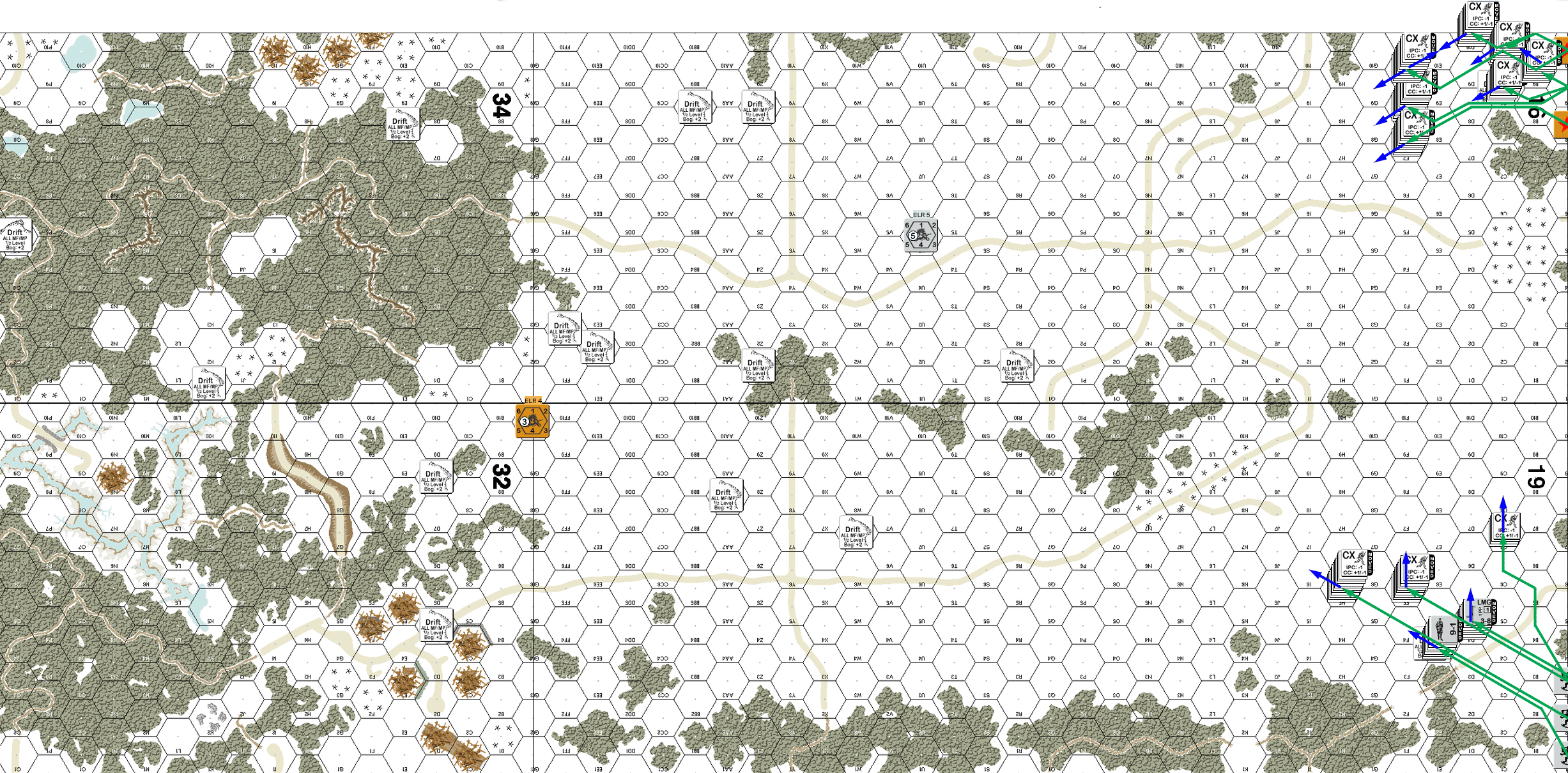
It’s an odd one. The Germans are trying to resupply the city by air, resulting in a fight over parachuted canisters of supplies. At the beginning of the game, the Axis performs rubble checks, and then scatter checks on nine canisters (4PP objects that can only be picked up during MPh). Then both sides take turns placing one squad at a time (plus SW/leaders, and dummies are possible), with the randomly-determined player who placed first going last. Victory goes to the side possessing the most canisters at the end, with ties going to the side with the higher CVP total. In addition, the first three turns (of six) have a +1/6 hexes LV and the Axis forces are at Ammo Shortage Level 3.

I took the Axis forces and ended up placing second once the initial setup chores were done. There were five canisters in open ground near the center, and two each on rooftops in the north and south. We both started in the center, with Patch going to the east, and me to the west, near the open ground that dominates that edge and the canisters scattered around. Patch put a unit to the north of that block, and I then put two units nearby, planning on covering the northernmost canister. I concentrated the Hungarian part of my forces in the rail station, where they could back up the center. We also ended up with a jumble in the center south, but my guys were all Dummies.

For my first turn I largely skulked, but managed to pick up the canister in the street at HH17 where no Russians could see me. I also advanced on the one at DD15r, and planned to hold the center building while I grabbed some out of the field. But first, I swarmed the Russian stack in GG16, which turned out to be a Dummy.

FB8 1A
Situation, Axis Turn 1, showing the entire board. Supply canisters are represented by parachute counters. North is to the left.
↓ Read the rest of this entry…

└ Tags: ASL, Festung Budapest, gaming
 Comment 

Building Economy

by Rindis on September 10, 2014 at 12:00 pm
Posted In: Computer games

I’ve been playing a fair amount of the old city-builder game Pharoah: Gold recently. (Bought it on sale at GoG at the beginning of the month.) And I’ve been pondering why.

I have played SimCity. I have a copy of SimCity 2000 (bought for cheap after 3000 came out). I have spent time with OpenTTD.

I think they’re all fine enough. But they don’t hold my attention for long. A few hours fiddling around with them and I’m done.

I am, in general, a strategy gamer. Which is a computer game genre definition so broad as to be close to useless. (The excellent strategy game podcast Three Moves Ahead has had occasional side discussions on ‘what is a strategy game?’, with Tom Chick asserting that ‘everything is’, and even making an interesting argument for The Sims as a strategy game.) There is, of course, a large number of sub-genres (ranging from overly-broad to tiny niche), and I’ve been meaning to talk about some of the smaller ones I’ve observed.

But, anyway: city-builders. SimCity is kind of the genre definer, and is generally a pure sandbox simulation ‘game’ without a lot of goals, and limited interaction with the actual mechanics. Pure sandbox games generally don’t do much for me; that’s the common thread between the games that don’t hold my interest that I mentioned earlier.

Caesar was a popular city-builder game, that spawned three sequels, and two spinnoffs based on the the Caesar III engine (Pharoah and Zeus). I enjoyed the Caesar III demo way back when (somewhat to my surprise, and that demo is why I bought Pharoah: Gold). I’ve now played Pharoah: Gold obsessively for over a week, which is now tailing off (I think).

The difference is that while the Caesar/Pharoah-model city-builders look a bit like SimCity, there is a decided difference in execution. As mentioned, SimCity is pretty much pure sim. You zone areas, lay out roads, and mix in essential services, and wait to see if the sims can put together a viable economy. Pharaoh is actually an economic engine game (who knew I had that much eurogamer in me?). You are placing specific industries to produce raw materials which are then taken to other industries to turn them into usable goods which are needed for other purposes (building weapons, improving living conditions, etc). It can be seen as a close-up of the ‘exploit’ part of 4X (a genre I regularly enjoy).

This brings me to another game that I discovered and enjoyed years ago that could be mistaken for a city-builder: The Settlers II: Gold Edition. It is fairly close to Pharoah/Caesar, but is easier to see as not related to SimCity. Settlers is a pure economic engine game. Every building has a cost in lumber and stone to build. So you need to cut down trees, convert it to lumber and quarry stone to get anything done. The full set of resources needed to get everything done is much more complicated (but mostly turns into providing food to miners to generate iron and coal for creating weapons and armor, and gold to pay/upgrade the resulting soldiers), but does not involve any hidden mechanisms.

Pharoah on the other hand still has the ‘sim’ aspect of the residents having wants and desires that are not entirely surfaced to the player. A basic building needs to be provided with water, so the residents do better and upgrade it; then they need a bazaar to get food from, then religion…. But there is also ‘desirability’. Placing a storage yard (for example) too close to a residential area makes it a less desirable location, and the building can only climb so far up the scale of increasing wealth. While there are ways to look at this in the game, no real guidance is given. How far does this effect spread? Which buildings are the worst for desirability? There’s also an ‘overall’ mood which can keep new immigrants from arriving when you open up new areas, but I have no idea what contributes to that….

There is a final, very important thing that Pharoah and Settlers share that SimCity does not: They both have campaigns, which have missions. I’m not set loose to just make my own city. I have goals. In Settlers II this is to take control of the gate that leads to the next island/mission (or just wipe everyone else off the map in the alternate campaign; both campaigns are quite challenging). Pharoah starts with a ‘build these buildings’ format common to a lot of early/tutorial RTS campaigns, but is looking like it is shifting over to ‘hit these arbitrary metrics in a challenging situation’. That makes sense, but I have a feeling I’m going abandon the campaign if it continues down that road.

There’s also a framing story around the main campaigns in both. Settlers II is the story of a Roman expedition that got shifted to some pocket universe, and is trying to find it’s way back through a succession of gates, hoping that one will lead home. Pharoah is about the successive generations of a family of administrators serving Egypt; the transition I mentioned happens at the beginning of the Old Kingdom stage. The former is far more effective at keeping me playing, but the latter is nicely used for a loose presentation of the history of Egypt.

└ Tags: city-builder, economic engine, game genres, gaming, Pharoah, Settlers II
 Comment 
  • Page 211 of 308
  • « First
  • «
  • 209
  • 210
  • 211
  • 212
  • 213
  • »
  • Last »

©2005-2026 Rindis.com | Powered by WordPress with ComicPress | Hosted on Rindis Hobby Den | Subscribe: RSS | Back to Top ↑