Rindis.com

All my hobbies, all the time
  • Home
  • My Blog
  • Games
  • History

Categories

  • Books (517)
  • Comics (10)
  • Gaming (931)
    • Boardgaming (684)
      • ASL (155)
      • CC:Ancients (85)
      • F&E (78)
        • BvR – The Wind (26)
        • Four Vassal War (9)
        • Konya wa Hurricane (17)
        • Second Wind (5)
      • SFB (84)
    • Computer games (163)
      • MMO (78)
    • Design and Effect (6)
    • RPGs (68)
      • D&D (28)
        • O2 Blade of Vengeance (3)
      • GURPS (32)
  • History (10)
  • Life (82)
    • Conventions (9)
  • News (29)
  • Technology (6)
  • Video (51)
    • Anime (49)
  • Writing (1)

Patreon

Support Rindis.com on Patreon!
Become a patron at Patreon!

Other blogs:

RSS feed: Inside GMT Inside GMT

RSS feed: Playing at the World Playing at the World

  • Playing at the World 2E V2 Arrives May 5, 2025

RSS feed: Dyson’s Dodecahedron Dyson’s Dodecahedron

  • HELLCRAWL Digestive Tract October 30, 2026

RSS feed: Quest for Fun! Quest for Fun!

  • The $139 Board Game August 7, 2026

RSS feed: Bruce Heard and New Stories Bruce Heard and New Stories

  • Not All Eyes are the Same, Pt. II October 28, 2026

RSS feed: Chicago Wargamer Chicago Wargamer

  • The 2 Half-Squads - Episode 310: Cruising Through Crucible of Steel January 27, 2023

RSS feed: CRRPG Addict CRRPG Addict

  • Pagan: The Beginning of Wisdom October 29, 2026
SF&F blogs:

RSS feed: Fantasy Cafe Fantasy Cafe

  • Review of The Sourdough Compendium by A. G. Slatter October 26, 2026

RSS feed: Lynn’s Book Blog Lynn’s Book Blog

  • Friday Face Off: Monthly Round Up of Covers October 30, 2026
ASL blogs:

RSS feed: Sitrep Sitrep

  • Fireweed Sale August 7, 2026

RSS feed: Hong Kong Wargamer Hong Kong Wargamer

  • FT114 Yellow Extract After Action Report (AAR) Advanced Squad Leader scenario April 16, 2025

RSS feed: Hex and Violence Hex and Violence

  • This still exists? March 25, 2025

RSS feed: Grumble Jones Grumble Jones

  • Halloween 2026 October 22, 2026

RSS feed: Desperation Morale Desperation Morale

  • How to Learn ASL March 16, 2025

RSS feed: Banzai!! Banzai!!

  • October North Texas Gameday October 21, 2019

RSS feed: A Room Without a LOS A Room Without a LOS

  • [Crossing the Moro CG] T=0902 -- Rough start July 18, 2015
GURPS blogs:

RSS feed: Dungeon Fantastic Dungeon Fantastic

  • Felltower & Atheism disadvantage levels October 18, 2026

RSS feed: Gaming Ballistic Gaming Ballistic

  • Harmonized Loot Schedule (HLS) September 22, 2026

RSS feed: Ravens N’ Pennies Ravens N’ Pennies

RSS feed: Let’s GURPS Let’s GURPS

  • Review: GURPS Realm Management March 29, 2021

RSS feed: No School Grognard No School Grognard

  • It came from the GURPS forums: Low-Tech armor and fire damage January 29, 2018

RSS feed: The Collaborative Gamer The Collaborative Gamer

  • Thoughts on a Town Adventures System January 18, 2022

RSS feed: Don’t Forget Your Boots Don’t Forget Your Boots

  • GURPS Supers Newport Academy #8: “Invitation to the future.. of the 1970’s: Part II” August 2, 2026

RSS feed: Orbs and Balrogs Orbs and Balrogs

  • Bretwalda - Daggers of Oxenaforda pt.4 - Fallen King May 27, 2017

Enter Myzal

by Rindis on August 5, 2015 at 1:30 pm
Posted In: Life

Well. This last weekend was bad.

I’ve been contemplating a minor upgrade to Smudge’s machine, Moebius, for a bit. The case it uses is one we inherited from a friend, and while it’s nice and sturdy and insulated, it has some problems. Mostly, it has a front door that must be opened to get at anything, including the main power button. This is not uncommon, but not a style we go for. More importantly, the door reaches to the bottom of the case, making it difficult to open if it’s standing on carpet. With our current arrangement, it does just that. We ended up putting a wooden box under it as a platform, but it’s not quite as long as the case, so it was resting on the bottom of the case, instead of its feet. Since the side door wraps around the bottom frame a bit, that became hard to open.

Yeah, just get a new case that works the way we want it to.

She also has a video card that was really, really good at the time (two GPUs!), but has been aging. It handles some things better than my cheaper but newer one, and some things much worse. We’ve been wondering about upgrading it, and then AMD updated the drivers and software. The update included automatically trying to record all gameplay to send it to Plays.tv, AMD’s equivalent to Twitch. We were able to turn it off, but it ate her system thanks to the default setting. Later that day, her monitor went dark. A reboot went fine, and I figure that it was part of a driver update, that Smudge thought she’d said ‘not now’ to, and which went forward anyway.

So, I decided it was time to replace the video card as well, if only to get away from automatic video recording shenanigans.

We spent a while going around looking at possibilities with a target budget of ~$300 (ha!). Smudge really liked the Corsair Vengeance C70 case, which looks a lot like an ammo box (very her), and the more we looked around, the more it had good features we wanted. I’m not thrilled by the drive bay set up, but it has nice cable runs behind the base plane. And we got a GTX 960 video card (4GB of video RAM).

I took Friday off to have a full weekend if anything went wrong, but it was really just transferring to a new case and installing a new video card.

…and then, while plugging everything back in, I noticed the data plug on the main hard drive looked odd. I was looking at the four metal pins, without the main plastic key. Looking at the cable, I found the plastic stuck inside the housing there.

This drive is a decade-old SATA-150 drive that started with Micca. It’s been the source of a number of failures, where suddenly the system couldn’t see it anymore. I’d have to open up the system unplug the drives, and re-plug them in for the motherboard to see it again. I’m guessing the plastic had been cracking all this time, and shifting, causing this intermittent problem. It had been fine for a couple of years before happening again a couple months ago, so it too was on the ‘to be upgraded’ list.

So, go down to Computer Central, and spend another $100 on a new 1TB drive (Smudge decided for space over speed). Plug everything in, hit power. Everything spins up, the BIOS splash screen comes up, it POSTs….

And that’s it. No response from the keyboard. Okay, back to a wired keyboard. Nope. Okay, dig out the emergency PS/2 keyboard. Nope.

Pull memory. ‘No memory’ error. Good. Check the sticks one at a time. Nope. Reset CMOS (via jumper, later pulling the battery, etc.). Nope. The motherboard’s not dead, but it might as well be, and the fact that it takes a good quarter minute or so to POST is not a good sign.

And thinking back, the last time the drive failed, it took some effort to get into the BIOS so I could reset the boot drive order. So, this was coming too, though I hadn’t realized it.

That was Friday night. Most of Saturday was spent driving around finding out that noplace in Silicon Valley still had any Socket 1155 boards left. I ended up buying one on NewEgg at 4:30 on a Saturday. And Smudge had no computer.

The board arrived yesterday, and I put the machine together last night, and am taking the day off as we get all the essential software and peripherals working again. This has been a major rework (at about double the budget!), and therefore a new name: Myzal (her Tiefling lightning-mage in Neverwinter).

Intel Core i7-3770 (Ivy Bridge)
ASRock Z75 Pro3
8 GB DDR3 1600 RAM
EVGA GTX 960 SSC; 4GB GDDR5
Windows Experience 5.9 (due to the hard drive, everything else is in the 7s)

It was just supposed to be a minor update!! T_T
└ Tags: life, Moebius, Myzal
2 Comments

Two Rounds of Amphipolis

by Rindis on July 28, 2015 at 10:20 pm
Posted In: CC:Ancients

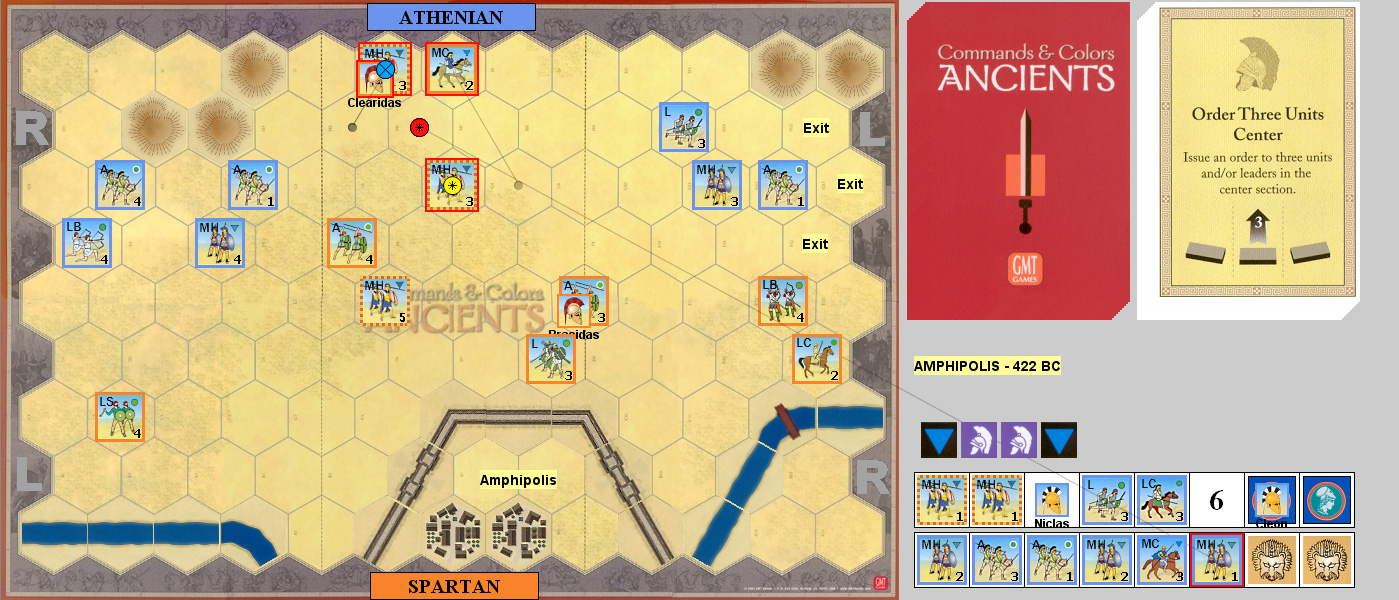
Having finally finished off our SFB game, Patch and I did our usual round of C&C:A between big games tonight. This time was the Battle of Amphipolis from Expansion #6.

This one is different. The Athenians get points for running away. Which is to say, there’s three hexes on their right that they can exit the board from, and get a victory banner per unit. The Spartans are charging out from a fortified city to stop them. As is usual for this period, this is a hoplite battle, though there’s actually light and medium cavalry on each side this time (one unit each).

I had the Athenians first, and Patch started with an Order Light to sort out his line. I did the same to try and assemble a line for a Line Command I was holding. Patch Ordered Three Right, and forced my lights to evade and break the line in two. I used Leadership to bring my line into contact, and move up a leader who started unattached. We did four blocks to each other, all of his on a Spartan MH, and mine spread over two MH.

Patch used Order Medium to move both flanks up, and eliminate my weak MH, while a First Strike knocked out his weak Spartan MH, though without killing his leader. I echoed Order Medium to bring up my center, and nearly wiped out two Aux. Out Flanked put both of his leaders in motion, and killed a fresh MH and Aux. I used Counter Attack to use my flanks, exiting a Light, and managing to finish off an Aux. Patch cried “I Am Spartacus!“… to order one light and one medium (and one heavy, if there were any in the scenario), and picked off an Aux, nearly killed a MH on momentum, and forced my MC to evade.

I responded with Mounted Charge. My LC caused two hits on his light trapped against the city wall, an MH got two blocks on a fresh Spartan MH and forced it back two hexes, while my MC finished off an Aux and MC. Patch Ordered Two Center to activate the units I’d just hit, and I got a hit and banner on battle back against his light unit to end the game (he could have, and should have moved to avoid that). 6-4

Amphipolis-1

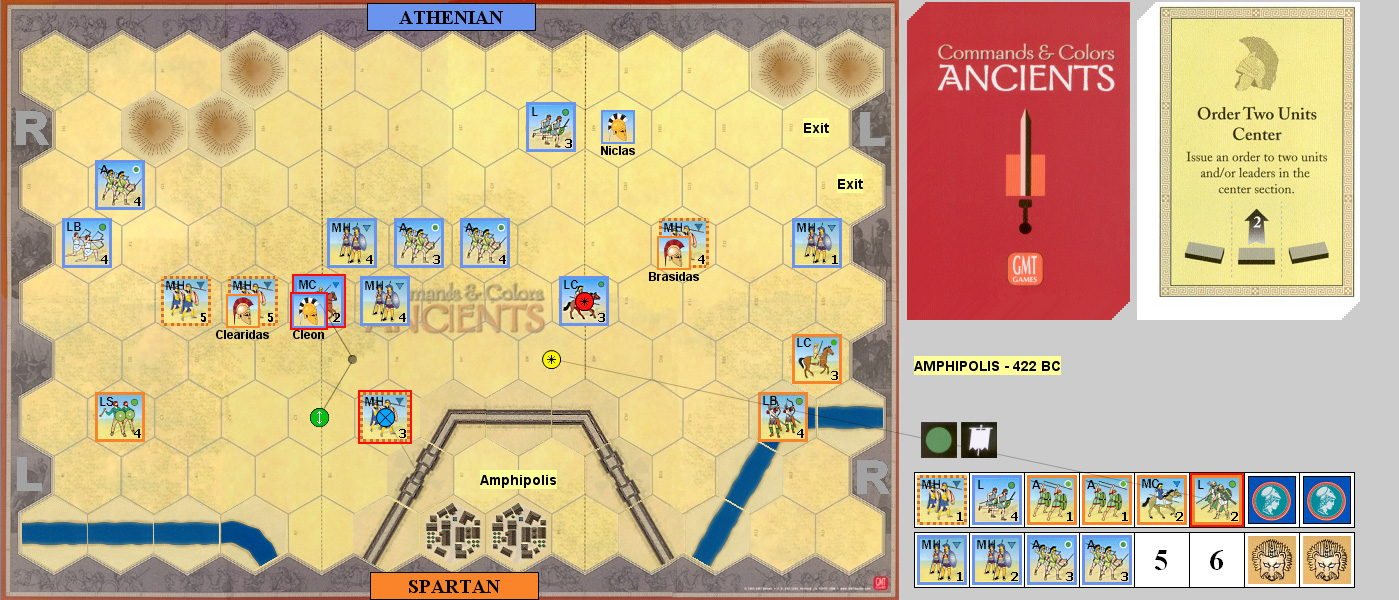
For the second game, I started with Line Command to move up the entire right flank. Patch moved up with an Order Three Center, driving back one unit, and trading three blocks for two against my Spartan MH. I moved forward again with Order Four Right, and drove back three units while reducing an Aux and eliminating a MH. Patch came back with Inspired Left Leadership and drove off my LC.

Since he was sitting too close to the exit with five units, I Ordered Three Right, but only did three blocks to four, and couldn’t eliminate anything. Patch Ordered Two Left, and pressed the attack to finish off a MH and trade blocks with my leader-led MH. Out of right cards, I used Double Time to slam into his center, doing six blocks to zero. Patch Ordered Mounted to eliminate my right-side MH, forcing my leader to escape through his LC to an Aux, while forcing another MH back three hexes!

I used Order Medium to get my center in motion (no Mediums were left anywhere else), and eliminated an Aux. Patch Darkened the Sky to get four blocks, three of which were on my center MHs. Inspired Center Leadership kept my compact center mass moving, eliminating an Aux, MH, MC (on leader momentum), and forcing his leader to evade off-board.

Patch Ordered Three Left to exit his remaining leader, a Light and a LC. Worse, his Aux was in range to exit next turn. As a one-block unit, I would have liked to go after it, but only a couple of lights were in range. I Ordered Three Center to go after his intact MH after cutting off its retreat, and hope he didn’t yahtzee me on a battle back. I got him on the second attack, losing one block in the process. 6-5

Amphipolis-2

Afterword:

It’s a very different and very interesting scenario. There’s no units in range of a one-turn exit at the beginning, but it’s a real possibility, and if the Athenian player can get the right cards could probably get very close to a win without much interference. But that leaves the rest of the battle at a disadvantage in troops. Both games were fairly close, though I had a lot of good cards, even if they weren’t always easy for me to use.

└ Tags: C&C Ancients, gaming
 Comment 

SH126 The Sally

by Rindis on July 25, 2015 at 5:25 pm
Posted In: SFB

Crossposted from the SFU blog on BGG.

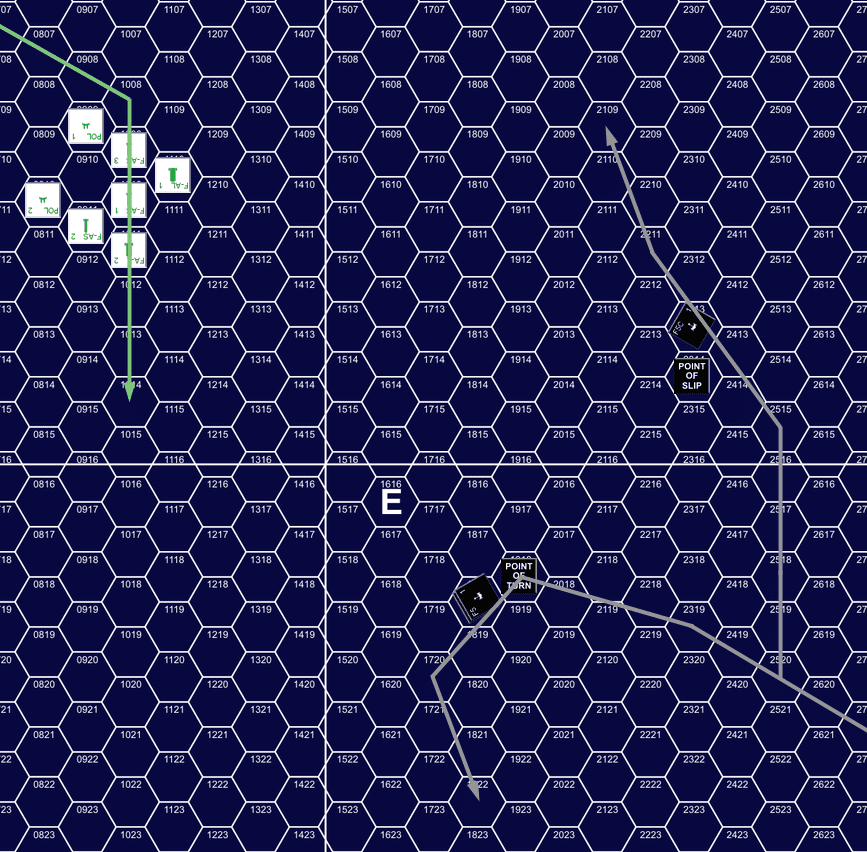
Patch and I decided to turn back to SFB a little while ago, finishing off a project that our group had been stuck on for a while (more on that in a bit). This particular scenario is the third of a set of three in S2 that has Klingons vs the LDR in Y157 (pre-gatlings).

“Captain Kruze had been watching the Hydran border for months, with no activity, when word reached him that the LDR had initiated hostilities. Kruze’s frigate squadron was the northernmost on the Hydran border, and having just left the base at the angle where Klingon, LDR, and Hydran space conjoined, he was in excellent position to sally into LDR space. Kruze intended to raid LDR shipping and avoid a decisive engagement. He found what he thought was a convoy and moved to attack.”

However, Kruze had found an LDR force of armed freighters (three small phaser-armed, and two large disruptor-armed) accompanied by two police ships. It doesn’t look like much, but there’s a lot of weapons in there. The Klingon squadron consists of an F5C, F5, and E4. Both sides cannot disengage at first, with the LDR only being able to disengage at all when both F-ALs are crippled or destroyed, and any Klingon ship only being able to disengage after being crippled.

I had the LDR and decided to load the POLs and F-ALs up on transporter bombs, and started each one with a suicide shuttle armed and ready to go (leaving the three shuttles on the F-ASs for point-defense and group protection if it should come down to that). I started with everything going speed 12, while the Klingons moved in at speed 19. I started in a pretty loose formation, and then tightened it up with sideslips, but Patch split off his F5C about halfway through the first turn. I turned for the larger group, as the F5C’s shields are tougher. A little later, Patch hit with three out of four disruptors to nearly take down a shield on an F-AS (not bad at range 13 with a +1 shift!). The F5C followed up and got one point in (hull…). As he turned away, I volleyed all six disruptors at the E4 and nearly got shield 2 down on four hits. We both followed up with Ph-2 shots, but range and ECM were problems. The F-ASs finally got an internal on the E4 after firing all phasers, and got a lucky R Warp hit.


First pass.
↓ Read the rest of this entry…

└ Tags: bgg blog, gaming, SFB
2 Comments

Forgotten Battle in the Mines

by Rindis on July 21, 2015 at 12:00 pm
Posted In: D&D

The year after Bloodstone Pass came out, H2 The Mines of Bloodstone came out. One thing had changed: This was a direct sequel to the former module, and there were definitely going to be more after this (whether they knew at this point it would be a four module series is not said).

Something else important changed: There’s no BattleSystem logo on this one. There’s one mention in the back blurb of “optional” BattleSystem scenarios. Which is entirely correct; any wargaming adventurers going through this one are in for a big let down. Instead, other newer, cooler, products are called out: the Dungeoneer’s Survival Guide and the Wilderness Survival Guide. The adventure instead featured an extremely tough dungeon environment which allowed a reversion to the typical 32-page adventure book, though it is worth noting that (contrary to usual practice) the cover was stapled to the book. There’s several maps, many of which are in the isometric format introduced in the DSG.

At this point one could wonder if the H series was just a way to show off the latest new product, and convince people they really wanted to get them. In practice, there’s no crying need for either of the new hardbacks, and the need for the WSG is very minimal. The actual need for the DSG is also fairly minimal, but at the same time it was essential to writing the module. The DSG had discussed the idea of sprawling linked cavern complexes under the entire game world, called variously ‘deepearth’ and ‘underdark’, and this module, co-authored by the author of the DSG, featured a corner of what was explicitly just that.

This is still before the Forgotten Realms became a TSR property, and the setting is ‘anywhere you wish to drop in the countries involved’. However, the background became more concrete in this installment. Vaasa was ‘ruled by a Witch-King of incredible power’ in H1, but now this is expanded upon with Vaasa being a barren wilderness until the coming of Zhengyi a little more than 10 years ago. After that comes some quick notes on the module, and the lead ins for if the players have or have not been through H1.

And that’s where the inconsistencies begin.

(Caution: I’m headed into spoiler territory here.)

Thankfully, it’s never anything really game breaking, but there’s a handful of problems throughout the module. The first one is probably the biggest: The module starts with the basic rundown of the next couple months after the end of H1, as a harsh winter settles over the valley. Thanks to all the fighting, the harvest was delayed, and now heavy rains and an early freeze have ruined some of it before it can be brought in, leaving the village short of food for the winter. But wait, H1 had a nice schedule that explicitly said the harvest was completed right before the party arrives. After all, the bandits don’t come calling until the villagers have done all the work so they can take it from them, and fighting starts at that point.

So, the first thing the DM gets to do is figure out how to short the village of food. If part of the village got torched during the fighting (likely), that can explain it. Also, if the party hired troops to help out (possible), there’s extra mouths to feed. Otherwise….

Bloodstone Village only gets three pages of detailing this time, repeating the brief profiles and random villager tables, plus an updated map. The local dwarf, centaur, and halfling communities are each introduced in a little under a page each this time, including a map, important people, BattleSystem info, and a small encounter/adventure that could happen if/when the party visits.

The module purposely starts slow, with worries about the winter, wolves, and some minor annoyances before a night attack on the village attempts to jump-start the plot. It certainly provides a nice little mystery that might take a few (bloody) nights to solve. Intelligent players shouldn’t have any trouble figuring out Orcus is involved (they may not know what to make of what they’re finding, but the obvious questions will lead to answers). Making the jump to the abandoned mines (that may not have even been seen—though they are part of the background—in H1) seems tenuous to me. Okay, they were important, and they were abandoned when something evil was found in there, but does that really have anything to do with vampires and warg attacks? The fact that Bloodstone needs money, and reopening the mines would produce a lot of money, seems a safer bet to motivate the PCs to check them out, which will draw them into the rest of the adventure, but there’s no direct link.

The mines themselves are where the module gets going, but there’s minor consistency problems again. The box canyon the mine entrances are in is only mapped in H1, but that implies they’re on the north side (the compass rose is missing), but the entrances lead to the west here. Past that, there’s problems every time you go from one map to another, and the connections don’t match up right. They can all be explained easily enough, but feels like they were all written separately and then stuck together. There’s one passage that goes off-map and and off into the deepearth map in the DSG in here, but it has nothing to do with the current module, and there’s no good mechanism for steering the players straight if they divert down it (“if the PCs are still plodding along, have them meet a beholder”).

The general goal is to find the svirfneblin (gesundheit) kingdom in exile and get them to attack a duergar city in a massive diversion while the PCs sneak into the Temple of Orcus. This can be played out in BattleSystem, and stats are given, but there’s no particular need to, as the PCs are presumed off doing their high-level dungeon stuff instead of taking part.

After that, comes the main course: the Temple of Orcus. It’s big, it’s tough, it has magical protections to keep the players from short-circuiting things. (Which is generally fine; a big temple to a major demon lord should have magical protections in place. I just wish things like that were handled a bit more systematically for the world at large, instead of feeling like a band-aid.) And in classic fashion, the party arrives (one hopes) right as a ritual to summon Orcus into the world is starting! …And there’s no hint that this is about to happen in the rest of the module. I mean, what makes now special, as opposed to, oh, say, a month ago?

Okay, that’s a list of complaints and inconsistencies. In general, these are actually fairly minor to the flow of the module, but it means the module needs a bit of massaging before being truly ready to go. This is really just a bigger, badder dungeon module. It has some good pacing, with local problems escalating all the way up to a very bad, and immediate, problem. Of course, if you’re expecting something different from a high-level module (like H1), then this will be a disappointment.

Now, back above ground in the valley, the dwarves and centaurs got BattleSystem info, but the module pretty much states outright it’ll never be used. (The halflings also get BattleSystem info, but there is a small battle for them (only) to take part in.) There’s also a couple sample battle maps given for the underground that are part of the section on the big battle, but aren’t directly referenced in the text. One of them looks to be far inside the main cavern, away from any battle that would naturally get fought. I’m wondering if we’re seeing fragments of a much more complicated campaign to fight an army up to the temple so the party can get in and do their heroic thing, which got cut to make room for a really, really, big temple. The latter was probably a safer bet for the general TSR audience, but it means the module is nothing special.

└ Tags: Bloodstone, D&D, Forgotten Realms, gaming, review, rpg
1 Comment

More Magic Than You Can Shake a Wand At

by Rindis on July 17, 2015 at 12:00 pm
Posted In: D&D

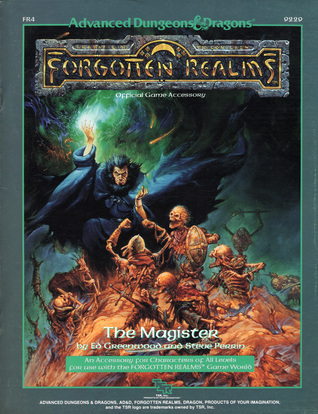
After three modules, it seemed that the FR series was a set of geographical supplements filling out the further reaches of the Forgotten Realms in more detail. FR4 turned it into a more general series than that, as The Magister had no geographical lore at all. It also marked the return of Ed Greenwood to the series, and the book focused on one of his main interests: magic books and items. Greenwood had been contributing articles to Dragon magazine for years, many of them dealing with items and lore from the Realms. The best of these were collected together for this volume, and all-new material added.

The all-item focus of the book meant that the cover was stapled to the interior, and the inside front cover includes a modified version of the random magic item treasure table, so these new items could be randomly rolled for. The last few pages of the book have much expanded rules for a character creating a new magic item, with a chart of (new) modifiers for the final success roll stipulated in the DMG on the inside back cover.

About half the book is descriptions of a dozen spellbooks known to be wandering the Realms, giving their appearance, known history, and the spells they contain, which generally includes two or three new ones. At the end of this section is a couple of pages that lists all the new spells from here and the DM’s Sourcebook of the Realms, with their spell levels, what book they’re in, and where to find the description. I like the spellbook descriptions, and the vast bulk of the spells are inventive and look good (though there’s some really complicated potential interactions on many), but I think there’s some missed opportunities here. Some of these new spells are ‘unique’; they’re only found in the described book. Others are known to have been copied down a few times, and might be found elsewhere. This isn’t in the table. Furthermore, I think it could have been neat to come up with a basic ‘common-uncommon-rare-unique’ scheme and not only define these spells as rare and unique, but define how widely known the bulk of the ‘normal’ spells from the Players Handbook and Unearthed Arcana are. Most low-level spells should be ‘common’, but defining a few as ‘uncommon’, and then mixing it up more at higher levels could have some very interesting effects on a campaign. It would have taken up quite a bit of space however.

Instead, the second half of the book is taken up with about fifty magic items, with especial attention to shields, cloaks, harps, wands and swords. Again, these are generally well done, and if you need any sort of inspiration for magic items, this is a very good book. There’s a lot of potential complex interactions detailed again, which says something about the mess of different uncategorized effects AD&D had, but this also means that all these items have had some true thought given to them.

Just about all of these spell books and items have lore attached to them. The past history (as far as it is known) is given for almost all of these items (a couple are just mentioned as being relatively common). But these histories often don’t have a lot of detail. “Named for the legendary mage…”, but nothing about this person is given. How long ago? Why is he legendary? This is fine for a DM who is adapting these ideas to his own campaign, but considering that we are now dealing with a supplement for a particular setting, some more details would nice. And then there’s things like the Orb of Holiness, which has application outside of normal adventuring (“usually found at the heart of a temple, grove, or other holy place…”). It would be nice to have info like this show up someplace talking about places like that (though they are ‘rare’ even there, so having a temple without one isn’t a big problem). So, it’s a bunch of color, some not really linked to anything else known about the setting, some of it with potential wide-spread implications that I don’t think have ever been repeated elsewhere.

The title of the book is explained in about a third of a page in the introduction: the Magister is the goddess Mystra’s champion of magic. This was a subject that would be revisited in Secrets of the Magister.

Still, it’s a good collection of items. It makes a good source of inspiration for any high-magic fantasy setting, under any rules, though you’ll have to do a lot more mechanical work as you move away from 1e AD&D. And if you’re running a D&D-style campaign, the spellbooks should inspire you to think a lot more about the books the magic-user is always carrying around. I don’t recommend paying a lot for this, but it’s worth having, as there’s a lot of ideas in here.

└ Tags: D&D, Forgotten Realms, gaming, reading, review, rpg
2 Comments
  • Page 208 of 320
  • « First
  • «
  • 206
  • 207
  • 208
  • 209
  • 210
  • »
  • Last »

©2005-2026 Rindis.com | Powered by WordPress with ComicPress | Hosted on Rindis Hobby Den | Subscribe: RSS | Back to Top ↑