Rindis.com

All my hobbies, all the time
  • Home
  • My Blog
  • Games
  • History

Categories

  • Books (504)
  • Comics (10)
  • Gaming (918)
    • Boardgaming (674)
      • ASL (155)
      • CC:Ancients (83)
      • F&E (78)
        • BvR – The Wind (26)
        • Four Vassal War (9)
        • Konya wa Hurricane (17)
        • Second Wind (5)
      • SFB (78)
    • Computer games (162)
      • MMO (77)
    • Design and Effect (6)
    • RPGs (66)
      • D&D (25)
        • O2 Blade of Vengeance (3)
      • GURPS (32)
  • History (10)
  • Life (82)
    • Conventions (9)
  • News (29)
  • Technology (6)
  • Video (50)
    • Anime (48)
  • Writing (1)

Patreon

Support Rindis.com on Patreon!
Become a patron at Patreon!

Other blogs:

RSS Inside GMT

RSS Playing at the World

  • Playing at the World 2E V2 Arrives May 5, 2025

RSS Dyson’s Dodecahedron

  • Shrine of the Diseased One July 17, 2026

RSS Quest for Fun!

  • The Expense Post May 24, 2026

RSS Bruce Heard and New Stories

  • Pain, Exhaustion, and Morale in D&D BECMI June 7, 2026

RSS Chicago Wargamer

  • The 2 Half-Squads - Episode 310: Cruising Through Crucible of Steel January 27, 2023

RSS CRRPG Addict

  • The Search for Freedom: Won! July 18, 2026
SF&F blogs:

RSS Fantasy Cafe

  • The Leaning Pile of Books July 5, 2026

RSS Lynn’s Book Blog

  • Friday Face Off: The Raven and the Reindeer by T Kingfisher July 17, 2026
ASL blogs:

RSS Sitrep

  • Cardinal ASL Sins March 18, 2026

RSS Hong Kong Wargamer

  • FT114 Yellow Extract After Action Report (AAR) Advanced Squad Leader scenario April 16, 2025

RSS Hex and Violence

  • This still exists? March 25, 2025

RSS Grumble Jones

  • Grumble Jones July Scenario GJ162 You Will Engage the Enemy July 1, 2026

RSS Desperation Morale

  • How to Learn ASL March 16, 2025

RSS Banzai!!

  • October North Texas Gameday October 21, 2019

RSS A Room Without a LOS

  • [Crossing the Moro CG] T=0902 -- Rough start July 18, 2015
GURPS blogs:

RSS Dungeon Fantastic

  • Felltower - Monsters Fleeing between Sessions vs. PCs replenishing June 28, 2026

RSS Gaming Ballistic

  • B-Scale Detail and Examples July 16, 2026

RSS Ravens N’ Pennies

RSS Let’s GURPS

  • Review: GURPS Realm Management March 29, 2021

RSS No School Grognard

  • It came from the GURPS forums: Low-Tech armor and fire damage January 29, 2018

RSS The Collaborative Gamer

  • Thoughts on a Town Adventures System January 18, 2022

RSS Don’t Forget Your Boots

  • GURPS Supers Newport Academy #7: “Invitation to the future.. of the 1970’s” July 5, 2026

RSS Orbs and Balrogs

  • Bretwalda - Daggers of Oxenaforda pt.4 - Fallen King May 27, 2017

There Will Be War, Part 1

by Rindis on December 18, 2017 at 12:00 pm
Posted In: Books

I can remember coming across this anthology in the library when it first came out. I had completely forgotten that I had actually checked it out and read it until a few scenes in the stories started resonating with me, and I started remembering having read them before. I’m pretty sure I never got around to reading the later ones though.

Overall, it’s a good anthology, and a great idea for one, though unlike many such, many of the stories here had been published before. There’s also a few non-fiction essays, which are naturally quite dated now. Actually, the stories are too; you can see a lot of their time in them. Overall, it’s a pretty good collection; here’s some particular notes:

“Reflex” – Basically an outtake from The Mote in God’s Eye, it’s just as well that it was left out of the novel, as it wouldn’t add anything to it. As a separate short story, it’s pretty good, though not anything special. Having some idea of the peculiarities of Langston Field ahead of time might help, as it’s not really described here, though the effects are.

“Spanish Man’s Grave” – A 1947 western seems an odd choice for a military SF collection, though Pournelle’s reasons are good, and it’s probably the best-written story in the collection.

“Marius” – This was the story that confirmed I’d read the anthology before, as the description of ruined Strasbourg (and Europe) rang a bell. This time, I had a lot more knowledge of reference of the title. A 1957 story, it has a survivable nuclear war in its past, and is really about pragmatism vs idealism. It’s the only story Pournelle saw fit to do an afterword to, and while what he has to say is true enough, I think he misses some of Anderson’s point.

“Ender’s Game” – Unlike most of the other stories, all my memories of reading this are gone, and I just remember reading the full novel a few years later. I actually like this 1977 short story better, as it’s much better focused, and I don’t care for a lot of the early added material in the novel (which I’ve always regarded as quite good, but not up to the accolades a lot of people have given it).

“A Death in Realtime” – One of the few new stories here, it definitely is a product of it’s time and 1981 computer technology. However, McEnroe has a real feel for the early computer/arcade generation that really helps give the story some extra punch. At least if you’re of an age to remember those times.

“Overdose” – Written in 1975. Vietnam merged with extradimensional invasion. For me, probably one of the poorest stories here, not counting the poems or non-fiction.

“Diasporah: A Prologue” – Nuclear war from the defender’s point of view. Israel is attacked by the surrounding Arab nations in a scenario that feels like it hasn’t aged much in the last 35 years. The “prologue” in the title isn’t explained, but seems to be a reference to the author’s later novel Diasporah.

“His Truth Goes Marching On” – I’m not sure of the propriety of an editor picking one of his own stories for inclusion in an anthology (especially after leading with he co-authored), but it’s good enough that I’m not going to actually complain. It’s the Spanish Civil War with the serial numbers filed off—but he didn’t actually do a lot of filing, since the background just transplants the entire general situation to another planet, complete with Spanish names. Still, well done, and another reprint of a 1975 story.

“The Defenders” – This feels like a Twilight Zone episode, and with an original publication in 1953, it’s about the right time for it.

“Unlimited Warfare” – Another 1975 story, this one featuring the law of unintended consequences as Britain and France have another spat.

“The Battle” – A 1954 story featuring a look at what happens when technology fights the biblical Last Battle.

“Ranks of Bronze” – A 1975 David Drake story (later turned into a novel I haven’t read) with a Roman legion fighting battles for aliens. No, really, it’s good. I often don’t care for Drake, but I might look up the full novel of this.

“I am Nothing” – A 1952 Eric Frank Russell story that shows its age. It’s not poor, but does have a terminal case of black-and-white psychology in order to make a point.

“Call Him Lord” – 1966 Gordon R. Dickson; Earth is a museum piece (or at least it looks that way to the rest of the galaxy), but considers itself to have a separate mission. I’d kind of like to see some more of the world.

“Quiet Village” – 1970, a bit late to be presenting the aftermath of a survivable (presumably) nuclear war, but it works well off the traditional Seven Samurai setup.

Whew, that was a longer list than I expected! There’s a lot of stories in here, and most of them are good, but not great. There are some real winners in here, though I have to imagine that someone who’d been keeping up with short SF in 1981 might feel a bit cheated by the fact that there’s only about three new things in here. As it is now, I don’t know how many of these have appeared elsewhere, but the age of many of the stories bears keeping in mind.

└ Tags: books, reading, review, science fiction
 Comment 

The Reformation

by Rindis on December 14, 2017 at 12:00 pm
Posted In: Books

MacCulloch’s book on the Protestant Reformation is a huge work on a huge subject. Everything you might expect is in here, and much, much, more.

He starts with a fairly good overview of western Christianity at the end of the Middle Ages, and moves on to the expected history of the reformation. This covers the Reformation in terms of both thought and politics, and I’m not entirely sure that I really understand much more than I did before. Some of it is just me (I find philosophical/theological arguments tough going at the best of times), but MacCulloch’s writing is dense, and not the easiest reading. The book is extensively crossreferenced with itself (and these are all links in the Kindle version), which also points up how many balls he’s trying to keep in the air. For all the scenery that goes by, I don’t feel like I know the period any better, or have a good sense of what any of the principles were like.

The last major section of the book is more of a social history of the period, and I have to think the main text might have benefited from this being right there. On the other hand, it has a focus that the earlier sections lack, so maybe the book would have been better if it had all been more split up than it is. This section goes into the witch hysteria, the status of marriage, sex and the ‘Reformation of Manners’, and a number of similar subjects.

I can’t really recommend this this book except as being thorough, and the only book I’ve read on the subject. It certainly should make a good general reference when dealing with something more specific.

└ Tags: books, history, reading, review
 Comment 

Civilization IV by 4

by Rindis on December 10, 2017 at 12:00 pm
Posted In: Computer games

While I was down visiting my parents, I played a good amount of Civilization IV, including a few attempts at multiplayer with my dad. (Which is sadly only possible on LAN now, as internet play relies on a service which is no more.)

These all ran into trouble.

In our first game, I got attacked by three of the other civilizations, and rapidly lost ground. I’m pretty sure that part of the motivation for the initial attack was a city I’d squeezed into the borderland, that was my first shot at getting iron; I didn’t have any access to copper, and only later built out to a second iron, so things didn’t go well for a while. I eventually stabilized the front, but probably wasn’t going to get back my third city, much less two smaller ones.

Our second attempt somehow managed not to have any AI players at all… which meant a constant stream of barbarians. This was okay until my dad built the Great Wall, which keeps barbarians out of your culture area… whereupon all the barbarians turned and headed for me. That went downhill fast.

Our third attempt felt a lot like the second. We’d been setting up maps that are about 30% water, so there’s a good amount of it around, but it’s generally all small seas. This time, the map managed to generate two separate large continents, and we were on one, and all the AIs were on the other. We could tell there were AIs out there as events would happen (such as building a wonder) that weren’t either of us, but we never contacted them. My dad built the Great Wall again, which gave me some trouble, but without the entire world’s barbarians rushing me, it wasn’t a huge problem, even though all my copper and iron were in the outlying areas again. We did both end up with financial trouble however. I overexpanded and sank my economy, being at 100% money generation and then losing most of my units when the treasury ran out. I eventually figured out how to recover from that, when my dad finally hit the same problem, but even harder (being at ~-30 gold/turn), since he’d been funding his cities with gold from villiages.


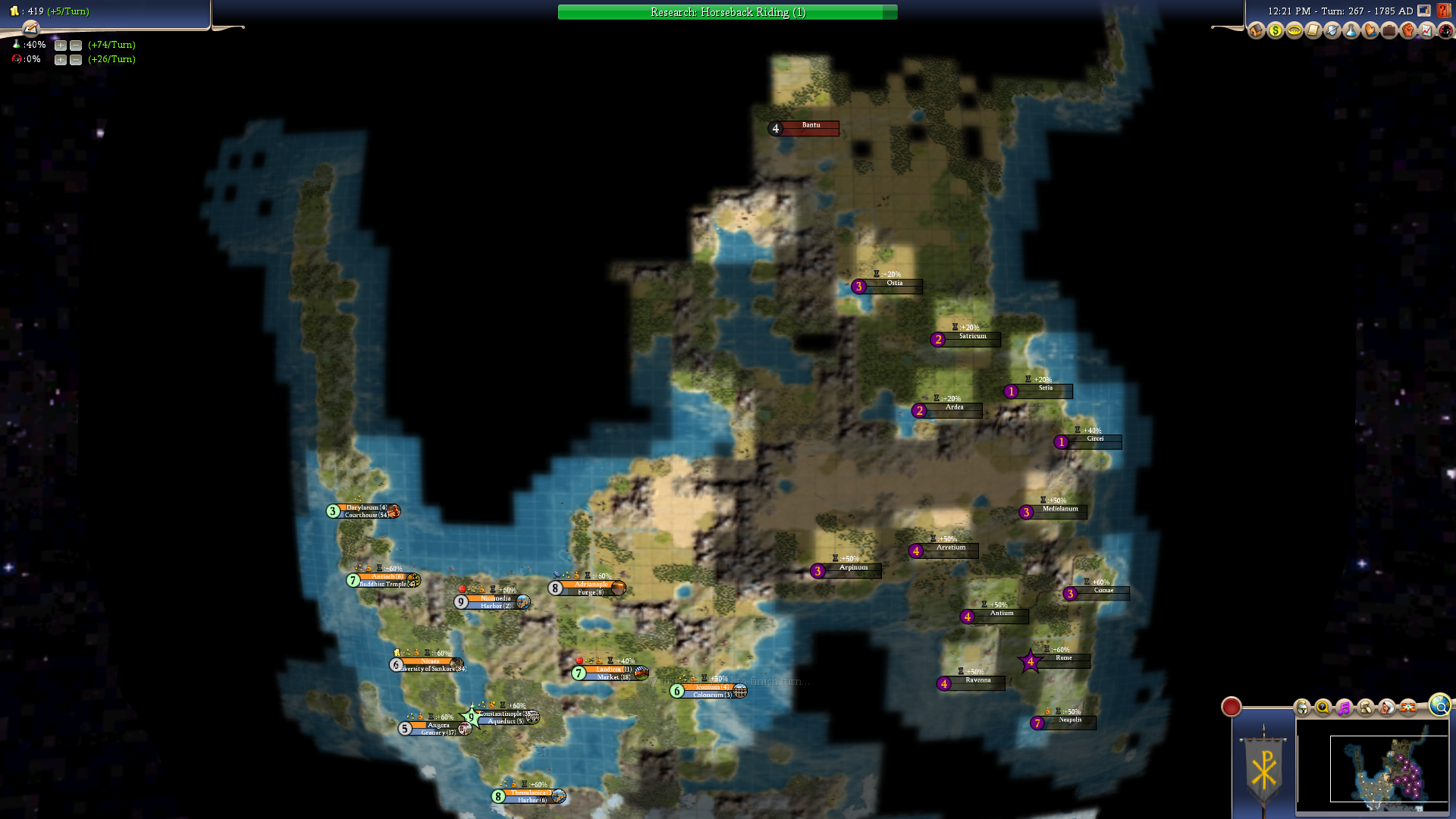
Our continent, after map trading. There’s still much more in the northeast. Exploring the western peninsula early on was very odd, and the combination of barbarians and debt kept me from settling very far along it. Charlemagne turned out to be just west of Antioch, the 7 along the west coast (I can see the edge of his cultural border).

For our fourth game we went with a ‘Mediterranean’ map, which indeed had land all around the north, east, and south sides. As it turned out, there wasn’t much presence along the south, and a bunch of barbarian cities grew up down there. That one eventually ended in the frustration of warfare again. It took a long time for us to see the other players, and then there was a slow slide of them not liking me, followed by a long phony war after Portugal declared war but my dad refused to open borders for him to send troops through.

It’d been a while since I’d really played Civ IV much, so there was a fair amount of learning going on during all of this (and a couple of solo games). The fourth game went very well in the early stages as we both managed our growth and worked towards Currency and Code of Laws, the two technologies that allow having more than a few cities to be viable. We started falling behind all the computer players, and were having to do a lot of organized trading to try and keep up. (And did get ahead in the gunpowder line for quite a bit.)

But a lot of the play forcefully reminded me of my biggest gripe about Civ IV: wars. I don’t mind the ‘stack of doom’ that you hear a lot of complaints about so much, the sheer numbers of units the computer will build and have standing around is the real problem there (especially since managing all that as a human is boring). No, I don’t like the fact that the AI players are all too willing to pursue a war at long distance, often going through someone else’s territory. This turns into an unwinnable war. You might be able to defeat his units. Go back through the neutral country and defeat his armies there. Take a city… which will be surrounded by his culture and that of the neutral powers, and therefore forever useless to you. And that’s if the war goes well. Add to this the fact that most AI players will keep asking for technologies and other gifts, and then be permanently upset when you don’t help them win the game… it’s a recipe for frustration.

On the other hand, there’s a lot to like about Civ IV, and if you can avoid the wars of infinite units, it plays well. We tried out the ‘tectonics’ algorithm for generating the world, and it really does have a pretty good feel for mountain ranges… which can lead to ‘dead’ areas. A bigger concern is that there’ll areas that are all hills (which really adds/causes ‘dead’ areas). The ‘lakes’ setting for it also generates pretty good terrain if you don’t want to deal with oceans much, and the ‘Mediterranean’ setting needs another try.

└ Tags: Civilization IV, gaming
 Comment 

Three Battles of Kanazawa

by Rindis on December 6, 2017 at 12:00 pm
Posted In: Boardgaming

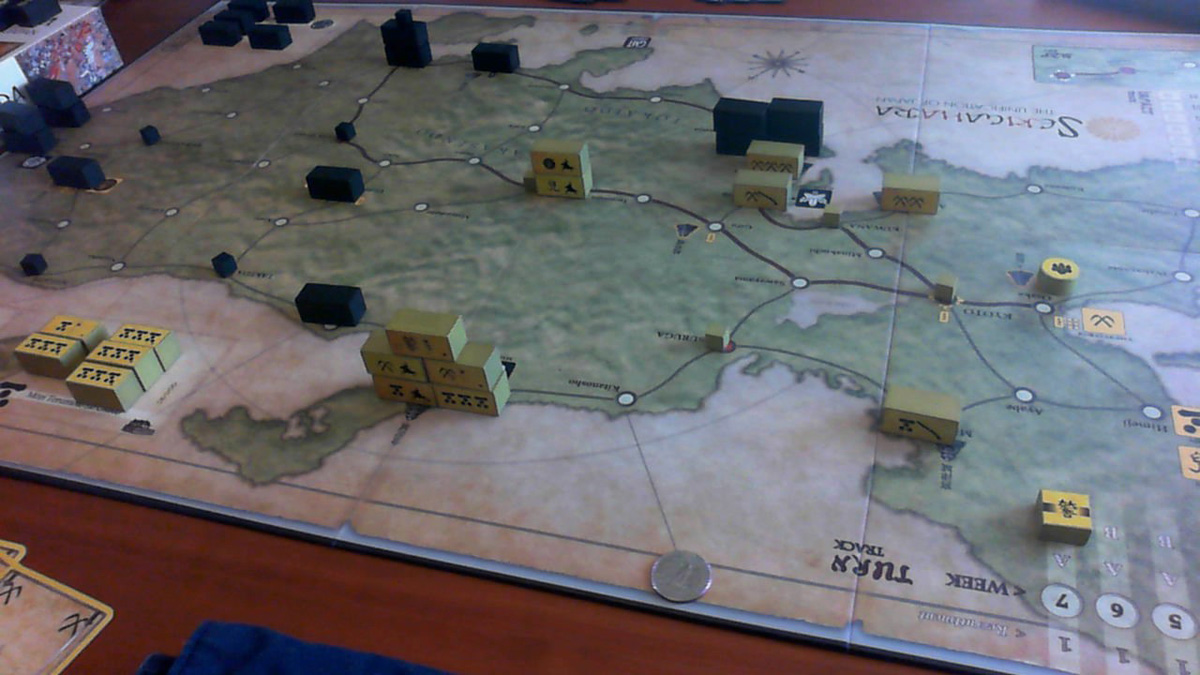
I did a second round of Sekigahara with my dad last Wednesday, the day after our first game. We stuck with the same sides, but things went different from the beginning, partly because I had trouble forming a decent siege force as Ishida at first. Also, Maeda stayed in place for a while, so I grabbed Miyazu in the north during week 2, and then sat for a bit.

My dad slowly bottled up and reduced all resistance in the west, gaining an early lead on resources that lasted the rest of the game. He didn’t immediately take Aizu castle, but Uesugi was bottled up there, and he took Ueda. I sent an ‘efficient’ siege force into Anotsu to take it, and regain a lead in castles… and then had to waste a lot of time trying to figure out how to shuffle forces in there, with the goal of taking out Fukushima in Kiyosu, and holding it to prevent any reinforcements from mustering there, and then taking Okazaki castle.

With the net drawing tighter around Uesugi, I drove south towards Edo, forcing troops to return there, and they then forced a battle with me. It was a bloody affair that I won, since I had a good four-block army that I could use to full impact, since I finally had some Uesugi cards, and I managed to successfully use a Loyalty Challenge to end the battle tied at 16-16. It was a Pyrrhic victory as I lost two of four blocks in the process, and kept the two three-mon Uesugis as a force that might possibly kill a block.

My dad also sent Maeda out to retake Miyazu, and I sneaked a four-block army into Kanazawa and took that in a seige. Despite trying to go first and have another battle at Kitanosho (or Tsuruga, I don’t remember), Tokugawa won the bid, and forced a follow-up battle at Kanazawa, which he won, leaving me one block. What he didn’t realize was that the one survivor in the castle, which had not deployed, was Ishida himself! I force-marched another army up there at the start of Week 7 and won that battle, driving his army out and retaining control of the castle.

I burned three cards in force marches on the ‘B’ turn of Week 7 to get everything juuust right and block my dad from getting far. He tried another fight at Kanazawa as the finale, but didn’t have the cards to deploy much and couldn’t win that fight either.

The VPs were 16 (6 castles + 4 resources) to 11 (3 castles + 5 resources), only 1 point closer than the first game. But in reality this was a tense game all the way through, as I never built up the really large hand I got last time (partly because of a number of forced marches), and more and more blocks were going to Tokugawa. I nearly lost the game at the first battle in Kanazawa, but had the foresight to keep Ishida hidden. Also, the successful Loyalty Challenge in Oyama kept Uesugi as a threat a bit longer, when my dad really needed that area wrapped up.


Situation at the end of the game.

└ Tags: gaming, Sekigahara
 Comment 

Konya wa Hurricane Alliance Turn 12

by Rindis on December 2, 2017 at 12:00 pm
Posted In: Konya wa Hurricane

Crossposted from the SFU blog on BGG.

My efforts to separate out the Federation 4th Fleet SB had finally paid off, with it being its own 5 EP grid, that spent 4.5 on repairs, with further ships needing work. However, Byron was able to call up POLs that restored a connection to that part of the grid, and got most of the Kzinti navy away from the capital back in supply, both of which meant the ships got their fighters replenished.

Builds:
Federation: CVA, CF, TG, 8xNCL, NCD, LTT, 9xFF, 3xFFE, 4xDD->DE, FF->FFE
Kzinti: CV, TGC, LTT, 3xMEC, 3xFKE, 3xFF, FF->FFK
Gorn: DNT, BC, CM, HD, LTT, TG, 3xBD, BDE, FCR, HD->CM, CL->CV, CL->CLE
Hydran: RN, CU, PGV

Hydran raids of course hit the same back-area Klingon provinces as always, disrupting the area, and crippling one F5, which is a marked improvement. There was only one Kzinti raid, which wiped out a garrisoning E4. The Federation raids similarly went after garrisons, though one was sitting on planet 2610, which was the only one to survive (crippled, and retreated off the planet), while the other two F5s died. Gorn raids both went after Romulan garrisons in Federation space, and for a change the cloaking devices worked, so the Gorns disrupted Romulan control of the provinces, but didn’t get the garrisons. (Maybe the Federation needs to share their cloak detectors with the Gorns.)

I was surprised to see a significant Fed force move even further away from the Romulan border, but it turned out that Byron wanted to pin the Klingon South Fleet so it couldn’t intercept his cripples as they headed to the capital (which was six hexes away and had to pass adjacent). This helped insure that the Romulans had sufficient pinning for most everything else that came in, and only one major target was hit (one of the captured Federation planets).

Meanwhile Hydran moves went fairly predictably. He sent forces to pin both reserves in the theater and moved to sweep the Klingons off all the planets in the area. However, I was set up slightly better than two turns ago, and managed at least local parity in a few places as he stretched to get at them all.

Bryon didn’t bother with the planets held deeper in the Federation at all, and concentrated on knocking out the Klingon border, and the planet closest to Klingon space, along with the northern NZ planet. At the same time, the Kzinti finally came boiling out of their capital to challenge Lyran control of the west half of their territory, taking out 1001, which I hadn’t really been trying to hold, while also going after the fortifications on 1105, which had become under-shipped with the pressures elsewhere.


The Kzinti strike back.


Dismantling the border.


Maneuvers towards and away from the Romulan front.


The Hydran Ulcer bleeds…


The Gorn prepare.

Battles:
0319: SSC: Mutual retreat
1001: Lyran: FF destroyed; planet captured
0519: SSC: Mutual retreat; planet captured
0718: SSC: Mutual retreat; planet captured
1203: SSC: Lyran: FF destroyed
1805: SSC: Lyran: crip DDG
1804: SSC: Lyran: crip DW
1803: SSC: Lyran: dest cripDDG
2003: SSC: Klingon: dest E4
2106: Klingon: crip D7, D5, F5; Federation: crip FF, capture planet
3707: SSC: Romulan: dest K4; Federation: retreat
3609: SSC: Romulan: crip K4 & retreat
3410: SSC: NE (mutual retreat)
2602: Klingon: dest F5L
2407: Klingon: dest F5; Federation: crip FF
2210: Klingon: capture CL
2608: Klingon: dest F5
0617: Klingon: dest E4; Hyran: capture capital
0517: Klingon: dest F5, crip D6M, D5, 2xF5, F5S; Hydran: dest RN
0518: Klingon: dest MD5; Hydran: dest TR
1202: Lyran: dest DW; Kzinti: dest EFF
1105: Lyran: dest BATS, FRD, DWE, crip 3xDW; Kzinti: dest 3xEFF; capture cripCW, planet
1802: Lyran: dest CW, DWE, crip CW; Kzinti: dest SF, planet captured
1702: Lyran: crip FF; Kzinti: dest POL
1809: Klingon: dest BATS, 1xD5, crip AD5; Federation: dest 2xDE
1910: Klingon: dest cripD5, cripAD5, E4, G2; Federation: dest FF; planet liberated
1707: Klingon: dest BATS, F5L, G2, crip D5S; Kzinti: dest FKE
1807: Klingon: dest BATS, F5J; Lyran: crip STT, DW; Federation: dest CC, NSC
3110: Klingon: crip D6, D5, 2xF5
3611: Romulan: dest SKE; Federation: crip 2xNCL, 2xFF
3610: Romulan: dest cripK4
3711: Romulan: dest KRC, SKE; Gorn: dest 2xHD, crip HD, 2xBD, BDS
3911: Romulan: dest SP, crip SP, SPB, 2xSK, CE; Gorn: crip CL, 3xDD, CL captured
3808: Romulan: crip FHF, SP, dest SEH; Federation: dest NCD, CC; Gorn: crip DD

The Hydran front featured a few SSCs where I had a disadvantage, but Byron didn’t roll better than 1 casualty. Because of working from the small outer battles in, I was able to consolidate into the larger battles, where either things were more even, or I could sacrifice one or two ships out of the combined fleet instead of losing 2-3 per battle.

1805 happened to have supply sources that pulled both forces directly up, turning it into a three-hex running battle, with the Lyrans taking 2 casualties each time, and never able to touch the Kzintis (I couldn’t do more than force a retreat which just continues the problem anyway). Even better, this was accidental instead of a purposeful set-up.

The pile of Klingon cripples from last turn were weathering in 2106, and I withdrew them out of the fight there. I thought that prevented them from being picked off in retreat (as the rules state to put them in the new hex immediately), but actually they do get pursued. As it was, it kept them out of the way, and the Federation pursuit roll failed, saving them.

The Romulans are still having trouble with the cloaking devices, with three out of three attempts to evade combat failing. At least in the last one, Byron rolled a ‘2’ allowing the SNB to escape unharmed.

The one unpinned Klingon reserve didn’t have anything pressing to do, so it went to a pinning battle, where Byron gave up a CL to retreat out a FF. My poor luck on captures finally turned around, and I got the CL. As I consider spending the money on conversion a good deal compared to overbuilding for pin count, I’ll probably keep it, and maybe turn it into an LSC (which would be one less D6S I need).

The Hydran capital area turned into a small problem for Byron, as we had a pinning battle in 0518. If he resolved that before the capital fight, I could retreat into there and have a lot more ships than he did. If he retreated after the capital fight, then I could still retreat into the hex (to avoid the fight in 0517, or because it was just as valid as 0517). And if he did it before the fight in 0517, I could still have a choice to go back into the capital. So he ended up doing 0517 without a proper command ship, which was stuck in the capital, and that reduced the pain on my fighterless fleet a little. Sadly, the D6M shocked, and I really wanted to have an operational 10-point mauler available in the area.

I’d been expecting an assault on 1105 from the beginning, when the Lyrans started fortifying the captured Kzinti planet, and it finally happened this time. Byron apparently expected me to leave after the first round, but even if the available fleet was inadequate, I finally had a chance to hit him from behind my fortifications, though as ever with the Kzinti it was impossible to kill anything other than escorts. I stuck some cripples awaiting their turn at the FRD on the line for the third round, and he promptly captured the CW he directed on to kill. It’s a pity I can’t be everywhere at once; the Kzintis ran through almost all of their spare fighters in the fighting that did happen. I’m happy he didn’t get the LTT that was setting up a PDU (also lost) on the planet (I just don’t have enough transports).

1809/1910 was a trap I didn’t see until too late. I knew that the Federation 3rd Fleet would inevitably retreat over NZ planet 1910, and thought to try to prevent that, only to realize too late that I would also have to retreat there. (I’m generally fine with the retreat rules, but keep feeling like I should just always be able to retreat towards my own capital, especially if I’m already within my own space, as I would in any other game.) I went around in circles with several different plans to get myself out of the hole I’d dug, all of which had their own problems before managing to get out with only a few destroyed ships (instead of wrecking the entire force).

I actually had a somewhat bigger fleet for the base battle in 1807, but didn’t realize that ahead of time, and let him into the base. He probably would have passed approach on the first try (he rolled better), but it would have been another round to wear the Federation down before he directed the BATS.

The Romulan battles all went fairly well. The Gorns can put out big lines more easily than the Lyrans can, which is a problem, and their ability to do field repairs at the normal repair rate means their cripples don’t stay that way for long. But while the Romulan carrier force is still getting itself established, almost all of the Federation carriers have passed out of the area, and the Gorns never have very many, allowing the Romulans some better ability to absorb damage.

I knew that Byron would be going after more of the line Klingon BATS on the Fed border this turn, but was hoping to save at least one, and failed. Now the entire chain of supply into my gains into Federation space is extremely fragile (I need to hold on to planets that I failed to this time), and there’s no immediately obvious way to restore it. Worse, a chunk of the Kzinti fleet retrograded to the 4th Fleet SB, making that area even more dangerous. The good news is that most of the plan in that area is already accomplished, and it might still be possible to make the supply grid to that SB purely reliant on devastated planets, which can be retaken each turn. The question becomes if that is currently worthwhile. I have a lot of ships semi-permanently out of supply, and I’m not sure that going further down this rabbit hole would pay off….

└ Tags: bgg blog, F&E, gaming, KwH
 Comment 
  • Page 160 of 315
  • « First
  • «
  • 158
  • 159
  • 160
  • 161
  • 162
  • »
  • Last »

©2005-2026 Rindis.com | Powered by WordPress with ComicPress | Hosted on Rindis Hobby Den | Subscribe: RSS | Back to Top ↑