Rindis.com

All my hobbies, all the time
  • Home
  • My Blog
  • Games
  • History

Categories

  • Books (490)
  • Comics (10)
  • Gaming (911)
    • Boardgaming (669)
      • ASL (154)
      • CC:Ancients (83)
      • F&E (78)
        • BvR – The Wind (26)
        • Four Vassal War (9)
        • Konya wa Hurricane (17)
        • Second Wind (5)
      • SFB (78)
    • Computer games (161)
      • MMO (76)
    • Design and Effect (6)
    • RPGs (66)
      • D&D (25)
        • O2 Blade of Vengeance (3)
      • GURPS (32)
  • History (10)
  • Life (82)
    • Conventions (9)
  • News (29)
  • Technology (6)
  • Video (48)
    • Anime (46)
  • Writing (1)

Patreon

Support Rindis.com on Patreon!
Become a patron at Patreon!

Other blogs:

RSS Inside GMT

  • Meet The Han: A Civilization of GMT’s Ancient Civilizations of East Asia  March 20, 2026

RSS Playing at the World

  • Playing at the World 2E V2 Arrives May 5, 2025

RSS Dyson’s Dodecahedron

  • Return to An-Nayyir’s Pyramid – Part 3 of 3 March 20, 2026

RSS Quest for Fun!

  • The Myth of Rational Animals November 23, 2025

RSS Bruce Heard and New Stories

  • Preview: The Iron Queen February 9, 2026

RSS Chicago Wargamer

  • The 2 Half-Squads - Episode 310: Cruising Through Crucible of Steel January 27, 2023

RSS CRRPG Addict

  • Star Trail: Sweet Is the Swamp with Its Secrets March 20, 2026
SF&F blogs:

RSS Fantasy Cafe

  • Michael Swanwick Guest Post and Book Giveaway February 23, 2026

RSS Lynn’s Book Blog

  • Friday Face Off: The Geomagician by Jennifer Mandula March 20, 2026
ASL blogs:

RSS Sitrep

  • Cardinal ASL Sins March 18, 2026

RSS Hong Kong Wargamer

  • FT114 Yellow Extract After Action Report (AAR) Advanced Squad Leader scenario April 16, 2025

RSS Hex and Violence

  • This still exists? March 25, 2025

RSS Grumble Jones

  • 2026 Kansas City ASL Club's March Madness Tournament March 16, 2026

RSS Desperation Morale

  • How to Learn ASL March 16, 2025

RSS Banzai!!

  • October North Texas Gameday October 21, 2019

RSS A Room Without a LOS

  • [Crossing the Moro CG] T=0902 -- Rough start July 18, 2015
GURPS blogs:

RSS Dungeon Fantastic

  • What color is paut? Sigh. March 3, 2026

RSS Gaming Ballistic

  • Pigskin project (by Chris Eisert) February 28, 2026

RSS Ravens N’ Pennies

RSS Let’s GURPS

  • Review: GURPS Realm Management March 29, 2021

RSS No School Grognard

  • It came from the GURPS forums: Low-Tech armor and fire damage January 29, 2018

RSS The Collaborative Gamer

  • Thoughts on a Town Adventures System January 18, 2022

RSS Don’t Forget Your Boots

  • GURPS Supers Newport Academy #3: “Season Of The Witch” February 8, 2026

RSS Orbs and Balrogs

  • Bretwalda - Daggers of Oxenaforda pt.4 - Fallen King May 27, 2017

Plataea 479 BC

by Rindis on June 23, 2020 at 12:00 pm
Posted In: Books

The Greco-Persian Wars are famous thanks to some very good accounts written not long after they happened (primarily The Histories), but still get boiled down to a few famous battles. The Battle of Plataea isn’t one of those, and feels more like a denouement after the drama of Salamis.

However, the Persan Empire still had a very large army that wintered over in Greece after Salamis. Much of the army pulled back with Xerxes, but what was left was still larger than what the Greeks could likely put up against it. The next year would see the Persians finish by land what they had started by land, and been delayed by sea.

Osprey has done Campaign books for all the major battles of the two invasions of Greece, though I only have this one and Marathon (which was good). This one is meant to stand alone, and starts with an eleven-page summary of the rise of Persia and its conflicts with Greece. This is followed by the usual short descriptions of the various commanders involved (very short in this case, ~3 pages for five people). There is a good look at the Persian and Greek armies, with the general equipment of both, and some analysis of the likely number of men in each army. The following section on overall planning is fairly brief, but covers the situation well.

The main narrative starts with the Persian withdrawal after Salamis (noting that the Greeks had expected a ’round two’ the next day), and deals well with all the politicking that surrounded the efforts to keep the Greek army in the field, and decide just where it would be stationed. The main bulk of the battle is well described, and there’s a couple of good ‘soldier’s eye’ view illustrations, but of course, it largely follows Herodotus’ account. There is some good analysis over how the Greek supplies were working, and the Persian attempts to cut that off; this is also followed by some good work on just what happened during the attempted pull out and the climatic day of the battle.

There’s also a very short section on the Battle of Mycale, which supposedly happened on the same day. The Histories doesn’t talk as much about it, and therefore there’s not a lot to say here, though there is an area map, and a good photo of where the battle presumably happened.

Overall, it’s a competent Campaign book, but not a stellar one. This is mostly caused by the fact we’re dependent on one well-known source. It’s well analyzed here, but there’s not a whole lot to do, though of course the photos of the area, and the maps are a great help.

└ Tags: books, history, reading, review
 Comment 

J114 The Marketplace at Wormhoudt

by Rindis on June 19, 2020 at 12:00 pm
Posted In: ASL

After finishing up To the Square, Martin proposed a scenario from Journal #8. It features board 12, and more notably, the marketplace there is not only not SSRed out of existence, but is likely to be a central part of the climax of the scenario.

The evacuation of Dunkirk is underway, and the Germans are starting forward again. The British are holding Wormhoudt as part of the perimeter, with twelve squads (mostly 1st Line), a HMG, MMG, a pair of light MTRs, a pair of ATR, and a 40mm AT Gun. A pair of A10s show up on turn 2, and then a pair of Matilda IIs on turn 4. The main defense is of the board 12 village, while the tanks have to cross board 16 to get there, and the Germans start in a small corner of board 19. They have fourteen squads (mostly 4-6-8 SS with a couple assault engineer 548 SS), with good leadership, the usual MGs and MTRs, as well as two DCs and and two ATRs. Two each Pz IIIs and IVs enter on turn 1, followed by a pair of unarmored halftracks towing 150mm INF on turn 2.

The Germans have 7.5 turns to get more VPs than the British, with each building on board 14 giving as many VPs as it has locations, with a bonus for the Marketplace, added to the CVP totals. The Germans also have a CVP cap of 45, which mostly means don’t lose the tanks and a bunch of infantry.

The Germans also get one free Smoke FFE at the start of the game, which he put in 19L8, and errored to N7. I hadn’t properly thought about that part, and it pretty well closed down my plan to keep him to a slow pace across the open areas of the board. I had set up concentrated on the woods line near the edge of board 19, with a Dummy off in the X6 farmhouse, and an ATR and MTR on my left flank, where they could cause some interference, and then presumably fall back… with little to no cover, but at long range. Naturally, the main line would need to fall back after a couple turns, and then the fight for the town would begin, with my ATG in 12P5, the HMG and 9-2 in O4h2 (the type of thing I’ve found to be too vulnerable, but at the opening ranges…), and the MMG over in U5. He opened up with his MTRs on the flanks of my main line, but missed.

His first move was a HS who was pinned as I set up a fire lane, but after that, he moved in his tanks, and used smoke dispensers (succeeding three out of four times) to create another barrier of smoke behind the FFE, and then the assault engineers put down another hex. This left me with little to do, as most of the shots were poor, if not outright blocked. Worse, shortly after the tanks drove CE through the FL with no result other than his sniper pinning a backfield squad, the LMG malfunctioned, shutting down the FL.


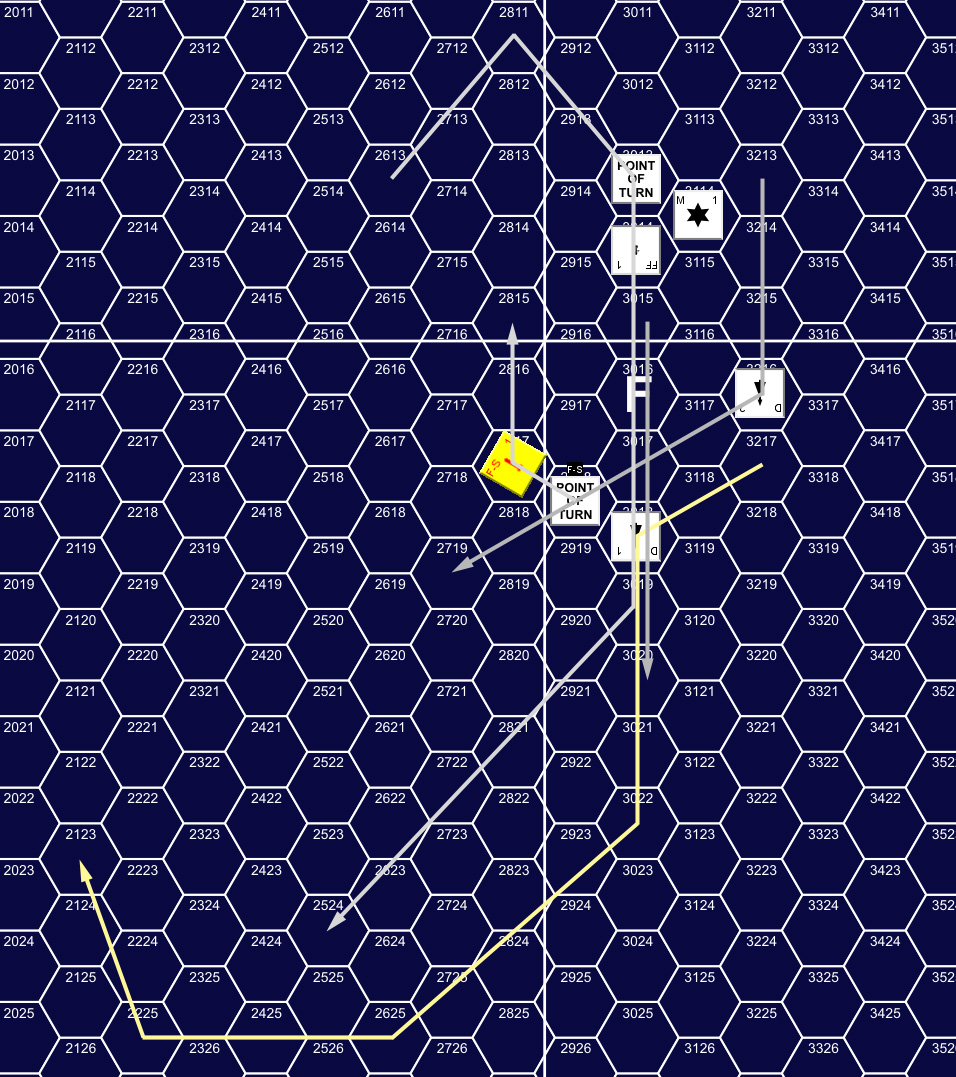
Situation, German Turn 1, showing the full board. North is to the left, the victory area is between the blue dashed lines, and many buildings have been redefined as two-story buildings instead of multi-story. There should be a bunch of shellholes scattered around board 19, but both of us missed them during setup.
↓ Read the rest of this entry…

└ Tags: ASL, gaming, Journal 8
 Comment 

Constantinople 717-18

by Rindis on June 15, 2020 at 12:00 pm
Posted In: Books

The city of Constantinople is best known for the ‘bookends’ of its founding as a capital for the newly-Christian Roman Empire, and its fall to the Muslim Ottomans over a millennium later. Following that would be its fall to the Fourth Crusade. With those two exceptions, the city never fell to enemy forces, mostly thanks to a very defensible position, and extensive fortifications.

This does not mean that this important city was never brought under siege apart from 1204 and 1453, and Sheppard discusses what might be the most serious of those other attempts to take the city. As is usual, there is a background to the campaign, though this one goes back to 626 and the first ever siege of Constantinople. This, and some other sieges are largely passed over, but the chapter as a whole is quite long, going fairly in-depth for a book of this size into the military history of the next ~100 years.

To a certain extent I was disturbed by how much space this was allowed to take, but it really is a very good ~20-page history of the fighting between Byzantium and the early Caliphate. It does dissolve into a flow of names on a couple occasions, but mostly it’s very effective at showing the amount and types of activity on the frontier during this time. There are constant raids into Anatolia, and fighting over Armenia, and its obvious that the Byzantine military is struggling to get any real grasp of the situation ever since the Battle of Yarmuk. This is something that gets assumed, or passed over in a lot of works touching on the period, so its very nice to have a lot of the action layed out and shown.

Sheppard also spares a few words for various Muslim commanders of this period. Their achievements rank in the first order of military command, but not only do they not get celebrated (or even reviled) in the West, but their names are nearly unknown. He posits ideological reasons for this, but I wonder if at least some of this comes from Islamic myth-making, which has done a good job of painting the entire early expansion of the Islamic world as being bigger than any one person, and more of an impersonal force (divinely-inspired or not); this would also tend to minimize the contributions of army commanders. It would be informative what Islamic scholarship makes of them, and how they were viewed historically. At any rate, learning more of Maslama b. ‘Abd al-Malik (the commander of the army at this siege) would be interesting, as he shows as a capable and accomplished commander.

Except, on this occasion. I’m seeing a TV-miniseries drama, where Emperor Leo III is sponsored onto the throne of Byzantium by the Muslims, and as he keeps promising al-Malik that he’ll be a good puppet king, and hand over the city just as soon as he convince the rest of the nobles that it’s the best idea. And then he turns around and tells the rest of the Byzantine government of course he’s not going to turn the city over to the infidel, he just needs their support to hold out a bit longer. And as the tension mounts, the audience is never quite sure who, if anyone, he’s telling the truth to.

But al-Malik believed him. Believed him enough to destroy his food stores when Leo III told him that it would convince the city that they were serious, and on the verge of storming the city. And he even agreed to let Leo send men out to to gather some of the food first, to distribute in the city.

I’d love to see that conversation.

As a whole, the book is very well produced, with color reproductions of art and coins throughout, along with some very good maps, and some good illustrations. Its a highly recommend addition to Osprey’s Campaign series that covers a siege that just does not get enough attention.

└ Tags: books, Byzantium, history, reading, review
 Comment 

Reform-Minded Patch

by Rindis on June 11, 2020 at 12:00 pm
Posted In: Computer games

This is the fourth in a series of reviews looking at the evolution of Europa Universalis IV. See the previous reviews here:
Europa Universalis IV: A Fantastic Point of View
Wealth of Nations: National Trade
Res Publica: A Tradition of the People

After Res Publica, a fairly small update and expansion, Paradox scheduled a larger expansion, and the biggest overhaul to EU IV yet. Art of War concentrated on warfare, with new events and mechanics for the Thirty Years War and the Napoleonic period. It was released with patch 1.8 on October 30, 2014, which included some massive overhauls of major mechanics in the game.

Patch 1.9 was a major patch with no accompanying expansion (this every-other major patch pattern became the general procedure for EU IV) that was released on December 19th, and did more re-works of the game. This review looks at both patches and the expansion.

Country Update

While different, the EU IV world map was naturally based on EU III’s, and was more detailed in Europe than anywhere else. Patch 1.8 increased the number of provinces by about half, and added a large number of new nations in all corners of the world. Some of these are only ‘potential’ countries; ones that can exist only by revolt or being released by a larger country, but many represent smaller nations that couldn’t be represented on the old map, or just better research on an area.

In addition, a number of new tradition sets were created, mostly for sets of these new countries, but overall the variety and individuality increased substantially. Finally, more dynamic historical events were added for all sorts of countries, enhancing that system overall.

Patch 1.9 then added the idea of disasters. There were a number of large-scale bad events that could affect a country, seemingly randomly. Now, they were surfaced to the user, making the game a bit more controllable, and feeding into the feel of this iteration being a game. Generally, all countries are eligible for the ‘peasant revolt’ (low manpower and stability) and ‘civil war’ (low legitimacy), while some countries have special ones (England can have the War of the Roses and the English Civil War disasters).

When the preconditions for a disaster are met, the clock starts ticking down to it. If the conditions go away, then the disaster stops, otherwise it fires once the clock ends. Peasant Wars have always been a more common one (especially for the AI), and as an example, force stability to -3, cause additional unrest, make stability more expensive, and creates a couple peasant armies for an immediate problem while the unrest and negative stability cause more.

This is one place where I feel too much is being surfaced to the user, as these are the types of events that, at best, are only obvious in retrospect. That said, getting stuck in a poor position, and watching the clock tick to an even bigger problem certainly does add its own brand of tension to the game.

Revolt & Unrest

Speaking of revolts, those changed too. The province-by-province check for revolts every month, that had existed since the original game was replaced by unrest. This is pretty much figured the exact same way, but it does not cause revolts in itself.

Instead, the province’s prominent revolt type is figured (independence, religious, pretender king, etc.), and all the provinces with a positive unrest towards that particular type add together for a chance of progressing a revolt. Then that is checked each month, and when it does come up, that revolt gets 10% progress, which is displayed in a few places. Once progress hits 100%, then an actual revolt happens with a decent army or two.

This makes revolts something of a ‘mini-disaster’, where you can see the problem coming from some time off. The listing of factions will even tell you, on average, how long it will take a revolt to occur based on current unrest and progress. If an in-progress revolt loses all support (i.e., the respective provinces go to negative unrest), it will lose 10% progress each month until it goes away, so solving a problem for a month or two will set it back, but not instantly get rid of it.

A final adjustment is that revolts that start on an island have been a very small problem as they can’t spread, and take control of more territory. Now a revolt that has control of everything it can reach will automatically try to move to a non-connected nearby province, without needing sea movement or anything, just a decent amount of time.

Autonomy and Clients

One of the things revolt risk did was cause lower taxes and recruiting, as the population was resisting the government’s efforts. This did not get taken over by unrest, and instead these factors are now reduced by autonomy.

Autonomy is a new measure of how much attention a province is paying to the central government expressed as a percentage; manpower and income from the province are both reduced by the amount of autonomy, which generally goes down a little each month while the country is at peace, and the later government forms tend to have bonuses to autonomy reduction.

Naturally, newly conquered territory will have fairly high autonomy to start with, though reconquering core areas and inheriting in a union will result in minimal, if any, autonomy. The big thing is that you can also raise or lower autonomy in an area, which will lower or raise unrest in the province. So, take a new province, raise autonomy, which reduces unrest, and then peace will eventually bring autonomy back down again. Or, lower autonomy to exploit a rich province, and garrison the area to put down any revolts that crop up.

Also, releasing independent nations has always been a way of splitting off troublesome areas, or creating a buffer. But, it requires an appropriate possible nation in the area, and that may include areas you don’t wish to let go of. With AoW active, custom client states become possible in the late game (emulating Napoleon’s many reorganizations of the map of Europe). They’re set to be fairly loyal, and get their own traditions, in addition to their territory and name being entirely at the whim of the creating nation (well, the territory has to be contiguous).

Wars of Reformation

The Reformation came in for its own major overhaul. Generally, events would fire to randomly convert provinces to Protestant or Reformed, causing chaos and potentially making conversion a smart idea for smaller central European states.

With the new patch, instead there would be centers of reformation that would actively try to convert other provinces nearby, going for more of a proselytizing model. This makes the entire process much less random, and ensures that anyone near one of these centers will have to deal with the problem for some time to come.

Generally, three centers show up for the Protestants, and then another three for Reformed (with the first of each as an event, and the other two being ‘rewards’ for the first countries to convert to the new religion). The process can be stopped, by conquering the province and converting it (which will destroy the center), but that’s not easy either.

AoW also introduced religious leagues. These are coalitions that form to enforce, or change, the religion of the Holy Roman Empire. To start with, the Emperor must be Catholic; but there’s no restrictions on the electors, and if one of them goes Protestant, then he automatically forms the Protestant League, which can declare war on the emperor to force the official religion of the HRE to change. Once started, anyone (regardless of religion) can join the leagues, but religious tension is what starts them.

Liberty, Equality, Fraternity

Along with the Thirty Years War, the French Revolution came in for some serious attention. The Revolution was of course one of the major points of events in the original two games, In III, there had been the separate Revolutionary Republic and Empire government types, which had event chains as pre-requisites for them, and some very powerful bonuses, along with plenty of events to make sure that such a government would end up at war with most of the rest of Europe.

Now, a Revolution disaster was added which could happen to any European country that was in dire straights in the late 18th Century, making them the revolutionary target (France gets a customized French Revolution disaster). The lead ‘unhappy’ country gets to be the target of the events that bring about the revolution, changing the government to Revolutionary Republic, and changing the national symbol to a tricolor (many countries have the colors defined, and the rest get random colors picked for them).

Of course, all the relations problems of the old system are kept here, with the Revolutionary government getting a casus belli to ‘spread the revolution’, while everyone else gets reactionary modifiers to put the anti-monarchist upstarts down.

Naval Affairs

Art of War had a few tweaks for the military, the biggest one being the ability to just upgrade ships to modern types with a single click. You still pay the standard construction cost, and the ships are reset to minimum morale and durability, but it’s instant, and saves all the trouble of retiring old ships to stay under your naval limit while building the new ones.

Even better (and really needed), the expansion allows the ability to mothball fleets. Generally, it was common to set naval maintenance to minimum during peacetime in previous EU games. This can save a fair amount of money, and you don’t generally need the morale while at peace. Except now, trade protection with light ships suffers with lower maintenance, so mercantile nations can’t afford to do that (and possibly still can’t afford a regular fleet). Mothballing basically sets maintenance to minimum for selected fleets, so your light ships can still do their thing (along with any anti-pirate patrols you end up needing), allowing big ship and galley navies to not strangle the economy any more.

A final option is the ability to sell surplus ships to other powers, though I’ll admit I haven’t played around with it, and don’t know how eager the AI is to take your old castoffs. Also, as part of the big map expansion, trade was reworked with a more stable pricing scheme, and three new trade items were added.

A final naval convenience is that transporting armies was made simpler in the expansion. If you give an army an order to march across a body of water, the game will now ask if you want to use your transports automatically. And then it will send them out, pick up your troops (automatically dividing the army if it’s bigger than the transport fleet), and ferry them over. It’s not perfect, as it’ll try to do this when the waters are contested, and you need to ‘sneak’ across away from patrolling enemy fleets, but it’s a big convenience when it can be used.

Conclusion

Just in terms of the patch, 1.8 was a great improvement for EU IV. The new Reformation mechanics feel a lot more natural, and let you see whether or not you’re likely to be in the path of religious controversy. The new revolt mechanics aren’t as dramatic, but affect you no matter when/where you play the game as, and was just the beginning of PDS re-thinking core mechanics that had been there from the beginning. EU IV changed a lot of things in the interests of a better game, and this showed that the process hadn’t stopped.

The new map of course added a lot of content. If you’re stuck in Western Europe, you won’t see the changes, but everywhere else saw some major changes, and loads of new nations (and potential nations), adding even more life away from the ‘bright center’ of the game’s roots. The amount of work to update the timeline files for all the extra provinces and counties must have been massive. As much as I say I’m not a fan of patch 1.9’s disasters, they are in line with the rest of the features of EU IV, and I can’t really complain.

The expansion is also big, with a lot of nice things in it, though the out-of-expansion changes are still big enough to get all the top billing. Much of it is paying for convenience, and despite the features, nothing is really essential. It certainly makes you happy to be able to just automatically ferry troops, or any of a half-dozen other things. Content-wise there’s also a lot in the events, but they’re hard to pick up on. So there’s no one ‘get this now’ feature, and I only recommend this to dedicated players.

└ Tags: EU IV, Europa Universalis, gaming, Paradox, review
 Comment 

Servant of the Empire

by Rindis on June 7, 2020 at 12:00 pm
Posted In: Books

I will admit to not being a big fan of the Riftwar Saga. It certainly made a splash at the time, but I was unhappy with stretches of it, and have never had a desire to revisit it.

However, I read Daughter of the Empire… either shortly before or after that, I don’t recall, on a recommendation, and it lived up to it. DotE is a great, highly recommended book. I regret that it’s taken literal decades to get back to it, but I finally have, and the second book lived up to my memories of the first.

Mara is a maverick, a leader in a very traditional society who is not afraid of change. She has bent rules before, and now she plunges into actual questioning of her society’s values. Slaves from Midkemia (the main setting for the main series) were popular exotics at first, but their alien values and general intransigence has made them much less prized, but Mara ends up buying a lot of them for her under-staffed estates. It’s obvious from the first that they’re exceptional, as they’re organized to make a hash of the ordinary way of doing things (such as selling off clothes as they’re being distributed, and then complaining the allotment was short).

This is basically because they’re ably led by an intelligent, resourceful man who’s determined to get out. A lot of what follows certainly owes Shogun a debt, as Kevin ends up as a nearly co-equal central character for… say three-quarters of the book. He and Mara have a passionate relationship, and she absorbs a lot of information from him, and becomes ever more reform-minded.

Meanwhile, the politics of the Great Game continue, advancing the plot in somewhat uneven lurches. Also, some of the more dramatic parts of the middle of the Riftwar saga happen during this book, with the characters here present for one of the big ones (which was dramatic enough that I have dim memories of it from the original books roughly thirty years later). The Minwanabi clan is still more powerful than the Acoma, and continue to be the main source of threat.

The really nice thing here is that despite being the middle book of a trilogy, it stands well on its own. What happened in the first book is important, but you don’t really need to have read it to understand this one, and… where the next book is going isn’t really shown here. This is a separate complete book, and therefore does not suffer from the common ‘middle’ problem. Also, the Kindle version is in very good shape, and I didn’t note any of the usual OCR-induced typoes, though the formatting needed a little help.

└ Tags: books, fantasy, reading, review
 Comment 
  • Page 106 of 310
  • « First
  • «
  • 104
  • 105
  • 106
  • 107
  • 108
  • »
  • Last »

©2005-2026 Rindis.com | Powered by WordPress with ComicPress | Hosted on Rindis Hobby Den | Subscribe: RSS | Back to Top ↑