
Rindis.com

All my hobbies, all the time
  • Home
  • My Blog
  • Games
  • History

Categories

  • Books (503)
  • Comics (10)
  • Gaming (917)
    • Boardgaming (673)
      • ASL (154)
      • CC:Ancients (83)
      • F&E (78)
        • BvR – The Wind (26)
        • Four Vassal War (9)
        • Konya wa Hurricane (17)
        • Second Wind (5)
      • SFB (78)
    • Computer games (162)
      • MMO (77)
    • Design and Effect (6)
    • RPGs (66)
      • D&D (25)
        • O2 Blade of Vengeance (3)
      • GURPS (32)
  • History (10)
  • Life (82)
    • Conventions (9)
  • News (29)
  • Technology (6)
  • Video (49)
    • Anime (47)
  • Writing (1)

Patreon

Support Rindis.com on Patreon!
Become a patron at Patreon!

Other blogs:

RSS Inside GMT

  • Foxes and Lions (Part 3): Military Matters, Captains, and Condottieri June 12, 2026

RSS Playing at the World

  • Playing at the World 2E V2 Arrives May 5, 2025

RSS Dyson’s Dodecahedron

  • Hollowshore Cairn June 17, 2026

RSS Quest for Fun!

  • The Expense Post May 24, 2026

RSS Bruce Heard and New Stories

  • Pain, Exhaustion, and Morale in D&D BECMI June 7, 2026

RSS Chicago Wargamer

  • The 2 Half-Squads - Episode 310: Cruising Through Crucible of Steel January 27, 2023

RSS CRRPG Addict

  • Yendorian Tales: Here There Be Dragons June 15, 2026
SF&F blogs:

RSS Fantasy Cafe

  • The Leaning Pile of Books May 24, 2026

RSS Lynn’s Book Blog

  • Summer of Horror: Can’t Wait Wednesday: Sleepers in the Snow by Joanne Harris June 17, 2026
ASL blogs:

RSS Sitrep

  • Cardinal ASL Sins March 18, 2026

RSS Hong Kong Wargamer

  • FT114 Yellow Extract After Action Report (AAR) Advanced Squad Leader scenario April 16, 2025

RSS Hex and Violence

  • This still exists? March 25, 2025

RSS Grumble Jones

  • YouTube AAR for Critical Hit's Gettysburg Turning Point 1863 - ID4 At Will Fire June 16, 2026

RSS Desperation Morale

  • How to Learn ASL March 16, 2025

RSS Banzai!!

  • October North Texas Gameday October 21, 2019

RSS A Room Without a LOS

  • [Crossing the Moro CG] T=0902 -- Rough start July 18, 2015
GURPS blogs:

RSS Dungeon Fantastic

  • GMing Shortcuts in Felltower June 17, 2026

RSS Gaming Ballistic

  • B-Scale: Damage That Scales from Tardigrades to Kaiju June 5, 2026

RSS Ravens N’ Pennies

RSS Let’s GURPS

  • Review: GURPS Realm Management March 29, 2021

RSS No School Grognard

  • It came from the GURPS forums: Low-Tech armor and fire damage January 29, 2018

RSS The Collaborative Gamer

  • Thoughts on a Town Adventures System January 18, 2022

RSS Don’t Forget Your Boots

  • GURPS Supers Newport Academy #6: “Old Friends, New Again” June 7, 2026

RSS Orbs and Balrogs

  • Bretwalda - Daggers of Oxenaforda pt.4 - Fallen King May 27, 2017

Designers & Dragons: Part 3

by Rindis on May 8, 2018 at 12:00 pm
Posted In: Books

The third volume of Shannon Appelcline’s history of the RPG industry maintains the same general format as before: about four hundred pages, separate chapters for each publisher, covering (essentially) a decade of time (1990-1999).

I tend to be fascinated by beginnings, and with 25 years since the first RPG when this book opens, the beginnings are over, leading to a slightly lower interest for me. Also, this is a time period where I wasn’t paying as much attention to RPGs, so there’s not a lot of personal connection. Reading through the ’10 things about the decade’ section in the back shows that maybe it was mutual. Trends in the ’90s angled away from my interests, which carried over into less interest in some company histories. Cyberpunk did well in the late ’80s, and urban fantasy did well throughout the ’90s, and they’re both genres that have never appealed to me.

But there’s still a lot of interest to me here. Most notably, part two of the book is a single chapter, a pattern that echoes TSR being the sole chapter of part one of the first book. In fact, it is called ‘The Other Half of the Story’, on the idea that the story of the RPG is still very much the story of D&D, and Wizards of the Coast is the other half of that. This was published in 2014, so actual end of 4th Edition D&D and the last few years of 5th are too recent to be covered, which is a shame (and great grist for a future update of this volume). Past that, AEG was interesting, as they kind of came out of left field on me with a few issues of Shadis being handed out for free at cons. The full stories of a few other companies I knew of (especially the train-wreck of Imperium Games) were very nice to see, though I found the history of Guardians of Order didn’t seem to dig in to what exactly happened to the company as much as I’d like.

There’s 21 company histories this time, plus four mini-histories, and a nice page on Ars Magica fanzines and how they helped keep that property going; an all too rare look at the fan side of the industry in these histories. There’s also a good section on early Swedish RPGs as the background to ’90s English-language publisher Metropolis. As much as I admire how wide-ranging these books generally are, it is a little annoying to not get any sense of what was going on outside the US, Canada and Britain (and I imagine far more than merely ‘annoying’ for anyone from outside those countries).

It’s another well-written book, and I doubt there’s any other wide-ranging source for RPGs in the ’90s, and so is recommended if you have any interest in that subject. I will note that the (necessarily) focused coverage on RPGs continues to hurt proper coverage of what exactly many of the companies were doing, but instead of the lack of wargame coverage, now it is the lack of CCG coverage that causes problems. However the overall CCG boom-and-bust cycle was so fast that what is given is sufficient in many, but not all, cases.
└ Tags: books, gaming, history, reading, review, rpg
 Comment 

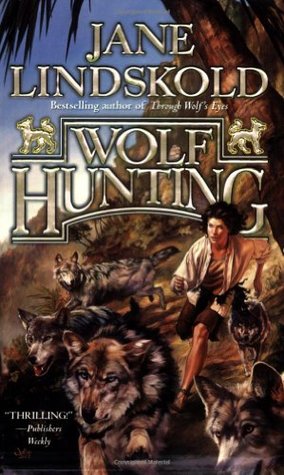
Wolf Hunting

by Rindis on April 30, 2018 at 12:00 pm
Posted In: Books

The fifth Firekeeper book does an all-around good job of continuing the characters and exploring more of the world. It’s been a while since I’ve read the previous books, so I can say that this one doesn’t lean too heavily on them, though prior events get referenced a lot. In fact the biggest weak point here might be too much referencing of the previous background; in a couple places it felt repetitious.

After the sudden change of venue in the previous book, this one continues with exploring new lands, and ends up dealing with the foundational events of the setting: The ‘divine retribution’ plague that ravaged the old mage lord empire(s).

The politics and related plot lines of the first three books are completely gone, and more of the original characters effectively drop out of this book in favor of the new cast. However, the dangling threads from the fourth book are in force, and much of the action here revolves around the jaguar Truth, who lost her sanity at the end of that book. This ends up bringing in a few new characters, and pointers to the quest that underlies the bulk of the book.

And that quest manages to provide the mix of action, exploration, and the more complicated problems of power and how to use it that I enjoy in novels. So, while much of the series has been enjoyable for me, the, oh, say, second half of this novel has been my favorite part so far. I still think the change in direction was way too abrupt in the previous book, but this was more enjoyable on its own than the first three books. Better yet, Lindskold is digging into the backstory of the setting, and I’m sure there’ll be more of that in the next book.

└ Tags: books, fantasy, reading, review
 Comment 

Designers & Dragons: Part 2

by Rindis on April 14, 2018 at 12:00 pm
Posted In: Books

The second volume of Shannon Appelcline’s history of the RPG industry is every bit as large as the first. It’s a much bigger subject though, since the 1980s saw a lot of activity up and down. But TSR and GDW were very prominent parts of this decade, and were already covered in the first volume. This is also the decade of most of my role-playing activity, so there’s a lot of familiar names here, and many more I remember from ads, but never knew someone who actually got the products.

There’s another 23 major histories here, plus six ‘mini-histories’, and two magazine histories (these really need to be in the table of contents). This is about twice as many entries as the previous volume, which shows that most of them aren’t as long, though there’s still some very substantial chapters.

The biggest omission I noted in this volume was Car Wars. Appelcline passes over it quickly as a board game that Steve Jackson Games did very well with. However, it really exists in that halfway realm of the ‘proto-RPG’ or ‘hybrid game’ that he explores a little in the first volume. While the people in Car Wars are largely not the focus, there is a skill system, and there is character advancement through those skills. Moreover, the expected mode of play was for characters to persist from session to session. Sunday Drivers (expanded and reprinted from The Space Gamer, and later retitled Crash City) was labeled as ‘a role-playing supplement for Car Wars‘ and Convoy (reprinted from the first issue of Autoduel Quarterly) is a solo adventure (though not for one character) not unlike the ones produced for Tunnels & Trolls. Perhaps a large history of the RPG industry isn’t the place to meditate on just what constitutes an RPG, but I think looking at the edge cases, especially where play styles and fan groups start bleeding over into each other, is instructive.

While there’s several companies I’m very familiar with in here, they’re concentrated in the early parts of the book. In the last two (of six) parts, the company I’m most familiar with (DGP) I only really knew of after the fact, and I never got anything by New Infinities and only one from R. Talsorian (Dream Park, though I certainly enjoyed playing Teenagers From Outer Space). Again, it’s an extremely informative book that covers a lot of ground well.

└ Tags: books, gaming, history, reading, review, rpg
 Comment 

Decline and Fall of the Ottoman Empire

by Rindis on April 10, 2018 at 12:00 pm
Posted In: Books

The title of Palmer’s book is generally familiar, and he acknowledges directly that he’s writing a similar book to Decline and Fall of the Roman Empire in the introduction. However, this is a ’90s book for a more casual audience, and so isn’t anywhere near as long or as moralizing as Gibbon’s classic.

And… maybe a little moralizing would help. He does a good job describing a lot of the events of the Ottoman Empire’s slow breakup, but never really tries to posit any real reason why such a strong state should come apart, and why it took so much longer to do so than many outside observers assumed. A large part of this, is that you never get a good picture of the Empire as a whole, with the bulk of the attention being tied up with the person of the Sultan, and innermost circle of advisers and diplomats.

Palmer picks the failure of the second siege of Vienna (1683) as the starting point of his book, which seems to be a good one. I had not realized just how battered the Empire was in the next few years, with revolts in Greece, and various European powers picking up what they could. But like the Byzantine Empire before them, the Ottomans recover, and retake almost everything that was lost.

After a decent amount of detail in this section, coverage becomes light, but slowly picks up detail again, with the 19th Century (understandably) taking up a fair amount of the book. The various diplomatic maneuverings of Europe around the ‘sick man’ are covered in more and more detail as time passes. WWI itself isn’t as detailed, but the actual fighting of the war is not the primary focus. Instead, we get good broad accounts of the activity on the fronts, increasing Arab restlessness, and the maneuverings of the men at the top. The ‘post WWI’ struggles of Kemal, and the final fall of the Sultanate and Caliphate are handled in some detail.

It’s a very good introductory account of all these events, and probably at its strongest at the beginning and the end, which deal with subjects that don’t get enough coverage in histories. The real shortcoming is the lack of any kind of look at how it all came to be. There’s a good amount on the efforts to ‘Westernize’ (and to resist Westernizing) the Empire late in its life, but Palmer does little to show just how the Ottomans ended up with with a dysfunctional system that left them unable (or likely, unwilling) to adapt, and unable to impose its will within its own borders.

└ Tags: books, history, reading, review
 Comment 

Page

by Rindis on April 2, 2018 at 12:00 pm
Posted In: Books

The second book of Protector of the Small picks up directly, and predictably, from the first. Kel is now a page, and no longer on any sort of probation. It also moves more into the usual tropes growing up, and dealing with the world. Hazing an bullying aren’t absent by any means, but is not the major running theme.

There is some action early on, as well as for the conclusion, and we find that Keladry has a good head for basic tactics, and maintaining awareness under stress. Outside of these sections, about three years pass, told in a few significant parts. The training continues to be tough, but she has an established network of friends now, and takes on a servant at the beginning of the book. Lalasa is interesting as she seems determined to stay as inoffensive as possible, but later shows that Kel has had a real effect on her.

Compared to the Alanna quartet, this book comes off very well, as it feels like a complete book, instead of a mere ‘part two’ that In the Hand of the Goddess did. Both Alanna and Kel are good characters that I enjoy reading about, but so far this series is a bit better structured.

└ Tags: books, fantasy, reading, review
 Comment 
  • Page 69 of 96
  • « First
  • «
  • 67
  • 68
  • 69
  • 70
  • 71
  • »
  • Last »

©2005-2026 Rindis.com | Powered by WordPress with ComicPress | Hosted on Rindis Hobby Den | Subscribe: RSS | Back to Top ↑