Rindis.com

All my hobbies, all the time
  • Home
  • My Blog
  • Games
  • History

Categories

  • Books (504)
  • Comics (10)
  • Gaming (918)
    • Boardgaming (674)
      • ASL (155)
      • CC:Ancients (83)
      • F&E (78)
        • BvR – The Wind (26)
        • Four Vassal War (9)
        • Konya wa Hurricane (17)
        • Second Wind (5)
      • SFB (78)
    • Computer games (162)
      • MMO (77)
    • Design and Effect (6)
    • RPGs (66)
      • D&D (25)
        • O2 Blade of Vengeance (3)
      • GURPS (32)
  • History (10)
  • Life (82)
    • Conventions (9)
  • News (29)
  • Technology (6)
  • Video (50)
    • Anime (48)
  • Writing (1)

Patreon

Support Rindis.com on Patreon!
Become a patron at Patreon!

Other blogs:

RSS Inside GMT

RSS Playing at the World

  • Playing at the World 2E V2 Arrives May 5, 2025

RSS Dyson’s Dodecahedron

  • Red Knife Hole July 13, 2026

RSS Quest for Fun!

  • The Expense Post May 24, 2026

RSS Bruce Heard and New Stories

  • Pain, Exhaustion, and Morale in D&D BECMI June 7, 2026

RSS Chicago Wargamer

  • The 2 Half-Squads - Episode 310: Cruising Through Crucible of Steel January 27, 2023

RSS CRRPG Addict

  • Al-Qadim: Over, Sideways, and Under July 13, 2026
SF&F blogs:

RSS Fantasy Cafe

  • The Leaning Pile of Books July 5, 2026

RSS Lynn’s Book Blog

  • Top Ten Tuesday: Books I Want to Read by New to Me Authors  July 14, 2026
ASL blogs:

RSS Sitrep

  • Cardinal ASL Sins March 18, 2026

RSS Hong Kong Wargamer

  • FT114 Yellow Extract After Action Report (AAR) Advanced Squad Leader scenario April 16, 2025

RSS Hex and Violence

  • This still exists? March 25, 2025

RSS Grumble Jones

  • Grumble Jones July Scenario GJ162 You Will Engage the Enemy July 1, 2026

RSS Desperation Morale

  • How to Learn ASL March 16, 2025

RSS Banzai!!

  • October North Texas Gameday October 21, 2019

RSS A Room Without a LOS

  • [Crossing the Moro CG] T=0902 -- Rough start July 18, 2015
GURPS blogs:

RSS Dungeon Fantastic

  • Felltower - Monsters Fleeing between Sessions vs. PCs replenishing June 28, 2026

RSS Gaming Ballistic

  • B-Scale at the Table July 13, 2026

RSS Ravens N’ Pennies

RSS Let’s GURPS

  • Review: GURPS Realm Management March 29, 2021

RSS No School Grognard

  • It came from the GURPS forums: Low-Tech armor and fire damage January 29, 2018

RSS The Collaborative Gamer

  • Thoughts on a Town Adventures System January 18, 2022

RSS Don’t Forget Your Boots

  • GURPS Supers Newport Academy #7: “Invitation to the future.. of the 1970’s” July 5, 2026

RSS Orbs and Balrogs

  • Bretwalda - Daggers of Oxenaforda pt.4 - Fallen King May 27, 2017

Two Rounds of Hannibal’s Camp

by Rindis on April 2, 2013 at 10:19 pm
Posted In: CC:Ancients

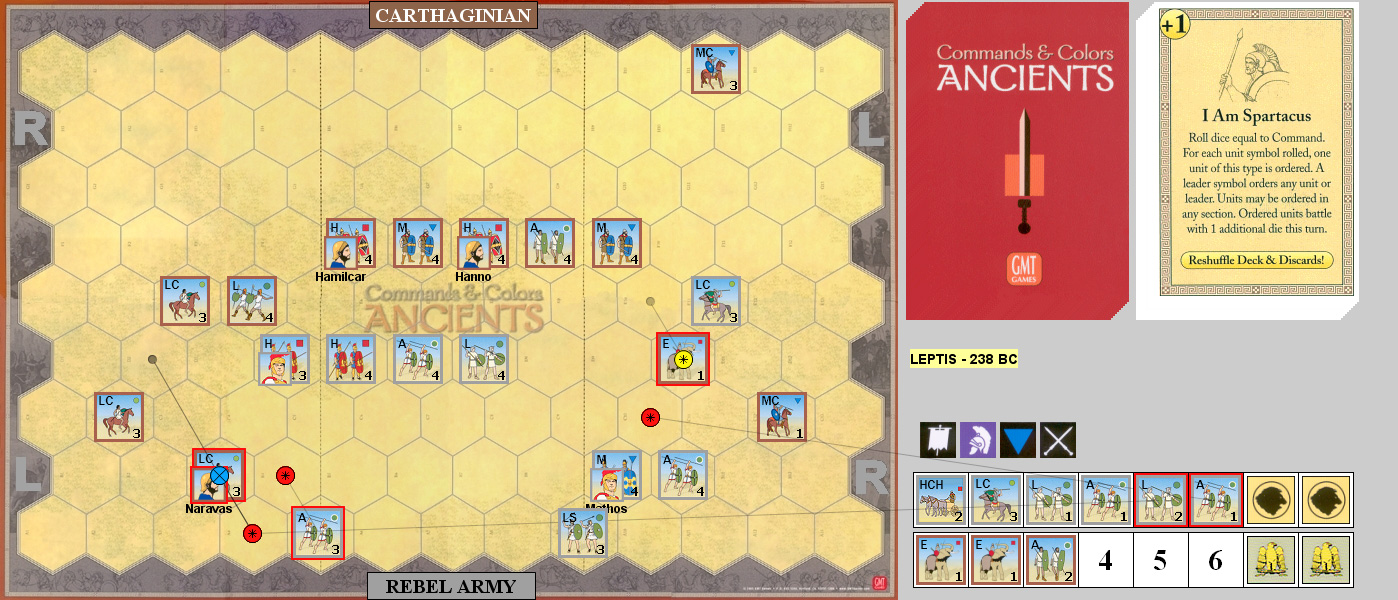
Well, the last short ASL scenario was shorter than I expected, and so Patch and I were back for another CC:A scenario from Truceless War. This time, Hannibal’s Camp was up, which is certainly unusual. It’s the first time we’ve actually seen ramparts and fortified camps in a scenario.

And now I realize we got the latter wrong. Forgot to take off a die for all attacks out of the camps. And that probably benefited me more than Patch, darn it. Well, we got the rest of it right….

Anyway, I had the Carthaginians first again, who definitely have the short end of the stick. The rebels go first, have six cards and three more units. The Carthaginians have the defensive position, but aren’t properly occupying it at the game start, and start the game with three cards, going up to five over the first couple turns. Oh, and they lose instantly if their leader dies.

I spent my first couple turns sorting out my defensive line on the ramparts, and worried that Patch would manage to envelop my flanks. (Not that likely at the rate units move in this game, but I wasn’t thinking of that.) Patch shook out his line before going in on the left, and crumpling my flank. I countered with a Mounted Charge to hit his leader-led mediums with my elephants, and move up the MC on the other flank. The elephants just barely took out the Med, advanced and took on the Heavies that the leader evaded to, but could only get two hits on six dice. The battle back killed them, but six blocks to two is better than we usually manage.

Patch followed up with a Line Command, and both sides got chewed up. He took out my left-side Mediums in three attacks, at the cost of half of an Aux and the death of his Heavy, with the leader going with it. He took out the Aux in the center of my line at the cost of two Heavy blocks, and he advanced into the rampart. He failed to damage the right-side Med, but they took three blocks off an Aux.

I activated the left flank area, where I was still grimly holding on, knocked out his Aux, damaged his Med and forced them to retreat two hexes with my Heavies, who Advanced and attacked his heavies to knock them out. 5-3

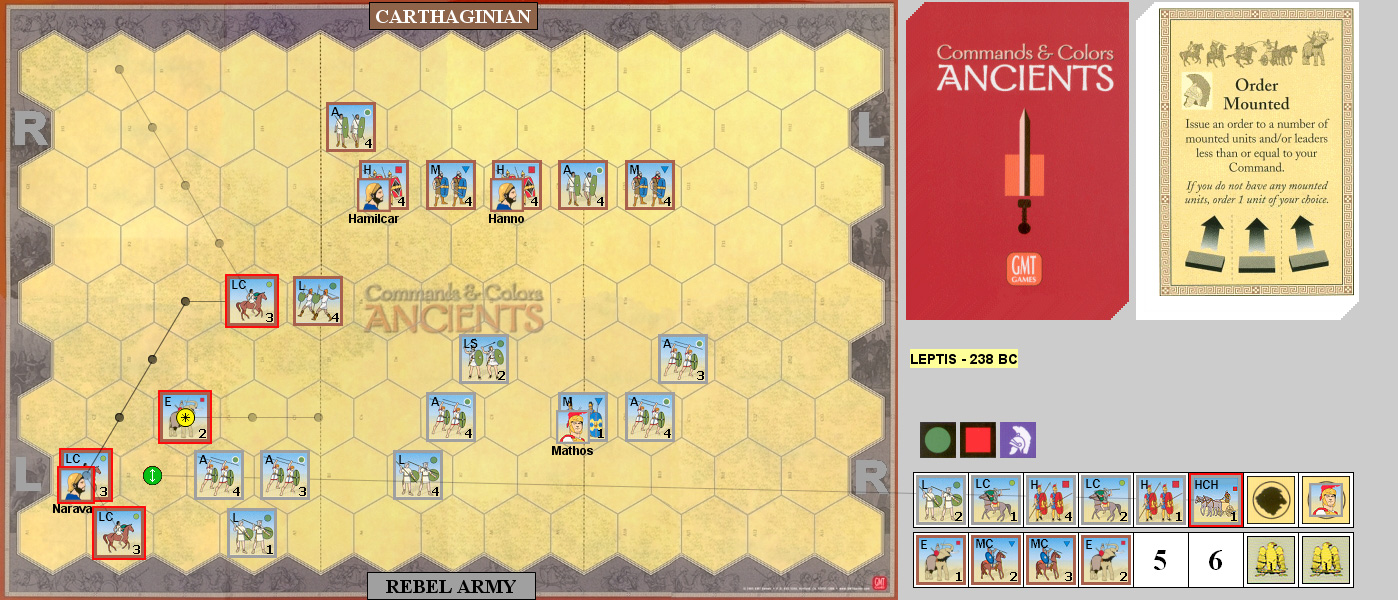
For the second round, I took a pretty slow and steady approach, trying to use as much archery as possible. Both flanks have some light troops, so it’s not hard to do some archery, and the sword hits that the defenses protect against don’t count on archery anyway. I got pretty lucky and reduced both ‘corner’ mediums to two blocks without much else happening. I advanced a little more, took a hit on my Heavies, and took out his left-side Med. Patch moved his MC up, got three hits on the Aux at the end of the line, and retreated out of the way.

Then I played the Line Command I’d finally drawn, engaging the center, and drawing close on the left flank (which I had a lot of cards for). My Med went after his remaining corner Med, suffered a First Strike that weakened them before knocking his Med out and occupying the camp on Momentum. The rest of his line held, one Aux losing two blocks in return for killing two Med and two Heavy blocks in my line. Patch managed to finish both of them off in his turn, but couldn’t touch the Med in the camp. I moved up the left flank, killing his elephants and forcing two light units back.

Patch pursued my right flank, finishing off the Aux, but failing to touch the Med again, and losing his Aux to the battle back. I forced a light to lose two blocks to a banner on the baseline, and Patch played Mounted Charge (he’d been about to play it when I got the elephants—thank goodness!), and his MC and my Med traded one block apiece. I managed to get another banner on his Light to kill it on the baseline for the win. 5-3

└ Tags: C&C Ancients, gaming
1 Comment

D11 Ripe Pickings

by Rindis on March 28, 2013 at 12:00 pm
Posted In: ASL

Patch mentioned recently that he wanted to see the Americans in action again. I figured since we were still wanting to do some DASL, and I’ve been trying to go through more of the early scenarios, there should be something in Hedgerow Hell. Looking them over, we decided to give the first scenario from there, “Ripe Pickings”, a try, and Patch picked the Americans. Then I looked on ROAR and noted that the record is 15-49 in the German’s favor….

Hedgerow Hell suffers from the same oversized scenario problem as Streets of Fire, but D11 is small. The Germans have a nearly fixed setup (some minor CA choices can be made) with four Pz IVs and seven elite squads near a roadblock in the middle of three hedgerow-crowded DASL boards. The Americans get to set up a Sherman and four squads in a group nearby, having accidentally arrived in the German’s rear the preceding night. The Americans win by getting 20 CVP (normally 22, but we went with the American balance) in five turns, or by controlling the location of the roadblock at the end of the scenario. The Germans also have the problem of limited movement: they can only move as many MMC+vehicles as double the current turn number.

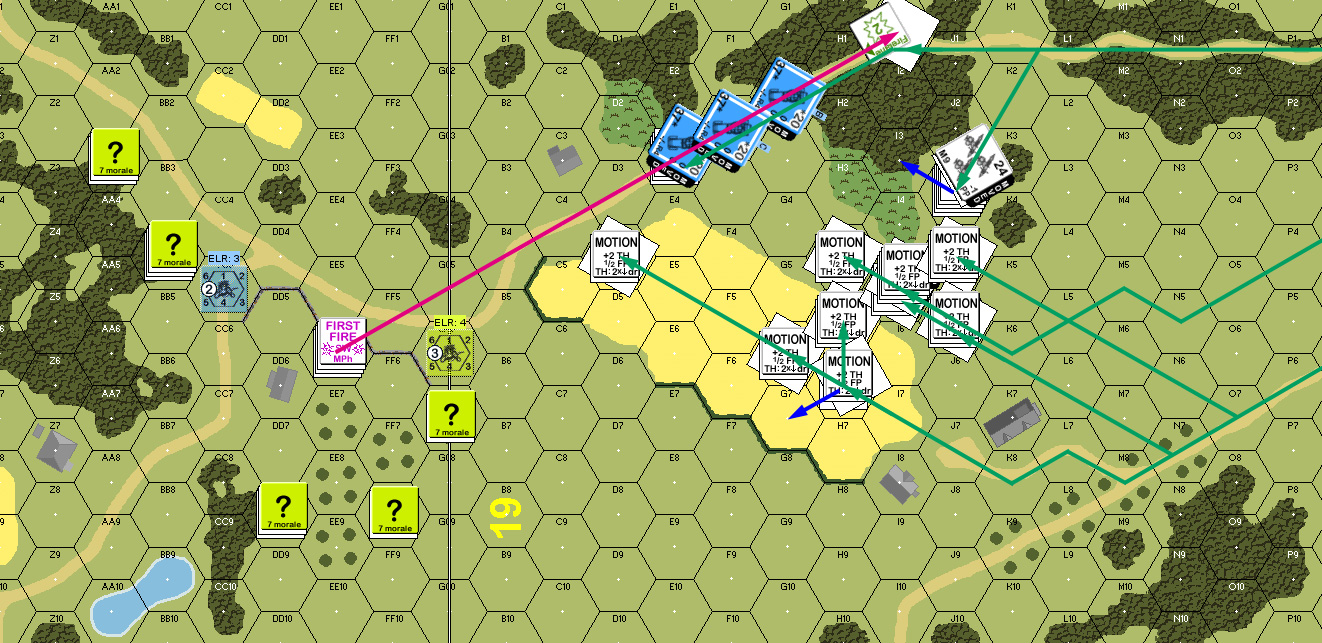
Patch set up in what has to be one of the more popular sites for the Americans, with a good view of the rear of two of the Pz IVs, and opened up with everything he had. The Sherman burned the Pz IV in H3, and a BAZ shot burned the one in I3. He rolled my SAN a couple of times in that, and as a small favor it went off once to pin a squad that hadn’t fired yet. The rest of his fire was at my squads in H2, but only pinned one of them on a pair of NMCs. Patch buttoned up the Sherman with an active Sniper nearby, but stayed put for my (limited) reaction.

D11 1A
Full scenario map, Turn 1. Plenty of room for a running fight.
↓ Read the rest of this entry…

└ Tags: ASL, DASL, gaming, Hedgerow Hell
 Comment 

A Tale of Two Europas

by Rindis on March 16, 2013 at 4:53 pm
Posted In: Computer games

For me, 1997 represents a high water mark in computer gaming. Some of this is an accident of circumstance, where I had a fair amount of free time and money, and a roommate who shared my interests. But, for me, it is really hard to beat any year that sees titles like Panzer General II, Emperor of the Fading Suns, Warlords III, and Imperialism.

By 2000, the honeymoon was long over. By now, my circumstances had changed, and I was starting to drift back to my first love: board wargames. SSI was dying, and not putting out anything interesting. TalonSoft was purchased by Take Two, and stopped doing the serious wargames that had been their specialty. SSG had faded into the background where they remain. Meanwhile, ever more demanding RTS and FPS games were coming out and taking over the market, and had long since turned what had been entertaining novelty games into frustrating (and uninteresting) click-fests.

But I discovered something in a used game bin that year. If I hadn’t already been pretty seriously drifting away, I would have paid a lot more attention to the names “Strategy First” and “Paradox Interactive”. (And, sadly, the former is gone now too.)

Europa Universalis is of the grandest stripe of grand strategy games. It is what I call an “empire management game”. In it, you take charge of a country, and chart its course over three centuries of history on the world stage. EU covers from 1492 to 1792, taking it from the discovery of the New World to a little after the American Revolution. Unlike previous grand strategy games, it used a real-time format: days tick by one by one, and many actions require a certain amount of time to happen.

However, while being ‘real-time’ and ‘strategic’ it holds no real relationship with the real-time strategy genre; EU was grand strategy in scope, rather than purely tactical (‘strategy’ in the RTS name merely refers to needing strategy within the scope of the game, not to the military/wargaming idea of being ‘strategic’, which examines countries and wars, or even entire periods of history the way EU does). Beyond the scope, the game is pauseable, so you can stop and ponder the situation, and issue orders as needed. It is not designed to become a contest of who can issue orders the most efficiently, the way most RTS games do. In fact, its real time elements are more due to the game’s simulation roots, and comparison to the various games from Maxis might be a little closer to the mark. (Including the fact that few others have dared to tread on the respective ground broken by Maxis and Paradox….)

A second game dropped on me way too soon: Europa Universalis II. It is very much the same game, and there are cases where there are bigger changes caused by an expansion to a game than there are between these two games. However, there was some significant rewriting of core concepts (and presumably code), so a new full package is understandable. Notably, the event engine was completely rewritten and expanded, and made moddable. Also, the world map was redone, and the scope of the game expanded from three centuries to four (now covering 1419-1820). It markedly improved upon the original title, and the bulk of this review will be talking about EU II in particular, although most of it will apply to the original as well.

History

Three to four hundred years of history is a big subject, and EU has a lot of moving parts. Like many strategy games, the initial problem is that it is very hard to know what to do, or, really, what can be done. Here, the problem is all the greater because it is that rare animal: a sandbox strategy game. While it lends itself most easily to being a game of conquest and world domination, that’s not necessarily the core intent, and certainly not the only thing to do. The New World will be discovered early in the game, and it is possible to concentrate largely on colonization (…conquest with less shooting and more smallpox). In the early 16th Century religious controversy will erupt with the Reformation, forcing a reevaluation of the state’s stance on religious matters. Trade spans the globe, with money to be made wherever luxuries exist. Countries form alliances, declare war, insult each other, and issue warnings against would-be aggressors.

Of course, while all of this brings the game to life, and makes sure there is always something to be concerned with, most of it is only of interest as a means to an end, as a way of getting an advantage in other realms. And, that, generally, feeds back into the final test: the clash of arms. However, while some of the concerns above apply mainly to Europe, EU II does not have to be about Europe. The original game was very much focused on Europe, with the rest of the world mostly something to be exploited, but II expanded its scope to make most of the rest of the world come to the same vibrant life as Renaissance Europe.

While the ‘main cast’ of characters continue to be European, it is possible in EU II to play as any country in existence at the start of the scenario. You can play as the Aztecs and try to survive the coming of the colonial powers. You can play as one of the countries of India, and try to unify the subcontinent to present a united front to the Europeans. You can be one of the minor powers of the Holy Roman Empire, and try to survive the deadly politics, or perhaps, with hard work, become something much more. It is this ability to take unusual positions, and say ‘what if’ or ‘I wonder if I can…’ that makes this a true sandbox game. The fact that the world is not just what you make of it, but is also what the active agencies of the other NPC countries make of it that can make it so compelling.

Events

A regular occurrence for the player will be message boxes popping up and telling of an event that just happened. Some of these are generic, and just randomly happen from time to time if the circumstances are right. Others are based on actual historical events with consequences that are meant to mirror actions of the real thing. All these events have in-game effects, which are spelled out in the hover over tag. At the same time, the response button itself is nicely ‘in character’.

Some events fire off, and all you can do is acknowledge it. Others present two or three options. An interesting wrinkle in the game engine/AI is that an AI nation, confronted with an event with a choice, will usually choose the first option, but has a chance of choosing the second or third options. With a historical event, the historical choice is presented first, so that when it happens to an AI nation, it will most often choose to mirror history, but they can go off on tangents….

There is an annoying UI shortcoming here. When an event pops up, it pauses the game—which is good—and keeps you from working any other controls. Many events can actually change governmental settings, but because you’re locked out of the controls, you can’t go check what the current settings are.

And at this point I should mention that the historical events demonstrate a general philosophy of the game. Events and leaders are historically based, so the entire game is built around ‘acting out’ history even while parts of that history are redefined. It is also possible for an event to have ‘triggers’ so that they only happen when appropriate. For instance, The War of the Roses resulted in large part because of dissatisfaction with English losses in France at the end of the Hundred Years War. If England does not lose its French possessions, then that event doesn’t need to fire. But these are limited to obvious historical turning points, and the real focus of the game is to mirror actual history.

Government

The general idea of the EU series is that the player is the “Grey Eminence”, or the power behind the throne. Kings come and go, but the player remains, guiding the country to its destiny. What, precisely, this destiny is, is largely up to the player as mentioned before. Of course, the other nations around will sooner or later try to impose their goals on you, which not only means dealing with things like unwanted wars, but can also shape your goals. Getting revenge on a the stubborn AI power that keeps declaring war on you may have little to do with your initial goals, but it is by no means uncommon….

Even by the somewhat more modest standards of the 15th-18th centuries, governments are big complicated things, and in Europa Universalis, there are a lot of means at its disposal to pursue goals and dreams of glory.

In the original game, various countries had certain bonuses over others. England did better in naval matters, and Russia had lot of cheap infantry available. In EU II, this was turned into a system of policy sliders (rated from +5 to -5), where each slider represented an extreme policy on each end, and the various positions (at the ends and in between) had in-game effects, that are generally mixed, so that there is no one ‘perfect’ setting. For instance, Russia’s default high ‘Quantity’ setting allows you to buy more military units, and they are cheaper, but morale is lowered, making them less effective at winning battles. England’s high ‘Naval’ rating allows cheaper ships, with higher morale, but army expense is raised and army morale is lowered.

Military

The modern concept of the ‘standing army’ only really got started in the mid 15th century. However, the EU series ignores this, and armies, once deployed, are intended to stand around even in peacetime, though parts of it might be disbanded to save on upkeep. Being a high-level game, there’s not a lot of detail, and there’s no units below the armies that you move around the world, but men may be consolidated or split off freely.

Armies are divided into the standard branches of infantry, cavalry and artillery. Combat has a ‘shock’ phase and a ‘fire’ phase, with an army generating losses in men and morale depending the types of troops (cavalry does better in shock than fire, for instance), and the current military technology of the nation. At the beginning of the game, artillery does not exist, and once it does, it is nearly useless in combat despite being slow to build, slow to move and very expensive. Similarly, infantry and cavalry have no ‘fire’ ratings, and don’t do any damage in that phase, but the real point of military ‘technology’ is as a gage of how much re-equipping the military has done, and as technology levels go up, so do the shock and fire ratings of the troops—shock much more slowly than fire.

Cavalry never does that well in the fire phase, so combat slowly moves from being dominated by cavalry (especially in open terrain where there is a bonus for having more cavalry), to centering on the firepower of infantry and cavalry.

When an army is by itself in enemy-held territory, it settles down to siege the province, and take control of it. There are defensive bonuses for fortifications and rough terrain, and artillery, even the early, little value in combat forms, can provide an offensive bonus, which can speed up the process immensely.

Navies are built with individual ships, split into warships, galleys and transports. Galleys are the best ships at the start of the game, but are not very safe outside the Mediterranean, while warships become more effective as naval technology rises, and of course transports are useless in battle, but are needed to ferry land units across water.

I’m not horribly pleased about how sieges are handled, since for the most part they seem to last far longer than it normally took for an army to take control of a region. However, peace negotiations are fairly nice. Winning (and losing) battles, and capturing territories are added up into a war score, and various concessions (territory, money, vassalage) have a cost in war score. This gives a fair guide to the AI as to how things are going, and you can punish a recalcitrant player by low-balling your demands, forcing it to make peace or suffer internal instability. The system is by no means perfect, but does help avoid some abuses, and the fact that territory does not truly change hands until the peace treaty is signed is a nice reflection of the politics of the era.

Religion

In 1517 Martin Luther wrote his 95 Theses, sparking off the Protestant Reformation, and over a century of religious warfare. Naturally, one of the important themes of Europa Universalis and its sequel is religion in the state. To this end, it recognizes that each country has a religion, and then the population of each province has its own religion. If a province and state disagree about religion, there is a reduction of tax revenues and military recruiting (these are linked).

There is also a system for establishing how tolerant your government is to various religions. A series of sliders allow you to set how tolerant you are of each branch of your religion group, and every other major religion. These sliders are ‘zero sum’, so that the more tolerant a country is to one religion, the less tolerant is is of every other religion. These sliders affect both how happy the population of the provinces are, and your relations with other countries.

The original Europa Universalis only recognized Christianity and Islam, with all other religions being generically lumped together as ‘Pagan’. Within those two religions there is a fair amount of detail however, with the Moslems split between Suni and Shia, and Christianity starting out split between Catholic and Orthodox, with later events creating the Protestant and Reformed branches, and eventually allowing countries to be Counter-Reformed Catholic (which has some governmental bonuses over ‘regular’ Catholicism, but is otherwise considered identical with it). EU II, with its expanded focus on the rest of the world, introduced Hinduism, Buddhism, and Confucianism as separate world religions.

Exploration

When you start the game as any country, you can only see part of the world. (Western European powers can’t see much past Europe for instance.) Travelling off into ‘Terra Incognita’ is generally not possible; the edge of the map is the edge of the world.

The easy exception to this is taking the capital of another power in a war, which generally gets you access to their world map. There are explorer and conquistador leaders who can lead units to (slowly) explore new territory, and near the end of the game, any unit will gain the ability.

However, this is Earth, and this is history, so there are limitations keeping this from being an exploration game. The geography is always the same, so while early European explorers did not now the shape of the New World, you do. Also, the resource production of every province is fixed, so (at least after the first time) you will always know where the gold provinces are, where the rich china provinces in Asia are, and so on.

Of course, there’s an entire cast of characters (nations) in the hidden parts of the world, so when you get there, the situation can be unexpected. This is more true of Asia than of America, however, as most of the American countries do not have the power to do much to radically rearrange the map.

Summary

When Phillipe Thibault proposed doing a computer version of his boardgame, Europa Universalis, Johan Anderson quit his job to start a new company and start coding. From this beginning has grown Paradox Interactive, which has several lines of similar games, as well as publishing games from other developers. The quality of these initial games is reflected in the current size of the company.

When I first found the EU games, I fell in love with them. They were strategic, they were historical, and they were different. They aren’t perfect; a full game takes a long time to play through, and I’ve usually gotten what I want out of the game long before it’s over. But there’s always something new to do, someplace new to be. Redmond Simonsen once called wargames “paper time machines”, and Europa Universalis is a very good electronic time machine, and satisfies those cravings very well.

Playing This Game Today

This is an older game, and a bit creaky on modern systems. It was originally released for both Windows and Mac OS, but I’ve only played it on Windows. At release, EU II was plagued by ‘crash to desktop’ errors, that have been mostly dealt with during the life-cycle of patches. Currently, the loading screens flicker madly while loading occurs, but once loaded, the game looks good, and plays pretty rock-solid on my Win7 64-bit machine. As an added plus, the final version of the game does not need the CD in the drive to play, if you have an old physical copy (it is for sale in a downloadable version at GamersGate).

At one point Paradox released the source code for EU II, and the remaining community of fans that created some very extensive mods got together and reworked parts of the code, adding new features, and building the main community mod into the game. Paradox released this effort in 2009 as For the Glory. I have not played it myself, but it should be a very well-polished version of the game, with the same minimal hardware requirements. If you’re looking for a grand-strategy game for a low-power notebook, this would seem to be a great place to go.

└ Tags: Europa Universalis, gaming, Paradox, review
23 Comments

FB19 Waffenbrüderschaft – test run

by Rindis on March 14, 2013 at 12:00 pm
Posted In: ASL

“…and that’s it. This is the latest ASL scenario I’ve finished.”

And so Patch gets a good die roll to end our current game the day after I said that. One last weekly post:

A little while back, Patch and I volunteered to help playtest further Festung Budapest scenarios. We ended up starting with a Saturday FtF session where neither of us was adequately prepared. In fact, I wasn’t able to get the counters all pulled before Patch arrived. So I left Patch to start planning the Russian defense while I pulled out the Germans.

It is January 25th, and the Germans and Hungarians are counterattacking to take Hill 259 on the outskirts of Buda. This dominates the west edge of the FB maps, rising to level 7 at the top. The scenario is reasonably large, space-wise, being 15 x 26 hexes, covering from level 2 to the top of the hill. In version 4, which we played, the Germans enter in two groups, with six squads, two tanks (Pz IV and Panther), and two halftracks (one with a 20mm AA cannon) in the north of the east edge, nine SS squads (of varying quality), with two halftracks (one is a flamethrower 251/16) entering in the middle, while the Hungarians get nine squads (including three assault engineer squads), and a Zrinyi II assault gun with 9-1 AL in the south, and along part of the south edge.

The Russians have fifteen squads… and six crew-served guns (two 82mm MTR, two 76.2mm ART, and two 122mm ART). Four of the guns have to set up on or near the top of the hill, but everything else gets the run of most of the map. There’s also six hexes of buildings to rubble (with the usual FB chances of creating falling rubble or debris), and the first thing Patch realized was that it was theoretically possible to cut the main German armor off from the rest of the map with the rubble. It would take some falling rubble or debris, but it would force bog checks on the tanks, and be impassible to the two halftracks. I pointed out that A2.5 would allow the vehicles to enter a turn later, having gone around the obstacles (assuming that debris counts, even though A2.5 only mentions Blaze/rubble, but that’s pretty obviously within the intent of the rule, as debris doesn’t exist outside of HASL).

On the other hand, it’s still a way to choke off paths into the rest of the board, and Patch did a modified version of this scheme, leveling buildings to get better LOS into that corner from the hill. He only got falling debris once, scattering it into T27, T28, S29. This left S26 as a VBM path out of the NE corner, and W24 at the edge of the set up area, but I forgot about that when I set up. For the rest, Patch found that despite a fair number of units, he had a lot of area to cover, and went with a ‘shell’ defense that would fall back during the game.

Victory features the common idea (in FB) of the attackers needing to get four out of six objectives. More than half of them feature the top of the hill, with the Axis needed to get 9 buildings at level 5, elim/capture two of the four guns that set up at level 5 or higher, getting three AFV with functioning MA at level 5 or higher, and/or getting two squads up to level 7. The remaining two objectives are to capture all the stone buildings and getting 22 CVP. Ground snow is present (making going up those crest lines even harder…) and the Axis is at Ammo Shortage level 2.

I concentrated the SS troops towards the north end of their area, planning on one big mass mostly aimed at the X27 area. The Hungarians set up entirely along the south edge, planning on concentrating on the three stacks there, and bypassing/flanking two more that were covering the east edge part of the Hungarian set up area.

I started off the game with the southern area, flooding the Russian defenders with Magyar hordes. I managed to press in fairly hard, and keep a concealed reserve, which proved to be somewhat superfluous when his forward stack turned out to be a Dummy. Elsewhere, I was much more cautious with my entry, not liking some of the terrain I had to cross. The FT halftrack parked in AA25, two hexes away from two Russian stacks, and revealed both of them with the FTs, but didn’t manage to do anything to them. And then late in the turn we had our only Sniper activation, which hit the HT and Recalled it.

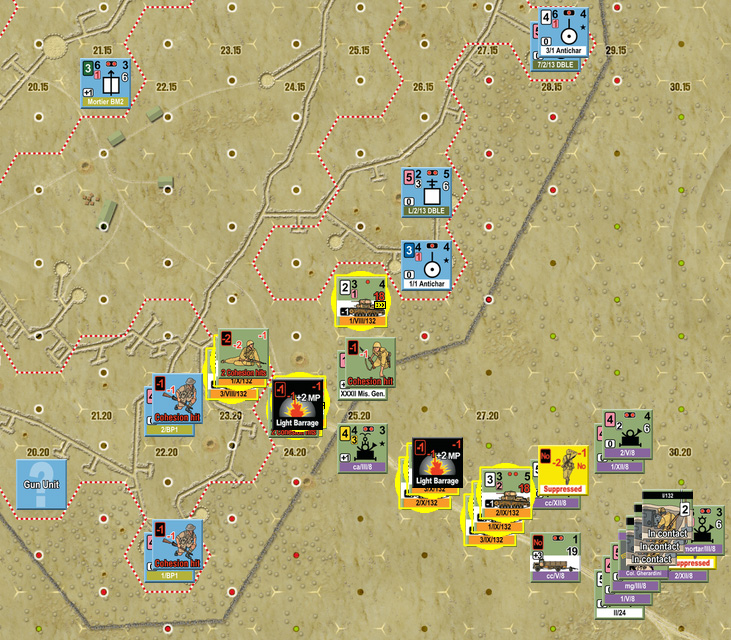
FB19 1A
The initial assault, German sector.
FB19 1Ah
Initial assault, Hungarian side.
↓ Read the rest of this entry…

└ Tags: ASL, Festung Budapest, gaming, playtest
 Comment 

Two Rounds of Hippacritae

by Rindis on March 12, 2013 at 10:53 pm
Posted In: CC:Ancients

Well, with a very long ASL game, and then another one that we needed to continue when that was done, it’s been a while since Patch and I have done any CC:A. So, tonight we played the battle of Hipparcritae from the Truceless War pack.

I had the Carthaginians first, and lead off with an Out Flanked to put the cavalry on both sides in motion. I had a couple Left Flank cards and figured to keep peppering him with archery there. The Med Cav on my right picked on a Light Cav that couldn’t evade, and picked it off for no losses. I then drew a second Out Flanked, and made the mistake of abandoning the plan and trying it again. This time the MC picked on an Aux, who battled back for two banners that killed the first unit (I lost a block on his turn), and the second lost two blocks, all for doing one block to him.

Patch played Line Command, which nearly surrounded the remaining MC, and killed it despite evading. In addition, archery took out a block on my right flank elephants. I moved my Med Inf up to fill out a line, and advanced my elephants to get them into range. Patch moved up with Inspired Leadership and killed the elephants. I moved up two of my Med Inf and took out a unit of Warriors in exchange for two blocks. The second unit had Hamilcar, who advanced and tried to take out his remaining Warriors, trading two for one (I thought I’d gotten away clear with two banners, but I’d forgotten that the fresh Warriors could ignore one along with a second for his leader).

Both of us re-dressed our center lines at that point, then Patch used a Double Time to go charging into my line. It cost me five blocks across two units, while he lost two. With the end of my line of Med Inf down to one block, I gambled on a Rally, but only got one block back. Patch got his heavies into contact with it to get the two hits and win. 2-5

Flipping sides, Patch led off with Order Two Right to get the elephants in motion, and take out three blocks on my Light Slingers. I got a banner on the battle back, and he finished them off with the trample. I mostly had Right cards, and started trying to develop that flank when a Move-Fire-Move knocked my LC back to the base line and reduced it to one block. He then moved the other two units of elephants up and reduced both of my Heavies to two blocks and forced them to retreat.

I Ordered Heavy to kill an elephant and force the other to retreat. He brought them back up with an Order Three Right (along with ordering two LC), and forced one Heavy to retreat again. I decided to take a chance, and blocked the retreat of the other unit to pull them out of range of further archery. He killed one block, and I got the elephants on battle back.

I dressed my line, and Patch brought in the remaining elephants to kill a Warrior unit (two swords->two triangles), and kill two blocks on the other with momentum. I Ordered Light to deploy my left flank (was was short of left cards all game). The elephants came in again, finishing off the Warriors (forcing Autartas to evade) and reducing an Aux to two blocks before succumbing to battle back.

The elephants were finally gone, but I was seriously short of units in good shape, while Patch had only taken one other block. My plan at that moment was to move Autartas into the middle of the left line where he might still do some good with a couple Aux, but I managed to forget that by the time I played the card and getting him to the line took an extra turn. Patch moved up on the right, and killed one Heavy, reduced the other to one block, and then nearly killed it when the last archery die came up red, but he’d fired on the LC stuck at the base line instead.

I could have taken a turn to try and move my two one block units on the right out of the way, but I figured either he didn’t have any cards for that flank, or the LC would catch up to anything I could do anyway, and shored up the center. Patch played Darken the Sky to knock out the LC and win. 3-5

Not my best play or dice in either game. Patch had good luck with the elephants for once, which really hurt in the second game.

└ Tags: C&C Ancients, gaming
 Comment 
  • Page 233 of 315
  • « First
  • «
  • 231
  • 232
  • 233
  • 234
  • 235
  • »
  • Last »

©2005-2026 Rindis.com | Powered by WordPress with ComicPress | Hosted on Rindis Hobby Den | Subscribe: RSS | Back to Top ↑