Rindis.com

All my hobbies, all the time
  • Home
  • My Blog
  • Games
  • History

Categories

  • Books (504)
  • Comics (10)
  • Gaming (918)
    • Boardgaming (674)
      • ASL (155)
      • CC:Ancients (83)
      • F&E (78)
        • BvR – The Wind (26)
        • Four Vassal War (9)
        • Konya wa Hurricane (17)
        • Second Wind (5)
      • SFB (78)
    • Computer games (162)
      • MMO (77)
    • Design and Effect (6)
    • RPGs (66)
      • D&D (25)
        • O2 Blade of Vengeance (3)
      • GURPS (32)
  • History (10)
  • Life (82)
    • Conventions (9)
  • News (29)
  • Technology (6)
  • Video (50)
    • Anime (48)
  • Writing (1)

Patreon

Support Rindis.com on Patreon!
Become a patron at Patreon!

Other blogs:

RSS Inside GMT

RSS Playing at the World

  • Playing at the World 2E V2 Arrives May 5, 2025

RSS Dyson’s Dodecahedron

  • Scavengers’ Deep – Map 33 July 16, 2026

RSS Quest for Fun!

  • The Expense Post May 24, 2026

RSS Bruce Heard and New Stories

  • Pain, Exhaustion, and Morale in D&D BECMI June 7, 2026

RSS Chicago Wargamer

  • The 2 Half-Squads - Episode 310: Cruising Through Crucible of Steel January 27, 2023

RSS CRRPG Addict

  • Game 581: Dragon Quest (1982) July 15, 2026
SF&F blogs:

RSS Fantasy Cafe

  • The Leaning Pile of Books July 5, 2026

RSS Lynn’s Book Blog

  • Friday Face Off: The Raven and the Reindeer by T Kingfisher July 17, 2026
ASL blogs:

RSS Sitrep

  • Cardinal ASL Sins March 18, 2026

RSS Hong Kong Wargamer

  • FT114 Yellow Extract After Action Report (AAR) Advanced Squad Leader scenario April 16, 2025

RSS Hex and Violence

  • This still exists? March 25, 2025

RSS Grumble Jones

  • Grumble Jones July Scenario GJ162 You Will Engage the Enemy July 1, 2026

RSS Desperation Morale

  • How to Learn ASL March 16, 2025

RSS Banzai!!

  • October North Texas Gameday October 21, 2019

RSS A Room Without a LOS

  • [Crossing the Moro CG] T=0902 -- Rough start July 18, 2015
GURPS blogs:

RSS Dungeon Fantastic

  • Felltower - Monsters Fleeing between Sessions vs. PCs replenishing June 28, 2026

RSS Gaming Ballistic

  • B-Scale Detail and Examples July 16, 2026

RSS Ravens N’ Pennies

RSS Let’s GURPS

  • Review: GURPS Realm Management March 29, 2021

RSS No School Grognard

  • It came from the GURPS forums: Low-Tech armor and fire damage January 29, 2018

RSS The Collaborative Gamer

  • Thoughts on a Town Adventures System January 18, 2022

RSS Don’t Forget Your Boots

  • GURPS Supers Newport Academy #7: “Invitation to the future.. of the 1970’s” July 5, 2026

RSS Orbs and Balrogs

  • Bretwalda - Daggers of Oxenaforda pt.4 - Fallen King May 27, 2017

Child of Flame

by Rindis on September 1, 2016 at 12:00 pm
Posted In: Books

Book four of Crown of Stars follows the usual practice of giving time to four major plot threads. The new major character this time is Adica, the Hollowed One of a tribe that is part of an effort to cast a truly earth-shattering spell.

Instead of this being a completely separate plot with no real tie in to the regular major cast, it is tied directly to Alain, who has been thrown 2,700 years into the past, and finds peace in a troubled little paradise. This is a big case of showing exactly what we were told about in the big reveal of the previous volume, and gives a preview of the calamity that is yet to come.

Liath meanwhile has her own separate arc that also takes her out of the main action for the entire book. This is in essence the personal journey that she turned down at the beginning of book three, and she finally gets the space and time to go through the growth that she has needed, and ends with the answers about what she is that have only been getting bigger as the series progresses.

The final two major plots are back on earth. The main focus is decidedly still in Wendar, with a lot of action and a good chunk of the secondary cast revolving around the Quman invasion. South in Aosta, King Henry starts the process of adding a third kingdom to his crown as all the more dangerous antagonists gather around.

I find it very interesting that much of this volume mirrors some of what had gone immediately previous, and while the main plot definitely moves forward, the secondaries take center stage. This continues to be a very good epic fantasy series, and overall very well paced, mostly because it never looses sight of what its own main plot is.

└ Tags: books, fantasy, reading, review
 Comment 

Deadly Protection

by Rindis on August 28, 2016 at 12:00 pm
Posted In: GURPS

About a year after the release of GURPS Thaumatology: Sorcery, it got its first dedicated supplement in August 2016: GURPS Sorcery: Protection and Warning Spells. This is a relatively small PDF supplement (15 pages, including the obligatory cover page and 1-page ad at the end), going for a minimal $5. It presents 35 new spells (and repeats the two spells of this college from the original book)… and very little else.

Thanks to the nature of power builds in GURPS 4e, it’s very easy to rework every spell here for use elsewhere if you don’t want to use Sorcery, and a little under a half page is spent discussing that process. It is likely that some math would be required if you want to get rid of the standard fatigue cost, though methods of keeping costs in line without that are also mentioned.

Having the first supplement for the under-resourced Sorcery system be ‘protection and warning’ seems a bit odd at first, but it makes sense. Many offensive powers aren’t too hard to figure out, and there’s a good number of example abilities that could be ported over. Several of the spells here get very complicated in how they’re built out, and it’s another great buy just on the tinkering GM end.

Two spells are marked with a warning that they are based on spells from GURPS Magic: Death Spells, and are particularly lethal (they are!) and must be specifically approved by the GM. Black Sphere gives a chance for the target to get out before it forms (DX roll, etc.) or make a quick contest of HT vs the caster’s HT + Talent, or be completely destroyed (no damage, just good old ‘instant death’). This is done with a couple different applications of the Cosmic modifier, at a cost of 110 points (which really means 10 levels of Sorcerous Empowerment + 22 points). The other, Force Guillotine, comes in at a very hefty 315 points (or 31 levels of Sorcerous Empowerment + 63 points) for a 20d6 (‘5dx4’) attack that ignores all normal protections.

Sorcery has been no stranger to 100+ point spells, but this supplement establishes a new top end with Force Guillotine simply having the highest minimum cost of any spell. Utter Dome creates a 2-yard radius barrier that stops 10 damage points of just about anything at a cost of 197 points + 40 per extra yard of radius. Or it can be boosted to a DR100 barrier for 1,367 points + 265/yard of radius. (And yes, 500 points is still considered to be well into the superheroic genre; some of these will not appear in very many campaigns no matter what the GM allows.) Meanwhile, Mystic Mist sets a new high-water mark in complicated mechanics breakdowns, since it has three parts linked together into one ability.

As would be expected from a ‘protection’ supplement, there are eight different ‘resist’ spells. Several of these are for things that normally have lingering effects (poison, disease, acid), and have the interesting effect in that they protect against getting them, but cannot cure an ongoing condition. However, they do cause the subject to make all HT rolls for an ongoing condition for the duration of the spell, and can allow the person to outlast the effects.

Overall, the spells range from the expected (Armor) to some unusual ones (Nightingale, as well as most of the ones previously mentioned), and really extend the usefulness of the Sorcery system. Repeating the earlier spells is a little surprising, though I expect the idea is that once there’s a supplement for every magic college out, there’ll be no need to go back to the original supplement other than for basic reference. Since some spells ‘are also water spells’ and the like, I do wonder if they’ll repeat them when those supplements come out. If they come out; it has been mentioned that a very high crunch supplement like this is a lot more expensive to produce than the low price from its low page count suggests. I certainly hope it does well enough for the series to continue.

└ Tags: gaming, GURPS, review, rpg, Sorcery
 Comment 

Two Rounds of Piraeus

by Rindis on August 24, 2016 at 12:00 pm
Posted In: CC:Ancients

Patch and I just finished our usual pair of C&C:A games between bigger games, this time playing the Battle of Piraeus from Expansion #6. The Athenians have a lighter army, but have occupied a hill near the center of the board, while the main line of Spartan hoplites are way back on the baseline.

Patch led off with a Line Command as the Spartans in the first game, pushing his Auxilia into the hills and doing one block damage. After a couple turns for both of us to get better positioned, an Order Mediums brought more of the line up, and Patch killed an Auxilia on the hills. I Out Flanked to deploy the wings of the army, and then Two Right followed by Inspired Center Leadership allowed him to occupy much of the hill while killing four light units at a cost of two blocks.

I Ordered Four Center to finally engage my hoplites (uphill), and a lucky hit killed Pausanias, and further attacks got the unit he was with at a cost of three blocks across two units (it would have been much worse with the leader). Patch used Line Command to bring up the left half of his force and we traded a couple blocks. I Ordered Three Center onto the hill, knocked out his Warriors, chased off an Auxilia and traded blocks on the flank. Patch Ordered Three Center in turn against my weakened line, but couldn’t quite kill any units, and took one more block than I did.

I used Clash of Shields to order five units… including a LS adjacent to a pair of fresh Spartan Hoplites, and two units that were down to a single block each. I picked off the two easy units, but couldn’t get his leader or a MC, and while a lucky roll reduced a Spartan Hoplite to one block, it also chased it away out of range of my last active unit. That managed a solid three-hit strike against his last intact unit in the area, but got eliminated in turn. Patch Ordered Mounted to activate most of his army, and finished off an Auxilia for the win. 5-6
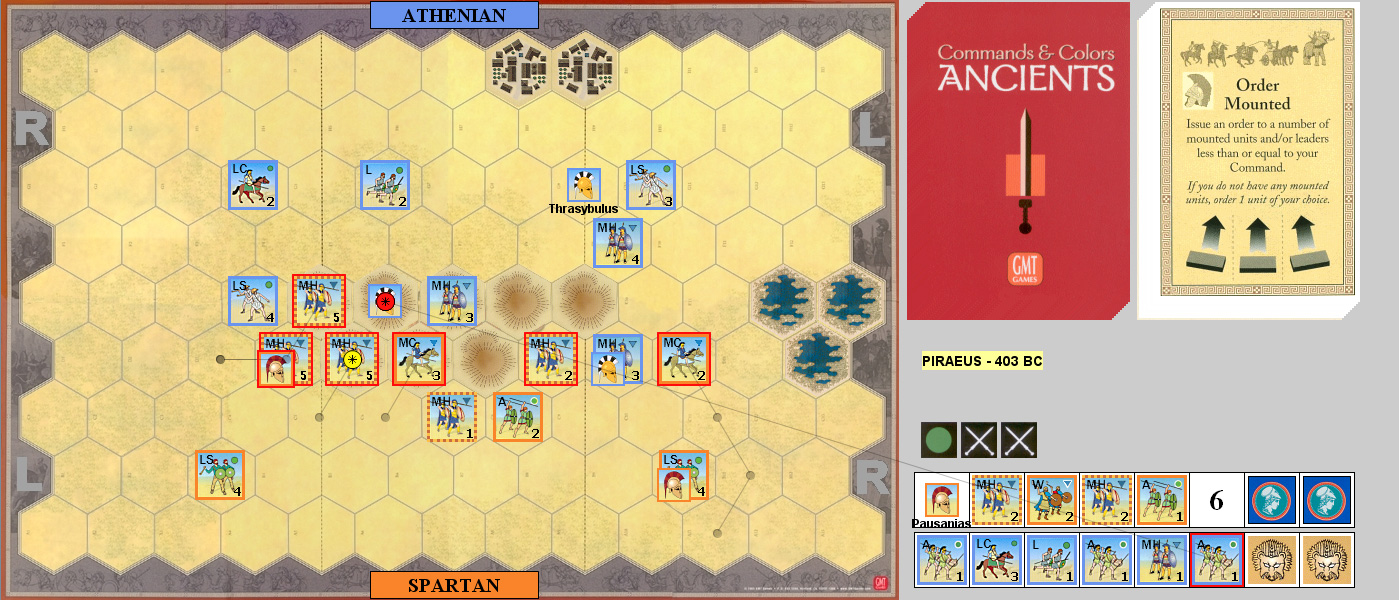
Piraeus-1

I also led off with Line Command as the Spartans, but ended up splitting my line in the process. However, I nearly wiped out a LS as it evaded out of range, caused a hit on his other evading LS, and forced a LC to lose a block by retreating into the baseline. An Order Left and Line Command got me barely onto the central hill, where I chased off a Light with damage, and my Warriors traded two blocks with a leader-led Auxilia. Patch used Move-Fire-Move to reorder his flanks, but only did a single banner. Order Three Left continued my advance on the hill, and destroyed an Aux. Patch Ordered Four Right to force a couple units back, and cost me a couple blocks, but I also forced his leading Hoplites back to the rest of his line. A followup Darken the Sky did a little more damage, and finished off an Auxilia.

Order Lights weakened his flanks a bit, but Patch used Leadership any Section to finally get the main line of Hoplites engaged but, having to fight uphill, traded three blocks for five. I used Leadership any Section to keep my left going, but took two to one losses. Patch used Line Command to order the entire center, and eliminated my Warriors and a Hoplite for minimal losses. Order Three Center put good units in action, but the only good result was eliminating a weakened Hoplite, and driving off a leader. Patch Ordered Mediums to knock out the remaining Hoplite on my left, but blew a roll against my 1-block Auxilia and lost his Hoplites instead.

I moved up my remaining left units, and Patch had Inspired Center Leadership to continue the fight for the hills. He blew another attack against my Auxilia, and lost another Hoplite unit to them, but knocked out a 3-block Hoplite in two attacks that cost him two blocks, and also traded two blocks between an Auxilia and my remaining engaged Hoplites.

I used Leadership any Section to keep the remnants of my left flank going again, and my slingers finally finished off his LC at range, while my MC finished off a 1-block Hoplite. 6-5
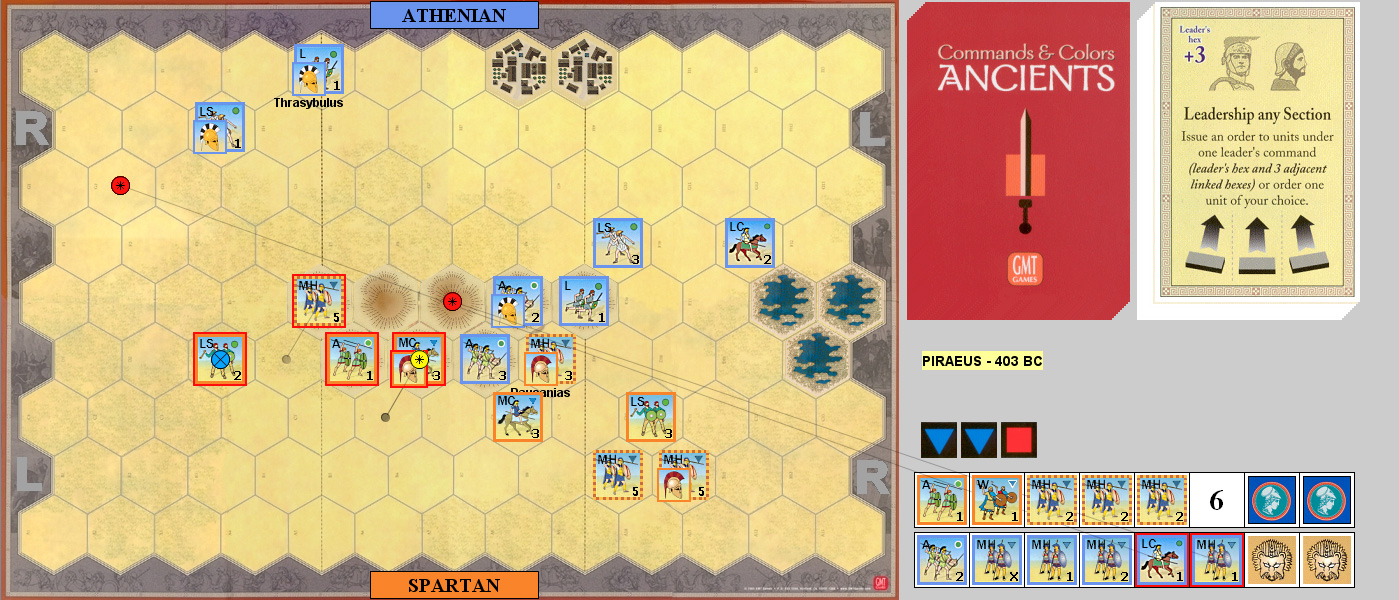
Piraeus-2

Afterword

Both plays of this battle were unexpectedly brutal. The Spartans have a great force hampered by having the Hoplites so far back, with everything else in the way. The Athenians start with a position on the hill, but their truly good units are a bit far back. Both times it looked like the Spartans were going to have a pretty good time of it when some timely die rolls or cards gave the Athenians what they needed. I was worried about a shutout in the first game until that lucky leader loss, and in the second game, my hand went steadily from ‘pretty good’ to ‘junk’, and I never had much I could do to engage my right flank.

└ Tags: C&C Ancients, gaming
 Comment 

Thoroughly Social

by Rindis on August 20, 2016 at 12:00 pm
Posted In: GURPS

How to deal with social interactions in a role playing game is often a difficult subject. In many games, truly inspired ideas (of whatever type), should just work, and having a die roll interfere with some good improv acting just breaks up the flow. On the other hand, letting a player play a character who is much more charismatic, or socially adept, than he is pretty much begs for mechanics to translate desires into working action.

In a more generally practical sense, having some form of rules for how NPCs react to player actions can take a lot of burden off an overloaded GM. The particular version of this in GURPS is the reaction roll, one of the primary mechanisms of the game, and the one with the least other rules related to it (compared to success rolls, quick contests, and damage rolls). GURPS Social Engineering changes this, as an 88-page supplement that is centered around the reaction roll mechanic.

As such, the bulk of the supplement details different types of social interactions (looking for information, debates, lying, bribery, propaganda… and oh, so many other subjects), how they should be handled in play with appropriate skills, modifiers, and types of reactions. (An appendix has twelve new tables of reaction roll results using the same general result categories, but geared towards particular types of situations.) It is an amazingly thorough list, and full of good advice. The immediate building block to all this is a good breakdown of the six skills GURPS generally uses to influence someone, and points out that the differences are a matter of approach instead of subject. A few well-chosen side boxes point out things like the fact that the use of quick contests does not mean social challenges are a ‘struggle’ (though they can be), but often center around decisiveness and insight.

How these rules should be used with the players comes up a few times. “Influencing PCs” talks directly to PCs using social skills on each other, and the fact since some NPCs can have a penalty to be influenced, or limited to certain reactions, similarly a player cannot be forced to change his PCs actions because of a roll. It also talks about existing Basic Set advice where successful influence can be turned into a skill penalty, and gives a couple of examples applying it. At the very end, the chapter “Throw Away This Book!” is a page that talks about how necessary all the little detailed mechanics really are. It’s a nice quick discussion of the problem, and ends with some very good advice: “The dice are there to help players who can’t come up with good lines, and to hold in check players who can’t restrain their wit…. Beyond that, treat Social Engineering as a compendium of social situations and challenges for any campaign.”

But it is also more than just that compendium outlined above. The book starts with a look at social activities in a game, beginning with where they may crop up in an action-oriented game, and then moves on to some general campaign types that are much more socially focused. From there it does not get crunchy, but there is a lot of good discussion that amounts to ‘how to set up your game world in GURPS terms’. This starts in the first chapter with discussion of the concept of the ‘reference society’, which spells out a few assumptions GURPS implicitly makes. After that, a full chapter is dedicated to fleshing out the existing Rank, Status, and Wealth (dis)advantages with variations, and lots of advice of just what types are available in a society.

Overall, Social Engineering is a surprising package. I wasn’t expecting to see general world-building advice show up here. I… don’t think I was really expecting the bulk of the book to be a detailed cataloging of types of social encounters, though it pretty much had to be something of that sort. For a GURPS GM, I think the former part makes it a valuable (though expensive, if that’s all you get it for) addition to laying out campaign basics. The main compendium part seems like it could be of use for someone wanting to tinker in any system that has a reaction roll type idea already. In some ways its too much to just use straight, as there’s a lot of different little modifiers and procedures and the like. On the other hand, reading it for general inspiration, and just recalling ‘it said to handle it in this general way’ can do a lot for a GM. And it can be used directly for special occasions of specific inspiration, when you know a set piece event is going/likely to happen. “How do I run two characters having a formal debate?” is a question that Social Engineering provides an answer for, along with things like “How does a character talk down a hostile mob?” I find it a good extension the core rule set, specifically because all it really does is extend what is already there and offer advice.

└ Tags: gaming, GURPS, review, rpg, Social Engineering
2 Comments

Going Pokemon

by Rindis on August 11, 2016 at 12:00 pm
Posted In: Computer games

No, I don’t play Pokemon Go. I’m still not at the point of having a smartphone, so it would be a bit difficult….

But Smudge has been playing. And over the last couple weeks, I’ve started playing assistant. We often go out to lunch and on errands together, and since she likes driving more than I do, she drives. So I’ve taken to hitting the pokestops as we go by, helping her keep supplied with pokeballs and the like. I’ve also done a little catching for her, but I generally prefer to let her make the decision to waste a few balls catching a pigey.

But it’s certainly gotten me thinking again about a franchise that I’ve never quite gotten around to checking out. It’s been part of the background radiation for 20 years now, and a there’s always been some very nice creature design. It’s in the pool of ‘games to check out because they’re different’ (Nintendo’s handheld consoles have been good for generating a lot of those).

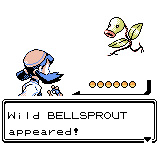
Pokemon-Crystal-EncounterSo, anyway, yeah, I’m now working my way through Pokemon Crystal (yeah, I stuck with an earlier, and hopefully simpler, game). For some reason, I hadn’t expected it to have so much JRPG feel. The premise is so far off of the usual quest-to-save-the-world, that I expected it to be a different genre mechanically as well. But, you travel around the world doing things, talking to NPCs, and having plenty of random battles in a reasonably complicated menu-driven system.

There’s some very interesting refinements to the usual format. Instead of the usual ‘have to deal with a random encounter every few steps’, random encounter areas are clearly marked. You generally can’t keep out of them while traveling, but you can minimize it, and of course go seeking them out when you need to. Capturing different pokemon for use in battle allows for a wide variety of approaches. The number of different creatures, moves, and types (eighteen different element types is too much, but at least they started large and have been very conservative about adding more) is overwhelming, but it boils down nicely (at least at first) into a few decisions, and you have enough backup available to be able to get through any single fight.

The plot is the weakest point of the game. There’s three general things going on at the early stage of the game where I’m at: There’s your ‘rival’, who’s definitely bad news (having stolen a pokeball from Professor Elm, who gives you your first one), but while he appears on occasion, there’s very little time spent on him. There’s the goal of becoming a Pokemon Master, which involves traveling around to different dojos to take on their masters to gain recognition. This is very much a Japanese trope, and just feels artificial to me, though its a great excuse to have some themed fights that you have to craft your team around (the first dojo is all bird types). And then there’s the exploration of the system and world. ‘Catching them all’ is a secondary goal, and one you can’t really do without some help, but I am indulging my obsessive side and getting as many as I easily (or not so easily) can. And its another place where the design stands out again. All the different types of pokemon seem to have their own niche, which is impressive when there’s so many of them.

Like most RPGs, I probably won’t get around to finishing it, but it is surprisingly good. I can see why the series has done so well for so long.

└ Tags: gaming, Pokemon
 Comment 
  • Page 184 of 315
  • « First
  • «
  • 182
  • 183
  • 184
  • 185
  • 186
  • »
  • Last »

©2005-2026 Rindis.com | Powered by WordPress with ComicPress | Hosted on Rindis Hobby Den | Subscribe: RSS | Back to Top ↑