Rindis.com

All my hobbies, all the time
  • Home
  • My Blog
  • Games
  • History

Categories

  • Books (504)
  • Comics (10)
  • Gaming (919)
    • Boardgaming (675)
      • ASL (155)
      • CC:Ancients (83)
      • F&E (78)
        • BvR – The Wind (26)
        • Four Vassal War (9)
        • Konya wa Hurricane (17)
        • Second Wind (5)
      • SFB (78)
    • Computer games (162)
      • MMO (77)
    • Design and Effect (6)
    • RPGs (66)
      • D&D (25)
        • O2 Blade of Vengeance (3)
      • GURPS (32)
  • History (10)
  • Life (82)
    • Conventions (9)
  • News (29)
  • Technology (6)
  • Video (50)
    • Anime (48)
  • Writing (1)

Patreon

Support Rindis.com on Patreon!
Become a patron at Patreon!

Other blogs:

RSS Inside GMT

  • Defiance AAR: North Jersey, July 2026 — Chili Dogs and Chit Pulls July 20, 2026

RSS Playing at the World

  • Playing at the World 2E V2 Arrives May 5, 2025

RSS Dyson’s Dodecahedron

  • Barin’s Stonehold July 20, 2026

RSS Quest for Fun!

  • The Expense Post May 24, 2026

RSS Bruce Heard and New Stories

  • Pain, Exhaustion, and Morale in D&D BECMI June 7, 2026

RSS Chicago Wargamer

  • The 2 Half-Squads - Episode 310: Cruising Through Crucible of Steel January 27, 2023

RSS CRRPG Addict

  • Al-Qadim: Bottle Shock July 20, 2026
SF&F blogs:

RSS Fantasy Cafe

  • The Leaning Pile of Books July 5, 2026

RSS Lynn’s Book Blog

  • Top Ten Tuesday: I’ve gone with a freebie July 21, 2026
ASL blogs:

RSS Sitrep

  • Cardinal ASL Sins March 18, 2026

RSS Hong Kong Wargamer

  • FT114 Yellow Extract After Action Report (AAR) Advanced Squad Leader scenario April 16, 2025

RSS Hex and Violence

  • This still exists? March 25, 2025

RSS Grumble Jones

  • Grumble Jones AAR for Crucible of Steel Scenarios on the YouTube page. July 20, 2026

RSS Desperation Morale

  • How to Learn ASL March 16, 2025

RSS Banzai!!

  • October North Texas Gameday October 21, 2019

RSS A Room Without a LOS

  • [Crossing the Moro CG] T=0902 -- Rough start July 18, 2015
GURPS blogs:

RSS Dungeon Fantastic

  • Felltower - Monsters Fleeing between Sessions vs. PCs replenishing June 28, 2026

RSS Gaming Ballistic

  • Mission X and Genre Fidelity in Combat July 19, 2026

RSS Ravens N’ Pennies

RSS Let’s GURPS

  • Review: GURPS Realm Management March 29, 2021

RSS No School Grognard

  • It came from the GURPS forums: Low-Tech armor and fire damage January 29, 2018

RSS The Collaborative Gamer

  • Thoughts on a Town Adventures System January 18, 2022

RSS Don’t Forget Your Boots

  • GURPS Supers Newport Academy #7: “Invitation to the future.. of the 1970’s” July 5, 2026

RSS Orbs and Balrogs

  • Bretwalda - Daggers of Oxenaforda pt.4 - Fallen King May 27, 2017

Spinning Silver

by Rindis on December 26, 2019 at 12:00 pm
Posted In: Books

Naomi Novik’s latest novel is currently my favorite by her. It’s very strong, well written, and avoids the minor issues I had with Uprooted. There is a bit as it gets going where the number of viewpoint characters increase from one to three, and the novel threatens to break into three, but the three separate plots very quickly feed back into each other again and made whole.

In fact, my only real problem with the novel is that the number of viewpoints continues to slowly get larger for the rest of the book, and I had some trouble telling just who was talking. These viewpoints made their scenes more effective, as the way it gets told adds more power and impact, but I might have been just as happy keeping things a little simpler. And, at the end, things fold back down to the original viewpoint, and the main character, Miryem.

The atmosphere of the story is extremely well done. Novik really gets what makes Eastern European folk tales work. It doesn’t get into some of the creepy horror-vibe of Uprooted, but the impoverished countryside, the ice-spirits that come with winter, all really work here. Surprisingly, when the book expands scope, and gets into the politics of the realm of Lithvas, those also really work, and make sense, instead of feeling a bit simplified after the careful work on the overall atmosphere.

It adds up to something that feels a bit like a fairy tale (it is supposed to be a retelling of Rumpelstiltskin, but any adherence to that concept was left on the cutting room floor in the first draft), but peopled with real people (all too real on occasion, like the depiction of a family suffering with an abusive father), and a real world. It all adds up to a great read.

└ Tags: books, fantasy, reading, review
 Comment 

Short Ardennes

by Rindis on December 23, 2019 at 12:00 pm
Posted In: Boardgaming

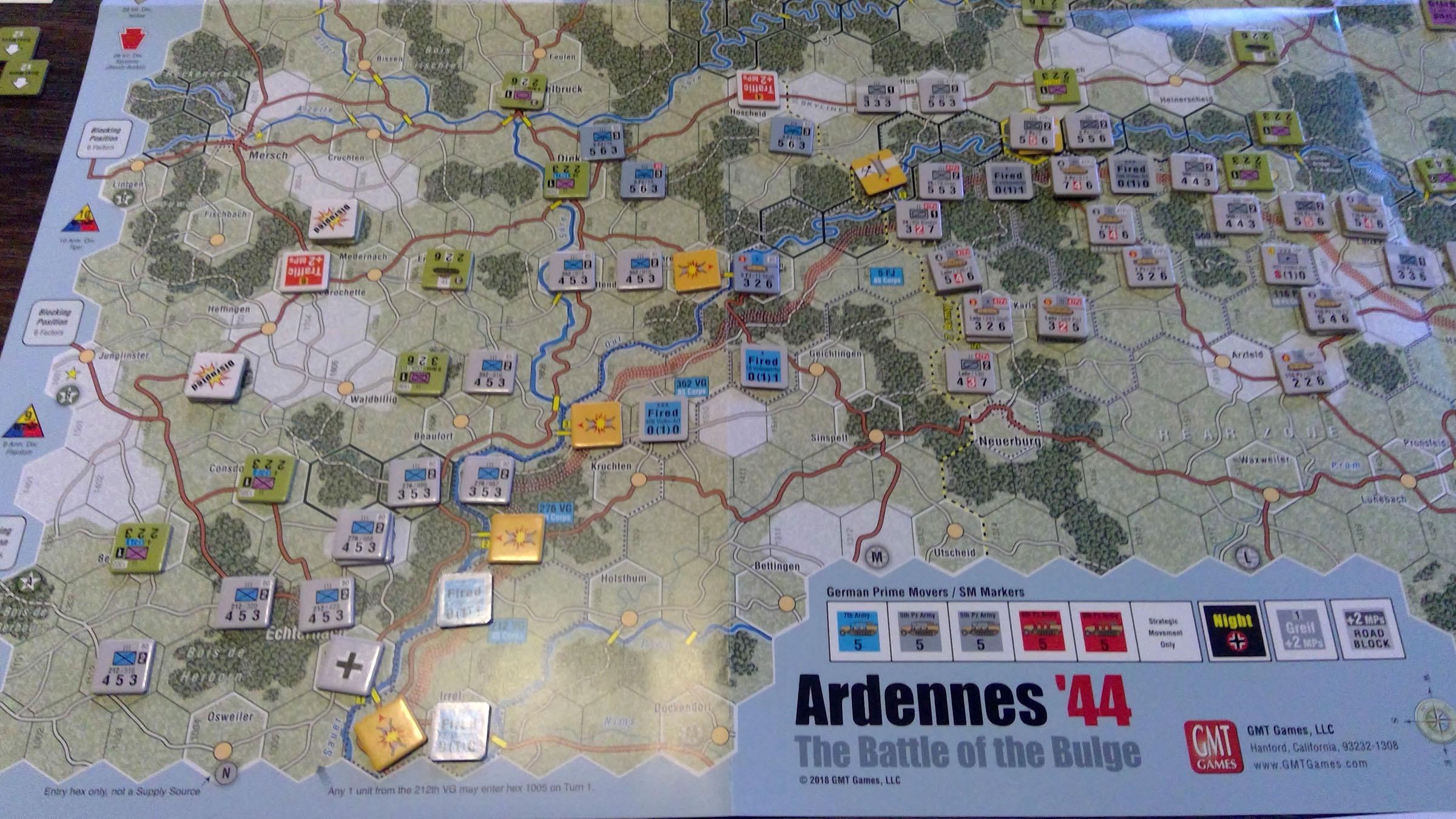
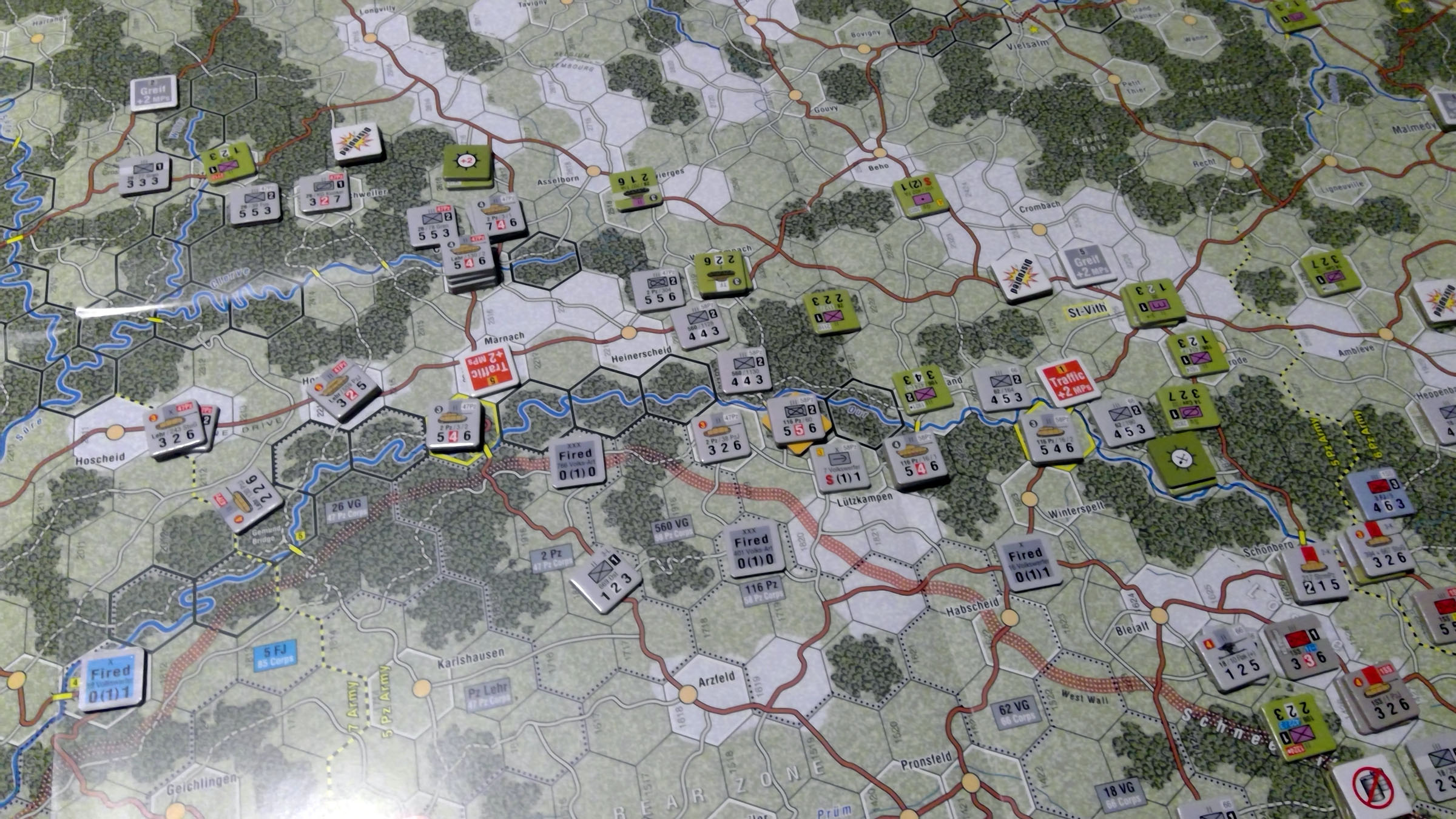
Mark came over on Nov 23rd for one of our two-player days. Up this time was Ardennes ’44; he had gotten me a copy as a gift some time back, and we finally got around to giving it a try. We only got through three turns this time, but we’re still getting used to parts of the system. Also, I was reorganizing my counter storage now that I had a better idea what the game needed.

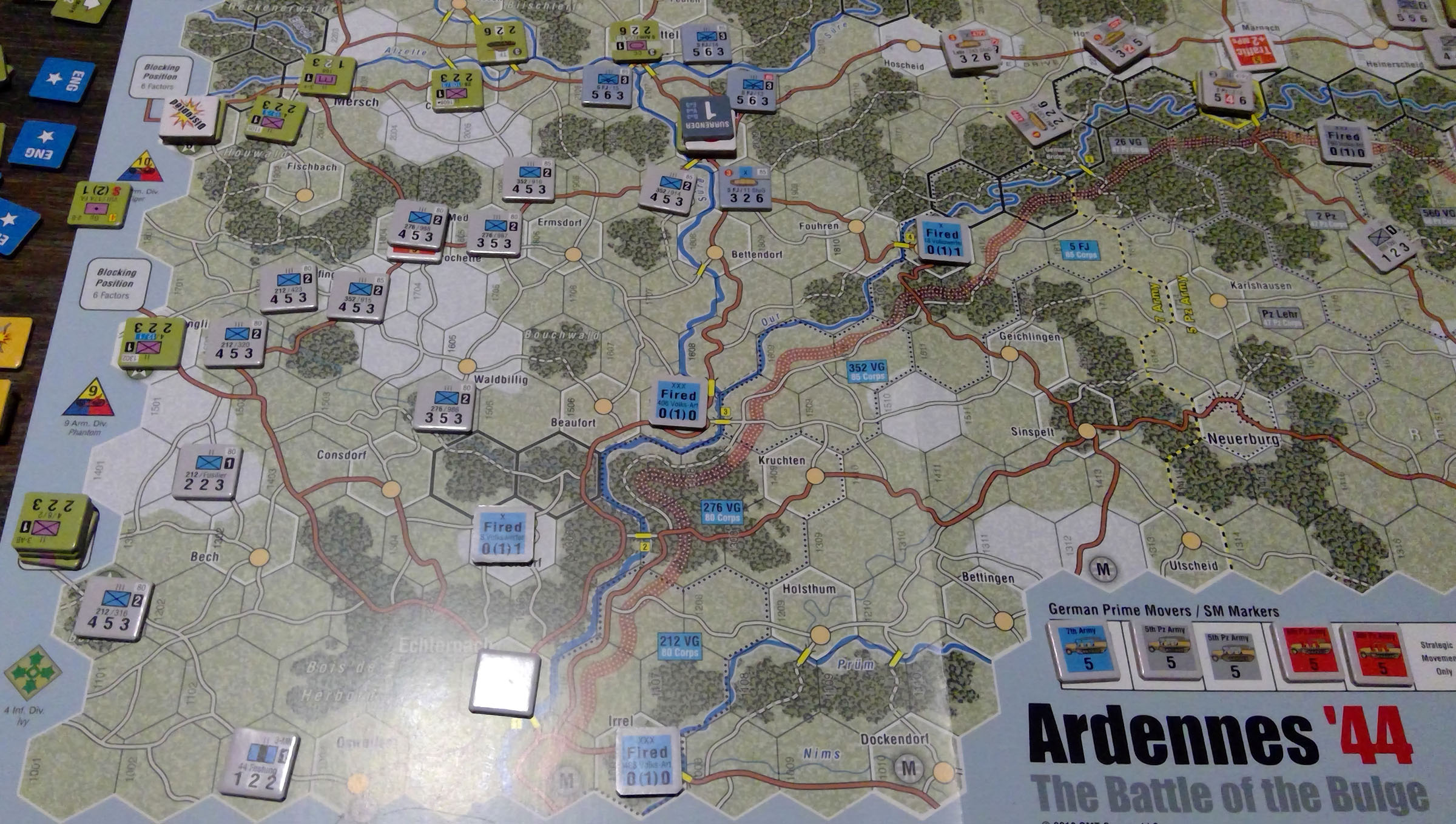
I had the Germans, and stuck with the suggested opening, with minimal modifications (skipping an art on an attack already at good odds), but resolving the attacks on our own, not using the example results. The dice liked me, with several early ‘1’s, and only a few token 4s and 5s later. A DR4 at the extreme south end of the line (and another nearby) led to that flank completely unraveling, though splitting off a Task Force (suggested by the play book) allowed the Americans to put together a shaky line in the area. It was interesting to note that the 5th FJ StuG battalion is completely trapped on the first two turns, with no way over the river, and and the 7th Army boundary keeping him from intact bridges until the blown ones can be repaired.

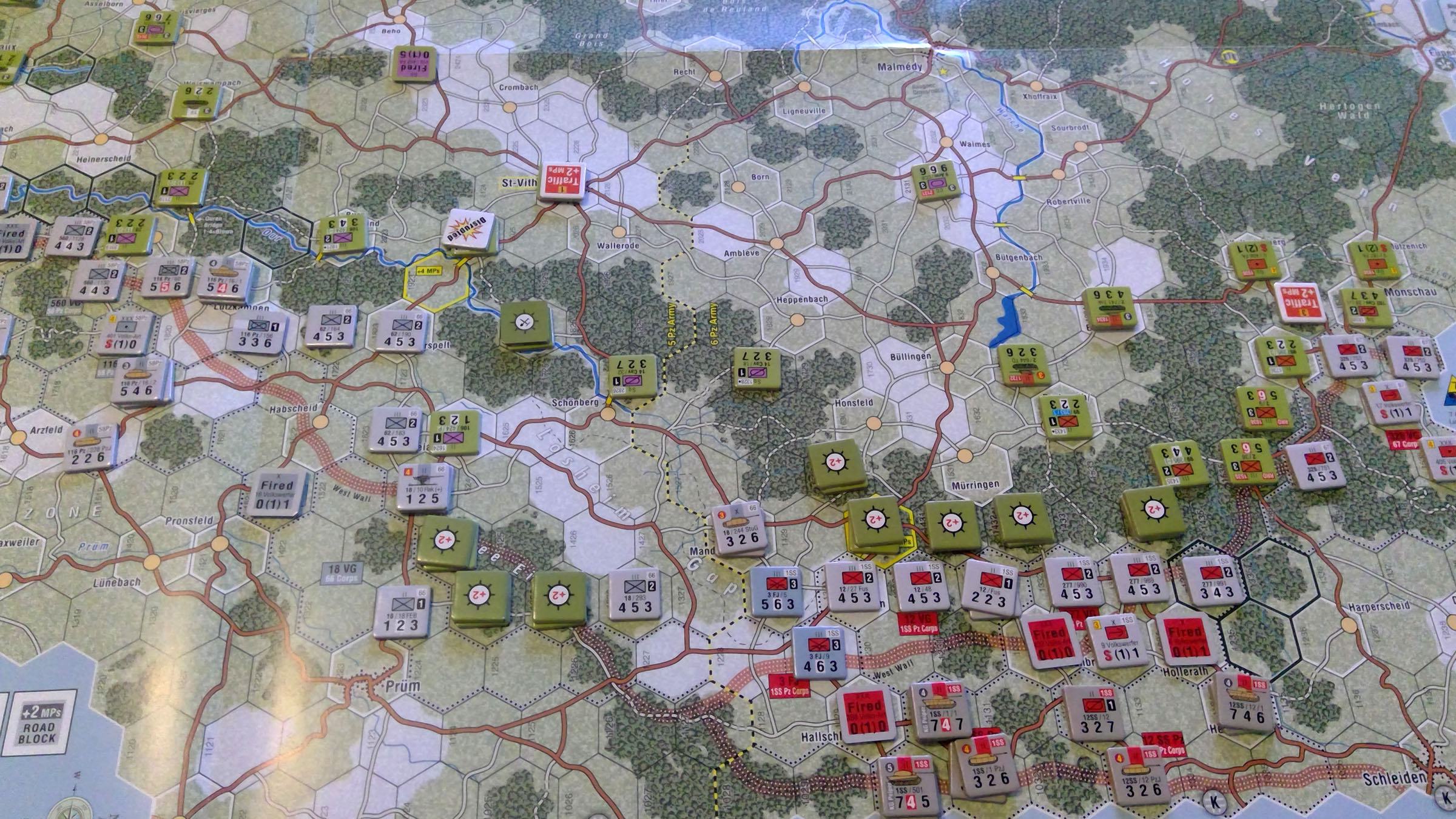
The center was more typical, with few Americans present, and Mark hastily trying to block Skyline Drive. By the time I got to the north, my luck was fading, and only one unit in the main line in front of the 1st SS retreated. The main problem in that sector was not enough units to go around near St. Vith, and a broken unit was put into a blocking position on the main road (which then recovered to disrupted).


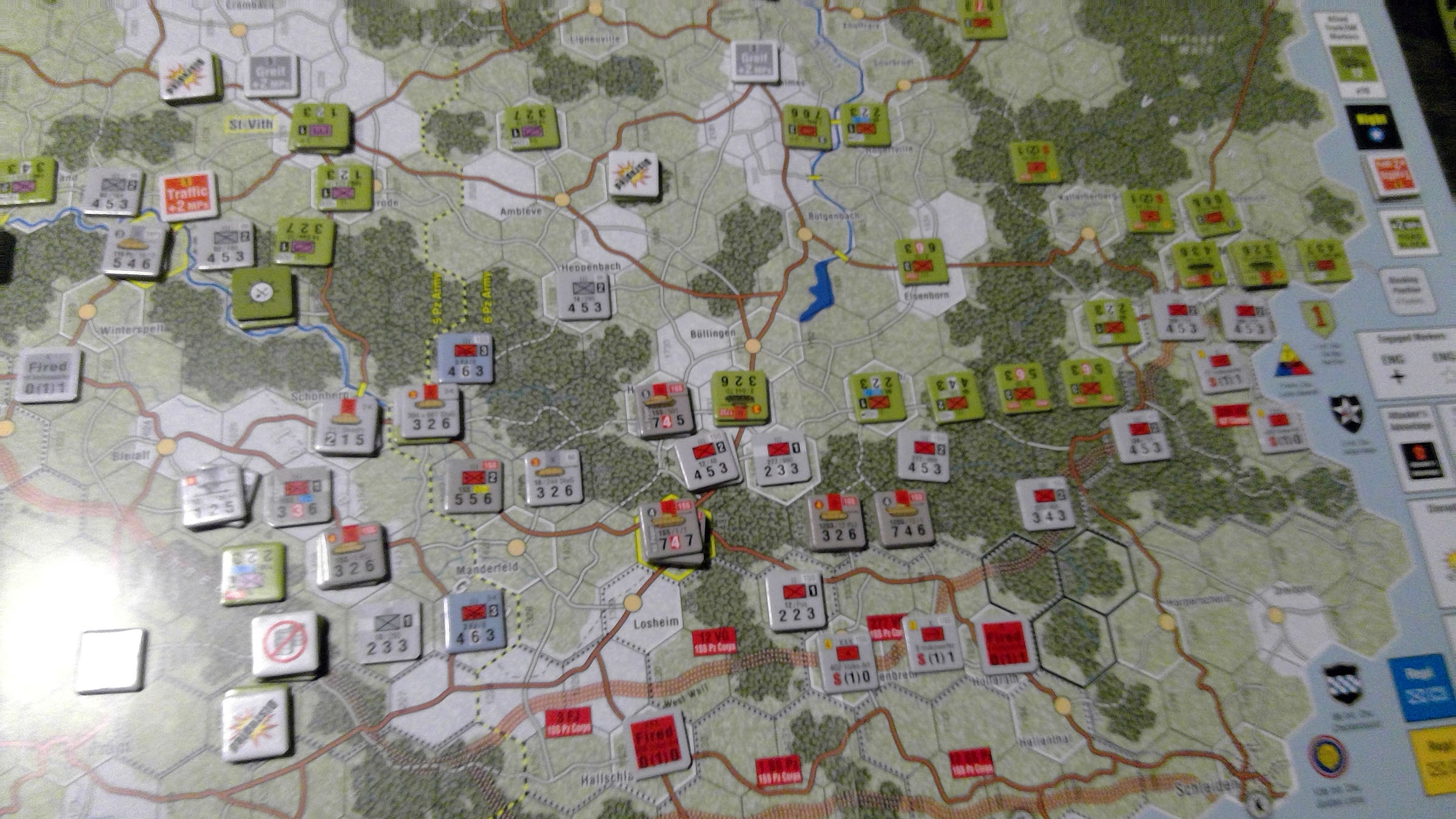
At the end of turn 1.

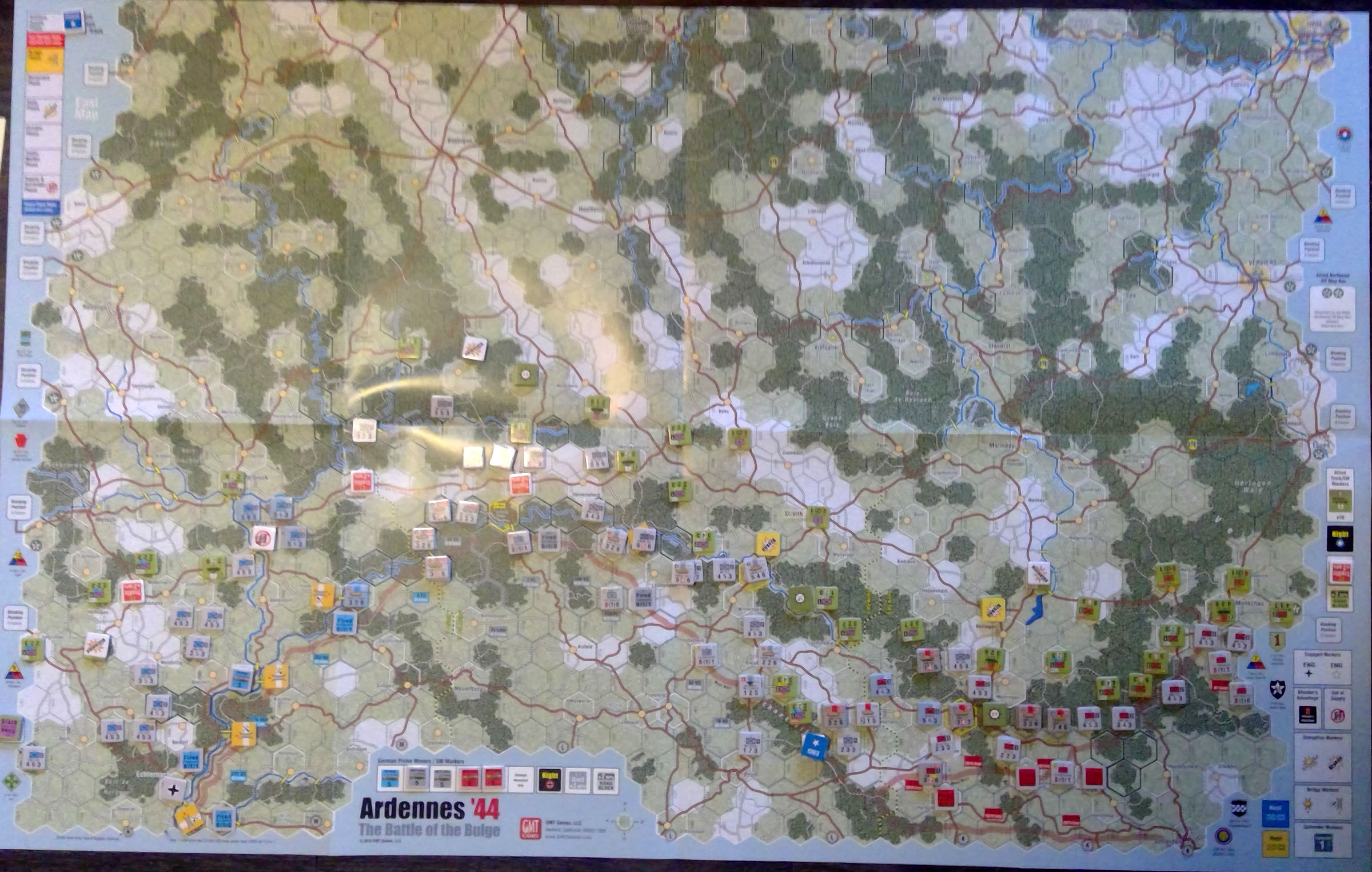
It was no trouble to take the first American entry point on turn 2, forcing the reinforcements to go into the blocking position, and cut off Diekirch with American troops very thin on the ground. In the center, Skyline drive was clear from there to Hienersheld, and both lines sort of didn’t exist in all the woods. I didn’t make any real progress towards St. Vith, but the American line was still thin, I and kept the unit there Engaged, and it broke trying to disengage (or something like that).

Progress was slow in the north, where I wasn’t really pushing as much, though all massed troops allowed me to break up the entire initial American line of improved positions, and Pieper’s attacks helped with that too. In fact, I started getting through the woods, and the American 106th Division was cut off (not quite isolated, and only one was out of supply, but it was close for all of them).

I had forgotten about setting up for the night turn, so KG Pieper was all the night activity. Similarly, not a lot continued to happen in the north, where woods made going tough, though I was breaking through into lighter terrain by the end of turn 3, having made it to Heppensbach, though American reinforcements in the area were going to add to the trouble. With proper planning, I’d be feeding units into that area, but I was still figuring out how I wanted to slide things around further northeast.

The center continued being a mix of trying to come to grips with American defenders, and exploiting the hole in the line. In the west, I was shoving him out the woods, but feeling exposed other than the fact there just wasn’t anything there to be exposed to. Lead units were outside of Wiltz, and I probably would have attacked next turn. My main attack was against the combat command sitting on Clervaux, and I had taken that for the second victory location.

In the south, I was forcing my way towards Mersch, Diekerch was starting to accumulate surrender points (probably shouldn’t wait for the surrender, especially after the turn 2 roll had been good for the Americans), and I was trying to get in position to take Ettelbruck.

We figured I had very good odds at getting six VPs of ten for the six-turn scenario, as I was almost certain to get the next three in the south and had good possibilities for number six (Mersch and Wiltz). Ten is going to be a tough stretch. (Mersch and Wiltz). Both of us are getting used to the system, especially ZOC-bonds, which stop a lot of moves that other systems that allow ZOC-to-ZOC moves allow.

But, both of us really enjoyed the game, and will be having a rematch soon. Mark also has several of the other Simonitch games, and we’ll want to get them to the table as well.

└ Tags: Ardennes '44, gaming
 Comment 

The Great Betrayal

by Rindis on December 20, 2019 at 12:00 pm
Posted In: Books

Even if the title didn’t clue you in, Bradford wastes no time and pulls no punches letting you know what he thinks of the fall of Constantinople to the Fourth Crusade. He begins with the arrival of the Venetian fleet in the Sea of Mamara, and the initial clashes before going back and laying the groundwork.

Dandolo, Philip of Swabia, and Boniface are considered to have directly and purposefully conspired to divert the Crusade to Constantinople. This is a far from an unpopular view, and Bradford is on solid ground following this track. Personally, the fall of Constantinople is one of those things that would have seemed unlikely enough beforehand that it’s a little hard to believe that it was the planned outcome. My feeling is that it was the outcome of opportunism, and damage control. Dandolo especially was using his political skill to ride the tiger, knowing that getting off would cause such a financial crash in Venice that he would not survive.

But no matter the intentions, the outcome was calamitous for everything besides Venice’s art collections. Bradford does a good job relating events, and impressing upon the reader the horrors associated with the fall of a rich city untouched for hundreds of years. If you want a sympathetic take on Venice’s part, read Crowley’s City of Fortune; but it has a much bigger scope, so Bradford’s gives a fuller account of the Crusade as a whole.

└ Tags: books, history, reading, review
 Comment 

My Elephant for a Kingdom

by Rindis on December 16, 2019 at 12:00 pm
Posted In: Computer games

This is the fourth in a series of reviews looking at the evolution of Crusader Kings II. See the previous reviews here:
Crusader Kings II:
The Second Crusade
The Old Gods: That Old-Time Religion
Sons of Abraham: A Little of Everything

Paradox gave Crusader Kings II another huge update after the grab-bag of Sons of Abraham. This time, the map was extended hundreds of miles east, to take in the entirety of India, Transoxiana, and part of Siberia.

The engine came in for a round of optimizations to keep this from bogging the game down, and of course, everyone got the new map with free patch 2.1, which was released with Rajas of India on March 25, 2014, and also featured an updated launcher. With Islam already at the fringes of India at any start date of the game, having adventures there is easy if you already have Sword of Islam.

Aren’t You Special

One place that the CK series was a bit inflexible is that there were seven types of troops, with no way to expand that. So patch 2.1 introduced something of a workaround.

The seventh type had always been horse archers that were not available to conventional Christian armies. Now, they were changed to be special troops, that could be different in each unit. As the building blocks of armies are individual units from separate levies, each levy could now have something different in the seventh slot, and the army as a whole would support multiple different types, with different stats, together.

Here, the point was to add elephants to Indian armies. But the slot was moddable, so that mods could be made that had all sorts of special or fantastic troop types available, as long as no holding had more than one special.

Big Game Hunting

As can be expected, there’s a fair amount of new content surrounding the new areas. New illustrations for the holdings, new events, and of course new dynasties and realms.

Some of it seems to have been not well worked out. Many realms start with the ruler personally holding the bulk of the realm with a few vassals, putting him well over the demense limit. This may actually reflect what’s known of the situation in the region at the time, implying that CK’s feudal system isn’t a good match for India, but the in-game problem is that this happens just as Paradox enforced feudalism more stringently.

“North Korea Mode” had become a popular way of getting around the constraints meant to be set on the player. If you hold all the lands in your kingdom yourself it doesn’t matter how much your non-existent vassals dislike you being over your demense limit.

So patch 2.1 tightened the screws by having all except your capital’s holdings’ musters and taxes reduced for being over the limit (annoyingly, you have to drill very deep to find the one place that modifier gets displayed). Considering that this starts with a 20% reduction at one holding over the limit, these massive new realms (where holding 20 out of 6 in the demense limit isn’t uncommon) start with almost no troops outside the capital. Even under normal circumstances, the reduction means it’s wisest to stay with your limit, especially once it’s over 3 or 4, as the reduction to all your musters will be bigger than the troops you can gain from a single holding.

India

The patch was more successful at getting the general feel of India across, however. Three new religions (all within one group of dharmic religions) were introduced in the patch, and the expansion makes them playable. While they conform to the normal CK II presentation of religion, they do have some important differences.

As all three are somewhat related, and coexisted peacefully, they generate smaller penalties to relations. There’s still a penalty for being of a different religion than someone else, but it is much smaller here. Similarly, the population will not revolt because their lord is of a different religion. A character of one of the faiths can also convert to one of the other two (once), through a decision with no penalty.

Indian religions do not have heresies like other religions, thus eliminating that source of trouble. Instead, they have sects, a bit like the Islamic Mutazilite/Ashari factions from Sons of Abraham. They are organized, and have good base authority, but have no formal head, and cannot use the equivalent of Crusades, though each one has a holy order that can be formed (in keeping with the practice established for everyone else in the previous patch). Finally, characters of these religions use karma in place of piety (with few, if any, mechanical differences), or purity for Jainites.

Indian characters also have a caste. This is simplified down to three, with the Brahmins being used for temples, Kshatriyas for castles, and Vaishyas for cities. While the Brahmins are technically top of the pecking order, this is a game of worldly power, and the manual acknowledges that the Kshatriyas are on top for game purposes. There are penalties for having the wrong type of holding, and Hindu characters cannot marry outside their caste without a large penalty. It is possible to change caste to Kshatria, though it’s expensive, hard to do, and still has lingering penalties akin to an acknowledged bastard.

Hinduism

Hinduism is most like non-Indian religions, with a number of opportunities to go to war. They can raid and loot non-dharmic realms like pagans, can declare holy wars against non-dharmics, and their troops have a notable bonus to morale. Combined with moderately good technological levels (especially for culture, which boosts opinions and demense), Hindu armies are capable, reasonably large, and the countries are fairly stable.

As mentioned before, they also pay the most attention to the caste system, as the other two do not generate so many non-caste penalties, which can cause trouble (a notable Hindu ruler in 867 is a Brahmin with no heirs, and no brahmins available to marry…). There are four sects, which can boost prestige, karma, fertility, or vassal opinion. There is also a decision to pick a patron deity, which will grant a one-point bonus to one stat, and a countering penalty to another.

Buddhism

Buddhists move further away from the normal patterns. Holy wars are unavailable, but they can still pursue claims on other’s territory (legitimate or not). They can designate one child as his heir instead of dealing with the usual problems of gavelkind inheritance, or changing the laws to something more stable, but less popular. In addition, there is no short reign opinion penalty, or problems with female rulers. There are three sects which can boost vassal opinion, health, or learning. That last in in addition to a learning bonus that all Buddhists get, and they can get ambitions to remove negative traits. On the other hand, they don’t get the morale bonus.

Jainism

Jainism is a pacifistic religion, avoiding all but the minimal amount of violence necessary for self-defense and protection of others. Naturally, many technically Jain rulers have not lived up to these ideals, and CK II still allows some latitude for action.

That said, Jain rulers still have fewer ways to go to war than anyone else. On the other hand, they get a boost to demense size and vassal opinion, making them the overall most stable realms in the game. Their two sects can grant a bonus to health, or a further boost to vassal opinion.

Conclusion

As an expansion, this is a pretty simple yes/no deal. If you’re interested in playing as a native Indian culture (and there’s plenty of reasons to want to), get this, if not, don’t. Like with SoI, there’s nothing else to it. The Old Gods gives the ability to play as a pagan, and a new start date; Legacy of Rome gives a bunch of events and retinues. This feels a little more one-note, and is recommended only if you’re feeling a little played out in boring old Western Europe, or if you have an interest in Indian history (in which case, go for it!).

Along with the realm annoyances, no Indians were included in the ‘interesting character’ listings for the at start bookmarks in 2.1, but that did get fixed when Paradox reworked the starting bookmarks in 2.2. The scope of the game took another leap larger with the patch, but it would take another major patch for Paradox to catch up with it and fill out the possibilities. So as a patch, this was in essence great, but needing a little more work.

└ Tags: Crusader Kings, gaming, Paradox, review
 Comment 

Drowning in the Sea Peoples

by Rindis on December 13, 2019 at 12:00 pm
Posted In: Boardgaming

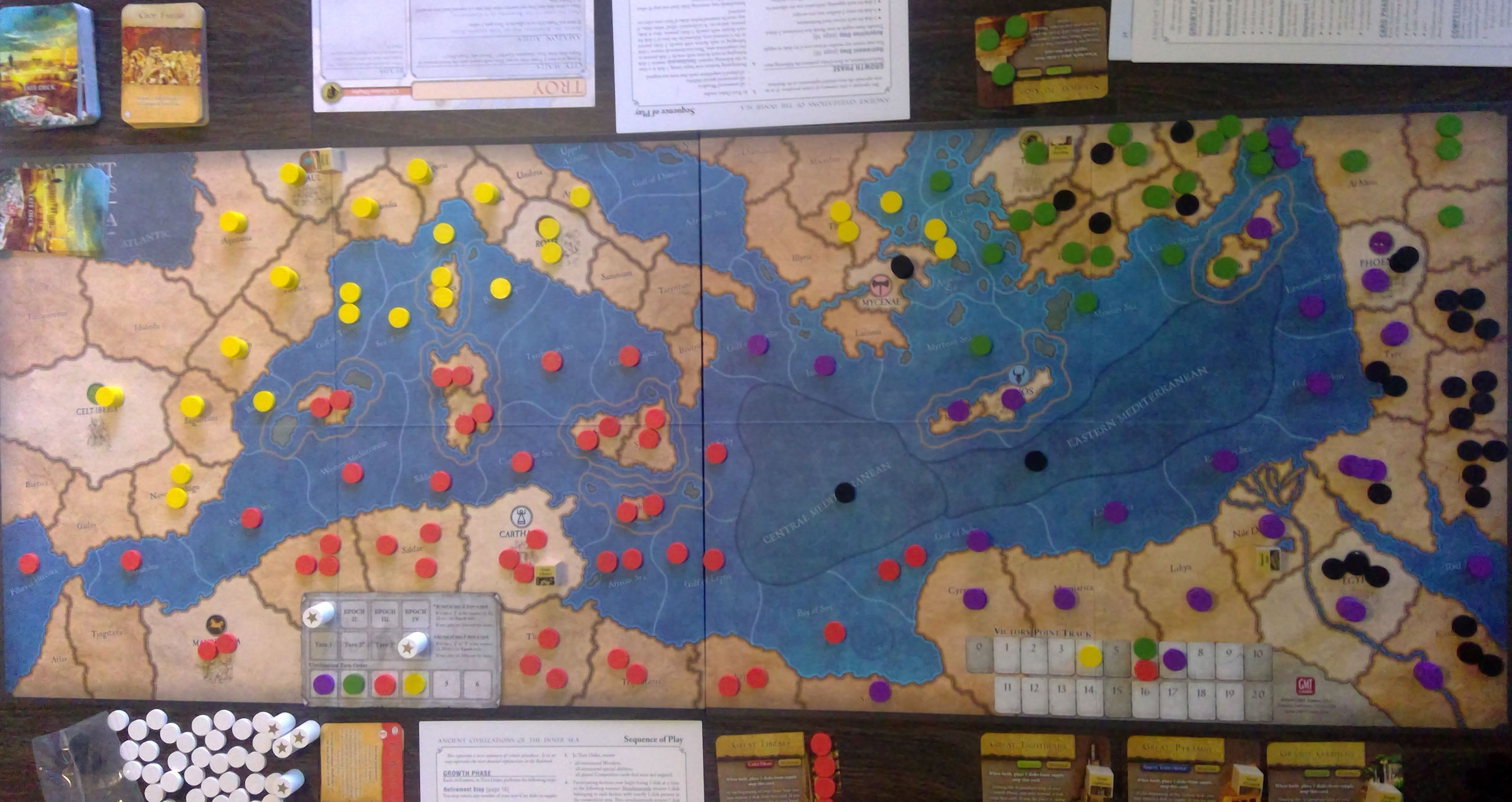
Finally had another multiplayer day on November 17th, and we tried out Ancient Civilizations of the Inner Sea with the basic 4-player setup. We had hoped for five, but Jason had to drop out, leaving us with me, Dave, Mark and Patch. Thanks to the long skinny board, I had to put both leaves into the table, which usually isn’t needed for four.

We’d generally sat down before getting to things, and so just took the nearest power to where we ended up. Mark and I had tried it out once before, but as a whole we were unused to things and had a fair number of rules flubs which we slowly started working through as the game went on. Patch and Dave ended up out west as Gaul and Carthage respectively, and started spreading out. Patch had some over-ambitious plans on Greece at the beginning, which slowly trimmed back as he got a better grasp of his token limits. Dave spread out more slowly, but dominated the western Mediterranean, and started island hopping. Patch was the first one to build a wonder as I recall, and we all followed suit right afterward.

Mark and I reprised our earlier roles as Troy and Egypt, and I got off to the strongest start (followed by Patch). The north-edge barbarians showed up early, and swamped Asia Minor, hampering Mark as I got going. I then got swamped with Sea Peoples, and the east-edge barbarians which came up a couple of times (and helped by the fact that Egypt does touch the east edge of the map). Mark and Dave got things moving, and the scores tightened up again at the end of Epoch I, and our break for lunch.

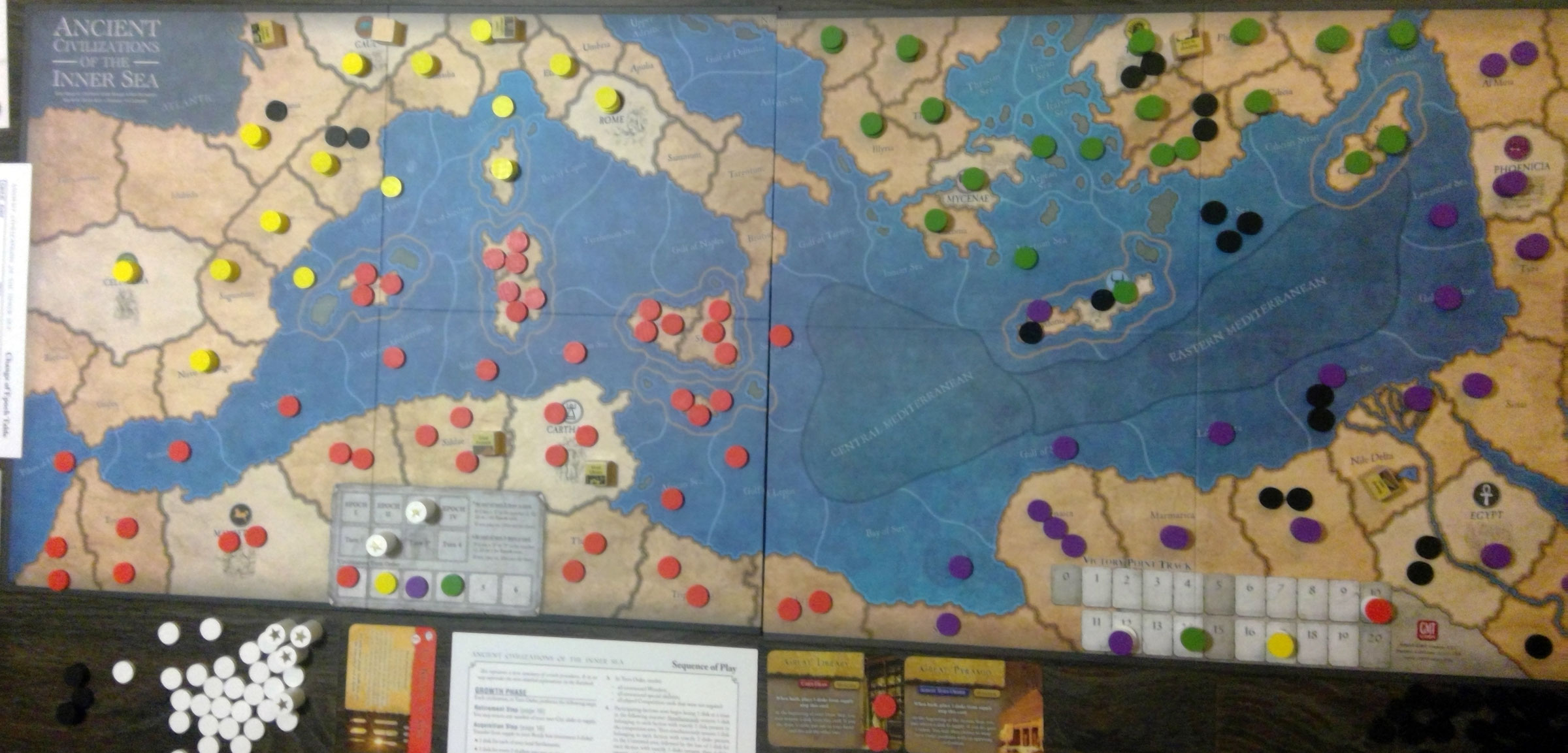
Things may look odd there. One rules problem we never did sort through that day was competition. The main cycle is a huge over-explained paragraph, followed by three bullet points. We (mostly ‘I’) repeatedly missed the separate step right below the bullet points that says you repeat the main cycle if it’s still contested. The ‘stop’ conditions in the bullets took all the attention. So, we had lots of unresolved contests with barbarians all day, with the full set of black disks in play, and plenty of shuffling them around for the next wave of barbarians. Next time, things are going to play a lot different, though the ‘stop when everyone’s lost a token’ had interesting interactions with some of the cards which prevent token loss.

We saw a lot of the east and south-edge barbarians in the later parts of the game. Since Dave was trailing behind in score the entire time, all the south-edge barbarians were Nubians boiling into Egypt. One of his problems is that he had a fairly stable and settled position, so he had very little in the way of tokens to redeploy (sure, he could have pulled some into supply/ready to re-do, but there was little motivation to). Towards the end of the game though, he did work up a high number of cities and started making great gains in VPs (not necessarily a bad strategy…).

Time ran short, and we stopped partway through Epoch III. (We let the standard method chose if it ended on turn 2. Next time we’ll aim for a straight three-epoch game.) The last turn saw a lot of maneuvering for VPs of course, and I thought I’d done well with building up cities… and still was on the short end.

Final scores were: Patch/Gaul 57, Mark/Troy 54, Rindis/Egypt 52, Dave/Carthage 50. Everyone had a good time with the game, and I’m sure we’ll get a few repeat playings fairly soon.

└ Tags: ACIS, gaming
 Comment 
  • Page 121 of 315
  • « First
  • «
  • 119
  • 120
  • 121
  • 122
  • 123
  • »
  • Last »

©2005-2026 Rindis.com | Powered by WordPress with ComicPress | Hosted on Rindis Hobby Den | Subscribe: RSS | Back to Top ↑