Rindis.com

All my hobbies, all the time
  • Home
  • My Blog
  • Games
  • History

Categories

  • Books (503)
  • Comics (10)
  • Gaming (917)
    • Boardgaming (673)
      • ASL (154)
      • CC:Ancients (83)
      • F&E (78)
        • BvR – The Wind (26)
        • Four Vassal War (9)
        • Konya wa Hurricane (17)
        • Second Wind (5)
      • SFB (78)
    • Computer games (162)
      • MMO (77)
    • Design and Effect (6)
    • RPGs (66)
      • D&D (25)
        • O2 Blade of Vengeance (3)
      • GURPS (32)
  • History (10)
  • Life (82)
    • Conventions (9)
  • News (29)
  • Technology (6)
  • Video (49)
    • Anime (47)
  • Writing (1)

Patreon

Support Rindis.com on Patreon!
Become a patron at Patreon!

Other blogs:

RSS Inside GMT

  • Foxes and Lions (Part 3): Military Matters, Captains, and Condottieri June 12, 2026

RSS Playing at the World

  • Playing at the World 2E V2 Arrives May 5, 2025

RSS Dyson’s Dodecahedron

  • Barrow of the Great Mothers June 16, 2026

RSS Quest for Fun!

  • The Expense Post May 24, 2026

RSS Bruce Heard and New Stories

  • Pain, Exhaustion, and Morale in D&D BECMI June 7, 2026

RSS Chicago Wargamer

  • The 2 Half-Squads - Episode 310: Cruising Through Crucible of Steel January 27, 2023

RSS CRRPG Addict

  • Yendorian Tales: Here There Be Dragons June 15, 2026
SF&F blogs:

RSS Fantasy Cafe

  • The Leaning Pile of Books May 24, 2026

RSS Lynn’s Book Blog

  • Booking Ahead/Weekly Wrap Up June 14, 2026
ASL blogs:

RSS Sitrep

  • Cardinal ASL Sins March 18, 2026

RSS Hong Kong Wargamer

  • FT114 Yellow Extract After Action Report (AAR) Advanced Squad Leader scenario April 16, 2025

RSS Hex and Violence

  • This still exists? March 25, 2025

RSS Grumble Jones

  • YouTube AAR for Critical Hit's Gettysburg Turning Point 1863 - ID4 At Will Fire June 16, 2026

RSS Desperation Morale

  • How to Learn ASL March 16, 2025

RSS Banzai!!

  • October North Texas Gameday October 21, 2019

RSS A Room Without a LOS

  • [Crossing the Moro CG] T=0902 -- Rough start July 18, 2015
GURPS blogs:

RSS Dungeon Fantastic

  • Rules & Rulings from Session 224 June 16, 2026

RSS Gaming Ballistic

  • B-Scale: Damage That Scales from Tardigrades to Kaiju June 5, 2026

RSS Ravens N’ Pennies

RSS Let’s GURPS

  • Review: GURPS Realm Management March 29, 2021

RSS No School Grognard

  • It came from the GURPS forums: Low-Tech armor and fire damage January 29, 2018

RSS The Collaborative Gamer

  • Thoughts on a Town Adventures System January 18, 2022

RSS Don’t Forget Your Boots

  • GURPS Supers Newport Academy #6: “Old Friends, New Again” June 7, 2026

RSS Orbs and Balrogs

  • Bretwalda - Daggers of Oxenaforda pt.4 - Fallen King May 27, 2017

The Legacy of Gird

by Rindis on October 3, 2015 at 12:00 pm
Posted In: Books

Elizabeth Moon’s Legacy of Gird is a pair of prequel novels to her Deed of Paksenarrion series. They’re something of an odd pair: the two books have some significant overlap in time, and while the first one is easy to read independently, the second one has framing that happens after Paksenarrion, and makes it partly dependent on that series. I enjoyed both, but they don’t have a lot of the appeal of the original books.

Surrender None is the story of Gird, told from his point of view. It is the story of the peasant rebellion that would establish the grange system and society seen in the later Paks books. Gird is some sort of ill-defined saint/demigod centuries later, but now he is a simple peasant, until the slow squeeze of the lords forces him (and many before him) into outlawry/rebellion.

As such, it is well told, using a very episodic structure. Various subjects and challenges are brought up, and confronted; while the fighting itself is important, it never crowds out the eventual challenge of building a system to replace the one being torn down.

Liar’s Oath overlaps the last section of Surrender None, from the viewpoint of Luap. For the most part. Scattered throughout the book are a few chapters from the viewpoint of two proto-paladins, which also provide most of the action/adventure of novel, with the rest being politics and personal relations. In general, I liked the bulk of the book, but it ends instead of resolving. The framing with post-Oath of Gold Paks (or really, Phelan) becomes a space-time wedgie that cuts off the ending of the book.

This makes it obvious that the point of the book is to explain what was found in the abandoned fortress of Divided Allegiance, which it does, but that also undermines the structure of the book. Liar’s Oath has enough burdens without this, as Luap never comes across well enough to make a good main character, but it is obvious that this is a foundation for the Paladin’s Legacy series (which I will need to get to).

└ Tags: books, fantasy, reading, review
 Comment 

The Influence of Sea Power Upon History

by Rindis on September 9, 2015 at 12:00 pm
Posted In: Books

You could easily write a recursive book about the influence of The Influence of Sea Power Upon History upon history. Mahan wanted to show that navies decided wars, even between land powers, and many powerful and influential people listened. In the list of influential works on strategy it is probably number four, behind The Art of War, The Prince, and On War.

There’s actually a few interrelated theses here. The primary one is the assertion that naval power is a deciding factor for everyone but the most land-locked of countries. The secondary one is not so clearly stated, but quite evident in the later parts of the book, that the proper goal of military operations is the reduction of organized enemy forces in the field. The later parts of the book particularly talk about this, showing that the French government and navy held to theory that saw the taking of objectives while preserving force, and that it time and again failed to gain results, while the British habit of forcing battles inevitably put their opponents into a worse position over time. Lastly, he considers the pursuit of interrupting merchant shipping to be a mistaken strategy, as British trade increased even during wars where the French captured large numbers of British merchants. (The Battle of the Atlantic might be seen as a condemnation of this rule, but I imagine Mahan might argue that the failure to actually hamper the British—and American—navies gave them the ability to find a way to destroy U-Boats and end “The Happy Time”.)

Mahan covers the most of height of the Age of Sail in his book, from the Restoration of Charles II to the end of the Revolutionary War, after an extended chapter that looks at naval power throughout history. This is definitely a preferred era for him, but he considers that while tactics must change over time, with new technology, it is still possible to find strategic truths that always apply, and I think he did so very well. His narrative gets steadily more detailed as it goes on, with the last couple chapters looking at actions in India and the Caribbean from 1781-1783 in great detail. As his descriptions get more detailed, so too do the conclusions that he draws from them. This is decidedly Nineteenth Century writing, and technical in nature to boot, with overly long-winded sentences and paragraphs by today’s standards (thankfully, the page-long paragraph is a thing of the past), but it still retains a high degree of readability.

My copy of the book is an OCR Pyrrhus Press ebook, which is in decent shape. I started noticing errors about a third of the way through, and they slowly become more common as the book went on, but never got to the levels I’ve seen in other books. On the other hand, the tactical description of battles is reliant on a number of maps that are directly referenced in the text, but are not included in this copy. I could generally follow along, but it takes a fair amount of effort it shouldn’t, and the details are lost.

└ Tags: books, history, reading, review
2 Comments

The Godson’s Triumph

by Rindis on August 30, 2015 at 10:25 am
Posted In: Books

This is part two of two of Hogarth’s Godkindred Saga, and I wish I’d leafed through the first book again before reading it like I had planned. This is so tied to the first book that after a short prologue it picks up with chapter 27. So, yes, do not pick this up without getting the first book (and conversely, don’t pick it up without this! it is one story in two covers).

That said, it’s an excellent book. There is a bit of change in direction at the very beginning, avoiding the action that was promised at the end of the first part. Past that, it follows on very naturally, and continues to explore a number of themes, including colonialism, loyalty and religion.

I really like the world she’s set up here, and while it would be possible to see other stories set here, I get a feeling that this will be it. It is set up to explore certain ideas, which this story then does. The long denouement not only shows the break up of the group that had assembled as they go their separate ways to rebuild the political world, but explains those few things that were inexplicable. With ‘reality’ as well defined as it is at the end, it seems this setting has done all that Hogarth has intended.

But while the world is bounded by the story and vice versa, it is about people. The characters are all well-realized, especially the viewpoint character of Angharad.

The one problem I do have is that the physical descriptions are a bit lacking. There’s a great variety of species, with a large number of cross-breeds, and it can be hard to put together a comprehensive picture of what some people look like easily (the author’s art is a big help here).

So, don’t get either book without the other, but do get them!

└ Tags: books, fantasy, reading, review
 Comment 

The Ottoman Centuries

by Rindis on August 17, 2015 at 8:27 pm
Posted In: Books

The Ottoman Empire lasted a shade over six centuries, and Lord Kinross covers its history in a bit over 600 pages. 600 quite good pages, with a fair number of full-page images (mostly period portraits or landscapes) and a small number of maps. This is high-level history, so details are often sparse, but it does the job of outlining the course of the Ottoman state well.

This is not ‘a new history’, or… ‘new’ anything, even for when it came out in 1977. It is a long look at an admired subject, all told in one volume without going outside the confines of established historical study. It is instead a solid bedrock to lay the foundation for other works, such as The Ottoman Age of Exploration. If anything comes off a bit biased, it is probably British involvement in the 19th century; I can’t help but feel a little cynical about that, though I think he didn’t romanticize it all that heavily either.

└ Tags: books, history, reading, review
 Comment 

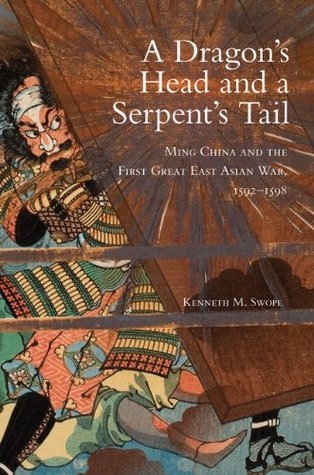
A Dragon’s Head and A Serpent’s Tail

by Rindis on July 3, 2015 at 10:10 am
Posted In: Books

Being something of a fan of warring states Japan (you can largely thank Nobunaga’s Ambition II for that), I’ve been aware for some time that at the end of the era, there was a Japanese invasion of Korea. But not a lot of attention gets paid to it; it’s just a short incident between the death of Nobunaga and the death of Hideyoshi.

So Kenneth M. Swope’s book on the entire war with Korea is very interesting, and pretty much all-new to me. Even more so, as Swope is primarily a specialist in Ming China, and this book is centered on China’s role in the war. Korea pretty much collapsed at the beginning of the war, and Ming China sent all sorts of aid to retrieve the situation.

Swope calls this the ‘First Great East Asian War’, because China was also dealing with other border problems at, or nearly so, the same time, and at the beginning of the book, he places the Korean problem in context with the rest of the ‘Three Great Campaigns’, which are something of a high water mark for the late Ming Dynasty. In fact, this period is generally seen as something of a disaster for the Ming, and Emperor Wanli one of the worst China had. Swope argues that this is not so, and that China weathered these crises well, and in good shape. Wanli is shown as being able to override court factionalism and appoint competent administrators and commanders, and stick by them when they are criticized. He was not, however, able to stop such infighting, which seems to be part of why he thinks the Ming collapsed only a couple decades later (he has a book about this out, currently on sale for $120. No.)

This is primarily a military history, but also includes accounts of the diplomatic talks between China and Japan, and the fate of Korean civilians, and court politics. This is a fairly high-level overview, and a very good one, but there’s a lot more details I’d like to read about in the future.

└ Tags: books, history, reading, review
 Comment 
  • Page 84 of 93
  • « First
  • «
  • 82
  • 83
  • 84
  • 85
  • 86
  • »
  • Last »

©2005-2026 Rindis.com | Powered by WordPress with ComicPress | Hosted on Rindis Hobby Den | Subscribe: RSS | Back to Top ↑