
Rindis.com

All my hobbies, all the time
  • Home
  • My Blog
  • Games
  • History

Categories

  • Books (503)
  • Comics (10)
  • Gaming (917)
    • Boardgaming (673)
      • ASL (154)
      • CC:Ancients (83)
      • F&E (78)
        • BvR – The Wind (26)
        • Four Vassal War (9)
        • Konya wa Hurricane (17)
        • Second Wind (5)
      • SFB (78)
    • Computer games (162)
      • MMO (77)
    • Design and Effect (6)
    • RPGs (66)
      • D&D (25)
        • O2 Blade of Vengeance (3)
      • GURPS (32)
  • History (10)
  • Life (82)
    • Conventions (9)
  • News (29)
  • Technology (6)
  • Video (49)
    • Anime (47)
  • Writing (1)

Patreon

Support Rindis.com on Patreon!
Become a patron at Patreon!

Other blogs:

RSS Inside GMT

  • Foxes and Lions (Part 3): Military Matters, Captains, and Condottieri June 12, 2026

RSS Playing at the World

  • Playing at the World 2E V2 Arrives May 5, 2025

RSS Dyson’s Dodecahedron

  • Barrow of the Great Mothers June 16, 2026

RSS Quest for Fun!

  • The Expense Post May 24, 2026

RSS Bruce Heard and New Stories

  • Pain, Exhaustion, and Morale in D&D BECMI June 7, 2026

RSS Chicago Wargamer

  • The 2 Half-Squads - Episode 310: Cruising Through Crucible of Steel January 27, 2023

RSS CRRPG Addict

  • Yendorian Tales: Here There Be Dragons June 15, 2026
SF&F blogs:

RSS Fantasy Cafe

  • The Leaning Pile of Books May 24, 2026

RSS Lynn’s Book Blog

  • Booking Ahead/Weekly Wrap Up June 14, 2026
ASL blogs:

RSS Sitrep

  • Cardinal ASL Sins March 18, 2026

RSS Hong Kong Wargamer

  • FT114 Yellow Extract After Action Report (AAR) Advanced Squad Leader scenario April 16, 2025

RSS Hex and Violence

  • This still exists? March 25, 2025

RSS Grumble Jones

  • YouTube AAR for Critical Hit's Gettysburg Turning Point 1863 - ID4 At Will Fire June 16, 2026

RSS Desperation Morale

  • How to Learn ASL March 16, 2025

RSS Banzai!!

  • October North Texas Gameday October 21, 2019

RSS A Room Without a LOS

  • [Crossing the Moro CG] T=0902 -- Rough start July 18, 2015
GURPS blogs:

RSS Dungeon Fantastic

  • Rules & Rulings from Session 224 June 16, 2026

RSS Gaming Ballistic

  • B-Scale: Damage That Scales from Tardigrades to Kaiju June 5, 2026

RSS Ravens N’ Pennies

RSS Let’s GURPS

  • Review: GURPS Realm Management March 29, 2021

RSS No School Grognard

  • It came from the GURPS forums: Low-Tech armor and fire damage January 29, 2018

RSS The Collaborative Gamer

  • Thoughts on a Town Adventures System January 18, 2022

RSS Don’t Forget Your Boots

  • GURPS Supers Newport Academy #6: “Old Friends, New Again” June 7, 2026

RSS Orbs and Balrogs

  • Bretwalda - Daggers of Oxenaforda pt.4 - Fallen King May 27, 2017

Peter the Great

by Rindis on February 8, 2016 at 12:00 pm
Posted In: Books

Robert K. Massie’s volume is a massive biography that delivers a good look at its subject. “His Life” is covered in ~850 pages covering from his childhood and the later parts of the reign of his father, Czar Alexis, and the unstable politics that produced the co-reign of his half-brother Fedor and himself in 1682, through his death in 1725 with an epilogue that outlines the politics that produced four reigning empresses, ending with Catherine the Great.

The “and World” part of the title also gets good coverage with various extended asides that help bring the 17th-18th centuries alive, starting with a description of Moscow ca. 1680. Peter is the nominal focus of the entire book, but in true Massie fashion, any subject that catches his eye along the way (such as Charles XI of Sweden) gets an extended treatment in it’s own chapter. Peter, of course, had two extended trips into western Europe, and these also serve as a springboard into a look at the situation there as well, helping provide a wider context to Peter the Great’s life and just what he was trying to emulate in Russia.

As a popular history, it does not delve into historical controversy, and presents Peter solidly in his typical role as the hero of ‘westernizing’ Russia, even while clearly showing the tyrannical side that (for instance) pursued suspicions of a conspiracy against him with relentless torture and executions, and that his reforms almost entirely relied on threats and force from Peter himself. I particularly would have liked a better look at the great families of Russia that were important in the state at this time, though I guess that Massie felt they were only important near the beginning and again at the end of his life, and it would have distracted too much from the core of his book to delve into them in any depth.
└ Tags: books, history, reading
 Comment 

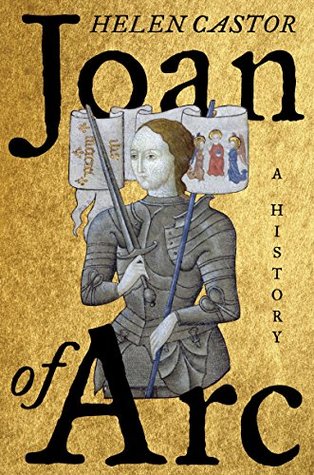
Joan of Arc: A History

by Rindis on January 9, 2016 at 12:00 pm
Posted In: Books

Helen Castor describes the story of Joan of Arc as normally being written backwards. Everything is colored by the knowledge of what she would become to history. Also, the histories pour over the transcripts of her trials looking for clues to her early life from people who had already been heavily impacted by what she had done.

So, Castor starts with the story of the civil war that tore France apart and allied Burgundy with an English bid for the French throne. How continuous political dissension tore apart the Kingdom of France and left it unable to act even in the face of a serious external threat.

And only at this point, is Joan introduced, at the point where she steps in to contemporary reports. Castor does a careful job of trying to present the religious attitudes of the day, of showing both how popular opinion would have reacted to events, and the careful scholastic investigation into Joan’s claims.

The last part of the book continues the collapse of English France after her death, and concludes with her second trial, where greatly changed political conditions guaranteed a different verdict than the original. It is at that point where people from Joan’s home village were questioned, and anything is said of her early life. There is then a short afterword that talks about her canonization as a saint in 1920.

In all, it’s a surprisingly short book, but well done, and a good look at early fifteenth-century France.

└ Tags: books, history, reading, review
 Comment 

Sing the Four Quarters

by Rindis on December 18, 2015 at 12:00 pm
Posted In: Books

A friend who has been the source of a number of good recommendations over the years recommended Sing the Four Quarters back when it came out. It always stuck in my mind, and I’ve meant to get to it for… yeah. Anyway, I got the Kindle edition a while ago, and finally read it.

It’s good, but a little vague in places. The general fantasy premise is that there are kigh, who are elemental spirits, that some people can sense and influence, generally by singing. But while there are fire spirits, and fires would attract them, and they can affect the fire, the fire exists in the absence of the kigh, and still I don’t know just where they really exist in the nature of the world (though it does come out that they avoid the interiors of large buildings, but not really why).

This is something of an idealized ‘living nature’ magic, when you get down to it, which goes along with an idealized kingdom, with a good king, and an idealized other expansionist enemy kingdom across the border. There’s also what appears to be an idealized ‘free love’ aspect, but this is pretty obviously part and parcel of how this society works, and adults are left to be adults, and to work out the consequences of their own mistakes.

However, the characters, as people, do not fall into any of this idealization. The background may be painted in broad strokes, but the people involved are complex and fallible, and can have a heck of a time getting along with each other, even they do care about each other.

The plot takes a little bit to get going, and suffers a bit in places from a number of quick cuts as the action gets more complex than the narrative can handle. Also, its a bit transparent, and telegraphs where, in the main, it is going. But, it’s not plot by rote, and the journey is quite enjoyable. Definitely recommended, and I’m keeping an eye out for the later books, which I understand are not direct sequels.

└ Tags: books, fantasy, reading
 Comment 

Empires and Barbarians

by Rindis on October 29, 2015 at 12:00 pm
Posted In: Books

I picked up Peter Heather’s 2009 book simply because it was cheap on Kindle at one point. I’m now thinking I want to get a proper hard copy book. This is mostly a measure of how much I liked the book, but there are a number of good maps that I’d like a better look at too.

The primary purpose of this book is to re-examine Europe from the Roman to Dark/Early Middle Ages, and argue against the cultural continuity/no migration stance that has gained popularity from the 70s onward. The main new thing brought to the analysis is concepts from modern migration studies (it was highly appropriate that I started this book about the time the Syrian migration crisis started hitting the headlines). These have identified a lot of trends in how and why migration happens, and Heather then applies those concepts to Roman narratives and archaeological evidence.

Starting around 1 AD, he notes that the areas the Romans conquered were relatively prosperous and well developed; Roman expansion in Europe pretty much petered out when it reached (largely Germanic-speaking) areas that were less well developed with less intensive agricultural patterns. In fact, agriculture still relied on picking up and moving every couple of generations as the land was exhausted. Heather points out that migration studies show that people who have migrated once are likely to do it again, and that the next couple generations retain the habit. So, if there’s an entire cultural system that has to pack up and move every so often, it’s likely that migration will be a major answer to any new problems that come up.

One of major motivators of migration is economic disparity. More prosperous areas draw people from less prosperous areas. Not only was the Roman Empire the most developed part of Europe, but the Empire spent a fair amount of money and effort in promoting power structures on the frontier, and occasionally breaking them apart when they got too big. Heather shows that the fall of the Western Empire started when this system failed (and argues that this had to happen at some point, but the actual event was earlier than it had to be). Rome’s wars in the east drew off troops, and allowed the short-lived Hunnic Empire to form in central Europe, causing all sorts of groups to migrate to get out of the way, and then it came apart, causing all sorts of groups to migrate away from the resulting chaos.

After tracking how the late fourth and fifth centuries play out, Heather continues with the evolution of central and eastern Europe through the year 1000. This involves the Avar Empire, the spread of Slavic speakers through much of Eastern Europe, the Viking era of Scandinavian migration, and briefly the Magyars, and why they didn’t set off any noticeable migrations.

So, it is a study of the fall of the Roman Empire, from outside of the Empire, and a study of the demographic changes that happened across most of Europe over a thousand years. I think it does a lot to correct current scholarly wisdom (which, itself, was a much-needed correction), and I found it very informative and well argued.

└ Tags: books, history, reading, review
1 Comment

Deep Secret

by Rindis on October 6, 2015 at 12:00 pm
Posted In: Books

Deep Secret begins with a cryptic message that the following was secretly deposited in the archive at Iforion. I’d pretty much forgotten that by the time reference was made to it late in the book. There’s a number of things from early on that circle back into prominence towards the end.

To a certain extent, it is a standard contemporary fantasy novel: Earth is one of a large number of alternate worlds, which have varying amounts of magic, and there is an organization of high-power mages that keep an eye on the multi-verse. The part that is a delight for someone like me, is that the bulk of the middle of the story takes place at a SF convention. It’s obvious that Jones was thoroughly familiar with them. I don’t know any of the people she describes, but they’d all fit in at any con; I know a lot of people who are very like them.

The hotel with the mirrors at every corner? Been there. (Thankfully, I have yet to encounter more than four right turns in a row, though there are hotels where it feels possible.)

The story itself has a slow start, with the main character switching between two disconnected plotlines. However, this smooths out, and in the end, everything is shown to have a place in the overall structure. It’s not a stellar book, but it is a fun one, and there’s a lot of extra fun to be had if you’re used to the con circuit.

└ Tags: books, fantasy, reading, review
 Comment 
  • Page 83 of 93
  • « First
  • «
  • 81
  • 82
  • 83
  • 84
  • 85
  • »
  • Last »

©2005-2026 Rindis.com | Powered by WordPress with ComicPress | Hosted on Rindis Hobby Den | Subscribe: RSS | Back to Top ↑