Rindis.com

All my hobbies, all the time
  • Home
  • My Blog
  • Games
  • History

Categories

  • Books (503)
  • Comics (10)
  • Gaming (917)
    • Boardgaming (673)
      • ASL (154)
      • CC:Ancients (83)
      • F&E (78)
        • BvR – The Wind (26)
        • Four Vassal War (9)
        • Konya wa Hurricane (17)
        • Second Wind (5)
      • SFB (78)
    • Computer games (162)
      • MMO (77)
    • Design and Effect (6)
    • RPGs (66)
      • D&D (25)
        • O2 Blade of Vengeance (3)
      • GURPS (32)
  • History (10)
  • Life (82)
    • Conventions (9)
  • News (29)
  • Technology (6)
  • Video (49)
    • Anime (47)
  • Writing (1)

Patreon

Support Rindis.com on Patreon!
Become a patron at Patreon!

Other blogs:

RSS Inside GMT

  • Foxes and Lions (Part 3): Military Matters, Captains, and Condottieri June 12, 2026

RSS Playing at the World

  • Playing at the World 2E V2 Arrives May 5, 2025

RSS Dyson’s Dodecahedron

  • Barrow of the Great Mothers June 16, 2026

RSS Quest for Fun!

  • The Expense Post May 24, 2026

RSS Bruce Heard and New Stories

  • Pain, Exhaustion, and Morale in D&D BECMI June 7, 2026

RSS Chicago Wargamer

  • The 2 Half-Squads - Episode 310: Cruising Through Crucible of Steel January 27, 2023

RSS CRRPG Addict

  • Yendorian Tales: Here There Be Dragons June 15, 2026
SF&F blogs:

RSS Fantasy Cafe

  • The Leaning Pile of Books May 24, 2026

RSS Lynn’s Book Blog

  • Booking Ahead/Weekly Wrap Up June 14, 2026
ASL blogs:

RSS Sitrep

  • Cardinal ASL Sins March 18, 2026

RSS Hong Kong Wargamer

  • FT114 Yellow Extract After Action Report (AAR) Advanced Squad Leader scenario April 16, 2025

RSS Hex and Violence

  • This still exists? March 25, 2025

RSS Grumble Jones

  • YouTube AAR for Critical Hit's Gettysburg Turning Point 1863 - ID4 At Will Fire June 16, 2026

RSS Desperation Morale

  • How to Learn ASL March 16, 2025

RSS Banzai!!

  • October North Texas Gameday October 21, 2019

RSS A Room Without a LOS

  • [Crossing the Moro CG] T=0902 -- Rough start July 18, 2015
GURPS blogs:

RSS Dungeon Fantastic

  • Rules & Rulings from Session 224 June 16, 2026

RSS Gaming Ballistic

  • B-Scale: Damage That Scales from Tardigrades to Kaiju June 5, 2026

RSS Ravens N’ Pennies

RSS Let’s GURPS

  • Review: GURPS Realm Management March 29, 2021

RSS No School Grognard

  • It came from the GURPS forums: Low-Tech armor and fire damage January 29, 2018

RSS The Collaborative Gamer

  • Thoughts on a Town Adventures System January 18, 2022

RSS Don’t Forget Your Boots

  • GURPS Supers Newport Academy #6: “Old Friends, New Again” June 7, 2026

RSS Orbs and Balrogs

  • Bretwalda - Daggers of Oxenaforda pt.4 - Fallen King May 27, 2017

Byzantine Infantryman

by Rindis on March 25, 2016 at 12:00 pm
Posted In: Books

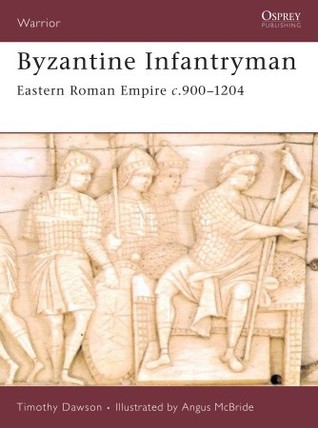
Osprey’s book on Byzantine infantry covers from around the reign of Emperor Leo VI, which saw a revival of interest in military matters, to the fall of Constantinople in the Fourth Crusade, which interrupted tradition, and very effectively brought the era to a close.

As a Warrior series book, the emphasis is on the individual men, and how they were organized, equipped and trained. I found the text of the book to be excellent, and very informative on a number of subjects. I’m not fully sure of some of Dawson’s assertions, but don’t know enough to be able to argue the point, and the vast majority seem well founded.

On the other hand, the color art is lacking. Angus McBride was one of the most celebrated of military historical artists for good reason, but this book must have been one of the last he did (it came out the year he died), and I think that forced it to be rushed through. Osprey’s Warrior series tends to feature highly detailed illustrations of all the variations of equipment, showing what all the pieces are. Instead, while there’s some very nice illustrations of people here, the backgrounds that Angus popularized are barely there at all, and there’s only a few fairly plain bits of equipment illustration. There are a few black-and-white diagrams that are very helpful in the main text, but it is disappointing compared to the ‘can we fit one more piece of equipment into this’ studies that I’m used to in a Warrior book.

This does overall hold the book back a bit, but again the main text is very good, and I was overall impressed with it. It just isn’t everything you expect from a book in this series.

└ Tags: books, Elite, history, Osprey, reading, review
 Comment 

Constantine Not-the-Emperor

by Rindis on March 21, 2016 at 12:46 pm
Posted In: Books

David Potter’s book on Constantine is at first a little hard to pin down. It’s not really a biography, and despite the title, only about half the book is about the reign of Emperor Constantine, with the first half being a grounding in the crisis of the third century, and Diocletian’s reign (and depicts the Tetrarchy as being far less far-sighted as I’ve seen elsewhere), and then shows what Constantine’s place in the Imperial court was before his self-appointment to the rank of Augustus.

Through it all, the book is a slightly dry recounting of Roman government from Diocletian through Constantine’s death. There is a lot of attention paid to, and things read into, surviving official correspondence. Knowing what the person Constantine was like is probably impossible with the surviving sources, and Potter doesn’t try. He sketches in the outlines, but doesn’t go for a lot of color. The thrust of the narrative presents the early fourth century Empire as the world in which Constantine existed, and what his conversion to Christianity really meant.

And the answer is ‘not a lot’. Potter’s interpretation of Constantine’s faith is (understandably) as something that evolved over time, and doesn’t necessarily bear a strong resemblance to faith as it is understood today. His reign was not the dramatic conversion of the purpose of the Empire that it is generally presented as (especially in Christan sources). Instead, Potter shows that Constantine’s legislation shows a very evenhanded approach, retaining traditional practice (as he saw it) where possible, while integrating Christian belief into it.

He also admits that Constantine leaned towards promoting Christian administrators, which one would figure would promote the process of the Roman Empire becoming a ‘Christian’ Empire, but such long-term results are not looked into. Given Potter’s emphasis on the somewhat heterogeneous composition of the the empire and its government, I’d like to see what he has to say about the reign of Julian, and if it comes off as controversial at the time as it gets presented in hindsight or from hostile Christian sources.

└ Tags: books, history, reading, review
 Comment 

The Amazons

by Rindis on March 17, 2016 at 12:00 pm
Posted In: Books

I was expecting something of a detailed look at the Greek myths of Amazons with modern archaeology put in to start telling us just how much of it might have been true.

Instead, this is a bit more wide-ranging, largely conflating ‘amazon’ with ‘woman warrior’, and examining pretty much everything we know, from a variety of mythological traditions from Greece to China, and from archaeology, and from those ancient traditions that still continue today, though the strongest associations are still Greek myth.

Mostly, it’s a good discussion of what we do know of ancient women warriors (through archaeology) in nomadic peoples such as the Scythians, but a little more general than I was hoping for.

└ Tags: books, history, reading, review
 Comment 

Walls of Troy VI

by Rindis on March 4, 2016 at 12:00 pm
Posted In: Books

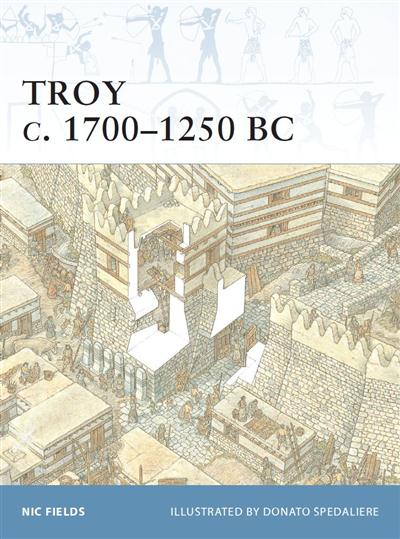
Osprey’s Fortress book on ancient Troy is not a bad guide to the history of the site as known to archaeology as a whole, but the bulk of the book concentrates (understandably) on Troy VIh, which is one of the contenders to be the Troy of the Illiad (there are arguments for VIIa). It also has the most well-developed defenses.

Beyond a few pages introducing archaeological periods, and the history of excavations of the site, there is a nice color diagram of the major features of each level of the city showing how it grew over time, and a 12-page history of the city from 2900 BC to 550 AD. I should say in the previous sentence, how the central fortress of Troy grew, since it has now been established that there was a walled lower town, at least during the Troy VI period, typical of major fortresses.

After a five-page digression on techniques of mud-brick building (the stone lower walls of Troy had mud-brick upper sections), book gets into its main focus on the walls of Troy IV, with an emphasis on the later portions of the period. Various towers and gates have technical names for archaeologists to identify them by (such as Gate VIT), but no diagram of these elements is provided, and would have made things much clearer. As usual with Osprey, there are some very good photos of various elements, that also show some of the unusual features of Troy’s fortifications. The color illustrations also do a great job with reconstructions of the city, and cut away views, but are curiously washed out with low contrast (the cover has much higher contrast than the full illustration when shown on page 39, and is much easier to read because of it).

The last parts of the book deal with evidence that the Myceneans were indeed involved in plundering the shores of Anatolia (as well as other places), and spends a few pages pondering interpretations of the Trojan Horse, including possibly as an actual siege engine. While the discussion was interesting, there just is too little known for it to be more than speculation.

In general, this is a typical interesting Osprey look at an interesting subject, but I think the color illustrations desperately need another pass through the art department to get the color balance and contrast fixed, and some of the subsidiary material could have been dropped for a detailed layout of Troy VI, both of which leave the book a little lacking.

└ Tags: books, fortress, history, Osprey, reading, review
 Comment 

The Name of the Rose

by Rindis on February 27, 2016 at 12:00 pm
Posted In: Books

It’s hard to figure out where I should start with this book, because there’s a lot of places where I could start.

The Name of the Rose is set in 1327, and the struggles of the Christian church in northern Italy form the real background of the novel. The early 14th century comes through very clearly throughout the pages of the book, and as a historical novel it does extremely well. Various struggles surrounding the idea poverty and the church, heresy, the nature of heresy, the changing nature of towns and power, the emperor and the pope are all there, and come to life as much as the monastery that provides the setting of all the action.

However, all of this is part of the secondary plot, and form long passages that distract from what is technically the main action. The center of the book is a series of murders at a Benedictine monastery, which are investigated by the two main characters. (The main—not viewpoint—character, William of Baskerville, is an obvious homage to the origin of the mystery story, Sherlock Holmes.) The mystery itself is less successful, partially because all the other parts of the book demand too much time to keep it moving consistently, but more because the story is more of a tragedy than the mystery it presents itself as.

The book is well-written, even in translation from Italian, and well worth reading for a good combination of prose, history and mystery, but it tends towards the overwrought and long-winded.

└ Tags: books, history, reading, review
 Comment 
  • Page 82 of 93
  • « First
  • «
  • 80
  • 81
  • 82
  • 83
  • 84
  • »
  • Last »

©2005-2026 Rindis.com | Powered by WordPress with ComicPress | Hosted on Rindis Hobby Den | Subscribe: RSS | Back to Top ↑