Rindis.com

All my hobbies, all the time
  • Home
  • My Blog
  • Games
  • History

Categories

  • Books (503)
  • Comics (10)
  • Gaming (917)
    • Boardgaming (673)
      • ASL (154)
      • CC:Ancients (83)
      • F&E (78)
        • BvR – The Wind (26)
        • Four Vassal War (9)
        • Konya wa Hurricane (17)
        • Second Wind (5)
      • SFB (78)
    • Computer games (162)
      • MMO (77)
    • Design and Effect (6)
    • RPGs (66)
      • D&D (25)
        • O2 Blade of Vengeance (3)
      • GURPS (32)
  • History (10)
  • Life (82)
    • Conventions (9)
  • News (29)
  • Technology (6)
  • Video (49)
    • Anime (47)
  • Writing (1)

Patreon

Support Rindis.com on Patreon!
Become a patron at Patreon!

Other blogs:

RSS Inside GMT

  • Foxes and Lions (Part 3): Military Matters, Captains, and Condottieri June 12, 2026

RSS Playing at the World

  • Playing at the World 2E V2 Arrives May 5, 2025

RSS Dyson’s Dodecahedron

  • Hollowshore Cairn June 17, 2026

RSS Quest for Fun!

  • The Expense Post May 24, 2026

RSS Bruce Heard and New Stories

  • Pain, Exhaustion, and Morale in D&D BECMI June 7, 2026

RSS Chicago Wargamer

  • The 2 Half-Squads - Episode 310: Cruising Through Crucible of Steel January 27, 2023

RSS CRRPG Addict

  • Yendorian Tales: Here There Be Dragons June 15, 2026
SF&F blogs:

RSS Fantasy Cafe

  • The Leaning Pile of Books May 24, 2026

RSS Lynn’s Book Blog

  • Summer of Horror: Can’t Wait Wednesday: Sleepers in the Snow by Joanne Harris June 17, 2026
ASL blogs:

RSS Sitrep

  • Cardinal ASL Sins March 18, 2026

RSS Hong Kong Wargamer

  • FT114 Yellow Extract After Action Report (AAR) Advanced Squad Leader scenario April 16, 2025

RSS Hex and Violence

  • This still exists? March 25, 2025

RSS Grumble Jones

  • YouTube AAR for Critical Hit's Gettysburg Turning Point 1863 - ID4 At Will Fire June 16, 2026

RSS Desperation Morale

  • How to Learn ASL March 16, 2025

RSS Banzai!!

  • October North Texas Gameday October 21, 2019

RSS A Room Without a LOS

  • [Crossing the Moro CG] T=0902 -- Rough start July 18, 2015
GURPS blogs:

RSS Dungeon Fantastic

  • Rules & Rulings from Session 224 June 16, 2026

RSS Gaming Ballistic

  • B-Scale: Damage That Scales from Tardigrades to Kaiju June 5, 2026

RSS Ravens N’ Pennies

RSS Let’s GURPS

  • Review: GURPS Realm Management March 29, 2021

RSS No School Grognard

  • It came from the GURPS forums: Low-Tech armor and fire damage January 29, 2018

RSS The Collaborative Gamer

  • Thoughts on a Town Adventures System January 18, 2022

RSS Don’t Forget Your Boots

  • GURPS Supers Newport Academy #6: “Old Friends, New Again” June 7, 2026

RSS Orbs and Balrogs

  • Bretwalda - Daggers of Oxenaforda pt.4 - Fallen King May 27, 2017

Child of Flame

by Rindis on September 1, 2016 at 12:00 pm
Posted In: Books

Book four of Crown of Stars follows the usual practice of giving time to four major plot threads. The new major character this time is Adica, the Hollowed One of a tribe that is part of an effort to cast a truly earth-shattering spell.

Instead of this being a completely separate plot with no real tie in to the regular major cast, it is tied directly to Alain, who has been thrown 2,700 years into the past, and finds peace in a troubled little paradise. This is a big case of showing exactly what we were told about in the big reveal of the previous volume, and gives a preview of the calamity that is yet to come.

Liath meanwhile has her own separate arc that also takes her out of the main action for the entire book. This is in essence the personal journey that she turned down at the beginning of book three, and she finally gets the space and time to go through the growth that she has needed, and ends with the answers about what she is that have only been getting bigger as the series progresses.

The final two major plots are back on earth. The main focus is decidedly still in Wendar, with a lot of action and a good chunk of the secondary cast revolving around the Quman invasion. South in Aosta, King Henry starts the process of adding a third kingdom to his crown as all the more dangerous antagonists gather around.

I find it very interesting that much of this volume mirrors some of what had gone immediately previous, and while the main plot definitely moves forward, the secondaries take center stage. This continues to be a very good epic fantasy series, and overall very well paced, mostly because it never looses sight of what its own main plot is.

└ Tags: books, fantasy, reading, review
 Comment 

The Battle of Salamis

by Rindis on July 28, 2016 at 12:00 pm
Posted In: Books

Barry Strauss has written a very accessible account of the second time the Greeks fought off the Persian Empire. He spends a good amount of time on the background: the Ionian revolt, the general configuration of the Persian court, etc. Along the way, we good descriptions of triremes, the geography, and the backgrounds of many of the important people. So it’s was a little surprising that he spends so little time and descriptive power on Marathon and (while talking about the aftermath) Plataea. But, Strauss is fixated on the water; the fighting at Thermopylae gets decent coverage, but the naval fighting at Artemesium is where the early focus lies. This generally makes sense for a book mostly about a naval battle, but enough other things are thrown in that I found these omissions surprising. A nice touch is that every chapter has a small map near the beginning (at least in the Kindle version, they might be elsewhere in print).

The biggest enemy in any book looking back ~2500 years is the lack of sources. Strauss leans heavily on Thucidides (who I agree is more reliable than sometimes given credit for) and Aeschylus, but does leaven his text with a few other sources and modern reconstructions of triremes. He does not hesitate to speculate, but marks these off with ‘we may assume’, etc., so you know when he is doing so (which, as to be expected, is pretty often).

Generally, he does a good job with his analysis, but there are places I disagree. He compares the Spartan stand at Thermopylae to Persian confusion at Salamis saying “Leonidas served a transcendent cause, while the Phoenician king Tetramnestus merely calculated the odds.” I’d think Leonidas saw delaying the Persian army as much as possible as his strategic goal, while Tetramnestus’ only goal was the destruction of the Greek navy; if that wasn’t going to happen, then the battle wasn’t worth fighting. He also assumes that Artemesia must have fooled the Greeks into thinking hers was a Greek ship, and Xerxes into thinking she had just rammed a Greek ship during a famous incident when she rammed her ally Damasithymus’ ship (this is the usual view). I wonder. Given that there are only a few angles at which ramming is truly effective, I wonder if she had just put her ship in position much more difficult to get at (by having to go through Damasithymus’ ship to do so, for instance). Given normal courtly politics, Xerxes may also have been willing to celebrate the competence of someone who instantly saw and acted upon a chance to avoid defeat/capture and cut down a rival at the same time.

The subtitle is a bit mixed. ‘Saving Greece’ is hard to argue—except for the fact that ‘Greece’ was not a very cohesive concept, a fact pointed up, as Strauss does, by the fact that a lot of ‘Greeks’ fought for the Persians. But there was a cohesive Greek alliance, fairly untroubled by defections to Persia, and Salamis was the turning point in the campaign. As for ‘Western Civilization’… Strauss notes that, perhaps, defeated Greeks would have fled to Italy and continued on, even retaken Greece. But there’d be no Delian League, what he calls the birth of ‘imperial democracy’. “Defeat at Salamis would not have deprived the world of Greece’s glory but of its guile and greed.” From there he talks about the road to Western political philosophy. So it’s not just hyperbole.

└ Tags: books, history, reading, review
 Comment 

Off To See the Red Wizards

by Rindis on July 24, 2016 at 12:00 pm
Posted In: D&D

The sixth FR-series supplement headed east, extending the detail maps of the Forgotten Realms another panel to the east of the original boxed set ones (while jogging slightly south), and hit the eastern edge of the large map in the process. This centered the book on one of the peripheral villains of the setting, the Red Wizards of Thay. The Wizards themselves remain popular villains (including a 5e adventure series that echoes the title of this book), and the general area has been revisited in Spellbound and Unapproachable East.

The module returns to the normal layout: 64-page detached book in brown ink with faux-parchment background, one poster map, and no printing on the inside cover. The east edge of the map just barely shows some of the Sunrise Mountains, another convenient chain that defines the edge of the known lands of the Realms (there’s only a bit of hint of foothills on the boxed set’s 90 mi/in maps, meaning this map actually goes slightly off the edge of that map). While there’s some very nice Valerie Valusek illustrations, and a reproduction of the main map in the book, there’s no detail maps to be had (perhaps because the Red Wizards forbid any maps to be made of their cities…).

While Thay is actually only a part of the area covered, they are front and center in the book, even when they aren’t (the ‘History of Thay’ and ‘Geography of Thay’ sections actually cover a lot of things outside of Thay). Surrounding countries are largely defined by how prepared they are, or who they typically ally with, to fight off Thay when they inevitably invade. Make no mistake, Thay is an evil country; expansionist, power-hungry, and with an economy built on slave labor. It’s made clear that not everyone is evil (just like a ‘good’ country doesn’t have an entirely ‘good’ population), just everyone in charge is.
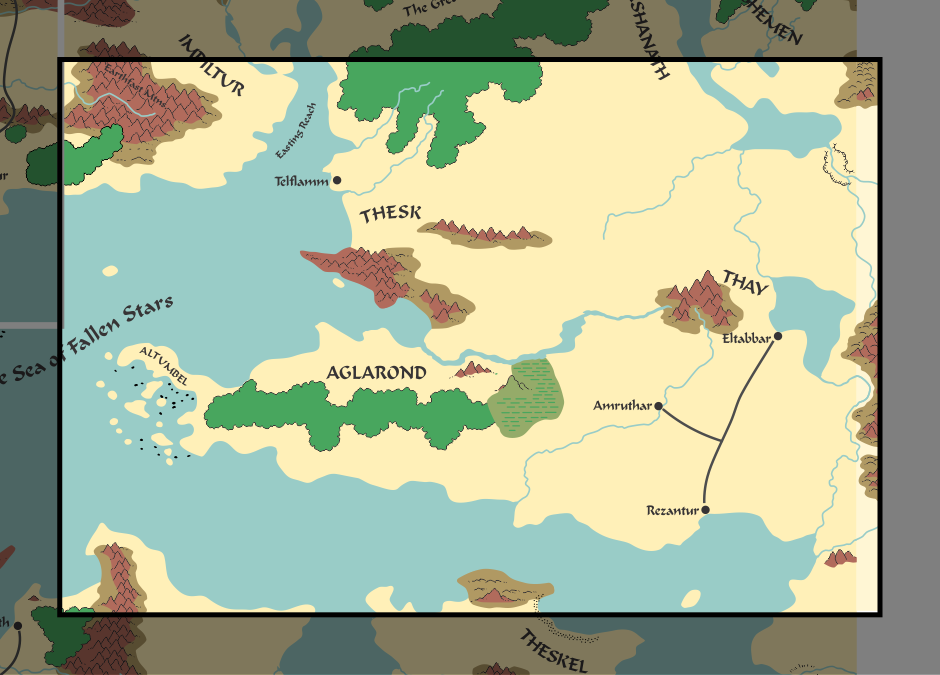

Region the FR6 map covers. The pale section on the right is where it sticks past the original 90 mi/inch map area.

Overall, Thay is given a well-rounded presentation. There’s no ‘rule of law’, just tradition and pronouncements, no one system of taxation (merchants going through one city are effectively ‘taxed’ by the Thieves Guild…), but there is administration. The Tharchions handle the ordinary running of the country, and defer to the Zulkirs (the top Wizards) when they intervene. With a bunch of high-level magic-users in charge, one might wonder how Thay isn’t much bigger than it is, especially since most of its neighbors don’t have the ability to resist that sort of firepower. But the Zulkirs aren’t a united group, and often work against each other to prevent any one from becoming too powerful, moreover there are some who would rather research, and not deal with wars disrupting trade in rare spell ingredients. And the economy is changing, with an emerging middle-class that the powers that be are uncertain about.

Late-era 1e AD&D seems to have gotten an inclination to keep adding new spells to the system. Focused on a set of wizards, FR6 naturally spends ten pages on new spells more-or-less unique to the Red Wizards. This could have been great, if the spells had a bit more flavor, like many of the ones in FR4 had. Unfortunately, many of these actually borrow from existing Cleric and Druid spell lists, with minor changes (different levels, different component requirements, and slightly different effects), making it feel more like they are destroying the essential flavor of those classes instead of adding anything new. Also, the largest section is for Abjuration (protection) spells, the bulk of which are variations on the theme of ‘Protection From [Effect/Creature]’. This could allow a Red Wizard to be annoyingly difficult to deal with, if he knew which spells to memorize beforehand.

There is also an eight-page player’s guide to Thay. Instead of the well done in-world introductions of the Gazetteer series, the bulk of this is taken up by giving the available spells to learn if you’re a magic-user studying in Thay, or are from Thay. For a campaign visiting the mysterious country for the first time, half the player’s guide needs to be hidden away. But the first sections are a handy player-facing glossary, and a set of rumors. The latter are followed up in an adventuring section that gives further information and inspiration on what to do with them (this is much better than the usual approach that can leave you wondering what the author was thinking about). Thay is currently involved in two different wars, and a few other activities that adventurers could easily get involved in.

The big problem with Dreams of the Red Wizards is that Thay is a long way away from the usual adventuring grounds of the Forgotten Realms line, and the book wanders between presenting it as a possible campaign site, and trying to figure out how to draw existing adventurers from further west into range of the material presented. Furthermore, the power structure of Thay is primed to be rife with intrigue and deadly politics, but very little is really said about that, making an internal-view campaign difficult to set up. This isn’t as good as the highlights of the series (Waterdeep and the North and The Savage Frontier) as it doesn’t have the same ‘sufficient unto itself’ feel, but despite the problems, still presents a lot of material very well.

└ Tags: D&D, Forgotten Realms, gaming, reading, review, rpg
 Comment 

The Burning Stone

by Rindis on July 20, 2016 at 12:00 pm
Posted In: Books

Book three of Crown of Stars introduces Zacharias as the new viewpoint character to help hold the book together as a separate unit. His story is largely passive, as he follows Sanglant’s mother, who re-enters after her exit in the original prologue. He also doesn’t get nearly as much time as Anna did, but it is put to good use introducing elements that are important later, and Zacharias develops nicely through the book.

Liath continues to be the main center of interest, and also holds the book together as she is confronted with the same choice at the beginning and end of the book. Much is finally revealed about her background, though uncertainty resists. And in the middle of it all, we get the info-dump that puts the ‘epic’ in this fantasy….

Meanwhile, Alain, having gone from the bottom to the top, rapidly descends back to the bottom of the ladder in this volume. He stays very essentially true to himself, even as everything he’s gained is taken away, and major changes (including a shift to a completely different subplot) are promised for book four.

And in addition, all the other plots keep going, and the scope of the series continues to expand, with the action leaking out from Wendar to the south and east. Overall, despite the increased length (800 pages instead of 600) I felt this one held together a bit better than book two. It doesn’t deliver the excitement of the end of the previous book, but it maintains a good pace throughout, and doesn’t bog down the way Anna’s story did for me.

└ Tags: books, fantasy, reading, review
 Comment 

Blenheim: Battle for Europe

by Rindis on June 30, 2016 at 12:00 pm
Posted In: Books

Charles Spenser is certainly correct in his assertion that the Battle of Blenheim is one of the more important battles of history that is not well remembered today. This is more surprising in the English-speaking world since it was an English commander in charge, and English troops played an important part in the battle.

I’m not so sure how much I can go for his subtitle, “How Two Men Stopped The French Conquest Of Europe“, however. It’s not just a tag put on by the publisher, as it is certainly an idea present in his book, but it’s not that well supported. The immediate consequences of a (likely) French victory in the War of Spanish Succession are obvious enough, but after some good analysis of  internal French troubles one wonders just how well they could have done. Finally, I felt through the entire book that the story of the second man, Prince Eugène of Savoy, was not very well served by the narrative.

In fact, Blenheim suffers most from being too close to typical English accounts of the battle, instead being much more about the story of Marlborough than anything else. There are good reasons for this, but I was hoping that the book would move its center of gravity a little further away from the instinctual ‘how great our man is’ mode.

Thankfully, the book is at the same time much more than that, and very handy for the casual history reader. Spenser does spend quite a bit of time laying the groundwork, presenting the career of Louis XIV as whole, as well as William of Orange’s resistance to his territorial aims in the Low Countries, and an account of the War of the League of Augsburg. So the background is very good, and takes up a fair chunk of the book.

The War of Spanish Succession itself is centered around Marlborough’s campaigning, and isn’t an account of the war as a whole; coverage after Blenheim drops off dramatically. That said, as with much else with the book, what is there is well done, and the Marlborough’s move from the Low Countries to the Danube is handled very well.

As a casual history book, centered around Marlborough, it’s very good, and other viewpoints from contemporary diaries are included to good effect, and I recommend it, but on that basis only. Prince Eugène’s story is given, but not in as much detail. As a history of the War of Spanish Succession it fails from not giving proper attention to the rest of the war, and as a history of the Battle of Blenheim, it spends too much time on the rest.

└ Tags: books, history, reading, review
 Comment 
  • Page 83 of 96
  • « First
  • «
  • 81
  • 82
  • 83
  • 84
  • 85
  • »
  • Last »

©2005-2026 Rindis.com | Powered by WordPress with ComicPress | Hosted on Rindis Hobby Den | Subscribe: RSS | Back to Top ↑