Rindis.com

All my hobbies, all the time
  • Home
  • My Blog
  • Games
  • History

Categories

  • Books (503)
  • Comics (10)
  • Gaming (917)
    • Boardgaming (673)
      • ASL (154)
      • CC:Ancients (83)
      • F&E (78)
        • BvR – The Wind (26)
        • Four Vassal War (9)
        • Konya wa Hurricane (17)
        • Second Wind (5)
      • SFB (78)
    • Computer games (162)
      • MMO (77)
    • Design and Effect (6)
    • RPGs (66)
      • D&D (25)
        • O2 Blade of Vengeance (3)
      • GURPS (32)
  • History (10)
  • Life (82)
    • Conventions (9)
  • News (29)
  • Technology (6)
  • Video (49)
    • Anime (47)
  • Writing (1)

Patreon

Support Rindis.com on Patreon!
Become a patron at Patreon!

Other blogs:

RSS Inside GMT

  • Foxes and Lions (Part 3): Military Matters, Captains, and Condottieri June 12, 2026

RSS Playing at the World

  • Playing at the World 2E V2 Arrives May 5, 2025

RSS Dyson’s Dodecahedron

  • Hollowshore Cairn June 17, 2026

RSS Quest for Fun!

  • The Expense Post May 24, 2026

RSS Bruce Heard and New Stories

  • Pain, Exhaustion, and Morale in D&D BECMI June 7, 2026

RSS Chicago Wargamer

  • The 2 Half-Squads - Episode 310: Cruising Through Crucible of Steel January 27, 2023

RSS CRRPG Addict

  • Yendorian Tales: Here There Be Dragons June 15, 2026
SF&F blogs:

RSS Fantasy Cafe

  • The Leaning Pile of Books May 24, 2026

RSS Lynn’s Book Blog

  • Summer of Horror: Can’t Wait Wednesday: Sleepers in the Snow by Joanne Harris June 17, 2026
ASL blogs:

RSS Sitrep

  • Cardinal ASL Sins March 18, 2026

RSS Hong Kong Wargamer

  • FT114 Yellow Extract After Action Report (AAR) Advanced Squad Leader scenario April 16, 2025

RSS Hex and Violence

  • This still exists? March 25, 2025

RSS Grumble Jones

  • YouTube AAR for Critical Hit's Gettysburg Turning Point 1863 - ID4 At Will Fire June 16, 2026

RSS Desperation Morale

  • How to Learn ASL March 16, 2025

RSS Banzai!!

  • October North Texas Gameday October 21, 2019

RSS A Room Without a LOS

  • [Crossing the Moro CG] T=0902 -- Rough start July 18, 2015
GURPS blogs:

RSS Dungeon Fantastic

  • Rules & Rulings from Session 224 June 16, 2026

RSS Gaming Ballistic

  • B-Scale: Damage That Scales from Tardigrades to Kaiju June 5, 2026

RSS Ravens N’ Pennies

RSS Let’s GURPS

  • Review: GURPS Realm Management March 29, 2021

RSS No School Grognard

  • It came from the GURPS forums: Low-Tech armor and fire damage January 29, 2018

RSS The Collaborative Gamer

  • Thoughts on a Town Adventures System January 18, 2022

RSS Don’t Forget Your Boots

  • GURPS Supers Newport Academy #6: “Old Friends, New Again” June 7, 2026

RSS Orbs and Balrogs

  • Bretwalda - Daggers of Oxenaforda pt.4 - Fallen King May 27, 2017

The Winter Prince

by Rindis on September 25, 2016 at 12:00 pm
Posted In: Books

This isn’t quite an Arthurian book in the usual sense. Set in post-Roman Britain, The Winter Prince adapts from the Welsh versions of Arthurian legend, taking the general situation to tell its own story.

The entire story is told by Medraut in first person to his mother Morgause, though exactly when and where is unclear, as she doesn’t seem to be present (and a novel makes for a very long letter); perhaps it is really just an inner monologue of Medraut’s as part of coming to terms with his mother. But the novel centers around Medraut’s relationship with Lleu, the heir of King Artos. Medraut is his older half-brother, and in many ways a better candidate for kingship. Lleu is young, inexperienced, and sickly, and has a certain amount of arrogance, while Medraut is experienced, well-traveled, and competent in a number of fields. But it is not to be, kingship is forbidden to Medraut.

The plot of the novel just kind of wanders about through a number of different incidents. But the real purpose of the book is the complicated relationship between Medraut and Lleu. This is well handled, and comes to a good ending. I generally recommend this as a YA book, though it never got me especially involved.

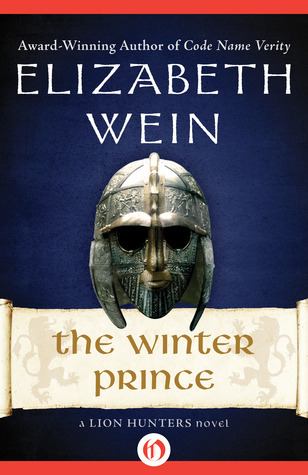
My Kindle edition has a full page illustration by the author at the start of every chapter, so that is also recommended, even if the cover came straight from the stock-photo department.

└ Tags: Arthurian, books, historical, reading, review
 Comment 

Hall of Extras

by Rindis on September 17, 2016 at 12:00 pm
Posted In: D&D

TSR’s seventh FR-series module went into unusual territory again. A 128-page perfect bound book, it was one of the first products to sport a 2nd Edition logo, though the interior stats are all still first edition (magic-user, not mage, etc.). Instead of the usual geographical supplement, it was an anthology of writeups of characters in the Forgotten Realms, drawn mostly (though not entirely) from the novel line.

At that point, the existing novels to draw from were the Moonshae trilogy, the first two books of the Icewind Dale trilogy, Azure Bonds, Spellfire, the upcoming Avatar trilogy, and a planned Kara-Tur novel (never released). The book is divided into three parts, with “Main Characters” getting one to four pages, “Minor Characters” (including some villains) generally getting a little under a page each, and two “Adventuring Brotherhoods” split about twenty pages between them. While each section presents them in alphabetical order, they can be broken up into distinct groups, not all of which are strongly associated with any novel:

Moonshae: The main couple of the trilogy, Tristan and Robyn, get main character listings, with Cyndre, Daryth, Finellen, Grunnarch, Hobarth, Kazgaroth (which repeats information from FR2 almost verbatim, including a note to see a ‘next section’ that doesn’t exist in this book), Genna Moonsinger, and Pawldo among the minor characters. The descriptions are mostly for after the end of the series (which means several of the characters are dead), but there’s also notes on the pre-trilogy islands presented in FR2.

Icewind Dale: The main three of the trilogy (Bruenor, Drizzt, and Wulfgar) get much larger writeups than had been in FR5 (and the characteristic scores generally go up here, though Wulfgar’s 17 INT gets trimmed back to 15), while Cattie-Brie, Dendybar, Artemis, Regis, and Sydney all get minor character writeups. There’s also some background given on the northern dwarves. All three main characters have high characteristics and extra ‘because he’s him’ combat abilities.

Azure Bonds: Naturally, Alias and Dragonbait get major character entries, while Akabar, Cassana, Mistinarperadnacles, Zrie Prakis, and Olive Ruskettle have minor character entries. I like the idea that Alias, as a created person, has all equal characteristics, but all 17s seems a bit much. The three villains are dead, but it is noted that they could all easily return in one form or another. There’s also some basic information about saurials and playing one that isn’t Dragonbait.

Spellfire: Along with Shandril, Narm also gets a major character writeup, and the dracolich Rauglothgar gets a minor character writeup (with a full description of the powers of a dracolich). Many other characters here appear in the novel, but I’ve separated them out as they are convenient for lore purposes outside the novel.

Avatar: The main characters of the Avatar trilogy, Adon, Cyric, Kelemvor, and Midnight all get major character writeups. As the trilogy was still upcoming, only the backgrounds are given, with no secondary characters or villains presented, though some new lycanthrope types are presented.

Kara-Tur: Only the presumed main character, Doin Sanehiro gets a main character writeup, with six others: Jinchin, Kuang, Masakado, Okotampe, Onoye, and The Wanderer getting minor character writeups. There’s enough to get the main plot, and potentially run this as a campaign, but naturally it’d need a lot more fleshing out.

Shadowdale: Elminster is a major character in Spellfire, and gets a three page entry, plus some new spells, info on his home and bolt-hole, and a discussion of sages in general with thumbnail descriptions of another seven prominent sages of the Realms. Lhaeo, Mourngrym, and Shaerl all get minor character writeups, while the Knights of Myth Drannor as a whole get thirteen pages. The history of the Knights only confirms their status as the characters of one of Ed Greenwood’s primary campaigns.

Waterdeep: Five of the Lords of Waterdeep, Khelben, Durnan, Mirt, Peirgeiron and Nymara, get entries expanded from FR1. As well, Kappiyan, Malchor, Maaril appeared in FR1 and have much-expanded entries here.

Zhentil Keep: Alzegund, Fzoul, Manshoon, Manxam, Orgauth, all have minor character writeups, and present both Zhentarim and anti-Zhentarim characters, with some very good notes on using Orgauth as a villain.

Cormyr: Azoun IV and his court mage, Vangerdahast get expanded writeups from the boxed set, while Dimswart, a minor character from Azure Bonds gets an entry as well.

Five Sisters: Later known as the seven sisters, who would get their own book, Alustriel, Storm Silverhand, The Simbul, and Sylune all get minor character entries here, with the the fifth, Dove Falconhand appearing with the Knights of Myth Drannor.

Tethyr: The final part of the book contains a much expanded description of the Company of Eight from FR3. It was obvious that they were meant to form the basis of an adventuring party, with character sheets, and a little over a half page of text. Here, the full background of the Company is given, and descriptions of the personalities involved in nine pages. The former version was an okay ‘blank slate’, but without any real hooks. This version would require player buy in, but has plenty of direction, goals, and potential hooks, including for how they relate to each other.

In general, the levels given for everyone seem fairly appropriate, and often fairly tame, occasionally moving up into the twenties for longer-lived characters as established in the boxed set. The primary characteristics however, tend to be especially high, especially in the Main Character section. Most have no characteristic under 12, and an average of around 15-16; it’s worth noting that the Avatar characters are much more down to earth.

If you want to run a campaign where the players meet (or even play as) the main characters of any of the early Forgotten Realms novels, this is a great supplement. However, I’m not aware of a great many people who want to do that. My own take was always that they’re out there, and the party will often hear tavern tales of them (most of their adventures are pretty high profile), but only if the party really gets involved in something of direct interest to one of these characters are their paths likely to cross.

That said, there’s a good amount of use to be had with the minor characters. There’s just enough shown of Zhentil Keep that introducing them as a villain is much easier. At the same time, the presentation of several personalites of Waterdeep makes running adventures in that city easier as well. As well, there’s a fair amount of lore scattered throughout the entries, especially for the Shadowdale characters.

└ Tags: D&D, Forgotten Realms, gaming, reading, review, rpg
 Comment 

The Norman Conquest of Southern Italy and Sicily

by Rindis on September 13, 2016 at 12:00 pm
Posted In: Books

If you study the history of the Middle Ages, it doesn’t take long to realize the Normans were involved in a lot more than England and northern France. However, while I’d become aware of the Norman state in southern Italy, a lot of my reading didn’t get into the origins of this state beyond ‘Normans showed up and gradually took over’. Gordon Brown’s book matches exactly with its title, and was thus exactly what I’ve been wanting.

After an in medias res introduction around the Battle of Civitate (I’m a little tired of these), and then a short overview of the founding of Normandy before starting in 1107 with Norman pilgrims to southern Italy being invited to help in Lombard revolt against Byzantine power. The revolt didn’t go anywhere, but neither did some of the Normans who saw good opportunities for mercenary employment. Brown gives a pretty detailed look at the beginnings of Norman involvement, including the origins of the two families that rose to prominence (Hautville and Dregnot), which was one of my primary interests.

From there, the book pretty much covers through the death of Robert Guiscard in 1085, though a few more chapters deal with final consolidation of the Kingdom of Sicily, Apulia, and Calabria, and the Principate of Capua. In between, he covers the problems and successes of the Normans as they go from mercenaries to a power that neither the Pope, the Holy Roman Emperor or the Byzantine Emperor can entirely contain in a very readable format. He doesn’t get bogged down in minutiae, but doesn’t gloss over anything either; overall the writing is not ‘exciting’, but very well done, and this is an excellent lighter history book.

The kindle edition is a bit oddly produced, as the text is forced into full width mode (I read on a Surface Pro 2, so the wide screen usually uses two columns), and the chapters flow into one another without any break other than the chapter headers themselves. Initial large capitals are retained by using scanned images instead of using markup to naturally produce them. All this strangeness seems to overload the format/app a bit, and it commonly had to stop and think when flipping back and forth a page. Other than these oddities though, it is well done, and the text is in very good shape, though there was an increased incidence of words broken up by hyphens late in the book.

└ Tags: books, history, reading, review
 Comment 

The Disfavored Hero

by Rindis on September 9, 2016 at 12:00 pm
Posted In: Books

The very beginning of The Disfavored Hero directly states that this is an alternate Japan (Naipon) where myth is real. This is something that should never be said in a novel. Let your creation stand on its own feet, and show us what you’re doing.

Thankfully, after that little hiccup, the rest of the book is very good. It’s broken into three parts (without any shorter chapters), that are practically separate novellas. Each one has its own set of secondary characters, its own plot with solid beginning, middle, and end, that lends the book an episodic quality and makes it almost a short story collection. At the same time, the beginning of the book sets up a conflict that is not resolved until the epilogue, and ties the book together. The problem is that while this drives the circumstances of the middle of the novel, it doesn’t drive any of the action, which just adds to the episodic feel.

Past that, the actual writing is very good, with a lot of the feel of older Japanese literature and tales (at least from what little I’ve seen). My kindle edition retains several nice illustrations (also done in an appropriate style), so that is also recommended.

└ Tags: books, fantasy, reading, review
 Comment 

Foundations of Adventure

by Rindis on September 5, 2016 at 12:00 pm
Posted In: D&D

In 1988 SSI released the first of their celebrated “Gold Box” games, Pool of Radiance. TSR cashed in on their new AD&D and Forgotten Realms tie-in with a novel… loosely… based on the game, and 96-page adventure module, Ruins of Adventure. While Pool of Radiance was pretty solidly focused on being a solid computer RPG using the AD&D rules and Forgotten Realms setting, Ruins of Adventure isn’t so focused.

Generally, it is a regular large adventure module, perfect bound, with no detached maps or anything. It also attempts to be a hint book for Pool of Radiance, which means it sticks to the format of that game more than is wise for a good adventure. The computer game required breaking up into 16×16 grid areas for the party to move around in, and many of the maps are taken directly from that, which helps on the ‘hint book’ end, but causes a lot of the maps to look very primitive, being a square grid with thin wall-lines.

The high concept is good for a moderate-sized campaign: Years ago, the city of Phan was overrun by various monsters, who seemed better organized than usual. Now, descendants of the leading citizens of the city are trying to reclaim it, and are hiring adventurers to clear it out for resettlement. In the computer game, the city is divided up into a bunch of ‘blocks’, and the party is given missions to clear portions of the city.

The module follows much the same format, with each block being a small chapter giving all the relevant details. Mostly. In some places there is a distinct lack of detail, with two sections being one-page ‘chapters’ consisting of the 16×16 map and a couple paragraphs, which include reference to the random encounter tables in the back. In fact, the random encounters is one of the more worked out areas, with 15 different tables, that reference each other.

The initial setup for the campaign is fairly nicely done, with an overview of the main plot, a bunch of NPCs for the party to hire, and a set of business for the party to interact with (including such things as a nice inn that’s the target of thieves, and a rough dive that all the thieves stay in, so possessions are relatively safe). After that, it starts coming apart. The theory is that the city council is posting rewards for getting certain things done, and one particular councilmember should take an early interest in the party, and use his patronage of their successes to improve his position. But while the introductory sections establish all this, it never gets any real attention.

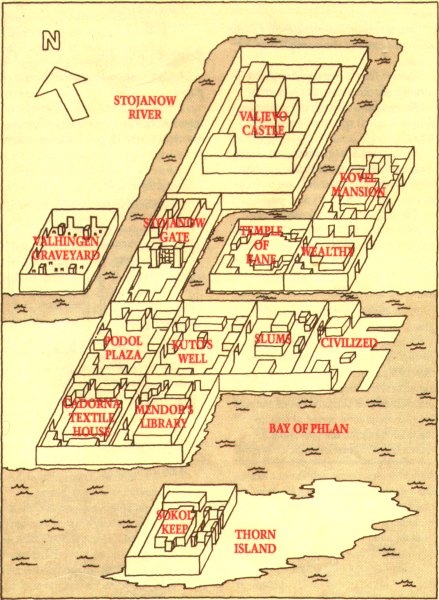
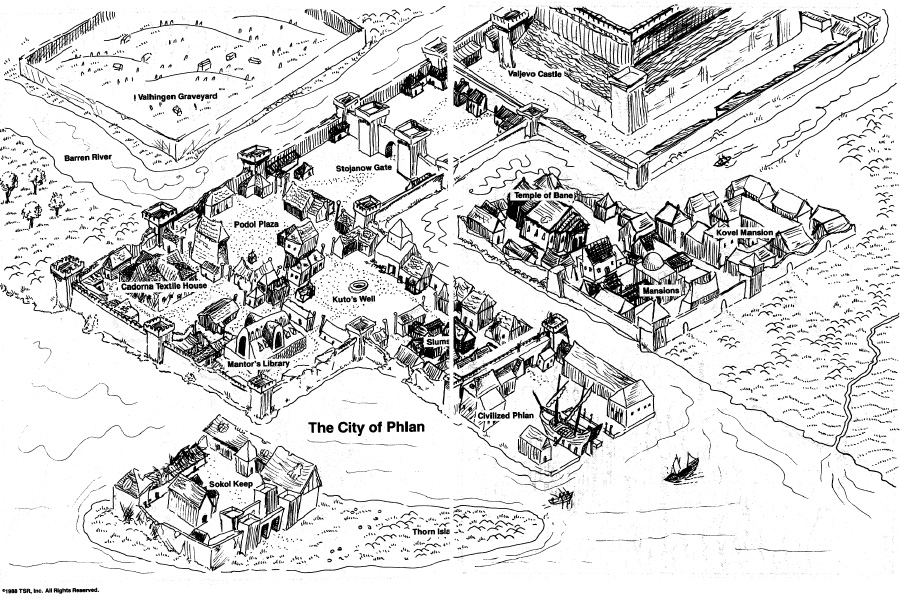
An interesting bit is that SSI and TSR provided similar overview maps of the city, but the one in Ruins of Adventure is much nicer looking.

RoA-Phlan

When not dealing with the really bare-bones sections, there are some planned encounters. One area has the party deal with a bunch of orcs and goblins that have some fairly effective tactics outlined for them. Actually, that’s something of a repeating theme, there’s several places where the monsters have set up shop intelligently, and the players could easily have a rough time of it. Most of the areas feel very random in layout, and the descriptions don’t help, but there are a couple areas that got more attention. The absolute worst section is Valhingen Graveyard, where the map doesn’t even match the descriptions (large structures that don’t appear on the map).

The big bad and final confrontations are about halfway through the module. After that, there’s several short chapters dealing with things in the wilderness outside of Phlan. One of these is tied directly into the overall plot, and one other is tied directly to the main goal of restoring Phlan. The rest… are things the party may or may not stumble across, depending on if they get an itch to explore. They do help populate the region, and if this is run as more than just a ‘clear the city’ adventure, will help out. However, they do tend to be very combat heavy (fighting hundreds of monsters is a recurring theme here), with no negotiating options, though there is one that can be peaceful if the characters were smart in an earlier bit.

As a whole, there’s some really good ideas in this module… but they don’t get past the idea stage. In fact, the module feels like it needed a lot more room to be fleshed out in, and would have made a decent 128+ page supermodule, but is instead a poor 96-page one. Most of the sections have pretty concrete ideas of what’s there, and what the characters will be facing, but nowhere does the module say how many characters and what levels are expected (it is in fact unhelpfully hand-waved away in the text). The overall plot gets a good description, but there’s only occasional concrete hooks to it in the main part of the module. But, for a DM who wants to do a the additional work, the skeleton of a good campaign is here.

└ Tags: D&D, Forgotten Realms, gaming, reading, review, rpg
 Comment 
  • Page 82 of 96
  • « First
  • «
  • 80
  • 81
  • 82
  • 83
  • 84
  • »
  • Last »

©2005-2026 Rindis.com | Powered by WordPress with ComicPress | Hosted on Rindis Hobby Den | Subscribe: RSS | Back to Top ↑