Rindis.com

All my hobbies, all the time
  • Home
  • My Blog
  • Games
  • History

Categories

  • Books (503)
  • Comics (10)
  • Gaming (917)
    • Boardgaming (673)
      • ASL (154)
      • CC:Ancients (83)
      • F&E (78)
        • BvR – The Wind (26)
        • Four Vassal War (9)
        • Konya wa Hurricane (17)
        • Second Wind (5)
      • SFB (78)
    • Computer games (162)
      • MMO (77)
    • Design and Effect (6)
    • RPGs (66)
      • D&D (25)
        • O2 Blade of Vengeance (3)
      • GURPS (32)
  • History (10)
  • Life (82)
    • Conventions (9)
  • News (29)
  • Technology (6)
  • Video (49)
    • Anime (47)
  • Writing (1)

Patreon

Support Rindis.com on Patreon!
Become a patron at Patreon!

Other blogs:

RSS Inside GMT

  • Foxes and Lions (Part 3): Military Matters, Captains, and Condottieri June 12, 2026

RSS Playing at the World

  • Playing at the World 2E V2 Arrives May 5, 2025

RSS Dyson’s Dodecahedron

  • Barrow of the Great Mothers June 16, 2026

RSS Quest for Fun!

  • The Expense Post May 24, 2026

RSS Bruce Heard and New Stories

  • Pain, Exhaustion, and Morale in D&D BECMI June 7, 2026

RSS Chicago Wargamer

  • The 2 Half-Squads - Episode 310: Cruising Through Crucible of Steel January 27, 2023

RSS CRRPG Addict

  • Yendorian Tales: Here There Be Dragons June 15, 2026
SF&F blogs:

RSS Fantasy Cafe

  • The Leaning Pile of Books May 24, 2026

RSS Lynn’s Book Blog

  • Booking Ahead/Weekly Wrap Up June 14, 2026
ASL blogs:

RSS Sitrep

  • Cardinal ASL Sins March 18, 2026

RSS Hong Kong Wargamer

  • FT114 Yellow Extract After Action Report (AAR) Advanced Squad Leader scenario April 16, 2025

RSS Hex and Violence

  • This still exists? March 25, 2025

RSS Grumble Jones

  • YouTube AAR for Critical Hit's Gettysburg Turning Point 1863 - ID4 At Will Fire June 16, 2026

RSS Desperation Morale

  • How to Learn ASL March 16, 2025

RSS Banzai!!

  • October North Texas Gameday October 21, 2019

RSS A Room Without a LOS

  • [Crossing the Moro CG] T=0902 -- Rough start July 18, 2015
GURPS blogs:

RSS Dungeon Fantastic

  • Rules & Rulings from Session 224 June 16, 2026

RSS Gaming Ballistic

  • B-Scale: Damage That Scales from Tardigrades to Kaiju June 5, 2026

RSS Ravens N’ Pennies

RSS Let’s GURPS

  • Review: GURPS Realm Management March 29, 2021

RSS No School Grognard

  • It came from the GURPS forums: Low-Tech armor and fire damage January 29, 2018

RSS The Collaborative Gamer

  • Thoughts on a Town Adventures System January 18, 2022

RSS Don’t Forget Your Boots

  • GURPS Supers Newport Academy #6: “Old Friends, New Again” June 7, 2026

RSS Orbs and Balrogs

  • Bretwalda - Daggers of Oxenaforda pt.4 - Fallen King May 27, 2017

The Secret of Platform 13

by Rindis on November 15, 2025 at 12:00 pm
Posted In: Books

This is identified as one of the influences on Harry Potter, and it’s easy to see parallels with the start of that series.

That said, the influence is less about Platform 9 3/4, and more for the initial characters.

We have the nice people (the royal family of The Island—the hidden fantasy land of the book), the absolutely horrible, entitled people (the Trottles), and the eclectic mix of the rescuers.

The main part of the book is a caper. The prince of The Island was kidnapped shortly after he was born, and now, nine years later, the Island and modern England are in contact again for nine days and it’s time to get him back.

Plot-wise, and caper-wise, the book is a lot of fun and well done. Generally, I recommend it.

However, a bigger question comes up when the team sent to get the now nine year-old prince find that having been taken by a desperate, entitled, and rich Mrs. Trottle, he is growing up into a perfectly horrible boy. And there’s the nephew of his nanny, a very nice and polite boy of the same age, picked on by everyone in the estate except his aunt. Unfortunately, instead of wrestling with the problem of the horrible person with the right inheritance and the great person who isn’t, the book takes the predictable easy way out. That let a lot of the air out of an otherwise fun kids book.

└ Tags: books, contemporary fantasy, reading, review
 Comment 

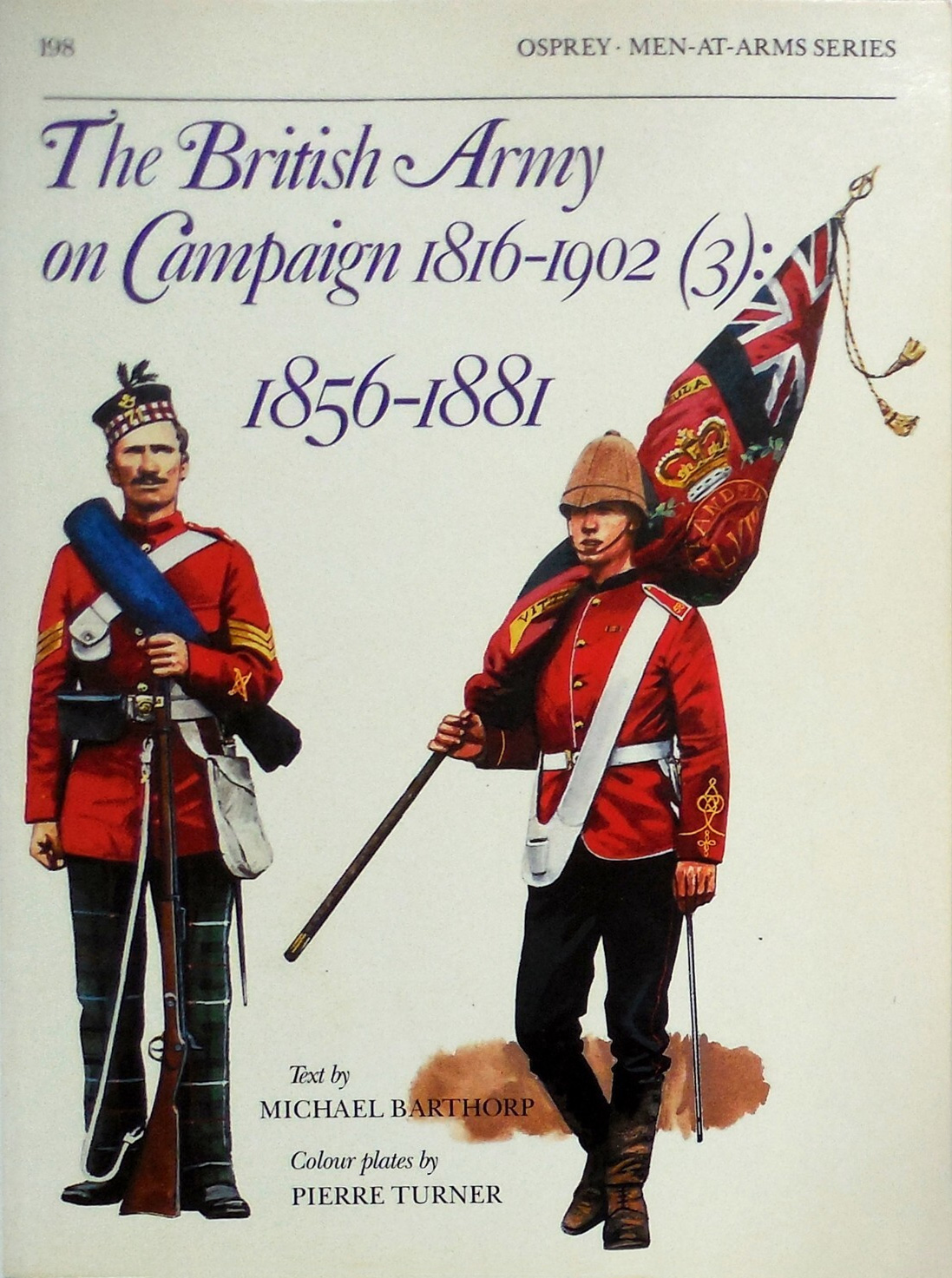
The British Army on Campaign (3): 1856-1881

by Rindis on November 7, 2025 at 12:00 pm
Posted In: Books

In 1988, Osprey did a four-part series on the Nineteenth Century British Army by Michael Barthorp. I’ve only read part three, but I can say that it does stand well on its own.

This volume covers from after the Crimean War through the First Boer War. The main famous incident during this is the Indian Mutiny, but there’s a nice chronology of everything else that Britain got involved in for a decade-and-a-half.

On the art end, this book is severely lacking. Surprisingly for a book done well after Angus McBride had transformed the MMA color pieces to being much more dynamic, this one is all static fashion plates. No interaction, no background, except for perfunctory splots of color behind the figure’s knees(!). Worse, the color/tone balance seems off, making it all muddy. Thankfully, the B/W reproduction is as good as usual, and there’s the usual large number of photographs and art reproductions.

The first main section goes into general tactics, including the speed at which troops were expected to maneuver. This could have done with some more technical bits thrown in, and some diagrams, but it is a good introduction, and follows up the introduction thesis of the British army being mostly involved in low-intensity warfare while becoming better equipped for a European war well.

There is a good section on the standard equipment of the time, and how that changed in this period. It’s a bit brief, there is also a good diagram of the Enfield, the ‘short’ version, the common bayonet, and the conversion for Snider. But, the real reason this is short is there is a much longer section on all the modifications to official equipment that happened in the field. Barthorp goes through all the major campaigns describing variations in dress and equipment for them all, giving general sources (which are text descriptions in journals and reports, often as not).

Overall, it’s a good guide. By this point, Men-At-Arms books were evolving to a more general military hobbyist audience than miniatures gamers, so this is a bit of a throwback, especially art-wise. But it does provide details of interest, and a good chronology. There’s also a good amount of cross-referencing to other other MAA titles, generally to the earlier books in Barthorp’s series (naturally), and to the Crimean War title.

└ Tags: books, history, Men-at-Arms, Osprey, reading, review
 Comment 

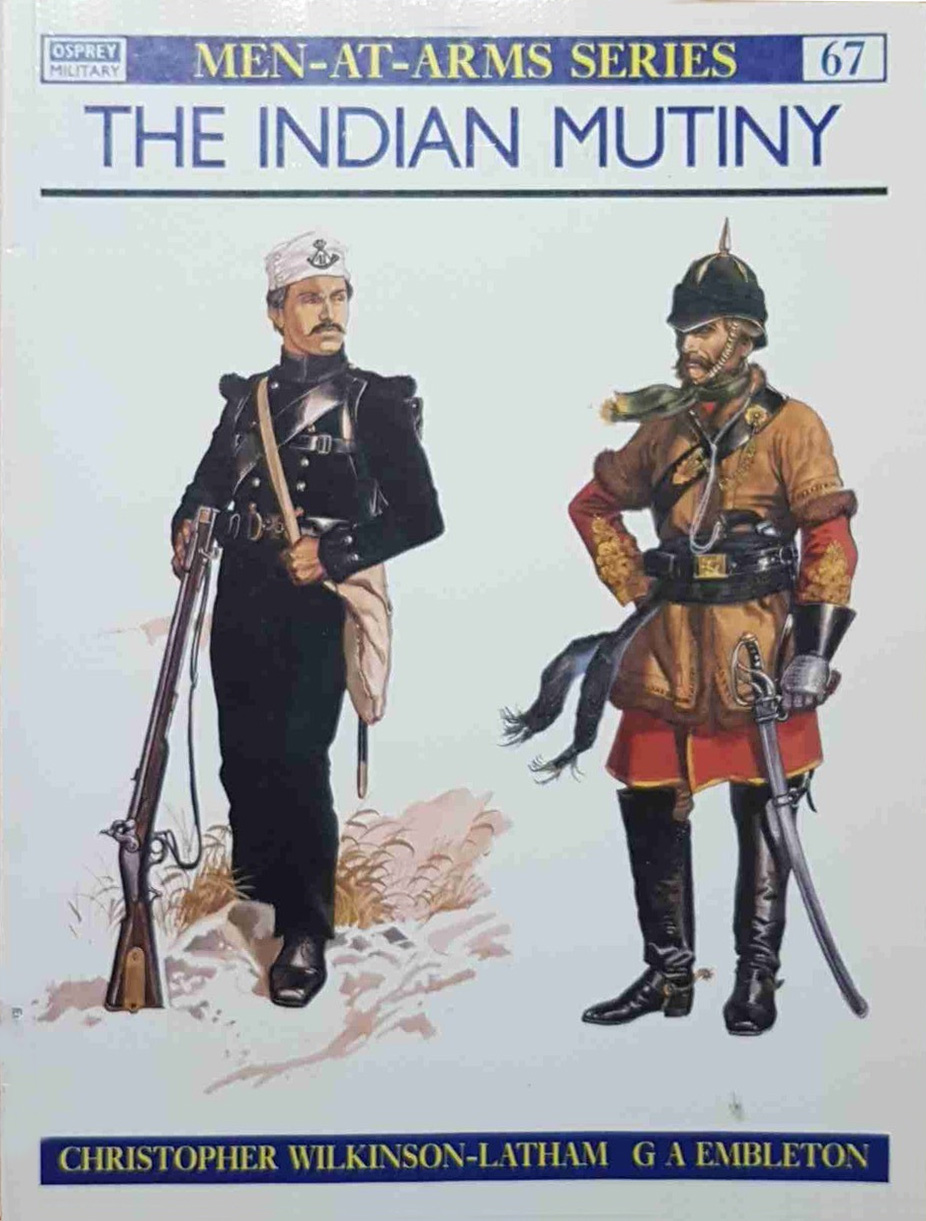
The Indian Mutiny

by Rindis on November 3, 2025 at 12:00 pm
Posted In: Books

This is an older Osprey Men at Arms book, and has a few characteristics related to a 1977 release.

First, it is something of a light guide to the history of the Mutiny. This would be better in an Essential History (which they did in 2002), but at this stage many MAA books were light histories, instead of being more specialized on the troops.

The color plates are early Gary Embleton, in the older ‘fashion plate’ style with just some hints of background. For what they are, they’re fairly good, and the usual good description giving all the details of equipment types, sources, etc., and there’s a small box giving the facing (detail) colors for all the native regiments. There are seventeen black-and-white photographs reproduced, some of prominent people, but mostly showing troops in actual dress, and a couple of locations. There’s a good amount of period art reproduced in B/W as well, which is also handy, and all of it shows fairly well for 1970s reproductions. There are also maps of Delhi, Cawnpore, and Lucknow.

The main text is pretty much “the Indian Mutiny in four sieges”. The introductory section goes into the rising tensions of the mid-1850s, but avoids any easy answers as to the actual cause of the Mutiny. Then we get a section on Meerut, where the crisis begins, and the mutinying troops move to Delhi, which is naturally the second section. This is the biggest section, and then there’s sections for Lucknow and Cawnpore, the latter of which gets a couple paragraphs to wrap things up.

Overall, it is by no means a bad history, especially for the page count. Neither is it truly a good nor sufficient one. It is almost entirely looking at the British side, and does not get into any of the weeds of causes, blame, or even what the Mutiny hoped to do. It covers the central actions well enough, which for an early MAA title is to be expected. But much more is needed. On the arms and equipment side, I would expect that Men-At-Arms 268, The British Troops in the Indian Mutiny 1857-59, would be a superior replacement.

└ Tags: books, history, Men-at-Arms, Osprey, reading, review
 Comment 

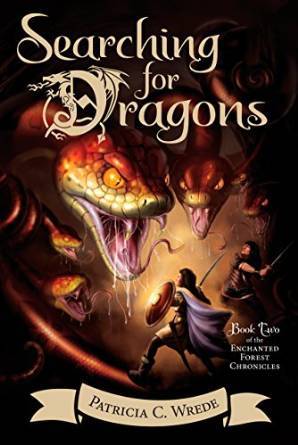
Searching for Dragons

by Rindis on October 26, 2025 at 12:00 pm
Posted In: Books

The introduction to this book is interesting, as we find there is something of a path to this second book that leads through another book on to another. Essentially, Wrede wrote a sequel, then wrote a book in between (this one), and was told by her editor that she needed to write one between this and the original sequel.

The novel itself manages to keep a lot of the same tone as the first book, but has a different feel because we have a different main character. Cimorene was (is) a no-nonsense princess in a world of fairy-tale tropes, so her arc is very much rebellion against social authority, and something of an Andre Norton-like finding (or more making) a place where you fit in properly. Mendanbar has a place—he is King of the Enchanted Forest—though he does have problems with fitting in with his expected role. And, sympathetically enough, wants nothing to do with the silly princesses that populate most fairy tales.

Really though, my biggest complaint about him is that name. “Mendanbar” does not roll off my tongue, and more trips down the stairs.

Despite his problems, Mendanbar is also nearly unconsciously competent, and starts causing problems for the villains without realizing it. Since it’s somewhat obvious something is afoot, this does make him come off as a bit of a dunce, and he fails to ask important questions early on, but he does catch up to the plot, and is properly genre-savvy.

Of course, when a king who doesn’t like your typical fairy-tale princess, and a princess who doesn’t like your typical fairy-tale prince meet, its obvious where things are going to go, and there are no surprises here. Thankfully, we don’t get books upon books of romantic melodrama either, and the relationship is well done.

The main plot is back to the Society of Wizards causing problems. And the characters get to loop around trying to find out what and where things are happening, which does drag out for me, despite how entertaining the characters are. (My favorite part is where everyone, even the most unlikely characters, are trying to get themselves into the final mission to put things right.)

Overall, it was enjoyable for many of the same reasons as Dealing With Dragons, but I did like that one better. Generally, I liked Cimorene better, and find Mendanbar a bit of a grump in comparison (and then there’s his name). And there is a relative lack of dragons, though a number of good secondary characters are introduced.

└ Tags: books, fantasy, reading, review
 Comment 

The Homicidal Earl

by Rindis on October 18, 2025 at 4:00 pm
Posted In: Books

James Brudenell, 7th Earl of Cardigan’s, name is best remembered with the cardigan sweater.

The person will forever be known as the man who led the Charge of the Light Brigade.

At the time, he was already well known, as he had been involved in a number of scandals and political fights in the public arena, and a few duels got him the nickname of “the homicidal earl”. History has not been too kind to him, and Saul David’s book is looking to correct this, and has important things to say.

But, at the same time, I think he’s much to fast to let some problems go. The start of Cardigan’s career was spent as colonel of the 15th Hussars (after buying several promotions), and is there that the problems start. Trying to have a unit in a high state of drill in the quickest manner possible, the unit was put through a grueling schedule which wore out the horses and ended with a court martial of one of his captains, and was so disastrous that Brudenell (not yet an Earl) was removed from command, and his name gained a negative notoriety.

Two years later, his dismissal was reversed, and he was put in command of the 11th Light Hussars. At the time he took charge, they were just being rotated home after duty in India. Cardigan was not exactly swift in going out to take command, finally arriving shortly before the transfer to Britain. This time, there were a series of public disputes with various officers. The end result was a well-trained regiment, which David obliquely points up. However, a better leader would have managed this without a continual parade of arrests and disputes and court martials of his own officers, and Cardigan bears all the blame for making sure this would happen. When he first took command, he made clear he thought little of “Indian officers” (which are British officers who served in India; I do not care to think of what he’d have to say about actual native officers).

The general motive behind this is that commissions to units serving outside of Britain were cheaper, and therefore anyone holding such was a social inferior. Since the other officers were gentlemen who were unused to being snubbed. It also supported an instant break in the officers between antagonistic pro- and con-Cardigan camps. Any leader worth having does not do this.

In comparison, his record in the Crimea War is actually quite reasonable. Well, other than his constant fighting with his superior officer, Lord Lucan, a brother-in-law who he detested. Given past history, the two could have done much worse, and the orders that led to the famous Charge were more than incoherent enough to lead to disaster if passed between people who liked each other. That said, he had opportunity and initiative enough to find a better course than charging down the valley at what he supposed the objective must be. Worse, once there, he seems to have expected that’s where his part ended, and did nothing to bring order out of the chaos that inevitably resulted as the Light Brigade got past the Russian guns.

David does point out some good correctives. Cardigan has often been seen as a dunce, and it’s fairly evident he was smart enough, but did not have the upbringing to curb an excitable temper, nor to consider anyone’s needs or views other than purely his own. He, and much of the upper command levels of the British force in Crimea, had little cause for being responsible for so many with so little understanding of anything beyond prestige.

My copy of the ebook (which seems to have been superseded) has plenty of minor problems. Words broken in the middle (formerly broken between lines, no doubt), occasional mistaken characters (‘l’ for ‘1’, etc). This follows the common pattern of getting slowly more common until about 3/4 of the way through the book, and then clearing up again for the end. But there’s no big problems, and no formatting goofs, so it’s still a very readable, if not entirely cleaned up text. The current version (with the same cover) may be better.

└ Tags: books, history, reading, review
 Comment 
  • Page 7 of 96
  • « First
  • «
  • 5
  • 6
  • 7
  • 8
  • 9
  • »
  • Last »

©2005-2026 Rindis.com | Powered by WordPress with ComicPress | Hosted on Rindis Hobby Den | Subscribe: RSS | Back to Top ↑