

The British Army on Campaign (3): 1856-1881
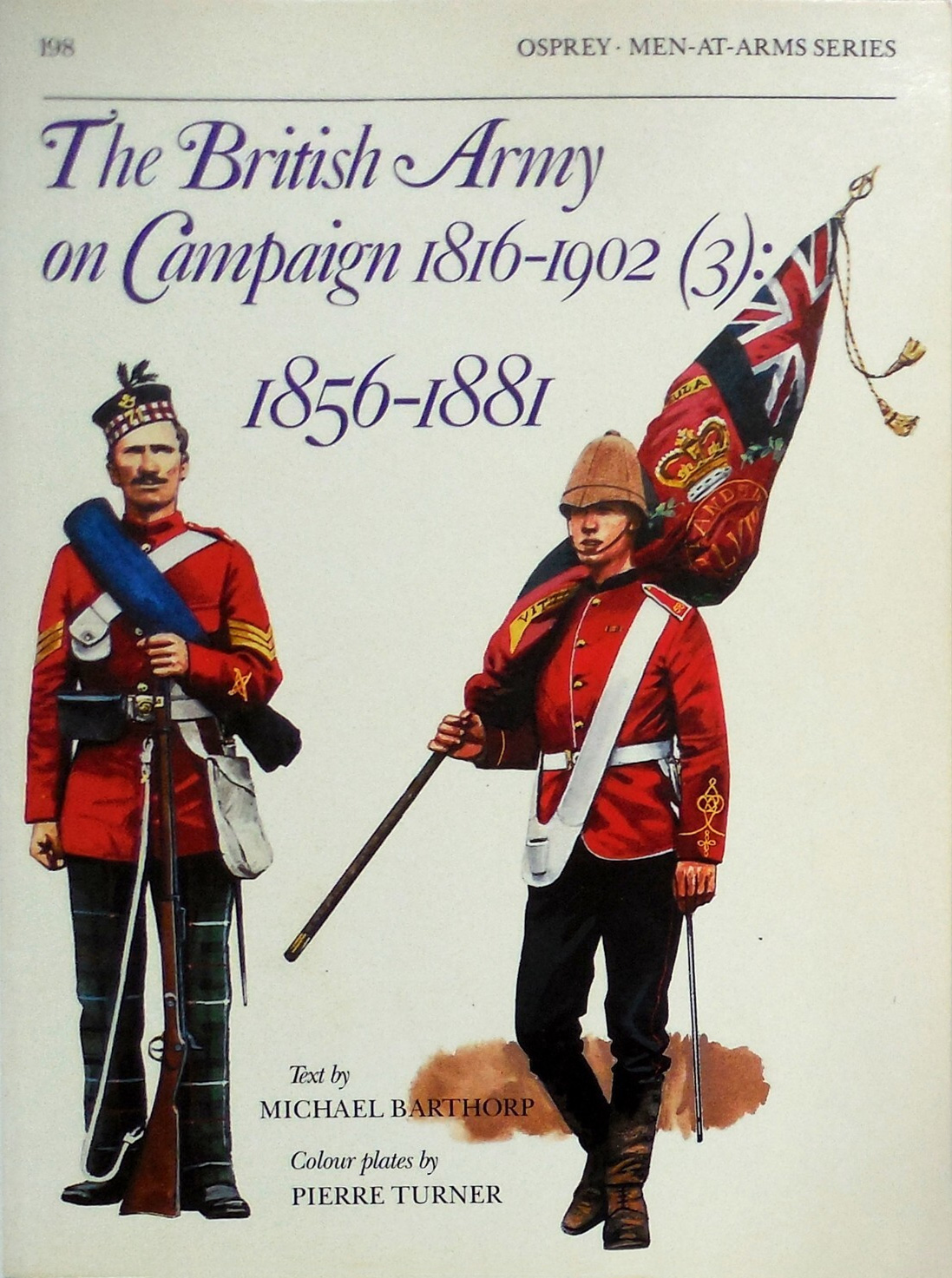 In 1988, Osprey did a four-part series on the Nineteenth Century British Army by Michael Barthorp. I’ve only read part three, but I can say that it does stand well on its own.
This volume covers from after the Crimean War through the First Boer War. The main famous incident during this is the Indian Mutiny, but there’s a nice chronology of everything else that Britain got involved in for a decade-and-a-half.
On the art end, this book is severely lacking. Surprisingly for a book done well after Angus McBride had transformed the MMA color pieces to being much more dynamic, this one is all static fashion plates. No interaction, no background, except for perfunctory splots of color behind the figure’s knees(!). Worse, the color/tone balance seems off, making it all muddy. Thankfully, the B/W reproduction is as good as usual, and there’s the usual large number of photographs and art reproductions.
The first main section goes into general tactics, including the speed at which troops were expected to maneuver. This could have done with some more technical bits thrown in, and some diagrams, but it is a good introduction, and follows up the introduction thesis of the British army being mostly involved in low-intensity warfare while becoming better equipped for a European war well.
There is a good section on the standard equipment of the time, and how that changed in this period. It’s a bit brief, there is also a good diagram of the Enfield, the ‘short’ version, the common bayonet, and the conversion for Snider. But, the real reason this is short is there is a much longer section on all the modifications to official equipment that happened in the field. Barthorp goes through all the major campaigns describing variations in dress and equipment for them all, giving general sources (which are text descriptions in journals and reports, often as not).
Overall, it’s a good guide. By this point, Men-At-Arms books were evolving to a more general military hobbyist audience than miniatures gamers, so this is a bit of a throwback, especially art-wise. But it does provide details of interest, and a good chronology. There’s also a good amount of cross-referencing to other other MAA titles, generally to the earlier books in Barthorp’s series (naturally), and to the Crimean War title.
Discussion ¬