
Rindis.com

All my hobbies, all the time
  • Home
  • My Blog
  • Games
  • History

Categories

  • Books (503)
  • Comics (10)
  • Gaming (917)
    • Boardgaming (673)
      • ASL (154)
      • CC:Ancients (83)
      • F&E (78)
        • BvR – The Wind (26)
        • Four Vassal War (9)
        • Konya wa Hurricane (17)
        • Second Wind (5)
      • SFB (78)
    • Computer games (162)
      • MMO (77)
    • Design and Effect (6)
    • RPGs (66)
      • D&D (25)
        • O2 Blade of Vengeance (3)
      • GURPS (32)
  • History (10)
  • Life (82)
    • Conventions (9)
  • News (29)
  • Technology (6)
  • Video (49)
    • Anime (47)
  • Writing (1)

Patreon

Support Rindis.com on Patreon!
Become a patron at Patreon!

Other blogs:

RSS Inside GMT

  • Foxes and Lions (Part 3): Military Matters, Captains, and Condottieri June 12, 2026

RSS Playing at the World

  • Playing at the World 2E V2 Arrives May 5, 2025

RSS Dyson’s Dodecahedron

  • Hollowshore Cairn June 17, 2026

RSS Quest for Fun!

  • The Expense Post May 24, 2026

RSS Bruce Heard and New Stories

  • Pain, Exhaustion, and Morale in D&D BECMI June 7, 2026

RSS Chicago Wargamer

  • The 2 Half-Squads - Episode 310: Cruising Through Crucible of Steel January 27, 2023

RSS CRRPG Addict

  • Yendorian Tales: Here There Be Dragons June 15, 2026
SF&F blogs:

RSS Fantasy Cafe

  • The Leaning Pile of Books May 24, 2026

RSS Lynn’s Book Blog

  • Summer of Horror: Can’t Wait Wednesday: Sleepers in the Snow by Joanne Harris June 17, 2026
ASL blogs:

RSS Sitrep

  • Cardinal ASL Sins March 18, 2026

RSS Hong Kong Wargamer

  • FT114 Yellow Extract After Action Report (AAR) Advanced Squad Leader scenario April 16, 2025

RSS Hex and Violence

  • This still exists? March 25, 2025

RSS Grumble Jones

  • YouTube AAR for Critical Hit's Gettysburg Turning Point 1863 - ID4 At Will Fire June 16, 2026

RSS Desperation Morale

  • How to Learn ASL March 16, 2025

RSS Banzai!!

  • October North Texas Gameday October 21, 2019

RSS A Room Without a LOS

  • [Crossing the Moro CG] T=0902 -- Rough start July 18, 2015
GURPS blogs:

RSS Dungeon Fantastic

  • Rules & Rulings from Session 224 June 16, 2026

RSS Gaming Ballistic

  • B-Scale: Damage That Scales from Tardigrades to Kaiju June 5, 2026

RSS Ravens N’ Pennies

RSS Let’s GURPS

  • Review: GURPS Realm Management March 29, 2021

RSS No School Grognard

  • It came from the GURPS forums: Low-Tech armor and fire damage January 29, 2018

RSS The Collaborative Gamer

  • Thoughts on a Town Adventures System January 18, 2022

RSS Don’t Forget Your Boots

  • GURPS Supers Newport Academy #6: “Old Friends, New Again” June 7, 2026

RSS Orbs and Balrogs

  • Bretwalda - Daggers of Oxenaforda pt.4 - Fallen King May 27, 2017

Rome and Attila

by Rindis on January 17, 2025 at 12:00 pm
Posted In: Books

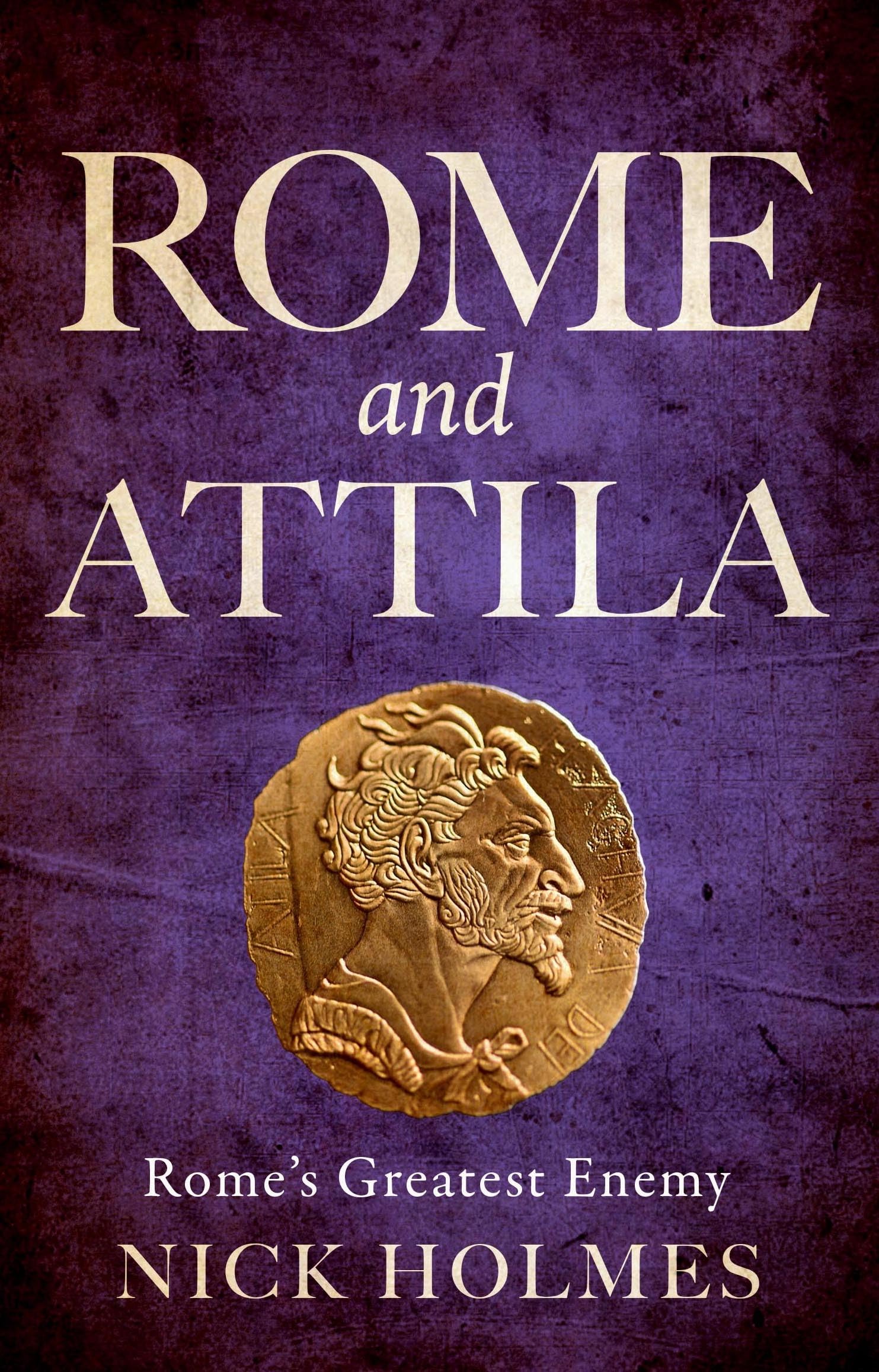
The third of Nick Holmes’ books on the end of the Roman Empire covers from the sacking of Rome in 410 through the death of Attila in 453, and then the end of Western Roman administration in 476.

The good news is that the transition between The Fall of Rome and this book isn’t as repetitious as between the first two, and I don’t know of any books essential to the period that he’s missed out on this time.

The bad news is the transition does still have a lot of copy-and-pasted material that someone reading straight through will want to skip, and there’s no roadsigns to it. But it’s not as extensive, and seems broken up a little by new or rewritten material.

I am gratified to see Ian Hughes’ books (most notably Patricians and Emperors) show up in the notes. I have some problems with his books, but they are invaluable reconstructions of what was going on politically in the western Empire in this period. For anyone wanting more on the climatic battle between (effectively) Western Europe and Atilla, I recommend Osprey Publishing’s Catalaunian Fields AD 451 (Campaign #286). This is a detailed look at the campaign, and might have informed this book some, but is at a lower level than the bulk of the narrative.

On the other hand, Holmes has definitely fallen in love with one of his sources, Priscus’ History of Byzantium; or at least those pieces that survive. The actual work is lost to us, but it extensively quoted in other places, and he presents a translation of parts of those quotes put together at the end of his book. I admit I haven’t really read that part, but I certainly commend him for its inclusion.

Holmes does have his own thoughts on the importance of Atilla, and the tribute the eastern Empire was paying during this period. Even better, he has some thoughts on a military recovery in this period. I’d have to see something a little more finely argued, and some counter arguments to come to a real opinion, but he does make an interesting case. Overall, its a good addition to the series, and while I still say don’t read it immediately after the previous book, it’s still a great starting place on this bit of history.

└ Tags: books, history, reading, review, Rome
 Comment 

Lady Knight

by Rindis on January 9, 2025 at 12:00 pm
Posted In: Books

Tamora Pierce finishes off her second YA female knight series in great fashion here. There’s been a lot built up during the previous three books, and there’s a lot here. You can read this independently, but I recommend against it.

Most importantly, Kel is finally through training, and not before time, as all-out war is coming to Tortall. A strong king has emerged in Scanra, so actions are moving from unorganized raiding to organized raiding, and the occasional battle when Tortall’s army can catch a real force.

Worse, is the creation of magical ‘killing machines’ by a wizard up there, this is the main continuing bit from the previous novel, and the focus is largely on this. However, first, we get a taste of real military command. Which is defending an under-provisioned outpost, waiting. Knowing the enemy may show up soon.

Of course, the enemy does show up, and we get plenty of action. This also leads back into the central plot, which has even more action. If there’s any problems with Song of the Lioness and Protector of the Small it’s that the central points of ‘knights in training’ precludes a lot of action sequences. You get certainly get some, and Pierce does them very well, but they’re generally just part of the climax of the novel instead of being part of a roller coaster ride. Well, she more than makes up for it in this one.

It’s a good concluding novel with payoff for all the training, and plenty of new complications thrown in. This delivers on all the promises of the rest of the series. While I liked Song of the Lioness, I like this series more.

└ Tags: books, fantasy, reading, review
 Comment 

The Fall of Rome

by Rindis on December 24, 2024 at 12:00 pm
Posted In: Books

Holmes’ second book covers from the recovery of the Roman Empire from the Crisis of the Third Century to the sacking of Rome in 410.

Well, mostly. While the second book in a series, it is meant to be a stand-alone read as well. This means there’s some lead-in summary introduction. This is generally fine, but a lot of it is copy-and-pasted from book one, which makes it rough going if you read one directly after another. I can’t blame him, but some sort of guidepost to where that stops would have been good in my case.

But the main action is tracing the events that brought Alaric to Rome, three times, and led him to sack it.

Along the way, we see various people come and go, decisions made, and the slow crumbling away of authority in the western Empire, until the government is in northern Italy (Ravenna), and unable/unwilling to do anything for Rome when Alaric threatens it.

Holmes also sees this as the ‘true’ end of the Western Empire, rather than the later ending of central authority there. He’s not alone in that assessment, and you could make a very good argument (he doesn’t, really) that it is the end of the west’s reputation, and that the next fifty years were government without respect. Personally, I go with the “official” end of government, but that is entirely a personal preference.

So, this is the tale of the years leading up to the fall of the Western Roman Empire, well-told at a high level, with attention paid to more modern works, especially dealing with climate change. I think he missed another opportunity here. He does reference Peter Heather’s The Fall of the Roman Empire, but I think Holmes would have been better served to pay attention to his Empires and Barbarians, which looks at the Germanic migrations through the lens of modern migration studies.

So, another readable, informative book. If you have an interest in the later Roman Empire, but are not already well-read on it, this is a great place to start. But… maybe don’t read this right after the first book.

└ Tags: books, history, reading, review, Rome
 Comment 

Return of the Thief

by Rindis on December 16, 2024 at 12:00 pm
Posted In: Books

The final book of the Queen’s Thief series features another change in viewpoint. This time, we get Pheris, who is new for this book, instead of a returning secondary character.

Pheris is physically deformed, and is the grandson of Baron Erondites, who we have seen before. Pheris is viewed with suspicion as a ‘monster’ by the superstitious, and his nurse has taught him to play this up so that is all that is thought of him, even though he’s actually quite clever and cunning. The inciting incident of the novel is his uncomfortable stable life coming to an end when he is sent to the court of the new high king, Eugenides.

The idea was to get the heir of Erondites away from the current baron. Pheris isn’t expected to inherit anything, but he is the older brother. Gen, as ever, doesn’t take long to see there is more here than anyone else has realized, and Pheris is given a chance to be more than his cramped little life has allowed him.

As he starts realizing his own potential, internal and external politics heat up, and we are treated to the war that has threatened for some time. This is the final book, and many arcs from the rest of the series come to rest here. It can be hard to bring a series of books that can all be read independently to a proper conclusion, but Turner does it here. There are more things that could be said, and I would dearly like to see more of this world, but that would be as a separate series, different in place and time. For here, we have a good ending to a great series. I recommend people start with the first book, but also be aware that the themes of the series largely start with the second one.

└ Tags: fantasy, reading, review
 Comment 

The Roman Revolution

by Rindis on December 4, 2024 at 12:00 pm
Posted In: Books

Nick Holmes is doing a very good job writing a clear beginning-level series on Roman history. This also has the advantage of being recent (2022), and so has access recent findings.

There is one short chapter two-thirds of the way through titled “Climate Change” which talks about what fairly recent research has to say about the Roman Climate Optimum from 200 BC to AD 150, and how it seems to have helped Rome’s rise, and how shifting climate trends after that added instability (he starts with a series of years where the Nile did not flood, or had a very weak flood in the 240s).

This was the highlight of the book for me, and if there’d been more chapters like it, I’d have been very happy with the book. However, it seems there are missed opportunities here. He talks about the Roman economy at times, and reference to The Roman Empire and the Indian Ocean could have helped develop some arguments. That book has problems, but talking about the evident closing of the Iberian silver mines after the Antonine Plague would be valuable for Holmes’ discussion of the Roman economy.

At the same time, Holmes is wanting to make a specific argument, and I just didn’t feel like he ever got to really arguing it. A better feel for what he considers ‘revolutionary’, as opposed to ‘evolutionary’ would have helped (he doesn’t use the latter term; part of his trouble is a lack of contrast against his thesis). The idea seems to be that the Crisis of the Third Century left Rome in a vulnerable place, and the way out (at least the one taken) was the ‘revolutionary’ measure of converting the Empire from Ancient paganism to Christianity. But there’s not enough there on what that meant either.

Which is part of the other weakness: A real look at where Roman thought and culture had gone during the life of the Empire. He does address part of it, trying to unravel the rise of Christianity. But, he doesn’t look at the other side. From other books (I don’t remember which ones), it’s been argued that paganism had hit a dead-end, with it becoming slowly clearer to the educated that the myths and mysteries associated with the old cults had no reality behind them. And there was nothing really to put in it’s philosophical place. Other than those odd monotheists that is.

So, it’s not really the reassessment of the Third Century Holmes says it is, but it is very readable, and does a good job presenting… too long of a period in a very readable format. To give background, Holmes goes back to the mythical founding of Rome and gives a quick view of how it got to a Mediterranean empire. But that is a lot of ground to cover, and so takes up a fair chunk of the book, no matter how abbreviated it is.

└ Tags: history, reading, review, Rome
 Comment 
  • Page 14 of 96
  • « First
  • «
  • 12
  • 13
  • 14
  • 15
  • 16
  • »
  • Last »

©2005-2026 Rindis.com | Powered by WordPress with ComicPress | Hosted on Rindis Hobby Den | Subscribe: RSS | Back to Top ↑