

UR1 Y163 Federation vs Empire Region 6
With several battles to fight for Y163 in the campaign, I picked region 6 first, a fleet battle with (by BPV) nearly even fleets. Terrain generation went to the Klingon choice of asteroids. One of my more recent additions to the rules was that a player who gets asteroids as their choice also gets to replace one entry of the subtable with a different entry, and they got their choice of a ‘light’ field (through a natural roll, not the replacement entry). Unlike last time, asteroid damage is on the normal table, but there’s not as many of them around.
Then the setup rolls put the two sides in 3-E and 4-E, as close to each other as possible (range 29 if they both set up aggressively, which they did), and only about three asteroid counters in the way. I should have checked weapon status before this point, but didn’t, and both sides’ rolls were low, for WS-0 for the Klingons, and WS-I for the Federation. So, both sides were at long range, and headed towards moderate ranges with unprepared ships. The Klingons were hurt since they couldn’t even arm phasers the first turn, but Star Fleet was on first turn of photon arming, and needed to find power for any overloads. (They probably should have backed off their set up to gain time for this.)
The Klingons, wanting to have phasers before contact went speeds 9/10 with heavy EW, while Star Fleet went 12/14. Both sides approached each other, with the two E4s turning off to become a flanking force. In the last quarter of turn 1, LOS opened up, and most of the Klingon fleet fired disruptors at CL USS Hokkaido (NCC-918), getting 7 hits on slightly good rolls, cracking the #6 shield. Two impulses later IKV Sworn (E4C-1) hit the range 15 bracket to get another hit, finishing off the armor and doing two forward hull hits.
The Klingons then turned off (following the E4s). Ordinarily, there would be concerns of showing the weak rear shields, but there was an asteroid cluster to take advantage of, and a high proportion of their ships were command types (3/7), which lack that problem. Star Fleet obliged by continuing straight, headed for a showdown right beyond that asteroid set (also concerned by the lack of torpedoes).
The Klingons slowed down even more for EW, phasers, and some overloads on turn 2. With phasers largely charged, Federation ships boosted EW, though speeds were mixed. As both sides cleared the asteroids, SC USS Cody (NCC-594) started loaning 4 points of OEW to both IKV Devilslayer (D7C-4) and IKV Gnasher (D6-23). Drones were launched on impulse 15, and on 18 the shooting began.
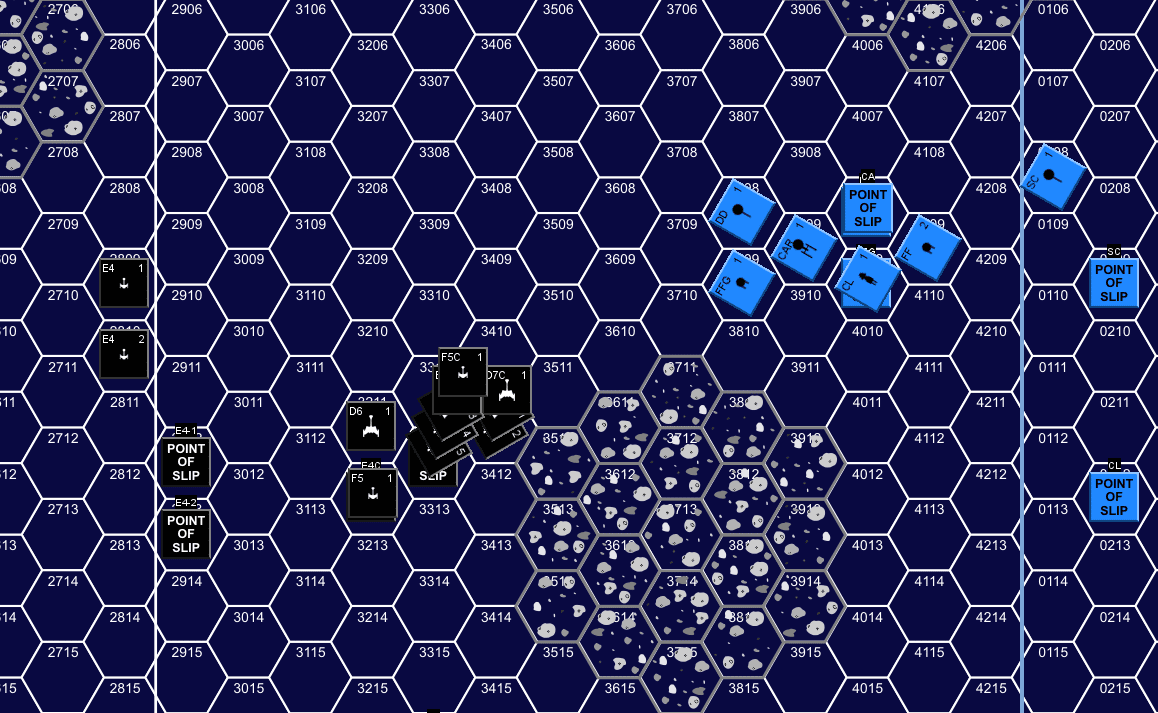
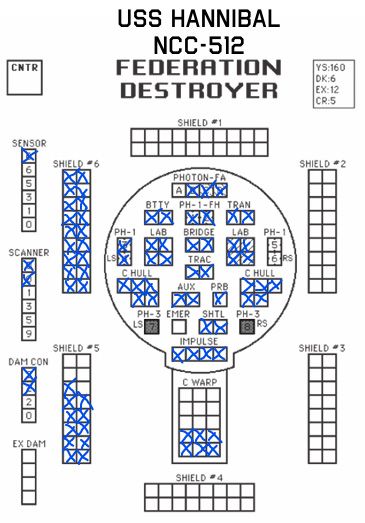 FFG USS Chadwick (NCC-350) boosted ECCM and took a full shot at D7C Devilslayer, hitting with one photon for fifteen total at range four. The next impulse, Devilslayer fired on DD USS Hannibal (NCC-512), hitting with one overload and two regular disruptors and decent phaser rolls for 11 internals, most of which was hull. Gnasher followed up the next impulse with one overload and one regular disruptor hit and good ph-2 rolls for another 21 internals, which easily finished off the hull, impulse and facing phasers.
Hannibal simultaneously fired on Gnasher, hitting with three photon torpedoes, and okay phaser rolls for 30 damage, doing 8 internals, getting the once only warp hits and two batteries. IKV Fire Leader (F5C-7) added in on Hannibal, hitting with both disruptors (one overloaded), and low phaser rolls (the two ph-1s were good, but three ph-2s did one point of damage total) for another 21 internals, getting two damage control hits, all control spaces other than the emergency bridge… and well, almost everything else on the ship.
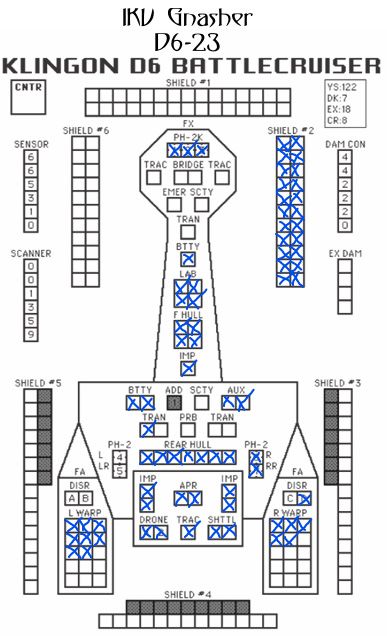 On impulse 22, Hannibal was finally able to turn her #6 shield away, and CAR USS Monitor (NCC-1713) fired on Gnasher, hitting with only two of four photon torpedoes, but one of those two was fully-overloaded, and decent phaser rolls added up to a further 40 internals to her, taking out about half warp power, and all impulse and APR. She had been preparing a suicide shuttle, and a re-examination of the rules showed that it counted as ‘armed’ even though it wasn’t done prepping, causing a chain reaction to take out the drone racks and do two extra damage.
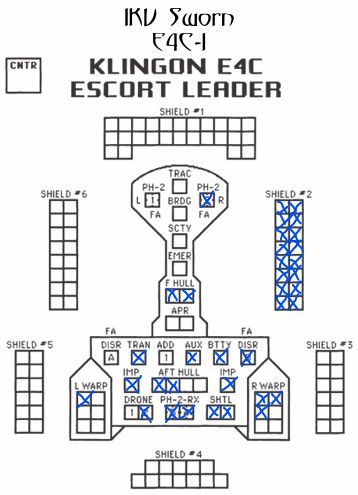
Both sides started turning off, and range between the main elements started creeping upwards again, even as the E4s turned in to intercept. IKV Sworn (E4C-1), lagging behind the rest of the main force, shot at FF USS Berg (NCC-359), on impulse 29, doing 13 damage to her #6 shield. Meanwhile she and Hokkaido fired on Sworn, hitting with one photon (sadly, Hokkaido had already turned off, so her torpedoes weren’t in arc) and slightly good phaser rolls for 36 damage, 20 of which went straight through the #2 shield as internals, taking out all weapons other than the #1 phaser and left-side disruptor.
 IKV Glorious (F5-11) got a range 6 shot on Berg on impulse 30, hitting with both disruptors to do 9 damage to the #5 shield. The two E4s were still further out than they wanted, and fired disruptors on impulse 32, getting three hits to do 11 damage to Hannibal‘s #5.
Turn 3 saw Star Fleet dealing with nearly no photon torpedoes loaded (they had been fired off last turn), and a wrecked DD to escort to disengagement. The good news was the closest enemy ships were the E4s, who had just fired disruptors. Only Fire Leader and Glorious were paralleling their current course, with everything else having turned off after being shot out, and shot up. Hannibal made her best speed of 16 with most other ships following suit, and the two frigates at 18 and 15.
The Klingons prepared their good ships for pursuit, mostly going 15 or 16, but Sworn could only do speed 9, and the E4s did 12 while rearming. With power going to disengagement by acceleration (if she could keep from taking more than two warp engine hits this turn), Hannibal had no EW up, but Cody lent 3 ECM to her. The two E4s had 2 ECCM, and used batteries for a third point and fired the forward phaser-2s on impulse 1, doing five damage to the #5 shield.
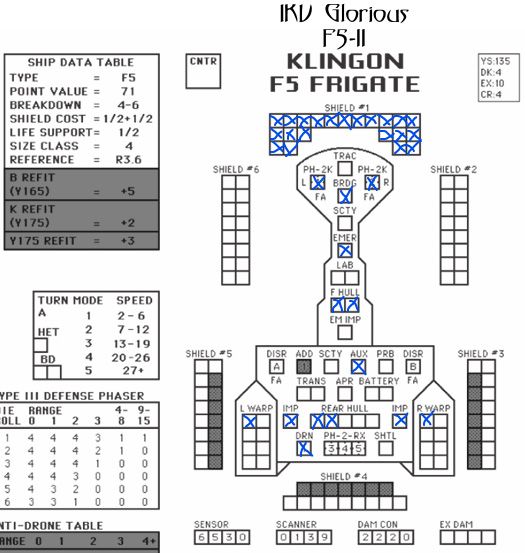 Fire Leader fired disruptors on impulse 2, hitting with both for six damage to Berg‘s #5 shield. On impulse 9, Devilslayer fired disruptors at Hokkaido for three hits, doing nine damage to the #5 (leaving one box).
That took care of all the easy shots, and the bulk of the turn involved maneuvering around the mass of asteroids, with Devilslayer and Fire Leader in pursuit, and the two E4s and Glorious coming around the other way. On impulse 28, the E4s had a range 6 shot on Hokkaido, but only hit with one disruptor, doing 3 damage to the #3 shield. On impulse 32, Hokkaido turned to bring her two photons to bear on Glorious, while Monitor and Chadwick also fired phasers at her. One photon hit, while the phasers had good rolls, for a total of thirty-seven damage, crashing through the #1 and doing fourteen internals, getting the once-only warp hits, the forward phasers and the drone rack.
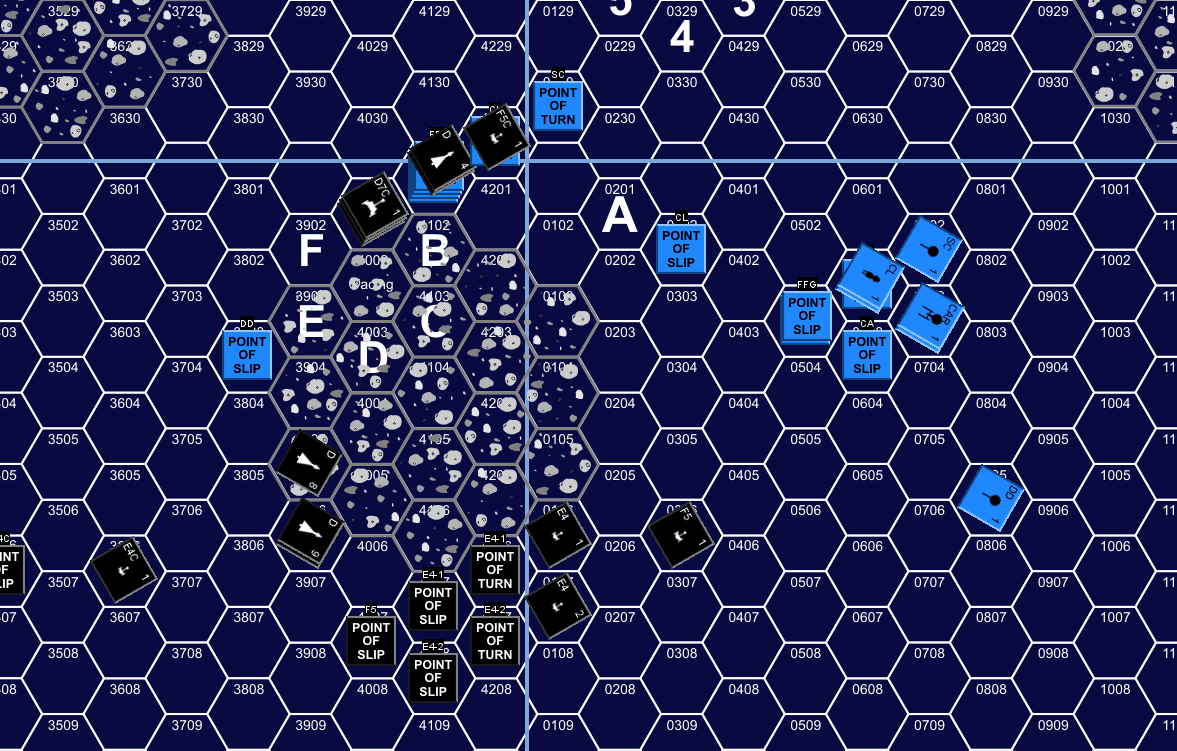
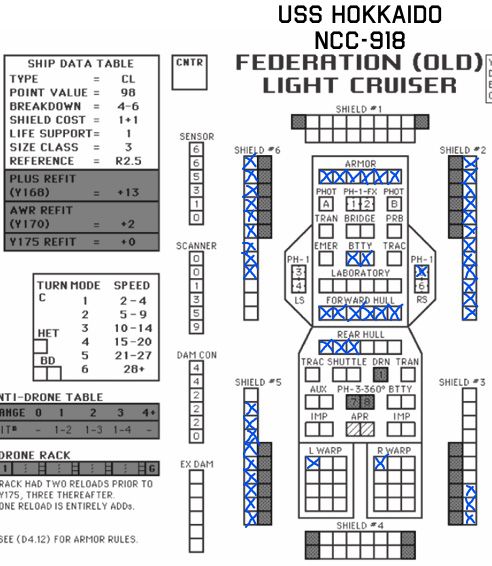 Hannibal made the jump to non-tactical warp at the end of turn 3, leaving the rest of the Star Fleet units free to do something other than escort her, but it was obvious that the situation had deteriorated to getting the rest of the ships out in good shape. For some reason, it didn’t really occur to me to just allocate everyone else to disengagement at this point. Of course, photons were coming back online, and there were a number of potential Klingon targets about. The real problem was there was no good way of pointing forward weapons at them short of shifting to very slow speeds and accepting another close-range pass that would see the Klingon fleet get in the first real shots and control the range.
Stuck between two different plans, Monitor was the ‘slow’ unit at speed 16, while Hokkaido went 24 to sprint towards the bottom boundary of the map, and the other three Star Fleet ships went 18. Meanwhile, Klingon ships were in two elements. Glorious was at range 3 with a downed #1, and went to tactical warp to conserve power and turn immediately, the E4s were at range 4, and went speed 6 to overload one disruptor and charge phasers. The rest maneuvered at whatever speeds they could manage while needing to balance EW with disruptor charging, ranging from 19 to 12.
Cody loaned ECM to Hokkaido and Berg, while Berg and Glorious boosted ECCM and took their shots. IKV Safeguard (E4-10) was just in Berg‘s FA arc, who hit with one photon torpedo to do eight damage to the #1 shield. Glorious hit Hokkaido with both disruptors (one overloaded), nearly knocking down the #2 shield.
On impulse 4, the E4s’ disruptors cycled, and they fired on Hokkaido at range 5, hitting with both overloads and one regular disruptor, plus a point of phaser damage (all with a +1 EW shift) to finish off the one box of the #2 and do 12 internals, getting the once-only warp hits and half the batteries.
The battle degenerated into a chase at this point, with Star Fleet largely drawing away from the Klingons. With nothing better presenting itself, Devilslayer took her shot on impulse 17, hitting with two disruptors and nine phaser damage with poor rolls to do 17 points to Monitor‘s #4 shield.
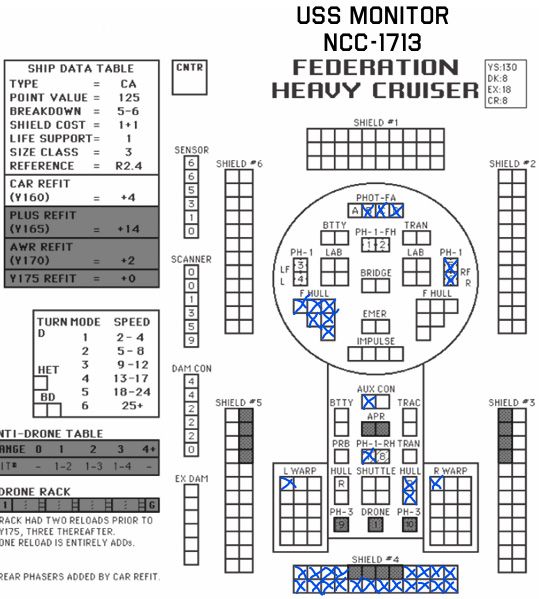 This was the last activity of turn 4, and now it really was time to disengage, and Monitor ejected her held photon torpedoes for extra speed (24) on turn 5. Other speeds stayed about the same, and the real problem was that Monitor was starting the turn with Devilslayer three hexes behind her, and there were only three boxes left on shield #4. So she put up 6 ECM, and Cody loaned her 6 more. Devilslayer had 2 ECCM and boosted that to 4 with batteries to get down to a “mere” +2 shift.
Devilslayer could only overload one disruptor at speed and with the EW. It and two standard disruptors missed, while phasers had good rolls for 15 damage, causing 12 internals. Monitor turned to get Fire Leader off the #4, which she managed to get back to anyway on impulse 7, hitting with one disruptor at range 8, plus two damage from the phaser-1s, doing another five internals. Sworn got a shot on impulse 15, but missed, with Gnasher doing the same on 16.
At that point most things were shot out, and there were only a few hexes to go for disengagement, so I called it at that point.
Klingon after-action review:
Given this was technically an even matchup, the battle ended in a clear victory despite the initial pummeling of Klingon ships. The bad news is that no Federation ships were destroyed outright, though three suffered enough damage to need yard time to fully repair. Separating out the two E4s as a flanking force, and keeping them together as a separate squadron worked well, and was the appropriate amount of force (putting the E4C with them probably would have been too much). The quick advance to closer combat ranges worked because Federation ships were still struggling to power everything on turn 2, leaving few overloads to deal with.
IKV Devilslayer – Took half of #2 shields in the initial shots, and turned off, keeping it from being a real target. However, while launching the one wave of drones I discovered a problem. Most Klingon ships of this era have type-F ‘jump’ racks, which get upgraded to regular A-racks with the -B refit. Older command ships (C6, F5C…) already have this, and then get six-space B-racks later (C8/9, F5Cy). The D7C starts with B-racks, but since I wasn’t looking at the SSD when I paid for the speed-12 upgrades, only 4 points (for 8 spaces) were paid. Right now, they’re operating with 1xI, 3xII, and 1xV drones per rack. I will need to increase their drone fund next year.
IKV Gnasher – Took most of the initial Federation battle pass, and after repairs, is out all Aft Hull, 2xForward Hull, all Batteries, Auxiliary Control, 1xTransporter, 1xTractor, all Labs, all APR, 4xImpulse, 4xeach Warp Engine, both Drone Racks, Disruptor D and Phaser #6. She turned off and started heading off-board before turning back to rejoin the chase, taking the final missed shot at USS Monitor. With this much permanent damage, she will need repairs before seeing battle again. However, she might be used as part of a minimal two-ship force that will immediately declare disengagement before battle next year. This would force her into Reserve for Y165, at which point she would get the -B refit. She is the the second ship to suffer internal explosions in two battles, and the Klingons really need to not use scatterpacks and suicide shuttles on ships with the jump racks.
IKV Glorious – Thankfully, she only took damage in the second round of Federation fire, and if both photons had hit, more important systems could have been taken out. (I did not notice until now that all the control boxes were taken out.) As it is, after repairs she is out Auxiliary Control, Emergency Bridge, 1xF Hull, 2xA Hull, 2xImpulse, 1xDrone. The same thoughts apply to her as to Gnasher.
IKV Sworn – The Module R8 SSD for the E4C has some problems. It has the standard early Klingon note about only firing one drone per turn on two racks, and that this was fixed with the -B refit. As a command ship, there is no -B refit. There’s also a UIM refit line (command ships usually have it automatically), and UIM lines in the disruptor table, but there’s no hit-and-run box. So, I have deleted the drone fire rate note, and added a (currently greyed out) H&R box to my SSD. Like the F5C, the E4C has the -B refit rear shields, and improved forward shields (somewhere between an F5 and F5C). That still wasn’t enough for the amount of firepower aimed at her, and after repairs is still out 1xeach Warp Engine, all Impulse, Drone Rack #2, Disruptor B, Phasers #3-4, both Shuttles, Transporter, and 2xAft Hull. She will almost certainly be in Reserve for repairs next year.

Star Fleet after-action review:
Given this should have been a fairly even fight, it is surprising that it turned into a rout. Certainly, the Klingons managed to focus fire on Hannibal better than Fleet elements did, leading to the near-destruction of that ship; the high-endurance center warp engine really paid off here. Past that, one major problem is that Cody just wasn’t able to supply enough EW support to make up for her lack of weapons. Powering two channels and loaning some EW is about all she could do; other scouts run into this problem, but they only have two channels, and usually other weapons for when needed. She certainly forced the Klingons to spend more power on EW (and less on overloads), but that was not the force multiplier hoped for.
USS Monitor – Her performance was fine during the entire battle, though sadly, she did not manage to disengage without taking permanent damage. Since that is restricted to 5xForward Hull, she’ll probably be in the lineup next year. (And perhaps repair in Y165 to become a CAR+.)
USS Hokkaido – This is the weak-point of the Federation lineup. The side shields are way too weak for this large of a unit in a fleet battle, making a CL too easy to damage. The initial disruptor volley was able to penetrate the #6 shield and take out the armor at range. A closing volley is de rigueur for disruptor fleets; usually this is at the smallest ship, hoping to knock it out of line, but much the same can be done to the CL here. After all repairs, she is out 6xArmor and 2xAft Hull. She could return next year, but the lack of armor would make her very vulnerable.
USS Hannibal – After repairs, it is still faster to say what is working. Namely, 2xImpulse, Photon B, and Phasers #1-3 were repaired (plus the undamaged systems you can see above). She will be spending next year in drydock for full repairs. (The delay a year trick for the Klingons would work for filling out a line, but no refit would be available.)
USS Chadwick – One point not brought up elsewhere is that while she has a drone fund, it was not used. Since there was only the one drone rack available, she was outfitted purely with ADDs, and used them to knock down the first few drones in the main turn 2 brawl. This was definitely the right choice, and will continue to be so until more drones are available in a fleet. USS Berg was shot at a few times, but nothing penetrated the shields; the Federation FF is an amazing ship for its size, and they helped carry the battle when Hannibal‘s firepower was taken out of the equation.
There is an interesting potential solution to the SC/CL problem. The Federation’s only other scout class right now is the LSC, a CL with scout channels in much the same pattern as the SC. This means that it only has 2xph-1s, but they are FX. There’s “only” six scout channels, but the extra power and bulk of a CL would allow it to use more of them. Also, it could sit back, and not put the vulnerable side shields out into the middle of enemy firepower. But this is an expensive solution. Building one outright is 124 EPV, and converting one is 60 (15 x the 4 EP F&E rate, by which scout conversions are generally expensive). And Star Fleet is hoping to build a CS+ for 141 EPV in Y165, plus start a new round of refits.
As it is, Star Fleet is looking at waiting until Y168 for the CL+ (which adds six boxes to each side shield) and Y171 for the SC+ (which adds four power).
Discussion ¬