Rindis.com

All my hobbies, all the time
  • Home
  • My Blog
  • Games
  • History

Categories

  • Books (503)
  • Comics (10)
  • Gaming (917)
    • Boardgaming (673)
      • ASL (154)
      • CC:Ancients (83)
      • F&E (78)
        • BvR – The Wind (26)
        • Four Vassal War (9)
        • Konya wa Hurricane (17)
        • Second Wind (5)
      • SFB (78)
    • Computer games (162)
      • MMO (77)
    • Design and Effect (6)
    • RPGs (66)
      • D&D (25)
        • O2 Blade of Vengeance (3)
      • GURPS (32)
  • History (10)
  • Life (82)
    • Conventions (9)
  • News (29)
  • Technology (6)
  • Video (49)
    • Anime (47)
  • Writing (1)

Patreon

Support Rindis.com on Patreon!
Become a patron at Patreon!

Other blogs:

RSS Inside GMT

  • Foxes and Lions (Part 3): Military Matters, Captains, and Condottieri June 12, 2026

RSS Playing at the World

  • Playing at the World 2E V2 Arrives May 5, 2025

RSS Dyson’s Dodecahedron

  • Hollowshore Cairn June 17, 2026

RSS Quest for Fun!

  • The Expense Post May 24, 2026

RSS Bruce Heard and New Stories

  • Pain, Exhaustion, and Morale in D&D BECMI June 7, 2026

RSS Chicago Wargamer

  • The 2 Half-Squads - Episode 310: Cruising Through Crucible of Steel January 27, 2023

RSS CRRPG Addict

  • Yendorian Tales: Here There Be Dragons June 15, 2026
SF&F blogs:

RSS Fantasy Cafe

  • The Leaning Pile of Books May 24, 2026

RSS Lynn’s Book Blog

  • Summer of Horror: Can’t Wait Wednesday: Sleepers in the Snow by Joanne Harris June 17, 2026
ASL blogs:

RSS Sitrep

  • Cardinal ASL Sins March 18, 2026

RSS Hong Kong Wargamer

  • FT114 Yellow Extract After Action Report (AAR) Advanced Squad Leader scenario April 16, 2025

RSS Hex and Violence

  • This still exists? March 25, 2025

RSS Grumble Jones

  • YouTube AAR for Critical Hit's Gettysburg Turning Point 1863 - ID4 At Will Fire June 16, 2026

RSS Desperation Morale

  • How to Learn ASL March 16, 2025

RSS Banzai!!

  • October North Texas Gameday October 21, 2019

RSS A Room Without a LOS

  • [Crossing the Moro CG] T=0902 -- Rough start July 18, 2015
GURPS blogs:

RSS Dungeon Fantastic

  • Rules & Rulings from Session 224 June 16, 2026

RSS Gaming Ballistic

  • B-Scale: Damage That Scales from Tardigrades to Kaiju June 5, 2026

RSS Ravens N’ Pennies

RSS Let’s GURPS

  • Review: GURPS Realm Management March 29, 2021

RSS No School Grognard

  • It came from the GURPS forums: Low-Tech armor and fire damage January 29, 2018

RSS The Collaborative Gamer

  • Thoughts on a Town Adventures System January 18, 2022

RSS Don’t Forget Your Boots

  • GURPS Supers Newport Academy #6: “Old Friends, New Again” June 7, 2026

RSS Orbs and Balrogs

  • Bretwalda - Daggers of Oxenaforda pt.4 - Fallen King May 27, 2017

The Barbarian Frontier

by Rindis on August 11, 2015 at 12:00 pm
Posted In: D&D

The fifth FR-series book not only returned to the geography of the Realms, but returned to presenting an area that had already gotten a boost from the rest of the line. It was also a return to “The North” of FR1’s Waterdeep and the North. The latter had given some information on the region, but without proper maps, it hadn’t been very useful. Finally, The Crystal Shard had been a hit early Forgotten Realms novel, making this region supplement highly anticipated. It has continued to be a popular region, seeing more Drizzt novels, the Neverwinter games, and further supplements such as Volo’s Guide to the North and the Sword Coast Adventurer’s Guide.

The Savage Frontier is typical of the series as 64-page book with a faux parchment pattern on the pages, a detached trifold cover, and two poster-sized maps. The maps are in the usual 30 miles/inch ‘small’ scale, and join up north of the ones in the original campaign set, covering from a bit south of Waterdeep to the Spine of the World mountains (a somewhat convenient straight east-west mountain chain that defines the northern boundary of livable land), with the main map reaching from The Great Desert in the east to the coast in the west. The coast runs further west near the north, forcing a second map for the last four inches of land, leaving most of that map to be left to ocean, with some fairly major islands scattered about. One quarter of the map is used for insets, including a northern extension to the bit of land in the corner of this map, showing Icewind Dale, as well as a couple location maps. The cover includes a repeat of the main Waterdeep map, and five other locations, making this the first FR book to not leave at least one panel empty.
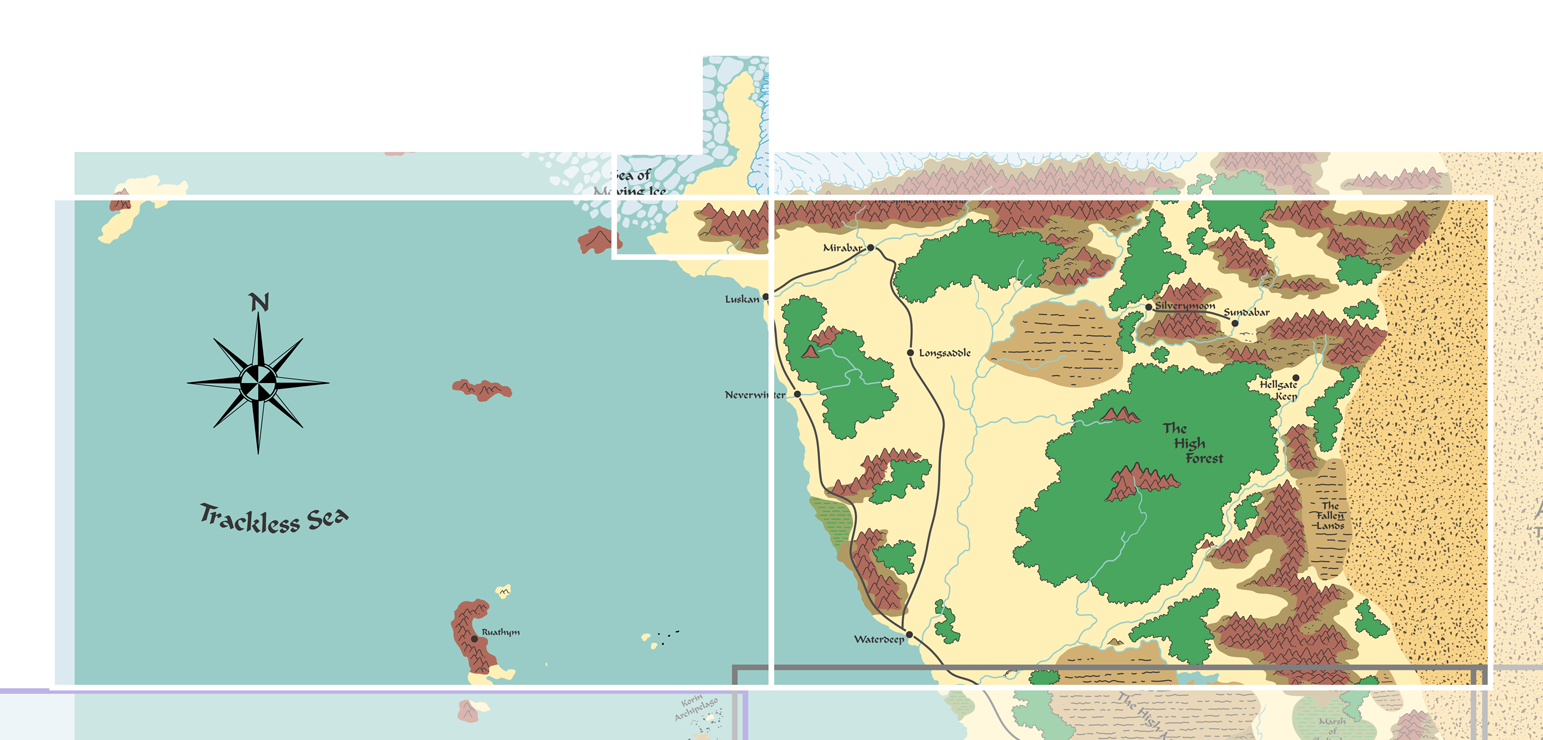

Region the FR5 maps cover, showing the overlap with the gray box and FR2’s detail maps.

The book is supposedly written by an in-universe character, Amelior Amanitas of Secomber, though this is generally limited to humorous little intros and outros to chapters, and does not affect the main text. (It is also worth noting that he is originally from DQ1 The Shattered Statue, also by Paul Jaquays, which does happen in Cormyr, despite getting no Forgotten Realms logos.) It starts with a two page history, goes on to an overview talking of trade, climate, major factions, and the various peoples of the region. There is then six chapters of geographical description, broken up somewhat oddly. The first one is just cities and towns and the like, and is in a smaller font as well as based off of the similar chapter from FR1 (I don’t think any description is exactly the one from that book, but they’re often about 80% the same). There’s a separate chapter for ‘lost lands, strongholds, & ruins’, each with their own subchapter, then one on pure geographical features (mountains, rivers, etc.), and then a chapter just on the High Forest, which is something of a central focus of the book. And, towards the beginning of all this, is a chapter on the islands, folding all of their towns and geographical features together. So part of the description of the area is broken up by type of feature, and part of it by region. It’s obvious enough to not interfere with looking things up, but it is a bit grating, and presumably partly caused by the reuse of material from FR1.

Overall, a fair amount of attention is given to barbarians in this book. I’m not sure if it was seen as TSR’s best chance at showing how the backgrounds for that character class should work, or what, but there’s a lot here. In the section on the various peoples of the North, the Uthgardt barbarians get five pages, going into detail about various tribes, the broad outlines of society, special shaman powers, and the like. Also, the Northmen (more of the Norse-analogues from FR2, who can be barbarians) get two pages, while everything else (aarakocra, dwarves, orcs, trolls, etc… aaand the barbarians of Icewind Dale) gets two pages. And then there’s a three-page chapter on the ancestor mounds of the various Uthgardt tribes. Three of the location maps are actually of these, one showing ‘typical’ ones, one is an adventure one, and one is… atypical. What makes all this coverage work is that the barbarians are not all the same, and each has it’s own attitudes, from the extremely conservative, to tribes that are settling down and farming and becoming ‘civilized’, to one that is completely under the thumb of devils from Hellgate Keep.

The final chapter of the book is three pages outlining various prominent people, including, of course, the main trio from The Shattered Shard, and another refugee from a different Jaquays project, I12 The Egg of the Phoenix (which, no, is not a Forgotten Realms adventure, he’s been exiled here). And then there’s four appendices in the last four pages, with some new magic items (including a minor artifact), a new non-weapon proficiency, an expansion of one from the Wilderness Survival Guide (plant lore, including a handy table of medicinal plants of the region), a year’s worth of events and rumors (Year of Shadows/DR 1358, the year considered ‘just beginning’ in the original set), and six adventure ideas.

I consider this product one of the highlights of the the FR series, and certainly the best one to this point. Moonshae has mood without detail, Empires of the Sands lacks mood while providing detail. Waterdeep and the North suffers (just a bit) from the chapter on the North that is unusable thanks to the lack of maps. This is a well-rounded supplement that stands well on its own, and you could run games here without ever getting the main boxed set.
└ Tags: D&D, Forgotten Realms, gaming, reading, review, rpg
 Comment 

More Magic Than You Can Shake a Wand At

by Rindis on July 17, 2015 at 12:00 pm
Posted In: D&D

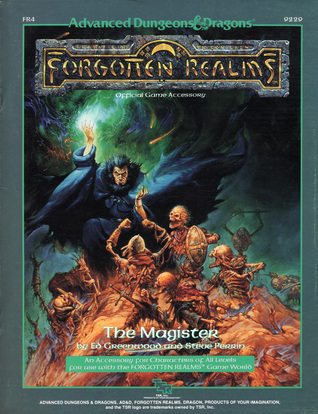
After three modules, it seemed that the FR series was a set of geographical supplements filling out the further reaches of the Forgotten Realms in more detail. FR4 turned it into a more general series than that, as The Magister had no geographical lore at all. It also marked the return of Ed Greenwood to the series, and the book focused on one of his main interests: magic books and items. Greenwood had been contributing articles to Dragon magazine for years, many of them dealing with items and lore from the Realms. The best of these were collected together for this volume, and all-new material added.

The all-item focus of the book meant that the cover was stapled to the interior, and the inside front cover includes a modified version of the random magic item treasure table, so these new items could be randomly rolled for. The last few pages of the book have much expanded rules for a character creating a new magic item, with a chart of (new) modifiers for the final success roll stipulated in the DMG on the inside back cover.

About half the book is descriptions of a dozen spellbooks known to be wandering the Realms, giving their appearance, known history, and the spells they contain, which generally includes two or three new ones. At the end of this section is a couple of pages that lists all the new spells from here and the DM’s Sourcebook of the Realms, with their spell levels, what book they’re in, and where to find the description. I like the spellbook descriptions, and the vast bulk of the spells are inventive and look good (though there’s some really complicated potential interactions on many), but I think there’s some missed opportunities here. Some of these new spells are ‘unique’; they’re only found in the described book. Others are known to have been copied down a few times, and might be found elsewhere. This isn’t in the table. Furthermore, I think it could have been neat to come up with a basic ‘common-uncommon-rare-unique’ scheme and not only define these spells as rare and unique, but define how widely known the bulk of the ‘normal’ spells from the Players Handbook and Unearthed Arcana are. Most low-level spells should be ‘common’, but defining a few as ‘uncommon’, and then mixing it up more at higher levels could have some very interesting effects on a campaign. It would have taken up quite a bit of space however.

Instead, the second half of the book is taken up with about fifty magic items, with especial attention to shields, cloaks, harps, wands and swords. Again, these are generally well done, and if you need any sort of inspiration for magic items, this is a very good book. There’s a lot of potential complex interactions detailed again, which says something about the mess of different uncategorized effects AD&D had, but this also means that all these items have had some true thought given to them.

Just about all of these spell books and items have lore attached to them. The past history (as far as it is known) is given for almost all of these items (a couple are just mentioned as being relatively common). But these histories often don’t have a lot of detail. “Named for the legendary mage…”, but nothing about this person is given. How long ago? Why is he legendary? This is fine for a DM who is adapting these ideas to his own campaign, but considering that we are now dealing with a supplement for a particular setting, some more details would nice. And then there’s things like the Orb of Holiness, which has application outside of normal adventuring (“usually found at the heart of a temple, grove, or other holy place…”). It would be nice to have info like this show up someplace talking about places like that (though they are ‘rare’ even there, so having a temple without one isn’t a big problem). So, it’s a bunch of color, some not really linked to anything else known about the setting, some of it with potential wide-spread implications that I don’t think have ever been repeated elsewhere.

The title of the book is explained in about a third of a page in the introduction: the Magister is the goddess Mystra’s champion of magic. This was a subject that would be revisited in Secrets of the Magister.

Still, it’s a good collection of items. It makes a good source of inspiration for any high-magic fantasy setting, under any rules, though you’ll have to do a lot more mechanical work as you move away from 1e AD&D. And if you’re running a D&D-style campaign, the spellbooks should inspire you to think a lot more about the books the magic-user is always carrying around. I don’t recommend paying a lot for this, but it’s worth having, as there’s a lot of ideas in here.

└ Tags: D&D, Forgotten Realms, gaming, reading, review, rpg
2 Comments

…And One From Column C

by Rindis on July 5, 2015 at 12:00 pm
Posted In: D&D

Module I14 Swords of the Iron Legion sits at a crossroads of Dungeons and Dragons: It is the last of the fabled “I” series modules. It is an early Forgotten Realms adventure. It is a set of BattleSystem scenarios.

In all, it’s a disappointing note for the I series to go out on.

In form, it is a slightly large adventure module: 64-pages with a detached cover. The contents are a collection of eight loosely-connected adventures, plus three pure BattleSystem scenarios. All the adventures have a common general background, and are supposed to happen in sequence… an unspecified time apart. While it is mentioned that you could run them as part of a campaign, there is no support for actually doing so. This is an anthology, with each adventure written by a separate author, and it shows, with different styles, amounts of information given, and pretty close to zero linking between adventures (one NPC shows up in two of the adventures, with no acknowledgement of this fact). Also, the recommended level for the PCs goes up by about two each time, meaning that the DM of a campaign would have to find something for the PCs to do each time before steering them towards the next battle/adventure from the module.

All of this is set around the Vilhon Reach, in parts of Turmish and Chondath, an area that would not get any further exploration for years. There’s not a lot said about the region in the module, though a few things do come up. A nice touch is a reproduction of the appropriate area of the poster maps from the Campaign Setting box set on the interior cover. The cover also has the map for the climatic battle of the series, and a chart of all monster types encountered in the module.

As a set of BattleSystem combats, they’re not too bad, the scenarios start out small, though maybe not as simple as could be desired, and move up in scale and scope from there. The three ‘firefights’ (pure BattleSystem combats) are relatively small, and while uncredited, also suffer from uneven writing. Sadly, while there’s good tabular stats for all the units in each battle, the commanders (needed for each unit, plus possibly brigade and army commanders) are all buried in the text. Now, the PCs should be taking part, often as commanders at various levels, but it would much better to display the basics for these too. (And in some places, including one of the firefights, I don’t see the commander info at all.)

As AD&D adventures, any one of them could be dropped into a campaign, some with more trouble than others. At that point, their success will largely depend on having a group that wants to go adventuring and likes the idea of commanding a small body of troops enough to want to play out a miniatures battle at the end of the adventure. A rare breed in my experience. My initial thought when seeing this module was that it would be the adventures of the commanders of a mercenary company as they accept various contracts, so that miniatures combat would be part of the buy-in to the campaign. I still think that’s a workable idea, and would lead to a much more cohesive module than this collection of battles that normal adventurers just happen to stumble into (and given the original Campaign Set outlined a number of mercenary companies, a reasonably obvious one).

Fine, but you still have the bare bones of a Vilhon Reach campaign that a DM could flesh out into something workable, right? Well….

The biggest problem with these adventures as a set, is that they all have a supposed common thread, they’re all part of the machinations of a daemon who’s using this fighting to further goals elsewhere, and it is all invisible to the players. Even the final climatic battle isn’t designed to let the PCs in on what’s happening. They get briefly told that this one daemon that they’ve never heard of (though they might have encountered him disguised) has been instigating wars to get souls to power a doomsday machine. No big discovery, just a bit of background info-dump. And the info-dump isn’t even complete or entirely correct (more invisible machinations).

The main feeling I would imagine a party feeling after the final adventure is frustration. I think some of the other adventures are worth a look, though I don’t know that I’d want to run any of them ‘straight’. But it’s just a nice idea, with some good production (I really like the combined monster statistics table), and a severely lacking execution.

└ Tags: D&D, Forgotten Realms, gaming, reading, review, rpg
 Comment 

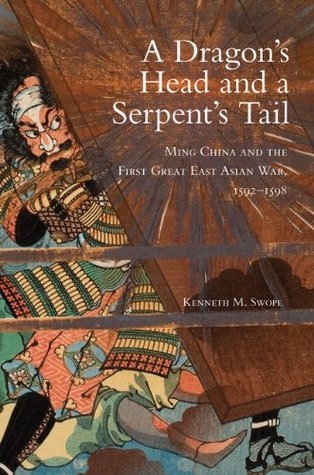
A Dragon’s Head and A Serpent’s Tail

by Rindis on July 3, 2015 at 10:10 am
Posted In: Books

Being something of a fan of warring states Japan (you can largely thank Nobunaga’s Ambition II for that), I’ve been aware for some time that at the end of the era, there was a Japanese invasion of Korea. But not a lot of attention gets paid to it; it’s just a short incident between the death of Nobunaga and the death of Hideyoshi.

So Kenneth M. Swope’s book on the entire war with Korea is very interesting, and pretty much all-new to me. Even more so, as Swope is primarily a specialist in Ming China, and this book is centered on China’s role in the war. Korea pretty much collapsed at the beginning of the war, and Ming China sent all sorts of aid to retrieve the situation.

Swope calls this the ‘First Great East Asian War’, because China was also dealing with other border problems at, or nearly so, the same time, and at the beginning of the book, he places the Korean problem in context with the rest of the ‘Three Great Campaigns’, which are something of a high water mark for the late Ming Dynasty. In fact, this period is generally seen as something of a disaster for the Ming, and Emperor Wanli one of the worst China had. Swope argues that this is not so, and that China weathered these crises well, and in good shape. Wanli is shown as being able to override court factionalism and appoint competent administrators and commanders, and stick by them when they are criticized. He was not, however, able to stop such infighting, which seems to be part of why he thinks the Ming collapsed only a couple decades later (he has a book about this out, currently on sale for $120. No.)

This is primarily a military history, but also includes accounts of the diplomatic talks between China and Japan, and the fate of Korean civilians, and court politics. This is a fairly high-level overview, and a very good one, but there’s a lot more details I’d like to read about in the future.

└ Tags: books, history, reading, review
 Comment 

Lands of Summary

by Rindis on June 27, 2015 at 12:00 pm
Posted In: D&D

After covering two areas that were already developed, the third FR-series module went off into new territory: the South. The area had of course shown up in the original boxed set, and had gotten a number references in FR1 Waterdeep (as its primary trading rivals are all down there), but there’s no sense that it had ever been a major focus of Ed Greenwood’s campaign, and there were no novels like Darkwalker on Moonshae set there. Part of the area covered would be covered again in Lands of Intrigue, and the rest in Empires of the Shining Sea (both which included areas outside the scope of this product) and one section in particular would achieve fame with Baldur’s Gate II: Shadows of Amn.

Physically, it’s a typical TSR product of the time; a 64-page 8.5″x11″ book with a color cover. Like with Moonshae, there’s nothing on the inside cover, and the cover is detached from the main book, but that’s because there’s two 30-mile per inch poster maps wrapped around the book (one can fit in the middle of the book, but two would be too thick). As such, it is a much more expansive supplement than either Moonshae (which occupied about half of one map) or Waterdeep (which concentrated on a single city), and that presents some problems.

The main book is divided into three main sections for the three countries in the area covered: Amn, Tethyr, and Calimshan. Inside of each section, there’s a quick overview of the country, talking about general cultural quirks, languages spoken, what races are present and the like. The longest section tends to be a description of the various prominent cities (and towns) of the country. Scott Haring stated that it was his intent that each place can serve as as inspiration for an adventure, and this largely works. There’s no ‘typical town, population x’ entries here. Many may not inspire the type of adventure a DM is looking for right now, but some will, and there’s always something.


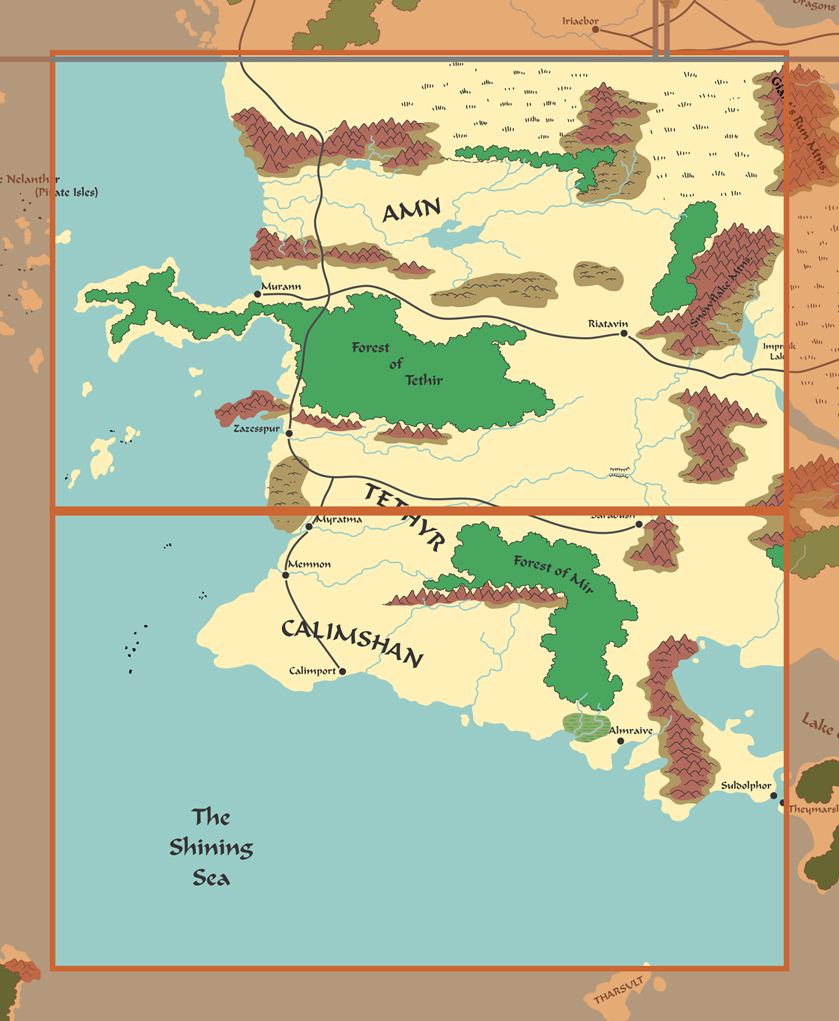
Region the FR3 maps cover, showing the overlap with the gray box’s detail maps.

The real problem is there’s no focus to the book at all. Each country gets about the same page count (they are all about the same size), and no particular city gets any sort of detailed look. There are also sections on places and people of interest, and these do tend to more detail. Castle Spulzeer gets one of the longest description in the book (and a map) at a bit over half a page. There’s two other maps, one a diagram of a cave complex near the described location, and the other is of the Plaza of Divine Truth in Calimport (which does have the longest description at over a page). Never is the general layout, or surrounding area, of a city shown.

In the center of the book are eight character sheets, and smaller reproductions of the poster maps (in black-and-white). Sadly, this last is the victim of the obligatory layout disaster of the book. The southern map is fine, but on the opposite side of the sheet, one part of the northern map (coasts and rivers) is rotated from the other, making it useless. Seven of the character sheets are pre-filled out with the details of the ‘Company of Eight’ (yes), an NPC group that’s not really described well enough for the DM to know well. The eighth is a blank Forgotten Realms-themed sheet that looks good, but because the book is done in the usual dark brown ink on faux-parchment pattern is difficult to reproduce well (and a few dark info boxes are impossible to photocopy usably).

The south is a much richer place than the north, with several cities larger than Waterdeep, up to the city of Calimport at 2 million (which I think is a bit much; Rome at its height was 1 million, and I’m not aware of any million+ cities in say the Middle East or Persia through the Middle Ages). While some of this it mentioned about in the overall descriptions, there’s no rules/pricing tie-ins given.

In general, it’s meant to be more of an Arabian/Middle-East themed setting, but this is not well supported in the text either. Amn is a stable merchant-dominated state (supposedly meant to have a Andalucia feel to it; I’d think more pre-Crusade Palestine coast), Tethyr has recently lost it’s royal family in bloody coup, and there’s currently no central authority (that feels more like Andalucia to me), and Calimshan is one of the wealthiest nations around, though the central authority is weak.

Calimshan was supposed to have a more Arabian Nights feel, and this actually comes through better, as the past history involves much of the area having been colonized by humanoids from the Elemental Plane of Air. In fact, it’s the one with the best developed history (outlined back 7000 years). In many ways, this feels like it should be the focus of the book, since there’s bigger hooks, that could have interesting consequences, but Calimshan gets the same page count as the other two countries. Also, Al-Qadim would come along and become the ‘Arabian Nights area’ of the Forgotten Realms, forcing a rewrite of Calimshan.

It is by no means a bad module, and if you like maps (I do!) it’s got those. And it does generate a lot adventuring possibilities. But it is unfocused, spread across a much larger area than anything other than the original boxed set (which was focused on Cormyr and the Dales). It’s not a bad module for an inventive DM, nor a bad place to visit, but basing a campaign anywhere in the area would take a lot more work.

└ Tags: D&D, Forgotten Realms, gaming, reading, review, rpg
 Comment 
  • Page 89 of 96
  • « First
  • «
  • 87
  • 88
  • 89
  • 90
  • 91
  • »
  • Last »

©2005-2026 Rindis.com | Powered by WordPress with ComicPress | Hosted on Rindis Hobby Den | Subscribe: RSS | Back to Top ↑