Rindis.com

All my hobbies, all the time
  • Home
  • My Blog
  • Games
  • History

Categories

  • Books (503)
  • Comics (10)
  • Gaming (917)
    • Boardgaming (673)
      • ASL (154)
      • CC:Ancients (83)
      • F&E (78)
        • BvR – The Wind (26)
        • Four Vassal War (9)
        • Konya wa Hurricane (17)
        • Second Wind (5)
      • SFB (78)
    • Computer games (162)
      • MMO (77)
    • Design and Effect (6)
    • RPGs (66)
      • D&D (25)
        • O2 Blade of Vengeance (3)
      • GURPS (32)
  • History (10)
  • Life (82)
    • Conventions (9)
  • News (29)
  • Technology (6)
  • Video (49)
    • Anime (47)
  • Writing (1)

Patreon

Support Rindis.com on Patreon!
Become a patron at Patreon!

Other blogs:

RSS Inside GMT

  • Foxes and Lions (Part 3): Military Matters, Captains, and Condottieri June 12, 2026

RSS Playing at the World

  • Playing at the World 2E V2 Arrives May 5, 2025

RSS Dyson’s Dodecahedron

  • Hollowshore Cairn June 17, 2026

RSS Quest for Fun!

  • The Expense Post May 24, 2026

RSS Bruce Heard and New Stories

  • Pain, Exhaustion, and Morale in D&D BECMI June 7, 2026

RSS Chicago Wargamer

  • The 2 Half-Squads - Episode 310: Cruising Through Crucible of Steel January 27, 2023

RSS CRRPG Addict

  • Yendorian Tales: Here There Be Dragons June 15, 2026
SF&F blogs:

RSS Fantasy Cafe

  • The Leaning Pile of Books May 24, 2026

RSS Lynn’s Book Blog

  • Summer of Horror: Can’t Wait Wednesday: Sleepers in the Snow by Joanne Harris June 17, 2026
ASL blogs:

RSS Sitrep

  • Cardinal ASL Sins March 18, 2026

RSS Hong Kong Wargamer

  • FT114 Yellow Extract After Action Report (AAR) Advanced Squad Leader scenario April 16, 2025

RSS Hex and Violence

  • This still exists? March 25, 2025

RSS Grumble Jones

  • YouTube AAR for Critical Hit's Gettysburg Turning Point 1863 - ID4 At Will Fire June 16, 2026

RSS Desperation Morale

  • How to Learn ASL March 16, 2025

RSS Banzai!!

  • October North Texas Gameday October 21, 2019

RSS A Room Without a LOS

  • [Crossing the Moro CG] T=0902 -- Rough start July 18, 2015
GURPS blogs:

RSS Dungeon Fantastic

  • Rules & Rulings from Session 224 June 16, 2026

RSS Gaming Ballistic

  • B-Scale: Damage That Scales from Tardigrades to Kaiju June 5, 2026

RSS Ravens N’ Pennies

RSS Let’s GURPS

  • Review: GURPS Realm Management March 29, 2021

RSS No School Grognard

  • It came from the GURPS forums: Low-Tech armor and fire damage January 29, 2018

RSS The Collaborative Gamer

  • Thoughts on a Town Adventures System January 18, 2022

RSS Don’t Forget Your Boots

  • GURPS Supers Newport Academy #6: “Old Friends, New Again” June 7, 2026

RSS Orbs and Balrogs

  • Bretwalda - Daggers of Oxenaforda pt.4 - Fallen King May 27, 2017

Prime Directive

by Rindis on December 1, 2022 at 12:00 pm
Posted In: Books

Prime Directive came out a bit after my primary era of reading Trek novels, money was tighter, and there were just too many coming out. But, it got a fairly good marketing push at the time, as one of the early (third, I think) hardcover novels. I have to say the current cover is much better than the original hardcover version.

So, we get a bit of a confused opening, as the action is over, and the crew of the Enterprise has been scattered in disgrace for a violation of the Prime Directive that ended in the disaster it was designed to prevent: a dead world. Most of the bridge crew has resigned, Uhura is under court martial, Bones hit an admiral… and the Enterprise is a wreck in orbit around a moon, with one warp engine having been ejected, and the other ruined and evaporating, possibly into subspace.

A common idea in SF for various FTL drives is that they can’t be used too close to the gravity field of a large body; either it’s impossible, or there is a great chance of something going wrong (like going to Pluto when you meant to go to the Moon, and your FTL drive disappearing in the process). Star Trek has been largely silent on the subject, implying that any such trouble is fairly minimal at most. But here its assumed that it’s not mentioned because everyone knows not to do it—and the Enterprise is now the first ship to survive the attempt.

Once the stage is set, we get an extended flashback to the mission that caused all this. This gives us a look at how the Federation works to obey its own Prime Directive while studying developing worlds. There’s some interesting bits showing how the inevitable slip-ups are generally accounted for. In fact, this section is generally well done, and would make a good, if not great, novel even without the tension of the coming disaster looming over it.

Star Trek at its non-philosophical best can deliver mysteries. Not necessarily murder mysteries, but related, where the plot and action are bent towards figuring out just what is really going on, what is our limited human viewpoint missing, and how to bring a solution to bear to what has been learned. The bulk of this novel is exactly this. Even before disaster, it is obvious that something is not right in the Talin system, and the desire to delve deeper helps the pages fly by.

A bit of expectation setting/trivia: The intro to the novel firmly says this is set during the final year of the original five-year mission. I was wondering, with all the dramatic career bits here, if it was intended to be the end of the mission and the reason for Enterprise‘s refit. No, an early novel claimed that bit of the timeline, and the Reeves-Stevens respect that claim. Current fan theory likes to instead place the novel a year earlier, and use it to explain some changes in the bridge crew and small differences in the bridge in The Animated Series.

The worst problem is that after the highly public nature of events depicted here, it’s hard to imagine everyone picking up right where they left off, set for another adventure without acknowledging this one. Outside of that, this is good, gripping Star Trek novel, and well recommended. At some point, I’m going to have to read Federation (which was the novel the authors originally pitched for this publication slot, but Paramount took years to be talked into it).
└ Tags: books, reading, review, science fiction, Star Trek
 Comment 

Armies of Castile and Aragon 1370–1516

by Rindis on November 23, 2022 at 12:00 pm
Posted In: Books

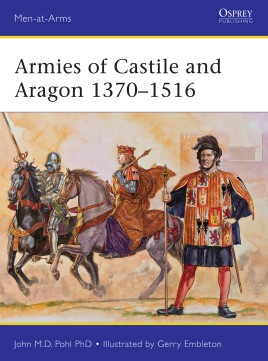
Osprey’s book on Castile and Aragon is really more about Trastamara rule, with Enrique II taking the throne of Castile in 1369 and the Hapsburg Charles II taking over Spain in 1516.

The beginning of this tale is familiar to many English-language history buffs, as it crosses over with the Hundred Years War. After that, not a lot of attention is paid until 1492 and the surrender of Granada allows for funding overseas adventures. As usual, there’s a good three-page chronology at the start to help place everything.

The Weaponry & Tactics section is brief, but introduces the important points, including vulnerability to English armies. This is best known for the battle of Nájera,  but lesser known is the battle of Aljubarrota, where Juan I Trastamara tried pressing a claim to Portugal and was defeated by a smaller force with plenty of English and Gascon veterans in it. Unfortunately, there’s little follow-up to this section, including how Iberian organization and tactics changed (or failed to) after this, though in the short term Juan refused any more set piece battles with English troops.

There’s a good couple of pages about sea power in the two kingdoms, a subject that hardly ever gets enough attention in this era. From there, we get a history of the campaigns from 1407-1444, which is mostly the Aragonese expansion into Sicily and Italy. This is also informative, if predictably a bit confusing (we are talking Italian politics here), especially as we get to see how the two areas tie together.

After that is a major section on the consolidation of Castile and Aragon, and of course the conquest of Granada. That section in particular was eye-opening, as it was logistically extremely difficult country, and the war was quite extended by the difficulties in campaigning there. The book then finishes up with further campaigning in Italy at the end of the Fifteenth Century.

This is much more of a ‘pocket history’ than the examination of the armies that the Men-At-Arms series is technically supposed to be. As such, it’s well-written and informative, but doesn’t really give much idea of what these campaigns might have looked like. Similarly, Gary Embleton’s color plates are decent, but nothing special. That said the plate descriptions are good, and there’s the usual plethora of photos of period artifacts, and art (all black-and-white this time, which is becoming less common in the series).

└ Tags: books, history, MAA, Men-at-Arms, Osprey, reading, review
 Comment 

A Song For Arbonne

by Rindis on November 15, 2022 at 12:00 pm
Posted In: Books

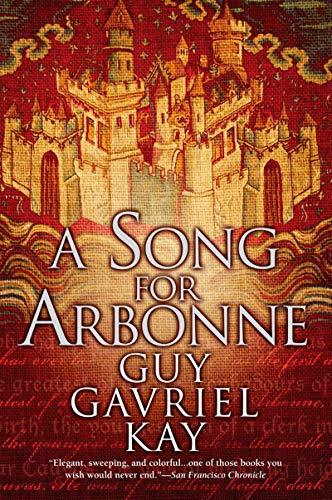
Once again, Guy Gavriel Kay does not disappoint. That said, the very beginning didn’t really grab me (especially the caper on Rian’s Island). But partway through chapter 3, Blaise, our main character, gets ambushed, and I was hooked for the rest of the novel.

This is a fantasy drawing deeply of southern France. The Court of Love rules here, and troubadours and joglars are what keep the Court vital. There is a god-goddess duo here which is much reflected in somewhat separate but equally important male and female characters of the novel. The nature of Corannos the god are not much gone into, but Rian’s, the goddess, power all emanates from an island in the southern sea. The world is much wider than we really get to see, Gorhaut being somewhat developed as the antithesis of Arbonne, and Portezza being an Italy-equivalent that a couple characters are from and the main character has spent time in, and other areas merely mentioned.

The novel is, as ever with Kay, well-paced, with the action working up to greater heights after every lull, and Blaise becoming more important in every lull. His centrality to events flows naturally as we learn more about him, and he takes to himself more responsibility.

There is a much wider cast of characters, many of which get to be viewpoint characters at one point or another. However, Lisset, the second-most prominent, seems a little undeserved as her progression doesn’t seem to mirror the novel’s like Blaise, even though she’s a vital viewpoint, and in the center of the distinctive artistic-centered culture Kay is presenting here.

And that just barely scratches the surface of an expansive novel. All of Kay’s books have enough going on to feel epic, and I think this one tops Tigana and Al-Rassan in that for me. Better yet, I have thought for a while that Occitian France needed more attention, and this makes a good primer on the subject.

└ Tags: books, fantasy, reading, review
 Comment 

Russia Against Napoleon

by Rindis on November 7, 2022 at 12:00 pm
Posted In: Books

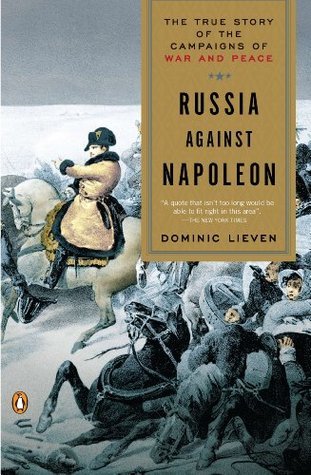
Dominic Lieven’s position as a professor of Russian studies shows clearly in this book. He clearly knows whereof he speaks as he tackles the last stages of the Napoleonic Wars from a Russian perspective. And he is quite right in that this is an overdue work. Russian histories of the period have been overshadowed by Tolstoy, and tend to focus on 1812 to the detriment of the following two years, when Russia led a coalition from its borders to Paris.

Russia was by far the main power involved in 1813 and 1814, and if they don’t bother to talk about it, who will? I personally hadn’t realized much had gone on then, much less the very contested campaigning of 1813 until I recently read Chandler’s The Campaigns of Napoleon.

So, this book is excellent just for providing a good focus on that action. Of course, he talks about the earlier war (ending with the Treaty of Tilsit) somewhat briefly, and then spends a lot of time going in-depth with Russia’s preparations over the next five years, and all the fighting in 1812. Those of you who are familiar with Tolstoy also get a parenthetical ‘reader’s guide’ to War & Peace, as he points the people who are the basis of major characters of the novel.

And not only is this book informative on two different levels, it is well-written. Not stellar prose, but still very clear, and well put together. There is a lot packed into the book, and it is highly recommended.

└ Tags: books, gaming, history, reading, review
 Comment 

Metamorphosis

by Rindis on October 30, 2022 at 12:00 pm
Posted In: Books

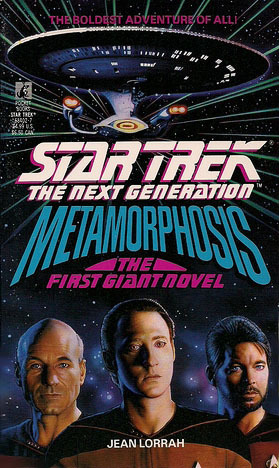
The “giant” novels were Pocket’s stepping stone to hardcover Star Trek novels, which took over the ‘premium’ slots in the production of way too many novels at the start of the ’90s. They were longer, more involved stories, and the three Original Series giant novels were excellent. I’d heard good things about Metamorphosis, the first (of two) TNG giant novels, at the time, so I was happy to finally get to read it.

Now, I’m frustrated. This novel is well written, but has a big glaring problem.

Now, this isn’t a spoiler, this is the high-concept of the entire novel, stated clearly in the blurb: Data is turned into a human. The core tension of his character is that while as an android he is superhuman in many ways, there is much he is missing, and he longs to understand just how organic sentient life, and humans in particular, work. This is 1990, the series is still airing, so you know going in there’s going have to be a big reset button in there somewhere. If Data is still human at the end of the novel, then it’s not going to fit with anything else, and therefore he won’t be.

In fact, this novel is placed explicitly as happening right after “The Measure of a Man” in second season. (Which, by the way, is a very good episode, and well worth reviewing. Especially as it is the first appearance of Bruce Maddox, who shows up again in the first season of Picard.) Everyone is still feeling the emotional effects of the trial to determine if Data could be considered property, or an actual person. The Enterprise moves on to it’s next mission which is very interesting in and of itself.

In fact, given the prominence of that high concept, the plot does quite well without it. I won’t spoil that, but we are fairly deep in before the magic happens. Which, from our viewpoint, it might as well be, since Data is turned into an ordinary human down to the last detail (if perhaps with an uncanny resemblance to a 27-year old Brent Spiner). And we get treated to Data’s viewpoint as he discovers all he’s been missing. Sleep, eating (and the complexities of the human perception of taste), emotions, not being superhumanly strong and durable…. And, this is well done, and well thought through, and well presented.

This also serves as something of a bridge to a completely new plotline in the novel, as the Enterprise finishes up its mission, and goes on to the next, which, in the ordinary, run-of-the-mill, aired episodes scheme of things would be another episode entirely. Of course, Data (newly re-qualified for most of his duties) is different, and that ties in intimately with what’s going on here.

And here’s where we run into trouble. The big reset button that you know must be in here somewhere shows up. I do think it’s a little more forced than the change itself, and a bit more abrupt, pacing wise. But the big problem of the novel is here: the reset is basically going back in time so that Data never becomes human, and in so doing, he also loses all memories having been human. (Technically, he has the memories, just sealed away, so he gets a couple bouts of deja vu as we go through the finishing leg of the time loop.)

Plots are the general ‘engine’ of a story. The mainspring that serves it is that the main character will learn (or occasionally, spectacularly fail to learn) something by the end of the story. This is often subtle, but robbing the character of his memories at the end makes them unable to do this at all, and spells danger to the plot as a whole. I particularly find this irksome, and I am put out by any story that does this (the end of Silver on the Tree wrecked an entire series for me).

That said, Data does get to save the day at the end, and does learn something related to the main theme here anyway. But… we still have nearly two hundred pages that might as well not exist as far as any of the characters are concerned. I still give a limited recommendation to this novel because it is well written, and if you want to see how Data handles being human, this is a good presentation of it.

└ Tags: books, reading, review, science fiction, Star Trek, TNG
 Comment 
  • Page 31 of 96
  • « First
  • «
  • 29
  • 30
  • 31
  • 32
  • 33
  • »
  • Last »

©2005-2026 Rindis.com | Powered by WordPress with ComicPress | Hosted on Rindis Hobby Den | Subscribe: RSS | Back to Top ↑