Rindis.com

All my hobbies, all the time
  • Home
  • My Blog
  • Games
  • History

Categories

  • Books (503)
  • Comics (10)
  • Gaming (917)
    • Boardgaming (673)
      • ASL (154)
      • CC:Ancients (83)
      • F&E (78)
        • BvR – The Wind (26)
        • Four Vassal War (9)
        • Konya wa Hurricane (17)
        • Second Wind (5)
      • SFB (78)
    • Computer games (162)
      • MMO (77)
    • Design and Effect (6)
    • RPGs (66)
      • D&D (25)
        • O2 Blade of Vengeance (3)
      • GURPS (32)
  • History (10)
  • Life (82)
    • Conventions (9)
  • News (29)
  • Technology (6)
  • Video (49)
    • Anime (47)
  • Writing (1)

Patreon

Support Rindis.com on Patreon!
Become a patron at Patreon!

Other blogs:

RSS Inside GMT

  • Foxes and Lions (Part 3): Military Matters, Captains, and Condottieri June 12, 2026

RSS Playing at the World

  • Playing at the World 2E V2 Arrives May 5, 2025

RSS Dyson’s Dodecahedron

  • Hollowshore Cairn June 17, 2026

RSS Quest for Fun!

  • The Expense Post May 24, 2026

RSS Bruce Heard and New Stories

  • Pain, Exhaustion, and Morale in D&D BECMI June 7, 2026

RSS Chicago Wargamer

  • The 2 Half-Squads - Episode 310: Cruising Through Crucible of Steel January 27, 2023

RSS CRRPG Addict

  • Yendorian Tales: Here There Be Dragons June 15, 2026
SF&F blogs:

RSS Fantasy Cafe

  • The Leaning Pile of Books May 24, 2026

RSS Lynn’s Book Blog

  • Summer of Horror: Can’t Wait Wednesday: Sleepers in the Snow by Joanne Harris June 17, 2026
ASL blogs:

RSS Sitrep

  • Cardinal ASL Sins March 18, 2026

RSS Hong Kong Wargamer

  • FT114 Yellow Extract After Action Report (AAR) Advanced Squad Leader scenario April 16, 2025

RSS Hex and Violence

  • This still exists? March 25, 2025

RSS Grumble Jones

  • YouTube AAR for Critical Hit's Gettysburg Turning Point 1863 - ID4 At Will Fire June 16, 2026

RSS Desperation Morale

  • How to Learn ASL March 16, 2025

RSS Banzai!!

  • October North Texas Gameday October 21, 2019

RSS A Room Without a LOS

  • [Crossing the Moro CG] T=0902 -- Rough start July 18, 2015
GURPS blogs:

RSS Dungeon Fantastic

  • Rules & Rulings from Session 224 June 16, 2026

RSS Gaming Ballistic

  • B-Scale: Damage That Scales from Tardigrades to Kaiju June 5, 2026

RSS Ravens N’ Pennies

RSS Let’s GURPS

  • Review: GURPS Realm Management March 29, 2021

RSS No School Grognard

  • It came from the GURPS forums: Low-Tech armor and fire damage January 29, 2018

RSS The Collaborative Gamer

  • Thoughts on a Town Adventures System January 18, 2022

RSS Don’t Forget Your Boots

  • GURPS Supers Newport Academy #6: “Old Friends, New Again” June 7, 2026

RSS Orbs and Balrogs

  • Bretwalda - Daggers of Oxenaforda pt.4 - Fallen King May 27, 2017

1809: Thunder on the Danube – Part 2

by Rindis on May 29, 2023 at 12:00 pm
Posted In: Books

Book two of John Gill’s continues straight on from the first volume, with the Austrian army in strategic disarray after Eggmühl and covers up to the end of the Battle of Aspern-Essling on May 22, 1809.

Unlike the previous book, he then steps back and looks at the campaign in Italy, starting with Archduke Johann’s invasion and early victories, and ending with his retreat back out of Italy in mid-May after the Battle of the Piave.

This expanded scope is welcome, but I wish it had been inserted earlier. Even better, the maps in this volume are much improved from the ones in the first book. Those were horrible to actually use, while these are much better at depicting the geography in question.

Better yet, while these problems with the first volume are addressed, the quality of writing and descriptions are exactly at the high levels of before. This obviously one work under three covers and, with improvements, continues straight through with his description of events in the summer of 1809.

└ Tags: books, history, reading, review
 Comment 

Bryony and Roses

by Rindis on May 21, 2023 at 12:00 pm
Posted In: Books

The first thing I found out reading this is that I should read Robin McKinley’s Rose Daughter. I think I remember a friend enthusing about it at the time, but that recommendation has been lost to mists of time.

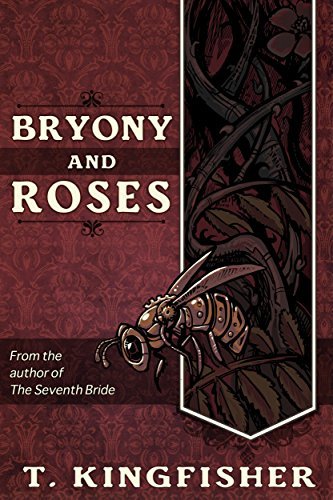
Ursula Vernon’s retelling of Beauty and the Beast takes from a number of sources. Not least of all, her own sensibilities. We have a practical, gardening, heroine. When she come across a mansion where none should be, with no one around, and immaculately kept, she has questions. (“…it occurred to her that boxwoods needed pruning and unless the abandoned convent still kept a gardening staff, the neat cubical hedge would be a thicket in two seasons.”)

Disney’s version shows a bit here. Bryony and her horse are lost in a severe snowstorm when she stumbles across an impossible road to a mansion that shouldn’t be there with self-pruning topiary. The Beast’s description is a bit vague, but would fit Disney’s version just fine. And Vernon answers the common complaint of that movie (spoiler!) by not having the Beast turn back to human.

There are no enchanted servants. The mansion itself takes care of everything. Somehow. Working into that, and the fact that the Beast is obviously constrained from talking about certain things provides the bulk of the tension of the novel. The main outlines are familiar, but just what has the Beast trapped as much as Bryony is the question.

The main new element is the fact that Bryony (which, by the way is not only a type of climbing, flowering, plant, but as a name comes from Latin “to sprout”), is a gardener, who like Vernon, has little patience for roses. And of course, there is a rose motif all over in this book (starting with the first view of the mansion, “a high stone wall, inset with a pair iron gates with twining wrought-iron roses.”).

Past that, do remember this is a fairly short novel. It’s a very good one, but don’t expect too many surprises of a well-known tale, though, being a T. Kingfisher novel, a bit of turn towards horror shouldn’t be a big surprise either (thankfully, the main horrific elements are quite limited).

└ Tags: books, fantasy, reading, review
 Comment 

The Merlin Conspiracy

by Rindis on May 13, 2023 at 12:00 pm
Posted In: Books

I know what you’re thinking. And no, the book isn’t about that. This isn’t a conspiracy of Arthurian legend.

In this case, “Merlin” is an office title in an alternate-universe Britain (The Isles of Blest), and the conspiracy centers around that.

This is technically a sequel to Deep Secret, and picks up with one of the secondary characters from there as well as introducing a new character from Blest. However, there’s no real need to read Deep Secret before this one, though I’d say it was a bit more fun as a novel. Like the other, this book features an alternating pair of point of views, and I kind of think that stylistic choice was what made this a “series” for DWJ. This time however, it takes a while for the two separate stories to converge, but they do, and do so very well.

As is typical for a young-adult novel, we have a few teens who have stumbled into something big that the adults around don’t believe or worry about, and thereby hangs adventure. However, we do have a fairly good secondary cast of adults who are not helpless, as well as ones enmeshed in the conspiracy’s machinations.

The main trouble is that the plot does take a bit to get going properly. Thankfully, we have some good characters, and there is action right up front. It just doesn’t cohere into a single plot for a while. Once going, the book picks up pace nicely, and comes to a typical climatic ending with a lot going on all at once. Certainly not her best book, but if you enjoy her books, do read it.

└ Tags: books, contemporary fantasy, fantasy, reading, review
 Comment 

Strasbourg AD 357

by Rindis on May 1, 2023 at 12:00 pm
Posted In: Books

Julian the Apostate is known for his disastrous defeat by the Sassanids in 363. d’Amato and Frediani go back six years to show Julian’s very successful campaign in Gaul.

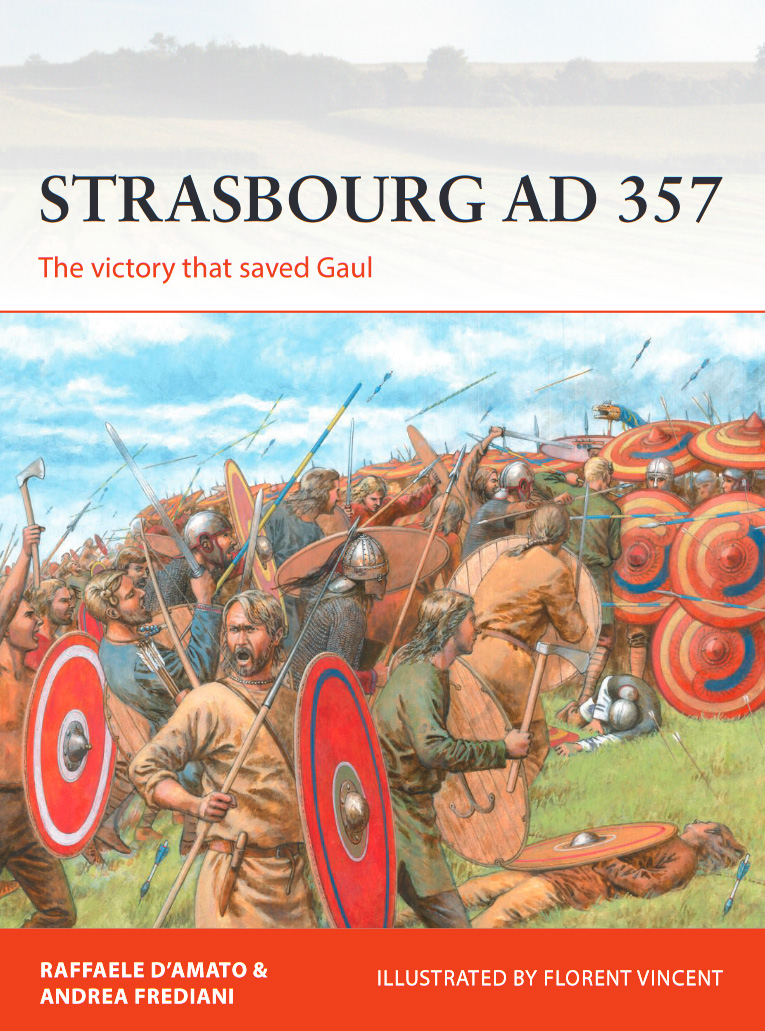
This is a typical Osprey Campaign book with its conventional format, length, and topics. With two exceptions, all the photographs are in color, and Florent Vincent’s illustrations are good (there are three two-page spreads), better than many from Osprey, but not the best. There also a few older small illustrations showing sample figures with equipment by Igor Dzis. The bibliography goes two pages, the section on the battlefield today is merely one paragraph, but there are several good photos of it in the book.

The authors go into the political background that kept Julian out of the spotlight before he finally ends up in command in Gaul. This also has implications for his relationship with the court of Constantius, and Barbatio, who was effectively a co-commander. This is followed up with events after the main campaign being discussed, and fills out the situation well.

d’Amato and Frediani point to Julian’s background in the classics as explaining his successes here. Roman practice of the time had become very conservative, endeavoring to take as few chances as possible, and manage the various crises that had come up. Julian, his head full of Julius Caesar’s Commentaries, went for a much more bold approach, looking for decisive battles after which he could dictate terms.

They don’t go into the reasons why Roman practice had evolved this way. But Julian’s approach certainly worked here. The battle at Argentoratum (Strasbourg) led to the surrender of the main Germanic commander, and Julian got time to arrange a series of buffer states on the other side of the Rhine, instead of settling people inside of Gaul. Northeastern Gaul especially had taken enough damage that this may never have been a stable arrangement, but we (and Julian) never got a chance to find out, as he and most of his Roman army got transferred to the east because of the latest disaster from the Sassanids, and the frontier collapsed again without them.

Short of some of the imponderables, Julian certainly made it work for a few years, and Osprey has another very good book in their Campaign line discussing the central action.

└ Tags: books, history, reading, review, Rome
 Comment 

Divided Houses

by Rindis on April 23, 2023 at 12:00 pm
Posted In: Books

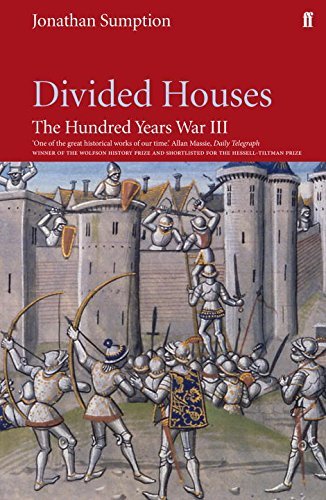
The third book of Sumption’s history of The Hundred Years War continues the excellent job of the first two. This one is less “sexy” than the others as none of the famous battles fall in the thirty year period of this book (1369-1399).

There are a couple of battle in here, the most prominent of which is Aljubarrota (1385), where a Castilian army managed to march around an allied English/Portuguese army, and hit it from behind, and still lost heavily. I’d definitely like to see a treatment of this one in Men of Iron. It’s only one of about two set-piece battles, and they’re much smaller than the great clashes you mostly hear about.

Mostly, the book is given to the slow grind of warfare between two powers short on cash. The French overrun much of Aquitaine near the start of this period because the English just couldn’t get the cash to pay for an army to stop them. However, this grinds to a halt from a combination of running out of money and political will. The theme, as much as a history like this can have one, is reflected well in the title: both sides have deep internal divisions that sap their ability to wage a war to the finish.

In both cases this is largely a result of change of generations. The Black Prince falls ill and dies over the course of a few years, and is followed by Edward III, leaving the government in the hands of his brothers and Richard II. The latter is not a horrible king, but is not a strong or wise one, which is not a workable combination with a nation in a war with a larger neighbor. The book basically ends with him deposed in favor of Henry IV.

Meanwhile Charles V dies in 1380, leaving the throne of France to his eleven-year-old son, Charles VI. Similar to England, his uncles take over much of the administration of France, and war aims get diverted to personal pet projects. Worse, after taking the reigns of government, he goes mad, suffering a psychotic break in 1392, with frequent relapses. The unpredictability of these bouts leaves France rudderless again while still at war.

During this period, both sides suffer peasant rebellions caused by taxation for war expenditures. Both are put down, and France eventually exerts control over taxation again, while England continues to need Parliamentary grants, but it’s clear signal that this can’t go on. Castilian finances also collapse after a few years of heavy taxation, causing peace to be the only practical solution.

So one of the major themes of the book, especially in the second half is the continual search for a peace that both sides can live with. The problem is the root issues of the war have yet to be resolved, and when the competing claims are for England to give up all its extensive possessions in France, or for France to give up claims to sovereignty in its own territory, there’s a big gap to be bridged. So there is a series of truces, peace conferences, and outside arbitration trying to find a way to resolve the irresolvable. Overall, Richard II was seen leaning heavily towards peace, and the crowning of Henry IV was seen as a disaster in France because he was obviously a creature of the war party. (Tune in next time for Cursed Kings….)

└ Tags: books, history, reading, review
1 Comment
  • Page 27 of 96
  • « First
  • «
  • 25
  • 26
  • 27
  • 28
  • 29
  • »
  • Last »

©2005-2026 Rindis.com | Powered by WordPress with ComicPress | Hosted on Rindis Hobby Den | Subscribe: RSS | Back to Top ↑