

Europa Universalis V
 Paradox’s latest game has been out for a week, and I’m actually going to go through my thoughts. It’ll be years before I get formally reviewing it.
It might also be that long before I’m past ‘first impressions’.
First off, I’ve been a bit disturbed by Paradox’s current trend towards more and more complicated systems. Part of what made EU IV a great game is they practiced great parsimony in major systems. Much of the game centered around monarch points, and many major decisions revolved around how to spend those. Since launch, more and more extra things got added in, most of which were dissociated from that. I actually consider the game was at its best around a couple years after release. After that, it’s much more mixed for whether any particular mechanic was worthwhile, and especially the more I have dealt with the mission trees, the less I have liked them.
EU V is massive, and much more complex than its predecessors. Despite the fact that I would prefer a more ‘game first’ design, it is well done, and I am enjoying it, even though I’m still barely getting my feet wet. This may be just the enjoyment of an especially long Chick Parabola, but I think the replayability will be there too.
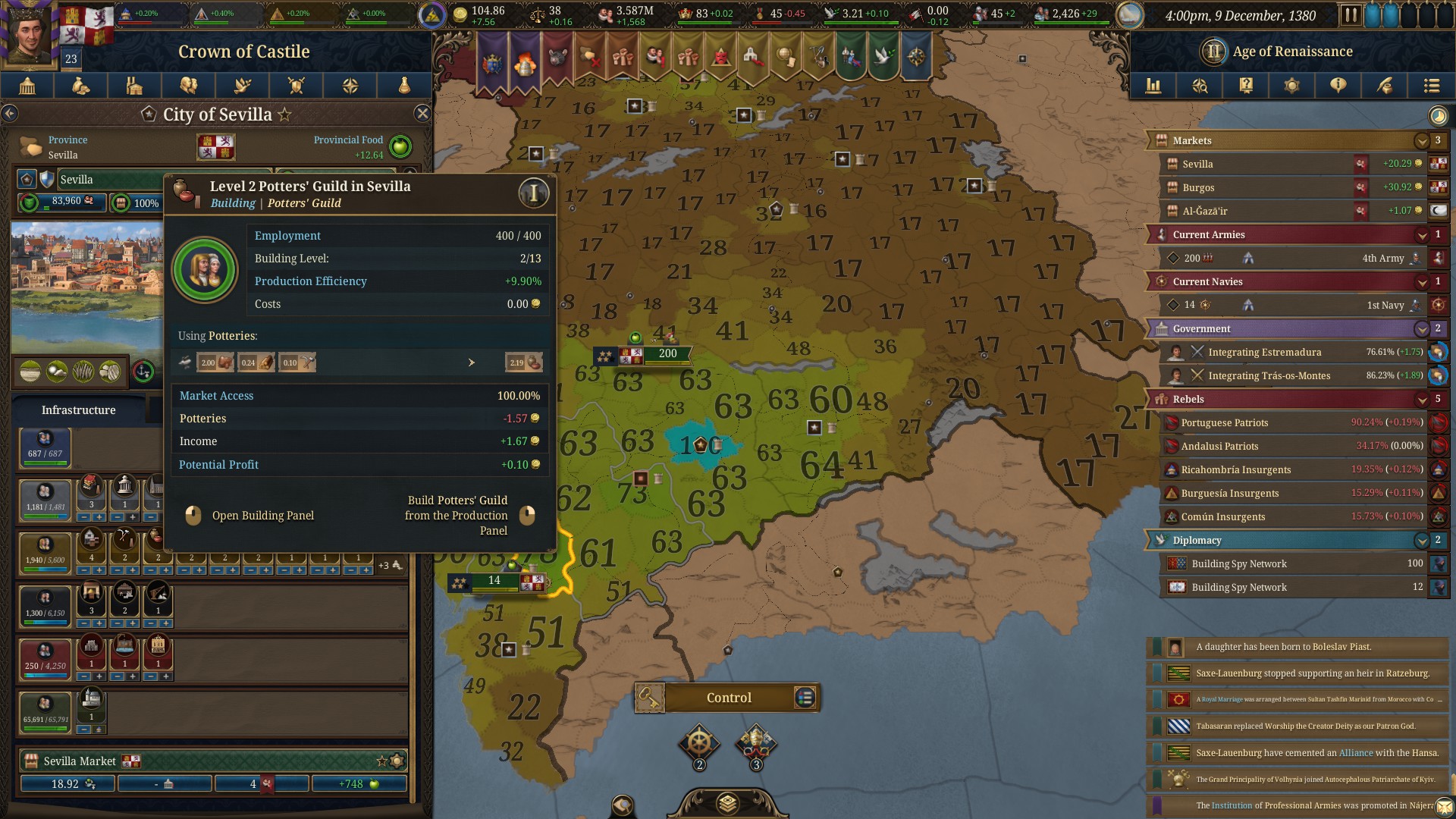 The first thing I noticed is that the production and trade system has been scrapped and replaced with the much more detailed one from Victoria III. It’s a good system, and a nice elaboration of the earlier versions’. But a game about the 19th century is about industrialization, and showcasing all the changes that brought is part of the point. Trade flow, as seen in EU IV is part of the point of the Age of Exploration, so I really liked EU IV‘s trade network (with some notable problems). Obviously, trade will open up with longer distances available later, but I don’t think it’ll have the same kind of impact.
On the other hand, its a really good system for mucking around with internal improvements, and feeling good about building everything up. That makes it a good system for the local end. Unfortunately, there are some missing bits of information. The market each province is attached to is dependent of market availability, the ease of travel to each one. But, there’s no map mode showing how all that works out, i.e., how the pull to each market happens. Being able to find “dead” areas would be good for seeing if you want to start a new market, or just focus roadbuilding, but there’s no way to tell that I can find.
Warfare is familiar, but has changed. One thing I appreciate is that you do not have standing armies (or at least tiny ones) at the start of the game. Instead, you call forth levies for the vast bulk of your forces. Presumably, these are much less capable than the regular military units you can build, and become more penalized as the game goes on. Combat itself has changed for the first time since EU III. Namely, they now break it into a center and two flanks (like the CK series), which act somewhat independently. It’s a bit more detail, but I’m not sure how much difference it will really make.
Conquest on the other hand, seems to be a lot more punishing. The process of making a new territory in any way useful is much harder and slower so far. Also, the EU IV version made it pretty clear what you needed: a ruler with good administration, to get the monarch points to kick off the process. Here, you have to assign integration to the cabinet, and there’s a hard limit on the number of actions you can do. Worse, you can’t concentrate on one location, but must spread attention across an entire state (…which encourages just taking a bit of a state at a time, not what I think Paradox has in mind), which slows it down. And strangely, this process is ruled by military ability instead of administrative.
The government mechanics are more of an evolution of… later EU IV‘s. With monarch points gone, there’s nothing nearly as direct to tell you how things are going, but the effects of the people in charge can be felt. For instance, going from a reasonably competent king to a bad one has done much to my game. Revenues are down, I just discovered all the spare manpower of the kingdom has drained away….
Which is why I do like game systems over big sims. With a big sprawling game, there’s a lot to keep track of and juggle. Parsimony in systems means everything’s pointed the same way, and and it easier to see what is going on. As an additional problem, the game is fairly heavy, and it complains that what was a top-of-the-line graphics card five years ago isn’t good enough. One of the reasons why I like strategy games is that they don’t generally need big graphics cards.
While I did pre-order EU V, I was worried that it would be too much sim and too little game for me. Well, it’s one of those sims that you can really sink your teeth into, and spend way too much time with. But it is not a focused game in any respect; if you’ve played EU IV or Vic III and like them, by all means get this game. If you’re newer to big strategy games, this is probably way too much. I’d get EU IV or III first, though those are not good first-time games either.
Discussion ¬